


Genesis 24:64
Bible text: King James Version (1769 Blayney text) · Public domain
Bible text: Berean Standard Bible · Public domain
Bible text: American Standard Version (1901) · Public domain
Bible text: World English Bible, Messianic edition · Public domain
Bible text: Geneva Bible (1599) · Public domain
Bible text: Young's Literal Translation · Public domain
- וַתִּשָּׂאva·ti·Sa'and she lifted upH5375Conj-w ¦ V-Qal-ConsecImperf-3fsVerb Qal Consecutive Imperfect 3rd Singular Feminineוַandתִּשָּׂאshe lifted up
- רִבְקָהriv·KahRebekahH7259N-proper-fNoun Proper Feminine
- אֶת'et<obj.>H853DirObjMParticle Object Indicator
- עֵינֶיהָ'ei·Nei·haher eyesH5869N-fdc ¦ 3fsNoun Dual Feminine Constructעֵינֶיeyesהָher
- וַתֵּרֶאva·Te·re'and she sawH7200Conj-w ¦ V-Qal-ConsecImperf-3fsVerb Qal Consecutive Imperfect 3rd Singular Feminineוַandתֵּרֶאshe saw
- אֶת'et<obj.>H853DirObjMParticle Object Indicator
- יִצְחָקyitz·ChakIsaacH3327N-proper-mNoun Proper Masculine
- וַתִּפֹּלva·ti·Poland she fellH5307Conj-w ¦ V-Qal-ConsecImperf-3fsVerb Qal Consecutive Imperfect 3rd Singular Feminineוַandתִּפֹּלshe fell
- מֵעַלme·'Alfrom onH5921Prep-m ¦ PrepPrepositionמֵfromעַלon
- הַגָּמָלha·ga·Malthe camelH1581Art ¦ N-csNoun Singular common gender Absoluteהַtheגָּמָלcamel
English is a literal word-by-word gloss of the Hebrew, not the KJV's wording. Why?
This is the original text the KJV's translators worked from — each Hebrew word with its own literal English meaning in this verse, prepared by scholars at Tyndale House, Cambridge. The KJV translates whole sentences, not word by word, so its wording differs: one Hebrew word can become several English words, and the KJV may choose “the LORD” where the gloss reads “Yahweh”. Both are faithful — they answer different questions. For the KJV's own rendering, switch to the KJV text.
Details
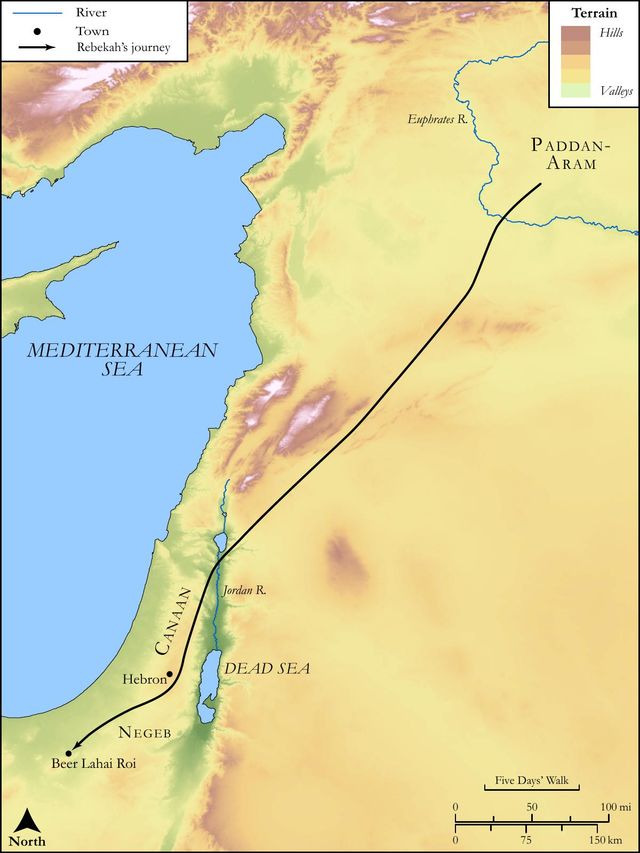
See on the biblical-era maps


Study this verse
Public-domain commentary
Matthew Henry
From his Commentary on the Whole Bible. Henry comments on passages, not single verses — this entry covers Genesis 24:62–67. His two-level outline is real structure in the source text, so it is rendered as structure.
Isaac and Rebekah are, at length, happily brought together. Observe,
I.Isaac was well employed when he met Rebekah:
He went out to meditate, or pray, in the field, at the even-tide, Gen 24:62, Gen 24:63. Some think he expected the return of his servants about this time, and went out on purpose to meet them. But, it should seem, he went out on another errand, to take the advantage of a silent evening and a solitary field for meditation and prayer, those divine exercises by which we converse with God and our own hearts. Note,
1.Holy souls love retirement. It will do us good to be often left alone, walking alone and sitting alone; and, if we have the art of improving solitude, we shall find we are never less alone than when alone.
2.Meditation and prayer ought to be both our business and our delight when we are alone; while we have a God, a Christ, and a heaven, to acquaint ourselves with, and to secure our interest in, we need not want matter either for meditation or prayer, which, if they go together, will mutually befriend each other.
3.Our walks in the field are then truly pleasant when in them we apply ourselves to meditation and prayer. We there have a free and open prospect of the heavens above us and the earth around us, and the host and riches of both, by the view of which we should be led to the contemplation of the Maker and owner of all.
4.The exercises of devotion should be the refreshment and entertainment of the evening, to relieve us from the fatigue occasioned by the care and business of the day, and to prepare us for the repose and sleep of the night.
5.Merciful providences are then doubly comfortable when they find us well employed and in the way of our duty. Some think Isaac was now praying for good success in this affair that was depending, and meditating upon that which was proper to encourage his hope in God concerning it; and now, when he sets himself, as it were, upon his watch-tower, to see what God would answer him, as the prophet (Hab 2:1), he sees the camels coming. Sometimes God sends in the mercy prayed for immediately, Act 12:12.
II.Rebekah behaved herself very becomingly, when she met Isaac:
understanding who he was, she alighted off her camel (Gen 24:64), andtook a veil, and covered herself (Gen 24:65), in token of humility, modesty, and subjection. She did not reproach Isaac for not coming himself to fetch her, or, at least, to meet her a day's journey or two, did not complain of the tediousness of her journey, or the difficulty of leaving her relations, to come into a strange place; but, having seen Providence going before her in the affair, she accommodates herself with cheerfulness to her new relation. Those that by faith are espoused to Christ, and would be presented as chaste virgins to him, must, in conformity to his example, humble themselves, as Rebekah, who alighted when she saw Isaac on foot, and must put themselves into subjection to him who is their head (Eph 5:24), as Rebekah, signifying it by the veil she put on, Co1 11:10.
III.They were brought together (probably after some further acquaintance), to their mutual comfort, Gen 24:67. Observe here,
1.What an affectionate son he was to his mother: it was about three years since her death, and yet he was not, till now, comforted concerning it; the wound which that affliction gave to his tender spirit bled so long, and was never healed till God brought him into this new relation. Thus crosses and comforts are balances to each other (Ecc 7:14), and help to keep the scale even.
2.What an affectionate husband he was to his wife. Note, Those that have approved themselves well in one relation, it may be hoped, will do so in another: She became his wife, and he loved her; there was all the reason in the world why he should, for so ought men to love their wives even an themselves. The duty of the relation is then done, and the comfort of the relation is then enjoyed, when mutual love governs; for there the Lord commands the blessing.
Historical interpretation
Historical reception
1 surviving comment on this verse from the historical church.
Rebekah followed the servant and comes to Isaac. The church followed the prophetic word, to be sure, and comes to Christ. Where does she find him? “Walking,” the text says, “at the well of the oath.” On no occasion is one withdrawn from wells; on no occasion does one stand apart from waters. Rebekah is found “at a well.” Rebekah in turn finds Isaac “at a well.” There she gazed upon his countenance for the first time. There “she dismounted from the camels.” There she sees Isaac, who was pointed out to her by the servant.Do you think these are the only words related about wells? Jacob also goes to a well and finds Rachel there.… But also Moses finds Zipporah, the daughter of Reuel, at a well. …
She also “dismounts from the camels,” that is, she departs from vices; she casts off the irrational senses and is united with Isaac. For it is worthy that Isaac pass “from virtue to virtue.” He who is the son of virtue, that is, of Sarah, is now united and joined with patience, which is Rebekah. And this is to pass “from virtue to virtue” and “from faith to faith.” But let us come also to the Gospels. Let us see where the Lord seeks rest when he was “wearied from the journey.” “He came,” Scripture says, “to the well and sat upon it.”17
You see that everywhere the mysteries are in agreement. You see the patterns of the New and Old Testament to be harmonious. There one comes to the wells and the waters that brides may be found; and the church is united to Christ in the bath of water.
You see how great a heap of mysteries presses upon us. We cannot treat all the things that present themselves. These things at least ought to stimulate you to listen, to assemble. Even if we hurry over some things for the sake of brevity, you yourself even, when you read the text again and inquire into it, may dispel the mystery and discover … that the Word of God, finding you also at the waters, may take you up and unite you with himself, that you may be made “one spirit” with him in Christ Jesus our Lord. “To him belongs glory and sovereignty forever and ever. Amen.”
Continue studying Genesis 24:64 across the web’s major study libraries — every link below opens this exact verse, chapter, or book on the destination site.
Read & Compare
 BibleGatewayThis verse in more than 200 translations and 70 languages.
 Bible.comThe YouVersion reader — hundreds of translations, reading plans, and highlights.
 ESV.orgCrossway's official English Standard Version reader.
 NET BibleThe NET translation with 60,000+ translators' notes on every rendering decision.
 STEP BibleTyndale House's free study tool — original text, vocabulary, and scholarly resources.
 BibliaLogos Bible Software's free web reader.
 USCCBThe New American Bible (Revised Edition) with the U.S. bishops' study notes.
Commentaries
 BibleHub CommentariesDozens of classic commentaries on this verse, gathered on one page.
 StudyLightMore than 100 commentary sets — the largest collection on the web.
 BibleRefPlain-English commentary on what this verse means, verse by verse.
 Enduring WordDavid Guzik's free commentary on this chapter, widely used by Bible teachers.
 Bible Study ToolsVerse commentary alongside Greek and Hebrew study aids.
Original Language & Research
- BibleHub InterlinearThe verse word by word — original language, transliteration, and English.
- BibleHub LexiconEvery word's original-language definition and Strong's entry.
 Blue Letter BibleDeep-study tools — Strong's numbers, concordance, and word studies.
 SefariaThe Hebrew text with Rashi and centuries of Jewish commentary.
Sermons, Hymns & Audio


TrulyRandomVerse is not affiliated with these sites and doesn’t control their content. They’re linked because they’re genuinely useful.
Summary
Genesis 24:64 captures the climactic moment of Rebekah's arrival in Canaan, where her immediate and respectful act of dismounting her camel upon seeing Isaac signifies the culmination of a divinely guided journey. This pivotal encounter not only marks the beginning of their relationship but also underscores the profound spiritual significance of their union in the unfolding of God's covenantal promises to Abraham, ensuring the continuation of the promised lineage.
Context
ShowHideLiterary Context
This verse serves as the dramatic culmination of the meticulously narrated journey detailed throughout Genesis chapter 24. Following Abraham's solemn charge to his chief servant to find a wife for Isaac from his own kindred in Mesopotamia, the narrative meticulously chronicles the servant's prayer for divine guidance, Rebekah's providential appearance and demonstration of extraordinary hospitality (as seen in Genesis 24:15-20), and the subsequent negotiations with her family. The long journey back to Canaan, laden with anticipation, concludes with this verse, immediately preceding Isaac's formal acceptance of Rebekah as his wife in Genesis 24:67. The verse thus acts as the narrative's emotional and physical meeting point, bringing together the two central figures of the story.
Historical & Cultural Context
In the days of the patriarchs, travel by camel was common for long distances, and dismounting was a significant gesture of respect and deference, particularly when encountering a person of higher status or a prospective spouse for the first time. Women of noble or wealthy families would typically ride camels, and their dismounting would be a deliberate act, often assisted. For Rebekah to "light off the camel" immediately upon seeing Isaac signifies her recognition of his importance as Abraham's heir and her future husband, demonstrating humility and honor. This cultural norm highlights the intentionality and gravity of their initial meeting, which was not a casual encounter but a divinely arranged union critical for the patriarchal lineage.
Key Themes
ShowHideGenesis 24:64 powerfully encapsulates several key themes prevalent in the broader Abrahamic narrative. Firstly, it highlights Divine Providence and Guidance, demonstrating God's meticulous orchestration of events to fulfill His covenant promises, particularly in the formation of families that would carry the lineage of faith (as seen in Genesis 12:1-3). Secondly, the verse underscores the theme of Respect and Humility in relationships, as Rebekah's immediate action sets a tone of honor and reverence for her future husband. Thirdly, it speaks to Covenantal Continuity, as the union of Isaac and Rebekah is crucial for the perpetuation of the promised seed, through whom the great nation would descend and ultimately bless all the families of the earth. This moment is a visible manifestation of God's faithfulness to His promises.
Exposition and Analysis
ShowHideGenesis 24:64 presents a concise yet profoundly significant moment: "And Rebekah lifted up her eyes, and when she saw Isaac, she lighted off the camel." This verse captures the first visual encounter between Isaac and Rebekah, an event charged with anticipation and cultural meaning, signifying the culmination of a divinely orchestrated journey.
Key Word Analysis
ShowHideThis verb (H5375) means "to lift, in a great variety of applications, literal and figurative." In the context of "lifting up her eyes," it denotes an intentional act of looking, a deliberate gaze. It implies that Rebekah actively sought out what was before her, rather than merely glancing. This active posture suggests her awareness and readiness to engage with the moment.
The verb (H7200) means "to see, literally or figuratively," encompassing perception, discernment, and observation. Rebekah's act of seeing Isaac is not just a physical act but implies a recognition of his identity and significance. It is the moment of visual confirmation that this is the man she is destined to marry, the son of Abraham.
This primitive root (H5307) generally means "to fall," but in this specific context, it is idiomatically translated as "to dismount" or "to light down." Rebekah's immediate action of dismounting is a profound cultural gesture. It was customary to dismount before a superior or an important person as a sign of respect, humility, and honor. Her swift descent from the camel, therefore, communicates her immediate recognition of Isaac's status and her respectful posture towards him, setting a tone of deference for their relationship.
Verse Breakdown
ShowHide"And Rebekah lifted up her eyes"
This initial clause emphasizes Rebekah's active engagement in the moment. Her action of "lifting up her eyes" suggests a deliberate and focused gaze, indicating her awareness and anticipation of meeting Isaac. It implies a conscious effort to observe her surroundings and identify the figure approaching in the field, setting the stage for the recognition that follows.
"and when she saw Isaac"
This phrase marks the pivotal moment of recognition. Upon seeing Isaac, Rebekah immediately perceives his identity, likely having been informed of his appearance or status by the servant. This visual confirmation triggers her subsequent, culturally significant action, highlighting the immediate impact of Isaac's presence on her.
"she lighted off the camel"
This final clause describes Rebekah's immediate and decisive response. Her act of dismounting, or "lighting off," the camel is a powerful non-verbal communication of respect, humility, and deference. Among the patriarchs, it was a customary and expected gesture of honor shown to someone of significant status, such as a prospective husband and the heir of a wealthy patriarch. This swift action underscores the gravity and intentionality of their first encounter, establishing a respectful foundation for their future relationship.
Literary Devices
ShowHideThe verse employs several literary devices to convey its profound significance. Narrative Climax is evident as this verse represents the culmination of the servant's long journey and the fulfillment of Abraham's mission, bringing the two protagonists together. The simplicity of the language belies the immense Symbolism embedded in Rebekah's action; her dismounting is not merely practical but a powerful gesture of humility, respect, and submission to her future husband and the divine plan. This act also serves as Foreshadowing, hinting at the respectful and honorable nature of their relationship and Rebekah's character as a suitable partner for Isaac, one who would honor his position and the covenant.
Theological and Thematic Connections
ShowHideThe encounter in Genesis 24:64 is a profound testament to God's meticulous providence and active involvement in human affairs, particularly in the sacred institution of marriage and the continuation of His covenantal purposes. It underscores that significant life decisions, such as choosing a spouse, are not left to chance but can be divinely guided, affirming God's sovereignty over every detail of our lives. Rebekah's immediate act of reverence also highlights the timeless biblical principle of respect and honor within relationships, a foundational element for healthy, God-honoring unions. This moment is not merely a personal anecdote but a crucial link in the unfolding drama of redemption, ensuring the lineage through which the promised Messiah would eventually come.
Reflection and Application
ShowHideGenesis 24:64 offers timeless wisdom for believers navigating significant life choices and cultivating godly relationships today. Just as God meticulously orchestrated the union of Isaac and Rebekah, we are encouraged to trust in His divine leading and providence in our own major life decisions, especially when seeking a spouse or making other profound commitments. This narrative reminds us that God is intimately involved in the details of our lives and can guide us toward His perfect will. Furthermore, Rebekah's immediate act of dismounting serves as a powerful reminder of the enduring importance of cultivating respect, honor, and humility in all our relationships. Approaching new relationships, particularly those with deep implications, with intentionality and reverence, sets a foundational tone for health and longevity. This verse beautifully sets the stage for their marriage, detailed shortly after in Genesis 24:67, marking the beginning of a new chapter in the lineage of faith and providing a model for how to enter into sacred bonds with a posture of honor and trust in God.
Questions for Reflection
ShowHideFAQ
ShowHideWhy was Rebekah's act of dismounting so significant?
ShowHideRebekah's immediate dismounting, or "lighting off the camel," was a culturally significant gesture of profound respect and humility in that age. It was customary to dismount before a superior, an elder, or an important person as a sign of deference and honor. By doing so, Rebekah acknowledged Isaac's status as the son of Abraham and her future husband, demonstrating her respectful posture towards him from their very first encounter. This action set a tone of reverence and intentionality for their relationship, indicating her understanding of the gravity and sacredness of the union, which was divinely orchestrated as part of God's covenant with Abraham (as seen in Genesis 12:2-3).
Christ-Centered Fulfillment
ShowHideThe divinely orchestrated union of Isaac and Rebekah in Genesis 24:64 stands as a vital link in the unfolding drama of God's redemptive plan, ultimately finding its fulfillment in Christ. Isaac, the promised son, born through divine intervention and offered as a sacrifice on Mount Moriah (foreshadowing Christ's ultimate sacrifice in Genesis 22), here receives his bride, brought from a distant land by a faithful servant. This narrative beautifully prefigures the relationship between Christ and His Church. Just as Rebekah journeyed to meet her bridegroom, the Church, comprised of believers from every nation, is called out of the world to be united with Christ, her heavenly Bridegroom (as described in Ephesians 5:25-27). The servant's diligent mission to secure a bride for Isaac parallels the Holy Spirit's work in drawing believers to Christ (as seen in John 16:13-14). This union of Isaac and Rebekah, ensuring the continuation of the promised seed, points directly to Christ, the ultimate Seed of Abraham, through whom all the families of the earth are blessed, establishing a new covenant relationship with His redeemed people (as prophesied in Galatians 3:16).