


Judges 1:14
Bible text: King James Version (1769 Blayney text) · Public domain
Bible text: King James Version with Strong's numbers · Public domain
Bible text: Berean Standard Bible · Public domain
Bible text: American Standard Version (1901) · Public domain
Bible text: World English Bible, Messianic edition · Public domain
Bible text: Geneva Bible (1599) · Public domain
Bible text: Young's Literal Translation · Public domain
- וַיְהִיvay·Hiand it wasH1961Conj-w ¦ V-Qal-ConsecImperf-3msVerb Qal Consecutive Imperfect 3rd Singular Masculineוַandיְהִיit was
- בְּבוֹאָהּbe·vo·'Ahwhen she cameH935Prep-b ¦ V-Qal-Inf ¦ 3fsVerb Qal Infinitive Constructבְּwhenבוֹאָcameהּshe
- וַתְּסִיתֵהוּva·te·si·Te·huand she incited himH5496Conj-w ¦ V-Hiphil-ConsecImperf-3fs ¦ 3msVerb Hiphil Consecutive Imperfect 3rd Singular Feminineוַandתְּסִיתֵshe incitedהוּhim
- לִשְׁאוֹלlish·'olto askH7592Prep-l ¦ V-Qal-InfVerb Qal Infinitive Constructלִtoשְׁאוֹלask
- מֵאֵתme·'etfrom withH854Prep-m ¦ PrepPrepositionמֵfromאֵתwith
- אָבִיהָ'a·Vi·haher fatherH1N-msc ¦ 3fsNoun Singular Masculine Constructאָבִיfatherהָher
- הַשָּׂדֶהha·sa·Dehthe fieldH7704Art ¦ N-msNoun Singular Masculine Absoluteהַtheשָּׂדֶהfield
- וַתִּצְנַחva·titz·Nachand she went downH6795Conj-w ¦ V-Qal-ConsecImperf-3fsVerb Qal Consecutive Imperfect 3rd Singular Feminineוַandתִּצְנַחshe went down
- מֵעַלme·'Alfrom onH5921Prep-m ¦ PrepPrepositionמֵfromעַלon
- הַחֲמוֹרha·cha·Morthe donkeyH2543Art ¦ N-csNoun Singular common gender Absoluteהַtheחֲמוֹרdonkey
- וַיֹּאמֶרvai·yo·merand he saidH559Conj-w ¦ V-Qal-ConsecImperf-3msVerb Qal Consecutive Imperfect 3rd Singular Masculineוַandיֹּאמֶרhe said
- לָהּlahto <the> herPrep-l ¦ 3fsSuffix Personal 3rd Singular Feminineלָto <the>הּher
- כָּלֵבka·LevCalebH3612N-proper-mNoun Proper Masculine
- מַהmahwhat?H4100InterrogPronoun Interrogative
- לָּךְLakh[is] to <the> youPrep-l ¦ 2fsSuffix Personal 2nd Singular Feminineלָּ[is] to <the>ךְyou
English is a literal word-by-word gloss of the Hebrew, not the KJV's wording. Why?
This is the original text the KJV's translators worked from — each Hebrew word with its own literal English meaning in this verse, prepared by scholars at Tyndale House, Cambridge. The KJV translates whole sentences, not word by word, so its wording differs: one Hebrew word can become several English words, and the KJV may choose “the LORD” where the gloss reads “Yahweh”. Both are faithful — they answer different questions. For the KJV's own rendering, switch to the KJV text.
Details
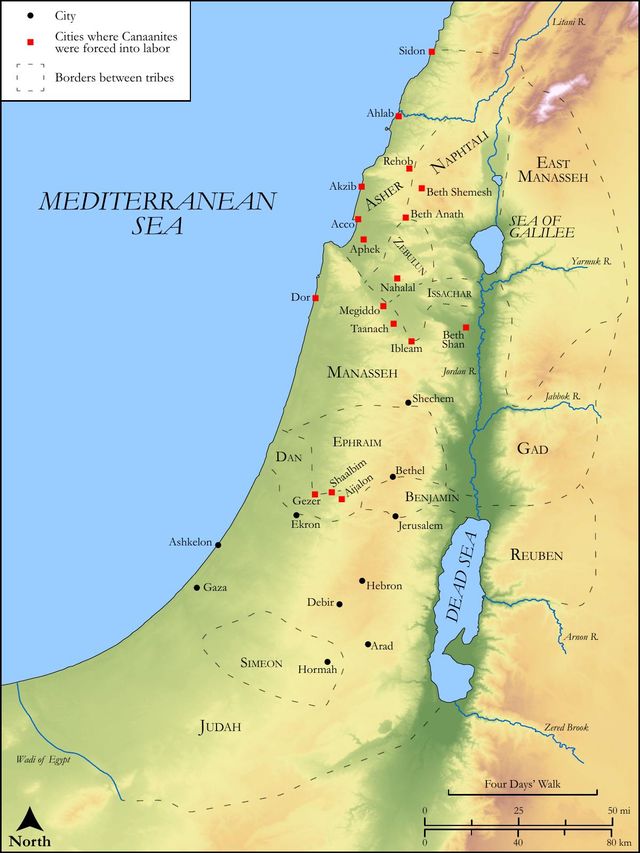
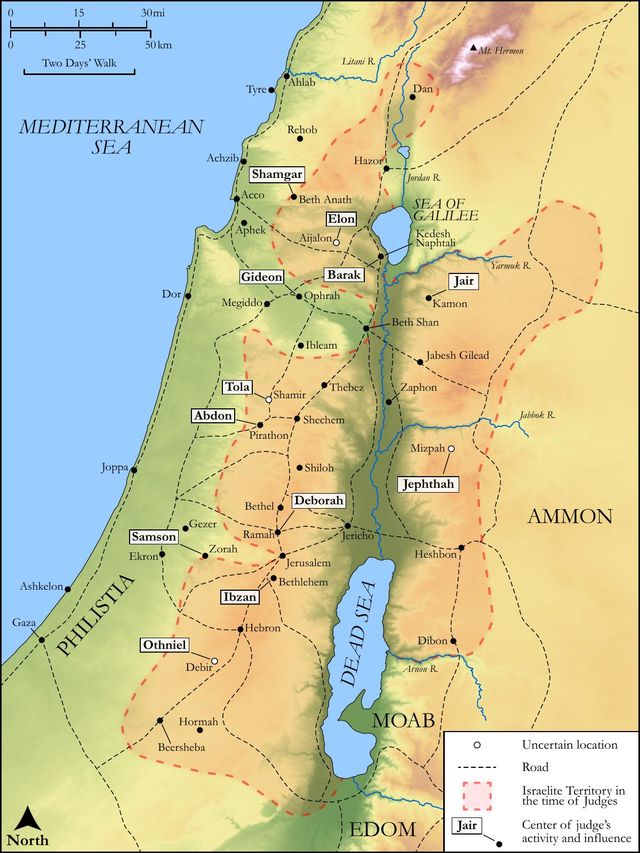
See on the biblical-era maps
Study this verse
Public-domain commentary
Matthew Henry
From his Commentary on the Whole Bible. Henry comments on passages, not single verses — this entry covers Judges 1:9–20.
We have here a further account of that glorious and successful campaign which Judah and Simeon made. 1. The lot of Judah was pretty well cleared of the Canaanites, yet not thoroughly. Those that dwelt in the mountain (the mountains that were round about Jerusalem) were driven out (Jdg 1:9, Jdg 1:19), but those in the valley kept their ground against them, having chariots of iron, such as we read of, Jos 17:16. Here the men of Judah failed, and thereby spoiled the influence which otherwise their example hitherto might have had on the rest of the tribes, who followed them in this instance of their cowardice, rather than in all the other instances of their courage. They had iron chariots, and therefore it was thought not safe to attack them: but had not Israel God on their side, whose chariots are thousands of angels (Psa 68:17), before whom these iron chariots would be but as stubble to the fire? Had not God expressly promised by the oracle (Jdg 1:2) to give them success against the Canaanites in this very expedition, without excepting those that had iron chariots? Yet they suffered their fears to prevail against their faith, they could not trust God under any disadvantages, and therefore durst not face the iron chariots, but meanly withdrew their forces, when with one bold stroke they might have completed their victories; and it proved of pernicious consequence. They did run well, what hindered them? Gal 5:7. 2. Caleb was put in possession of Hebron, which, though given him by Joshua ten or twelve years before (as Dr. Lightfoot computes), yet being employed in public service, for the settling of the tribes, which he preferred before his own private interests, it seems he did not till now make himself master of; so well content was that good man to serve others, while he left himself to be served last; few are like-minded, for all seek their own, Phi 2:20, Phi 2:21. Yet now the men of Judah all came in to his assistance for the reducing of Hebron (Jdg 1:10), slew the sons of Anak, and put him in possession of it, Jdg 1:20. They gave Hebron unto Caleb. And now Caleb, that he might return the kindness of his countrymen, is impatient to see Debir reduced and put into the hands of the men of Judah, to expedite which he proffers his daughter to the person that will undertake to command in the siege of that important place, Jdg 1:11, Jdg 1:12. Othniel bravely undertakes it, and wins the town and the lady (Jdg 1:13), and by his wife's interest and management with her father gains a very good inheritance for himself and his family, Jdg 1:14, Jdg 1:15. We had this passage before, Jos 15:16-19, where it was largely explained and improved. 3. Simeon got ground of the Canaanites in his border, Jdg 1:17, Jdg 1:18. In the eastern part of Simeon's lot, they destroyed the Canaanites in Zephath, and called it Hormah - destruction, adding this to some other devoted cities not far off, which they had some time ago, with good reason, called by that name, Num 21:2, Num 21:3. And this perhaps was the complete performance of the vow they them made that they would utterly destroy these cities of the Canaanites in the south. In the western part they took Gaza, Askelon, and Ekron, cities of the Philistines; they gained present possession of the cities, but, not destroying the inhabitants, the Philistines in process of time recovered the cities, and proved inveterate enemies to the Israel of God, and no better could come of doing their work by the halves. 4. The Kenites gained a settlement in the tribe of Judah, choosing it there rather than in any other tribe, because it was the strongest, and there they hoped to be safe and quiet, Jdg 1:16. These were the posterity of Jethro, who either went with Israel when Moses invited them (Num 10:29) or met them about the same place when they came up from their wanderings in the wilderness thirty-eight years after, and went with them then to Canaan, Moses having promised them that they should fare as Israel fared, Num 10:32. They had at first seated themselves in the city of palm-trees, that is, Jericho, a city which never was to be rebuilt, and therefore the fitter for those who dwelt in tents, and did not mind building. But afterwards they removed into the wilderness of Judah, either out of their affection to that place, because solitary and retired, or out of their affection to that tribe, which perhaps had been in a particular manner kind to them. Yet we find the tent of Jael, who was of that family, far north, in the lot of Naphtali, when Sisera took shelter there, Jdg 4:17. This respect Israel showed them, to let them fix where they pleased, being a quiet people, who, wherever they were, were content with a little. Those that molested none were molested by none. Blessed are the meek, for thus they shall inherit the earth.
Continue studying Judges 1:14 across the web’s major study libraries — every link below opens this exact verse, chapter, or book on the destination site.
Read & Compare
 BibleGatewayThis verse in more than 200 translations and 70 languages.
 Bible.comThe YouVersion reader — hundreds of translations, reading plans, and highlights.
 ESV.orgCrossway's official English Standard Version reader.
 NET BibleThe NET translation with 60,000+ translators' notes on every rendering decision.
 STEP BibleTyndale House's free study tool — original text, vocabulary, and scholarly resources.
 BibliaLogos Bible Software's free web reader.
 USCCBThe New American Bible (Revised Edition) with the U.S. bishops' study notes.
Commentaries
 BibleHub CommentariesDozens of classic commentaries on this verse, gathered on one page.
 StudyLightMore than 100 commentary sets — the largest collection on the web.
 BibleRefPlain-English commentary on what this verse means, verse by verse.
 Enduring WordDavid Guzik's free commentary on this chapter, widely used by Bible teachers.
 Bible Study ToolsVerse commentary alongside Greek and Hebrew study aids.
Original Language & Research
- BibleHub InterlinearThe verse word by word — original language, transliteration, and English.
- BibleHub LexiconEvery word's original-language definition and Strong's entry.
 Blue Letter BibleDeep-study tools — Strong's numbers, concordance, and word studies.
 SefariaThe Hebrew text with Rashi and centuries of Jewish commentary.
Sermons, Hymns & Audio


TrulyRandomVerse is not affiliated with these sites and doesn’t control their content. They’re linked because they’re genuinely useful.
Summary
Judges 1:14 presents a pivotal moment in the early settlement of Israel, focusing on Achsah, the discerning daughter of Caleb, as she strategically initiates a request for additional, vital land from her father. Upon her arrival with her new husband, Othniel, Achsah prompts him to ask Caleb for a field. Her subsequent act of dismounting from her donkey before her father underscores her earnestness and profound respect, prompting Caleb to inquire about her desire, thereby setting the stage for a significant interaction regarding their family's inheritance and future prosperity.
Context
ShowHideLiterary Context
Judges 1:14 is situated at the very outset of the Book of Judges, immediately following the death of Joshua and marking the transition into a new, often turbulent, era for Israel. The chapter itself serves as an introduction, detailing the initial, albeit incomplete, efforts of various tribes to conquer and settle their allotted territories, with Judah taking a prominent lead. The preceding verses, specifically Judges 1:11-13, establish the narrative foundation: Caleb's challenge to conquer Kirjath-sepher (Debir) and his promise of Achsah's hand in marriage to the victor. Othniel's successful capture of the city fulfills this condition, setting the stage for Achsah's arrival and her proactive steps described in verse 14. This verse acts as a crucial bridge, seamlessly connecting Othniel's military success to the domestic sphere, where Achsah's initiative leads directly to Caleb's generous provision of the "upper and lower springs" in Judges 1:15, thereby securing the long-term viability of their inheritance.
Historical & Cultural Context
The period of the Judges (roughly 1200-1000 BC) was a transitional and often chaotic time for Israel, characterized by tribal decentralization, intermittent warfare, and a struggle to fully possess the Promised Land. Land acquisition was not merely about property but represented the tangible fulfillment of God's covenant promises to Abraham and Moses regarding their inheritance in Canaan. Within this patriarchal society, inheritance typically flowed through the male line. However, the narrative of Achsah, much like that of the daughters of Zelophehad in Numbers 27, illustrates that women, particularly those from influential families, could exercise significant agency and strategic thinking in securing their family's well-being. The act of "lighting from off her ass" (dismounting) was a deeply ingrained cultural gesture of respect, humility, and earnestness in Israel, especially when approaching a superior, an elder, or a father, as when Abigail "lighted off the ass" before David. It signaled the gravity and importance of the forthcoming request, preparing Caleb for a serious and significant conversation. The geographical setting near Hebron and Kirjath-sepher (Debir) in the mountainous southern territory of Judah made water sources critically important for agricultural productivity and survival, making Achsah's subsequent request for springs (as revealed in Judges 1:15) highly practical and valuable.
Key Themes
ShowHideJudges 1:14 contributes significantly to several overarching themes within the book and the broader biblical narrative. Firstly, it underscores the theme of inheritance and divine promise, highlighting the ongoing process of Israel's possession of the land promised by God, a foundational covenant first established with Abraham in Genesis 12:7. Secondly, it powerfully illustrates human initiative and proactive seeking of blessing. Achsah does not passively accept her initial portion but actively pursues additional, crucial provision, embodying a biblical principle of diligent seeking, as encouraged in passages like Matthew 7:7. Thirdly, the interaction between Achsah and Caleb beautifully portrays healthy family dynamics and trust, showcasing a relationship where a daughter feels empowered to confidently approach her father with a significant request, and he responds with attentive love and generosity. Finally, this verse subtly points to divine provision through human agency, demonstrating how God's blessings often unfold not through miraculous intervention alone, but through the wise, diligent, and faithful actions of His people, who act as instruments of His will.
Exposition and Analysis
ShowHideKey Word Analysis
ShowHideThis verb (H5496), translated as "moved," "persuaded," or "incited," signifies an active and effective influence. While it can sometimes carry a negative connotation of seduction or provocation to evil, in this context, it clearly denotes a positive and successful persuasion. Achsah didn't merely suggest; she strategically and effectively stimulated Othniel to make the request. This highlights her discerning mind and her ability to guide her husband towards a beneficial outcome for their household, demonstrating her agency and foresight.
The term (H1) signifies a literal and immediate paternal relationship, but also carries broader implications of authority, origin, and provision. Here, it emphasizes the familial bond between Achsah and Caleb, highlighting the context of their interaction within a trusted, patriarchal structure. Achsah's appeal to her "father" underscores the relational foundation upon which her bold request is made, indicating a deep-seated respect and expectation of his benevolent care and provision, consistent with the role of a patriarch in ancient Israel.
This verb (H6795) means "to alight" or "to descend." Achsah's act of dismounting from her ass was not merely a practical action but a highly symbolic gesture. In Israel, dismounting before a superior or elder was a profound display of respect, humility, and earnestness. It communicated the seriousness and importance of the impending request, signaling to Caleb that Achsah was approaching him with a matter of great significance and reverence, thereby setting a tone of gravity and solemnity for their conversation.
Verse Breakdown
ShowHide"And it came to pass, when she came [to him], that she moved him to ask of her father a field"
This opening clause immediately establishes Achsah's strategic initiative. The phrase "when she came [to him]" refers to her arrival at Othniel's side, likely at their new home or upon their initial meeting after his victory. Achsah, rather than directly approaching Caleb herself initially, "moved" or persuaded Othniel, her new husband, to make the request for "a field." This could reflect cultural norms where a husband would typically make such a request, or it could be a shrewd move by Achsah to present a united front and test Othniel's initiative and commitment to their shared future. Her clear vision for additional, productive land for their household is evident in this proactive step.
"and she lighted from off [her] ass"
This phrase describes Achsah's deliberate physical action. As she approached Caleb, she dismounted from her donkey. This was a powerful non-verbal communication. In the cultural context of the time, dismounting was a gesture of profound respect, humility, and earnestness. It signaled to Caleb that the matter she was about to present was of great importance and that she approached him with reverence, preparing him for a serious and significant discussion rather than a casual one.
"and Caleb said unto her, What wilt thou?"
Caleb's immediate and direct question reveals his attentiveness and the nature of his relationship with his daughter. His inquiry, "What do you want?" or "What is your desire?" indicates his openness to listen and his willingness to consider her request. This response suggests a relationship built on trust and affection, where Achsah felt comfortable and confident in approaching her father with a significant desire, and Caleb, in turn, was prepared to hear and generously respond, setting the stage for the crucial interaction that follows in the next verse.
Literary Devices
ShowHideJudges 1:14 effectively employs Characterization to reveal the personalities of both Achsah and Caleb. Achsah is portrayed as a woman of remarkable initiative, foresight, and determination, not content with merely receiving her husband but actively seeking further blessing and provision for her new household. Her strategic persuasion of Othniel and her respectful, yet bold, approach to Caleb highlight her intelligence and initiative within a patriarchal society. Caleb, in turn, is characterized as an attentive, receptive, and benevolent father, whose immediate question signals his loving concern and willingness to provide for his daughter. The act of "lighting from off her ass" serves as powerful Symbolism, representing reverence, humility, and the gravity of Achsah's impending request. This gesture elevates the interaction beyond a simple conversation, imbuing it with cultural significance and emotional weight, emphasizing the importance of the moment. Furthermore, Caleb's question, "What wilt thou?", functions as Narrative Foreshadowing, building anticipation for Achsah's specific request (revealed in the next verse) and subtly hinting at Caleb's subsequent generosity, which fully unfolds in Judges 1:15.
Theological and Thematic Connections
ShowHideJudges 1:14 beautifully illustrates the dynamic interplay between divine promise, human initiative, and the unfolding of God's provision. While God had promised the land of Canaan to Israel as an inheritance, its full possession often required the active, courageous, and sometimes strategic efforts of individuals like Achsah. Her desire for a "field," and particularly the life-giving "springs" mentioned in the subsequent verse, speaks to the biblical understanding of land as a foundational blessing, providing sustenance, security, and a tangible inheritance that fulfilled God's covenant promises. Achsah's proactive seeking of blessing serves as a compelling model for believers, demonstrating that faith is not a passive waiting but often involves diligent effort, wise counsel, and bold, yet respectful, asking. This narrative reminds us that God often works through the ordinary, yet faithful, actions of His people to bring about His purposes and provide for their needs, reinforcing the principle that we are co-laborers with Him in the unfolding of His kingdom.
Reflection and Application
ShowHideAchsah's story in Judges 1:14 offers a profound lesson in discerning needs, exercising strategic initiative, and cultivating respectful communication in the pursuit of blessings. Her proactive approach reminds us that while we firmly trust in God's sovereign provision, there is a vital and indispensable place for our own diligent effort, thoughtful planning, and courageous articulation of our needs. We are not called to passively await divine intervention for every need, but rather to identify opportunities, articulate our desires respectfully, and take steps of faith, trusting that God often uses human agency—our wisdom, our actions, and our relationships—to fulfill His purposes. This account encourages us to cultivate a spirit of active seeking, whether it's for wisdom, resources, or opportunities, and to approach those who can help with both earnestness and profound respect. Furthermore, the healthy dynamic between Achsah and Caleb highlights the beauty and power of open communication and mutual trust within family and community relationships, demonstrating how such bonds can lead to significant blessings and provision for all involved.
Questions for Reflection
ShowHideFAQ
ShowHideWas it unusual for a woman in ancient Israel to take such initiative in matters of land inheritance?
ShowHideWhile land inheritance typically passed through the male line, and women generally did not directly inherit land unless there were no male heirs (as seen in the significant case of the daughters of Zelophehad in Numbers 27 and Numbers 36), Achsah's actions, while bold, were not entirely unprecedented or outside the bounds of what was possible for women of influence. Her initiative here demonstrates that women, particularly those from prominent families like Caleb's, could exert significant influence and agency within their social structures. Her approach was strategic: she first "moved" her husband Othniel to ask, and then she herself approached her father with a respectful, culturally appropriate gesture (dismounting), indicating her earnestness. This shows a remarkably astute and determined woman, not necessarily breaking established norms, but skillfully navigating them to secure a vital and productive blessing for her household, demonstrating a model of wise and proactive seeking.
What is the significance of "a field" and the subsequent request for "springs" (in Judges 1:15)?
ShowHideIn the arid climate of ancient Israel, especially in the mountainous regions allotted to Judah, water was an invaluable, life-sustaining resource. A "field" (Hebrew: sâdeh) implies agricultural land, but without a reliable water source, its productivity would be severely limited, making it less valuable and productive. The subsequent request for "springs" (Hebrew: gullot), specifically "upper springs and lower springs" as revealed in Judges 1:15, highlights the critical importance of consistent irrigation for sustainable agriculture and the very survival of a family. This was not merely a desire for more land, but for productive, fertile land capable of yielding a livelihood and ensuring long-term prosperity. It underscores Achsah's practical wisdom and foresight, recognizing that the true and lasting value of the land lay in its water supply, which would secure the abundance and security of her family's inheritance for generations.
Christ-Centered Fulfillment
ShowHideAchsah's proactive seeking of a greater inheritance, particularly the life-giving springs that would make her field fruitful, beautifully foreshadows the believer's pursuit of spiritual inheritance and the living water offered in Christ. Just as Achsah desired tangible sustenance and blessing from her earthly father, so too are believers invited to boldly approach their Heavenly Father, not for physical fields, but for the spiritual riches and abundant, eternal life found in Jesus. Christ Himself is the ultimate "field" of blessing, the inexhaustible source of all spiritual provision and the fulfillment of every promise. He declared, "If anyone thirsts, let him come to me and drink," and promised that those who believe in Him would experience "rivers of living water flow from within them" (John 7:38). The inheritance we receive in Christ is infinitely greater and more enduring than any earthly property; it is an "inheritance that is imperishable, undefiled, and unfading, kept in heaven for you" (1 Peter 1:4). Achsah's initiative to secure a more fruitful and abundant life for her family points to the spiritual initiative we are called to take in seeking Christ, the one who provides eternal springs of grace, truth, and life, fully embodying and fulfilling all the promises of God in Himself (2 Corinthians 1:20).