


Judges 1:13
- וַיִּלְכְּדָהּvai·yil·ke·Dahand he captured itH3920Conj-w ¦ V-Qal-ConsecImperf-3ms ¦ 3fsVerb Qal Consecutive Imperfect 3rd Singular Masculineוַandיִּלְכְּדָhe capturedהּit
- עָתְנִיאֵל'a·te·ni·'ElOthnielH6274N-proper-mNoun Proper Masculine
- בֶּןben[the] son ofH1121N-mscNoun Singular Masculine Construct
- קְנַזke·NazKenazH7073N-proper-mNoun Proper Masculine
- אֲחִי'a·Chi[the] brother ofH251N-mscNoun Singular Masculine Construct
- כָלֵבkha·LevCalebH3612N-proper-mNoun Proper Masculine
- הַקָּטֹןha·ka·Ton<the> youngH6996Art ¦ Adj-msAdjective Singular Masculine Absoluteהַ<the>קָּטֹןyoung
- מִמֶּנּוּmi·Me·numore than himH4480Prep ¦ 3msPreposition Definiteמִמֶּmore thanנּוּhim
- וַיִּתֶּןvai·yi·tenand he gaveH5414Conj-w ¦ V-Qal-ConsecImperf-3msVerb Qal Consecutive Imperfect 3rd Singular Masculineוַandיִּתֶּןhe gave
- לוֹloto <the> himPrep-l ¦ 3msSuffix Personal 3rd Singular Masculineלto <the>וֹhim
- אֶת'et<obj.>H853DirObjMParticle Object Indicator
- עַכְסָה'akh·SahAchsahH5915N-proper-fNoun Proper Feminine
- בִתּוֹvi·Tohis daughterH1323N-fsc ¦ 3msNoun Singular Feminine Constructבִתּdaughterוֹhis
- לְאִשָּׁהle·'i·Shahto a wifeH802Prep-l ¦ N-fsNoun Singular Feminine Absoluteלְtoאִשָּׁהa wife
English is a literal word-by-word gloss of the Hebrew, not the KJV's wording. Why?
This is the original text the KJV's translators worked from — each Hebrew word with its own literal English meaning in this verse, prepared by scholars at Tyndale House, Cambridge. The KJV translates whole sentences, not word by word, so its wording differs: one Hebrew word can become several English words, and the KJV may choose “the LORD” where the gloss reads “Yahweh”. Both are faithful — they answer different questions. For the KJV's own rendering, switch to the KJV text.
Details
See on the biblical-era maps
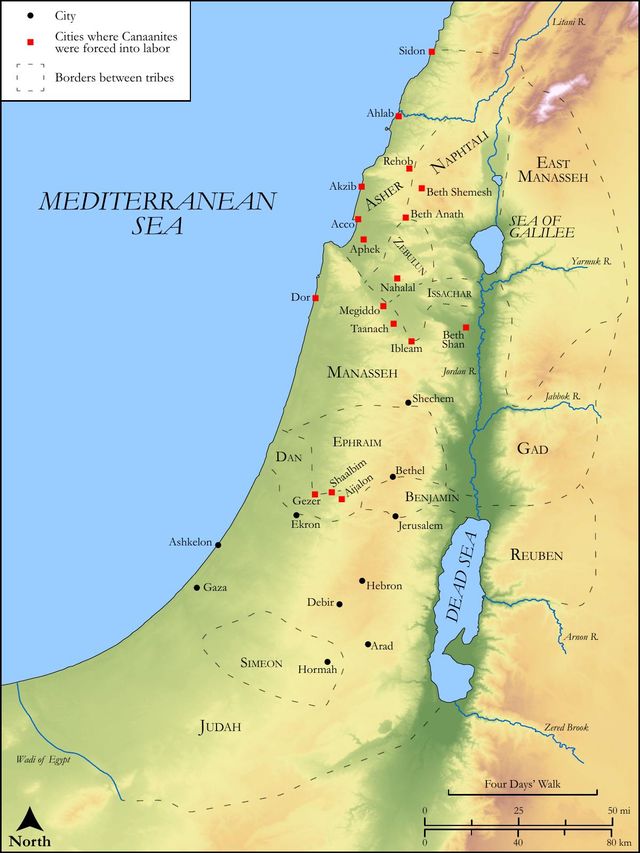
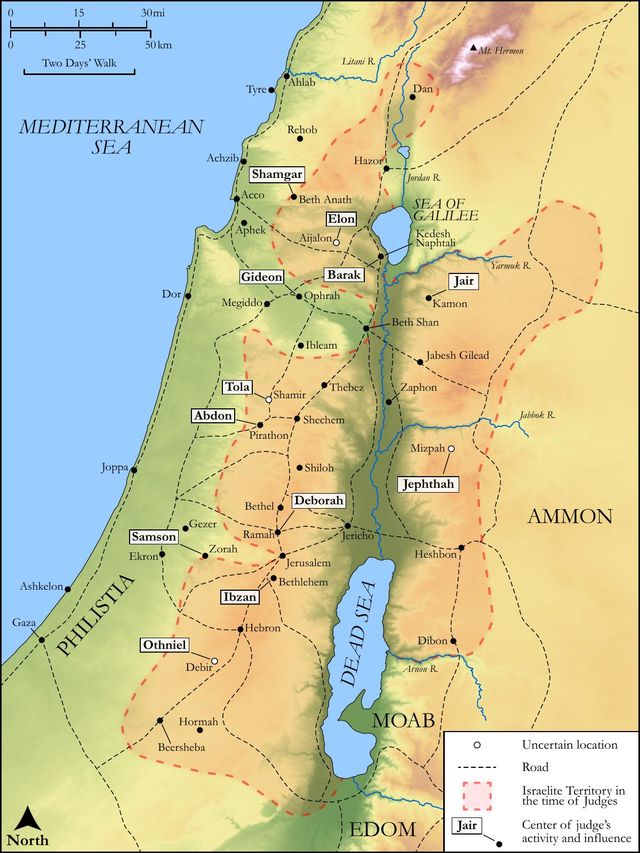
Study this verse
Public-domain commentary
Matthew Henry
From his Commentary on the Whole Bible. Henry comments on passages, not single verses — this entry covers Judges 1:9–20.
We have here a further account of that glorious and successful campaign which Judah and Simeon made. 1. The lot of Judah was pretty well cleared of the Canaanites, yet not thoroughly. Those that dwelt in the mountain (the mountains that were round about Jerusalem) were driven out (Jdg 1:9, Jdg 1:19), but those in the valley kept their ground against them, having chariots of iron, such as we read of, Jos 17:16. Here the men of Judah failed, and thereby spoiled the influence which otherwise their example hitherto might have had on the rest of the tribes, who followed them in this instance of their cowardice, rather than in all the other instances of their courage. They had iron chariots, and therefore it was thought not safe to attack them: but had not Israel God on their side, whose chariots are thousands of angels (Psa 68:17), before whom these iron chariots would be but as stubble to the fire? Had not God expressly promised by the oracle (Jdg 1:2) to give them success against the Canaanites in this very expedition, without excepting those that had iron chariots? Yet they suffered their fears to prevail against their faith, they could not trust God under any disadvantages, and therefore durst not face the iron chariots, but meanly withdrew their forces, when with one bold stroke they might have completed their victories; and it proved of pernicious consequence. They did run well, what hindered them? Gal 5:7. 2. Caleb was put in possession of Hebron, which, though given him by Joshua ten or twelve years before (as Dr. Lightfoot computes), yet being employed in public service, for the settling of the tribes, which he preferred before his own private interests, it seems he did not till now make himself master of; so well content was that good man to serve others, while he left himself to be served last; few are like-minded, for all seek their own, Phi 2:20, Phi 2:21. Yet now the men of Judah all came in to his assistance for the reducing of Hebron (Jdg 1:10), slew the sons of Anak, and put him in possession of it, Jdg 1:20. They gave Hebron unto Caleb. And now Caleb, that he might return the kindness of his countrymen, is impatient to see Debir reduced and put into the hands of the men of Judah, to expedite which he proffers his daughter to the person that will undertake to command in the siege of that important place, Jdg 1:11, Jdg 1:12. Othniel bravely undertakes it, and wins the town and the lady (Jdg 1:13), and by his wife's interest and management with her father gains a very good inheritance for himself and his family, Jdg 1:14, Jdg 1:15. We had this passage before, Jos 15:16-19, where it was largely explained and improved. 3. Simeon got ground of the Canaanites in his border, Jdg 1:17, Jdg 1:18. In the eastern part of Simeon's lot, they destroyed the Canaanites in Zephath, and called it Hormah - destruction, adding this to some other devoted cities not far off, which they had some time ago, with good reason, called by that name, Num 21:2, Num 21:3. And this perhaps was the complete performance of the vow they them made that they would utterly destroy these cities of the Canaanites in the south. In the western part they took Gaza, Askelon, and Ekron, cities of the Philistines; they gained present possession of the cities, but, not destroying the inhabitants, the Philistines in process of time recovered the cities, and proved inveterate enemies to the Israel of God, and no better could come of doing their work by the halves. 4. The Kenites gained a settlement in the tribe of Judah, choosing it there rather than in any other tribe, because it was the strongest, and there they hoped to be safe and quiet, Jdg 1:16. These were the posterity of Jethro, who either went with Israel when Moses invited them (Num 10:29) or met them about the same place when they came up from their wanderings in the wilderness thirty-eight years after, and went with them then to Canaan, Moses having promised them that they should fare as Israel fared, Num 10:32. They had at first seated themselves in the city of palm-trees, that is, Jericho, a city which never was to be rebuilt, and therefore the fitter for those who dwelt in tents, and did not mind building. But afterwards they removed into the wilderness of Judah, either out of their affection to that place, because solitary and retired, or out of their affection to that tribe, which perhaps had been in a particular manner kind to them. Yet we find the tent of Jael, who was of that family, far north, in the lot of Naphtali, when Sisera took shelter there, Jdg 4:17. This respect Israel showed them, to let them fix where they pleased, being a quiet people, who, wherever they were, were content with a little. Those that molested none were molested by none. Blessed are the meek, for thus they shall inherit the earth.
Continue studying Judges 1:13 across the web’s major study libraries — every link below opens this exact verse, chapter, or book on the destination site.
Read & Compare
 BibleGatewayThis verse in more than 200 translations and 70 languages.
 Bible.comThe YouVersion reader — hundreds of translations, reading plans, and highlights.
 ESV.orgCrossway's official English Standard Version reader.
 NET BibleThe NET translation with 60,000+ translators' notes on every rendering decision.
 STEP BibleTyndale House's free study tool — original text, vocabulary, and scholarly resources.
 BibliaLogos Bible Software's free web reader.
 USCCBThe New American Bible (Revised Edition) with the U.S. bishops' study notes.
Commentaries
 BibleHub CommentariesDozens of classic commentaries on this verse, gathered on one page.
 StudyLightMore than 100 commentary sets — the largest collection on the web.
 BibleRefPlain-English commentary on what this verse means, verse by verse.
 Enduring WordDavid Guzik's free commentary on this chapter, widely used by Bible teachers.
 Bible Study ToolsVerse commentary alongside Greek and Hebrew study aids.
Original Language & Research
- BibleHub InterlinearThe verse word by word — original language, transliteration, and English.
- BibleHub LexiconEvery word's original-language definition and Strong's entry.
 Blue Letter BibleDeep-study tools — Strong's numbers, concordance, and word studies.
 SefariaThe Hebrew text with Rashi and centuries of Jewish commentary.
Sermons, Hymns & Audio


TrulyRandomVerse is not affiliated with these sites and doesn’t control their content. They’re linked because they’re genuinely useful.
Summary
Judges 1:13 succinctly narrates Othniel's successful capture of Kirjath-sepher, also known as Debir, in response to Caleb's challenge. This act of valor secured a strategic city for the tribe of Judah and fulfilled Caleb's vow to give his daughter, Achsah, in marriage to the conqueror. The verse highlights Othniel's decisive action, establishing his prominence and foreshadowing his future role as a deliverer and the first judge of Israel.
Context
ShowHideLiterary Context
The Book of Judges commences following the death of Joshua, detailing Israel's initial, yet often faltering, attempts to fully possess the Promised Land. The preceding verses in Judges 1:1-11 describe the tribe of Judah's and Simeon's campaigns, establishing a pattern of partial success and ongoing conflict with the Canaanite inhabitants. Specifically, Judges 1:12 sets the immediate stage by introducing Caleb's challenge: whoever conquers the strategically important city of Kirjath-sepher (Debir) will be given his daughter Achsah in marriage. Judges 1:13 serves as the direct fulfillment of this challenge, showcasing Othniel's immediate and successful response, thereby transitioning the narrative from broader tribal conquests to a specific, personal act of valor that carries significant implications for the emerging leadership within Israel.
Historical & Cultural Context
The period of the Judges was characterized by a decentralized tribal confederacy, where individual tribes were largely responsible for securing and settling their allotted territories. Military prowess was highly esteemed, as the Israelites were engaged in continuous conflict to dispossess the Canaanites and establish their dominion. The custom of offering a daughter in marriage as a reward for a significant military achievement was a recognized practice in Israel. This tradition served to incentivize bravery, solidify alliances between prominent families, and integrate capable individuals into positions of influence. Kirjath-sepher, later known as Debir, was a crucial strategic city located in the hill country of Judah, and its capture was vital for the tribe's control over its designated inheritance. This significant event is also recounted in a parallel passage in Joshua 15:15-19, underscoring its importance in the broader narrative of the land's distribution and the establishment of Israelite control.
Key Themes
ShowHideThis verse contributes significantly to several overarching themes within the Book of Judges and the broader Deuteronomistic History. It vividly illustrates the theme of Incomplete Conquest, highlighting how individual acts of courage, like Othniel's, were necessary to secure what the nation as a whole often failed to fully possess due to disobedience or lack of resolve. It powerfully emphasizes Valor and Initiative, demonstrating that individual courage and proactive engagement were essential for fulfilling God's command to inherit the land. The theme of Faithfulness to Vows is also central, as Caleb, a figure renowned for his unwavering faith and obedience (e.g., Numbers 14:24), honorably fulfills his public promise. Furthermore, the verse serves as the crucial Introduction of a Future Leader, presenting Othniel, who will later emerge as the first judge of Israel, divinely raised up to deliver His people from oppression, as detailed in Judges 3:9-11.
Exposition and Analysis
ShowHideKey Word Analysis
ShowHideFrom the same root as "force" and "God," this name means "Force of God" or "God is my strength." This meaning is profoundly significant, foreshadowing Othniel's future role as a mighty warrior and the first judge of Israel, whose strength and success would come from divine empowerment, as explicitly stated in Judges 3:10. His introduction here establishes his character as a man of valor and sets the stage for his divinely appointed leadership.
This primitive root means "to catch (in a net, trap or pit); generally, to capture or occupy." In this context, it precisely describes Othniel's decisive military action in conquering Kirjath-sepher. The term emphasizes the successful and complete seizure of the city, indicating a forceful and effective military engagement that achieved the desired outcome of control and possession.
This primitive word denotes "a brother (used in the widest sense of literal relationship and metaphorical affinity or resemblance (like father)); another, brother(-ly); kindred, like, other." While literally "brother," its broad usage allows for interpretation as a kinsman, nephew, or close relative. In the context of Caleb offering his daughter, it strongly suggests a direct sibling relationship or a very close familial tie, likely a nephew (son of Caleb's actual brother, Kenaz, if Kenaz is a person, not just a clan). This close relationship underscores the internal family dynamic and the trust Caleb placed in Othniel, making the reward culturally appropriate within the family structure.
Verse Breakdown
ShowHide"And Othniel the son of Kenaz, Caleb's younger brother, took it"
This clause precisely identifies the protagonist, Othniel, by his lineage and his close familial relationship to Caleb. The phrase "took it" refers to the successful capture of Kirjath-sepher (Debir), the strategic city that Caleb had challenged his kinsmen to conquer. This concise statement highlights Othniel's decisive action and military success in a significant engagement, demonstrating his courage, capability, and immediate response to the challenge.
"and he gave him Achsah his daughter to wife"
This clause describes the immediate and honorable fulfillment of Caleb's vow. Caleb, a prominent and respected leader, demonstrates his integrity by giving his daughter Achsah to Othniel in marriage. This act serves as the promised reward for Othniel's valor, solidifying his position within Caleb's influential family and the tribe of Judah, and publicly affirming Caleb's trustworthiness and commitment to his word.
Literary Devices
ShowHideThe verse employs several literary devices that enhance its narrative impact. Conciseness is evident in the direct and unembellished reporting of Othniel's action and Caleb's response, reflecting the straightforward, factual narrative style characteristic of historical accounts within Judges. The phrase "Caleb's younger brother" functions as a form of Genealogy and Kinship Identification, immediately placing Othniel within a respected and influential family line. This familial connection is crucial for understanding his social standing, the dynamics within the tribe of Judah, and the legitimacy of his future leadership. Furthermore, the event itself serves as powerful Foreshadowing, subtly hinting at Othniel's future, more prominent role as Israel's first deliverer and judge. His success here establishes his character as a capable, courageous, and implicitly divinely favored warrior, preparing the reader for his later, more significant contributions to the nation.
Theological and Thematic Connections
ShowHideJudges 1:13 powerfully illustrates the intricate intersection of human initiative and divine purpose in the ongoing conquest of Canaan. While God had sovereignly promised the land to Israel, its full possession often required courageous and obedient human action, as vividly exemplified by Othniel. This verse underscores the critical importance of valor and faithfulness in fulfilling God's commands, particularly in a period where the broader community frequently struggled with obedience and commitment. Caleb's unwavering integrity in keeping his vow highlights the profound biblical emphasis on trustworthiness and honoring one's word, reflecting the very character of God's own faithfulness to His covenant promises. The strategic introduction of Othniel, a man characterized by action and integrity, foreshadows the desperate need for divinely appointed leaders during Israel's turbulent period of the Judges, a time when "everyone did what was right in his own eyes" (Judges 21:25).
Reflection and Application
ShowHideJudges 1:13 offers profound and enduring lessons for contemporary believers. Othniel's willingness to step forward and undertake a challenging, dangerous task, even when others might have hesitated, speaks powerfully to the importance of individual courage and initiative in serving God's purposes. We are called to be active, engaged participants in God's kingdom work, not passive observers, trusting that He will empower us for the specific tasks He sets before us, no matter how daunting they may seem. Caleb's unwavering commitment to his promise reminds us of the critical value of integrity and trustworthiness in all our relationships and commitments, reflecting the character of a faithful God who always keeps His word. Just as Othniel was rewarded for his valor, we are assured that faithfulness in both small and large acts of obedience contributes to God's grand design and does not go unnoticed in His eyes. This passage encourages us to prayerfully identify the "cities" or challenges in our own lives that God calls us to "take" – whether they be personal struggles, community needs, spiritual battles, or opportunities for service – and to respond with courage, faith, and decisive action, knowing that our efforts are part of a larger divine plan.
Questions for Reflection
ShowHideFAQ
ShowHideWho was Othniel, and why is his action significant?
ShowHideOthniel was the son of Kenaz and Caleb's kinsman, identified as his younger brother, though this term can also mean a close relative like a nephew. His action in successfully taking Kirjath-sepher (also known as Debir) was highly significant for several reasons: it directly fulfilled Caleb's public challenge, secured a vital strategic city for the tribe of Judah, and demonstrated his exceptional valor and military capability. More importantly, this event serves as his introduction as a capable and divinely favored leader, foreshadowing his later and more prominent role as the first judge of Israel, whom God raised up to deliver His people from oppression, as detailed in Judges 3:9-11.
What was the cultural purpose of Caleb offering his daughter as a reward?
ShowHideIn Israel, offering a daughter in marriage as a reward for military valor was a well-established cultural practice. It served multiple crucial purposes within the societal structure: it provided a powerful incentive for courageous acts necessary for conquest and securing territory, it solidified alliances and bonds between prominent families, and it served to integrate capable and brave individuals into influential lineages, thereby strengthening the tribe. For Caleb, it was a public declaration of his commitment to securing the strategic city of Kirjath-sepher for Judah and a demonstration of his integrity in fulfilling a public vow. This practice is also observed in other biblical accounts, such as King Saul's offer of his daughter to David for defeating Goliath in 1 Samuel 17:25.
Christ-Centered Fulfillment
ShowHideWhile Judges 1:13 describes a physical conquest and a human reward, it subtly points to the greater spiritual conquest and divine reward found supremely in Christ. Othniel's valor in taking a strategic city foreshadows the ultimate, decisive victory achieved by Jesus Christ, who, as the true Lion of the tribe of Judah (Revelation 5:5), conquered sin, death, and the devil through His sacrificial death on the cross and His glorious resurrection. Just as Othniel secured a tangible inheritance for the tribe of Judah, Christ secured an eternal, spiritual inheritance for all who believe in Him, an inheritance that is imperishable, undefiled, and unfading (1 Peter 1:3-4). Caleb's faithfulness in fulfilling his promise to Othniel reflects the perfect, unwavering faithfulness of God the Father, who promised a Redeemer from the lineage of David and perfectly fulfilled that promise in Christ Jesus (2 Corinthians 1:20). Our "reward" in Christ is not a physical land or a human spouse, but rather spiritual union with Christ Himself, becoming part of His glorious bride, the Church (Ephesians 5:25-27), and inheriting eternal life and all the blessings of salvation through His decisive and complete victory.