


1 Samuel 17:25
Bible text: King James Version (1769 Blayney text) · Public domain
Bible text: King James Version with Strong's numbers · Public domain
Bible text: Berean Standard Bible · Public domain
Bible text: American Standard Version (1901) · Public domain
Bible text: World English Bible, Messianic edition · Public domain
Bible text: Geneva Bible (1599) · Public domain
Bible text: Young's Literal Translation · Public domain
- וַיֹּאמֶרvai·Yo·merand he saidH559Conj-w ¦ V-Qal-ConsecImperf-3msVerb Qal Consecutive Imperfect 3rd Singular Masculineוַandיֹּאמֶרhe said
- אִישׁ'ish[the] man ofH376N-mscNoun Singular Masculine Construct
- יִשְׂרָאֵלYis·ra·'ElIsraelH3478N-properNoun Proper Location
- הַרְּאִיתֶםha·re·'i·Tem¿ have you seenH7200Interrog ¦ V-Qal-Perf-2mpVerb Qal Perfect 2nd Plural Masculineהַ¿רְּאִיתֶםhave you seen
- הָאִישׁha·'Ishthe manH376Art ¦ N-msNoun Singular Masculine Absoluteהָtheאִישׁman
- הָעֹלֶהha·'o·Lehwho comes upH5927Art ¦ V-Qal-Prtcpl-msVerb Qal Participle Singular Masculine Absoluteהָwhoעֹלֶהcomes up
- הַזֶּהha·Zeh<the> thisH2088Art ¦ PrtParticle Demonstrativeהַ<the>זֶּהthis
- כִּיkiforH3588PrtParticle Conditional
- לְחָרֵףle·cha·Refto defyH2778Prep-l ¦ V-Piel-InfVerb Piel Infinitive Constructלְtoחָרֵףdefy
- אֶת'et<obj.>H853DirObjMParticle Object Indicator
- יִשְׂרָאֵלYis·ra·'ElIsraelH3478N-properNoun Proper Location
- עֹלֶה'o·Leh[he is] coming upH5927V-Qal-Prtcpl-msVerb Qal Participle Singular Masculine Absolute
- וְהָיָהVe·ha·yahand it will beH1961Conj-w ¦ V-Qal-ConsecPerf-3msVerb Qal Consecutive Perfect 3rd Singular Masculineוְandהָיָהit will be
- הָאִישׁha·'Ishthe manH376Art ¦ N-msNoun Singular Masculine Absoluteהָtheאִישׁman
- אֲשֶׁר'a·SherwhoH834RelParticle Relative
- יַכֶּנּוּya·Ke·nuhe will strike down himH5221V-Hiphil-Imperf-3ms ¦ 3msVerb Hiphil Imperfect 3rd Singular Masculineיַכֶּhe will strike downנּוּhim
- יַעְשְׁרֶנּוּya'·she·Re·nuhe will make rich himH6238V-Hiphil-Imperf-3ms ¦ 3msVerb Hiphil Imperfect 3rd Singular Masculineיַעְשְׁרֶhe will make richנּוּhim
- הַמֶּלֶךְha·Me·lekhthe kingH4428Art ¦ N-msNoun Singular Masculine Absoluteהַtheמֶּלֶךְking
- עֹשֶׁר'O·sherrich[es]H6239N-msNoun Singular Masculine Absolute
- גָּדוֹלga·DolgreatH1419Adj-msAdjective Singular Masculine Absolute
- וְאֶתve·'Etand <obj.>H853Conj-w ¦ DirObjMParticle Object Indicatorוְandאֶת<obj.>
- בִּתּוֹbi·Tohis daughterH1323N-fsc ¦ 3msNoun Singular Feminine Constructבִּתּdaughterוֹhis
- יִתֶּןyi·tenhe will giveH5414V-Qal-Imperf-3msVerb Qal Imperfect 3rd Singular Masculine
- לוֹloto <the> himPrep-l ¦ 3msSuffix Personal 3rd Singular Masculineלto <the>וֹhim
- וְאֵתve·'Etand <obj.>H853Conj-w ¦ DirObjMParticle Object Indicatorוְandאֵת<obj.>
- בֵּיתbeit[the] house ofH1004N-mscNoun Singular Masculine Construct
- אָבִיו'a·Vivhis fatherH1N-msc ¦ 3msNoun Singular Masculine Constructאָבִיfatherוhis
- יַעֲשֶׂהya·'a·Sehhe will makeH6213V-Qal-Imperf-3msVerb Qal Imperfect 3rd Singular Masculine
- חָפְשִׁיcha·fe·ShifreeH2670Adj-msAdjective Singular Masculine Absolute
- בְּיִשְׂרָאֵלbe·Yis·ra·'Elin IsraelH3478Prep-b ¦ N-properNoun Proper LocationבְּinיִשְׂרָאֵלIsrael
English is a literal word-by-word gloss of the Hebrew, not the KJV's wording. Why?
This is the original text the KJV's translators worked from — each Hebrew word with its own literal English meaning in this verse, prepared by scholars at Tyndale House, Cambridge. The KJV translates whole sentences, not word by word, so its wording differs: one Hebrew word can become several English words, and the KJV may choose “the LORD” where the gloss reads “Yahweh”. Both are faithful — they answer different questions. For the KJV's own rendering, switch to the KJV text.
Details
See on the biblical-era map
Study this verse
Public-domain commentary
Matthew Henry
From his Commentary on the Whole Bible. Henry comments on passages, not single verses — this entry covers 1 Samuel 17:12–30. His four-level outline is real structure in the source text, so it is rendered as structure.
Forty days the two armies lay encamped facing one another, each advantageously posted, but neither forward to engage. Either they were parleying and treating of an accommodation or they were waiting for recruits; and perhaps there were frequent skirmishes between small detached parties. All this while, twice a day, morning and evening, did the insulting champion appear in the field and repeat his challenge, his own heart growing more and more proud for his not being answered and the people of Israel more and more timorous, while God designed hereby to ripen him for destruction and to make Israel's deliverance the more illustrious. All this while David is keeping his father's sheep, but at the end of forty days Providence brings him to the field to win and wear the laurel which no other Israelite dares venture for. We have in these verses,
I.The present state of his family.
His father was old (Sa1 17:12): He went among men for an old man, was taken notice of for his great age, above what was usual at that time, and therefore was excused from pubic services, and went not in person to the wars, but sent his sons; he had the honours paid him that were due his age, his hoary head was a crown of glory to him. David's three elder brethren, who perhaps envied his place at the court, got their father to send for him home, and let them go to the camp, where they hoped to signalize themselves and eclipse him (Sa1 17:13, Sa1 17:14), while David himself was so far from being proud of the services he had done his prince, or ambitious of further preferment, that he not only returned from court to the obscurity of his father's house, but to care, and toil, and (as it proved, Sa1 17:34) the peril, of keeping his father's sheep. It was the praise of this humility that it came after he had the honour of a courtier, and the reward of it that it came before the honour of a conqueror. Before honour is humility. Now he had that opportunity of mediation and prayer, and other acts of devotion, which fitted him for what he was destined to more than all the military exercises of that inglorious camp could do.
II.The orders his father gave him to go and visit his brethren in the camp.
He did not himself ask leave to go, to satisfy his curiosity, or to gain experience and make observations; but his father sent him on a mean and homely errand, on which any of his servants might have gone. He must carry some bread and cheese to his brethren, ten loaves with some parched corn for themselves (Sa1 17:17) and ten cheeses (which, it seems, he thought too good for them) for a present to their colonel, Sa1 17:18. David must still be the drudge of the family, though he was to be the greatest ornament of it. He had not so much as an ass at command to carry his load, but must take it on his back, and yet run to the camp. Jesse, we thought, was privy to his being anointed, and yet industriously kept him thus mean and obscure, probably to hide him from the eye of suspicion and envy, knowing that he was anointed to a crown in reversion. He must observe how his brethren fared, whether they were not reduced to short allowance, now that the encampment continued so long, that, if need were, he might send them more provisions. And he must take their pledge, that is, if they had pawned any thing, he must redeem it; take notice of their company, so some observe, whom they associate with, and what sort of life they lead. Perhaps David, like Joseph, had formerly brought to his father their evil report, and now he sends him to enquire concerning their manners. See the care the pious parents about their children when they are abroad from them, especially in places of temptation; they are solicitous how they conduct themselves, and particularly what company they keep. Let children think of this, and conduct themselves accordingly, remembering that, when they are from under their parents' eye, they are still under God's eye.
III.David's dutiful obedience to his father's command.
His prudence and care made him be up early (Sa1 17:20), and yet not to leave his sheep without a keeper, so faithful was he in a few things and therefore the fitter to be made ruler over many things, and so well had he learnt to obey before he pretended to command. God's providence brought him to the camp very seasonably, when both sides had set the battle in array, and, as it should seem, were more likely to come to an engagement than they had yet been during all the forty days, Sa1 17:21. Both sides were now preparing to fight. Jesse little thought of sending his son to the army just at that critical juncture, but the wise God orders the time and all the circumstances of actions and affairs so as to serve his designs of securing the interests of Israel and advancing the men after his own heart. Now observe here,
1.How brisk and lively David was, Sa1 17:22. What articles he brought he honestly took care of, and left them with those that had the charge of the bag and baggage; but, though he had come a long journey with a great load, he ran into the army, to see what was doing there, and to pay his respects to his brethren. Seest thou a man thus diligent in his business, he is in the way of preferment, he shall stand before kings.
2.How bold and daring the Philistine was, Sa1 17:23. Now that the armies were drawn out into a line of battle he appeared first to renew his challenge, vainly imagining that he was in the eager chase of his own glory and triumph, whereas really he was but courting his own destruction.
3.How timorous and faint-hearted the men of Israel were. Though they had, for forty days together, been used to his haughty looks and threatening language, and, having seen no execution done by either, might have learned to despise both, yet, upon his approach, they fled from him and were greatly afraid, Sa1 17:24. One Philistine could never thus have chased 1000 Israelites, and put 10,000 to flight, unless their Rock, being treacherously forsaken by them, had justly sold them, and shut them up, Deu 32:30.
4.How high Saul bid for a champion. Though he was the tallest of all the men of Israel, and, if he had not been so, while he kept close to God might himself have safely taken up the gauntlet which this insolent Philistine threw down, yet, the Spirit of the Lord having departed from him, he durst not do it, nor press Jonathan to do it; but whoever will do it shall have as good preferment as he can give him, Sa1 17:25. If the hope of wealth and honour will prevail with any man to expose himself so far, it is proclaimed that the bold adventurer, if he come off, shall marry the king's daughter and have a good portion with her; but, as it should seem, whether he come off or no, his father's house shall be free in Israel, from all toll, tribute, custom, and services to the crown, or shall be ennobled and advanced to the peerage.
5.How much concerned David was to assert the honour of God and Israel against the impudent challenges of this champion. He asked what reward was promised to him that should slay this Philistine (Sa1 17:26), though he knew already, not because he was ambitious of the honour, but because he would have it taken notice of, and reported to Saul, how much he resented the indignity hereby done to Israel and Israel's God. He might have presumed so far upon his acquaintance and interest at court as to go himself to Saul to offer his service; but his modesty would not let him do this. It was one of his own rules, before it was one of his son's proverbs, Put not forth thyself in the presence of the king, and stand not in the place of great men (Pro 25:6); yet his zeal put him upon that method which he hoped would bring him into this great engagement. Two considerations, it seems, fired David with a holy indignation: - (1.) That the challenger was one that was uncircumcised, a stranger to God and out of covenant with him. (2.) That the challenged were the armies of the living God, devoted to him, employed by him and for him, so that the affronts offered to them reflected upon the living God himself, and that he could not bear. When therefore some had told him what was the reward proposed for killing the Philistine (Sa1 17:27) he asked others (Sa1 17:30), with the same resentment, which he expected would at length come to Saul's ear.
6.How he was brow-beaten and discouraged by his eldest brother Eliab, who, taking notice of his forwardness, fell into a passion upon it, and gave David very abusive language, Sa1 17:28. Consider this,
(1.)As the fruit of Eliab's jealousy. He was the eldest brother, and David the youngest, and perhaps it had been customary with him (as it is with too many elder brothers) to trample upon him and take every occasion to chide him. But those who thus exalt themselves over their juniors may perhaps live to see themselves, by a righteous providence, abased, and those to whom they are abusive exalted. Time may come when the elder may serve the younger. But Eliab was now vexed that his younger brother should speak those bold words against the Philistine which he himself durst not say. He knew what honour David had already had in the court, and, if he should now get honour in the camp (from which he thought he had found means effectually to seclude him, Sa1 17:15), the glory of his elder brethren would be eclipsed and stained; and therefore (such is the nature of jealousy) he would rather that Goliath should triumph over Israel than that David should be the man that should triumph over him. Wrath is cruel and anger is outrageous, but who can stand before envy, especially the envy of a brother, the keenness of which Jacob, and Joseph, and David experienced? See Pro 18:19. It is very ill-favoured language that Eliab here gives him; not only unjust and unkind, but, at this time, basely ungrateful; for David was now sent by his father, as Joseph by his, on a kind of visit to his brethren. Eliab intended, in what he said, not only to grieve and discourage David himself, and quench that noble fire which he perceived glowing in his breast, but to represent him to those about him as an idle proud lad, not fit to be taken notice of. He gives them to understand that his business was only to keep sheep, and falsely insinuates that he was a careless unfaithful shepherd; though he had left his charge in good hands (Sa1 17:20), yet he must tauntingly be asked, With whom hast thou left those few sheep? Though he came down now to the camp in disobedience to his father and kindness to his brethren, and Eliab knew this, yet his coming is turned to his reproach: "Thou hast come down, not to do any service, but to gratify thy own curiosity, and only to look about thee;" and thence he will infer the pride and naughtiness of his heart, and pretends to know it as certainly as if he were in his bosom. David could appeal to God concerning his humility and sincerity (Psa 17:3; Psa 131:1) and at this time gave proofs of both, and yet could not escape this hard character from his own brother. See the folly, absurdity, and wickedness, of a proud and envious passion; how groundless its jealousies are, how unjust its censures, how unfair its representations, how bitter its invectives, and how indecent its language. God, by his grace, keep us from such a spirit!
(2.)As a trial of David's meekness, patience and constancy. A short trial it was, and he approved himself well in it; for,
[1.]He bore the provocation with admirable temper (Sa1 17:29): "What have I now done? What fault have I committed, for which I should thus be chidden? Is there not a cause for my coming to the camp, when my father sent me? Is there not a cause for my resenting the injury done to Israel's honour by Goliath's challenges?" He had right and reason on his side, and knew it, and therefore did not render railing for railing, but with a soft answer turned away his brother's wrath. This conquest of his own passion was in some respects more honourable than his conquest of Goliath. He that hath rule over his own spirit is better than the mighty. It was no time for David to quarrel with his brother when the Philistines were upon them. The more threatening the church's enemies are the more forbearing her friends should be with one another.
[2.]He broke through the discouragement with admirable resolution. He would not be driven off from his thoughts of engaging the Philistine by the ill-will of his brother. Those that undertake great and public services must not think it strange if they be discountenanced and opposed by those from whom they had reason to expect support and assistance; but must humbly go on with their work, in the face not only of their enemies' threats, but of their friends' slights and suspicions.
Historical interpretation
Historical reception
2 surviving comments on this verse. Each one is dated, so this reads as a timeline rather than a list.
Therefore, the man who strikes him, the king will enrich, etc. They say, the man who will overthrow the kingdom of the devil, the entire people of Israel acknowledges, distinguished above all nations by royal and priestly mystery, as the possessor of all the riches that are in the heavens and on the earth, that is, as the Lord of the whole world. But also, the early Church, undoubtedly generated from his own flesh, rejoices to be united to this man, outstanding above others, by the bond of a chaste and faithful spouse, and also testifies with unfaltering faith that all his elect will be freed from the bondage of sin and elevated by the freedom of the Holy Spirit. Whether you choose to understand it as the Father of Christ the Lord or as the people of the saints, from whom Christ is according to the flesh, the explanation will hold the same end valid; for there is also one house of all the faithful, living by one and the same faith, hope, and charity, and this same house is of Him to whom it is sung: And let all those who hope in You rejoice, they will exult forever, and You will dwell in them (Psalm V). Such was the faith of the ancients concerning the coming Christ in the flesh, and such is our faith concerning Him whom we rejoice has already come.
And one of the Israelites said: Have you seen? etc. One of the Israelites, asking whether he saw David or the Philistine; those who were awaiting the redemption of Israel, already illuminated by the miracles at the Lord's birth, with a careful mind inquired whether the same Lord was free from the snares of that ancient enemy who habitually reproaches all the faithful, whether he was in debt to death in any way, or to him who had the power of death; nor was it easy for all to recognize immediately that the Son of God, conceived from sanctification, born without sin, and destined to live in the world.
Continue studying 1 Samuel 17:25 across the web’s major study libraries — every link below opens this exact verse, chapter, or book on the destination site.
Read & Compare
 BibleGatewayThis verse in more than 200 translations and 70 languages.
 Bible.comThe YouVersion reader — hundreds of translations, reading plans, and highlights.
 ESV.orgCrossway's official English Standard Version reader.
 NET BibleThe NET translation with 60,000+ translators' notes on every rendering decision.
 STEP BibleTyndale House's free study tool — original text, vocabulary, and scholarly resources.
 BibliaLogos Bible Software's free web reader.
 USCCBThe New American Bible (Revised Edition) with the U.S. bishops' study notes.
Commentaries
 BibleHub CommentariesDozens of classic commentaries on this verse, gathered on one page.
 StudyLightMore than 100 commentary sets — the largest collection on the web.
 BibleRefPlain-English commentary on what this verse means, verse by verse.
 Enduring WordDavid Guzik's free commentary on this chapter, widely used by Bible teachers.
 Bible Study ToolsVerse commentary alongside Greek and Hebrew study aids.
Original Language & Research
- BibleHub InterlinearThe verse word by word — original language, transliteration, and English.
- BibleHub LexiconEvery word's original-language definition and Strong's entry.
 Blue Letter BibleDeep-study tools — Strong's numbers, concordance, and word studies.
 SefariaThe Hebrew text with Rashi and centuries of Jewish commentary.
Sermons, Hymns & Audio


TrulyRandomVerse is not affiliated with these sites and doesn’t control their content. They’re linked because they’re genuinely useful.
Summary
1 Samuel 17:25 vividly portrays the profound fear and desperation gripping the Israelite army and King Saul in the face of Goliath's audacious challenge. It details the extraordinary incentives offered by the king to any man brave enough to confront the Philistine giant: immense wealth, marriage into the royal family, and permanent exemption from taxes and service for the victor's entire household. This verse not only underscores the gravity of Goliath's defiance against Israel and its God but also highlights the paralyzing fear that had incapacitated the nation's leadership and military, creating a vacuum for a champion of faith to emerge.
Context
ShowHideLiterary Context
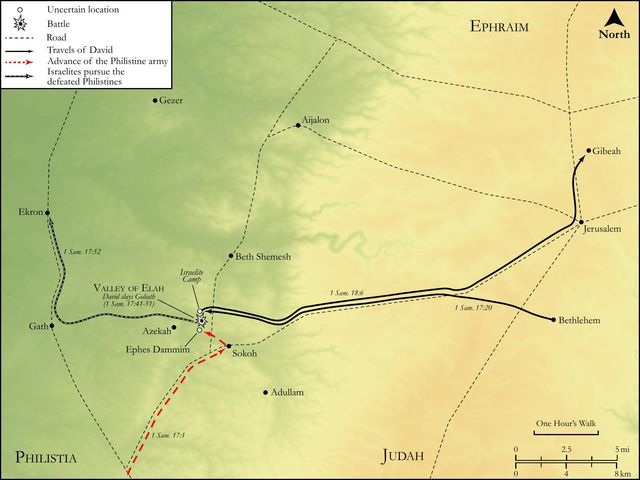
This verse is strategically placed within the dramatic narrative of 1 Samuel 17, which chronicles the pivotal standoff between the Philistine and Israelite armies in the Valley of Elah. For forty days, Goliath of Gath, a formidable Philistine champion, had relentlessly taunted Israel, demanding a single combat to decide the war's outcome, a challenge that left the Israelite forces, under King Saul, gripped by fear and despair (1 Samuel 17:1-11). Verse 25 immediately follows David's arrival at the camp, where he overhears the soldiers discussing Goliath's challenge and the king's unprecedented offer. This crucial moment sets the stage for David's questioning of the men, his subsequent righteous indignation, and his courageous decision to face Goliath, presenting a stark contrast to the widespread fear and inaction of the Israelite army and its king. The narrative emphasizes the spiritual vacuum left by Saul's failed leadership, creating the perfect backdrop for God to raise up His chosen deliverer.
Historical & Cultural Context
The practice of "champion warfare," where two armies agree to let a single combat between their strongest warriors decide the outcome of a battle, was a recognized, though not common, custom among the nations of that day. This method aimed to minimize casualties for both sides by resolving conflict through a proxy. Goliath's challenge was deeply rooted in this tradition. The rewards offered by King Saul—great riches, a royal marriage, and freedom from obligations for the victor's family—were exceptionally lavish, reflecting the dire straits of the kingdom and the immense pressure on Saul. Such a promise of substantial wealth and elevated social status (specifically, exemption from taxes, forced labor, or military conscription) would fundamentally transform a common family's destiny for generations. For an agrarian society, freedom from royal burdens was an immense and highly coveted privilege, ensuring economic stability and social standing. This testifies to the magnitude of the threat Goliath posed and the profound desperation of King Saul.
Key Themes
ShowHide1 Samuel 17:25 powerfully contributes to several overarching themes woven throughout the Book of 1 Samuel:
The Contrast Between Human and Divine Strength
Saul, chosen for his impressive physical stature and appearance (1 Samuel 9:2), proves utterly inadequate in the face of a spiritual challenge, highlighting God's preference for working through unexpected means rather than relying on human might or impressive outward appearance to deliver His people. Saul's inability to act or inspire reveals the bankruptcy of a kingship not fully reliant on God.
Fear vs. Faith
The verse vividly portrays the paralyzing fear that gripped the Israelites, contrasting sharply with David's later faith-filled response, which is rooted in his trust in the living God. It underscores that true courage comes not from human strength or royal incentives, but from unwavering trust in the Lord.
The Nature of Kingship
Saul's desperate offer exposes his spiritual weakness and his inability to protect his people effectively, foreshadowing his eventual downfall and the divine rejection of his kingship. It sets the stage for the emergence of David, a king after God's own heart, who would prioritize God's honor above all else, even without the promise of earthly rewards.
God's Honor
Goliath's defiance is explicitly stated as being "to defy Israel," which implicitly means to defy the God of Israel. The urgent need for a champion is not merely for military victory but, more profoundly, to vindicate God's name and honor among the nations, demonstrating His sovereignty and power.
Exposition and Analysis
ShowHideKey Word Analysis
ShowHideThis verb, חָרַף (H2778, ḥārap'), means "to taunt, reproach, blaspheme, defy." It carries a strong connotation of insult and challenge, often directed against God or His people. In this context, Goliath's actions are not merely a military maneuver but a direct, blasphemous affront to the God of Israel. The Israelites understood this as a spiritual battle, not just a physical one, which deepened their fear and sense of shame. It signifies a public act of contempt and scorn.
The verb עָשַׁר (H6238, ʿāšar') signifies "to become rich, to accumulate wealth," or causatively, "to make rich." The use of "great riches" (עֹשֶׁר גָּדוֹל, ʿōsher gādôl) emphasizes the extraordinary nature of the financial reward. This was not a modest sum but a life-altering fortune, indicating the immense value Saul placed on defeating Goliath and the dire need for a volunteer. It speaks to a substantial and transformative increase in one's material possessions.
The adjective חָפְשִׁי (H2670, ḥophshî') means "free, liberated, exempt." It typically refers to freedom from slavery or servitude. In this specific context, it implies exemption from all royal obligations, including taxes, forced labor (corvée), and potentially military service, for the entire family of the victor. This was an unprecedented privilege, granting the family a permanent, elevated social and economic status within Israel, securing their future prosperity and autonomy.
Verse Breakdown
ShowHide"And the men of Israel said, Have ye seen this man that is come up?"
This opening clause immediately establishes the collective sentiment of the Israelite soldiers. It is a question born of awe, fear, and perhaps a touch of morbid fascination, revealing their passivity. They are not strategizing how to fight, but rather observing and discussing Goliath's intimidating presence, highlighting the psychological grip he held over them and their inability to respond proactively.
"surely to defy Israel is he come up:"
This phrase articulates the clear understanding among the Israelites that Goliath's challenge was a direct, contemptuous insult and provocation against their nation. The word "defy" carries a spiritual weight, indicating that Goliath's taunts were perceived as an affront not only to the army but, more significantly, to the God of Israel. This understanding deepened the shame felt by the Israelites for their inability to respond.
"and it shall be, [that] the man who killeth him, the king will enrich him with great riches, "
This is the first of three extraordinary promises from King Saul. It signifies a massive financial reward, far beyond typical military compensation. The "great riches" would elevate the victor from any previous social standing to one of significant wealth and influence, underscoring Saul's desperation and the immense value he placed on Goliath's defeat.
"and will give him his daughter, "
The second promise is marriage into the royal family. This was an unparalleled honor, granting the victor immense social prestige, political influence, and a direct connection to the throne. It would secure the victor's status as a member of the royal household, a privilege typically reserved for the most elite or powerful individuals, signifying a profound elevation in social standing.
"and make his father's house free in Israel."
The third and final promise extends the benefits beyond the individual to his entire family, his "father's house." "Free" here means exempt from taxes, forced labor (corvée), and possibly military conscription. This would ensure the family's long-term economic security and social standing, releasing them from the burdens and obligations common to ordinary Israelite citizens. It was a guarantee of lasting prosperity and autonomy for generations, a truly transformative benefit.
Literary Devices
ShowHideThe passage effectively employs several literary devices to convey the narrative's tension and profound significance. Repetition is evident in the repeated mention of Goliath's defiance and the Israelites' pervasive fear throughout the chapter, emphasizing the overwhelming nature of the threat and the army's debilitating paralysis. There is profound Irony in Saul's predicament: despite being chosen for his impressive stature ("taller than any of the people"), he is utterly incapable of confronting Goliath, highlighting the spiritual weakness beneath his physical strength. This contrasts sharply with David, a humble shepherd boy, who embodies true courage and faith. The lavish promises themselves serve as Hyperbole, underscoring the extreme nature of the situation and Saul's desperate state of mind. Finally, the entire scenario, particularly the king's inability to act and the urgent need for an unexpected champion, serves as powerful Foreshadowing of the divinely orchestrated shift in kingship from Saul to David, and more broadly, of God's consistent method of delivering His people not through human might or worldly power, but through His chosen, often humble, instruments.
Theological and Thematic Connections
ShowHideThis verse highlights a profound theological truth: human inability to address overwhelming spiritual and physical threats often sets the stage for divine intervention. The Israelites' paralyzing fear and Saul's desperate, materially driven promises underscore humanity's inherent limitations when faced with a challenge that demands faith beyond mere sight or strength. Goliath's defiance was not just a military threat but a direct challenge to the sovereignty, honor, and very name of Yahweh. The solution, therefore, could not come from human strength, political maneuvering, or worldly incentives, but from a heart fully devoted to God's glory and a willingness to trust in His power. This narrative powerfully foreshadows the greater need for a champion who would confront the ultimate enemies—sin and death—not for riches or earthly glory, but for the vindication of God's holy name and the eternal salvation of His people. It teaches us that true victory, especially in spiritual battles, comes through trusting in God's power and faithfulness, not human might, cunning, or material enticements.
Reflection and Application
ShowHideThe scene described in 1 Samuel 17:25 serves as a powerful mirror for our own lives, reflecting our responses to overwhelming challenges. We often encounter "Goliaths"—whether they are daunting personal struggles, spiritual battles, or seemingly insurmountable obstacles in our communities—that leave us feeling paralyzed by fear and inadequacy, much like the Israelite army. In such moments, we might be tempted to seek purely external solutions, relying on our own strength, human ingenuity, or to be motivated by the "great riches" and "royal connections" that the world offers as incentives for overcoming our struggles. However, this narrative profoundly reminds us that true victory, especially over challenges that defy human strength or conventional solutions, comes not from our own might or the promises of others, but from a courageous faith rooted in God. Our primary motivation should be to honor God and to see His name vindicated, rather than focusing on personal gain, worldly recognition, or avoiding discomfort. When we face our own giants, we are called to look beyond our fears and trust in God's power to deliver, just as David did, understanding that God often uses the humble, the unexpected, and those who prioritize His glory to accomplish His greatest purposes.
Questions for Reflection
ShowHideFAQ
ShowHideWhy was King Saul unable to fight Goliath himself, despite his stature?
ShowHideKing Saul's inability to fight Goliath, despite being physically imposing and "taller than any of the people" (1 Samuel 10:23), was fundamentally a spiritual failure, not a physical one. Saul had been chosen by God to be king, but his reign was increasingly marked by disobedience and a lack of full reliance on the Lord. He had previously disobeyed God's direct commands, such as offering a sacrifice without waiting for Samuel (1 Samuel 13:8-14) and failing to completely destroy the Amalekites (1 Samuel 15:1-23). These acts of rebellion led to God's Spirit departing from him, and an evil spirit from the Lord began to torment him (1 Samuel 16:14). His fear and paralysis in the face of Goliath's challenge were direct symptoms of his spiritual distance from God. He lacked the faith and divine empowerment necessary to confront a foe who was defying the God of Israel, demonstrating that true kingship and leadership require more than just physical prowess; they demand a heart fully surrendered to God.
What did it mean for the victor's "father's house" to be "free in Israel"?
ShowHideThe promise to "make his father's house free in Israel" was an extraordinary and highly significant incentive, reflecting the immense value Saul placed on defeating Goliath. The Hebrew word for "free" (חָפְשִׁי, ḥopšî) in this context implies exemption from all royal obligations and burdens, a privilege that would elevate the family's status permanently. This would typically include:
This privilege would elevate the family's social and economic status permanently, ensuring their prosperity and autonomy for generations. It was a rare and highly coveted benefit, underscoring the immense value Saul placed on Goliath's defeat and the desperate state of his kingdom.
Christ-Centered Fulfillment
ShowHideThe narrative of 1 Samuel 17:25 and the subsequent victory of David over Goliath finds its ultimate and most profound fulfillment in the person and work of Jesus Christ. Goliath's audacious defiance of Israel and its God powerfully mirrors the universal defiance of sin and death against God's holy reign over humanity. Just as Saul and the Israelite army were utterly paralyzed by fear and helplessness, humanity is inherently incapable of overcoming the overwhelming power of sin and its ultimate consequence, death, on its own. No amount of human effort, worldly wealth, or earthly incentive could ever provide a lasting solution to this existential dilemma. Into this desperate human condition steps Jesus, the true and ultimate Champion. He is the Son of David, the promised Messiah, who came not for earthly riches or a royal bride in the temporal sense, but to vindicate the Father's name and rescue His people from eternal bondage. Unlike Saul, who was physically imposing but spiritually weak and fearful, Jesus, though appearing humble and unassuming, possessed divine authority and power. He confronted the ultimate "Goliath"—Satan, sin, and death—on the cross, not with a sling and stone, but through His perfect obedience, sacrificial love, and victorious resurrection (Hebrews 2:14-15). Through His death and resurrection, Christ secured for us not merely "great riches" but an eternal inheritance beyond measure (Ephesians 1:11), not just a royal marriage to an earthly king but a divine, eternal union with Him as His Bride, the Church (Ephesians 5:25-27), and not just "freedom" from taxes or earthly burdens, but true spiritual freedom from the bondage of sin and the curse of the law (Galatians 5:1). Jesus is the One who truly makes His Father's house—all who believe in Him—eternally free in the glorious kingdom of God.