


Joshua 15:16
- וַיֹּאמֶרvai·Yo·merand he saidH559Conj-w ¦ V-Qal-ConsecImperf-3msVerb Qal Consecutive Imperfect 3rd Singular Masculineוַandיֹּאמֶרhe said
- כָּלֵבka·LevCalebH3612N-proper-mNoun Proper Masculine
- אֲשֶׁר'a·Sher[the one] whoH834RelParticle Relative
- יַכֶּהya·Kehhe will strikeH5221V-Hiphil-Imperf-3msVerb Hiphil Imperfect 3rd Singular Masculine
- אֶת'et<obj.>H853DirObjMParticle Object Indicator
- קִרְיַתkir·yatKiriathH7158N-properNoun Proper Location
- סֵפֶרSe·ferSepherH7158N-properNoun Proper Location
- וּלְכָדָהּu·le·kha·Dahand he will capture itH3920Conj-w ¦ V-Qal-ConsecPerf-3ms ¦ 3fsVerb Qal Consecutive Perfect 3rd Singular Masculineוּandלְכָדָhe will captureהּit
- וְנָתַתִּיve·na·Ta·tiand I will giveH5414Conj-w ¦ V-Qal-ConsecPerf-1csVerb Qal Consecutive Perfect 1st Singular common genderוְandנָתַתִּיI will give
- לוֹloto <the> himPrep-l ¦ 3msSuffix Personal 3rd Singular Masculineלto <the>וֹhim
- אֶת'et<obj.>H853DirObjMParticle Object Indicator
- עַכְסָה'akh·SahAchsahH5915N-proper-fNoun Proper Feminine
- בִתִּיvi·Timy daughterH1323N-fsc ¦ 1csNoun Singular Feminine Constructבִתִּdaughterיmy
- לְאִשָּׁהle·'i·Shahto a wifeH802Prep-l ¦ N-fsNoun Singular Feminine Absoluteלְtoאִשָּׁהa wife
English is a literal word-by-word gloss of the Hebrew, not the KJV's wording. Why?
This is the original text the KJV's translators worked from — each Hebrew word with its own literal English meaning in this verse, prepared by scholars at Tyndale House, Cambridge. The KJV translates whole sentences, not word by word, so its wording differs: one Hebrew word can become several English words, and the KJV may choose “the LORD” where the gloss reads “Yahweh”. Both are faithful — they answer different questions. For the KJV's own rendering, switch to the KJV text.
Details
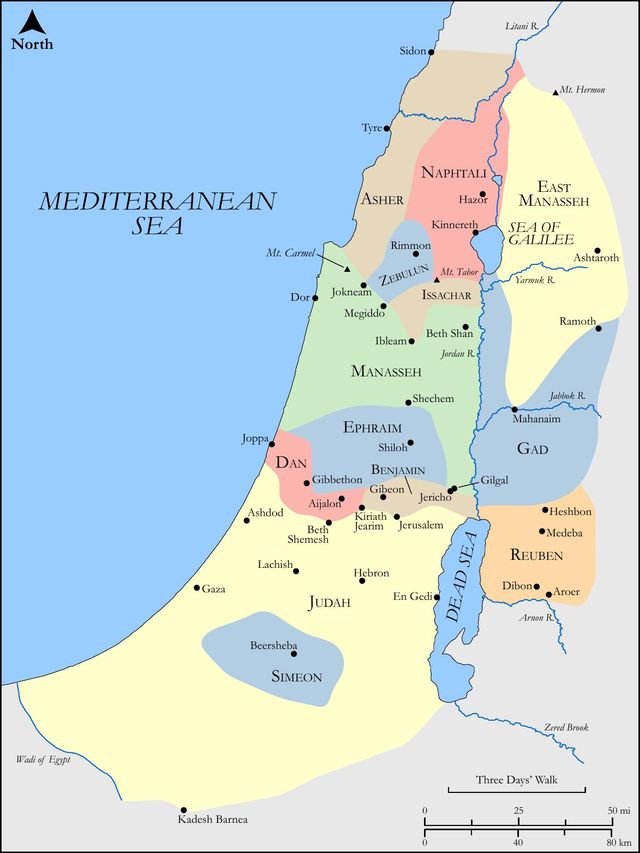
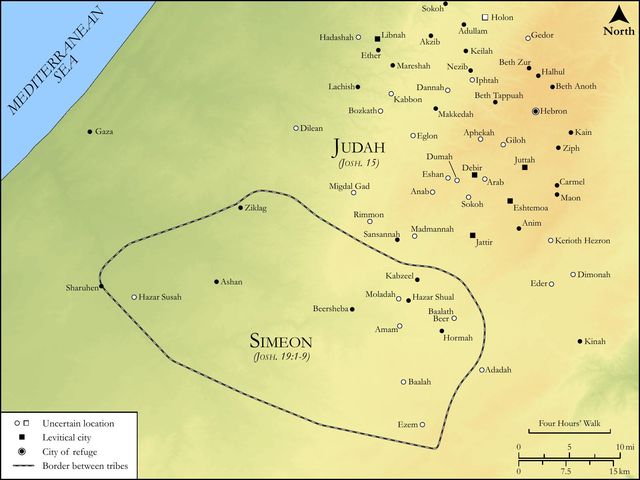
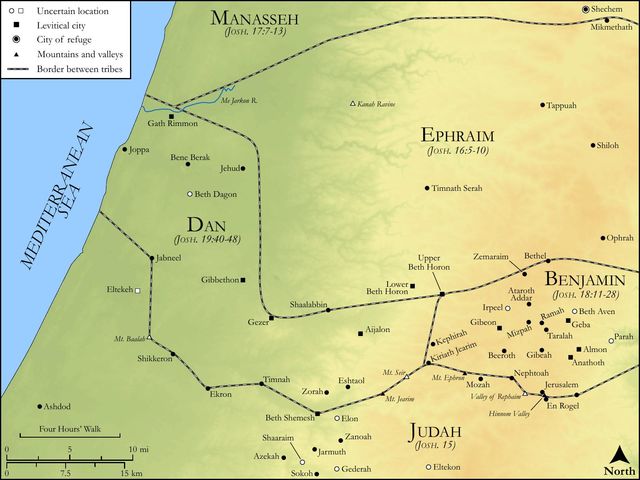
See on the biblical-era map
Study this verse
Public-domain commentary
Matthew Henry
From his Commentary on the Whole Bible. Henry comments on passages, not single verses — this entry covers Joshua 15:13–19. His four-level outline is real structure in the source text, so it is rendered as structure.
The historian seems pleased with every occasion to make mention of Caleb and to do him honour, because he had honoured God in following him fully. Observe,
I.The grant Joshua made him of the mountain of Hebron for his inheritance is here repeated (Jos 15:13), and it is said to be given him.
1.According to the commandment of the Lord to Joshua. Though Caleb, in his petition, had made out a very good title to it by promise, yet, because God had ordered Joshua to divide the land by lot, he would not in this one single instance, no, not to gratify his old friend Caleb, do otherwise, without orders from God, whose oracle, it is probable, he consulted upon this occasion. In every doubtful case it is very desirable to know the mind of God, and to see the way of our duty plain.
2.It is said to be a part among the children of Judah; though it was assigned him before the lot of that tribe came up, yet it proved, God so directing the lot, to be in the heart of that tribe, which was graciously ordered in kindness to him, that he might not be as one separated from his brethren and surrounded by those of other tribes.
II.Caleb having obtained this grant, we are told,
1.How he signalized his own valour in the conquest of Hebron (Jos 15:14): He drove thence the three sons of Anak, he and those that he engaged to assist him in this service. This is mentioned here to show that the confidence he had expressed of success in this affair, through the presence of God with him (Jos 14:12), did not deceive him, but the event answered his expectation. It is not said that he slew these giants, but he drove them thence, which intimates that they retired upon his approach and fled before him; the strength and stature of their bodies could not keep up the courage of their minds, but with the countenances of lions they had the hearts of trembling hares. Thus does God often cut off the spirit of princes (Psa 76:12), take away the heart of the chief of the people (Job 12:24), and so shame the confidence of the proud; and thus if we resist the devil, that roaring lion, though he fall not, yet he will flee.
2.How he encouraged the valour of those about him in the conquest of Debir, Jos 15:15, etc. It seems, though Joshua had once made himself master of Debir (Jos 10:39), yet the Canaanites had regained the possession in the absence of the army, so that the work had to be done a second time; and when Caleb had completed the reduction of Hebron, which was for himself and his own family, to show his zeal for the public good, as much as for his own private interest, he pushes on his conquest to Debir, and will not lay down his arms till he sees that city also effectually reduced, which lay but ten miles southward from Hebron, though he had not any particular concern in it, but the reducing of it would be to the general advantage of his tribe. Let us learn hence not to seek and mind our own things only, but to concern and engage ourselves for the welfare of the community we are members of; we are not born for ourselves, nor must we live to ourselves.
(1.)Notice is taken of the name of this city. It had been called Kirjath-sepher, the city of a book, and Kirjath-sannah (Jos 15:49), which some translate the city of learning (so the Septuagint Polis grammaton), whence some conjecture that it had been a university among the Canaanites, like Athens in Greece, in which their youth were educated; or perhaps the books of their chronicles or records, or the antiquities of the nation, were laid up there; and, it may be, this was it that made Caleb so desirous to see Israel master of this city, that they might get acquainted with the ancient learning of the Canaanites.
(2.)The proffer that Caleb made of his daughter, and a good portion with her, to any one that would undertake to reduce that city, and to command the forces that should be employed in that service, Jos 15:16. Thus Saul promised a daughter to him that would kill Goliath (Sa1 17:25), neither of them intending to force his daughter to marry such as she could not love, but both of them presuming upon their daughters' obedience, and submission to their fathers' will, though it might be contrary to their own humour or inclination. Caleb's family was not long honourable and wealthy, but religious; he that himself followed the Lord fully no doubt taught his children to do so, and therefore it could not but be a desirable match to any young gentleman. Caleb, in making the proposal, aims,
[1.]To do service to his country by the reducing of that important place; and,
[2.]To marry a daughter well, to a man of learning, that would have a particular affection for the city of books, and a man of war, that would be likely to serve his country, and do worthily in his generation. Could he but marry his child to a man of such a character, he would think her well bestowed, whether the share in the lot of his tribe were more or less.
(3.)The place was bravely taken by Othniel, a nephew of Caleb, whom probably Caleb had thoughts of when he made the proffer, Jos 15:17. This Othniel, who thus signalized himself when he was young, had long after, in his advanced years, the honour to be both a deliverer and a judge in Israel, the first single person that presided in their affairs after Joshua's death. It is good for those who are setting out in the world to begin betimes with that which is great and good, that, excelling in service when they are young, they may excel in honour when they grow old.
(4.)Hereupon (all parties being agreed) Othniel married his cousin-german Achsah, Caleb's daughter. It is probable that he had a kindness for her before, which put him upon this bold undertaking to obtain her. Love to his country, an ambition of honour, and a desire to find favour with the princes of his people, might not have engaged him in this great action, but his affection for Achsah did. This made it intolerable to him to think that any one should do more to win her favour than he would, and so inspired him with this generous fire. Thus is love strong as death, and jealousy cruel as the grave.
(5.)Because the historian is now upon the dividing of the land, he gives us an account of Achsah's portion, which was in land, as more valuable because enjoyed by virtue of the divine promise, though we may suppose the conquerors of Canaan, who had had the spoil of so many rich cities, were full of money too.
[1.]Some land she obtained by Caleb's free grant, which was allowed while she married within her own tribe and family, as Zelophehad's daughters did. He gave her a south land, Jos 15:19. Land indeed, but a south land, dry, and apt to be parched.
[2.]She obtained more upon her request; she would have had her husband to ask for a field, probably some particular field, or champaign ground, which belonged to Caleb's lot, and joined to that south land which he had settled upon his daughter at marriage. She thought her husband had the best interest in her father, who, no doubt, was extremely pleased with his late glorious achievement, but he thought it was more proper for her to ask, and she would be more likely to prevail; accordingly she did, submitting to her husband's judgment, though contrary to her own; and she managed the undertaking with great address. First, She took the opportunity when her father brought her home to the house of her husband, when the satisfaction of having disposed of his daughter so well would make him think nothing too much to do for her. Secondly, She lighted off her ass, in token of respect and reverence to her father, whom she would honour still, as much as before her marriage. She cried or sighed from off her ass, so the Septuagint and the vulgar Latin read it; she expressed some grief and concern, that she might give her father occasion to ask her what she wanted. Thirdly, She calls it a blessing, because it would add much to the comfort of her settlement; and she was sure that, since she married not only with her father's consent, but in obedience to his command, he would not deny her his blessing. Fourthly, She asks only for the water, without which the ground she had would be of little use either for tillage or pasture, but she means the field in which the springs of water were. The modesty and reasonableness of her quest gave it a great advantage. Earth without water would be like a tree without sap, or the body of an animal without blood; therefore, when God gathered the waters into one place, he wisely and graciously left some in every place, that the earth might be enriched for the service of man. See Psa 104:10, etc. Well, Achsah gained her point; her father gave her what she asked, and perhaps more, for he gave her the upper springs and the nether springs, two fields so called from the springs that were in them, as we commonly distinguish between the higher field and the lower field. Those who understand it but of one field, watered both with the rain of heaven and the springs that issued out of the bowels of the earth, give countenance to the allusion we commonly make to this, when we pray for spiritual and heavenly blessings which relate to our souls as blessings of the upper springs, and those which relate to the body and the life that now is as blessings of the nether springs.
From this story we learn, 1. That it is no breach of the tenth commandment moderately to desire those comforts and conveniences of this life which we see attainable in a fair and regular way. 2. That husbands and wives should mutually advise, and jointly agree, about that which is for the common good of their family; and much more should they concur in asking of their heavenly Father the best blessings, those of the upper springs. 3. That parents must never think that lost which is bestowed upon their children for their real advantage, but must be free in giving them portions as well as maintenance, especially when they are dutiful. Caleb had sons (Ch1 4:15), and yet gave thus liberally to his daughter. Those parents forget themselves and their relation who grudge their children what is convenient for them when they can conveniently part with it.
Historical interpretation
Historical reception
1 surviving comment on this verse from the historical church.
But now Caleb went up against that City of Letters and said, “I shall give Achsah my daughter for a wife to whoever demolishes the City of Letters and gains possession of it. And Othniel the son of Kenaz seized it.” Moreover, Othniel, who received the City of Letters, is interpreted “the reply of God.” But “the reply of God” can be said “he to whom God replies,” that is, he to whom God reveals secrets and discloses hidden things. That one, therefore, is the younger brother of Caleb, the one who is able to take the City of Letters of the old covenant, and to demolish the “killing letter.”
Continue studying Joshua 15:16 across the web’s major study libraries — every link below opens this exact verse, chapter, or book on the destination site.
Read & Compare
 BibleGatewayThis verse in more than 200 translations and 70 languages.
 Bible.comThe YouVersion reader — hundreds of translations, reading plans, and highlights.
 ESV.orgCrossway's official English Standard Version reader.
 NET BibleThe NET translation with 60,000+ translators' notes on every rendering decision.
 STEP BibleTyndale House's free study tool — original text, vocabulary, and scholarly resources.
 BibliaLogos Bible Software's free web reader.
 USCCBThe New American Bible (Revised Edition) with the U.S. bishops' study notes.
Commentaries
 BibleHub CommentariesDozens of classic commentaries on this verse, gathered on one page.
 StudyLightMore than 100 commentary sets — the largest collection on the web.
 BibleRefPlain-English commentary on what this verse means, verse by verse.
 Enduring WordDavid Guzik's free commentary on this chapter, widely used by Bible teachers.
 Bible Study ToolsVerse commentary alongside Greek and Hebrew study aids.
Original Language & Research
- BibleHub InterlinearThe verse word by word — original language, transliteration, and English.
- BibleHub LexiconEvery word's original-language definition and Strong's entry.
 Blue Letter BibleDeep-study tools — Strong's numbers, concordance, and word studies.
 SefariaThe Hebrew text with Rashi and centuries of Jewish commentary.
Sermons, Hymns & Audio


TrulyRandomVerse is not affiliated with these sites and doesn’t control their content. They’re linked because they’re genuinely useful.
Summary
Joshua 15:16 records Caleb's strategic and faith-filled declaration during the allocation of the Promised Land to the tribe of Judah. In a bold move to expedite the conquest of remaining Canaanite strongholds, Caleb offers his daughter, Achsah, in marriage to any man who successfully captures Kirjathsepher, a formidable city. This pronouncement serves as a powerful incentive, blending ancient Near Eastern custom with a profound commitment to fulfilling God's covenant promises through active, courageous engagement.
Context
ShowHideLiterary Context
This verse is situated within the detailed account of the land distribution among the Israelite tribes, specifically focusing on the extensive inheritance granted to Judah in Joshua 15. Following the general division of the land by lot (chapters 13-14), chapter 15 meticulously outlines Judah's boundaries and lists its assigned cities. Caleb's personal inheritance, promised to him by Moses and confirmed by Joshua due to his unwavering faithfulness (as recounted in Joshua 14:6-15), serves as a backdrop. Verse 16 is not a mere aside but an active step in Judah's ongoing process of dispossessing the Canaanite inhabitants and fully securing their divinely appointed territory. It directly precedes the account of Othniel's successful conquest of Kirjathsepher and his subsequent marriage to Achsah, detailed immediately in Joshua 15:17 and further corroborated in Judges 1:13.
Historical & Cultural Context
The period following the initial victories of the conquest was characterized by the challenging and often protracted process of settling the land and driving out the remaining Canaanite city-states. Despite God's promises and miraculous interventions, the Israelites were required to actively engage in military campaigns against well-fortified strongholds. Caleb, at an advanced age (85 years old, as mentioned in Joshua 14:10), exemplifies remarkable vigor, faith, and leadership in this ongoing effort. Culturally, the practice of offering a daughter in marriage as a reward for valor was a recognized and highly esteemed custom in the ancient Near East, signifying not only a significant personal honor but also the establishment of a powerful familial and political alliance. This custom is paralleled in other biblical narratives, such as King Saul's offer of his daughter to David for defeating Goliath (1 Samuel 17:25). Kirjathsepher, also known as Debir, was a strategically important Canaanite city, possibly a center of learning or a significant cultic site, making its capture crucial for Judah's complete control and spiritual integrity.
Key Themes
ShowHideJoshua 15:16 powerfully illuminates several overarching themes central to the book of Joshua and the broader Old Testament narrative. Firstly, it underscores the theme of Active Faith and Obedience, demonstrating that God's promises, while divinely assured, necessitate human initiative, courage, and diligent effort for their full realization. Caleb's challenge embodies the spirit of "taking" the land, not merely passively inheriting it. Secondly, it highlights the Importance of Dispossessing the Inhabitants, a divine command reiterated throughout Deuteronomy and Joshua (Deuteronomy 7:1-5), crucial for maintaining Israel's distinct covenant identity and preventing the pervasive influence of idolatry and Canaanite practices. Finally, the verse reinforces the theme of Divine Reward and Human Incentive, illustrating how God's blessings often unfold through human effort, and how wise leadership can effectively motivate people to achieve difficult, God-ordained tasks, ensuring the complete fulfillment of the divine mandate for the land.
Exposition and Analysis
ShowHideKey Word Analysis
ShowHidePossibly related to "dog" or from a root meaning "forcible." Caleb is presented as a man of unwavering faith and strength, even in old age. His name, potentially signifying "whole-hearted" or "faithful," perfectly reflects his character as one who fully followed the Lord, distinguishing him among his generation. His initiative here is consistent with his lifelong commitment to God's promises.
A primitive root meaning "to strike (lightly or severely, literally or figuratively)." In this military context, it denotes a decisive, forceful blow intended to defeat, kill, or conquer. The use of this verb emphasizes the violent and necessary nature of the conquest required to dispossess the inhabitants of Kirjathsepher, implying a complete and overwhelming victory rather than a mere skirmish.
A primitive root meaning "to catch (in a net, trap or pit); generally, to capture or occupy." This word signifies the successful capture and subsequent occupation of the city. It goes beyond merely striking or defeating, implying the complete seizure and control of Kirjathsepher, making it part of Israel's inheritance.
Feminine of עֶכֶס (anklet); meaning "anklet" or "ornament." Achsah is Caleb's daughter, offered as the prize for valor. While her name might suggest beauty or adornment, her subsequent actions in Joshua 15:18-19 reveal her own agency, wisdom, and resourcefulness, securing additional blessings (springs of water) for her inheritance and that of her husband. Her role here is significant not merely as property, but as a prestigious connection to Caleb's powerful lineage.
Verse Breakdown
ShowHide"And Caleb said"
This opening phrase immediately establishes Caleb as the authoritative speaker, underscoring his leadership and initiative. As one of the two faithful spies from the wilderness generation and a respected elder, his pronouncement carries significant weight and serves as a formal challenge to the men of Judah.
"He that smiteth Kirjathsepher, and taketh it"
This clause defines the specific military objective and the condition for receiving the promised reward. "Smiteth" implies a decisive, forceful conquest, while "taketh it" signifies the complete capture and occupation of the formidable Canaanite stronghold of Kirjathsepher. This highlights the remaining work of the conquest and the need for exceptional courage and strategic prowess.
"to him will I give Achsah my daughter to wife"
This is the promised incentive, a highly esteemed reward in ancient Israelite and Near Eastern culture. Offering one's daughter in marriage to a valiant warrior was a sign of great honor, establishing a powerful family alliance and elevating the social status of the recipient. It underscores Caleb's personal commitment to seeing the land fully possessed and his willingness to make a significant personal sacrifice to achieve this vital objective.
Literary Devices
ShowHideJoshua 15:16 effectively employs several literary devices to convey its message and forward the narrative. Motivation is central, as Caleb's offer of his daughter serves as a powerful incentive for military action, tapping into deep-seated cultural values of honor, lineage, and reward for valor. This is a form of Indirect Command, where a desired action is prompted by a promised reward rather than a direct order, allowing for voluntary courage and demonstrating a leader's wisdom in leveraging cultural norms. The verse also utilizes Foreshadowing, setting the stage for Othniel's heroic act of conquest in the very next verse (Joshua 15:17), which directly fulfills Caleb's challenge. Furthermore, the naming of Kirjathsepher and its subsequent conquest can be seen as Symbolism, representing the remaining pockets of resistance and the formidable spiritual and physical obstacles that required Israel's persistent effort and unwavering faith to overcome, even after major victories.
Theological and Thematic Connections
ShowHideCaleb's challenge in Joshua 15:16 is a profound demonstration of active faith that transcends mere belief, translating into courageous and strategic action. It powerfully illustrates the principle that while God gives promises and provides the means for their fulfillment, their full realization often requires human initiative, perseverance, and diligent engagement. This act of leadership by an elder statesman models the ongoing responsibility of God's people to press into and secure the full inheritance God has provided, even when facing formidable obstacles and requiring personal sacrifice. It also highlights the divine expectation for Israel to fully dispossess the Canaanites, not only for territorial control but also for spiritual purity, preventing the infiltration of idolatry and wicked practices that would compromise their covenant relationship with God.
Reflection and Application
ShowHideCaleb's bold declaration in Joshua 15:16 serves as a powerful call to active faith and courageous initiative in our own lives. We, too, have "promised lands"—spiritual blessings, callings, areas of personal growth, or spheres of influence—that God has allotted to us, yet often require our diligent effort to fully possess. Just as Kirjathsepher represented a stronghold that needed to be conquered for Judah to secure its inheritance, we face "strongholds" in our lives: entrenched habits, paralyzing fears, spiritual apathy, or societal injustices that hinder our full flourishing in Christ and the advancement of God's kingdom. Caleb's example challenges us not to passively wait for circumstances to change but to actively identify these obstacles and, by faith, commit to overcoming them. His willingness to offer a significant reward also reminds us of the value of motivating and empowering others to join in God's work, recognizing and celebrating their courage and contributions. This passage encourages us to ask: What "Kirjathsepher" is God calling you to "smite" and "take" in your personal life, family, church, or community today, and what profound spiritual "reward"—deeper intimacy with God, transformed relationships, or greater effectiveness in ministry—might be waiting on the other side of your obedience and courageous engagement?
Questions for Reflection
ShowHideFAQ
ShowHideWhy did Caleb offer his daughter as a prize instead of just commanding someone to take the city?
ShowHideCaleb's decision to offer Achsah as a prize, rather than simply issuing a command, reflects several strategic and cultural considerations deeply rooted in the ancient Near East. Firstly, it was a highly esteemed and culturally recognized form of incentive, signifying great honor, a strong alliance through marriage, and the elevation of social status. This method was often more effective than a mere command for particularly difficult and dangerous tasks, as it appealed to personal ambition, valor, and the desire for prestigious familial connection. Secondly, it allowed for a voluntary demonstration of exceptional courage and faith, serving as a means to identify the most capable and committed warrior. This process ultimately revealed Othniel, who would later become Israel's first judge (Judges 3:9-11). Finally, it showcased Caleb's wise and discerning leadership style, which combined his inherent authority with a shrewd understanding of cultural norms to achieve a vital objective for the tribe of Judah's complete inheritance, as meticulously outlined in Joshua 15.
Christ-Centered Fulfillment
ShowHideJoshua 15:16, with Caleb's challenge to conquer Kirjathsepher, finds its ultimate Christ-centered fulfillment in the person and redemptive work of Jesus Christ. Just as Caleb offered a significant reward for the conquest of a physical stronghold that hindered Israel's full inheritance, Christ himself is the ultimate "conqueror" who, through His sacrificial death and glorious resurrection, decisively "smits" and "takes" the spiritual strongholds of sin, death, and the devil. The inheritance promised to Israel in Canaan foreshadows the infinitely greater, eternal inheritance believers receive in Christ, an inheritance secured not through human military might but through Christ's perfect obedience and decisive spiritual victory. Jesus, the true and greater Caleb, did not merely offer a reward for valor; He is the supreme reward, and He Himself paid the ultimate price, conquering our spiritual enemies and securing our freedom. His triumph on the cross, as described in passages like Colossians 2:15, disarmed the principalities and powers, triumphing over them publicly. We, as His followers, are then called to "take" our spiritual inheritance, not by physical might, but by living out the implications of His victory, empowered by the Holy Spirit to overcome sin and live righteously, as we are "more than conquerors through Him who loved us" (Romans 8:37) and blessed with "every spiritual blessing in the heavenly places in Christ" (Ephesians 1:3). The "daughter" offered as a prize can be seen as a type of the Church, the Bride of Christ (Ephesians 5:25-27), won by the ultimate act of valor and sacrifice, and now eternally united with the victorious King.