


Judges 1:12
Bible text: King James Version (1769 Blayney text) · Public domain
Bible text: Berean Standard Bible · Public domain
Bible text: American Standard Version (1901) · Public domain
Bible text: World English Bible, Messianic edition · Public domain
Bible text: Geneva Bible (1599) · Public domain
Bible text: Young's Literal Translation · Public domain
- וַיֹּאמֶרvai·Yo·merand he saidH559Conj-w ¦ V-Qal-ConsecImperf-3msVerb Qal Consecutive Imperfect 3rd Singular Masculineוַandיֹּאמֶרhe said
- כָּלֵבka·LevCalebH3612N-proper-mNoun Proper Masculine
- אֲשֶׁר'a·Sher[the one] whoH834RelParticle Relative
- יַכֶּהya·Kehhe will strikeH5221V-Hiphil-Imperf-3msVerb Hiphil Imperfect 3rd Singular Masculine
- אֶת'et<obj.>H853DirObjMParticle Object Indicator
- קִרְיַתkir·yatKiriathH7158N-properNoun Proper Location
- סֵפֶרSe·ferSepherH7158N-properNoun Proper Location
- וּלְכָדָהּu·le·kha·Dahand he will capture itH3920Conj-w ¦ V-Qal-ConsecPerf-3ms ¦ 3fsVerb Qal Consecutive Perfect 3rd Singular Masculineוּandלְכָדָhe will captureהּit
- וְנָתַתִּיve·na·Ta·tiand I will giveH5414Conj-w ¦ V-Qal-ConsecPerf-1csVerb Qal Consecutive Perfect 1st Singular common genderוְandנָתַתִּיI will give
- לוֹloto <the> himPrep-l ¦ 3msSuffix Personal 3rd Singular Masculineלto <the>וֹhim
- אֶת'et<obj.>H853DirObjMParticle Object Indicator
- עַכְסָה'akh·SahAchsahH5915N-proper-fNoun Proper Feminine
- בִתִּיvi·Timy daughterH1323N-fsc ¦ 1csNoun Singular Feminine Constructבִתִּdaughterיmy
- לְאִשָּׁהle·'i·Shahto a wifeH802Prep-l ¦ N-fsNoun Singular Feminine Absoluteלְtoאִשָּׁהa wife
English is a literal word-by-word gloss of the Hebrew, not the KJV's wording. Why?
This is the original text the KJV's translators worked from — each Hebrew word with its own literal English meaning in this verse, prepared by scholars at Tyndale House, Cambridge. The KJV translates whole sentences, not word by word, so its wording differs: one Hebrew word can become several English words, and the KJV may choose “the LORD” where the gloss reads “Yahweh”. Both are faithful — they answer different questions. For the KJV's own rendering, switch to the KJV text.
Details
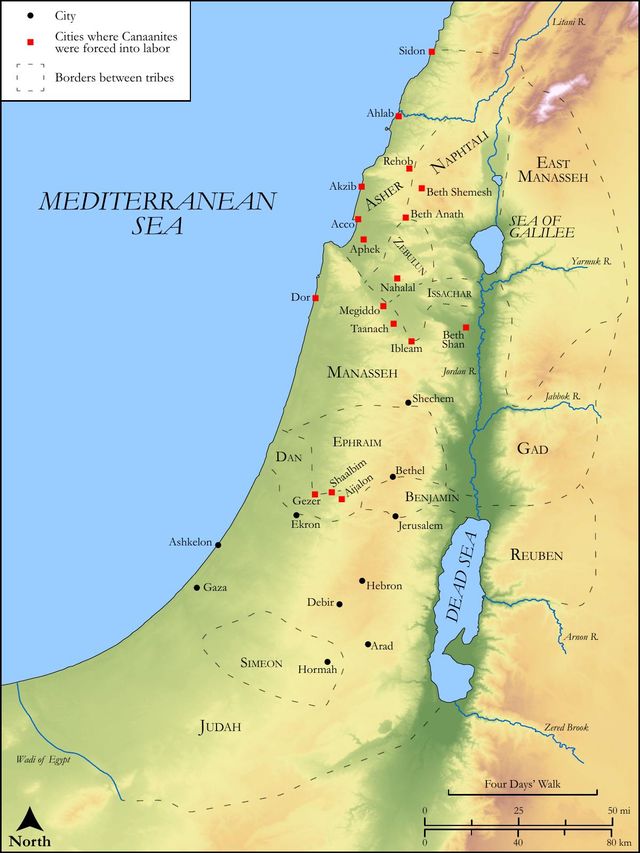
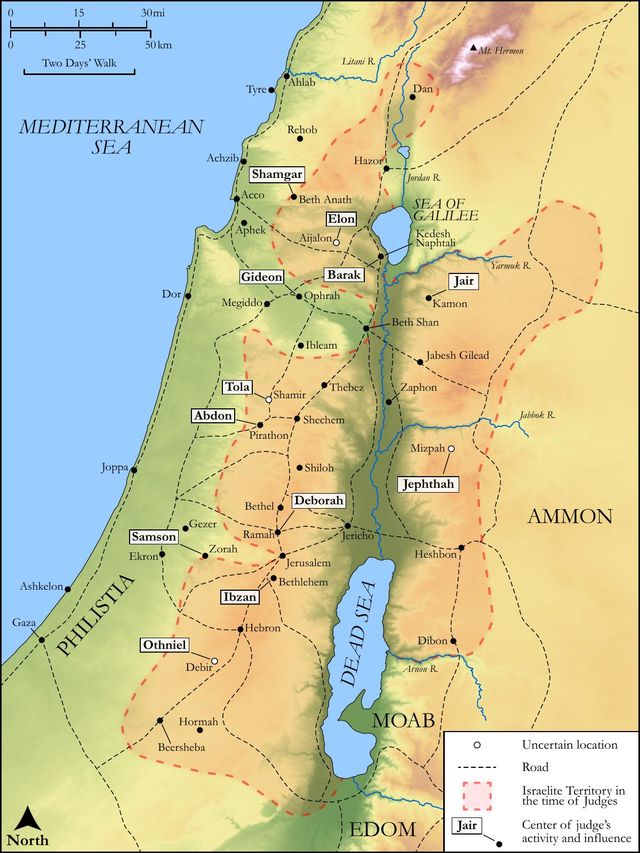
See on the biblical-era maps
Study this verse
Public-domain commentary
Matthew Henry
From his Commentary on the Whole Bible. Henry comments on passages, not single verses — this entry covers Judges 1:9–20.
We have here a further account of that glorious and successful campaign which Judah and Simeon made. 1. The lot of Judah was pretty well cleared of the Canaanites, yet not thoroughly. Those that dwelt in the mountain (the mountains that were round about Jerusalem) were driven out (Jdg 1:9, Jdg 1:19), but those in the valley kept their ground against them, having chariots of iron, such as we read of, Jos 17:16. Here the men of Judah failed, and thereby spoiled the influence which otherwise their example hitherto might have had on the rest of the tribes, who followed them in this instance of their cowardice, rather than in all the other instances of their courage. They had iron chariots, and therefore it was thought not safe to attack them: but had not Israel God on their side, whose chariots are thousands of angels (Psa 68:17), before whom these iron chariots would be but as stubble to the fire? Had not God expressly promised by the oracle (Jdg 1:2) to give them success against the Canaanites in this very expedition, without excepting those that had iron chariots? Yet they suffered their fears to prevail against their faith, they could not trust God under any disadvantages, and therefore durst not face the iron chariots, but meanly withdrew their forces, when with one bold stroke they might have completed their victories; and it proved of pernicious consequence. They did run well, what hindered them? Gal 5:7. 2. Caleb was put in possession of Hebron, which, though given him by Joshua ten or twelve years before (as Dr. Lightfoot computes), yet being employed in public service, for the settling of the tribes, which he preferred before his own private interests, it seems he did not till now make himself master of; so well content was that good man to serve others, while he left himself to be served last; few are like-minded, for all seek their own, Phi 2:20, Phi 2:21. Yet now the men of Judah all came in to his assistance for the reducing of Hebron (Jdg 1:10), slew the sons of Anak, and put him in possession of it, Jdg 1:20. They gave Hebron unto Caleb. And now Caleb, that he might return the kindness of his countrymen, is impatient to see Debir reduced and put into the hands of the men of Judah, to expedite which he proffers his daughter to the person that will undertake to command in the siege of that important place, Jdg 1:11, Jdg 1:12. Othniel bravely undertakes it, and wins the town and the lady (Jdg 1:13), and by his wife's interest and management with her father gains a very good inheritance for himself and his family, Jdg 1:14, Jdg 1:15. We had this passage before, Jos 15:16-19, where it was largely explained and improved. 3. Simeon got ground of the Canaanites in his border, Jdg 1:17, Jdg 1:18. In the eastern part of Simeon's lot, they destroyed the Canaanites in Zephath, and called it Hormah - destruction, adding this to some other devoted cities not far off, which they had some time ago, with good reason, called by that name, Num 21:2, Num 21:3. And this perhaps was the complete performance of the vow they them made that they would utterly destroy these cities of the Canaanites in the south. In the western part they took Gaza, Askelon, and Ekron, cities of the Philistines; they gained present possession of the cities, but, not destroying the inhabitants, the Philistines in process of time recovered the cities, and proved inveterate enemies to the Israel of God, and no better could come of doing their work by the halves. 4. The Kenites gained a settlement in the tribe of Judah, choosing it there rather than in any other tribe, because it was the strongest, and there they hoped to be safe and quiet, Jdg 1:16. These were the posterity of Jethro, who either went with Israel when Moses invited them (Num 10:29) or met them about the same place when they came up from their wanderings in the wilderness thirty-eight years after, and went with them then to Canaan, Moses having promised them that they should fare as Israel fared, Num 10:32. They had at first seated themselves in the city of palm-trees, that is, Jericho, a city which never was to be rebuilt, and therefore the fitter for those who dwelt in tents, and did not mind building. But afterwards they removed into the wilderness of Judah, either out of their affection to that place, because solitary and retired, or out of their affection to that tribe, which perhaps had been in a particular manner kind to them. Yet we find the tent of Jael, who was of that family, far north, in the lot of Naphtali, when Sisera took shelter there, Jdg 4:17. This respect Israel showed them, to let them fix where they pleased, being a quiet people, who, wherever they were, were content with a little. Those that molested none were molested by none. Blessed are the meek, for thus they shall inherit the earth.
Continue studying Judges 1:12 across the web’s major study libraries — every link below opens this exact verse, chapter, or book on the destination site.
Read & Compare
 BibleGatewayThis verse in more than 200 translations and 70 languages.
 Bible.comThe YouVersion reader — hundreds of translations, reading plans, and highlights.
 ESV.orgCrossway's official English Standard Version reader.
 NET BibleThe NET translation with 60,000+ translators' notes on every rendering decision.
 STEP BibleTyndale House's free study tool — original text, vocabulary, and scholarly resources.
 BibliaLogos Bible Software's free web reader.
 USCCBThe New American Bible (Revised Edition) with the U.S. bishops' study notes.
Commentaries
 BibleHub CommentariesDozens of classic commentaries on this verse, gathered on one page.
 StudyLightMore than 100 commentary sets — the largest collection on the web.
 BibleRefPlain-English commentary on what this verse means, verse by verse.
 Enduring WordDavid Guzik's free commentary on this chapter, widely used by Bible teachers.
 Bible Study ToolsVerse commentary alongside Greek and Hebrew study aids.
Original Language & Research
- BibleHub InterlinearThe verse word by word — original language, transliteration, and English.
- BibleHub LexiconEvery word's original-language definition and Strong's entry.
 Blue Letter BibleDeep-study tools — Strong's numbers, concordance, and word studies.
 SefariaThe Hebrew text with Rashi and centuries of Jewish commentary.
Sermons, Hymns & Audio


TrulyRandomVerse is not affiliated with these sites and doesn’t control their content. They’re linked because they’re genuinely useful.
Summary
Judges 1:12 presents Caleb's strategic and bold declaration, offering his daughter Achsah in marriage to the man who successfully conquers the formidable Canaanite city of Kirjathsepher. This challenge, issued in the immediate aftermath of Joshua's death, underscores the critical need for continued tribal initiative in completing the conquest of the Promised Land. It powerfully illustrates Caleb's unwavering zeal for the divine mandate, his commitment to rewarding valor, and the essential role of human courage and action in possessing God's promised inheritance.
Context
ShowHideLiterary Context
The Book of Judges opens in a pivotal transitional period for Israel, immediately following the death of Joshua, the unified leader of the conquest. Unlike the centralized campaigns under Joshua, Judges 1 portrays a decentralized effort, with individual tribes tasked with securing their allotted territories. Verses 1-8 describe Judah's initial, albeit incomplete, successes. Judges 1:9-15 then focuses specifically on the efforts of Judah and Simeon in their respective regions of the southern hill country and the Negeb. Caleb's challenge in verse 12 is strategically placed within this narrative of territorial acquisition, directly preceding the account of Othniel's successful capture of Kirjathsepher (Judges 1:13) and Achsah's subsequent request for additional land and water (Judges 1:14-15). This sequence not only highlights Caleb's enduring character and leadership but also serves to introduce Othniel, who will later emerge as the first divinely appointed judge of Israel, thereby subtly setting the stage for the cyclical pattern of apostasy, oppression, and deliverance that defines the rest of the book.
Historical & Cultural Context
The era immediately following Joshua's death was characterized by a fragmented Israelite presence in Canaan. While major strongholds had been subdued, numerous fortified Canaanite cities and pockets of indigenous resistance remained, necessitating ongoing military engagement by the individual tribes. The Israelites were transitioning from a unified, mobile force to settled tribal entities, each responsible for securing and inhabiting its designated inheritance. Culturally, the practice of a father offering his daughter in marriage as a reward for a heroic feat was a recognized and highly esteemed custom in Israel, as in the days of Saul, when the king's daughter was the promised reward for slaying Goliath. Such an offer not only conferred immense honor upon the recipient but also solidified a powerful family alliance, often accompanied by a share in the father's prestige, land, or other forms of inheritance. Kirjathsepher, meaning "City of the Book" or "City of the Scribe," suggests it was a significant cultural, administrative, or perhaps even religious center for the Canaanites, potentially housing important records or sacred texts. Its later name, Debir, meaning "sanctuary" or "inner room," further underscores its strategic and symbolic importance as a key target.
Key Themes
ShowHideJudges 1:12 significantly contributes to several overarching themes prevalent throughout the Book of Judges and the broader narrative of Israel's history. Firstly, it powerfully illustrates the theme of the Incomplete Conquest of the land, demonstrating that despite God's faithful promises and Joshua's initial victories, the full possession of Canaan required sustained effort and engagement from the individual tribes. Secondly, it highlights the crucial theme of Individual and Tribal Initiative, as the centralized leadership of Joshua gives way to a period where tribes and individuals must take personal responsibility for fulfilling the divine mandate. Caleb's proactive challenge serves as a prime example of this necessary initiative. Thirdly, the verse reinforces Caleb's enduring Faithfulness and Valor, consistent with his character first seen in his unwavering commitment to God's promises in Numbers 14:24 and his bold request for the mountainous region of Hebron in Joshua 14:12. His willingness to offer such a significant reward for a difficult task underscores his commitment to God's will and the completion of the conquest. Finally, this passage illuminates the crucial interplay between Divine Sovereignty and Human Responsibility, where God's promise of the land (e.g., Deuteronomy 1:36) required courageous human action and obedience for its ultimate realization.
Exposition and Analysis
ShowHideKey Word Analysis
ShowHideThis place name, also rendered as "Kirjath-sannah," literally translates to "City of the Book" or "City of the Scribe." This designation strongly suggests that it functioned as a significant cultural, administrative, or even scholarly center for the Canaanites, possibly serving as a repository for important records, legal documents, or religious texts. Its strategic importance is further emphasized by its later designation as Debir, meaning "sanctuary" or "inner room," which could refer to its fortified nature, a sacred site within its walls, or its position as a gateway to the surrounding hill country. The dual naming reflects both its original significance and the transition of control to the Israelites.
The Hebrew verb "smite" (נָכָה, nâkâh') carries the connotation of a decisive, forceful blow or strike, often leading to defeat, destruction, or even death. In a military context, as used here, it denotes a complete and overwhelming conquest, implying far more than a mere skirmish or a prolonged siege. The one who "smites" Kirjathsepher is expected to overcome its defenses and its inhabitants with a devastating impact, securing total and unequivocal victory, thereby fulfilling the challenging condition set by Caleb.
The Hebrew verb "taketh" (לָכַד, lâkad') means "to catch," "to seize," "to capture," or "to occupy." When paired with "smite," it emphasizes the comprehensive outcome of the military action. It signifies not merely the defeat of the enemy but the complete possession and occupation of the city. The one who "takes" Kirjathsepher will establish Israelite control, signifying the successful completion of the challenge and the full acquisition of the fortified stronghold.
Verse Breakdown
ShowHide"And Caleb said"
This opening phrase immediately establishes Caleb's prominent role, agency, and authority within the narrative. As a respected elder, a man of unwavering faith from the Exodus generation, and a key leader in the tribe of Judah, his words carry significant weight and are intended to inspire decisive action. His declaration is a public challenge, demonstrating his leadership, strategic thinking, and profound commitment to the ongoing conquest of the Promised Land.
"He that smiteth Kirjathsepher, and taketh it"
This clause precisely defines the specific, formidable military task required to earn the promised reward. "Smiteth" implies a decisive and overwhelming military victory, overcoming all resistance and breaking the city's defenses, while "taketh it" signifies the complete occupation and secure possession of the city. Kirjathsepher, being a fortified Canaanite stronghold, represented a significant and dangerous obstacle, requiring exceptional courage, strategic skill, and, ultimately, divine favor to conquer successfully.
"to him will I give Achsah my daughter to wife"
This is the stated, highly desirable reward for the successful conqueror. In ancient Israelite society, offering a daughter in marriage, particularly by a prominent and wealthy figure like Caleb, was a prize of immense value. It conferred great honor upon the recipient, established a powerful familial and tribal alliance with Caleb's prestigious lineage, and often included a share in his inheritance or status. This significant incentive underscores the high value placed on valor, initiative, and the successful fulfillment of God's mandate to possess the land.
Literary Devices
ShowHideJudges 1:12 primarily employs an Incentive/Reward System, a common narrative device where a challenging task is presented with a clear and highly desirable prize. This structure serves to powerfully motivate action and highlight the immense value placed on courage, military prowess, and initiative in the context of the ongoing conquest. The verse also functions as a powerful form of Characterization, further solidifying Caleb's already established reputation as a man of unwavering faith, decisive action, and strategic leadership, consistent with his portrayal throughout the books of Numbers and Joshua. Furthermore, the challenge itself serves as Foreshadowing, as the immediate subsequent verses reveal that Othniel, Caleb's kinsman, successfully meets this formidable challenge, thereby setting him up as a figure of valor and, crucially, as the first divinely appointed judge of Israel. The account in Judges 1:12-15 also exhibits clear Parallelism with the nearly identical narrative found in Joshua 15:16-19, underscoring the significance of this event in both historical and theological contexts and perhaps emphasizing its foundational importance for the subsequent period of the judges.
Theological and Thematic Connections
ShowHideJudges 1:12 powerfully illustrates the dynamic interplay between divine promise and human responsibility in the outworking of God's redemptive purposes. While God had faithfully promised the land of Canaan to Israel as an inheritance, its full possession required active, courageous, and sustained human effort. Caleb's challenge is a profound testament to the principle that God often calls His people to step out in faith and initiative, even when faced with formidable obstacles that seem insurmountable. His offer of Achsah as a reward transforms a purely military objective into a personal quest for honor, alliance, and familial continuity, demonstrating how human customs and motivations can align with and serve God's overarching plan for His people to inherit their promised blessings. This verse serves as a timeless reminder that spiritual inheritance, much like the physical land of Canaan, often demands active engagement, perseverance, and a willingness to confront challenges with courageous faith.
Reflection and Application
ShowHideCaleb's challenge in Judges 1:12 offers a profound and actionable spiritual lesson for believers today. Just as ancient Israel was called to actively "take" the land God had promised, we are called to actively pursue and possess the spiritual inheritance, callings, and blessings God has placed before us in Christ. This verse encourages us to move beyond passive waiting or mere intellectual assent and to embrace a spirit of initiative, courage, and unwavering faith in confronting the "Kirjathsephers" in our own lives. These modern "cities" might represent personal strongholds of sin, daunting ministries, seemingly insurmountable obstacles to spiritual growth, or areas where God is calling us to exercise greater faith. God consistently honors and empowers those who, like Caleb, are willing to step out in boldness and apply themselves diligently to His purposes. Our "promised land" in the New Covenant is not a physical territory, but the fullness of life in Christ, the expansion of His Kingdom through our witness, and the overcoming of spiritual opposition through the power of the Holy Spirit. This requires us to be proactive, to "smite" the challenges with the spiritual weapons God provides, and to "take" every thought captive to the obedience of Christ.
Questions for Reflection
ShowHideFAQ
ShowHideWhy was Kirjathsepher also called Debir?
ShowHideIt was common for ancient cities to have multiple names, or for their names to change over time, especially after a significant event like a change in control or a new cultural association. "Kirjathsepher" (קִרְיַת סֵפֶר, Qiryath Çannâh') literally means "City of the Book" or "City of the Scribe," suggesting it might have been a cultural, administrative, or scholarly center for the Canaanites, potentially housing important records or religious texts. "Debir" (דְּבִיר, Dĕbîr), meaning "sanctuary," "inner room," or "holy of holies," could refer to its highly fortified nature, a significant religious site within the city's walls, or its strategic importance as a gateway to the surrounding hill country. The name "Debir" is used consistently after its capture by Othniel (e.g., Joshua 15:15), suggesting it might have been the Hebrew name given to it by the Israelites, reflecting its new significance to them as part of their inheritance. Both names underscore the city's importance as a strategic and symbolic target.
What was the significance of offering a daughter as a reward for conquest?
ShowHideIn Israel, offering a daughter in marriage, particularly by a prominent and wealthy figure like Caleb, was a highly significant and valuable reward, far exceeding a mere personal transaction. It conferred immense honor upon the recipient, elevating his social standing and establishing a powerful familial and tribal alliance with Caleb's prestigious clan. This alliance often included a share in the family's inheritance, land, or status, ensuring future prosperity and security. This practice was a strategic way to secure a brave, capable, and loyal son-in-law who would contribute significantly to the family's strength, lineage, and continued prosperity. It powerfully reflected the high value placed on military prowess, courage, and leadership in a society where land possession, security, and the perpetuation of the family line were paramount. Achsah's subsequent actions in Judges 1:14-15 further highlight the importance of land and vital resources within these familial and societal arrangements.
Christ-Centered Fulfillment
ShowHideCaleb's challenge in Judges 1:12, though rooted in a literal military conquest, powerfully foreshadows the greater spiritual conquest achieved by Jesus Christ and the ongoing mission of His Church. Just as Caleb offered a profound reward for the "smiting" and "taking" of a formidable city, Christ, the ultimate divine warrior, has decisively "smitten" the powers of sin, death, and the devil through His crucifixion and glorious resurrection. Colossians 2:15 declares that He disarmed the spiritual rulers and authorities, triumphing over them by the cross. He has "taken" captivity captive, leading His people into a new and eternal spiritual inheritance. The "land" we are called to possess in the New Covenant is not a physical territory but the spiritual reality of God's Kingdom, which Jesus proclaimed is at hand and which Matthew 11:12 describes as being "taken by force" or advanced with spiritual intensity. For those who, by faith, align themselves with Christ's decisive victory and actively participate in the spiritual battle (as described in Ephesians 6:10-18), there is a profound and eternal reward: not a human daughter, but an indissoluble union with Christ Himself. The Church is presented throughout the New Testament as the Bride of Christ, and the ultimate fulfillment of this imagery is revealed in the "marriage supper of the Lamb" (Revelation 19:7-9), where believers are eternally united with their victorious King, inheriting all the spiritual blessings and eternal life secured by His ultimate conquest.