


Joshua 15:15
Bible text: King James Version (1769 Blayney text) · Public domain
Bible text: King James Version with Strong's numbers · Public domain
Bible text: Berean Standard Bible · Public domain
Bible text: American Standard Version (1901) · Public domain
Bible text: World English Bible, Messianic edition · Public domain
Bible text: Geneva Bible (1599) · Public domain
Bible text: Young's Literal Translation · Public domain
- וַיַּעַלvai·Ya·'aland he went upH5927Conj-w ¦ V-Qal-ConsecImperf-3msVerb Qal Consecutive Imperfect 3rd Singular Masculineוַandיַּעַלhe went up
- מִשָּׁםmi·Shamfrom thereH8033Prep-m ¦ AdvAdverbמִfromשָּׁםthere
- אֶל'elagainstH413PrepPreposition
- יֹשְׁבֵיyo·she·Vei[the] inhabitants ofH3427V-Qal-Prtcpl-mpVerb Qal Participle Plural Masculine Construct
- דְּבִרde·VirDebirH1688N-properNoun Proper Location
- וְשֵׁםve·shemand [the] name ofH8034Conj-w ¦ N-mscNoun Singular Masculine Constructוְandשֵׁם[the] name of
- דְּבִרde·VirDebirH1688N-properNoun Proper Location
- לְפָנִיםle·fa·Nim<to> beforeH6440Prep-l ¦ N-mpNoun Plural Masculine Absoluteלְ<to>פָנִיםbefore
- קִרְיַתkir·yat[was] KiriathH7158N-properNoun Proper Location
- סֵפֶרSe·ferSepherH7158N-properNoun Proper Location
English is a literal word-by-word gloss of the Hebrew, not the KJV's wording. Why?
This is the original text the KJV's translators worked from — each Hebrew word with its own literal English meaning in this verse, prepared by scholars at Tyndale House, Cambridge. The KJV translates whole sentences, not word by word, so its wording differs: one Hebrew word can become several English words, and the KJV may choose “the LORD” where the gloss reads “Yahweh”. Both are faithful — they answer different questions. For the KJV's own rendering, switch to the KJV text.
Details
See on the biblical-era maps
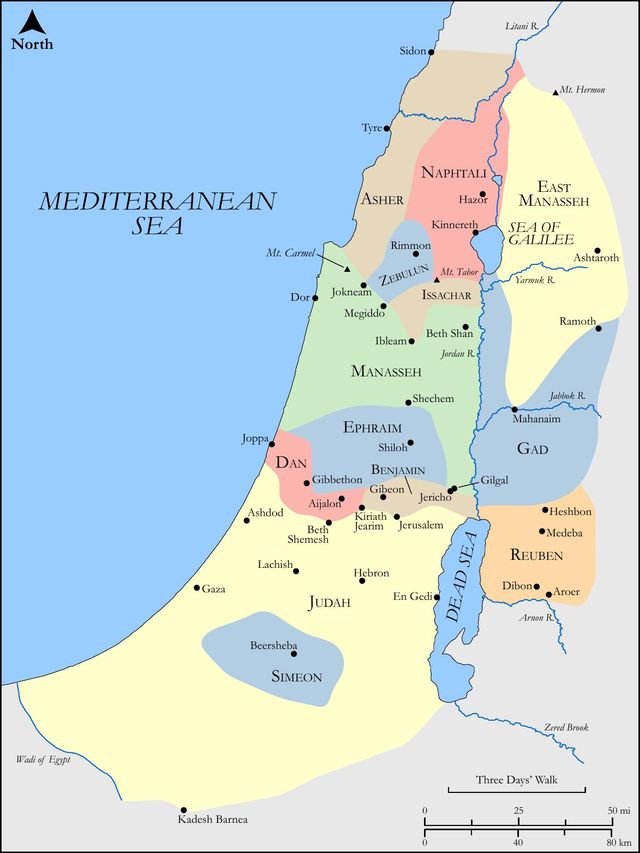
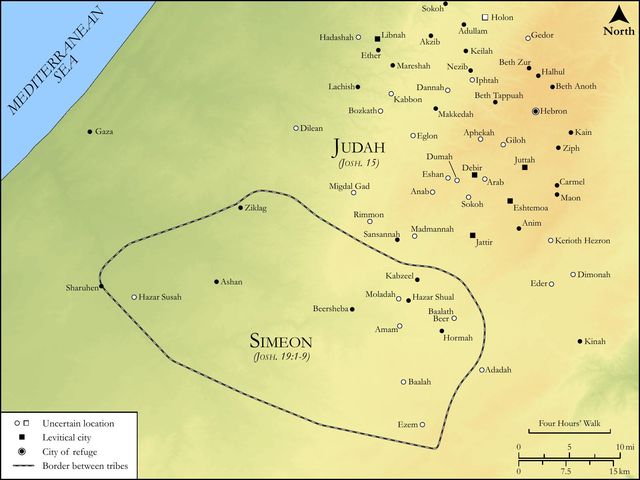
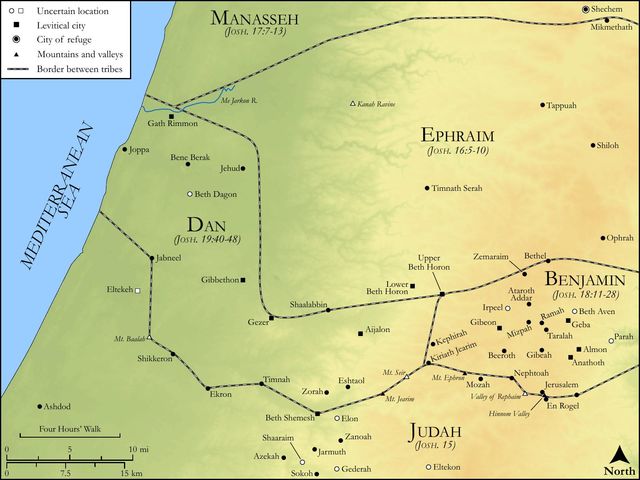
Study this verse
Public-domain commentary
Matthew Henry
From his Commentary on the Whole Bible. Henry comments on passages, not single verses — this entry covers Joshua 15:13–19. His four-level outline is real structure in the source text, so it is rendered as structure.
The historian seems pleased with every occasion to make mention of Caleb and to do him honour, because he had honoured God in following him fully. Observe,
I.The grant Joshua made him of the mountain of Hebron for his inheritance is here repeated (Jos 15:13), and it is said to be given him.
1.According to the commandment of the Lord to Joshua. Though Caleb, in his petition, had made out a very good title to it by promise, yet, because God had ordered Joshua to divide the land by lot, he would not in this one single instance, no, not to gratify his old friend Caleb, do otherwise, without orders from God, whose oracle, it is probable, he consulted upon this occasion. In every doubtful case it is very desirable to know the mind of God, and to see the way of our duty plain.
2.It is said to be a part among the children of Judah; though it was assigned him before the lot of that tribe came up, yet it proved, God so directing the lot, to be in the heart of that tribe, which was graciously ordered in kindness to him, that he might not be as one separated from his brethren and surrounded by those of other tribes.
II.Caleb having obtained this grant, we are told,
1.How he signalized his own valour in the conquest of Hebron (Jos 15:14): He drove thence the three sons of Anak, he and those that he engaged to assist him in this service. This is mentioned here to show that the confidence he had expressed of success in this affair, through the presence of God with him (Jos 14:12), did not deceive him, but the event answered his expectation. It is not said that he slew these giants, but he drove them thence, which intimates that they retired upon his approach and fled before him; the strength and stature of their bodies could not keep up the courage of their minds, but with the countenances of lions they had the hearts of trembling hares. Thus does God often cut off the spirit of princes (Psa 76:12), take away the heart of the chief of the people (Job 12:24), and so shame the confidence of the proud; and thus if we resist the devil, that roaring lion, though he fall not, yet he will flee.
2.How he encouraged the valour of those about him in the conquest of Debir, Jos 15:15, etc. It seems, though Joshua had once made himself master of Debir (Jos 10:39), yet the Canaanites had regained the possession in the absence of the army, so that the work had to be done a second time; and when Caleb had completed the reduction of Hebron, which was for himself and his own family, to show his zeal for the public good, as much as for his own private interest, he pushes on his conquest to Debir, and will not lay down his arms till he sees that city also effectually reduced, which lay but ten miles southward from Hebron, though he had not any particular concern in it, but the reducing of it would be to the general advantage of his tribe. Let us learn hence not to seek and mind our own things only, but to concern and engage ourselves for the welfare of the community we are members of; we are not born for ourselves, nor must we live to ourselves.
(1.)Notice is taken of the name of this city. It had been called Kirjath-sepher, the city of a book, and Kirjath-sannah (Jos 15:49), which some translate the city of learning (so the Septuagint Polis grammaton), whence some conjecture that it had been a university among the Canaanites, like Athens in Greece, in which their youth were educated; or perhaps the books of their chronicles or records, or the antiquities of the nation, were laid up there; and, it may be, this was it that made Caleb so desirous to see Israel master of this city, that they might get acquainted with the ancient learning of the Canaanites.
(2.)The proffer that Caleb made of his daughter, and a good portion with her, to any one that would undertake to reduce that city, and to command the forces that should be employed in that service, Jos 15:16. Thus Saul promised a daughter to him that would kill Goliath (Sa1 17:25), neither of them intending to force his daughter to marry such as she could not love, but both of them presuming upon their daughters' obedience, and submission to their fathers' will, though it might be contrary to their own humour or inclination. Caleb's family was not long honourable and wealthy, but religious; he that himself followed the Lord fully no doubt taught his children to do so, and therefore it could not but be a desirable match to any young gentleman. Caleb, in making the proposal, aims,
[1.]To do service to his country by the reducing of that important place; and,
[2.]To marry a daughter well, to a man of learning, that would have a particular affection for the city of books, and a man of war, that would be likely to serve his country, and do worthily in his generation. Could he but marry his child to a man of such a character, he would think her well bestowed, whether the share in the lot of his tribe were more or less.
(3.)The place was bravely taken by Othniel, a nephew of Caleb, whom probably Caleb had thoughts of when he made the proffer, Jos 15:17. This Othniel, who thus signalized himself when he was young, had long after, in his advanced years, the honour to be both a deliverer and a judge in Israel, the first single person that presided in their affairs after Joshua's death. It is good for those who are setting out in the world to begin betimes with that which is great and good, that, excelling in service when they are young, they may excel in honour when they grow old.
(4.)Hereupon (all parties being agreed) Othniel married his cousin-german Achsah, Caleb's daughter. It is probable that he had a kindness for her before, which put him upon this bold undertaking to obtain her. Love to his country, an ambition of honour, and a desire to find favour with the princes of his people, might not have engaged him in this great action, but his affection for Achsah did. This made it intolerable to him to think that any one should do more to win her favour than he would, and so inspired him with this generous fire. Thus is love strong as death, and jealousy cruel as the grave.
(5.)Because the historian is now upon the dividing of the land, he gives us an account of Achsah's portion, which was in land, as more valuable because enjoyed by virtue of the divine promise, though we may suppose the conquerors of Canaan, who had had the spoil of so many rich cities, were full of money too.
[1.]Some land she obtained by Caleb's free grant, which was allowed while she married within her own tribe and family, as Zelophehad's daughters did. He gave her a south land, Jos 15:19. Land indeed, but a south land, dry, and apt to be parched.
[2.]She obtained more upon her request; she would have had her husband to ask for a field, probably some particular field, or champaign ground, which belonged to Caleb's lot, and joined to that south land which he had settled upon his daughter at marriage. She thought her husband had the best interest in her father, who, no doubt, was extremely pleased with his late glorious achievement, but he thought it was more proper for her to ask, and she would be more likely to prevail; accordingly she did, submitting to her husband's judgment, though contrary to her own; and she managed the undertaking with great address. First, She took the opportunity when her father brought her home to the house of her husband, when the satisfaction of having disposed of his daughter so well would make him think nothing too much to do for her. Secondly, She lighted off her ass, in token of respect and reverence to her father, whom she would honour still, as much as before her marriage. She cried or sighed from off her ass, so the Septuagint and the vulgar Latin read it; she expressed some grief and concern, that she might give her father occasion to ask her what she wanted. Thirdly, She calls it a blessing, because it would add much to the comfort of her settlement; and she was sure that, since she married not only with her father's consent, but in obedience to his command, he would not deny her his blessing. Fourthly, She asks only for the water, without which the ground she had would be of little use either for tillage or pasture, but she means the field in which the springs of water were. The modesty and reasonableness of her quest gave it a great advantage. Earth without water would be like a tree without sap, or the body of an animal without blood; therefore, when God gathered the waters into one place, he wisely and graciously left some in every place, that the earth might be enriched for the service of man. See Psa 104:10, etc. Well, Achsah gained her point; her father gave her what she asked, and perhaps more, for he gave her the upper springs and the nether springs, two fields so called from the springs that were in them, as we commonly distinguish between the higher field and the lower field. Those who understand it but of one field, watered both with the rain of heaven and the springs that issued out of the bowels of the earth, give countenance to the allusion we commonly make to this, when we pray for spiritual and heavenly blessings which relate to our souls as blessings of the upper springs, and those which relate to the body and the life that now is as blessings of the nether springs.
From this story we learn, 1. That it is no breach of the tenth commandment moderately to desire those comforts and conveniences of this life which we see attainable in a fair and regular way. 2. That husbands and wives should mutually advise, and jointly agree, about that which is for the common good of their family; and much more should they concur in asking of their heavenly Father the best blessings, those of the upper springs. 3. That parents must never think that lost which is bestowed upon their children for their real advantage, but must be free in giving them portions as well as maintenance, especially when they are dutiful. Caleb had sons (Ch1 4:15), and yet gave thus liberally to his daughter. Those parents forget themselves and their relation who grudge their children what is convenient for them when they can conveniently part with it.
Continue studying Joshua 15:15 across the web’s major study libraries — every link below opens this exact verse, chapter, or book on the destination site.
Read & Compare
 BibleGatewayThis verse in more than 200 translations and 70 languages.
 Bible.comThe YouVersion reader — hundreds of translations, reading plans, and highlights.
 ESV.orgCrossway's official English Standard Version reader.
 NET BibleThe NET translation with 60,000+ translators' notes on every rendering decision.
 STEP BibleTyndale House's free study tool — original text, vocabulary, and scholarly resources.
 BibliaLogos Bible Software's free web reader.
 USCCBThe New American Bible (Revised Edition) with the U.S. bishops' study notes.
Commentaries
 BibleHub CommentariesDozens of classic commentaries on this verse, gathered on one page.
 StudyLightMore than 100 commentary sets — the largest collection on the web.
 BibleRefPlain-English commentary on what this verse means, verse by verse.
 Enduring WordDavid Guzik's free commentary on this chapter, widely used by Bible teachers.
 Bible Study ToolsVerse commentary alongside Greek and Hebrew study aids.
Original Language & Research
- BibleHub InterlinearThe verse word by word — original language, transliteration, and English.
- BibleHub LexiconEvery word's original-language definition and Strong's entry.
 Blue Letter BibleDeep-study tools — Strong's numbers, concordance, and word studies.
 SefariaThe Hebrew text with Rashi and centuries of Jewish commentary.
Sermons, Hymns & Audio


TrulyRandomVerse is not affiliated with these sites and doesn’t control their content. They’re linked because they’re genuinely useful.
Summary
Joshua 15:15 offers a concise yet crucial detail within the extensive account of Judah's tribal inheritance and the ongoing conquest of Canaan. This verse introduces the city of Debir, previously known as Kirjathsepher, setting the stage for the heroic act of Othniel, who, by conquering this significant stronghold, demonstrates the continued faith and effort required to fully possess the Promised Land. It highlights the transition of control over a key Canaanite center to the Israelites, symbolizing the displacement of pagan influence by God's people and the progressive fulfillment of divine promise.
Context
ShowHideLiterary Context
Joshua 15:15 is strategically placed within the meticulous description of the land allotted to the tribe of Judah, which encompasses the entirety of Joshua 15. Following the general overview of Judah's extensive borders, the chapter meticulously details specific cities and regions within the tribal territory. This particular verse serves as an immediate and vital prelude to the narrative of Caleb's challenge and Othniel's courageous response in Joshua 15:16-19, providing the geographical and historical backdrop for a pivotal act of conquest. Its significance is further underscored by a parallel account found in Judges 1:11-15, reinforcing its historical veracity and Othniel's foundational role as an early deliverer in Israel. The verse's brevity belies its importance in establishing the setting for a crucial demonstration of individual faith and military success within the broader tribal allocation.
Historical & Cultural Context
The period described in the book of Joshua marks a critical transition for the Israelites, moving from nomadic wanderers to settled inhabitants of the land God promised their ancestors. While major campaigns led by Joshua had broken the back of organized Canaanite resistance, many fortified city-states, like Debir, remained formidable strongholds that required sustained, often localized, efforts by individual tribes or clans to subdue. Debir was strategically located in the hill country of Judah, southwest of Hebron, making its capture vital for securing the southern territories and establishing Israelite dominance. The former name, Kirjathsepher, meaning "city of the book" or "city of the scribe," is particularly telling. It suggests that Debir was not merely a military outpost but likely a significant cultural, administrative, or even religious center for the Canaanites, possibly housing archives, libraries, or scribal schools. Its conquest, therefore, represented not just a military victory but also the symbolic dismantling of a center of Canaanite knowledge, idolatry, and influence, signifying a profound shift in power and spiritual authority.
Key Themes
ShowHideThis verse, though succinct, contributes significantly to several overarching themes prevalent in Joshua and the broader Old Testament narrative. Firstly, it powerfully underscores the theme of Conquest and Inheritance, demonstrating that the full possession of God's promised land was an ongoing, often challenging, process that required persistent effort beyond the initial major victories, as highlighted in passages like Joshua 13:1. Secondly, it exemplifies Faithful Initiative and Obedience. While the land was divinely promised, its actual occupation demanded courageous action from individuals and tribes, as seen in Othniel's willingness to "go up" and conquer Debir, aligning with God's repeated command to drive out the inhabitants (e.g., Deuteronomy 7:2). Finally, the capture of Debir, a formidable "city of the book," symbolizes Overcoming Strongholds—not just physical fortresses, but also centers of pagan wisdom and influence that stood in direct opposition to God's purposes. This foreshadows the spiritual battles believers face, as described in the New Testament (e.g., Ephesians 6:12).
Exposition and Analysis
ShowHideKey Word Analysis
ShowHideThis verb signifies an ascent, often implying a difficult or challenging movement upwards, typical for approaching a fortified city situated on elevated terrain. In the context of military conquest, it conveys deliberate action and effort required to overcome an obstacle. Its usage here emphasizes the active, determined nature of the Israelite advance against the Canaanite stronghold.
Derived from a root meaning "to sit down" or "to dwell," this term refers to the settled population of Debir. It highlights that the conquest was not merely of an empty city but of a place actively occupied by a resisting people. This underscores the human element of the conflict and the necessity of dispossessing those who were dwelling in the land God had promised to Israel.
This name, meaning "back" or "inner sanctuary," is intriguing. While it could refer to the city's geographical position at the "back" or interior of the hill country, its association with the "Holy of Holies" (the innermost sanctuary of the tabernacle/temple) is noteworthy. If the Canaanite city was indeed a significant religious or cultic center, its conquest would carry profound symbolic weight as the overthrow of a pagan "sanctuary" or a place of deep idolatrous practice.
This word refers to an appellation, a mark of individuality, or a memorial. In biblical thought, a name often encapsulates character, authority, or reputation. Here, it signifies the official designation of the city, highlighting the shift in identity and ownership from its Canaanite past to its Israelite present. The change in name reflects a change in dominion and cultural allegiance.
This term, literally "face" or "presence," is used here in a temporal sense, meaning "formerly" or "previously." It explicitly indicates that Kirjathsepher was the city's earlier designation, providing a historical marker and emphasizing the transformation of the city's identity under Israelite control.
This compound Hebrew name literally translates to "city of the book" or "city of the scribe." This unique designation strongly suggests that Debir (under its former name) was a prominent cultural, administrative, or intellectual hub. It likely housed important records, treaties, legal documents, or even a library, indicating a sophisticated level of Canaanite literacy and bureaucratic organization. Its capture by the Israelites thus represented a significant blow not just to Canaanite military might, but also to their intellectual and administrative power, signifying a comprehensive conquest.
Verse Breakdown
ShowHide"And he went up thence to the inhabitants of Debir"
This clause describes a specific military movement. The pronoun "he" refers to Othniel, as clarified in the subsequent verses, indicating a deliberate and challenging expedition. "Went up thence" suggests a movement from a previous location (likely Hebron or a nearby camp) to a higher elevation, characteristic of approaching a fortified city in the hill country. This phrase succinctly captures the initial action of a military campaign against a specific, resisting Canaanite population.
"and the name of Debir before [was] Kirjathsepher"
This clause provides crucial historical and cultural context. It identifies the city by its current Israelite name, Debir, while simultaneously preserving its older, Canaanite designation, Kirjathsepher. The KJV's parenthetical "[was]" clarifies that Kirjathsepher was its former name. This detail is not merely an archaeological note but serves to highlight the change of ownership, cultural dominance, and the displacement of one cultural system by another, marking the transition from Canaanite to Israelite control.
Literary Devices
ShowHideJoshua 15:15 employs several subtle yet effective literary techniques. Nomenclature is profoundly significant, as the text explicitly provides both the current (Debir) and former (Kirjathsepher) names of the city. This dual naming serves to ground the narrative in a specific historical reality while also adding layers of meaning, particularly through the evocative translation of "Kirjathsepher," which immediately suggests a center of knowledge or administration. There is also an element of Foreshadowing, as this brief mention of Debir immediately precedes and sets the stage for the detailed account of Othniel's heroic conquest and subsequent reward, building anticipation for the fulfillment of Caleb's challenge. Furthermore, the city itself functions as a form of Metonymy or Synecdoche, where the name of the city, especially "Kirjathsepher," stands in for the broader Canaanite cultural, intellectual, and idolatrous resistance that Israel was commanded to dismantle, representing more than just a physical stronghold but a nexus of pagan influence. The concise nature of the verse also lends itself to Understatement, as a momentous victory over a significant cultural center is conveyed with remarkable brevity, allowing the subsequent narrative to elaborate on its importance.
Theological and Thematic Connections
ShowHideJoshua 15:15, though a seemingly minor detail within the extensive tribal allocations, is rich with profound theological implications. It powerfully underscores God's unwavering faithfulness in fulfilling His covenant promises to Israel, even as it highlights the indispensable human responsibility to act in faith and obedience to fully realize those promises. The conquest of Debir, particularly as a "city of the book," illustrates that God's people are called not only to dispossess physical enemies but also to dismantle systems of worldly wisdom, knowledge, and idolatry that stand in opposition to divine truth. It serves as a potent reminder that true inheritance in God's kingdom often requires confronting formidable obstacles through persistent, Spirit-empowered effort, rather than passive waiting for divine intervention alone. The meticulous recording of these individual and tribal conquests serves as a testament to God's sovereign power working through His people to establish His righteous kingdom and displace ungodly influences.
Reflection and Application
ShowHideThe brief mention of Debir and its former name, Kirjathsepher, in Joshua 15:15 offers profound and timeless insights for contemporary believers. Just as Othniel was called to "go up" and conquer a formidable stronghold, we are similarly called to engage in spiritual battles within our own lives, families, and communities. This verse encourages us to prayerfully identify and courageously confront the "strongholds" – whether they be deeply ingrained patterns of sin, limiting beliefs, pervasive cultural idols, or systems of thought that oppose God's truth – that hinder our full possession of the spiritual inheritance Christ has secured for us. The fact that Debir was a "city of the book" is particularly poignant, reminding us that even intellectual or cultural centers, seemingly benign or even esteemed, can be places of spiritual resistance and idolatry. Our ultimate reliance must be on God's revealed Word, which is living and active, sharper than any two-edged sword, rather than on human wisdom or philosophies that may seem impressive but ultimately stand against divine purposes. This verse is a powerful call to active, courageous faith, trusting that God empowers us to overcome every obstacle as we diligently pursue His will and embrace His promises.
Questions for Reflection
ShowHideFAQ
ShowHideWho is "he" in Joshua 15:15?
ShowHideWhile not explicitly named in this specific verse, the immediate literary context clarifies that "he" refers to Othniel, the son of Kenaz and Caleb's nephew (and later son-in-law). This is made abundantly clear in the very next verses, Joshua 15:16-17, where Caleb offers his daughter Achsah to whoever conquers Kirjathsepher, and Othniel is the one who successfully takes the city. The account is further confirmed and elaborated in Judges 1:12-13, establishing Othniel as a significant figure and the first judge of Israel, a courageous leader who took initiative to fulfill God's command.
What is the significance of Debir's former name, Kirjathsepher?
ShowHideThe name Kirjathsepher (Hebrew for "city of the book" or "city of the scribe") is highly significant and provides crucial insight into the nature of the city. It strongly suggests that Debir was not merely a fortified military outpost but likely a major cultural, administrative, or even religious center for the Canaanites. It may have housed important archives, legal documents, treaties, or even a significant library, indicating a high level of literacy, intellectual activity, and bureaucratic organization among its inhabitants. Its capture by the Israelites, therefore, was more than just a military victory; it was a profound symbolic dismantling of a center of Canaanite intellectual, cultural, and perhaps even idolatrous influence. This act demonstrated the displacement of pagan wisdom and systems by the authority and truth of God's people, marking a significant step in establishing God's kingdom and His righteous order in the land.
Christ-Centered Fulfillment
ShowHideJoshua 15:15, with its account of the conquest of Debir/Kirjathsepher, finds its ultimate and profound fulfillment in the person and redemptive work of Jesus Christ. Just as Othniel, a deliverer, conquered a formidable stronghold that represented Canaanite power and wisdom, Christ is the ultimate Conqueror who has triumphed over all spiritual strongholds, principalities, and powers of darkness. The "city of the book" can be seen as a representation of human wisdom, legalism, worldly philosophies, or any system of thought that stands in opposition to God's divine truth. While the Old Covenant brought the Law—a "book" of commands—it was unable to truly conquer the stronghold of sin in the human heart or fully disarm the spiritual forces of evil. Christ, however, did not merely conquer a physical city; He disarmed the spiritual powers and authorities, making a public spectacle of them, triumphing over them by His cross (Colossians 2:15). He is the true wisdom of God, surpassing all human philosophy and earthly knowledge (1 Corinthians 1:24, Colossians 2:8). Through His death and resurrection, Jesus has secured for believers a spiritual inheritance far greater and more enduring than any earthly land (Ephesians 1:11, 1 Peter 1:4). We, as His followers, are now called to participate in His ongoing victory, empowered by the Holy Spirit, to tear down spiritual strongholds in our lives and in the world, not by physical might or human intellect, but by the truth of the Gospel and the transformative power of God (2 Corinthians 10:4-5).