


Joshua 13:1
Bible text: King James Version (1769 Blayney text) · Public domain
Bible text: King James Version with Strong's numbers · Public domain
Bible text: Berean Standard Bible · Public domain
Bible text: American Standard Version (1901) · Public domain
Bible text: World English Bible, Messianic edition · Public domain
Bible text: Geneva Bible (1599) · Public domain
Bible text: Young's Literal Translation · Public domain
- וִיהוֹשֻׁעַvi·ho·Shu·a'and JoshuaH3091Conj-w ¦ N-proper-mNoun Proper MasculineוִandיהוֹשֻׁעַJoshua
- זָקֵןza·Kenhe was oldH2204V-Qal-Perf-3msVerb Qal Perfect 3rd Singular Masculine
- בָּאba'he had comeH935V-Qal-Perf-3msVerb Qal Perfect 3rd Singular Masculine
- בַּיָּמִיםbai·ya·Mimin <the> daysH3117Prep-b ¦ N-mpNoun Plural Masculine Absoluteבַּin <the>יָּמִיםdays
- וַיֹּאמֶרvai·Yo·merand he saidH559Conj-w ¦ V-Qal-ConsecImperf-3msVerb Qal Consecutive Imperfect 3rd Singular Masculineוַandיֹּאמֶרhe said
- יְהוָהYah·wehYahwehH3068N-properNoun Proper Title
- אֵלָיו'e·Lavto himH413Prep ¦ 3msPreposition Definiteאֵלָיtoוhim
- אַתָּה'a·TahyouH859Pro-2msPronoun Personal 2nd Singular Masculine
- זָקַנְתָּהza·Kan·tahyou are oldH2204V-Qal-Perf-2msVerb Qal Perfect 2nd Singular Masculine
- בָּאתָBa·tayou have comeH935V-Qal-Perf-2msVerb Qal Perfect 2nd Singular Masculine
- בַיָּמִיםvai·ya·Mimin <the> daysH3117Prep-b ¦ N-mpNoun Plural Masculine Absoluteבַin <the>יָּמִיםdays
- וְהָאָרֶץve·ha·'A·retzand the landH776Conj-w ¦ Art ¦ N-fsNoun Singular Feminine Absoluteוְandהָtheאָרֶץland
- נִשְׁאֲרָהnish·'a·Rahit remainsH7604V-Niphal-Perf-3fsVerb Niphal Perfect 3rd Singular Feminine
- הַרְבֵּהhar·behmuchH7235V-Hiphil-InfAbsVerb Hiphil Infinitive Absolute
- מְאֹדme·'OdveryH3966Adj-msAdjective Numerical Singular Masculine Absolute
- לְרִשְׁתָּהּle·rish·Tahto take possession of itH3423Prep-l ¦ V-Qal-Inf ¦ 3fsVerb Qal Infinitive Constructלְtoרִשְׁתָּtake possession ofהּit
English is a literal word-by-word gloss of the Hebrew, not the KJV's wording. Why?
This is the original text the KJV's translators worked from — each Hebrew word with its own literal English meaning in this verse, prepared by scholars at Tyndale House, Cambridge. The KJV translates whole sentences, not word by word, so its wording differs: one Hebrew word can become several English words, and the KJV may choose “the LORD” where the gloss reads “Yahweh”. Both are faithful — they answer different questions. For the KJV's own rendering, switch to the KJV text.
Details
See on the biblical-era maps
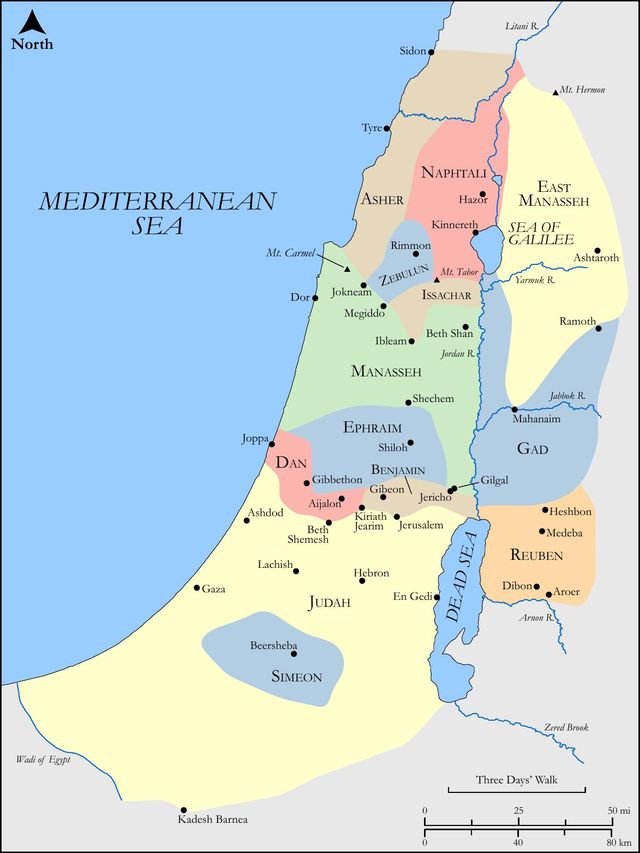
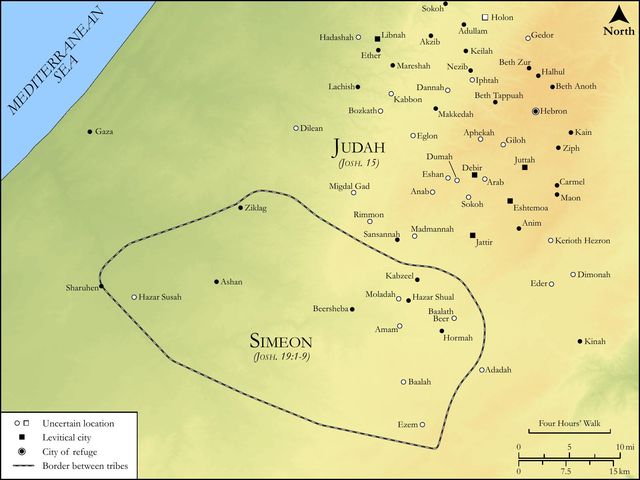
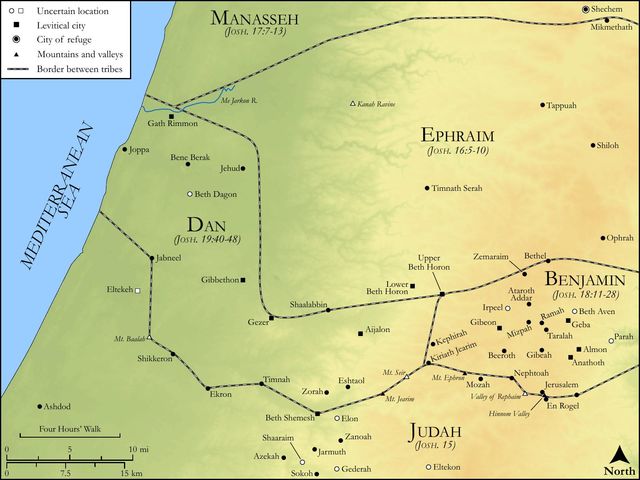
Study this verse
Public-domain commentary
Matthew Henry
From his Commentary on the Whole Bible. Henry comments on passages, not single verses — this entry covers Joshua 13:1–6. His two-level outline is real structure in the source text, so it is rendered as structure.
Here, I. God puts Joshua in mind of his old age, v. 1. 1. It is said that Joshua was old and stricken in years, and he and Caleb were at this time the only old men among the thousands of Israel, none except them of all those who were numbered at Mount Sinai being now alive. He had been a man of war from his youth (Exo 17:10); but now he yielded to the infirmities of age, with which it is in vain for the stoutest to think of contesting. It should seem Joshua had not the same strength and vigour in his old age that Moses had; all that come to old age do not find it alike good; generally, the days of old age are evil days, and such as there is no pleasure in, nor expectation of service from. 2. God takes notice of it to him: God said to him, Thou art old. Note, It is good for those who are old and stricken in years to be put in remembrance of their being so. Some have gray hairs here and there upon them, and perceive it not (Hos 7:9); they do not care to think of it, and therefore need to be told of it, that they may be quickened to do the work of life, and make preparation for death, which is coming towards them apace. But God mentions Joshua's age and growing infirmities, (1.) As a reason why he should now lay by the thoughts of pursuing the war; he cannot expect to see an end of it quickly, for there remained much land, more perhaps than he thought, to be possessed, in several parts remote from each other: and it was not fit that at his age he should be put upon the fatigue of renewing the war, and carrying it to such distant places; no, it was enough for him that he had reduced the body of the country. "Let him be gathered to rest with honour and the thanks of his people for the good services he had done them, and let the conquering of the skirts of the country be left for those that shall come after." As he had entered into the labours of Moses, so let others enter into his, and bring forth the top-stone, the doing of which was reserved for David long after. Observe, God considers the frame of his people, and would not have them burdened with work above their strength. It cannot be expected that old people should do as they have done for God and their country. (2.) As a reason why he should speedily apply himself to the dividing of that which he had conquered. That work must be done, and done quickly; it was necessary that he should preside in the doing of it, and therefore, he being old and stricken in years, and not likely to continue long, let him make this his concluding piece of service to God and Israel. All people, but especially old people, should set themselves to do that quickly which must be done before they die, lest death prevent them, Ecc 9:10.
II.He gives him a particular account of the land that yet remained unconquered, which was intended for Israel, and which, in due time, they should be masters of if they did not put a bar in their own door. Divers places are here mentioned, some in the south, as the country of the Philistines, governed by five lords, and the land that lay towards Egypt (Jos 13:2, Jos 13:3), some westward, as that which lay towards the Sidonians (Jos 13:4), some eastward, as all Lebanon (Jos 13:5), some towards the north, as that in the entering in of Hamath, Jos 13:5. Joshua is told this, and he made the people acquainted with it,
1.That they might be the more affected with God's goodness to them in giving them this good land, and might thereby be engaged to love and serve him; for, if this which they had was too little, God would moreover give them such and such things, Sa2 12:8.
2.That they might not be tempted to make any league, or contract any dangerous familiarity with these their neighbours so as to learn their way, but might rather be jealous of them, as a people that kept them from their right and that they had just cause of quarrel with.
3.That they might keep themselves in a posture for war, and not think of putting off the harness so long as there remained any land to be possessed. Nor must we lay aside our spiritual armour, nor be off our watch, till our victory be completed in the kingdom of glory.
III.He promises that he would make the Israelites masters of all those countries that were yet unsubdued, though Joshua was old and not able to do it, old and not likely to live to see it done. Whatever becomes of us, and however we may be laid aside as despised broken vessels, God will do his own work in his own time (Jos 13:6): I will drive them out. The original is emphatic: "It is I that will do it, I that can do it when thou are dead and gone, and will do it if Israel be not wanting to themselves." "I will do it by my Word," so the Chaldee here, as in many other places, "by the eternal Word, the captain of the hosts of the Lord." This promise that he would drive them out from before the children of Israel plainly supposes it as the condition of the promise that the children of Israel must themselves attempt their extirpation, must go up against them, else they could not be said to be driven out before them; if afterwards Israel, through sloth, or cowardice, or affection to these idolaters, sit still and let them alone, they must blame themselves, and not God, if they be not driven out. We must work out our salvation, and then God will work in us and work with us; we must resist our spiritual enemies, and then God will tread them under our feet; we must go forth to our Christian work and warfare, and then God will go forth before us.
Historical interpretation
Fifteen Centuries of Reception
4 surviving comments on this verse. Each one is dated, so this reads as a timeline rather than a list.
Select a marker to jump to its quote. Markers stagger vertically where authors wrote within a few decades of each other.
Certain attentive persons even before us have observed in the Scriptures that presbyters or elders are not so called because they have lived to a great age, but they are honored by this title for their maturity of thought and venerable dignity of life, especially when there is added to presbyter this phrase that follows: “full of days.” For if any “presbyter” or “elder” seemed so named because of his great age, who would have been even more fitting to designate by this name than Adam, or surely Methuselah or Noah, who clearly are declared to have lived far more years in this world than the rest? Yet, we see that indeed not one of these is called “presbyter” or “elder” by Scripture. But Abraham, who lived a much shorter life, is the first to be called “presbyter” or “elder” in holy Scriptures. Also it is said by the Lord to Moses, “Choose presbyters for yourself from all the people, those whom you yourself know to be presbyters.” But see, O hearer, whether anywhere in all Scripture you are able to find the title “an elder, full of days” attributed to any sinner.
But since we have determined that the things that are said about Jesus [Joshua] also refer to our Lord and Savior, whom do we understand to be as much “the presbyter and elder, advanced of days” as the one who is “the beginning, the firstborn of every creature”? And for that reason, perhaps, he alone, before whom there is no one, is truly and properly called presbyter. Therefore, although there are those in the Scriptures who are called presbyters or elders or high priests, nevertheless, among the presbyters or elders the Lord Jesus must be reckoned chief of presbyters, and among bishops, chief of bishops, just as among high priests he is “chief of high priests.” and as among shepherds he is “chief of shepherds.” The Savior must be held first and chief in this and in every honorable title, because he is the “head” of all.
Josue was old, and far advanced in years: He was then about one hundred and one years old.-- And there is a very large country left.
Which is not yet divided by lot: Not yet possessed by the children of Israel.
Continue studying Joshua 13:1 across the web’s major study libraries — every link below opens this exact verse, chapter, or book on the destination site.
Read & Compare
 BibleGatewayThis verse in more than 200 translations and 70 languages.
 Bible.comThe YouVersion reader — hundreds of translations, reading plans, and highlights.
 ESV.orgCrossway's official English Standard Version reader.
 NET BibleThe NET translation with 60,000+ translators' notes on every rendering decision.
 STEP BibleTyndale House's free study tool — original text, vocabulary, and scholarly resources.
 BibliaLogos Bible Software's free web reader.
 USCCBThe New American Bible (Revised Edition) with the U.S. bishops' study notes.
Commentaries
 BibleHub CommentariesDozens of classic commentaries on this verse, gathered on one page.
 StudyLightMore than 100 commentary sets — the largest collection on the web.
 BibleRefPlain-English commentary on what this verse means, verse by verse.
 Enduring WordDavid Guzik's free commentary on this chapter, widely used by Bible teachers.
 Bible Study ToolsVerse commentary alongside Greek and Hebrew study aids.
Original Language & Research
- BibleHub InterlinearThe verse word by word — original language, transliteration, and English.
- BibleHub LexiconEvery word's original-language definition and Strong's entry.
 Blue Letter BibleDeep-study tools — Strong's numbers, concordance, and word studies.
 SefariaThe Hebrew text with Rashi and centuries of Jewish commentary.
Sermons, Hymns & Audio


TrulyRandomVerse is not affiliated with these sites and doesn’t control their content. They’re linked because they’re genuinely useful.
Summary
Joshua 13:1 marks a pivotal transition in the book of Joshua, shifting the narrative focus from large-scale military conquest to the detailed, yet unfinished, task of land allocation and possession. The verse poignantly highlights Joshua's advanced age, serving as a divine declaration that his era of singular leadership in conquest is drawing to a close. More profoundly, it reveals God's omniscient perspective on the vast scope of the remaining work, emphasizing that despite significant victories, a substantial portion of the Promised Land still needed to be actively claimed and settled by the Israelite tribes, underscoring their ongoing covenantal responsibility.
Context
ShowHideLiterary Context
Joshua 13:1 functions as a crucial literary hinge, bridging the book's two major sections. Chapters 1-12 meticulously recount the initial, unified military campaigns led by Joshua, culminating in decisive victories over key Canaanite kings and the securing of strategic territories. This opening verse of chapter 13 abruptly shifts the tone and focus, moving from the triumphs of conquest to the reality of incomplete possession. It sets the stage for chapters 13-21, which meticulously detail the division of the land among the twelve tribes, and implicitly, the individual tribal responsibilities for completing the disinheritance of the remaining inhabitants. The verse thus serves as a divine re-calibration, reminding Israel that while God had granted significant success, the full realization of His promises required continued, diligent effort beyond the initial, centralized military phase.
Historical & Cultural Context
At this juncture, Joshua, having led Israel for many years since the death of Moses, was indeed "old and stricken in years," a fact reiterated by God Himself. Historical estimates place him well into his nineties, approaching his death at 110 years old (Joshua 24:29). The concept of "possessing the land" was deeply embedded in the Abrahamic Covenant, where God promised this specific territory as an eternal inheritance to Abraham's descendants (e.g., Genesis 15:18-21). For Israel, land ownership was paramount, signifying identity, security, and divine favor. The presence of unconquered pockets of Canaanites, as later detailed in Judges 1, highlights that "possession" was not a mere legal declaration but an arduous, ongoing process of dispossessing the indigenous populations and establishing Israelite control. This task would extend beyond Joshua's lifetime, underscoring the long-term commitment required for the full inheritance.
Key Themes
ShowHideThis verse introduces and reinforces several profound theological and narrative themes. Firstly, it highlights the theme of Divine Initiative and Unfinished Work. God, with His omniscient perspective, reveals that despite human perception of significant accomplishment, there remains "very much land to be possessed." This underscores that God's plans are often grander and more expansive than human vision, and He actively directs His people to the next phase of their mission, even when a leader is aging. Secondly, it emphasizes Human Responsibility in God's Covenant. While the land was divinely promised, its full inheritance required active human obedience, faith, and sustained effort in dispossessing the remaining inhabitants. This tension between divine promise and human action is a recurring motif throughout the Old Testament, exemplified by the repeated commands for Israel to "drive out" the nations (e.g., Deuteronomy 7:1-5). Thirdly, the verse signals a Transition of Leadership and Responsibility. Joshua's old age naturally points to a shift from his singular, central leadership in conquest to a more decentralized tribal responsibility for securing their inheritances, implicitly preparing for a new era where the entire nation, not just one charismatic leader, must remain committed to God's purposes. This shift is crucial for understanding the subsequent narrative of the division of the land in Joshua 14-19.
Exposition and Analysis
ShowHideKey Word Analysis
ShowHideThis adjective (H2204) describes Joshua's advanced age. From a primitive root meaning "to be old," it signifies a person who has reached a considerable number of years, often implying wisdom and experience but also a diminishing capacity for strenuous physical activity. The repetition of this term, both from the narrator and from God, emphasizes its significance as a marker of a transitional period in Israel's history, signaling the impending end of Joshua's active, frontline leadership.
This is the sacred, covenantal name of God (H3068), derived from the root meaning "to be" or "to exist." It refers to the self-Existent or Eternal One, Jehovah, the Jewish national name of God. The use of "the LORD" here underscores the divine authority and covenantal faithfulness behind the instruction given to Joshua, emphasizing that this command comes directly from the sovereign God who initiated the promise of the land to Abraham and is now bringing it to fruition.
This verb (H3423) is central to the covenantal theme of the land. It means "to occupy (by driving out previous tenants, and possessing in their place)," "to seize," "to inherit," or "to dispossess." It implies not merely physical occupation, but the legal and spiritual claiming of something as a rightful inheritance, often through active, sometimes forceful, appropriation. In the context of Joshua, it highlights that the land was a divine gift, but its full realization required active, obedient engagement by Israel to disinherit its previous inhabitants.
Verse Breakdown
ShowHide"Now Joshua was old [and] stricken in years;"
The opening clause, an observation by the narrator, immediately establishes Joshua's physical state. The phrase "stricken in years" (literally "come into days") is an idiomatic expression signifying advanced age, implying that Joshua's capacity for leading large-scale military campaigns was naturally waning. This sets a poignant human context for the divine revelation that follows, signaling a necessary shift in leadership and strategy.
"and the LORD said unto him, Thou art old [and] stricken in years,"
This clause marks a direct divine address, confirming and reiterating the narrator's observation. God's repetition of Joshua's age is not a rebuke but an affirmation of reality and a compassionate acknowledgment of Joshua's long service. Crucially, it serves as a divine preface, preparing Joshua for the significant, yet challenging, instruction that immediately follows, demonstrating God's awareness of His servant's limitations while simultaneously revealing the grander scope of His plan.
"and there remaineth yet very much land to be possessed."
This is the core divine message and the theological pivot of the verse. Despite the significant victories and initial conquests achieved under Joshua's leadership, God reveals that a substantial portion of the Promised Land remains unconquered and unpossessed. This statement shifts the focus from past triumphs to future responsibilities, emphasizing that the initial conquests were a beginning, not the culmination, of Israel's task. It sets the agenda for the remainder of the book, detailing the division of this remaining land and the ongoing responsibility of the tribes to fully claim their inheritance.
Literary Devices
ShowHideJoshua 13:1 employs several impactful literary devices. Repetition is prominent with the phrase "old and stricken in years" appearing twice, first as the narrator's observation and then as God's direct address. This repetition serves to underscore Joshua's advanced age and the necessity of a transition in leadership and strategy. The direct Divine Oracle ("and the LORD said unto him") highlights the divine initiative and absolute authority behind the subsequent command, ensuring that the remaining task is understood as God's will, not merely a human assessment. There is a subtle but profound Contrast between Joshua's likely perception of significant accomplishment (having led major conquests) and God's broader, more comprehensive perspective, which reveals the vast amount of work still to be done. The "land to be possessed" functions as a powerful Symbol for the ongoing, often challenging, spiritual and practical tasks that God's people must undertake to fully realize His promises and inheritances, extending beyond mere physical territory to encompass the full scope of God's purposes.
Theological and Thematic Connections
ShowHideJoshua 13:1 profoundly illustrates the ongoing dynamic between divine promise and human responsibility within God's covenant. While God faithfully delivers on His promises to give Israel the land, its full possession is contingent upon their continued obedience and effort. This verse reminds us that God's vision often extends far beyond our immediate accomplishments, calling us to persevere in faith even when we feel we have done enough or are past our prime. It emphasizes that the full realization of God's kingdom on earth is a continuous process, requiring successive generations to take up the mantle of responsibility. The "land to be possessed" symbolizes not just physical territory but the full scope of God's purposes for His people, which always involves active engagement and faithful stewardship, a task that often outlives individual leaders and requires corporate commitment.
Reflection and Application
ShowHideJoshua 13:1 offers a timeless spiritual mirror for believers today, challenging us to adopt God's expansive perspective on our lives and ministries. Just as Joshua, despite his great accomplishments, was called to acknowledge the "very much land to be possessed," we too are often confronted with the reality that our spiritual journey, our personal growth, and our participation in God's kingdom work are far from complete. This verse serves as a powerful antidote to complacency after initial victories or periods of fruitfulness. It calls us to recognize that there are always new territories of faith to explore, new areas of sin to conquer, new ministries to embrace, and new people to reach with the Gospel. Our age, physical limitations, or perceived accomplishments are not excuses for inaction, but rather prompts for discerning God's ongoing call, perhaps shifting from one form of service to another, or empowering the next generation to carry the torch. The "land to be possessed" can be a metaphor for the unreached areas of our communities, the unaddressed needs in our churches, the uncultivated virtues in our own hearts, or the unfulfilled potential in our spiritual gifts. God's mission for us is always bigger than we imagine, and He calls us to faithful perseverance until His purposes are fully realized.
Questions for Reflection
ShowHideFAQ
ShowHideWhy did God tell Joshua he was old if Joshua already knew it?
ShowHideGod's statement, "Thou art old and stricken in years," was not merely an informative observation but a divinely strategic and deeply pastoral preface. Firstly, it served as a compassionate acknowledgment and validation of Joshua's long and faithful service, recognizing his accomplishments and the natural progression of his life. This divine affirmation provided comfort and a clear sense of divine recognition for his leadership. Secondly, and more importantly, it functioned as a clear signal for a significant transition in leadership and methodology. God was not rebuking Joshua for his age but highlighting that his role was shifting from leading large-scale military campaigns to overseeing the meticulous and complex task of land distribution and tribal inheritance. This divine pronouncement prepared Joshua, and by extension, the entire nation, for the next phase of their covenantal responsibility, emphasizing that the work would continue, albeit under different leadership and with different strategies, even as Joshua neared the end of his life. It underscored the continuity of God's overarching plan despite human transitions, ensuring that the people understood the divine imperative behind the upcoming division of the land (Joshua 14:1-5).
Christ-Centered Fulfillment
ShowHideJoshua 13:1, with its emphasis on "land to be possessed" and a leader nearing the end of his active mission, finds its ultimate fulfillment and transformation in Jesus Christ. While Joshua led Israel to possess a physical land, Jesus, the greater Joshua (a Greek form of the Hebrew name), leads His people into a spiritual inheritance that transcends geographical boundaries and is eternal in nature. The "very much land to be possessed" under the Old Covenant points forward to the vast spiritual dominion and eternal inheritance secured by Christ for all who believe. Through His atoning work on the cross, Jesus disarmed the powers of darkness (Colossians 2:15) and conquered sin and death, thereby possessing the ultimate spiritual territory for His followers. Our "inheritance" in Christ is not a piece of land but "every spiritual blessing in the heavenly places" (Ephesians 1:3) and a "kingdom that cannot be shaken" (Hebrews 12:28). Furthermore, the ongoing task of possessing the land for Israel foreshadows the Great Commission given by Jesus, where His disciples are commanded to "go and make disciples of all nations" (Matthew 28:19-20), extending the spiritual kingdom of God to the ends of the earth. Just as Joshua's mission had unfinished parts, the church's mission continues until Christ's return, when the full spiritual "land" of God's redeemed people will be gathered. The rest that remained for Israel to fully enter into the land (Hebrews 4:1-11) is ultimately found in Christ, who is our true Sabbath rest and the one who fully possesses and shares His inheritance with all who believe, ushering us into a new heaven and a new earth where righteousness dwells (2 Peter 3:13).