


Joshua 13:2
Bible text: King James Version (1769 Blayney text) · Public domain
Bible text: Berean Standard Bible · Public domain
Bible text: American Standard Version (1901) · Public domain
Bible text: World English Bible, Messianic edition · Public domain
Bible text: Geneva Bible (1599) · Public domain
Bible text: Young's Literal Translation · Public domain
- זֹאתzotthisH2063PrtParticle Demonstrative
- הָאָרֶץha·'A·retz[is] the landH776Art ¦ N-fsNoun Singular Feminine Absoluteהָ[is] theאָרֶץland
- הַנִּשְׁאָרֶתha·nish·'A·retwhich remainsH7604Art ¦ V-Niphal-Prtcpl-fsVerb Niphal Participle Singular Feminine Absoluteהַwhichנִּשְׁאָרֶתremains
- כָּלkolallH3605N-mscNoun Singular Masculine Construct
- גְּלִילוֹתge·li·Lot[the] territories ofH1552N-fpcNoun Plural Feminine Construct
- הַפְּלִשְׁתִּיםha·pe·lish·Timthe PhilistinesH6430Art ¦ N-mpNoun Gentilic Plural Masculine AbsoluteהַtheפְּלִשְׁתִּיםPhilistines
- וְכָלve·kholand allH3605Conj-w ¦ N-mscNoun Singular Masculine Constructוְandכָלall
- הַגְּשׁוּרִיha·ge·shu·Rithe Geshurite[s]H1651Art ¦ N-msNoun Gentilic Singular Masculine AbsoluteהַtheגְּשׁוּרִיGeshurite[s]
English is a literal word-by-word gloss of the Hebrew, not the KJV's wording. Why?
This is the original text the KJV's translators worked from — each Hebrew word with its own literal English meaning in this verse, prepared by scholars at Tyndale House, Cambridge. The KJV translates whole sentences, not word by word, so its wording differs: one Hebrew word can become several English words, and the KJV may choose “the LORD” where the gloss reads “Yahweh”. Both are faithful — they answer different questions. For the KJV's own rendering, switch to the KJV text.
Details
See on the biblical-era maps
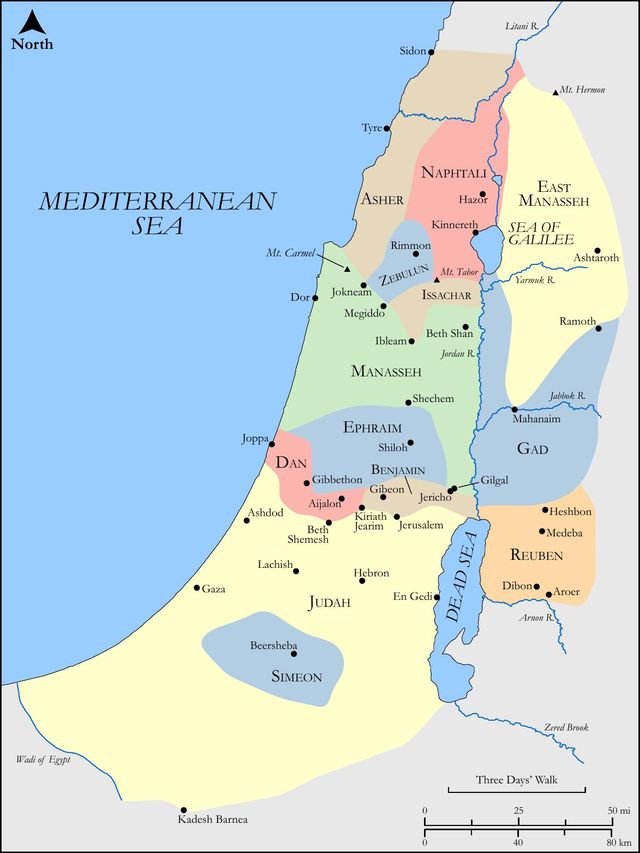
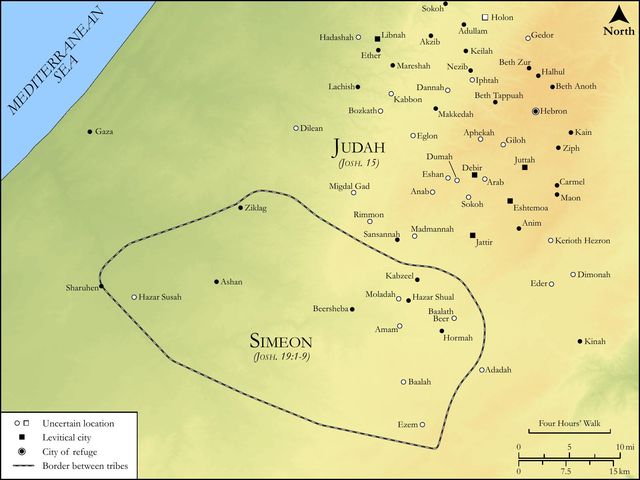
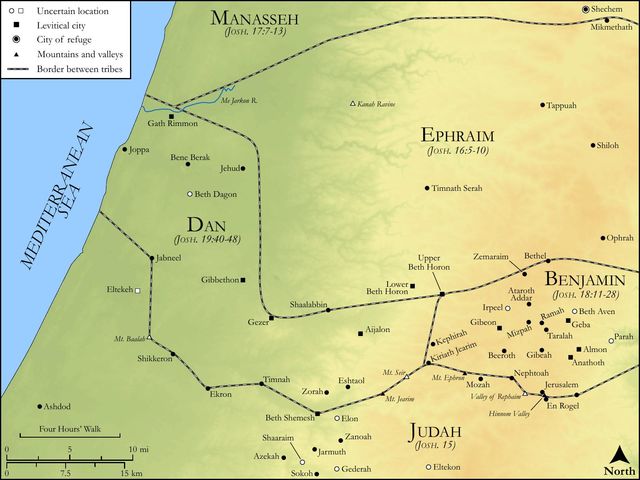
Study this verse
Public-domain commentary
Matthew Henry
From his Commentary on the Whole Bible. Henry comments on passages, not single verses — this entry covers Joshua 13:1–6. His two-level outline is real structure in the source text, so it is rendered as structure.
Here, I. God puts Joshua in mind of his old age, v. 1. 1. It is said that Joshua was old and stricken in years, and he and Caleb were at this time the only old men among the thousands of Israel, none except them of all those who were numbered at Mount Sinai being now alive. He had been a man of war from his youth (Exo 17:10); but now he yielded to the infirmities of age, with which it is in vain for the stoutest to think of contesting. It should seem Joshua had not the same strength and vigour in his old age that Moses had; all that come to old age do not find it alike good; generally, the days of old age are evil days, and such as there is no pleasure in, nor expectation of service from. 2. God takes notice of it to him: God said to him, Thou art old. Note, It is good for those who are old and stricken in years to be put in remembrance of their being so. Some have gray hairs here and there upon them, and perceive it not (Hos 7:9); they do not care to think of it, and therefore need to be told of it, that they may be quickened to do the work of life, and make preparation for death, which is coming towards them apace. But God mentions Joshua's age and growing infirmities, (1.) As a reason why he should now lay by the thoughts of pursuing the war; he cannot expect to see an end of it quickly, for there remained much land, more perhaps than he thought, to be possessed, in several parts remote from each other: and it was not fit that at his age he should be put upon the fatigue of renewing the war, and carrying it to such distant places; no, it was enough for him that he had reduced the body of the country. "Let him be gathered to rest with honour and the thanks of his people for the good services he had done them, and let the conquering of the skirts of the country be left for those that shall come after." As he had entered into the labours of Moses, so let others enter into his, and bring forth the top-stone, the doing of which was reserved for David long after. Observe, God considers the frame of his people, and would not have them burdened with work above their strength. It cannot be expected that old people should do as they have done for God and their country. (2.) As a reason why he should speedily apply himself to the dividing of that which he had conquered. That work must be done, and done quickly; it was necessary that he should preside in the doing of it, and therefore, he being old and stricken in years, and not likely to continue long, let him make this his concluding piece of service to God and Israel. All people, but especially old people, should set themselves to do that quickly which must be done before they die, lest death prevent them, Ecc 9:10.
II.He gives him a particular account of the land that yet remained unconquered, which was intended for Israel, and which, in due time, they should be masters of if they did not put a bar in their own door. Divers places are here mentioned, some in the south, as the country of the Philistines, governed by five lords, and the land that lay towards Egypt (Jos 13:2, Jos 13:3), some westward, as that which lay towards the Sidonians (Jos 13:4), some eastward, as all Lebanon (Jos 13:5), some towards the north, as that in the entering in of Hamath, Jos 13:5. Joshua is told this, and he made the people acquainted with it,
1.That they might be the more affected with God's goodness to them in giving them this good land, and might thereby be engaged to love and serve him; for, if this which they had was too little, God would moreover give them such and such things, Sa2 12:8.
2.That they might not be tempted to make any league, or contract any dangerous familiarity with these their neighbours so as to learn their way, but might rather be jealous of them, as a people that kept them from their right and that they had just cause of quarrel with.
3.That they might keep themselves in a posture for war, and not think of putting off the harness so long as there remained any land to be possessed. Nor must we lay aside our spiritual armour, nor be off our watch, till our victory be completed in the kingdom of glory.
III.He promises that he would make the Israelites masters of all those countries that were yet unsubdued, though Joshua was old and not able to do it, old and not likely to live to see it done. Whatever becomes of us, and however we may be laid aside as despised broken vessels, God will do his own work in his own time (Jos 13:6): I will drive them out. The original is emphatic: "It is I that will do it, I that can do it when thou are dead and gone, and will do it if Israel be not wanting to themselves." "I will do it by my Word," so the Chaldee here, as in many other places, "by the eternal Word, the captain of the hosts of the Lord." This promise that he would drive them out from before the children of Israel plainly supposes it as the condition of the promise that the children of Israel must themselves attempt their extirpation, must go up against them, else they could not be said to be driven out before them; if afterwards Israel, through sloth, or cowardice, or affection to these idolaters, sit still and let them alone, they must blame themselves, and not God, if they be not driven out. We must work out our salvation, and then God will work in us and work with us; we must resist our spiritual enemies, and then God will tread them under our feet; we must go forth to our Christian work and warfare, and then God will go forth before us.
Historical interpretation
Historical reception
1 surviving comment on this verse from the historical church.
But follow me, O hearer, through delicate threads of expression, and I shall disclose to you how for a second time he takes possession of this earth, very much of which is now said to Jesus to be left behind. Listen to what Paul says concerning this: “For he must reign until he makes all his enemies his footstool.” This, therefore, is the “land,” much of which is now said to be left behind, until all are placed entirely under his feet and until he takes possession of all persons for his inheritance. “This,” it says, “is the land that was left behind: all the regions of the Philistines,” and, indeed, very many other lands that follow. Much still “remains,” as far as this pertains to our times, which we see has not yet been “placed beneath the feet of Jesus,” who is certainly to possess all.…From this it is evident that in the second coming Jesus will obtain this extensive land that still remains. But blessed are those who were taken over at his first coming; for those will be truly dear who receive the inheritance of the land of promise in spite of the resistance of many adversaries and the attacks of many enemies by war and by weapons.
Continue studying Joshua 13:2 across the web’s major study libraries — every link below opens this exact verse, chapter, or book on the destination site.
Read & Compare
 BibleGatewayThis verse in more than 200 translations and 70 languages.
 Bible.comThe YouVersion reader — hundreds of translations, reading plans, and highlights.
 ESV.orgCrossway's official English Standard Version reader.
 NET BibleThe NET translation with 60,000+ translators' notes on every rendering decision.
 STEP BibleTyndale House's free study tool — original text, vocabulary, and scholarly resources.
 BibliaLogos Bible Software's free web reader.
 USCCBThe New American Bible (Revised Edition) with the U.S. bishops' study notes.
Commentaries
 BibleHub CommentariesDozens of classic commentaries on this verse, gathered on one page.
 StudyLightMore than 100 commentary sets — the largest collection on the web.
 BibleRefPlain-English commentary on what this verse means, verse by verse.
 Enduring WordDavid Guzik's free commentary on this chapter, widely used by Bible teachers.
 Bible Study ToolsVerse commentary alongside Greek and Hebrew study aids.
Original Language & Research
- BibleHub InterlinearThe verse word by word — original language, transliteration, and English.
- BibleHub LexiconEvery word's original-language definition and Strong's entry.
 Blue Letter BibleDeep-study tools — Strong's numbers, concordance, and word studies.
 SefariaThe Hebrew text with Rashi and centuries of Jewish commentary.
Sermons, Hymns & Audio


TrulyRandomVerse is not affiliated with these sites and doesn’t control their content. They’re linked because they’re genuinely useful.
Summary
Joshua 13:2 marks a pivotal moment in the narrative of Israel's conquest, as the Lord declares to an aging Joshua that substantial portions of the promised land remain unconquered. Specifically highlighting the territories of the Philistines and Geshuri, this verse transitions the focus from initial military victories to the intricate phase of land distribution among the Israelite tribes. It underscores both God's unwavering faithfulness in providing the inheritance and Israel's enduring responsibility to fully possess what had been divinely granted, even in the face of persistent challenges and formidable inhabitants.
Context
ShowHideLiterary Context
Joshua 13:2 immediately follows the Lord's direct and poignant address to Joshua in Joshua 13:1, where God acknowledges Joshua's advanced age and explicitly states, "There remains yet very much land to be possessed." This divine declaration sets the narrative stage for the detailed instructions regarding the division of the land among the tribes, even for territories not yet fully subdued. The verse functions as a crucial bridge, shifting the narrative from the unified military campaigns of conquest (chapters 1-12) to the complex realities of tribal inheritances and the challenges of incomplete conquest (chapters 13-21). It highlights that while major victories had been achieved under Joshua's leadership, the full realization of God's promise required continued effort, faithfulness, and tribal cooperation from Israel.
Historical & Cultural Context
The specific mention of "the borders of the Philistines" holds immense historical and cultural significance. The Philistines were a powerful, non-Semitic "Sea Peoples" group who had settled in the fertile coastal plain of Canaan (the Shephelah) around the 12th century BCE. They established a formidable pentapolis of major cities: Gaza, Ashkelon, Ashdod, Gath, and Ekron. Possessing superior iron technology and a highly organized military, they posed a persistent and formidable threat to Israel throughout the periods of the Judges and the United Monarchy, as vividly illustrated in later accounts like 1 Samuel 17. Their presence here underscores a powerful, un-dispossessed enemy that would plague Israel for centuries. "All Geshuri" likely refers to the Aramean kingdom of Geshur, located east of the Jordan River, north of Bashan, and south of Mount Hermon, near the Sea of Galilee (compare Deuteronomy 3:14). Its inclusion indicates that even territories east of the Jordan, initially settled by some tribes, still had pockets of unconquered inhabitants, reinforcing the widespread nature of the unfinished task.
Key Themes
ShowHideThis verse powerfully contributes to several overarching themes in the Book of Joshua and the broader Old Testament narrative. Primarily, it underscores the theme of Divine Promise and Human Responsibility. God had faithfully promised the entire land to Abraham and his descendants (e.g., Genesis 15:18-21), but its full possession was contingent upon Israel's active obedience and perseverance in driving out the inhabitants. The "land that yet remaineth" highlights Incomplete Obedience and Unfinished Business, serving as a prophetic warning that Israel's failure to fully dispossess the inhabitants would lead to future troubles and compromise, a theme extensively explored in the subsequent book of Judges. Furthermore, it emphasizes God's Ongoing Commission, demonstrating that even in Joshua's advanced age, God's plan for His people's inheritance remained active and required continued leadership and engagement, reminding us that God's purposes transcend human limitations and lifespans.
Exposition and Analysis
ShowHideKey Word Analysis
ShowHideThis verb, שָׁאַר (shâʼar), means "to be left over," "to remain," or "to be a remnant." In this context, it signifies territory that has not yet been taken possession of, emphasizing the incomplete nature of the conquest despite significant victories. It carries a sense of what is "left behind" or "still outstanding" regarding the divine commission for Israel to fully inherit the land.
The feminine noun גְּלִילָה (gᵉlîylâh) refers to a "circuit," "region," or "border." Here, it denotes the defined territorial limits or sphere of influence of the Philistines. Its use emphasizes that not just isolated pockets, but entire regions and their established boundaries, remained outside Israelite control, highlighting the scale of the unfulfilled task.
The Hebrew term פְּלִשְׁתִּי (Pᵉlishtîy) refers to the inhabitants of Philistia, the coastal plain southwest of Canaan. This designation identifies a specific, well-known, and militarily formidable non-Israelite people group who would become Israel's perennial adversaries. Their mention here highlights a significant and persistent challenge to Israel's full occupation of the land, foreshadowing centuries of conflict.
Verse Breakdown
ShowHide"This [is] the land that yet remaineth:"
This opening clause serves as a direct continuation and elaboration of the statement in Joshua 13:1 that "there remains yet very much land to be possessed." It functions as a divine inventory, specifically pointing out that despite the major campaigns and initial victories, the conquest was far from complete. The phrase underscores God's precise awareness of the unfulfilled aspects of His command and promise, setting the stage for the subsequent instructions on land division and the ongoing responsibility of the tribes.
"all the borders of the Philistines,"
This part of the verse specifies a significant unconquered region. The "borders of the Philistines" refers to the territory controlled by the powerful Philistine city-states along the southwestern coastal plain of Canaan. This area was densely populated and militarily strong, representing a major strategic and theological challenge for Israel. Their inclusion highlights a formidable enemy that Israel would largely fail to dispossess, leading to centuries of conflict and demonstrating a critical area of incomplete obedience to God's command to drive out all the inhabitants.
"and all Geshuri,"
The mention of "all Geshuri" points to another specific territory that remained outside full Israelite control. While there were possibly two regions named Geshur, this reference, alongside the Philistines, likely pertains to the Aramean kingdom of Geshur located east of the Jordan River, north of Bashan. Its inclusion indicates that even in areas designated for settlement by the Transjordanian tribes (Reuben, Gad, and half-Manasseh), complete subjugation of the native inhabitants was still pending, reinforcing the overarching theme of unfinished conquest and the widespread nature of the remaining task.
Literary Devices
ShowHideJoshua 13:2 employs several literary devices to convey its significant message. The most prominent is Merism, where "all the borders of the Philistines, and all Geshuri" are named to represent the totality of the unconquered territories. By specifying two distinct and geographically separate regions (one in the southwest coastal plain, the other east of the Jordan), the text implies that the problem of "land that yet remaineth" was widespread and encompassed various strategic areas, emphasizing the comprehensive scope of the unfinished task. Furthermore, the verse uses Emphasis through direct declaration, building on the previous verse (Joshua 13:1) to underscore the urgency and importance of the remaining conquest. The concise, declarative statement also carries a tone of Divine Authority, as it is God Himself who is providing this inventory and subsequent instruction, highlighting His sovereign oversight of Israel's inheritance and His unwavering commitment to His covenant promises.
Theological and Thematic Connections
ShowHideJoshua 13:2 serves as a profound theological statement about the intricate relationship between divine promises and human responsibility. While God faithfully provided the land as promised to Abraham and his descendants (e.g., Genesis 12:7), its full possession was contingent upon Israel's active obedience and perseverance in driving out the inhabitants. The "remaining land" signifies that God's covenant faithfulness does not negate the need for human effort and faith. This theological tension highlights that spiritual inheritance, much like physical inheritance, requires active engagement and often involves ongoing struggle against entrenched opposition. It foreshadows Israel's repeated failures in the book of Judges, where their incomplete conquest led to constant conflict, spiritual compromise, and a cycle of apostasy, demonstrating that partial obedience yields partial blessing and persistent challenges rather than complete peace and security.
Reflection and Application
ShowHideJoshua 13:2 offers a potent spiritual mirror for believers today, revealing a timeless principle about the nature of God's call and our response. Just as Israel had "land that yet remaineth" to be conquered, we often find "remaining territory" in our own lives—areas of character not fully surrendered to Christ, spiritual disciplines not fully embraced, or aspects of our divine calling not yet pursued with full commitment. This verse reminds us that initial victories, while celebrated and necessary, are not the end of the spiritual journey. God's promises of transformation, sanctification, and fruitfulness are sure, but they often require our active participation, perseverance, and ongoing reliance on His strength to overcome the "Philistines" of our own spiritual landscape—stubborn sins, persistent temptations, deeply ingrained habits, or areas of unbelief that hinder our full walk with God. We are called to press on, not to become complacent, and to trust that God, who has begun a good work in us, will bring it to completion as we faithfully engage in the ongoing process of spiritual growth and obedience, recognizing that the journey of faith is one of continual possession.
Questions for Reflection
ShowHideFAQ
ShowHideWhy did God not simply clear the land for Israel completely, rather than leaving "land that yet remaineth"?
ShowHideWhile God certainly possessed the omnipotent power to instantly clear the land of all inhabitants, His method of conquest and inheritance often involved human participation and obedience, serving several divine purposes. Firstly, the "land that yet remaineth" was a test of Israel's faithfulness and obedience to God's explicit commands to dispossess the inhabitants (e.g., Deuteronomy 7:1-5). Secondly, it was a means of teaching them warfare and fostering a continual reliance on God for victory (e.g., Judges 3:1-2). Thirdly, a gradual dispossessing prevented the land from becoming desolate and wild animals from multiplying before Israel could fully populate it (e.g., Exodus 23:29-30). Ultimately, the remaining land highlighted Israel's partial obedience and foreshadowed the ongoing spiritual battles and consequences of compromise that would plague them throughout their history, demonstrating that God's purposes often unfold through human cooperation and choice.
Christ-Centered Fulfillment
ShowHideJoshua 13:2, with its declaration of "land that yet remaineth" to be possessed, finds its profound Christ-centered fulfillment not in a physical territory but in the spiritual inheritance and kingdom established by Jesus Christ. While Israel's conquest was incomplete due to their human limitations and disobedience, Christ's victory on the cross was absolute and complete, securing for believers a spiritual inheritance that is "imperishable, undefiled, and unfading" (1 Peter 1:4). Jesus, the greater Joshua, has fully conquered sin, death, and the powers of darkness, utterly dispossessing the ultimate enemies (compare Colossians 2:15). Yet, just as Israel had to "possess" their physical land through ongoing effort, believers are called to "possess" their spiritual inheritance by living out the implications of Christ's victory in their daily lives. This involves actively putting off the old self and putting on the new self, created in righteousness and holiness (Ephesians 4:22-24), engaging in spiritual warfare against spiritual strongholds (e.g., Ephesians 6:10-18), and proclaiming the gospel to "all the borders" of the earth as part of the Great Commission (Matthew 28:19-20). Thus, the "remaining land" for the New Covenant believer is the ongoing process of sanctification and the expansion of Christ's kingdom through faithful obedience until His glorious return.