


2 Samuel 15:8
Bible text: King James Version (1769 Blayney text) · Public domain
Bible text: King James Version with Strong's numbers · Public domain
Bible text: Berean Standard Bible · Public domain
Bible text: American Standard Version (1901) · Public domain
Bible text: World English Bible, Messianic edition · Public domain
Bible text: Geneva Bible (1599) · Public domain
Bible text: Young's Literal Translation · Public domain
- כִּיkiforH3588PrtParticle Conditional
- נֵדֶרne·dera vowH5088N-msNoun Singular Masculine Absolute
- נָדַרna·Darhe vowedH5087V-Qal-Perf-3msVerb Qal Perfect 3rd Singular Masculine
- עַבְדְּךָ'av·de·Khayour servantH5650N-msc ¦ 2msNoun Singular Masculine Constructעַבְדְּservantךָyour
- בְּשִׁבְתִּיbe·shiv·Tiwhen I dweltH3427Prep-b ¦ V-Qal-Inf ¦ 1csVerb Qal Infinitive ConstructבְּwhenשִׁבְתִּdweltיI
- בִגְשׁוּרvig·Shurat GeshurH1650Prep-b ¦ N-properNoun Proper LocationבִatגְשׁוּרGeshur
- בַּאֲרָםba·'a·Ramin AramH758Prep-b ¦ N-properNoun Proper LocationבַּinאֲרָםAram
- לֵאמֹרle·Mor<to> sayingH559Prep-l ¦ V-Qal-InfVerb Qal Infinitive Constructלֵ<to>אמֹרsaying
- אִם'imifH518PrtParticle Conditional
- יָשׁוֹבye·shovcertainly <to dwell>H3427V-Qal-InfAbsVerb Qal Infinitive Absolute
- יְשִׁיבֵנִיye·shi·Ve·nihe will bring back meH7725V-Hiphil-Imperf-3ms ¦ 1csVerb Hiphil Imperfect 3rd Singular Masculineיְשִׁיבֵhe will bring backנִיme
- יְהוָהYah·wehYahwehH3068N-properNoun Proper Title
- יְרוּשָׁלִַםye·Ru·sha·LimJerusalemH3389N-properNoun Proper Location
- וְעָבַדְתִּיve·'a·vad·Tiand I will serveH5647Conj-w ¦ V-Qal-ConsecPerf-1csVerb Qal Consecutive Perfect 1st Singular common genderוְandעָבַדְתִּיI will serve
- אֶת'et<obj.>H853DirObjMParticle Object Indicator
- יְהוָהYah·wehYahwehH3068N-properNoun Proper Title
- בְּחֶבְרוֹןbe·chev·Ronin HebronH2275Prep-b ¦ N-properNoun Proper LocationבְּinחֶבְרוֹןHebron
English is a literal word-by-word gloss of the Hebrew, not the KJV's wording. Why?
This is the original text the KJV's translators worked from — each Hebrew word with its own literal English meaning in this verse, prepared by scholars at Tyndale House, Cambridge. The KJV translates whole sentences, not word by word, so its wording differs: one Hebrew word can become several English words, and the KJV may choose “the LORD” where the gloss reads “Yahweh”. Both are faithful — they answer different questions. For the KJV's own rendering, switch to the KJV text.
Details
See on the biblical-era maps

Study this verse
Public-domain commentary
Matthew Henry
From his Commentary on the Whole Bible. Henry comments on passages, not single verses — this entry covers 2 Samuel 15:7–12. His two-level outline is real structure in the source text, so it is rendered as structure.
We have here the breaking out of Absalom's rebellion, which he had long been contriving. It is said to be after forty years, Sa2 15:7. But whence it is to be dated we are not told; not from David's beginning his reign, for then it would fall in the last year of his life, which is not probable; but either from his first anointing by Samuel seven years before, or rather (I think) from the people's desiring a king, and the first change of the government into a monarchy, which might be about ten years before David began to reign; it is fitly dated thence, to show that the same restless spirit was still working, and still they were given to change: as fond now of a new man as then of a new model. So it fell about the thirtieth year of David's reign. Absalom's plot being now ripe for execution,
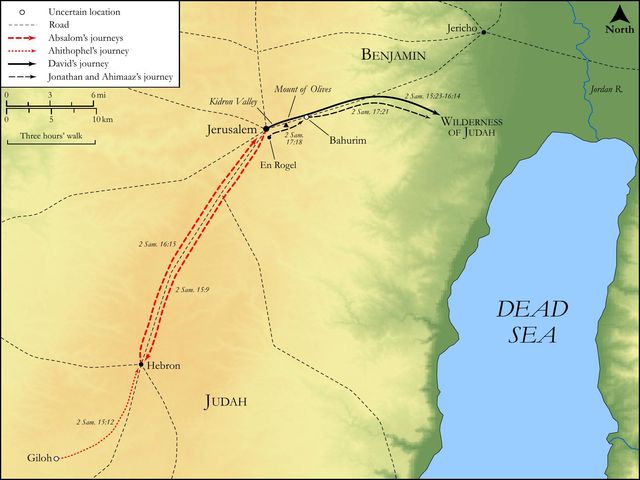
I.The place he chose for the rendezvous of his party was Hebron, the place where he was born and where his father began his reign and continued it several years, which would give some advantage to his pretensions. Every one knew Hebron to be a royal city; and it lay in the heart of Judah's lot, in which tribe, probably, he thought his interest strong.
II.The pretence he had both to go thither and to invite his friends to him there was to offer a sacrifice to God, in performance of a vow he had made during his banishment, Sa2 15:7, Sa2 15:8. We have cause enough to suspect that he had not made any such vow; it does not appear that he was so religiously inclined. But he that stuck not at murder and treason would not make conscience of a lie to serve his purpose. If he said he had made such a vow, nobody could disprove him. Under this pretence,
1.He got leave of his father to go to Hebron. David would be well pleased to hear that his son, in his exile, was so desirous to return to Jerusalem, not only his father's city, but the city of the living God, - that he looked up to God, to bring him back, - that he had vowed, if he were brought back, to serve the Lord, whose service he had hitherto neglected, - and that now, being brought back, he remembered his vow, and resolved to perform it. If he think fit to do it in Hebron, rather than in Sion or Gibeon, the good king is so well pleased with the thing itself that he will not object against his choice of the place. See how willing tender parents are to believe the best concerning their children, and, upon the least indication of good, to hope, even concerning those that have been untoward, that they will repent and reform. But how easy is it for children to take advantage of their good parents' credulity, and to impose upon them with the show of religion, while still they are what they were! David was overjoyed to hear that Absalom inclined to serve the Lord, and therefore readily gave him leave to go to Hebron, and to go thither with solemnity.
2.He got a good number of sober substantial citizens to go along with him, Sa2 15:11. There went 200 men, probably of the principal men of Jerusalem, whom he invited to join with him in his feast upon his sacrifice; and they went in their simplicity, not in the least suspecting that Absalom had any bad design in this journey. He knew that it was to no purpose to tempt them into his plot: they were inviolably firm to David. But he drew them in to accompany him, that the common people might think that they were in his interest, and that David was deserted by some of his best friends. Note, It is no new thing for very good men, and very good things, to be made use of by designing men to put a colour upon bad practices. When religion is made a stalking-horse, and sacrifice a shoeing-horn, to sedition and usurpation it is not to be wondered at if some that were well affected to religion, as these followers of Absalom here, are imposed upon by the fallacy, and drawn in to give countenance to that, with their names, which in their heart they abhor, not having known the depths of Satan.
III.The project he laid was to get himself proclaimed king throughout all the tribes of Israel upon a signal given, Sa2 15:10.
Spies were sent abroad, to be ready in every country to receive the notice with satisfaction and acclamations of joy, and to make the people believe that the news was both very true and very good, and that they were all concerned to take up arms for their new king. Upon the sudden spreading of this proclamation, "Absalom reigns in Hebron," some would conclude that David was dead, others that he had resigned: and thus those that were in the secret would draw in many to appear for Absalom, and to come into his assistance, who, if they had rightly understood the matter, would have abhorred the thought of it, but, being drawn in, would adhere to him. See what artifices ambitious men use for the compassing of their ends; and in matters of state, as well as in matters of religion, let us not be forward to believe every spirit, but try the spirits.
IV.The person he especially courted and relied upon in this affair was Ahithophel, a politic thinking man, and one that had a clear head and a great compass of thought, that had been David's counsellor, his guide and his acquaintance (Psa 55:13), his familiar friend, in whom he trusted, who did eat of his bread, Psa 41:9. But, upon some disgust of David's against him, or his against David, he was banished, or retired from public business, and lived privately in the country. How should a man of such good principles as David, and a man of such corrupt principles as Ahithophel, long agree? A fitter tool Absalom could not find in all the kingdom than one that was so great a statesman, and yet was disaffected to the present ministry. While Absalom was offering his sacrifices, in performance of his pretended vow, he sent for this man. So much was his heart on the projects of his ambition that he could not stay to make an end of his devotion, which showed what his eye was upon in all, and that it was but for a pretence that he made long offerings.
V.The party that joined with him proved at last very considerable.
The people increased continually with Absalom, which made the conspiracy strong and formidable. Every one whom he had complimented and caressed (pronouncing his matters right and good, especially if afterwards the cause went against him) not only came himself, but made all the interest he could for him, so that he wanted not for numbers. The majority is no certain rule to judge of equity by. All the world wondered after the beast. Whether Absalom formed this design merely in the height of his ambition and fondness to rule, or whether there was not in it also malice against his father and revenge for his banishment and confinement, though this punishment was so much less than he deserved, does not appear. But, generally, that which aims at the crown aims at the head that wears it.
Continue studying 2 Samuel 15:8 across the web’s major study libraries — every link below opens this exact verse, chapter, or book on the destination site.
Read & Compare
 BibleGatewayThis verse in more than 200 translations and 70 languages.
 Bible.comThe YouVersion reader — hundreds of translations, reading plans, and highlights.
 ESV.orgCrossway's official English Standard Version reader.
 NET BibleThe NET translation with 60,000+ translators' notes on every rendering decision.
 STEP BibleTyndale House's free study tool — original text, vocabulary, and scholarly resources.
 BibliaLogos Bible Software's free web reader.
 USCCBThe New American Bible (Revised Edition) with the U.S. bishops' study notes.
Commentaries
 BibleHub CommentariesDozens of classic commentaries on this verse, gathered on one page.
 StudyLightMore than 100 commentary sets — the largest collection on the web.
 BibleRefPlain-English commentary on what this verse means, verse by verse.
 Enduring WordDavid Guzik's free commentary on this chapter, widely used by Bible teachers.
 Bible Study ToolsVerse commentary alongside Greek and Hebrew study aids.
Original Language & Research
- BibleHub InterlinearThe verse word by word — original language, transliteration, and English.
- BibleHub LexiconEvery word's original-language definition and Strong's entry.
 Blue Letter BibleDeep-study tools — Strong's numbers, concordance, and word studies.
 SefariaThe Hebrew text with Rashi and centuries of Jewish commentary.
Sermons, Hymns & Audio


TrulyRandomVerse is not affiliated with these sites and doesn’t control their content. They’re linked because they’re genuinely useful.
Summary
In 2 Samuel 15:8, Absalom, King David's son, cunningly seeks permission from his father to travel to Hebron, fabricating a solemn vow he claims to have made during his exile in Geshur. He asserts that if the LORD would graciously restore him to Jerusalem, he would offer worship and dedicated service. This feigned piety serves as a calculated stratagem, providing a religious pretext for his departure to Hebron, which he intends to use as the staging ground for his rebellion against David's throne. The verse marks a pivotal moment, exposing Absalom's profound deception and setting in motion the tragic events of a civil war that would deeply wound both the royal family and the nation of Israel.
Context
ShowHideLiterary Context
This verse is strategically placed at the climax of Absalom's meticulous plot to usurp his father's kingdom. It follows a period of calculated public relations, during which Absalom systematically undermined David's authority and "stole the hearts of the men of Israel" (2 Samuel 15:6). Absalom had been exiled for three years in Geshur after murdering his half-brother Amnon (2 Samuel 13:38), and upon his return to Jerusalem, remained estranged from David for two more years (2 Samuel 14:28). Their eventual reconciliation (2 Samuel 14:33) provided Absalom the proximity he needed to execute his plan. Verse 8, therefore, represents Absalom's final, deceptive maneuver to secure his father's unsuspecting consent for his departure to Hebron, the chosen launchpad for his coup, thereby transforming his covert machinations into open rebellion.
Historical & Cultural Context
The practice of making vows (Hebrew: neder) was a deeply ingrained and highly respected religious and social custom in ancient Israel. Such vows were voluntary but considered absolutely binding promises made to God, often in exchange for divine favor, during times of distress, or as expressions of profound devotion (Numbers 30:2). Absalom's claim to have made such a vow "while I abode at Geshur in Syria" was a shrewd manipulation of this cultural reverence for sacred commitments. Geshur was a small Aramean kingdom where Absalom had found refuge with his maternal grandfather, King Talmai, after his fratricide. The destination, Hebron, held immense historical and religious significance as David's first capital, where he was anointed king over Judah (2 Samuel 2:1-4). Its traditional ties to the southern tribes and its status as a city of priestly importance made it an ideal location for Absalom to gather support and initiate a rebellion under the guise of religious pilgrimage.
Key Themes
ShowHideThis verse powerfully illuminates several critical themes within the broader narrative of 2 Samuel and the Davidic monarchy. Central to the passage is Deception and Hypocrisy, as Absalom cloaks his treasonous intentions beneath the veneer of a sacred religious act—a vow to "serve the LORD." This highlights the profound danger of outward religious observance devoid of inner sincerity, a warning frequently echoed by the prophets against superficial worship (Isaiah 29:13). Another prominent theme is the Manipulation of Faith and Trust, where Absalom ruthlessly exploits King David's respect for religious obligations to gain permission for his nefarious plot. This demonstrates how spiritual acts and genuine piety can be perverted and weaponized for personal, ungodly gain. Finally, the verse underscores Absalom's Ruthless Ambition and Usurpation, revealing his willingness to employ any means, including the most pious pretense, to seize power from his father, thereby setting the stage for a devastating civil war that would tear apart the kingdom and inflict deep wounds upon David's family.
Exposition and Analysis
ShowHideKey Word Analysis
ShowHideThis primitive root means "to promise (positively, to do or give something to God)" or "to make a vow." In ancient Israel, a vow was a voluntary but solemn and binding commitment made before God, often in a time of distress or in exchange for divine favor. The act of "vowing" underscored a deep personal pledge, implying a direct covenant with the Almighty. Absalom's use of this term, especially in the cognate accusative construction "vowed a vow" (Hebrew, nādar neder), emphasizes the supposed solemnity and binding nature of the oath he claims to have made, serving as a deliberate appeal to David's religious sensibilities and a calculated attempt to appear devout and trustworthy.
This primitive root means "to work (in any sense)," and by implication, "to serve," "till," or "enslave." In a religious context, particularly when combined with "the LORD," it specifically denotes acts of worship, sacrifice, and obedience to God's commands. Absalom's promise to "serve the LORD" implies an intention to offer sacrifices, make offerings, or engage in some form of dedicated worship in Jerusalem. The profound irony lies in the fact that his true intention is not to serve God, but to serve his own ambition by overthrowing God's anointed king, thus perverting the very meaning of true service.
Derived from the Hebrew root meaning "to be" or "to exist," this is the proper name of God in the Old Testament, often translated as "the self-Existent or Eternal." It is the covenant name of God, revealing His personal, relational, and unchanging nature. Absalom's invocation of "the LORD" lends an air of spiritual legitimacy to his fabricated vow, appealing to David's reverence for God's name and His sovereign will. By framing his return and subsequent service as divinely orchestrated, Absalom subtly attempts to sanctify his ulterior motives and manipulate David's faith.
Verse Breakdown
ShowHide"For thy servant vowed a vow"
Absalom begins with a feigned humility, referring to himself as "thy servant," a common deferential address to a king, while simultaneously asserting a solemn religious commitment. This opening phrase immediately establishes a tone of piety and submission, designed to disarm David and make his request seem legitimate and spiritually motivated. The "vow" is the fabricated pretense for his departure, a sacred obligation he claims he must fulfill.
"while I abode at Geshur in Syria"
This clause specifies the time and place of the supposed vow. Absalom strategically places the vow during his period of exile, a time when he would have been vulnerable, isolated, and potentially seeking divine intervention for his return to Jerusalem. This detail adds a layer of credibility to his claim, as it connects the vow to a period of personal distress and dependence on God's mercy, making it appear more authentic and religiously motivated.
"saying, If the LORD shall bring me again indeed to Jerusalem"
This is the conditional part of Absalom's alleged vow. It frames his return to Jerusalem not as a result of David's forgiveness or political maneuvering, but as a direct, providential act of God. By attributing his potential restoration to the LORD's direct intervention, Absalom further elevates the spiritual significance of his request and subtly reinforces the idea that his presence in Jerusalem is divinely sanctioned, making his subsequent "service" a necessary act of thanksgiving.
"then I will serve the LORD"
This is the promised fulfillment of the vow, the religious obligation Absalom claims he must now discharge. The act of "serving the LORD" could involve offering sacrifices, making offerings, or engaging in acts of worship. This promise is the ultimate justification for his request to go to Hebron, as it frames his journey as a pilgrimage of devotion rather than a strategic move for rebellion, thereby securing David's unsuspecting consent.
Literary Devices
ShowHideThe verse is saturated with Irony, particularly dramatic irony, as the audience is acutely aware of Absalom's true, treacherous intentions, while King David remains tragically oblivious to his son's profound deceit. Absalom's pious language about "vowing a vow" and promising to "serve the LORD" stands in stark contrast to his actual plot to usurp the throne, creating a palpable sense of dramatic tension and foreboding. There is significant Foreshadowing embedded in Absalom's deceptive words; his request to go to Hebron, ostensibly for religious purposes, clearly foreshadows the initiation of his rebellion from that very city, marking it as the strategic launchpad for his coup. Furthermore, Absalom employs Euphemism and Pretense, using the language of religious devotion and humble servitude to mask his underlying ambition and treason. His self-designation as "thy servant" is a profound verbal irony, as he is anything but a loyal servant, actively plotting against his king and father. The verse also evokes a sense of Pathos for David, who, in his eagerness for reconciliation and perhaps his own spiritual earnestness, is easily manipulated by his son's calculated show of piety, leading him unwittingly into a devastating family and national crisis.
Theological and Thematic Connections
ShowHide2 Samuel 15:8 serves as a stark biblical warning against the profound dangers of religious hypocrisy and the perversion of sacred acts for personal, ungodly gain. Absalom's manipulative vow highlights the crucial distinction between outward religious performance and the genuine, sincere devotion of the heart that God truly desires. Theologically, the passage underscores God's unwavering demand for integrity and truth in worship, contrasting Absalom's superficial piety with the authentic service that flows from a transformed heart and a spirit of obedience. It stands as a cautionary tale against using spiritual language or practices as a mask for selfish ambition or as a tool for manipulation, reminding believers that God sees beyond mere external displays to the deepest motives of the heart. This narrative challenges us to critically examine our own spiritual practices, ensuring they are rooted in authentic love and reverence for God, rather than being a means to achieve worldly ends or to deceive others.
Reflection and Application
ShowHideAbsalom's deceptive vow in 2 Samuel 15:8 offers a profound and timeless lesson on the critical importance of integrity in every aspect of our spiritual lives. It compels us to look beyond outward appearances and to diligently discern the true motives behind religious actions, both in ourselves and in those around us. We are called to cultivate a faith that is not merely performative, opportunistic, or a means to an end, but one that is deeply rooted in sincerity, authenticity, and genuine devotion to God. This passage serves as a powerful reminder that true service to the LORD is never a bargaining chip for personal gain or a cloak for ulterior motives, but rather a heartfelt response of love, gratitude, and obedience flowing from a transformed inner being. Absalom's story stands as a sober warning against the spiritual peril of hypocrisy, urging us to constantly examine whether our words and actions truly align with the true condition and intentions of our hearts. It prompts us to ask ourselves if we are genuinely seeking to honor God above all else, or if we are subtly, perhaps even unconsciously, using the language and practices of faith to advance our own agendas, gain favor, or manipulate circumstances for personal benefit.
Questions for Reflection
ShowHideFAQ
ShowHideWhy did Absalom choose Hebron as the starting point for his rebellion?
ShowHideAbsalom chose Hebron for several strategic and symbolic reasons. Firstly, it was King David's initial capital, where he was first anointed king over the tribe of Judah (2 Samuel 2:1-4). This gave Hebron immense historical and symbolic significance, allowing Absalom to tap into lingering loyalties or resentments from David's early reign, particularly among the southern tribes. Secondly, Hebron was a major city in Judah, Absalom's own tribe (through his mother, Maacah, though she was a Geshurite princess). This provided him with a natural base of support, especially among those who might have felt overlooked by David's shift of the capital to Jerusalem. Thirdly, Hebron was a city of refuge and a Levitical city, giving it a religious veneer that Absalom could exploit for his deceptive vow. Its location also provided a good staging ground for gathering forces before marching on Jerusalem, which was further north.
What was the significance of making a vow in ancient Israelite culture?
ShowHideIn ancient Israel, a vow (Hebrew: neder) was a solemn and binding promise made directly to God, often conditional upon divine favor (e.g., for deliverance from distress) or as an expression of gratitude or devotion. Vows were considered extremely serious and sacred commitments, and breaking them was regarded as a grave offense against God (Deuteronomy 23:21-23). They could involve abstaining from certain things (like the Nazirite vow, Numbers 6:1-21), offering specific sacrifices, or dedicating property or service to the LORD. Absalom's feigned vow to "serve the LORD" was meticulously designed to appeal to David's deep respect for such sacred commitments, thereby making his request to go to Hebron seem religiously imperative and beyond suspicion, a truly cunning manipulation of cultural and spiritual norms.
How does this verse contribute to our understanding of Absalom's character?
ShowHideThis verse is pivotal in revealing the manipulative and profoundly deceitful core of Absalom's character. It portrays him as a cunning strategist who is willing to exploit sacred religious practices and his father's trust as mere tools for his own ambitious and treasonous ends. His feigned piety demonstrates a shocking lack of integrity and a ruthless willingness to manipulate David's religious sensibilities and paternal affection. This act of hypocrisy, following his calculated efforts to win the people's hearts by undermining David's justice system (2 Samuel 15:1-6), paints a comprehensive picture of Absalom as a self-serving and ruthless individual, driven by an insatiable desire for power at any cost, even at the expense of family bonds, national unity, and spiritual truth.
Christ-Centered Fulfillment
ShowHideAbsalom's manipulative vow in 2 Samuel 15:8 stands in stark and profound contrast to the perfect integrity, genuine service, and ultimate sacrifice of Jesus Christ. Absalom, a son of David, sought to usurp his father's earthly throne through calculated deception and a false show of piety, ultimately leading to division, bloodshed, and his own demise. His "service" to the LORD was a cynical ruse for self-exaltation and the seizure of temporal power. In breathtaking contrast, Jesus, the true Son of David and the rightful, eternal King of Israel, came not to be served, but to serve, and to give his life as a ransom for many (Mark 10:45). While Absalom feigned a vow to gain earthly power, Christ truly "emptied himself, by taking the form of a servant" (Philippians 2:7), fulfilling the will of His Father in perfect obedience, truth, and humility. His "service to the LORD" was not a manipulative act but a complete and sacrificial offering of Himself on the cross, establishing a kingdom not of this world (John 18:36), a kingdom built on righteousness, grace, and genuine love, utterly devoid of the hypocrisy, ambition, and self-interest that characterized Absalom. In Christ, we witness the true fulfillment of what it means to serve the LORD, not through outward show or deceptive vows, but through inward transformation and an obedient, self-giving love that leads to eternal life and reconciliation, not rebellion.