


2 Samuel 13:37
Bible text: King James Version (1769 Blayney text) · Public domain
Bible text: Berean Standard Bible · Public domain
Bible text: American Standard Version (1901) · Public domain
Bible text: World English Bible, Messianic edition · Public domain
Bible text: Geneva Bible (1599) · Public domain
Bible text: Young's Literal Translation · Public domain
- וְאַבְשָׁלוֹםve·'av·sha·Lomand AbsalomH53Conj-w ¦ N-proper-mNoun Proper MasculineוְandאַבְשָׁלוֹםAbsalom
- בָּרַחba·Rachhe fledH1272V-Qal-Perf-3msVerb Qal Perfect 3rd Singular Masculine
- וַיֵּלֶךְvai·Ye·lekhand he wentH1980Conj-w ¦ V-Qal-ConsecImperf-3msVerb Qal Consecutive Imperfect 3rd Singular Masculineוַandיֵּלֶךְhe went
- אֶל'eltoH413PrepPreposition
- תַּלְמַיtal·MaiTalmaiH8526N-proper-mNoun Proper Masculine
- בֶּןben[the] son ofH1121N-mscNoun Singular Masculine Construct
- עַמִּיהוּדa·mi·churAmmihudH5989N-proper-mNoun Proper Masculine
- מֶלֶךְMe·lekh[the] king ofH4428N-mscNoun Singular Masculine Construct
- גְּשׁוּרge·ShurGeshurH1650N-properNoun Proper Location
- וַיִּתְאַבֵּלvai·yit·'a·Beland he mournedH56Conj-w ¦ V-Hithpael-ConsecImperf-3msVerb Hithpael Consecutive Imperfect 3rd Singular Masculineוַandיִּתְאַבֵּלhe mourned
- עַל'alonH5921PrepPreposition
- בְּנוֹbe·Nohis sonH1121N-msc ¦ 3msNoun Singular Masculine Constructבְּנsonוֹhis
- כָּלkolallH3605N-mscNoun Singular Masculine Construct
- הַיָּמִיםhai·ya·Mimthe daysH3117Art ¦ N-mpNoun Plural Masculine Absoluteהַtheיָּמִיםdays
English is a literal word-by-word gloss of the Hebrew, not the KJV's wording. Why?
This is the original text the KJV's translators worked from — each Hebrew word with its own literal English meaning in this verse, prepared by scholars at Tyndale House, Cambridge. The KJV translates whole sentences, not word by word, so its wording differs: one Hebrew word can become several English words, and the KJV may choose “the LORD” where the gloss reads “Yahweh”. Both are faithful — they answer different questions. For the KJV's own rendering, switch to the KJV text.
Details
See on the biblical-era maps
Study this verse
Public-domain commentary
Matthew Henry
From his Commentary on the Whole Bible. Henry comments on passages, not single verses — this entry covers 2 Samuel 13:30–39.
Here is, I. The fright that David was put into by a false report brought to Jerusalem that Absalom had slain all the king's sons, Sa2 13:30. It is common for fame to make bad worse; and the first news of such a thing as this represents it as more dreadful than afterwards it proves. Let us not therefore be afraid of evil tidings, while they want confirmation, but, when we hear the worst, hope the best, at least hope better. However, this false news gave as much affliction to David, for the present, as if it had been true; he tore his garments, and lay on the earth, while as yet it was only a flying story, Sa2 13:31. It was well that David had grace; he had need enough of it, for he had strong passions.
II.The rectifying of the mistake in two ways:
- 1. By the sly suggestions of Jonadab, David's nephew, who could tell him, Amnon only is dead, and not all the king's sons (Sa2 13:32, Sa2 13:33), and could tell him too that it was done by the appointment of Absalom, and designed from the day Amnon forced his sister Tamar. What a wicked man was he, if he knew all this or had any cause to suspect it, that he did not make David acquainted with it sooner, that means might be used to make up the quarrel, or at least that David might not throw Amnon into the mouth of danger by letting him go to Absalom's house. If we do not our utmost to prevent mischief, we make ourselves accessory to it. If we say, Behold, we knew it not; doth not he that pondereth the heart consider whether we did or no? See Pro 24:11, Pro 24:12. It is well if Jonadab was not as guilty of Amnon's death as he was of his sin; such friends do those prove who are hearkened to as counsellors to do wickedly: he that would not be so kind as to prevent Amnon's sin would not be so kind as to prevent his ruin, when, it should seem, he might have done both. 2. By the safe return of all the king's sons except Amnon. They and their attendants were speedily discovered by the watch (Sa2 13:34, Sa2 13:35), and soon arrived, to show themselves alive, but to bring the certain sad news that Absalom had murdered their brother Amnon. The grief David had been in for that which was not made him the better able to bear that which was, by giving him a sensible occasion, when he was undeceived, to thank God that all his sons were not dead: yet that Amnon was dead, and slain by his own brother is such a treacherous barbarous manner, was enough to put the king and court, the king and kingdom, into real mourning. Sorrow is never more reasonable than when there is sin in the case.
III.Absalom's flight from justice:
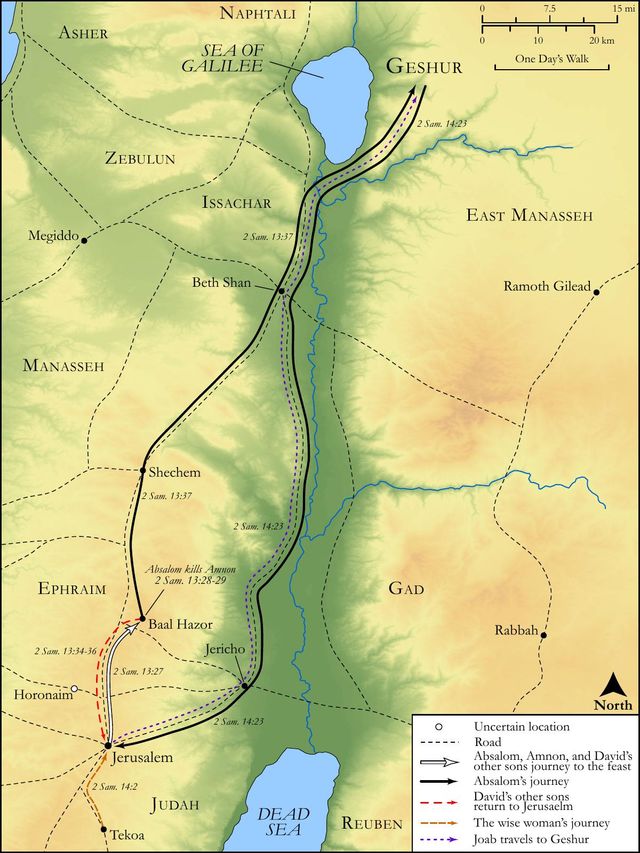
Absalom immediately fled, Sa2 13:34. He was now as much afraid of the king's sons as they were of him; they fled from his malice, he from their justice. No part of the land of Israel could shelter him. The cities of refuge gave no protection to a wilful murderer. Though David had let Amnon's incest go unpunished, Absalom could not promise himself his pardon for this murder; so express was the law in this case, and so well known David's justice, and his dread of blood-guiltiness. He therefore made the best of his way to his mother's relations, and was entertained by his grandfather Talmai, king of Geshur (Sa2 13:37), and there he was protected three years (Sa2 13:38), David not demanding him, and Talmai not thinking himself obliged to send him back unless he were demanded.
IV.David's uneasiness for his absence.
He mourned for Amnon a good while (Sa2 13:37), but, he being past recall, time wore off that grief: he was comforted concerning Amnon. It also wore off too much his detestation of Absalom's sin; instead of loathing him as a murderer, he longs to go forth to him, Sa2 13:39. At first he could not find in his heart to do justice on him; now he can almost find in his heart to take him into his favour again. This was David's infirmity. Something God saw in his heart that made a difference, else we should have thought that he, as much as Eli, honoured his sons more than God.
Historical interpretation
Historical reception
1 surviving comment on this verse from the historical church.
This is the first introduction of divine punishment; the first but not the only one. A long series of great tribulations followed, and an almost unending succession of misfortunes scarcely left his house. Tamar was corrupted by the madness of Amnon, and Amnon was slain by Absalom. A grave crime was committed by one brother, but it was avenged more grievously by the other. In this way David, the father, was punished for the crimes of both. Two sons sinned, but three suffered for the crime of two; Tamar lost her virginity, and the loss of Absalom was mourned in Amnon. Indeed, you cannot tell for which of these two sons the loving father mourned more grievously: for him who was slain in this world by his brother’s hand [Amnon] or for him who perished in the next because of killing by his own hand [Absalom].
Continue studying 2 Samuel 13:37 across the web’s major study libraries — every link below opens this exact verse, chapter, or book on the destination site.
Read & Compare
 BibleGatewayThis verse in more than 200 translations and 70 languages.
 Bible.comThe YouVersion reader — hundreds of translations, reading plans, and highlights.
 ESV.orgCrossway's official English Standard Version reader.
 NET BibleThe NET translation with 60,000+ translators' notes on every rendering decision.
 STEP BibleTyndale House's free study tool — original text, vocabulary, and scholarly resources.
 BibliaLogos Bible Software's free web reader.
 USCCBThe New American Bible (Revised Edition) with the U.S. bishops' study notes.
Commentaries
 BibleHub CommentariesDozens of classic commentaries on this verse, gathered on one page.
 StudyLightMore than 100 commentary sets — the largest collection on the web.
 BibleRefPlain-English commentary on what this verse means, verse by verse.
 Enduring WordDavid Guzik's free commentary on this chapter, widely used by Bible teachers.
 Bible Study ToolsVerse commentary alongside Greek and Hebrew study aids.
Original Language & Research
- BibleHub InterlinearThe verse word by word — original language, transliteration, and English.
- BibleHub LexiconEvery word's original-language definition and Strong's entry.
 Blue Letter BibleDeep-study tools — Strong's numbers, concordance, and word studies.
 SefariaThe Hebrew text with Rashi and centuries of Jewish commentary.
Sermons, Hymns & Audio


TrulyRandomVerse is not affiliated with these sites and doesn’t control their content. They’re linked because they’re genuinely useful.
Summary
Following his calculated and brutal murder of his half-brother Amnon, Absalom, King David's third son, sought refuge in Geshur, the kingdom of his maternal grandfather, Talmai. This act of vengeance and subsequent flight fractured David's royal household, plunging the king into a profound and continuous state of grief, as he mourned not only the loss of one son but also the effective banishment and moral corruption of another.
Context
ShowHideLiterary Context
This verse marks the immediate aftermath of one of the most tragic and pivotal events in David's family history, detailed in 2 Samuel 13. Amnon, David's firstborn, had committed a heinous act of sexual violence against his half-sister Tamar, Absalom's full sister, as recounted in 2 Samuel 13:1-19. Absalom, harboring a deep and patient vengeance, waited two full years before orchestrating Amnon's assassination during a sheep-shearing feast, as described in 2 Samuel 13:23-29. Absalom's flight to Geshur is a direct consequence of this fratricide, serving as a temporary escape from David's wrath and setting the stage for his eventual return and subsequent rebellion against his father. The narrative underscores the escalating dysfunction and violence within David's household, a direct and painful fulfillment of Nathan's prophecy concerning the "sword" never departing from David's house due to his own sin with Bathsheba, as foretold in 2 Samuel 12:10.
Historical & Cultural Context
Geshur was a small Aramaean kingdom located east of the Jordan River, in the region of Bashan. Absalom's mother, Maacah, was the daughter of Talmai, king of Geshur, as noted in 2 Samuel 3:3. Fleeing to his maternal grandfather's kingdom provided Absalom with a safe haven, a place of asylum where he would be protected by strong familial ties and a political alliance. This was a common practice among the nations for individuals seeking refuge from royal justice or blood vengeance, as when Moses fled from the face of Pharaoh into the land of Midian. The act of seeking refuge with a foreign monarch also highlights the intricate political complexities of the time, where intermarriage between royal families created complex networks of kinship and obligation. David's inability or unwillingness to immediately pursue Absalom also reflects the cultural sanctity of such asylum, as well as the deep personal anguish that likely paralyzed his response, leaving him in a state of profound grief.
Key Themes
ShowHideThis verse powerfully illustrates several enduring themes within the broader narrative of David's reign. Firstly, it highlights the devastating consequences of sin, particularly the ripple effects of David's own transgressions that now manifest in the horrific actions of his children. The "sword" prophesied by Nathan had indeed entered David's house, bringing incest, murder, and internal strife, demonstrating that divine judgment, while often tempered with mercy, carries lasting temporal consequences. Secondly, it explores the profound and complex nature of parental grief. Despite Absalom's heinous act of fratricide, David's heart is broken, demonstrating a love that transcends even the gravest betrayal. His continuous mourning ("every day") underscores the depth of his sorrow, not only for Amnon's death but also for Absalom's banishment and the shattered state of his family. Finally, the theme of exile and separation is prominent, as Absalom's flight to Geshur signifies a period of self-imposed banishment, setting the stage for future political and familial conflicts that will further destabilize David's reign and ultimately lead to Absalom's rebellion and tragic end, as vividly depicted in 2 Samuel 15.
Exposition and Analysis
ShowHideKey Word Analysis
ShowHideThis verb, derived from a primitive root meaning "to bolt," signifies a sudden and urgent escape, often implying a hasty departure to avoid danger or capture. In this context, it emphasizes Absalom's immediate and decisive action to evade the consequences of his fratricide, highlighting his desperation and the calculated nature of his flight to Geshur.
This primitive root signifies to bewail, lament, or mourn. It describes a profound internal and external expression of distress, indicating that David's grief was not a fleeting emotion but a consuming, pervasive state of being. It suggests a deep process of lament and a heavy burden of sorrow that weighed continuously upon him, reflecting the immense personal cost of the tragedy.
While the literal meaning is "day," when used in the phrase "every day" (Hebrew: kol hayyôm), it emphasizes the continuous, persistent, and unceasing nature of David's mourning. This intensifier underscores that his sorrow was not episodic but a constant companion, a daily burden that permeated his existence, demonstrating the depth and longevity of his emotional wound.
Verse Breakdown
ShowHide"But Absalom fled, and went to Talmai, the son of Ammihud, king of Geshur."
This clause details Absalom's immediate action after orchestrating Amnon's murder. His flight is an act of self-preservation and calculated evasion of justice. His destination, Geshur, is significant because it is the kingdom of his maternal grandfather, Talmai, offering him a place of familial refuge and political asylum, effectively placing him beyond David's immediate reach. This act of fleeing marks a definitive break from the royal court and initiates a period of exile that will last three years.
"And [David] mourned for his son every day."
This clause shifts focus to King David's reaction. The subject "David" is implied in the Hebrew, making his personal anguish central. His mourning is not merely for Amnon, the slain son, but also for Absalom, the son who has become a murderer and a fugitive. The phrase "every day" powerfully conveys the persistent, unremitting nature of his grief, indicating a profound and lasting wound to his soul and family, a constant reminder of the "sword" that had not departed from his house.
Literary Devices
ShowHideThe verse employs several literary devices to convey its profound emotional and narrative weight. Pathos is powerfully evident in the description of David's continuous mourning, evoking deep sympathy for the king caught in the tragic consequences of his family's dysfunction. The phrase "every day" functions as Hyperbole or Emphasis, underscoring the relentless and pervasive nature of David's sorrow, indicating a constant state of grief rather than a literal 24/7 grieving process. There is also an element of Dramatic Irony, as David mourns for Absalom's separation, unaware that this period of exile is merely a prelude to Absalom's even more devastating rebellion and ultimate demise, which will bring David even greater sorrow. The narrative also uses Foreshadowing, as Absalom's flight and David's deep grief hint at the deeper, unresolved tensions that will eventually erupt into open conflict and further tragedy for the royal family, culminating in Absalom's death.
Theological and Thematic Connections
ShowHideThis verse stands as a poignant testament to the devastating and far-reaching consequences of sin, particularly within the family unit. It illustrates how the choices of individuals, even those in positions of power like David, can unleash a torrent of pain and brokenness that impacts generations. The continuous mourning of David underscores the deep emotional cost of moral failure and the profound sorrow that accompanies fractured relationships. Theologically, it resonates with the principle that "what a person sows, he will also reap," as articulated in Galatians 6:7. Despite God's forgiveness for David's sin with Bathsheba and Uriah, the consequences of that sin, as prophesied by Nathan, continued to unfold within his household, demonstrating that while God extends grace and forgiveness, the natural consequences of actions often persist in the temporal realm, serving as a sobering reminder of sin's destructive power.
Reflection and Application
ShowHideThe profound grief of King David in 2 Samuel 13:37 offers a stark and sobering reflection on the enduring pain that accompanies sin and fractured relationships. It reminds us that even when God forgives, the natural consequences of our actions can cast long shadows, impacting not only ourselves but also those we love most deeply. David's persistent mourning for Absalom, despite Absalom's heinous act, speaks to the complex, often unconditional, and deeply painful nature of parental love. This passage challenges us to consider the long-term ripple effects of our choices, urging us towards integrity, reconciliation, and proactive measures to address conflict and dysfunction within our families and communities. It also invites us to cultivate empathy for those who grieve, recognizing that sorrow can be a continuous burden, and to seek God's wisdom in navigating the complex tapestry of human relationships and the painful realities of a fallen world, trusting in His ultimate sovereignty even amidst suffering.
Questions for Reflection
ShowHideFAQ
ShowHideWhy did Absalom flee to Geshur specifically?
ShowHideAbsalom fled to Geshur because it was the kingdom of his maternal grandfather, Talmai, the son of Ammihud. Absalom's mother, Maacah, was Talmai's daughter, as recorded in 2 Samuel 3:3. This familial connection provided Absalom with a safe haven and political asylum, a common practice among the nations for those seeking refuge from royal justice or blood vengeance. His grandfather's kingdom offered protection and a place where David's immediate authority would not extend, effectively placing Absalom beyond the reach of Israelite law for a period.
Why did David mourn for Absalom, the son who committed murder, "every day"?
ShowHideDavid's profound and continuous mourning for Absalom, despite Absalom's fratricide, highlights the complex and deeply painful nature of parental love. David was grieving not only for the tragic loss of Amnon, his firstborn, but also for the effective loss of Absalom, who was now a fugitive, a murderer, and estranged from the royal family. His sorrow was multifaceted: for the shattered state of his family, for the fulfillment of Nathan's prophecy concerning the "sword" never departing from his house (2 Samuel 12:10), and for the profound brokenness that had entered his royal line. His "every day" mourning signifies a persistent, unremitting burden of grief, a testament to the enduring bond of a father's love, even for a rebellious child, and the deep emotional toll of sin's consequences.
Christ-Centered Fulfillment
ShowHideThe deep sorrow of David, mourning for a son who brought violence and division into his house, profoundly foreshadows the ultimate grief of God the Father, who sent His Son into a world marred by sin and rebellion. While David's family was torn apart by human sin and vengeance, God's perfect plan of redemption unfolded through the willing sacrifice of His own Son, Jesus Christ. David's inability to reconcile his broken family, despite his deep love, stands in stark contrast to Christ's perfect work of reconciliation. Jesus, the true Son of David, did not flee from the consequences of sin but bore them on the cross, taking upon Himself the "sword" of divine judgment that should have fallen upon humanity (Isaiah 53:5). Through His death and resurrection, Christ offers true atonement for sin, healing the deepest wounds of humanity and reconciling us not only to God but also to one another (Colossians 1:20). David mourned the loss and separation of his son, but in Christ, we find the ultimate victory over death and separation, as He promises that those who believe in Him will never perish but have eternal life (John 3:16). Indeed, Jesus Himself wept over the lostness of Jerusalem (Luke 19:41-44), demonstrating a divine sorrow far deeper than David's, yet a sorrow that culminates not in despair but in the hope of redemption.