


2 Samuel 14:23
Bible text: King James Version (1769 Blayney text) · Public domain
Bible text: Berean Standard Bible · Public domain
Bible text: American Standard Version (1901) · Public domain
Bible text: World English Bible, Messianic edition · Public domain
Bible text: Geneva Bible (1599) · Public domain
Bible text: Young's Literal Translation · Public domain
- וַיָּקָםvai·Ya·komand he aroseH6965Conj-w ¦ V-Qal-ConsecImperf-3msVerb Qal Consecutive Imperfect 3rd Singular Masculineוַandיָּקָםhe arose
- יוֹאָבyo·'AvJoabH3097N-proper-mNoun Proper Masculine
- וַיֵּלֶךְvai·Ye·lekhand he wentH1980Conj-w ¦ V-Qal-ConsecImperf-3msVerb Qal Consecutive Imperfect 3rd Singular Masculineוַandיֵּלֶךְhe went
- גְּשׁוּרָהge·Shu·rahGeshur towardsH1650N-proper ¦ SfxNoun Proper LocationגְּשׁוּרָGeshurהtowards
- וַיָּבֵאvai·ya·Ve'and he broughtH935Conj-w ¦ V-Hiphil-ConsecImperf-3msVerb Hiphil Consecutive Imperfect 3rd Singular Masculineוַandיָּבֵאhe brought
- אֶת'et<obj.>H853DirObjMParticle Object Indicator
- אַבְשָׁלוֹם'av·sha·LomAbsalomH53N-proper-mNoun Proper Masculine
- יְרוּשָׁלִָםye·ru·sha·LimJerusalemH3389N-properNoun Proper Location
English is a literal word-by-word gloss of the Hebrew, not the KJV's wording. Why?
This is the original text the KJV's translators worked from — each Hebrew word with its own literal English meaning in this verse, prepared by scholars at Tyndale House, Cambridge. The KJV translates whole sentences, not word by word, so its wording differs: one Hebrew word can become several English words, and the KJV may choose “the LORD” where the gloss reads “Yahweh”. Both are faithful — they answer different questions. For the KJV's own rendering, switch to the KJV text.
Details
See on the biblical-era maps

Study this verse
Public-domain commentary
Matthew Henry
From his Commentary on the Whole Bible. Henry comments on passages, not single verses — this entry covers 2 Samuel 14:21–27. His two-level outline is real structure in the source text, so it is rendered as structure.
Observe here, I. Orders given for the bringing back of Absalom. The errand on which the woman came to David was so agreeable, and her management of it so very ingenious and surprising, that he was brought into a peculiarly kind humour: Go (says he to Joab), bring the young man Absalom again, Sa2 14:21. He was himself inclined to favour him, yet, for the honour of his justice, he would not do it but upon intercession made for him, which may illustrate the methods of divine grace. It is true God has thought of compassion towards poor sinners, not willing that any should perish, yet he is reconciled to them through a Mediator, who intercedes with him on their behalf, and to whom he has given these orders, Go, bring them again. God was in Christ reconciling the world to himself, and he came to this land of our banishment to bring us to God. Joab, having received these orders, 1. Returns thanks to the king for doing him the honour to employ him in an affair so universally grateful, Sa2 14:22. Joab took it as a kindness to himself, and (some think) as an indication that he would never call him to an account for the murder he had been guilty of. But, if he meant so, he was mistaken, as we shall find, Kg1 2:5, Kg1 2:6. 2. Delays not to execute David's orders; he brought Absalom to Jerusalem, Sa2 14:23. I see not how David can be justified in suspending the execution of the ancient law (Gen 9:6), Whoso sheds man's blood, by man shall his blood be shed, in which a righteous magistrate ought not to acknowledge even his brethren, or know his own children. God's laws were never designed to be like cobwebs, which catch the little flies, but suffer the great ones to break through. God justly made Absalom, whom his foolish pity spared, a scourge to him. But, though he allowed him to return to his own house, he forbade him the court, and would not see him himself, Sa2 14:24. He put him under this interdict, (1.) For his own honour, that he might not seem to countenance so great a criminal, nor to forgive him too easily. (2.) For Absalom's greater humiliation. Perhaps he had heard something of his conduct when Joab went to fetch him, which gave him too much reason to think that he was not truly penitent; he therefore put him under this mark of his displeasure, that he might be awakened to a sight of his sin and to sorrow for it, and might make his peace with God, upon the first notice of which, no doubt, David would be forward to receive him again into his favour.
II.Occasion taken hence to give an account of Absalom.
Nothing is said of his wisdom and piety. Though he was the son of such a devout father, we read nothing of his devotion. Parents cannot give grace to their children, though they give them ever so good an education. All that is here said of him is,
1.That he was a very handsome man; there was not his equal in all Israel for beauty, (Sa2 14:25), a poor commendation for a man that had nothing else in him valuable. Handsome are those that handsome do. Many a polluted deformed soul dwells in a fair and comely body; witness Absalom's, that was polluted with blood, and deformed with unnatural disaffection to his father and prince. In his body there was no blemish, but in his mind nothing but wounds and bruises. Perhaps his comeliness was one reason why his father was so fond of him and protected him from justice. Those have reason to fear affliction in their children who are better pleased with their beauty than with their virtue.
2.That he had a very fine head of hair. Whether it was the length, or colour, or extraordinary softness of it, something there was which made it very valuable and very much an ornament to him, Sa2 14:26. This notice is taken of his hair, not as the hair of a Nazarite (he was far from that strictness), but as the hair of a beau. He let it grow till it was a burden to him, and was heavy on him, nor would he cut it as long as ever he could bear it; as pride feels no cold, so it feels no heat, and that which feeds and gratifies it is not complained of, though very uneasy. When he did poll it at certain times, for ostentation he had it weighed, that it might be seen how much it excelled other men's, and it weighed 200 shekels, which some reckon to be three pounds and two ounces of our weight; and with the oil and powder, especially if powdered (as Josephus says the fashion then was) with gold-dust, bishop Patrick thinks it is not at all incredible that it should weigh so much. This fine hair proved his halter, Sa2 18:9.
3.That his family began to be built up. It is probable that it was a good while before he had a child; and then it was that, despairing of having one, he set up that pillar which is mentioned Sa2 18:18, to bear up his name; but afterwards he had three sons and one daughter, Sa2 14:27. Or perhaps these sons, while he was hatching his rebellion, were all cut off by the righteous hand of God, and thereupon he set up that monument.
Continue studying 2 Samuel 14:23 across the web’s major study libraries — every link below opens this exact verse, chapter, or book on the destination site.
Read & Compare
 BibleGatewayThis verse in more than 200 translations and 70 languages.
 Bible.comThe YouVersion reader — hundreds of translations, reading plans, and highlights.
 ESV.orgCrossway's official English Standard Version reader.
 NET BibleThe NET translation with 60,000+ translators' notes on every rendering decision.
 STEP BibleTyndale House's free study tool — original text, vocabulary, and scholarly resources.
 BibliaLogos Bible Software's free web reader.
 USCCBThe New American Bible (Revised Edition) with the U.S. bishops' study notes.
Commentaries
 BibleHub CommentariesDozens of classic commentaries on this verse, gathered on one page.
 StudyLightMore than 100 commentary sets — the largest collection on the web.
 BibleRefPlain-English commentary on what this verse means, verse by verse.
 Enduring WordDavid Guzik's free commentary on this chapter, widely used by Bible teachers.
 Bible Study ToolsVerse commentary alongside Greek and Hebrew study aids.
Original Language & Research
- BibleHub InterlinearThe verse word by word — original language, transliteration, and English.
- BibleHub LexiconEvery word's original-language definition and Strong's entry.
 Blue Letter BibleDeep-study tools — Strong's numbers, concordance, and word studies.
 SefariaThe Hebrew text with Rashi and centuries of Jewish commentary.
Sermons, Hymns & Audio


TrulyRandomVerse is not affiliated with these sites and doesn’t control their content. They’re linked because they’re genuinely useful.
Summary
Second Samuel 14:23 marks a pivotal moment in David's reign, detailing Joab's successful mission to retrieve Absalom from his three-year exile in Geshur and bring him back to Jerusalem. This verse signifies the culmination of Joab's intricate plan to persuade King David to allow his son's return, a return David deeply desired yet was hesitant to initiate due to Absalom's murder of his half-brother Amnon. While Absalom's physical return to the capital city might seem like a step towards reconciliation, the narrative immediately foreshadows the unresolved tensions and incomplete restoration that would ultimately lead to tragic consequences for David's family and kingdom.
Context
ShowHideLiterary Context
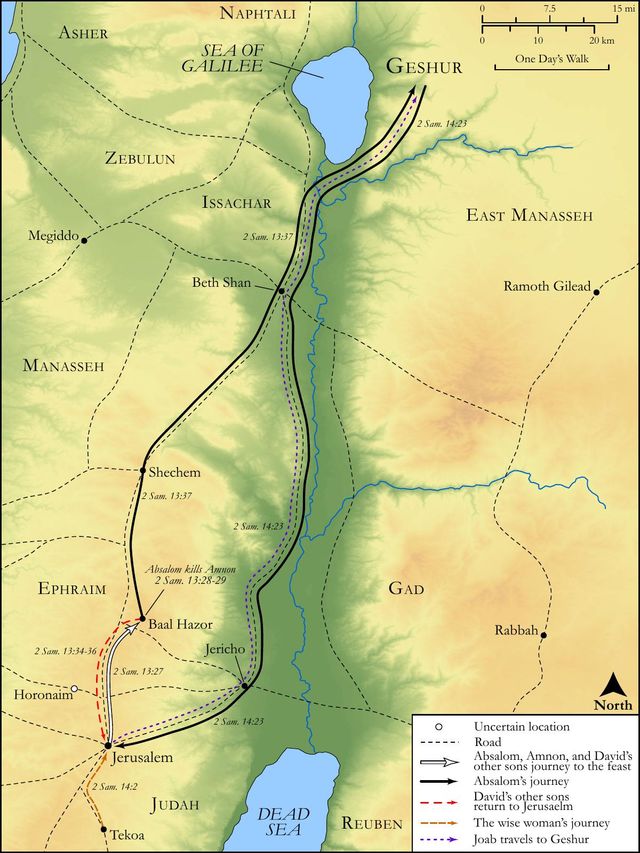
This verse is the direct outcome of a carefully orchestrated narrative designed to facilitate Absalom's return. Absalom had fled to Geshur, his maternal grandfather's kingdom, after meticulously planning and executing the murder of his half-brother Amnon, who had raped their sister Tamar. This act of vengeance is detailed in 2 Samuel 13:28-39. For three years, David grieved both Amnon's death and Absalom's absence, his heart torn by conflicting emotions. Recognizing David's internal conflict and the political void created by the absence of a potential heir, Joab, David's shrewd and pragmatic military commander, intervened. He dispatched a wise woman from Tekoah to present a hypothetical case to David, subtly mirroring David's own dilemma regarding Absalom, as described in 2 Samuel 14:1-20. Her plea for the preservation of a family line, even after a murder, resonated with David. After discerning Joab's hand in the matter, David finally gave his reluctant consent for Absalom's return in 2 Samuel 14:21-22, which 2 Samuel 14:23 then describes as being immediately executed by Joab.
Historical & Cultural Context
In ancient Israel, royal exile, particularly for a prince, was a significant event, often implying a loss of status and a cessation of claims to the throne, though not always irrevocably. Geshur was a small Aramean kingdom situated east of the Jordan River, ruled by Talmai, who was Absalom's maternal grandfather, as noted in 2 Samuel 3:3. This provided Absalom with a safe haven but also isolated him from the political center of power in Jerusalem. The societal norm of blood vengeance (Hebrew: go'el haddam) mandated that the next of kin avenge a murder. David, as king, was the ultimate arbiter of justice, grappling with the demands of justice for Amnon's murder against his profound paternal love for Absalom. Joab's intervention underscores the complex power dynamics within David's court, where influential figures often acted as pragmatic political strategists to maintain stability and influence royal decisions, sometimes even manipulating the king, as seen here and later in the handling of Absalom's rebellion in 2 Samuel 18:9-15.
Key Themes
ShowHideThis verse encapsulates several critical themes woven throughout the narrative of David's reign. Firstly, it powerfully illustrates the King's conflicted heart, deeply torn between the righteous demands of justice for a heinous crime and the profound, personal longing for his estranged son. David's inability to initiate Absalom's return himself speaks volumes about this deep internal struggle. Secondly, it highlights Joab's influential and often morally ambiguous role as David's chief commander. Joab consistently acts as a decisive agent, often taking matters into his own hands to achieve what he perceives as necessary for the kingdom's stability or to fulfill David's unspoken desires, demonstrating his strategic cunning. Thirdly, the verse marks the beginning of a troubled and incomplete reconciliation. While Absalom is physically returned to Jerusalem, the immediate follow-up in 2 Samuel 14:24 reveals David's condition: Absalom was not permitted to see the king's face. This partial restoration—a physical presence without full relational intimacy—sets the ominous stage for the festering resentment and eventual rebellion that would ultimately tear David's kingdom apart, as vividly recounted in 2 Samuel 15:1-12.
Exposition and Analysis
ShowHideKey Word Analysis
ShowHideThis verb, a frequent Hebrew idiom, signifies a decisive and immediate action, often marking the initiation of a new phase or undertaking. In this context, it emphasizes Joab's prompt and resolute obedience to David's command (or reluctant permission). It conveys a sense of purposeful efficiency, highlighting that once the king's will was known, Joab wasted no time in executing the difficult task of retrieving Absalom.
This verb denotes the successful completion of the mission, indicating movement towards a specific destination or objective. It is a simple yet powerful statement, underscoring that Joab not only traveled to Geshur but effectively accomplished the objective of retrieving Absalom and escorting him back to the capital. The directness of the verb emphasizes the efficacy of Joab's intervention and the fulfillment of the king's desire.
The capital city, the seat of David's throne, and the religious and political center of Israel. Absalom's return to Jerusalem is not merely a geographical relocation but a highly symbolic re-entry into the sphere of royal power and influence. However, as subsequent verses reveal, his physical presence in the city does not equate to a full restoration of his place within the royal court or his relationship with his father, the king.
Verse Breakdown
ShowHide"So Joab arose"
This clause immediately highlights Joab's agency and his pivotal role as the instrument of David's will. His "arising" signifies a prompt and purposeful action, immediately following David's reluctant permission for Absalom's return. It underscores Joab's character as a man of action, capable of executing complex and sensitive tasks for the king, often with strategic foresight.
"and went to Geshur"
This phrase details the destination of Joab's mission, emphasizing the distance and the foreign land where Absalom had sought refuge. It signifies the physical journey required to retrieve the exiled prince, a journey into a place of separation and isolation from the kingdom and the royal court.
"and brought Absalom to Jerusalem"
This final clause states the successful completion of Joab's mission. Absalom is physically returned to the capital, the heart of David's kingdom. This marks the end of his three-year exile and his re-entry into the political and social landscape of Israel, albeit under conditions of continued separation from his father, as the subsequent verses will reveal.
Literary Devices
ShowHideThe verse employs Conciseness to convey a momentous event with stark simplicity, allowing the weight of the action to speak for itself without elaborate description. This directness creates a sense of inevitability about Absalom's return. There is also significant Foreshadowing embedded in this seemingly positive development. While Absalom is brought back, the narrative immediately follows with the crucial detail that he was forbidden to see David's face, as revealed in 2 Samuel 14:24. This partial reconciliation, a physical return without true relational restoration, subtly hints at the deeper, unresolved issues that will fester and eventually lead to Absalom's tragic rebellion. The very act of his return, orchestrated by Joab, carries an underlying Irony, given that this desired outcome ultimately precipitates greater conflict and sorrow for David's house and the kingdom.
Theological and Thematic Connections
ShowHideThis verse, while narrating a specific historical event, resonates with profound theological and thematic truths concerning the nature of sin, reconciliation, and divine sovereignty. It illustrates the complex interplay between justice and mercy, particularly within the challenging contexts of leadership and family. David's struggle to fully reconcile with Absalom, despite his deep longing, reflects the tension between the righteous demands of justice for Amnon's heinous murder and the compassionate, paternal desire for his son's restoration. This human dilemma, where full reconciliation is hampered by unresolved issues and partial forgiveness, stands in stark contrast to God's perfect and complete reconciliation offered through Jesus Christ. The narrative implicitly teaches that physical proximity does not equate to true peace or forgiveness; genuine reconciliation requires a deeper process of repentance, forgiveness, and restoration of relationship, a process tragically absent in Absalom's initial return to Jerusalem.
Reflection and Application
ShowHideThe return of Absalom to Jerusalem, meticulously orchestrated by Joab, serves as a poignant and often sobering reminder of the complexities inherent in human relationships, especially after deep hurt, betrayal, and the lingering consequences of sin. It challenges us to consider that reconciliation is frequently a multi-layered process, where physical presence or superficial peace is merely a first step, not the ultimate culmination. True healing and restoration demand a deeper engagement with the underlying issues, genuine repentance from the offending party, and complete, unconditional forgiveness from the one wronged. David's reluctance to fully embrace Absalom, and Absalom's subsequent festering resentment and manipulative actions, vividly illustrate the profound dangers of unresolved conflict and partial reconciliation; such unaddressed wounds can tragically fester and lead to greater devastation than the initial offense. This passage encourages us to be proactive in seeking genuine peace, understanding that avoiding difficult conversations or offering only conditional forgiveness can perpetuate cycles of pain and brokenness. It also prompts us to reflect on the role of intermediaries in our own lives—those who, like Joab, might attempt to bridge divides, for better or worse, and the importance of their motives and methods. Ultimately, we are called to pursue not just the appearance of peace, but the deep, transformative work of true reconciliation, grounded in grace, truth, and genuine heart change.
Questions for Reflection
ShowHideFAQ
ShowHideWhy was Absalom in Geshur in the first place?
ShowHideAbsalom had fled to Geshur, his maternal grandfather's kingdom, to escape the immediate consequences of his actions after he orchestrated the murder of his half-brother Amnon. Amnon had committed a heinous act by raping Absalom's sister Tamar. Absalom waited two years before exacting his revenge by having Amnon killed at a feast he hosted for all the king's sons, as detailed in 2 Samuel 13:28-29. His flight to Geshur was an act of self-preservation and a self-imposed exile from the royal court and the direct wrath of his father, King David.
What was Joab's motivation in bringing Absalom back to Jerusalem?
ShowHideJoab's motivation was multifaceted and deeply strategic. Primarily, he recognized King David's profound and unspoken longing for Absalom's return, despite David's inability to initiate it himself due to the severity of Absalom's crime and the demands of justice. Joab, ever the shrewd political operator and a loyal (though sometimes ruthless) servant of David, understood that Absalom's continued exile created significant political instability within the kingdom and left a dangerous void in the succession line. By bringing Absalom back, Joab aimed to stabilize the kingdom, fulfill the king's unspoken desire, and perhaps even strengthen his own position as a key influencer in the court. His elaborate plan involving the wise woman of Tekoah, detailed in 2 Samuel 14:1-20, demonstrates his strategic thinking, his influence within David's court, and his willingness to take decisive action to achieve his objectives.
Christ-Centered Fulfillment
ShowHideThe narrative of Absalom's troubled return to Jerusalem, orchestrated by Joab, powerfully foreshadows and contrasts with the perfect and complete reconciliation offered through Jesus Christ. Absalom, exiled due to his grievous sin of murder, is brought back to the city but not immediately into the king's presence, signifying a partial, conditional, and ultimately failed restoration that only deepened the rift. In stark contrast, humanity's exile from God, caused by our own sin, is fully and unconditionally ended through the atoning work of Jesus. While Joab acted as a human mediator, imperfect and with mixed motives, Jesus is the divine Mediator who perfectly bridges the infinite chasm between a holy God and sinful humanity. He is the Lamb of God who takes away the sin of the world, whose perfect sacrifice makes full, unmerited reconciliation possible for all who believe. Unlike Absalom's return which, due to unaddressed sin and resentment, tragically led to further rebellion and sorrow, Christ's work brings us into a full, intimate, and eternal relationship with the Father, not merely physical proximity. Through Christ, we are not just brought back to the "city" but are reconciled to God through His death and entrusted with the ministry of reconciliation. He has broken down the dividing wall of hostility and presented us holy and blameless and above reproach before Him, ensuring a complete and eternal welcome into the Father's glorious presence.