


2 Samuel 13:38
Bible text: King James Version (1769 Blayney text) · Public domain
Bible text: Berean Standard Bible · Public domain
Bible text: American Standard Version (1901) · Public domain
Bible text: World English Bible, Messianic edition · Public domain
Bible text: Geneva Bible (1599) · Public domain
Bible text: Young's Literal Translation · Public domain
- וְאַבְשָׁלוֹםve·'av·sha·Lomand AbsalomH53Conj-w ¦ N-proper-mNoun Proper MasculineוְandאַבְשָׁלוֹםAbsalom
- בָּרַחba·Rachhe fledH1272V-Qal-Perf-3msVerb Qal Perfect 3rd Singular Masculine
- וַיֵּלֶךְvai·Ye·lekhand he wentH1980Conj-w ¦ V-Qal-ConsecImperf-3msVerb Qal Consecutive Imperfect 3rd Singular Masculineוַandיֵּלֶךְhe went
- גְּשׁוּרge·ShurGeshurH1650N-properNoun Proper Location
- וַיְהִיvay·hiand he wasH1961Conj-w ¦ V-Qal-ConsecImperf-3msVerb Qal Consecutive Imperfect 3rd Singular Masculineוַandיְהִיhe was
- שָׁםshamthereH8033AdvAdverb
- שָׁלֹשׁsha·LoshthreeH7969N-csNoun Singular common gender Absolute
- שָׁנִיםsha·NimyearsH8141N-mpNoun Plural Masculine Absolute
English is a literal word-by-word gloss of the Hebrew, not the KJV's wording. Why?
This is the original text the KJV's translators worked from — each Hebrew word with its own literal English meaning in this verse, prepared by scholars at Tyndale House, Cambridge. The KJV translates whole sentences, not word by word, so its wording differs: one Hebrew word can become several English words, and the KJV may choose “the LORD” where the gloss reads “Yahweh”. Both are faithful — they answer different questions. For the KJV's own rendering, switch to the KJV text.
Details
See on the biblical-era maps
Study this verse
Public-domain commentary
Matthew Henry
From his Commentary on the Whole Bible. Henry comments on passages, not single verses — this entry covers 2 Samuel 13:30–39.
Here is, I. The fright that David was put into by a false report brought to Jerusalem that Absalom had slain all the king's sons, Sa2 13:30. It is common for fame to make bad worse; and the first news of such a thing as this represents it as more dreadful than afterwards it proves. Let us not therefore be afraid of evil tidings, while they want confirmation, but, when we hear the worst, hope the best, at least hope better. However, this false news gave as much affliction to David, for the present, as if it had been true; he tore his garments, and lay on the earth, while as yet it was only a flying story, Sa2 13:31. It was well that David had grace; he had need enough of it, for he had strong passions.
II.The rectifying of the mistake in two ways:
- 1. By the sly suggestions of Jonadab, David's nephew, who could tell him, Amnon only is dead, and not all the king's sons (Sa2 13:32, Sa2 13:33), and could tell him too that it was done by the appointment of Absalom, and designed from the day Amnon forced his sister Tamar. What a wicked man was he, if he knew all this or had any cause to suspect it, that he did not make David acquainted with it sooner, that means might be used to make up the quarrel, or at least that David might not throw Amnon into the mouth of danger by letting him go to Absalom's house. If we do not our utmost to prevent mischief, we make ourselves accessory to it. If we say, Behold, we knew it not; doth not he that pondereth the heart consider whether we did or no? See Pro 24:11, Pro 24:12. It is well if Jonadab was not as guilty of Amnon's death as he was of his sin; such friends do those prove who are hearkened to as counsellors to do wickedly: he that would not be so kind as to prevent Amnon's sin would not be so kind as to prevent his ruin, when, it should seem, he might have done both. 2. By the safe return of all the king's sons except Amnon. They and their attendants were speedily discovered by the watch (Sa2 13:34, Sa2 13:35), and soon arrived, to show themselves alive, but to bring the certain sad news that Absalom had murdered their brother Amnon. The grief David had been in for that which was not made him the better able to bear that which was, by giving him a sensible occasion, when he was undeceived, to thank God that all his sons were not dead: yet that Amnon was dead, and slain by his own brother is such a treacherous barbarous manner, was enough to put the king and court, the king and kingdom, into real mourning. Sorrow is never more reasonable than when there is sin in the case.
III.Absalom's flight from justice:
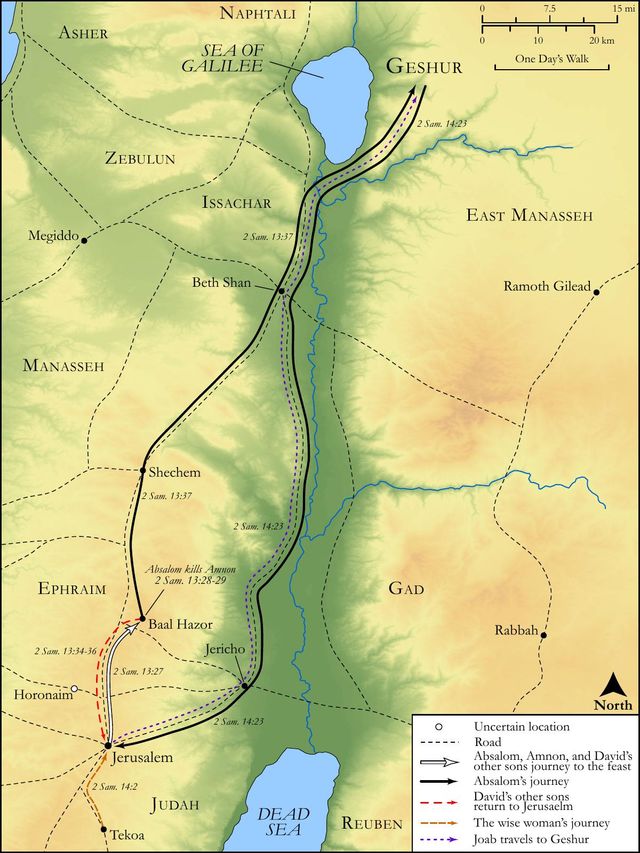
Absalom immediately fled, Sa2 13:34. He was now as much afraid of the king's sons as they were of him; they fled from his malice, he from their justice. No part of the land of Israel could shelter him. The cities of refuge gave no protection to a wilful murderer. Though David had let Amnon's incest go unpunished, Absalom could not promise himself his pardon for this murder; so express was the law in this case, and so well known David's justice, and his dread of blood-guiltiness. He therefore made the best of his way to his mother's relations, and was entertained by his grandfather Talmai, king of Geshur (Sa2 13:37), and there he was protected three years (Sa2 13:38), David not demanding him, and Talmai not thinking himself obliged to send him back unless he were demanded.
IV.David's uneasiness for his absence.
He mourned for Amnon a good while (Sa2 13:37), but, he being past recall, time wore off that grief: he was comforted concerning Amnon. It also wore off too much his detestation of Absalom's sin; instead of loathing him as a murderer, he longs to go forth to him, Sa2 13:39. At first he could not find in his heart to do justice on him; now he can almost find in his heart to take him into his favour again. This was David's infirmity. Something God saw in his heart that made a difference, else we should have thought that he, as much as Eli, honoured his sons more than God.
Historical interpretation
Historical reception
1 surviving comment on this verse from the historical church.
This is the first introduction of divine punishment; the first but not the only one. A long series of great tribulations followed, and an almost unending succession of misfortunes scarcely left his house. Tamar was corrupted by the madness of Amnon, and Amnon was slain by Absalom. A grave crime was committed by one brother, but it was avenged more grievously by the other. In this way David, the father, was punished for the crimes of both. Two sons sinned, but three suffered for the crime of two; Tamar lost her virginity, and the loss of Absalom was mourned in Amnon. Indeed, you cannot tell for which of these two sons the loving father mourned more grievously: for him who was slain in this world by his brother’s hand [Amnon] or for him who perished in the next because of killing by his own hand [Absalom].
Continue studying 2 Samuel 13:38 across the web’s major study libraries — every link below opens this exact verse, chapter, or book on the destination site.
Read & Compare
 BibleGatewayThis verse in more than 200 translations and 70 languages.
 Bible.comThe YouVersion reader — hundreds of translations, reading plans, and highlights.
 ESV.orgCrossway's official English Standard Version reader.
 NET BibleThe NET translation with 60,000+ translators' notes on every rendering decision.
 STEP BibleTyndale House's free study tool — original text, vocabulary, and scholarly resources.
 BibliaLogos Bible Software's free web reader.
 USCCBThe New American Bible (Revised Edition) with the U.S. bishops' study notes.
Commentaries
 BibleHub CommentariesDozens of classic commentaries on this verse, gathered on one page.
 StudyLightMore than 100 commentary sets — the largest collection on the web.
 BibleRefPlain-English commentary on what this verse means, verse by verse.
 Enduring WordDavid Guzik's free commentary on this chapter, widely used by Bible teachers.
 Bible Study ToolsVerse commentary alongside Greek and Hebrew study aids.
Original Language & Research
- BibleHub InterlinearThe verse word by word — original language, transliteration, and English.
- BibleHub LexiconEvery word's original-language definition and Strong's entry.
 Blue Letter BibleDeep-study tools — Strong's numbers, concordance, and word studies.
 SefariaThe Hebrew text with Rashi and centuries of Jewish commentary.
Sermons, Hymns & Audio


TrulyRandomVerse is not affiliated with these sites and doesn’t control their content. They’re linked because they’re genuinely useful.
Summary
This verse chronicles the immediate and decisive flight of Absalom to Geshur, where he remained for three years, following his calculated murder of his half-brother Amnon. This strategic retreat to his maternal grandfather's kingdom served as a temporary refuge from King David's wrath and the legal repercussions of fratricide, simultaneously setting the stage for future dramatic developments within the fractured Davidic monarchy and foreshadowing Absalom's eventual bid for power.
Context
ShowHideLiterary Context
This verse serves as the immediate narrative consequence of Absalom's meticulously planned act of vengeance against Amnon. The preceding chapters detail the sordid affair of Amnon's rape of Tamar, Absalom's sister, and King David's profound but ultimately passive reaction to this heinous crime. David's failure to administer justice for Tamar's violation created a deep-seated resentment in Absalom, which festered for two years. This simmering anger culminated in Absalom's orchestration of Amnon's assassination at a sheep-shearing feast, as vividly described in 2 Samuel 13:28-29. Absalom's subsequent flight to Geshur is not merely an escape but a calculated move to evade immediate retribution from his father and the legal consequences of his actions, marking a significant turning point in the tragic saga of David's family.
Historical & Cultural Context
Geshur was an independent Aramean kingdom situated east of the Jordan River, within the region of Bashan. Its strategic importance for Absalom stemmed directly from his lineage: his mother, Maacah, was the daughter of Talmai, the reigning king of Geshur (2 Samuel 3:3). This familial bond made Geshur an ideal and secure place of refuge, offering not just a hiding place but legitimate political asylum under the protection of his powerful maternal grandfather. Among the nations of that day, it was a common practice for individuals who had committed serious offenses or fallen out of favor with their rulers to seek sanctuary with kin, particularly those holding authority in foreign lands. Absalom's choice underscores his cunning and foresight, as he leveraged these international family ties to shield himself from David's immediate jurisdiction and potential retribution, highlighting the complex political landscape of the era.
Key Themes
ShowHideAbsalom's flight to Geshur powerfully encapsulates several pervasive themes throughout the book of 2 Samuel. Firstly, it starkly illustrates the devastating consequences of sin and unaddressed injustice. David's initial inaction regarding Amnon's crime created a void of justice, which Absalom filled with his own violent retribution, leading to a cascading series of tragedies. Secondly, the theme of exile and separation is prominent, a recurring motif in biblical narratives often associated with serious transgression or alienation from community. Absalom's three-year absence from Jerusalem underscores a period of forced removal from the royal court and the heart of Israelite society. Thirdly, this event further exposes the deep-seated dysfunction and moral decay within David's own household, a tragic harvest sown from David's past sins (e.g., 2 Samuel 11) and his subsequent failures in parental discipline and judicial administration. Finally, Absalom's calculated retreat to Geshur is a critical precursor to his future actions, subtly but significantly foreshadowing his ambition and eventual rebellion against King David, which would later erupt into open civil war, as detailed in 2 Samuel 15.
Exposition and Analysis
ShowHideKey Word Analysis
ShowHideThis verb (בָּרַח, H1272) describes a sudden, hasty, and often fearful departure, implying a rapid escape from danger or the consequences of an action. In Absalom's context, it signifies his immediate and urgent response to the fratricide, driven by the necessity to evade King David's potential wrath or the legal repercussions of his crime. This word underscores the gravity of his act and the precariousness of his position, highlighting his calculated move to secure safety.
(גְּשׁוּר, H1650) More than a mere geographical location, Geshur represents a strategically chosen sanctuary. As the kingdom of Absalom's maternal grandfather, Talmai, it offered not just a hiding place but a politically secure refuge. This choice of destination reveals Absalom's astute intelligence and foresight, as he leveraged deep familial ties and international relations to secure his immediate safety and potentially to bide his time for a future return or political maneuvering.
(שָׁלֹשׁ, H7969; שָׁנֶה, H8141) The specified duration of "three years" is profoundly significant. It was a period long enough for the immediate furor and grief over Amnon's murder to subside, allowing for emotional distance and the possibility of reconciliation or political maneuvering. This period of exile was not simply passive waiting; it was a formative time during which Absalom's character could be further shaped, his resentment could fester, and his ambitions could solidify, setting the stage for his eventual return and subsequent, dramatic actions against his father, King David.
Verse Breakdown
ShowHide"So Absalom fled"
This clause immediately follows the account of Amnon's murder, indicating Absalom's swift and decisive action to escape the immediate repercussions. His flight is a direct and calculated response to his violent act, demonstrating either a fear of retribution from King David or a desire to avoid the legal and social consequences of fratricide within Israelite society. It marks a clear and abrupt departure from his presence in Jerusalem and the royal court.
"and went to Geshur"
This specifies Absalom's chosen destination, highlighting the strategic nature of his refuge. Geshur was not a random hiding place but a secure sanctuary due to his strong familial ties with its king, Talmai, his maternal grandfather. This reveals Absalom's cunning and foresight, ensuring his safety in a foreign land where King David's immediate authority would not extend, thereby buying him time and protection.
"and was there three years"
This final clause provides the precise duration of Absalom's exile. The "three years" constitutes a significant period, long enough for the immediate crisis and public outcry to pass and for the political landscape to subtly shift, but not so long as to completely sever Absalom's ties with Israel. It was a time of forced separation, yet also a period during which Absalom could consolidate his thoughts, perhaps plan his return, and for David's initial anger or grief to potentially wane, paving the way for future reconciliation efforts.
Literary Devices
ShowHideThe verse employs several literary devices to convey its profound meaning and narrative impact. Foreshadowing is prominently featured, as Absalom's strategic flight and three-year exile are not merely an escape from immediate consequences but a crucial prelude to his eventual return and audacious rebellion against his father, King David. His calculated move to Geshur subtly hints at a deeper ambition than mere survival, suggesting a period of strategic planning. There is also a strong element of irony in David's initial failure to administer justice for Tamar's rape, which directly leads to Absalom's violent and self-administered justice, ultimately resulting in Absalom's own exile—a form of consequence that David himself had experienced due to his own sins. Furthermore, the specific duration of "three years" serves as a symbolic timeframe, often representing a period of significant transition, testing, or preparation in biblical narratives, thereby hinting at the profound changes that will occur both in Absalom's character and in the political dynamics of the kingdom during his absence.
Theological and Thematic Connections
ShowHideAbsalom's flight to Geshur profoundly underscores a critical theological principle: sin, particularly unaddressed injustice, unleashes far-reaching and devastating consequences that ripple through families, communities, and even nations. King David's failure to act decisively and justly after Amnon's rape created a vacuum of righteousness, which Absalom filled with his own violent and vengeful retribution. This narrative powerfully illustrates the destructive cycle of sin, where one transgression begets another, leading to broken relationships, forced exile, and prolonged suffering. It highlights the critical importance of righteous judgment and the painful truth that even royal families are not exempt from the bitter harvest sown by their choices. The absence of justice breeds chaos, and the pursuit of personal vengeance, even when provoked, perpetuates a cycle of brokenness.
Reflection and Application
ShowHideThe narrative of Absalom's flight to Geshur serves as a potent and sobering reminder of the enduring and often devastating consequences of unaddressed sin, particularly within the intimate sphere of family. David's inaction, though perhaps rooted in a desire to avoid further conflict or out of a misguided sense of parental love, ultimately permitted a festering wound to become a fatal infection within his household. This story challenges us to deeply consider the ripple effect of our choices, especially when we fail to uphold justice, address wrongdoing, or confront difficult truths. It prompts us to reflect on how bitterness and a thirst for vengeance, even when seemingly justified by prior injustice, can lead to further destruction, prolonged periods of isolation, and escalating conflict. For individuals, families, and communities, this account underscores the vital necessity of swift, righteous, and compassionate justice to prevent cycles of violence and to foster genuine healing, reconciliation, and peace. It calls us to be proactive in seeking reconciliation and to trust in God's justice rather than seeking our own.
Questions for Reflection
ShowHideFAQ
ShowHideWhy did Absalom choose Geshur specifically as his place of refuge?
ShowHideAbsalom's choice of Geshur was highly strategic and deeply personal. His mother, Maacah, was the daughter of Talmai, the king of Geshur (2 Samuel 3:3). This direct familial connection provided Absalom with an immediate and secure sanctuary. It was not merely a hiding place but a place of legitimate political asylum where he was under the protection of his maternal grandfather, a reigning monarch. This choice allowed him to escape the immediate wrath of King David and the legal repercussions of fratricide within Israel, while also maintaining a base from which he could potentially plan future actions without being directly subject to David's authority.
What was the significance of Absalom's "three years" in Geshur?
ShowHideThe duration of "three years" in Geshur was significant for several reasons. Firstly, it allowed a crucial cooling-off period after the shocking murder of Amnon. The immediate outrage, grief, and calls for justice would have had time to subside, creating an opportunity for David's anger to temper. Secondly, it was a period of forced exile and isolation for Absalom, during which he was removed from the royal court and the public eye in Israel. While this time could have been used for reflection and repentance, it also likely allowed his resentment and ambition to fester, as he was outside the direct influence of his father. Thirdly, this specific duration often carries symbolic weight in biblical narratives, representing a significant period of testing, preparation, or transition. In Absalom's case, these three years were a critical phase that set the stage for his eventual return to Jerusalem (2 Samuel 14) and his subsequent, dramatic rebellion against his father, as described in 2 Samuel 15.
Christ-Centered Fulfillment
ShowHideThe tragic narrative of Absalom's flight and exile, born from vengeance and unaddressed sin, stands in profound contrast to the ultimate refuge and perfect justice found in Jesus Christ. Absalom, a prince of Israel, fled to a foreign land for safety, driven by his own violent act and the fear of earthly retribution. Yet, in Christ, humanity finds a perfect sanctuary, not from the consequences of our own vengeance, but from the righteous judgment for our sin. While David failed to administer justice perfectly, leading to a cycle of familial brokenness, God's perfect justice and boundless mercy converge in the person of Jesus. The Lamb of God, unlike Absalom, did not flee from the consequences of sin but willingly bore them, becoming the ultimate sacrifice for humanity's rebellion against God (John 1:29). Where Absalom's exile was a period of festering resentment that led to further division and rebellion against his father, Christ's journey to the cross and resurrection brought profound reconciliation and peace between God and humanity (Romans 5:8 and 2 Corinthians 5:21). He is the true and living way, a refuge for all who are weary and burdened, offering not temporary political asylum but eternal rest and perfect justice, having lived a life of non-retaliation and perfect obedience, even unto death (1 Peter 2:23). In Him, the cycle of vengeance is broken, and a path to true healing and restoration is revealed.