


2 Samuel 13:39
Bible text: King James Version (1769 Blayney text) · Public domain
Bible text: Berean Standard Bible · Public domain
Bible text: American Standard Version (1901) · Public domain
Bible text: World English Bible, Messianic edition · Public domain
Bible text: Geneva Bible (1599) · Public domain
Bible text: Young's Literal Translation · Public domain
- וַתְּכַלva·te·Khaland it [fem] completedH3615Conj-w ¦ V-Piel-ConsecImperf-3fsVerb Piel Consecutive Imperfect 3rd Singular Feminineוַandתְּכַלit [fem] completed
- דָּוִדda·VidDavidH1732N-proper-mNoun Proper Masculine
- הַמֶּלֶךְha·Me·lekhthe kingH4428Art ¦ N-msNoun Singular Masculine Absoluteהַtheמֶּלֶךְking
- לָצֵאתla·Tzetto go outH3318Prep-l ¦ V-Qal-InfVerb Qal Infinitive Constructלָtoצֵאתgo out
- אֶל'elagainstH413PrepPreposition
- אַבְשָׁלוֹם'av·sha·LomAbsalomH53N-proper-mNoun Proper Masculine
- כִּיkiforH3588PrtParticle Conditional
- נִחַםni·Chamhe was comfortedH5162V-Niphal-Perf-3msVerb Niphal Perfect 3rd Singular Masculine
- עַל'alonH5921PrepPreposition
- אַמְנוֹן'am·NonAmnonH550N-proper-mNoun Proper Masculine
- כִּיkithatH3588PrtParticle Conditional
- מֵתMethe had diedH4191V-Qal-Perf-3msVerb Qal Perfect 3rd Singular Masculine
English is a literal word-by-word gloss of the Hebrew, not the KJV's wording. Why?
This is the original text the KJV's translators worked from — each Hebrew word with its own literal English meaning in this verse, prepared by scholars at Tyndale House, Cambridge. The KJV translates whole sentences, not word by word, so its wording differs: one Hebrew word can become several English words, and the KJV may choose “the LORD” where the gloss reads “Yahweh”. Both are faithful — they answer different questions. For the KJV's own rendering, switch to the KJV text.
Details
See on the biblical-era maps
Study this verse
Public-domain commentary
Matthew Henry
From his Commentary on the Whole Bible. Henry comments on passages, not single verses — this entry covers 2 Samuel 13:30–39.
Here is, I. The fright that David was put into by a false report brought to Jerusalem that Absalom had slain all the king's sons, Sa2 13:30. It is common for fame to make bad worse; and the first news of such a thing as this represents it as more dreadful than afterwards it proves. Let us not therefore be afraid of evil tidings, while they want confirmation, but, when we hear the worst, hope the best, at least hope better. However, this false news gave as much affliction to David, for the present, as if it had been true; he tore his garments, and lay on the earth, while as yet it was only a flying story, Sa2 13:31. It was well that David had grace; he had need enough of it, for he had strong passions.
II.The rectifying of the mistake in two ways:
- 1. By the sly suggestions of Jonadab, David's nephew, who could tell him, Amnon only is dead, and not all the king's sons (Sa2 13:32, Sa2 13:33), and could tell him too that it was done by the appointment of Absalom, and designed from the day Amnon forced his sister Tamar. What a wicked man was he, if he knew all this or had any cause to suspect it, that he did not make David acquainted with it sooner, that means might be used to make up the quarrel, or at least that David might not throw Amnon into the mouth of danger by letting him go to Absalom's house. If we do not our utmost to prevent mischief, we make ourselves accessory to it. If we say, Behold, we knew it not; doth not he that pondereth the heart consider whether we did or no? See Pro 24:11, Pro 24:12. It is well if Jonadab was not as guilty of Amnon's death as he was of his sin; such friends do those prove who are hearkened to as counsellors to do wickedly: he that would not be so kind as to prevent Amnon's sin would not be so kind as to prevent his ruin, when, it should seem, he might have done both. 2. By the safe return of all the king's sons except Amnon. They and their attendants were speedily discovered by the watch (Sa2 13:34, Sa2 13:35), and soon arrived, to show themselves alive, but to bring the certain sad news that Absalom had murdered their brother Amnon. The grief David had been in for that which was not made him the better able to bear that which was, by giving him a sensible occasion, when he was undeceived, to thank God that all his sons were not dead: yet that Amnon was dead, and slain by his own brother is such a treacherous barbarous manner, was enough to put the king and court, the king and kingdom, into real mourning. Sorrow is never more reasonable than when there is sin in the case.
III.Absalom's flight from justice:
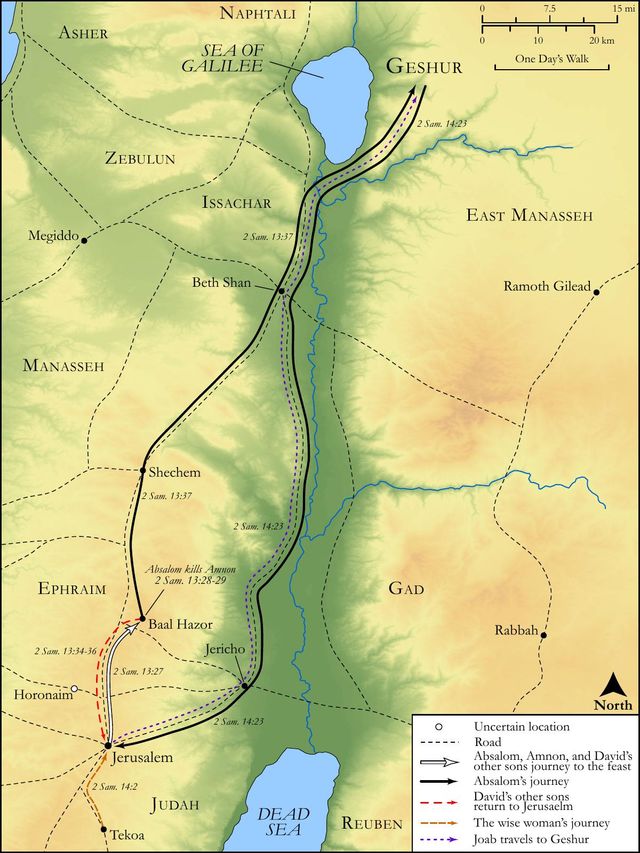
Absalom immediately fled, Sa2 13:34. He was now as much afraid of the king's sons as they were of him; they fled from his malice, he from their justice. No part of the land of Israel could shelter him. The cities of refuge gave no protection to a wilful murderer. Though David had let Amnon's incest go unpunished, Absalom could not promise himself his pardon for this murder; so express was the law in this case, and so well known David's justice, and his dread of blood-guiltiness. He therefore made the best of his way to his mother's relations, and was entertained by his grandfather Talmai, king of Geshur (Sa2 13:37), and there he was protected three years (Sa2 13:38), David not demanding him, and Talmai not thinking himself obliged to send him back unless he were demanded.
IV.David's uneasiness for his absence.
He mourned for Amnon a good while (Sa2 13:37), but, he being past recall, time wore off that grief: he was comforted concerning Amnon. It also wore off too much his detestation of Absalom's sin; instead of loathing him as a murderer, he longs to go forth to him, Sa2 13:39. At first he could not find in his heart to do justice on him; now he can almost find in his heart to take him into his favour again. This was David's infirmity. Something God saw in his heart that made a difference, else we should have thought that he, as much as Eli, honoured his sons more than God.
Continue studying 2 Samuel 13:39 across the web’s major study libraries — every link below opens this exact verse, chapter, or book on the destination site.
Read & Compare
 BibleGatewayThis verse in more than 200 translations and 70 languages.
 Bible.comThe YouVersion reader — hundreds of translations, reading plans, and highlights.
 ESV.orgCrossway's official English Standard Version reader.
 NET BibleThe NET translation with 60,000+ translators' notes on every rendering decision.
 STEP BibleTyndale House's free study tool — original text, vocabulary, and scholarly resources.
 BibliaLogos Bible Software's free web reader.
 USCCBThe New American Bible (Revised Edition) with the U.S. bishops' study notes.
Commentaries
 BibleHub CommentariesDozens of classic commentaries on this verse, gathered on one page.
 StudyLightMore than 100 commentary sets — the largest collection on the web.
 BibleRefPlain-English commentary on what this verse means, verse by verse.
 Enduring WordDavid Guzik's free commentary on this chapter, widely used by Bible teachers.
 Bible Study ToolsVerse commentary alongside Greek and Hebrew study aids.
Original Language & Research
- BibleHub InterlinearThe verse word by word — original language, transliteration, and English.
- BibleHub LexiconEvery word's original-language definition and Strong's entry.
 Blue Letter BibleDeep-study tools — Strong's numbers, concordance, and word studies.
 SefariaThe Hebrew text with Rashi and centuries of Jewish commentary.
Sermons, Hymns & Audio


TrulyRandomVerse is not affiliated with these sites and doesn’t control their content. They’re linked because they’re genuinely useful.
Summary
This pivotal verse marks a profound emotional shift for King David, revealing his deep and consuming yearning for his exiled son, Absalom. Following a period of intense and prolonged mourning for Amnon, who was tragically murdered by Absalom, David's acute grief has subsided sufficiently for a new, powerful longing to emerge for the son who fled. This transition highlights the complex interplay of enduring parental love, the natural yet arduous process of grief, and the deep-seated desire for family reconciliation, even amidst profound tragedy and the devastating consequences of sin within the royal household.
Context
ShowHideLiterary Context
This verse serves as a crucial turning point, concluding a deeply tragic and tumultuous chapter in David's family life and setting the stage for future events. Immediately preceding it, David's daughter, Tamar, was brutally raped by her half-brother Amnon, an act of profound betrayal and sin that violated both familial and societal norms, as recounted in 2 Samuel 13:14. Two years later, Tamar's full brother, Absalom, exacted his vengeful retribution by orchestrating Amnon's murder during a sheep-shearing feast, detailed in 2 Samuel 13:28-29. Following this act, Absalom fled to Geshur, his maternal grandfather's homeland, where he remained in exile for three years, as noted in 2 Samuel 13:37-38. David had been in deep and prolonged mourning for Amnon, weeping bitterly for many days, a sorrow described in 2 Samuel 13:36. Our verse signifies that David's acute grief for Amnon has begun to abate, allowing his heart to turn towards his other estranged son, Absalom, thus preparing the narrative for the complex attempts at reconciliation that will follow in 2 Samuel 14.
Historical & Cultural Context
The events unfold within the intricate framework of the ancient Israelite monarchy, where the king's personal and family life was inextricably linked to the stability, honor, and perception of the kingdom. Royal succession, the upholding of justice, and the preservation of family honor were paramount. Amnon's act was not merely a private sin but a public disgrace that demanded a response, particularly from the king, who was the ultimate arbiter of justice. Absalom's flight to Geshur, a foreign land, was a common practice for those guilty of blood vengeance, offering a temporary refuge from the immediate consequences of their actions and often allowing time for passions to cool. The king, as the head of the nation, faced a profound dilemma: pursuing justice for Amnon's murder while simultaneously grappling with the devastating loss of two sons—one dead, one exiled. The cultural understanding of grief involved a prescribed period of intense mourning, often with public displays, but also a natural progression towards a degree of comfort and acceptance, though never implying a complete forgetting of the loss.
Key Themes
ShowHideThis verse encapsulates several significant themes prominent throughout the book of 2 Samuel and the broader Deuteronomistic History. Firstly, it powerfully illustrates parental grief and longing, showcasing David's complex and enduring love for his children, even in the face of their grievous sins and the tragic consequences. This deep affection is a recurring motif in David's life, evident in his lament for Saul and Jonathan in 2 Samuel 1:17-27. Secondly, it speaks to the process of comfort and acceptance in mourning, demonstrating that time can mitigate the acute pain of loss, allowing for emotional space to address other pressing matters or relationships. This natural progression of grief is a universal human experience. Thirdly, the entire narrative arc underscores the devastating consequences of sin, particularly within a family, echoing the divine judgment pronounced upon David's house for his own sin with Bathsheba and Uriah, where Nathan prophesied that "the sword shall never depart from thine house" (2 Samuel 12:10). Finally, David's yearning for Absalom foreshadows the theme of reconciliation, however fraught and ultimately tragic, that will dominate the subsequent chapters, highlighting the human desire for restoration even in broken relationships.
Exposition and Analysis
ShowHideKey Word Analysis
ShowHideThe Hebrew verb כָּלָה (H3615) is deeply significant here. It means "to end," "to cease," "to be finished," "to perish," or "to be consumed." When used in the context of desire, as it is here, it conveys an overwhelming, almost agonizing yearning or pining away. It's not a casual wish but a deep, internal ache that consumes David's very being. This indicates a profound shift from his previous state of mourning for Amnon, suggesting that the initial, acute phase of grief had "finished" or "completed" its course, allowing this new, powerful desire to emerge and consume his thoughts.
The Hebrew verb נָחַם (H5162) means "to sigh," "to be sorry," "to pity," "to console," or "to repent." In this context, it signifies that David had found a measure of relief or consolation concerning Amnon's death. This does not imply a lack of love or memory for Amnon, nor does it suggest that David was "over" his son's death. Rather, it indicates that the initial, overwhelming sorrow had subsided, allowing him to move from a state of acute, debilitating grief to a more settled acceptance of the reality. This emotional shift freed his heart to focus on his other estranged son, Absalom.
Verse Breakdown
ShowHide"And [the soul of] king David longed to go forth unto Absalom"
This clause reveals the depth of David's desire. While "soul" is an interpretive addition in the KJV (the Hebrew subject is simply "King David," H4428 and H1732), the verb "longed" (H3615, kâlâh') inherently conveys an intense, internal, and consuming desire. David's heart, mind, and entire being were now focused on Absalom. "To go forth unto Absalom" (H3318, yâtsâ') implies not just a passive wish to see him, but an active yearning to initiate contact, to bring him back, or at least to bridge the chasm of their separation. It suggests an active yearning for reunion, a move beyond passive grief.
"for he was comforted concerning Amnon, seeing he was dead"
This explanatory clause provides the reason for David's shift in focus. The "comfort" (H5162, nâcham') David experienced regarding Amnon's death (H4191, mûwth') was not a sudden forgetting or a lack of sorrow, but rather the natural progression of grief. The initial shock and acute pain had lessened, allowing for a degree of acceptance that Amnon's fate was sealed and irreversible. This acceptance, however painful, freed David's emotional capacity to turn his attention to the living, albeit exiled, son, Absalom (H53). It highlights the human capacity to process loss and, over time, redirect emotional energy and focus.
Literary Devices
ShowHideThe verse effectively employs Psychological Realism, offering a nuanced portrayal of David's complex emotional landscape. It captures the ebb and flow of human grief, demonstrating that sorrow, while profound, is not static but evolves over time. The shift from mourning Amnon to longing for Absalom is a deeply human response, illustrating how the mind and heart grapple with loss and seek resolution. Furthermore, the verse functions as a powerful piece of Foreshadowing. David's longing for Absalom sets the stage for the subsequent attempts at reconciliation and Absalom's eventual return to Jerusalem. This seemingly hopeful development, however, tragically foreshadows the even greater rebellion and heartbreak that Absalom will inflict upon David and the kingdom, revealing the bitter irony that David's deepest paternal longing will lead to his greatest political and personal anguish.
Theological and Thematic Connections
ShowHideThis verse offers profound theological insights into the nature of human grief, the consequences of sin, and the enduring, yet often complex, path to reconciliation. David's experience mirrors the universal human journey through loss, where time, while not erasing pain, can bring a measure of comfort and allow for new desires and priorities to emerge. Theologically, it reminds us that God works within the messy realities of human families and their brokenness, often allowing the natural consequences of sin to unfold while also providing opportunities for grace and restoration. David's longing for his son, despite Absalom's heinous act, reflects a divine echo of God's own persistent love and desire for reconciliation with His estranged children, even when they have deeply sinned against Him. This narrative also underscores the truth that while comfort can come, the scars of sin, particularly within families, often remain, requiring ongoing efforts towards healing and forgiveness.
Reflection and Application
ShowHideDavid's journey from acute grief for Amnon to a profound longing for Absalom offers a powerful and relatable illustration of the human experience of loss and the complex dynamics of family relationships. It reminds us that grief is a process, not a destination, and that true healing involves acknowledging our pain while also allowing ourselves to move forward, to find comfort, and to redirect our emotional energy towards what is still possible. For those who have experienced deep family wounds, this verse can resonate deeply, highlighting the enduring nature of parental love and the often-arduous path towards reconciliation. It challenges us to consider our own responses to loss and estrangement: Do we allow ourselves to be comforted over time, releasing the acute grip of sorrow? Do we hold onto bitterness and resentment, or do we, like David, eventually yearn for the restoration of broken bonds, even when the path is uncertain and fraught with risk? This narrative calls us to cultivate compassion, understanding that even those who have caused great pain are often deeply loved, and that the desire for unity, though challenging, is a powerful human impulse that reflects God's own heart for reconciliation.
Questions for Reflection
ShowHideFAQ
ShowHideDoes "comforted concerning Amnon" mean David stopped grieving or loving Amnon?
ShowHideNo, "comforted" (Hebrew: nacham H5162) in this context does not mean David no longer cared about Amnon or had forgotten him. Instead, it signifies that the acute, overwhelming phase of his grief had subsided. The initial shock, sorrow, and perhaps anger had processed to a point where David could accept the finality of Amnon's death. This emotional shift allowed his heart and mind to turn towards his other living, though exiled, son, Absalom. It reflects the natural, albeit painful, progression of human grief, where intense sorrow eventually gives way to a degree of acceptance and the capacity to focus on other matters, including the desire for reconciliation with the living, as seen in 2 Samuel 14:1-2.
Why did David wait three years to long for Absalom?
ShowHideDavid's initial reaction to Amnon's death was profound and prolonged mourning, as described in 2 Samuel 13:36. The three-year period represents the time Absalom spent in exile in Geshur (2 Samuel 13:38). It is during this time that David's acute grief for Amnon gradually lessened. The delay is realistic; deep emotional wounds take time to heal and for the initial shock to wear off. It was only after the initial, consuming sorrow for Amnon began to abate that David's thoughts and desires could shift to his other son, Absalom, and the possibility of his return. This timing underscores the psychological reality of grief and the gradual nature of emotional processing, allowing for a new emotional space to emerge.
What does this verse tell us about David's character as a father?
ShowHideThis verse reveals David as a deeply complex and profoundly human father. Despite his own moral failures as a king and the devastating consequences of sin within his family, his parental love is undeniable and enduring. He is shown to be capable of intense grief, but also of moving through that grief to a place of longing for reconciliation. His desire for Absalom, even after Absalom committed murder, highlights a powerful, perhaps even unconditional, paternal affection. It portrays him as a man deeply affected by his family's brokenness, yearning for restoration, even if that yearning would ultimately lead to further tragedy. This vulnerability and deep emotional capacity are hallmarks of David's character throughout the biblical narrative, showcasing his humanity amidst his divine calling.
Christ-Centered Fulfillment
ShowHideDavid's profound longing for his estranged son, Absalom, after a period of grief and separation, serves as a poignant shadow of God the Father's own heart for humanity. Just as David yearned for the return of his son who had caused great pain and fled, so too does our heavenly Father long for the reconciliation of His children who are alienated from Him by sin. The devastating consequences of sin, vividly displayed in David's household, are ultimately borne by Christ. He is the ultimate Lamb of God, who takes away the sin of the world, bearing the full weight of our rebellion and estrangement. Through His sacrifice on the cross, Jesus bridged the chasm that sin created, making peace through the blood of His cross (Colossians 1:20). He is the one who goes out to seek the lost, much like the father in the parable of the Prodigal Son who eagerly runs to embrace his returning son, even before he fully repents (Luke 15:11-32). Our reconciliation with God is not based on our merit or our ability to "go forth" to Him, but on Christ's finished work, enabling us to be brought near to the Father by the blood of Jesus (Ephesians 2:13). In Christ, God's longing for us is fully satisfied, and our estrangement is overcome, establishing us as His beloved children, reconciled and adopted into His eternal family (Romans 8:15).