


2 Samuel 14:32
Bible text: King James Version (1769 Blayney text) · Public domain
Bible text: King James Version with Strong's numbers · Public domain
Bible text: Berean Standard Bible · Public domain
Bible text: American Standard Version (1901) · Public domain
Bible text: World English Bible, Messianic edition · Public domain
Bible text: Geneva Bible (1599) · Public domain
Bible text: Young's Literal Translation · Public domain
- וַיֹּאמֶרvai·Yo·merand he saidH559Conj-w ¦ V-Qal-ConsecImperf-3msVerb Qal Consecutive Imperfect 3rd Singular Masculineוַandיֹּאמֶרhe said
- אַבְשָׁלוֹם'av·sha·LomAbsalomH53N-proper-mNoun Proper Masculine
- אֶל'eltoH413PrepPreposition
- יוֹאָבyo·'AvJoabH3097N-proper-mNoun Proper Masculine
- הִנֵּהhi·Nehhere!H2009PrtParticle Interjection
- שָׁלַחְתִּיsha·Lach·tiI sentH7971V-Qal-Perf-1csVerb Qal Perfect 1st Singular common gender
- אֵלֶיךָ'e·Lei·khato youH413Prep ¦ 2msPreposition Definiteאֵלֶיtoךָyou
- לֵאמֹרle·Mor<to> sayingH559Prep-l ¦ V-Qal-InfVerb Qal Infinitive Constructלֵ<to>אמֹרsaying
- בֹּאbo'comeH935V-Qal-Imp-2msVerb Qal Imperative 2nd Singular Masculine
- הֵנָּהHe·nahhereH2008AdvAdverb
- וְאֶשְׁלְחָהve·'esh·le·Chahso let me sendH7971Conj-w ¦ V-Qal-Imperf-1csVerb Qal Imperfect 1st Singular common genderוְsoאֶשְׁלְחָהlet me send
- אֹתְךָ'o·te·Kha<obj.> youH853DirObjM ¦ 2msParticle Object Indicatorאֹתְ<obj.>ךָyou
- אֶל'eltoH413PrepPreposition
- הַמֶּלֶךְha·Me·lekhthe kingH4428Art ¦ N-msNoun Singular Masculine Absoluteהַtheמֶּלֶךְking
- לֵאמֹרle·Mor<to> sayingH559Prep-l ¦ V-Qal-InfVerb Qal Infinitive Constructלֵ<to>אמֹרsaying
- לָמָּהLa·mah<to> why?H4100Prep-l ¦ InterrogPronoun Interrogativeלָ<to>מָּהwhy?
- בָּאתִיba·tihave I comeH935V-Qal-Perf-1csVerb Qal Perfect 1st Singular common gender
- מִגְּשׁוּרmi·ge·Shurfrom GeshurH1650Prep-m ¦ N-properNoun Proper LocationמִfromגְּשׁוּרGeshur
- טוֹבTov[was] goodH2896Adj-msAdjective Singular Masculine Absolute
- לִיlifor <the> mePrep-l ¦ 1csSuffix Personal 1st Singular common genderלִfor <the>יme
- עֹד'odstillH5750Adj-msAdjective Numerical Singular Masculine Absolute
- אֲנִי'a·niIH589Pro-1csPronoun Personal 1st Singular common gender
- שָׁםSham[was] thereH8033AdvAdverb
- וְעַתָּהve·'a·Tahand thereforeH6258Conj-w ¦ AdvAdverbוְandעַתָּהtherefore
- אֶרְאֶה'er·'Ehlet me seeH7200V-Qal-Imperf-1csVerb Qal Imperfect 1st Singular common gender
- פְּנֵיpe·Nei[the] face ofH6440N-mpcNoun Plural Masculine Construct
- הַמֶּלֶךְha·Me·lekhthe kingH4428Art ¦ N-msNoun Singular Masculine Absoluteהַtheמֶּלֶךְking
- וְאִםve·'imand ifH518Conj-w ¦ PrtParticle Conditionalוְandאִםif
- יֶשׁyeshthereH3426Adj-csAdjective Numerical Singular common gender Absolute
- בִּיbiin <the> mePrep-b ¦ 1csSuffix Personal 1st Singular common genderבִּin <the>יme
- עָוֹן'a·Von[is] iniquityH5771N-msNoun Singular Masculine Absolute
- וֶהֱמִתָנִיve·he·mi·Ta·niand he will kill meH4191Conj-w ¦ V-Hiphil-ConsecPerf-3ms ¦ 1csVerb Hiphil Consecutive Perfect 3rd Singular Masculineוֶandהֱמִתָhe will killנִיme
English is a literal word-by-word gloss of the Hebrew, not the KJV's wording. Why?
This is the original text the KJV's translators worked from — each Hebrew word with its own literal English meaning in this verse, prepared by scholars at Tyndale House, Cambridge. The KJV translates whole sentences, not word by word, so its wording differs: one Hebrew word can become several English words, and the KJV may choose “the LORD” where the gloss reads “Yahweh”. Both are faithful — they answer different questions. For the KJV's own rendering, switch to the KJV text.
Details
See on the biblical-era maps

Study this verse
Public-domain commentary
Matthew Henry
From his Commentary on the Whole Bible. Henry comments on passages, not single verses — this entry covers 2 Samuel 14:28–33.
Three years Absalom had been an exile from his father-in-law, and now two years a prisoner at large in his own house, and, in both, better dealt with than he deserved; yet his spirit was still unhumbled, his pride unmortified, and, instead of being thankful that his life is spared, he thinks himself sorely wronged that he is not restored to all his places at court. Had he truly repented of his sin, his distance from the gaieties of the court, and his solitude and retirement in his own house, especially being in Jerusalem the holy city, would have been very agreeable to him. If a murderer must live, yet let him be for ever a recluse. But Absalom could not bear this just and gentle mortification. He longed to see the king's face, pretending it was because he loved him, but really because he wanted an opportunity to supplant him. He cannot do his father a mischief till he is reconciled to him; this therefore is the first branch of his plot; this snake cannot sting again till he be warmed in his father's bosom. He gained this point, not by pretended submissions and promises of reformation, but (would you think it?) by insults and injuries. 1. By his insolent carriage towards Joab, he brought him to mediate for him. Once and again he sent to Joab to come and speak with him, for he durst not go to him; but Joab would not come (Sa2 14:29), probably because Absalom had not owned the kindness he had done him in bringing him to Jerusalem so gratefully as he thought he should have done; proud men take every service done them for a debt. One would think that a person in Absalom's circumstances should have sent to Joab a kindly message, and offered him a large gratuity: courtiers expect noble presents. But, instead of this, he bids his servants set Joab's corn-fields on fire (Sa2 14:30), as spiteful a thing as he could do. Samson could not think of a greater injury to do the Philistines than this. Strange that Absalom should think, by doing Joab a mischief, to prevail with him to do him a kindness, or to recommend himself to the favour of his prince or people by showing himself so very malicious and ill-natured, and such an enemy to the public good, for the fire might spread to the corn of others. Yet by this means he brings Joab to him, Sa2 14:31. Thus God, by afflictions, brings those to him that kept at a distance from him. Absalom was obliged by the law to make restitution (Exo 22:6), yet we do not find either that he offered it or that Joab demanded it. Joab (it might be) thought he could not justify his refusal to go and speak with him; and therefore Absalom thought he could justify his taking this way to fetch him. And now Joab (perhaps frightened at the surprising boldness and fury of Absalom, and apprehensive that he had made an interest in the people strong enough to bear him out in doing the most daring things, else he would never have done this) not only puts up with this injury, but goes on his errand to the king. See what some men can do by threats, and carrying things with a high hand. 2. By his insolent message (for I can call it no better) to the king, he recovered his place at court, to see the king's face, that is, to become a privy counsellor, Est 1:14. (1.) His message was haughty and imperious, and very unbecoming either a son or a subject, Sa2 14:32. He undervalued the favour that had been shown him in recalling him from banishment, and restoring him to his own house, and that in Jerusalem: Wherefore have I come from Geshur? He denies his own crimes, though most notorious, and will not own that there was any iniquity in him, insinuating that therefore he had been wronged in the rebuke he had been under. He defies the king's justice: "Let him kill me, if he can find in his heart," knowing he loved him too well to do it. (2.) Yet with this message he carried his point, Sa2 14:33. David's strong affection for him construed all this to be the language of a great respect to his father, and an earnest desire of his favour, when alas! it was far otherwise. See how easily wise and good men may be imposed upon by their own children that design ill, especially when they are blindly fond of them. Absalom, by the posture of his body, testified his submission to his father: He bowed himself on his face to the ground; and David, with a kiss, sealed his pardon. Did the bowels of a father prevail to reconcile him to an impenitent son, and shall penitent sinners question the compassion of him who is the Father of mercy? If Ephraim bemoan himself, God soon bemoans him, with all the kind expressions of a fatherly tenderness: He is a dear son, a pleasant child, Jer 31:20.
Continue studying 2 Samuel 14:32 across the web’s major study libraries — every link below opens this exact verse, chapter, or book on the destination site.
Read & Compare
 BibleGatewayThis verse in more than 200 translations and 70 languages.
 Bible.comThe YouVersion reader — hundreds of translations, reading plans, and highlights.
 ESV.orgCrossway's official English Standard Version reader.
 NET BibleThe NET translation with 60,000+ translators' notes on every rendering decision.
 STEP BibleTyndale House's free study tool — original text, vocabulary, and scholarly resources.
 BibliaLogos Bible Software's free web reader.
 USCCBThe New American Bible (Revised Edition) with the U.S. bishops' study notes.
Commentaries
 BibleHub CommentariesDozens of classic commentaries on this verse, gathered on one page.
 StudyLightMore than 100 commentary sets — the largest collection on the web.
 BibleRefPlain-English commentary on what this verse means, verse by verse.
 Enduring WordDavid Guzik's free commentary on this chapter, widely used by Bible teachers.
 Bible Study ToolsVerse commentary alongside Greek and Hebrew study aids.
Original Language & Research
- BibleHub InterlinearThe verse word by word — original language, transliteration, and English.
- BibleHub LexiconEvery word's original-language definition and Strong's entry.
 Blue Letter BibleDeep-study tools — Strong's numbers, concordance, and word studies.
 SefariaThe Hebrew text with Rashi and centuries of Jewish commentary.
Sermons, Hymns & Audio


TrulyRandomVerse is not affiliated with these sites and doesn’t control their content. They’re linked because they’re genuinely useful.
Summary
Absalom's declaration marks a pivotal moment in his fraught relationship with King David, revealing a complex mixture of profound frustration and calculated manipulation. Having been permitted to return to Jerusalem from his exile in Geshur, yet still denied access to his father's presence, Absalom orchestrates a confrontation with Joab, demanding an audience with the king. His provocative challenge—to be fully restored to royal favor or to face execution if any genuine guilt remained—underscores his impatience, his relentless pursuit of full acceptance, and his readiness to force a resolution, thereby setting the stage for the tragic civil war that would soon engulf the kingdom.
Context
ShowHideLiterary Context
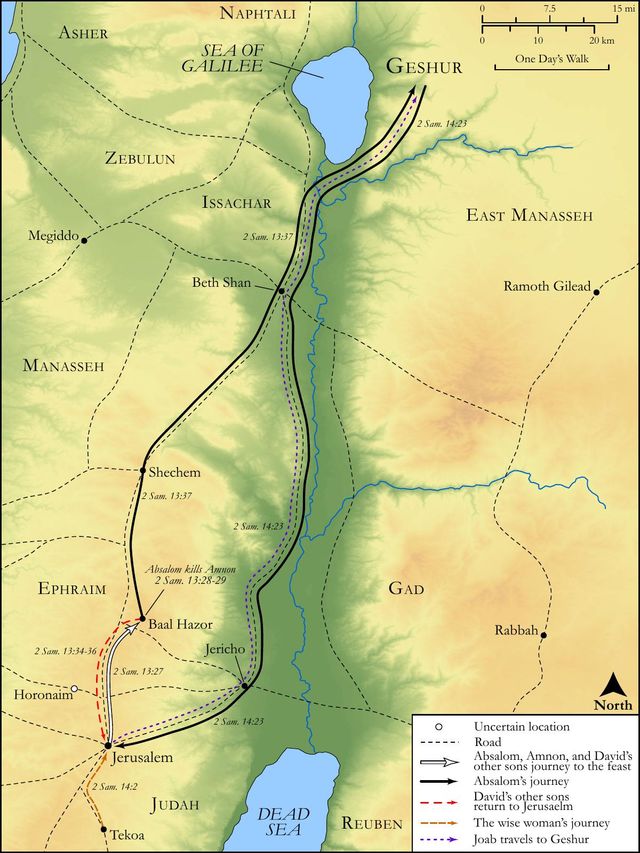
This verse is strategically placed within a highly volatile period of David's reign, immediately following Absalom's two-year exile in Geshur, a consequence of his vengeful murder of his half-brother Amnon for the rape of Tamar 2 Samuel 13:28-29. Joab, David's shrewd military commander, masterfully orchestrated Absalom's return to Jerusalem through the parable of the wise woman of Tekoa 2 Samuel 14:1-20. However, David's reconciliation was only partial; he allowed Absalom to reside in the capital but steadfastly refused to see his face 2 Samuel 14:24. This prolonged alienation, lasting another two years, deeply fueled Absalom's resentment and impatience, culminating in his drastic act of burning Joab's fields 2 Samuel 14:29-31 to compel a meeting with Joab, and subsequently, with the king. Absalom's words in 2 Samuel 14:32 are his direct explanation and ultimatum to Joab, laying bare his true motives and the depth of his frustration with his liminal status.
Historical & Cultural Context
In the royal courts of Israel and Persia, the act of "seeing the king's face" carried profound symbolic weight, signifying complete favor, acceptance, and restoration to royal presence, privilege, and access. To be denied this audience was a severe mark of disgrace, banishment, or ongoing disfavor, effectively a form of political house arrest even within the capital city. Absalom's demand thus reflects a deep cultural understanding that true reconciliation and reinstatement required direct, unhindered access to the monarch. His provocative challenge, "if there be any iniquity in me, let him kill me," while superficially appearing as submission to justice, was a calculated maneuver. It exploited the cultural expectation that a king must either fully pardon or fully punish, thereby forcing David's hand and shifting the burden of decision squarely onto the king's authority and perceived sense of justice. This also underscores the precarious position of a royal prince who, despite his lineage, found himself outside the king's direct favor.
Key Themes
ShowHideThis verse powerfully contributes to several overarching themes woven throughout the book of 2 Samuel. It starkly illustrates the theme of unresolved conflict and its devastating consequences, particularly within the royal family. David's passive and indecisive leadership regarding Absalom's return and subsequent alienation created fertile ground for festering resentment and future rebellion, rather than fostering genuine reconciliation. The verse also highlights Absalom's burgeoning ambition and manipulative nature, demonstrating his willingness to employ drastic and coercive measures to achieve his aims, even feigned submission. Furthermore, it speaks to the theme of royal authority and its exercise, as David's failure to either fully forgive or fully punish Absalom ultimately undermined his own kingship and directly contributed to the subsequent civil war described in 2 Samuel 15. Finally, the intense longing to "see the king's face" symbolizes a universal human desire for restoration and full acceptance, a profound spiritual need that, when unmet, can lead to desperate and destructive actions.
Exposition and Analysis
ShowHideKey Word Analysis
ShowHideThis term (עָוֹן, H5771) transcends a simple "misdeed" or "sin." It encompasses not only the act of transgression itself but also the inherent perversity, the resulting guilt, and the associated punishment or consequence. Absalom's deployment of ʿāwôn here is a highly provocative challenge to David. He is not genuinely confessing sin or seeking mercy; rather, he is daring David to acknowledge any remaining guilt or charge against him and, if such exists, to execute the appropriate capital judgment. If David cannot or will not condemn him to death, then Absalom subtly implies that he should be fully restored, as there is no longer any "iniquity" that warrants his continued alienation.
This idiomatic phrase (רָאָה פָּנִים, from H7200 rāʾāh "to see" and H6440 pānîym "face") is profoundly significant in Hebrew thought, denoting far more than a mere visual encounter. It signifies unhindered access, royal favor, complete acceptance, and full restoration to a position of honor and privilege within the royal court. To "see the king's face" meant to be in his direct presence, to have his ear, and to be recognized as a legitimate and valued member of his inner circle. Absalom's demand is not for a casual meeting but for absolute reconciliation and reinstatement to his former status as a prince, with all the rights, dignities, and privileges that entailed.
The verb (מוּת, H4191) means "to die" or, causatively, "to kill." Absalom's use of this word in his challenge, "let him kill me," is a dramatic and extreme rhetorical flourish. It is meant to highlight the perceived gravity of his situation and to force David's hand. By invoking the ultimate consequence, death, Absalom attempts to corner David: either his continued alienation is a matter of life and death (and thus, David should execute him), or it is not, and therefore, Absalom should be fully restored. It is a manipulative tactic designed to underscore his desperation and to pressure David into a definitive action.
Verse Breakdown
ShowHide"And Absalom answered Joab, Behold, I sent unto thee, saying, Come hither, that I may send thee to the king"
This opening clause immediately establishes Absalom's proactive agency and his deliberate, calculated strategy. He initiated contact with Joab, not from a position of humility or submission, but with the clear intent of using Joab as an indispensable conduit to the king. The emphatic "Behold, I sent unto thee" serves to highlight his authority and implicitly rebuke Joab's initial reluctance to respond, which necessitated Absalom's extreme measure of burning his fields to gain attention.
"to say, Wherefore am I come from Geshur? [it had been] good for me [to have been] there still"
Here, Absalom articulates his profound frustration and a thinly veiled accusation directed at David. He rhetorically questions the very purpose of his return to Jerusalem if it means continued alienation and effective house arrest. His lament, "it had been good for me to have been there still," is a masterfully manipulative statement, implying that his current state of limbo is worse than outright exile. It underscores his deep impatience and the perceived injustice of his situation, despite David's initial act of mercy in allowing his return.
"now therefore let me see the king's face"
This is the central demand and the ultimate objective driving all of Absalom's recent actions. It is a fervent plea for full restoration, for an immediate end to his effective house arrest, and for the public recognition of his rightful place within the royal family and court. As previously analyzed, this phrase signifies not merely a physical encounter but complete reconciliation, the re-establishment of his honor, and the full restoration of his princely position.
"and if there be [any] iniquity in me, let him kill me"
This dramatic and highly provocative challenge serves multiple strategic purposes. On the surface, it appears to be a profound submission to royal judgment, but it is, in fact, a daring ultimatum. Absalom is essentially asserting, "If I am truly guilty of a capital offense that warrants my continued exclusion, then let the king execute me without delay. If, however, no such capital charge remains, then there is no conceivable reason to prolong this alienation, and I should be fully and immediately restored." This statement artfully forces David into an agonizing dilemma: either condemn his beloved son to death (which David is demonstrably reluctant to do) or grant him full reconciliation, thereby implicitly declaring him innocent of any remaining charges that would justify his current isolated status. This is a calculated, manipulative ploy designed to compel David's hand.
Literary Devices
ShowHideThe passage is rich with several potent literary devices that amplify Absalom's character and the narrative tension. Irony is profoundly evident, as Absalom's seemingly submissive declaration, "if there be any iniquity in me, let him kill me," is deeply ironic given his manipulative actions preceding this statement and the full-blown rebellion he will soon instigate. This is not a genuine plea for justice or an act of repentance but a calculated challenge. Hyperbole is also clearly employed in this dramatic statement; Absalom uses extreme language—the ultimate punishment of death—to underscore his perceived desperation and to exert maximum pressure on David. The phrase "let him kill me" is an over-the-top pronouncement designed to elicit a strong, definitive reaction from the king. Furthermore, the repeated emphasis on "seeing the king's face" functions as powerful Symbolism, representing not merely physical sight but complete acceptance, full restoration, and unhindered access to power and favor. This intense desire for the king's face, when unmet, ultimately foreshadows the subsequent rebellion, as Absalom's profound impatience and his unmet need for full reconciliation tragically lead him to usurp the very throne from which he so desperately sought access.
Theological and Thematic Connections
ShowHideAbsalom's demand for full restoration, coupled with his manipulative challenge, profoundly illustrates the deep human yearning for acceptance and the destructive nature of unresolved conflict and partial reconciliation. David's inability to fully address the sin of Amnon's murder and its complex consequences, either through decisive justice or complete forgiveness and restoration, creates a dangerous vacuum that Absalom expertly exploits. This narrative serves as a powerful and enduring illustration of how unaddressed sin and persistent relational brokenness within a family, even a royal one, can fester, corrupt, and ultimately lead to catastrophic outcomes. The intense longing to "see the king's face" resonates deeply with humanity's innate spiritual yearning for unhindered access to God, a sacred privilege tragically lost through sin and only fully restored through the gracious and decisive intervention of divine grace.
Reflection and Application
ShowHideAbsalom's desperate plea to "see the king's face" resonates deeply with the universal human longing for acceptance, belonging, and genuine reconciliation, especially when relationships are fractured by conflict or offense. His manipulative tactic, however, serves as a profound cautionary tale: true, lasting reconciliation cannot be forced, coerced, or achieved through self-serving ultimatums. David's partial forgiveness—allowing Absalom to return to Jerusalem but denying him full access to the royal presence—created a volatile and unstable environment. This narrative powerfully underscores the critical importance of fully addressing conflict, whether through genuine repentance and complete forgiveness or through the administration of just and clear consequences, rather than allowing resentment and unresolved issues to fester in a state of ambiguous limbo. For us today, this story challenges us to deeply examine our own relationships: are there unresolved conflicts we are actively avoiding? When we feel alienated or unaccepted, do we tend to resort to manipulative tactics, or do we humbly seek genuine resolution rooted in truth and grace? What does "seeing the King's face" truly mean for us in our relationship with God, and what might be hindering that full, unhindered access? The path to true peace and flourishing relationships requires courageous engagement with difficult truths and a willingness to offer or receive full restoration, not merely a superficial or temporary truce.
Questions for Reflection
ShowHideFAQ
ShowHideWas Absalom genuinely seeking reconciliation, or was he being manipulative?
ShowHideAbsalom's actions and words in 2 Samuel 14:32 strongly indicate a manipulative intent rather than a genuine desire for true reconciliation or humble repentance. While he expresses frustration at his continued alienation, his demand to "see the king's face" is coupled with a highly provocative challenge: "if there be any iniquity in me, let him kill me." This is not a humble plea for forgiveness or a submission to justice, but a dare designed to force David's hand. Absalom had already resorted to burning Joab's fields (2 Samuel 14:29-31) to gain attention, clearly demonstrating a willingness to use coercive measures. His subsequent actions, which rapidly led to a full-blown rebellion against David (2 Samuel 15:1-12), unequivocally confirm that his primary goal was not reconciliation in the truest sense, but the restoration of his status and, ultimately, the usurpation of the throne. He desired the privileges of reconciliation without the accompanying humility, repentance, or submission it truly required.
Christ-Centered Fulfillment
ShowHideAbsalom's desperate longing to "see the king's face" and his manipulative attempts to force reconciliation stand in stark and illuminating contrast to the true, perfect reconciliation offered to humanity through Jesus Christ. Humanity, alienated from God by sin, found itself in a far more dire state of spiritual exile than Absalom, utterly unable to manipulate or coerce an audience with the divine King. Yet, God, in His boundless and unfathomable love, did not wait for us to contrive our way back. Instead, He proactively sent His beloved Son, Jesus, who perfectly fulfilled the righteous will of the Father, even to the ultimate point of death on a cross (Philippians 2:8). Unlike Absalom's feigned submission, Christ's obedience was genuine, complete, and sacrificial, offering Himself as the ultimate atonement for our "iniquity" (Isaiah 53:5-6). Through His atoning work, we are not merely allowed to return to the city; we are fully reconciled and granted unhindered, confident access to the Father's very presence, to "see His face" in a way Absalom could only ever dream of (Hebrews 10:19-22; Ephesians 2:18). Christ is our true and perfect mediator, not one who operates through manipulation, but through perfect obedience and self-sacrifice, bringing us into full adoption as beloved sons and daughters, no longer alienated but welcomed into the intimate presence of the King of Kings (Galatians 4:4-7).