


2 Samuel 14:33
Bible text: King James Version (1769 Blayney text) · Public domain
Bible text: King James Version with Strong's numbers · Public domain
Bible text: Berean Standard Bible · Public domain
Bible text: American Standard Version (1901) · Public domain
Bible text: World English Bible, Messianic edition · Public domain
Bible text: Geneva Bible (1599) · Public domain
Bible text: Young's Literal Translation · Public domain
- וַיָּבֹאvai·ya·Vo'and he wentH935Conj-w ¦ V-Qal-ConsecImperf-3msVerb Qal Consecutive Imperfect 3rd Singular Masculineוַandיָּבֹאhe went
- יוֹאָבyo·'AvJoabH3097N-proper-mNoun Proper Masculine
- אֶל'eltoH413PrepPreposition
- הַמֶּלֶךְha·me·leKhthe kingH4428Art ¦ N-msNoun Singular Masculine Absoluteהַtheמֶּלֶךְking
- וַיַּגֶּדvai·ya·gedand he toldH5046Conj-w ¦ V-Hiphil-ConsecImperf-3msVerb Hiphil Consecutive Imperfect 3rd Singular Masculineוַandיַּגֶּדhe told
- לוֹloto <the> himPrep-l ¦ 3msSuffix Personal 3rd Singular Masculineלto <the>וֹhim
- וַיִּקְרָאvai·yik·Ra'and he summonedH7121Conj-w ¦ V-Qal-ConsecImperf-3msVerb Qal Consecutive Imperfect 3rd Singular Masculineוַandיִּקְרָאhe summoned
- אֶל'el<to>H413PrepPreposition
- אַבְשָׁלוֹם'av·sha·lOmAbsalomH53N-proper-mNoun Proper Masculine
- וַיָּבֹאvai·ya·Vo'and he cameH935Conj-w ¦ V-Qal-ConsecImperf-3msVerb Qal Consecutive Imperfect 3rd Singular Masculineוַandיָּבֹאhe came
- אֶל'eltoH413PrepPreposition
- הַמֶּלֶךְha·Me·lekhthe kingH4428Art ¦ N-msNoun Singular Masculine Absoluteהַtheמֶּלֶךְking
- וַיִּשְׁתַּחוּvai·yish·Ta·chuand he bowed downH7812Conj-w ¦ V-Hishtaphel-ConsecImperf-3msVerb Hishtaphel Consecutive Imperfect 3rd Singular Masculineוַandיִּשְׁתַּחוּhe bowed down
- לוֹloto <the> himPrep-l ¦ 3msSuffix Personal 3rd Singular Masculineלto <the>וֹhim
- עַל'alonH5921PrepPreposition
- אַפָּיו'a·Pavhis faceH639N-mdc ¦ 3msNoun Dual Masculine Constructאַפָּיfaceוhis
- אַרְצָה'Ar·tzah[the] ground towardsH776N-fs ¦ SfxNoun Singular Feminine Absoluteאַרְצָ[the] groundהtowards
- לִפְנֵיlif·Nei<to> beforeH6440Prep-l ¦ N-mpcNoun Plural Masculine Constructלִ<to>פְנֵיbefore
- הַמֶּלֶךְha·Me·lekhthe kingH4428Art ¦ N-msNoun Singular Masculine Absoluteהַtheמֶּלֶךְking
- וַיִּשַּׁקvai·yi·Shakand he kissedH5401Conj-w ¦ V-Qal-ConsecImperf-3msVerb Qal Consecutive Imperfect 3rd Singular Masculineוַandיִּשַּׁקhe kissed
- הַמֶּלֶךְha·Me·lekhthe kingH4428Art ¦ N-msNoun Singular Masculine Absoluteהַtheמֶּלֶךְking
- לְאַבְשָׁלוֹםle·'av·sha·Lom<to> AbsalomH53Prep-l ¦ N-proper-mNoun Proper Masculineלְ<to>אַבְשָׁלוֹםAbsalom
English is a literal word-by-word gloss of the Hebrew, not the KJV's wording. Why?
This is the original text the KJV's translators worked from — each Hebrew word with its own literal English meaning in this verse, prepared by scholars at Tyndale House, Cambridge. The KJV translates whole sentences, not word by word, so its wording differs: one Hebrew word can become several English words, and the KJV may choose “the LORD” where the gloss reads “Yahweh”. Both are faithful — they answer different questions. For the KJV's own rendering, switch to the KJV text.
Details
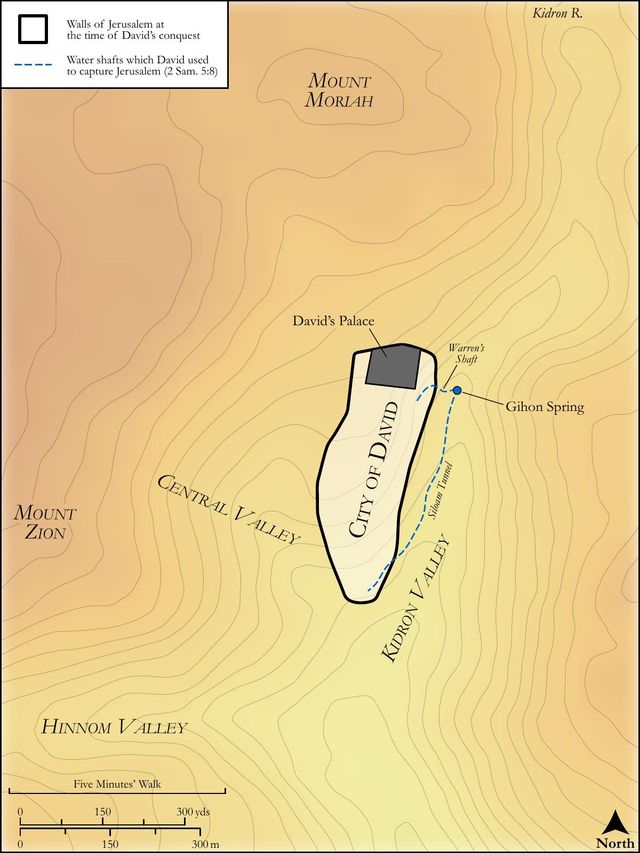
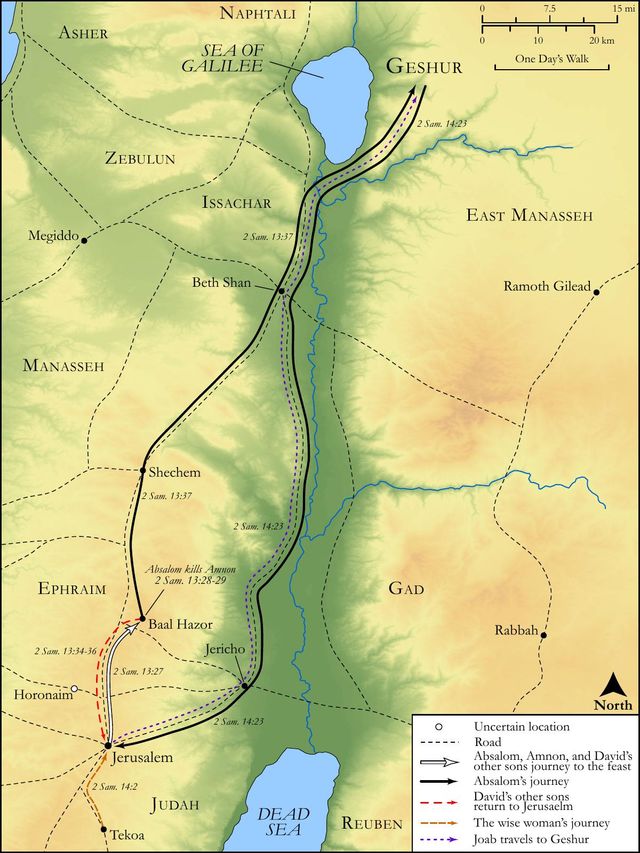
See on the biblical-era maps
Study this verse
Public-domain commentary
Matthew Henry
From his Commentary on the Whole Bible. Henry comments on passages, not single verses — this entry covers 2 Samuel 14:28–33.
Three years Absalom had been an exile from his father-in-law, and now two years a prisoner at large in his own house, and, in both, better dealt with than he deserved; yet his spirit was still unhumbled, his pride unmortified, and, instead of being thankful that his life is spared, he thinks himself sorely wronged that he is not restored to all his places at court. Had he truly repented of his sin, his distance from the gaieties of the court, and his solitude and retirement in his own house, especially being in Jerusalem the holy city, would have been very agreeable to him. If a murderer must live, yet let him be for ever a recluse. But Absalom could not bear this just and gentle mortification. He longed to see the king's face, pretending it was because he loved him, but really because he wanted an opportunity to supplant him. He cannot do his father a mischief till he is reconciled to him; this therefore is the first branch of his plot; this snake cannot sting again till he be warmed in his father's bosom. He gained this point, not by pretended submissions and promises of reformation, but (would you think it?) by insults and injuries. 1. By his insolent carriage towards Joab, he brought him to mediate for him. Once and again he sent to Joab to come and speak with him, for he durst not go to him; but Joab would not come (Sa2 14:29), probably because Absalom had not owned the kindness he had done him in bringing him to Jerusalem so gratefully as he thought he should have done; proud men take every service done them for a debt. One would think that a person in Absalom's circumstances should have sent to Joab a kindly message, and offered him a large gratuity: courtiers expect noble presents. But, instead of this, he bids his servants set Joab's corn-fields on fire (Sa2 14:30), as spiteful a thing as he could do. Samson could not think of a greater injury to do the Philistines than this. Strange that Absalom should think, by doing Joab a mischief, to prevail with him to do him a kindness, or to recommend himself to the favour of his prince or people by showing himself so very malicious and ill-natured, and such an enemy to the public good, for the fire might spread to the corn of others. Yet by this means he brings Joab to him, Sa2 14:31. Thus God, by afflictions, brings those to him that kept at a distance from him. Absalom was obliged by the law to make restitution (Exo 22:6), yet we do not find either that he offered it or that Joab demanded it. Joab (it might be) thought he could not justify his refusal to go and speak with him; and therefore Absalom thought he could justify his taking this way to fetch him. And now Joab (perhaps frightened at the surprising boldness and fury of Absalom, and apprehensive that he had made an interest in the people strong enough to bear him out in doing the most daring things, else he would never have done this) not only puts up with this injury, but goes on his errand to the king. See what some men can do by threats, and carrying things with a high hand. 2. By his insolent message (for I can call it no better) to the king, he recovered his place at court, to see the king's face, that is, to become a privy counsellor, Est 1:14. (1.) His message was haughty and imperious, and very unbecoming either a son or a subject, Sa2 14:32. He undervalued the favour that had been shown him in recalling him from banishment, and restoring him to his own house, and that in Jerusalem: Wherefore have I come from Geshur? He denies his own crimes, though most notorious, and will not own that there was any iniquity in him, insinuating that therefore he had been wronged in the rebuke he had been under. He defies the king's justice: "Let him kill me, if he can find in his heart," knowing he loved him too well to do it. (2.) Yet with this message he carried his point, Sa2 14:33. David's strong affection for him construed all this to be the language of a great respect to his father, and an earnest desire of his favour, when alas! it was far otherwise. See how easily wise and good men may be imposed upon by their own children that design ill, especially when they are blindly fond of them. Absalom, by the posture of his body, testified his submission to his father: He bowed himself on his face to the ground; and David, with a kiss, sealed his pardon. Did the bowels of a father prevail to reconcile him to an impenitent son, and shall penitent sinners question the compassion of him who is the Father of mercy? If Ephraim bemoan himself, God soon bemoans him, with all the kind expressions of a fatherly tenderness: He is a dear son, a pleasant child, Jer 31:20.
Continue studying 2 Samuel 14:33 across the web’s major study libraries — every link below opens this exact verse, chapter, or book on the destination site.
Read & Compare
 BibleGatewayThis verse in more than 200 translations and 70 languages.
 Bible.comThe YouVersion reader — hundreds of translations, reading plans, and highlights.
 ESV.orgCrossway's official English Standard Version reader.
 NET BibleThe NET translation with 60,000+ translators' notes on every rendering decision.
 STEP BibleTyndale House's free study tool — original text, vocabulary, and scholarly resources.
 BibliaLogos Bible Software's free web reader.
 USCCBThe New American Bible (Revised Edition) with the U.S. bishops' study notes.
Commentaries
 BibleHub CommentariesDozens of classic commentaries on this verse, gathered on one page.
 StudyLightMore than 100 commentary sets — the largest collection on the web.
 BibleRefPlain-English commentary on what this verse means, verse by verse.
 Enduring WordDavid Guzik's free commentary on this chapter, widely used by Bible teachers.
 Bible Study ToolsVerse commentary alongside Greek and Hebrew study aids.
Original Language & Research
- BibleHub InterlinearThe verse word by word — original language, transliteration, and English.
- BibleHub LexiconEvery word's original-language definition and Strong's entry.
 Blue Letter BibleDeep-study tools — Strong's numbers, concordance, and word studies.
 SefariaThe Hebrew text with Rashi and centuries of Jewish commentary.
Sermons, Hymns & Audio


TrulyRandomVerse is not affiliated with these sites and doesn’t control their content. They’re linked because they’re genuinely useful.
Summary
Second Samuel 14:33 narrates the pivotal moment of reconciliation between King David and his son, Absalom, following a five-year estrangement. After Absalom's three-year exile for the murder of his half-brother Amnon and two subsequent years under house arrest in Jerusalem, Joab's persistent mediation finally culminates in a direct audience with the king. This verse vividly portrays Absalom's profound act of prostration before David, a gesture of deep submission and reverence, met by the king's reciprocal kiss, symbolizing acceptance, the lifting of ostracization, and the outward restoration of their fractured father-son relationship.
Context
ShowHideLiterary Context
This verse serves as the long-anticipated climax of a complex narrative arc spanning several chapters. The preceding events in 2 Samuel 13 detail Absalom's calculated revenge for the rape of his sister Tamar, culminating in Amnon's murder and Absalom's subsequent flight to Geshur. David's profound grief over Amnon is tempered by a deep, persistent longing for Absalom, as indicated in 2 Samuel 13:39. 2 Samuel 14 then opens with Joab's shrewd intervention, employing the wise woman of Tekoah to subtly persuade David to permit Absalom's return to Jerusalem, albeit not yet to the king's presence (2 Samuel 14:1-20). Absalom endures two years of isolation in Jerusalem, unable to see his father (2 Samuel 14:28), growing increasingly impatient. His frustration leads him to extreme measures, twice sending for Joab and eventually burning Joab's fields to force a meeting (2 Samuel 14:30-31). Thus, 2 Samuel 14:33 is the direct outcome of Absalom's escalating demands and Joab's final, successful intercession, bringing father and son face-to-face after half a decade of painful estrangement. This fragile reconciliation, however, immediately precedes the tragic events of 2 Samuel 15, where Absalom's unaddressed ambition leads to full-blown rebellion.
Historical & Cultural Context
Among the nations round about, kings were considered divine representatives or even gods themselves, wielding absolute authority. Offenses against the monarch, especially by a member of the royal family, were not merely personal but political crimes, often punishable by death or permanent exile. Absalom's murder of Amnon, a royal prince and heir, was an act of regicide in waiting, a direct challenge to the king's authority and the stability of the succession. The act of prostration, "bowing himself on his face to the ground," was a universally understood gesture of profound submission, reverence, and often a plea for mercy or favor before a superior, whether a king, a high official, or a deity. It signified complete deference and acknowledgment of the other's supreme authority. Conversely, the kiss was a widely recognized symbol of greeting, affection, loyalty, and, critically in this context, reconciliation and acceptance. For a king to kiss a subject, particularly one who had committed a grave offense, publicly symbolized the lifting of royal displeasure, the granting of favor, and the restoration of the individual to their rightful place within the court and society. This public display was essential for demonstrating both the king's prerogative to forgive and the subject's renewed allegiance.
Key Themes
ShowHideThe central theme explored in this passage is the profound and often complex nature of reconciliation within human relationships, particularly those strained by severe sin and familial betrayal. David's persistent paternal love for Absalom, despite his son's heinous crime, is a poignant sub-theme, evident in his eventual acceptance, a love that will later manifest in his overwhelming grief at Absalom's death (2 Samuel 18:33). Joab's strategic pragmatism and his role as a persistent, albeit sometimes manipulative, intermediary are also highlighted. He consistently acts to maintain the stability of the kingdom and the king's well-being, even when navigating fraught family dynamics. Furthermore, the narrative subtly introduces the theme of fragile peace or superficial reconciliation. While an outward reconciliation is achieved, the underlying issues of Absalom's unrepentant ambition and David's perhaps incomplete processing of justice and forgiveness foreshadow the tragic rebellion that inevitably follows in 2 Samuel 15. This verse, therefore, represents a pivotal, yet ultimately temporary, resolution before a greater, more devastating conflict erupts.
Exposition and Analysis
ShowHideKey Word Analysis
ShowHideFrom the Hebrew words for "father" (אב, 'ab') and "peace" (שָׁלוֹם, shalom), meaning "father of peace" or "my father is peace." This name carries profound irony in the context of his life. Despite his name, Absalom becomes a source of great strife and division within David's family and kingdom, ultimately leading a rebellion against his own father. His actions directly contradict the meaning of his name, highlighting the tragic trajectory of his character.
A primitive root meaning "to depress, i.e. prostrate (especially reflexive, in homage to royalty or God); bow (self) down, crouch, fall down (flat), humbly beseech, do (make) obeisance, do reverence, make to stoop, worship." Absalom's act of prostration is a profound physical expression of humility, submission, and reverence. It is a gesture of complete deference to David's authority as king and father, a necessary prerequisite for any hope of restoration in the hierarchical context of the ancient court.
A primitive root meaning "to kiss, literally or figuratively (touch); also (as a mode of attachment), to equip with weapons; armed (men), rule, kiss, that touched." In this context, the verb signifies an act of reconciliation, acceptance, and restored favor. David's kiss publicly communicates the lifting of Absalom's ostracization and his formal reintegration into the royal family's presence and favor. It is a powerful non-verbal affirmation of the end of the official estrangement.
Verse Breakdown
ShowHide"So Joab came to the king, and told him:"
This clause underscores Joab's crucial and persistent role as the intermediary. After Absalom's desperate measures to gain his attention, Joab finally acts, approaching David to convey Absalom's desire for an audience. This demonstrates Joab's significant influence and his strategic understanding of both David's emotional state and the political necessity of resolving the Absalom situation.
"and when he had called for Absalom, he came to the king,"
This signifies David's ultimate decision and initiative in the final step of the reconciliation. Upon hearing Joab's report, David issues the royal summons, indicating his readiness to end the long period of estrangement. Absalom's immediate obedience to the summons, despite his previous defiance, highlights his continued, at least outward, recognition of David's authority and his eagerness for this long-awaited meeting.
"and bowed himself on his face to the ground before the king:"
This describes Absalom's posture upon entering David's presence. It is a dramatic and profound act of submission, humility, and reverence. By prostrating himself, Absalom publicly acknowledges David's kingship and paternal authority, offering a visible demonstration of deference and perhaps a silent plea for forgiveness, which was culturally essential for the reconciliation process to proceed.
"and the king kissed Absalom."
This is the climactic and most emotionally charged moment of the verse and the entire reconciliation process. David's kiss is a gesture rich in meaning: acceptance, affection, and reconciliation. It publicly signals the end of Absalom's ostracization, his restoration to the king's favor, and the formal re-establishment of their father-son relationship. While deeply personal, this act also carries immense political weight, signaling Absalom's reintegration into the public life of the royal family.
Literary Devices
ShowHideThe narrative of 2 Samuel 14:33 masterfully employs several literary devices to convey the profound significance and underlying tensions of this moment. The verse represents a Climax, as it is the long-awaited resolution of the five-year estrangement between David and Absalom, the culmination of Joab's intricate schemes and Absalom's persistent demands. The actions described, "bowed himself on his face to the ground" and "the king kissed Absalom," are rich in Symbolism. Absalom's prostration symbolizes abject submission, humility, and a plea for mercy and acceptance, acknowledging David's supreme authority. Conversely, David's kiss symbolizes acceptance, forgiveness, restored favor, and the re-establishment of the father-son bond. However, this outwardly harmonious scene is deeply tinged with Dramatic Irony and Foreshadowing. The audience, possessing the knowledge of subsequent events in 2 Samuel, understands that this reconciliation is tragically fragile and ultimately temporary. The "peace" achieved here is superficial, failing to address Absalom's deep-seated ambition, resentment, and unrepentant heart, which will soon erupt into open rebellion. This makes David's kiss a poignant, yet ultimately hollow, gesture of reconciliation, hinting at the greater tragedy to come.
Theological and Thematic Connections
ShowHideThe reconciliation between David and Absalom in 2 Samuel 14:33 offers a complex and often sobering study in human relationships, the limits of forgiveness, and the enduring consequences of sin. While David's kiss outwardly signifies acceptance and the lifting of estrangement, the narrative notably omits any explicit mention of Absalom's genuine repentance for Amnon's murder, nor does it portray a true change of heart on Absalom's part. This distinction highlights the crucial difference between outward, formal reconciliation and a deep, transformative inner change. David, as a human father and king, grapples with the tension between his paternal affection for Absalom and his kingly duty to uphold justice for Amnon. His act of reconciliation, though an expression of mercy, ultimately proves insufficient to prevent further tragedy, suggesting that true and lasting peace requires more than just a formal gesture; it demands a truly reconciled and transformed heart. This imperfect human reconciliation stands in stark contrast to God's perfect, transformative, and redemptive forgiveness, which always seeks not just outward peace but inward renewal.
Reflection and Application
ShowHideThe scene in 2 Samuel 14:33 is a deeply moving and complex portrayal of the profound human longing for reconciliation in fractured relationships, especially within the intimate bonds of family. David's willingness to embrace his son, despite Absalom's grievous and unrepented sin, speaks volumes about the enduring nature of parental love and the innate human desire for restoration. However, the subsequent narrative serves as a sobering reminder of the limitations of such reconciliation when one party's heart remains unchanged, leading inevitably to further betrayal and tragedy. This prompts us to consider that while outward gestures of reconciliation, such as apologies, forgiveness, and the lifting of estrangement, are vital and necessary steps, true and lasting peace requires genuine repentance, a transformed heart, and a commitment to new behavior. The role of intermediaries, like Joab, also highlights the importance of those who can bridge divides and facilitate dialogue, even if their own motives are mixed. For us, this passage encourages us to actively pursue reconciliation where possible, to be open to both offering and receiving forgiveness, and to recognize that while we can extend grace and make overtures of peace, we cannot force a change of heart in another. It calls us to reflect on the depth of our own repentance when seeking reconciliation and the sincerity of our forgiveness when extending it.
Questions for Reflection
ShowHideFAQ
ShowHideWhy did David wait so long to reconcile with Absalom, especially given his longing for him?
ShowHideDavid's delay in fully reconciling with Absalom was likely a complex interplay of personal grief, kingly duty, and political pragmatism. His initial mourning over Amnon's death and Absalom's involvement was profound (2 Samuel 13:37). As king, Amnon's murder was not merely a family tragedy but a capital offense and a challenge to royal authority. To immediately forgive Absalom might have been perceived as a failure of justice, undermining David's rule and the rule of law in Israel. There was an internal struggle between his deep paternal affection and his solemn kingly duty. The two years Absalom spent in Jerusalem without seeing David can be understood as a period of cooling off, a form of internal exile and punishment, or perhaps David's own emotional processing before he felt ready for a direct confrontation and reconciliation. Joab's persistent and strategic mediation was crucial in overcoming this impasse, recognizing the political instability caused by the unresolved family rift.
What was Joab's motivation in facilitating Absalom's return and reconciliation?
ShowHideJoab's motivations were complex, primarily rooted in pragmatic and political considerations for the stability of David's kingdom. As David's commander-in-chief, Joab was deeply invested in the strength and continuity of the monarchy. Absalom, as a popular and charismatic prince, represented a significant potential source of unrest if left in permanent exile or estranged from the king. Joab likely recognized David's deep emotional longing for Absalom (2 Samuel 13:39), and understood that a king's unresolved grief and family strife could weaken his reign. By orchestrating Absalom's return and reconciliation, Joab aimed to restore harmony within the royal family, secure the line of succession, and thereby strengthen David's rule and his own influential position within the court. His actions, though at times manipulative (as with the wise woman of Tekoah), were consistently aimed at what he perceived as the best interests of David and the kingdom.
Christ-Centered Fulfillment
ShowHideWhile the reconciliation between David and Absalom in 2 Samuel 14:33 is a poignant human drama of a father's love and a son's return, it ultimately falls short of true, lasting peace, tragically foreshadowing the profound need for a perfect and divine reconciliation. David's kiss, though an act of grace and acceptance, could not transform Absalom's ambitious and unrepentant heart, leading inevitably to further rebellion and national tragedy. This imperfect human reconciliation points powerfully to the ultimate and perfect reconciliation offered through Jesus Christ. We, like Absalom, are estranged from our heavenly King due to our sin, deserving of judgment and separation. Yet, in His boundless love, God, through Christ, initiates reconciliation. Our "bowing" before God is not merely an outward act of submission, but a genuine, Spirit-wrought repentance of heart, acknowledging His supreme authority and our desperate need for His mercy and grace (Romans 10:9-10). In response, God, through Christ, extends a divine "kiss" of complete acceptance, not merely restoring us to His presence but adopting us as His beloved children, granting us full access to His grace (Ephesians 1:5-6). Jesus is the ultimate mediator, far surpassing Joab, who bridges the infinite chasm between a holy God and sinful humanity through His atoning sacrifice on the cross (1 Timothy 2:5). Unlike the fragile and temporary peace in 2 Samuel, the reconciliation offered in Christ is complete, eternal, and transformative, not only changing our standing before God but also renewing our hearts by the Holy Spirit, enabling us to live in true, lasting peace with God and with one another (Colossians 1:21-22).