


2 Samuel 14:29
Bible text: King James Version (1769 Blayney text) · Public domain
Bible text: Berean Standard Bible · Public domain
Bible text: American Standard Version (1901) · Public domain
Bible text: World English Bible, Messianic edition · Public domain
Bible text: Geneva Bible (1599) · Public domain
Bible text: Young's Literal Translation · Public domain
- וַיִּשְׁלַחvai·yish·Lachand he sentH7971Conj-w ¦ V-Qal-ConsecImperf-3msVerb Qal Consecutive Imperfect 3rd Singular Masculineוַandיִּשְׁלַחhe sent
- אַבְשָׁלוֹם'av·sha·LomAbsalomH53N-proper-mNoun Proper Masculine
- אֶל'eltoH413PrepPreposition
- יוֹאָבyo·'AvJoabH3097N-proper-mNoun Proper Masculine
- לִשְׁלֹחַlish·Lo·achto sendH7971Prep-l ¦ V-Qal-InfVerb Qal Infinitive Constructלִtoשְׁלֹחַsend
- אֹתוֹ'o·To<obj.> himH853DirObjM ¦ 3msParticle Object Indicatorאֹת<obj.>וֹhim
- אֶל'eltoH413PrepPreposition
- הַמֶּלֶךְha·Me·lekhthe kingH4428Art ¦ N-msNoun Singular Masculine Absoluteהַtheמֶּלֶךְking
- וְלֹאve·Lo'and notH3808Conj-w ¦ NegParticle Negativeוְandלֹאnot
- אָבָה'a·Vahhe was willingH14V-Qal-Perf-3msVerb Qal Perfect 3rd Singular Masculine
- לָבוֹאla·Vo'to comeH935Prep-l ¦ V-Qal-InfVerb Qal Infinitive Constructלָtoבוֹאcome
- אֵלָיו'e·Lavto himH413Prep ¦ 3msPreposition Definiteאֵלָיtoוhim
- וַיִּשְׁלַחvai·yish·Lachand he sentH7971Conj-w ¦ V-Qal-ConsecImperf-3msVerb Qal Consecutive Imperfect 3rd Singular Masculineוַandיִּשְׁלַחhe sent
- עוֹד'OdagainH5750Adj-msAdjective Numerical Singular Masculine Absolute
- שֵׁנִיתshe·Nita second [time]H8145Adj-fsAdjective Numerical Position Singular Feminine Absolute
- וְלֹאve·Lo'and notH3808Conj-w ¦ NegParticle Negativeוְandלֹאnot
- אָבָה'a·Vahhe was willingH14V-Qal-Perf-3msVerb Qal Perfect 3rd Singular Masculine
- לָבוֹאla·Vo'to comeH935Prep-l ¦ V-Qal-InfVerb Qal Infinitive Constructלָtoבוֹאcome
English is a literal word-by-word gloss of the Hebrew, not the KJV's wording. Why?
This is the original text the KJV's translators worked from — each Hebrew word with its own literal English meaning in this verse, prepared by scholars at Tyndale House, Cambridge. The KJV translates whole sentences, not word by word, so its wording differs: one Hebrew word can become several English words, and the KJV may choose “the LORD” where the gloss reads “Yahweh”. Both are faithful — they answer different questions. For the KJV's own rendering, switch to the KJV text.
Details
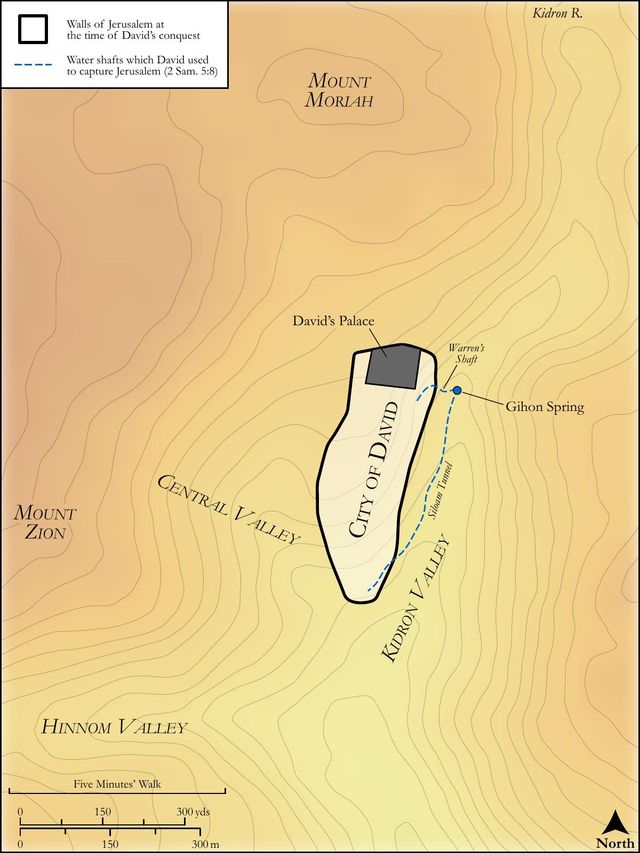
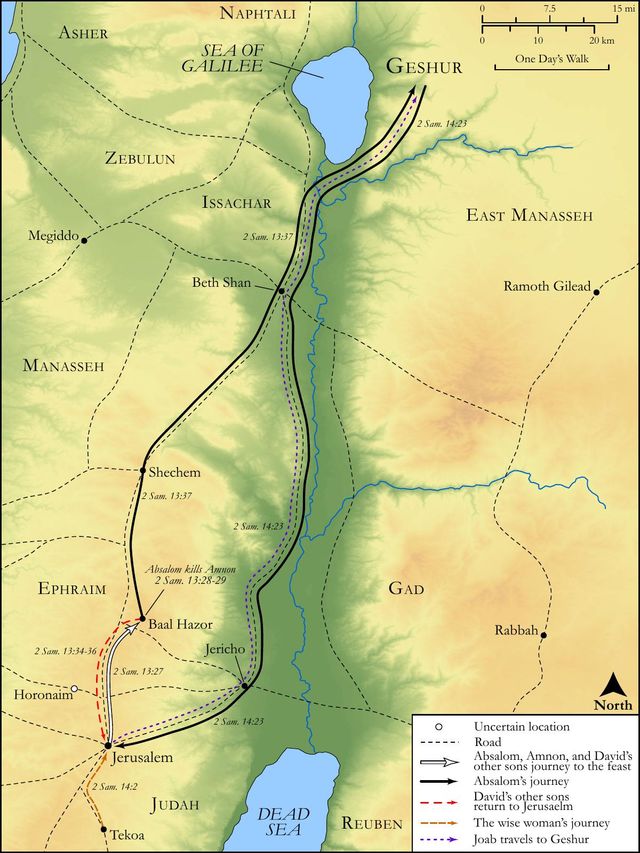
See on the biblical-era maps
Study this verse
Public-domain commentary
Matthew Henry
From his Commentary on the Whole Bible. Henry comments on passages, not single verses — this entry covers 2 Samuel 14:28–33.
Three years Absalom had been an exile from his father-in-law, and now two years a prisoner at large in his own house, and, in both, better dealt with than he deserved; yet his spirit was still unhumbled, his pride unmortified, and, instead of being thankful that his life is spared, he thinks himself sorely wronged that he is not restored to all his places at court. Had he truly repented of his sin, his distance from the gaieties of the court, and his solitude and retirement in his own house, especially being in Jerusalem the holy city, would have been very agreeable to him. If a murderer must live, yet let him be for ever a recluse. But Absalom could not bear this just and gentle mortification. He longed to see the king's face, pretending it was because he loved him, but really because he wanted an opportunity to supplant him. He cannot do his father a mischief till he is reconciled to him; this therefore is the first branch of his plot; this snake cannot sting again till he be warmed in his father's bosom. He gained this point, not by pretended submissions and promises of reformation, but (would you think it?) by insults and injuries. 1. By his insolent carriage towards Joab, he brought him to mediate for him. Once and again he sent to Joab to come and speak with him, for he durst not go to him; but Joab would not come (Sa2 14:29), probably because Absalom had not owned the kindness he had done him in bringing him to Jerusalem so gratefully as he thought he should have done; proud men take every service done them for a debt. One would think that a person in Absalom's circumstances should have sent to Joab a kindly message, and offered him a large gratuity: courtiers expect noble presents. But, instead of this, he bids his servants set Joab's corn-fields on fire (Sa2 14:30), as spiteful a thing as he could do. Samson could not think of a greater injury to do the Philistines than this. Strange that Absalom should think, by doing Joab a mischief, to prevail with him to do him a kindness, or to recommend himself to the favour of his prince or people by showing himself so very malicious and ill-natured, and such an enemy to the public good, for the fire might spread to the corn of others. Yet by this means he brings Joab to him, Sa2 14:31. Thus God, by afflictions, brings those to him that kept at a distance from him. Absalom was obliged by the law to make restitution (Exo 22:6), yet we do not find either that he offered it or that Joab demanded it. Joab (it might be) thought he could not justify his refusal to go and speak with him; and therefore Absalom thought he could justify his taking this way to fetch him. And now Joab (perhaps frightened at the surprising boldness and fury of Absalom, and apprehensive that he had made an interest in the people strong enough to bear him out in doing the most daring things, else he would never have done this) not only puts up with this injury, but goes on his errand to the king. See what some men can do by threats, and carrying things with a high hand. 2. By his insolent message (for I can call it no better) to the king, he recovered his place at court, to see the king's face, that is, to become a privy counsellor, Est 1:14. (1.) His message was haughty and imperious, and very unbecoming either a son or a subject, Sa2 14:32. He undervalued the favour that had been shown him in recalling him from banishment, and restoring him to his own house, and that in Jerusalem: Wherefore have I come from Geshur? He denies his own crimes, though most notorious, and will not own that there was any iniquity in him, insinuating that therefore he had been wronged in the rebuke he had been under. He defies the king's justice: "Let him kill me, if he can find in his heart," knowing he loved him too well to do it. (2.) Yet with this message he carried his point, Sa2 14:33. David's strong affection for him construed all this to be the language of a great respect to his father, and an earnest desire of his favour, when alas! it was far otherwise. See how easily wise and good men may be imposed upon by their own children that design ill, especially when they are blindly fond of them. Absalom, by the posture of his body, testified his submission to his father: He bowed himself on his face to the ground; and David, with a kiss, sealed his pardon. Did the bowels of a father prevail to reconcile him to an impenitent son, and shall penitent sinners question the compassion of him who is the Father of mercy? If Ephraim bemoan himself, God soon bemoans him, with all the kind expressions of a fatherly tenderness: He is a dear son, a pleasant child, Jer 31:20.
Continue studying 2 Samuel 14:29 across the web’s major study libraries — every link below opens this exact verse, chapter, or book on the destination site.
Read & Compare
 BibleGatewayThis verse in more than 200 translations and 70 languages.
 Bible.comThe YouVersion reader — hundreds of translations, reading plans, and highlights.
 ESV.orgCrossway's official English Standard Version reader.
 NET BibleThe NET translation with 60,000+ translators' notes on every rendering decision.
 STEP BibleTyndale House's free study tool — original text, vocabulary, and scholarly resources.
 BibliaLogos Bible Software's free web reader.
 USCCBThe New American Bible (Revised Edition) with the U.S. bishops' study notes.
Commentaries
 BibleHub CommentariesDozens of classic commentaries on this verse, gathered on one page.
 StudyLightMore than 100 commentary sets — the largest collection on the web.
 BibleRefPlain-English commentary on what this verse means, verse by verse.
 Enduring WordDavid Guzik's free commentary on this chapter, widely used by Bible teachers.
 Bible Study ToolsVerse commentary alongside Greek and Hebrew study aids.
Original Language & Research
- BibleHub InterlinearThe verse word by word — original language, transliteration, and English.
- BibleHub LexiconEvery word's original-language definition and Strong's entry.
 Blue Letter BibleDeep-study tools — Strong's numbers, concordance, and word studies.
 SefariaThe Hebrew text with Rashi and centuries of Jewish commentary.
Sermons, Hymns & Audio


TrulyRandomVerse is not affiliated with these sites and doesn’t control their content. They’re linked because they’re genuinely useful.
Summary
2 Samuel 14:29 captures a pivotal moment of escalating tension between Absalom and Joab, highlighting Absalom's growing impatience for full reconciliation with King David and Joab's strategic reluctance to intervene further. This verse underscores the deep-seated frustration Absalom felt during his two-year house arrest in Jerusalem, setting the stage for the dramatic events of his future rebellion and revealing the complex political and personal dynamics within David's court.
Context
ShowHideLiterary Context
This verse is situated immediately after Absalom's return to Jerusalem from Geshur, where he had fled after murdering his half-brother Amnon (2 Samuel 13:38). Joab, David's shrewd military commander, had previously orchestrated Absalom's return through the clever parable of the wise woman of Tekoa (2 Samuel 14:1-20). While David permitted Absalom to return, he did not allow him to see his face, a clear sign of continued displeasure and a form of royal banishment within the city. 2 Samuel 14:28 explicitly states that Absalom remained in Jerusalem for two full years without seeing the king. This prolonged estrangement fueled Absalom's frustration, leading to his desperate attempts to summon Joab to mediate once more, as detailed in the present verse and the subsequent actions in 2 Samuel 14:30.
Historical & Cultural Context
In the courts of kings, access to the king's presence was a profound symbol of favor, reconciliation, and political standing. To be denied the king's face was a severe form of punishment, akin to social and political exile, even if physically present in the capital. Absalom's situation, though back in Jerusalem, was one of continued disgrace and powerlessness. Joab, as David's commander and a key political figure, understood these dynamics intimately. His initial intervention to bring Absalom back was a calculated move, but his subsequent refusal to push for full reconciliation likely stemmed from a deep understanding of David's temperament, the gravity of Absalom's crime (fratricide), and perhaps an emerging suspicion of Absalom's true intentions, which may have extended beyond mere reconciliation to an ambition for power, as later revealed in 2 Samuel 15.
Key Themes
ShowHideThis verse powerfully contributes to several overarching themes within the book of 2 Samuel. Firstly, it highlights the consequences of David's dysfunctional family life and his often-passive approach to discipline and reconciliation. His failure to fully restore Absalom after his return created a breeding ground for resentment and rebellion. Secondly, it underscores Absalom's impatience and burgeoning ambition. His frustration with the prolonged estrangement reveals a character unwilling to wait for his father's full forgiveness, foreshadowing his later usurpation of the throne (2 Samuel 15:10-12). Thirdly, Joab's actions exemplify political pragmatism and strategic caution. While he initially facilitated Absalom's return, his refusal to act further suggests a shrewd assessment of the volatile situation, perhaps sensing the danger Absalom posed or simply respecting David's continued displeasure, even if it was prolonged. This theme of human agency and divine orchestration, often through flawed characters, runs throughout the narrative of David's reign.
Exposition and Analysis
ShowHideKey Word Analysis
ShowHideThis Hebrew verb, meaning "to send away, dispatch, or stretch out," is used twice in this short verse, emphasizing Absalom's repeated and deliberate attempts to summon Joab. The repetition highlights his persistence and growing desperation. It signifies an act of initiative and a claim to authority, even though Absalom's actual authority was currently limited. The fact that his "sending" was met with refusal underscores his diminished power and the challenge to his perceived authority.
This root word signifies "to breathe after, to be acquiescent, to consent, or to be willing." In 2 Samuel 14:29, its negation ("he would not come") is crucial. It indicates that Joab's refusal was not due to inability or absence, but a deliberate and conscious unwillingness or lack of consent to Absalom's summons. This highlights Joab's firm resolve and his intentional decision to not comply with Absalom's request.
This primitive root means "to go or come" in a wide variety of applications. In the context of this verse, Joab's refusal to "come" signifies his direct non-compliance with Absalom's command. Coupled with the negation of "would" (ʼâbâh), it underscores the finality and deliberateness of Joab's decision, effectively blocking Absalom's desired path to the king.
Verse Breakdown
ShowHide"Therefore Absalom sent for Joab, to have sent him to the king;"
This initial clause establishes Absalom's motivation and immediate goal. The "therefore" links directly to the previous verse, 2 Samuel 14:28, explaining that after two years of being unable to see David's face, Absalom's patience had worn thin. He sought Joab, the very person who had facilitated his return, to act as an intermediary once more, hoping Joab could persuade David to grant him full access and reconciliation. This reveals Absalom's continued reliance on Joab's influence and his own inability to directly approach the king.
"but he would not come to him:"
This is the first instance of Joab's refusal. It is a direct and immediate rejection of Absalom's initial summons. This refusal is significant, as Joab had previously gone to great lengths to bring Absalom back. His change of stance indicates a shift in his assessment of the situation or his relationship with Absalom, perhaps signaling a reluctance to overstep David's boundaries or to be further entangled in Absalom's volatile affairs.
"and when he sent again the second time, he would not come."
This final clause underscores Absalom's persistence and Joab's unwavering resolve. Absalom, undeterred by the initial refusal, escalates his efforts by sending a second time. However, Joab's response remains unchanged. The repetition of "he would not come" emphasizes the firmness of Joab's decision and the futility of Absalom's attempts through conventional means, pushing Absalom toward more drastic actions.
Literary Devices
ShowHideThe primary literary device at play in 2 Samuel 14:29 is Repetition. The phrase "he would not come" is repeated twice, first for the initial summons and then for the second. This repetition serves to emphasize Joab's resolute refusal and, by contrast, Absalom's growing frustration and desperation. It creates a sense of building tension and highlights the impasse in the relationship between Absalom and the royal court. Furthermore, the narrative employs Foreshadowing. Joab's refusal, coupled with Absalom's evident impatience, subtly hints at the deeper, unresolved conflicts that will soon erupt into open rebellion. The reader senses that Absalom's frustration, denied legitimate channels of resolution, will inevitably lead to destructive actions. There is also a subtle element of Dramatic Irony, as the reader, knowing the tragic outcome of Absalom's rebellion, perceives the futility of his attempts at reconciliation through Joab and the tragic consequences of David's prolonged estrangement from his son.
Theological and Thematic Connections
ShowHide2 Samuel 14:29 serves as a poignant illustration of the dangers of unresolved conflict and the complex interplay of human will and divine purpose. David's prolonged withholding of full reconciliation, even after Absalom's return, created a fertile ground for bitterness and impatience in his son. This narrative highlights how delayed justice or incomplete forgiveness can fester, leading individuals to take matters into their own hands, often with destructive consequences. Joab's calculated refusal, while perhaps politically astute, also underscores the limitations of human mediation when true repentance and reconciliation are absent or incomplete on both sides. The passage implicitly raises questions about the nature of restoration, the responsibility of leadership in fostering healing, and the perilous path of unchecked ambition.
Reflection and Application
ShowHideThis passage offers profound insights into the human condition, particularly the complexities of family dynamics, leadership, and the destructive power of unresolved grievances. For leaders, it serves as a cautionary tale about the perils of passive leadership and delayed reconciliation. David's inability or unwillingness to fully engage with Absalom after his return created a void that his son filled with resentment and ambition. For individuals, Absalom's impatience reminds us that while waiting for resolution can be agonizing, resorting to manipulative or destructive means to force an outcome only exacerbates problems. Joab's calculated prudence, on the other hand, prompts us to consider the wisdom of knowing when to intervene and when to hold back, particularly in delicate relational or political situations. Ultimately, the narrative challenges us to pursue genuine reconciliation, to address conflicts proactively, and to guard our hearts against the bitterness that can take root when hope is deferred and justice seems elusive.
Questions for Reflection
ShowHideFAQ
ShowHideWhy did Joab refuse to come to Absalom, especially after he had worked so hard to bring him back to Jerusalem?
ShowHideJoab's refusal was likely a calculated strategic move. Having successfully orchestrated Absalom's return to Jerusalem, Joab had fulfilled his part in easing David's grief and bringing his son back to the kingdom. However, David's continued refusal to see Absalom's face (2 Samuel 14:28) indicated that the king's displeasure remained. Joab, ever the pragmatist and keenly aware of the political landscape, probably sensed that pushing David further at this point would be counterproductive or even dangerous to his own standing. He might have also perceived Absalom's growing impatience and ambition, realizing that Absalom's desire for full reconciliation was intertwined with a desire for political prominence, which could destabilize the court. Joab's actions throughout 2 Samuel consistently demonstrate a focus on what he believed was best for David's kingdom, even if it meant making difficult or unpopular decisions.
Christ-Centered Fulfillment
ShowHideThe strained and ultimately tragic relationship between David and Absalom, particularly the delayed and incomplete reconciliation highlighted in 2 Samuel 14:29, stands in stark contrast to the perfect and complete reconciliation offered through Jesus Christ. Absalom sought human mediation from Joab to gain access to his father, but even Joab's efforts were limited and ultimately failed to prevent Absalom's rebellion. This points to the inadequacy of human mediators and the brokenness of human relationships marred by sin. In contrast, Jesus Christ is the ultimate and perfect Mediator between God and humanity (1 Timothy 2:5). Unlike Joab's reluctance to intervene further, Christ willingly and proactively came to reconcile us to God, not through negotiation or political maneuvering, but through His sacrificial death on the cross (Romans 5:10). Our access to the Father is not dependent on a reluctant intermediary or a prolonged period of separation, but is freely granted through faith in Christ, who has torn down the dividing wall of hostility (Ephesians 2:14). The full and eternal reconciliation that Absalom desperately sought but never truly achieved with David is fully realized for all who believe in the Lamb of God, who takes away the sin of the world (John 1:29).