


2 Samuel 14:30
Bible text: King James Version (1769 Blayney text) · Public domain
Bible text: King James Version with Strong's numbers · Public domain
Bible text: Berean Standard Bible · Public domain
Bible text: American Standard Version (1901) · Public domain
Bible text: World English Bible, Messianic edition · Public domain
Bible text: Geneva Bible (1599) · Public domain
Bible text: Young's Literal Translation · Public domain
- וַיֹּאמֶרvai·Yo·merand he saidH559Conj-w ¦ V-Qal-ConsecImperf-3msVerb Qal Consecutive Imperfect 3rd Singular Masculineוַandיֹּאמֶרhe said
- אֶל'eltoH413PrepPreposition
- עֲבָדָיו'a·va·Davhis servantsH5650N-mpc ¦ 3msNoun Plural Masculine Constructעֲבָדָיservantsוhis
- רְאוּre·'UseeH7200V-Qal-Imp-2mpVerb Qal Imperative 2nd Plural Masculine
- חֶלְקַתchel·Kat[the] portion of land ofH2513N-fscNoun Singular Feminine Construct
- יוֹאָבyo·'AvJoabH3097N-proper-mNoun Proper Masculine
- אֶל'el[is] toH413PrepPreposition
- יָדִיya·Dimy handH3027N-csc ¦ 1csNoun Singular common gender Constructיָדִhandיmy
- וְלוֹve·loand [belongs] to <the> himConj-w ¦ Prep-l ¦ 3msSuffix Personal 3rd Singular Masculineוְandל[belongs] to <the>וֹhim
- שָׁםshamthereH8033AdvAdverb
- שְׂעֹרִיםse·'o·Rimbarley<s>H8184N-mpNoun Plural Masculine Absolute
- לְכוּle·KhugoH1980V-Qal-Imp-2mpVerb Qal Imperative 2nd Plural Masculine
- וְהַצִּיתוּהָve·ho·tzi·tei·haand set on fire itH3341Conj-w ¦ V-Hiphil-Imp-2mp ¦ 3fsVerb Hiphil Imperative 2nd Plural Masculineוְandהַצִּיתוּset on fireהָit
- בָאֵשׁva·'Eshwith <the> fireH784Prep-b ¦ N-csNoun Singular common gender Absoluteבָwith <the>אֵשׁfire
- וַיַּצִּתוּvai·ya·Tzi·tuand they set on fireH3341Conj-w ¦ V-Hiphil-ConsecImperf-3mpVerb Hiphil Consecutive Imperfect 3rd Plural Masculineוַandיַּצִּתוּthey set on fire
- עַבְדֵי'av·Dei[the] servants ofH5650N-mpcNoun Plural Masculine Construct
- אַבְשָׁלוֹם'av·sha·LomAbsalomH53N-proper-mNoun Proper Masculine
- אֶת'et<obj.>H853DirObjMParticle Object Indicator
- הַחֶלְקָהha·chel·Kahthe portion of landH2513Art ¦ N-fsNoun Singular Feminine Absoluteהַtheחֶלְקָהportion of land
- בָּאֵשׁba·'Eshwith <the> fireH784Prep-b ¦ N-csNoun Singular common gender Absoluteבָּwith <the>אֵשׁfire
English is a literal word-by-word gloss of the Hebrew, not the KJV's wording. Why?
This is the original text the KJV's translators worked from — each Hebrew word with its own literal English meaning in this verse, prepared by scholars at Tyndale House, Cambridge. The KJV translates whole sentences, not word by word, so its wording differs: one Hebrew word can become several English words, and the KJV may choose “the LORD” where the gloss reads “Yahweh”. Both are faithful — they answer different questions. For the KJV's own rendering, switch to the KJV text.
Details
See on the biblical-era maps

Study this verse
Public-domain commentary
Matthew Henry
From his Commentary on the Whole Bible. Henry comments on passages, not single verses — this entry covers 2 Samuel 14:28–33.
Three years Absalom had been an exile from his father-in-law, and now two years a prisoner at large in his own house, and, in both, better dealt with than he deserved; yet his spirit was still unhumbled, his pride unmortified, and, instead of being thankful that his life is spared, he thinks himself sorely wronged that he is not restored to all his places at court. Had he truly repented of his sin, his distance from the gaieties of the court, and his solitude and retirement in his own house, especially being in Jerusalem the holy city, would have been very agreeable to him. If a murderer must live, yet let him be for ever a recluse. But Absalom could not bear this just and gentle mortification. He longed to see the king's face, pretending it was because he loved him, but really because he wanted an opportunity to supplant him. He cannot do his father a mischief till he is reconciled to him; this therefore is the first branch of his plot; this snake cannot sting again till he be warmed in his father's bosom. He gained this point, not by pretended submissions and promises of reformation, but (would you think it?) by insults and injuries. 1. By his insolent carriage towards Joab, he brought him to mediate for him. Once and again he sent to Joab to come and speak with him, for he durst not go to him; but Joab would not come (Sa2 14:29), probably because Absalom had not owned the kindness he had done him in bringing him to Jerusalem so gratefully as he thought he should have done; proud men take every service done them for a debt. One would think that a person in Absalom's circumstances should have sent to Joab a kindly message, and offered him a large gratuity: courtiers expect noble presents. But, instead of this, he bids his servants set Joab's corn-fields on fire (Sa2 14:30), as spiteful a thing as he could do. Samson could not think of a greater injury to do the Philistines than this. Strange that Absalom should think, by doing Joab a mischief, to prevail with him to do him a kindness, or to recommend himself to the favour of his prince or people by showing himself so very malicious and ill-natured, and such an enemy to the public good, for the fire might spread to the corn of others. Yet by this means he brings Joab to him, Sa2 14:31. Thus God, by afflictions, brings those to him that kept at a distance from him. Absalom was obliged by the law to make restitution (Exo 22:6), yet we do not find either that he offered it or that Joab demanded it. Joab (it might be) thought he could not justify his refusal to go and speak with him; and therefore Absalom thought he could justify his taking this way to fetch him. And now Joab (perhaps frightened at the surprising boldness and fury of Absalom, and apprehensive that he had made an interest in the people strong enough to bear him out in doing the most daring things, else he would never have done this) not only puts up with this injury, but goes on his errand to the king. See what some men can do by threats, and carrying things with a high hand. 2. By his insolent message (for I can call it no better) to the king, he recovered his place at court, to see the king's face, that is, to become a privy counsellor, Est 1:14. (1.) His message was haughty and imperious, and very unbecoming either a son or a subject, Sa2 14:32. He undervalued the favour that had been shown him in recalling him from banishment, and restoring him to his own house, and that in Jerusalem: Wherefore have I come from Geshur? He denies his own crimes, though most notorious, and will not own that there was any iniquity in him, insinuating that therefore he had been wronged in the rebuke he had been under. He defies the king's justice: "Let him kill me, if he can find in his heart," knowing he loved him too well to do it. (2.) Yet with this message he carried his point, Sa2 14:33. David's strong affection for him construed all this to be the language of a great respect to his father, and an earnest desire of his favour, when alas! it was far otherwise. See how easily wise and good men may be imposed upon by their own children that design ill, especially when they are blindly fond of them. Absalom, by the posture of his body, testified his submission to his father: He bowed himself on his face to the ground; and David, with a kiss, sealed his pardon. Did the bowels of a father prevail to reconcile him to an impenitent son, and shall penitent sinners question the compassion of him who is the Father of mercy? If Ephraim bemoan himself, God soon bemoans him, with all the kind expressions of a fatherly tenderness: He is a dear son, a pleasant child, Jer 31:20.
Continue studying 2 Samuel 14:30 across the web’s major study libraries — every link below opens this exact verse, chapter, or book on the destination site.
Read & Compare
 BibleGatewayThis verse in more than 200 translations and 70 languages.
 Bible.comThe YouVersion reader — hundreds of translations, reading plans, and highlights.
 ESV.orgCrossway's official English Standard Version reader.
 NET BibleThe NET translation with 60,000+ translators' notes on every rendering decision.
 STEP BibleTyndale House's free study tool — original text, vocabulary, and scholarly resources.
 BibliaLogos Bible Software's free web reader.
 USCCBThe New American Bible (Revised Edition) with the U.S. bishops' study notes.
Commentaries
 BibleHub CommentariesDozens of classic commentaries on this verse, gathered on one page.
 StudyLightMore than 100 commentary sets — the largest collection on the web.
 BibleRefPlain-English commentary on what this verse means, verse by verse.
 Enduring WordDavid Guzik's free commentary on this chapter, widely used by Bible teachers.
 Bible Study ToolsVerse commentary alongside Greek and Hebrew study aids.
Original Language & Research
- BibleHub InterlinearThe verse word by word — original language, transliteration, and English.
- BibleHub LexiconEvery word's original-language definition and Strong's entry.
 Blue Letter BibleDeep-study tools — Strong's numbers, concordance, and word studies.
 SefariaThe Hebrew text with Rashi and centuries of Jewish commentary.
Sermons, Hymns & Audio


TrulyRandomVerse is not affiliated with these sites and doesn’t control their content. They’re linked because they’re genuinely useful.
Summary
2 Samuel 14:30 meticulously details Absalom's calculated and desperate act of ordering his servants to set Joab's barley field ablaze. This extreme measure was a direct consequence of his two-year confinement by King David and Joab's repeated refusal to mediate an audience with the king. Driven by profound frustration and a strategic desire to force a confrontation, Absalom resorted to destroying valuable property to compel Joab's attention, thereby highlighting the escalating tension, communication breakdown, and manipulative tactics within David's royal household.
Context
ShowHideLiterary Context
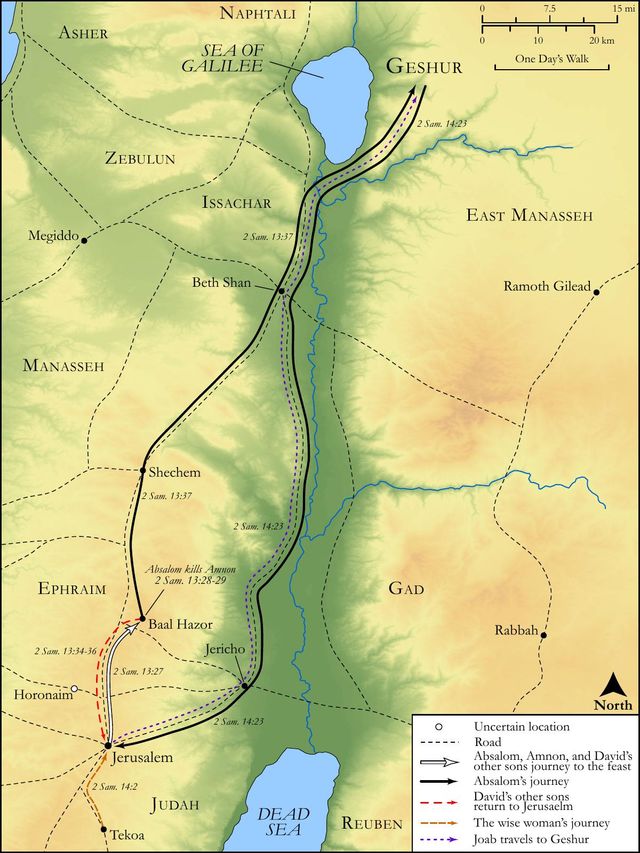
This verse is situated at a pivotal moment in the unfolding drama of David's family, following Absalom's three-year exile in Geshur after his vengeful murder of his half-brother Amnon, who had raped his sister Tamar (2 Samuel 13:28-38). Joab, David's astute and often ruthless military commander, had skillfully engineered Absalom's return to Jerusalem through the wise woman of Tekoah (2 Samuel 14:1-20). However, despite Absalom's physical presence in the capital, King David maintained a strict emotional and physical distance, refusing to see his son for two full years, effectively keeping him under a form of house arrest (2 Samuel 14:28). Absalom, feeling isolated, dishonored, and desperate for reconciliation or at least an audience, had twice sent for Joab to intercede on his behalf, but Joab, perhaps wary of David's displeasure or Absalom's volatile nature, steadfastly refused to come (2 Samuel 14:29). This act of arson is Absalom's final, drastic attempt to break the prolonged stalemate and force Joab's hand, thereby compelling an audience with David.
Historical & Cultural Context
In ancient Israel, agricultural fields, particularly those with ripening barley, represented a family's or individual's primary source of livelihood, wealth, and social standing. Barley was a fundamental staple crop, typically harvested in early spring, and its destruction would have constituted a significant economic blow, considered a grave offense with severe legal and social repercussions. Absalom's act was therefore not merely vandalism but an aggressive, calculated attack on Joab's property and, by extension, his honor, economic security, and public reputation. Such an act would have been a public declaration of grievance and a direct, undeniable challenge. Furthermore, the power dynamics within David's court were inherently complex. Joab, as commander of the army, wielded immense influence, often acting as David's enforcer and sometimes, as seen here, as a reluctant intermediary. Absalom, as a prince, held a privileged but precarious position, especially after his previous crime. His inability to gain access to his father, the king, through conventional means underscores the absolute authority of the monarch and the rigid social hierarchy that governed access to power and favor.
Key Themes
ShowHideThis verse powerfully illustrates several recurring themes within 2 Samuel and the broader Deuteronomistic History. First, it highlights the destructive consequences of unresolved conflict and fractured family relationships. David's prolonged emotional distance from Absalom, coupled with Joab's reluctance to mediate, created a pressure-cooker environment where desperate measures seemed like the only viable option. Second, it showcases Absalom's manipulative and coercive nature, revealing his willingness to employ destructive tactics to achieve his political and personal aims. This act of arson chillingly foreshadows his later, far more widespread and devastating rebellion against his father (2 Samuel 15:1-12). Third, the incident underscores the breakdown in communication and trust within David's inner circle, a recurring motif throughout his reign that frequently led to tragic outcomes. Finally, it subtly touches upon the theme of divine sovereignty amidst human folly, as even these desperate human machinations ultimately unfold within God's overarching plan, though not necessarily with His approval of the sinful means employed.
Exposition and Analysis
ShowHideKey Word Analysis
ShowHideThis term (H2513) refers to an "allotment" or "piece of land," specifically an agricultural field. Its mention here emphasizes the target of Absalom's destructive act—a productive, valuable asset belonging to Joab. The choice of a field, particularly one with ripening crops, signifies a direct assault on Joab's livelihood and economic stability, designed to inflict maximum financial and emotional distress.
The specific mention of "barley" (H8184) is highly significant. Barley was a foundational grain in ancient Israel, typically associated with the early harvest (spring). Its presence in the field indicates a ripe, valuable crop, representing a crucial part of the annual agricultural cycle and a family's sustained livelihood. Its destruction was not a minor inconvenience but a direct attack on Joab's economic well-being and a public display of power designed to provoke an immediate, unavoidable response. It also provides a subtle clue to the timing of this incident, likely during the spring harvest season when the fields would be at their most vulnerable and valuable.
The verb "yâtsath" (H3341) unequivocally means "to burn," "to consume with fire," or "to set ablaze." Its usage here emphasizes the deliberate, destructive, and aggressive nature of Absalom's command. There is no ambiguity; it is a direct order for an act of violence against property. This word choice underscores the extremity of Absalom's frustration and his willingness to engage in destructive behavior to achieve his objective, highlighting the calculated malice behind his actions.
Verse Breakdown
ShowHide"Therefore he said unto his servants"
This opening clause immediately establishes Absalom's agency, authority, and the calculated nature of his action. The "therefore" links this act directly to the preceding narrative of David's refusal to see him and Joab's refusal to mediate, indicating that this arson is a deliberate, albeit extreme, consequence of the prolonged stalemate and Absalom's festering frustration. His command to "his servants" underscores his royal authority and the swift execution of his will.
"See, Joab's field is near mine, and he hath barley there"
Absalom's observation is strategic and precise. He has identified a vulnerable and valuable target—Joab's field—and noted its proximity to his own property, making the act feasible and perhaps less immediately traceable to him directly, though the intent would be clear. The explicit mention of "barley" specifically indicates a valuable, ripe crop, ensuring maximum damage and provocation. This detail highlights Absalom's deliberate planning and cold calculation rather than a spontaneous outburst of rage.
"go and set it on fire"
This is the direct, unambiguous command. It is an imperative, leaving no room for negotiation or alternative actions. The simplicity and directness of the order underscore Absalom's resolve and the gravity of his intent to force a confrontation. It is an act of clear aggression, designed to disrupt the status quo.
"And Absalom's servants set the field on fire"
This final clause confirms the immediate and effective execution of Absalom's command. It demonstrates his effective authority over his servants and their unquestioning obedience. The act is carried out swiftly, emphasizing the immediate and tangible impact of Absalom's desperate strategy, bringing the narrative to a dramatic climax that demands a response.
Literary Devices
ShowHideThe passage employs several potent literary devices that deepen its meaning and impact. Foreshadowing is prominently featured, as Absalom's willingness to destroy Joab's property to gain attention ominously predicts his later, far more destructive and widespread rebellion against his own father and the kingdom (2 Samuel 15). There is a strong element of Irony, as Joab, the very individual who meticulously orchestrated Absalom's return to Jerusalem, now becomes the victim of Absalom's desperate and destructive tactics, highlighting the unpredictable and often ungrateful nature of political maneuvering and the bitter fruits of unresolved conflict. The Symbolism of fire is also significant; it represents not only physical destruction but also the burning frustration, desperation, and simmering rage within Absalom, as well as the destructive potential of unresolved conflict and fractured relationships within the royal family. The act itself is a form of Dramatic Action, a sudden, violent event designed to break a prolonged stalemate, serving as a critical turning point in the narrative that shifts from passive waiting to aggressive confrontation.
Theological and Thematic Connections
ShowHideAbsalom's destructive act, born of profound frustration and a desire for control, resonates with broader biblical themes concerning the pervasive consequences of sin, the breakdown of human relationships, and the inherent dangers of seeking one's own way through manipulation and coercion rather than through patient, humble, and reconciliatory means. It serves as a stark reminder that unresolved grievances, particularly within families or leadership structures, can fester and erupt in destructive ways, often harming the very people one seeks to influence or control. This incident underscores the human tendency to resort to desperate measures when feeling unheard or powerless, revealing a profound lack of trust and healthy communication. The narrative implicitly critiques David's passive leadership in this situation, demonstrating how a king's emotional distance and failure to engage directly with his son can have devastating ripple effects throughout his household and kingdom, ultimately contributing to the tragic trajectory of Absalom's life.
Reflection and Application
ShowHideAbsalom's desperate act in 2 Samuel 14:30 offers profound and enduring lessons for contemporary life, particularly regarding conflict resolution, effective communication, and the perils of unchecked frustration. We often find ourselves in situations where we feel ignored, unheard, or trapped by circumstances, much like Absalom. This passage serves as a powerful cautionary tale: resorting to destructive or manipulative tactics, even when driven by deep-seated frustration and a sense of injustice, rarely leads to true resolution and almost invariably escalates problems, creating further damage to relationships and circumstances. Instead, it highlights the vital importance of proactive communication, earnestly seeking reconciliation, and addressing conflicts directly and constructively, even when such engagement is difficult or uncomfortable. It challenges us to consider the far-reaching ripple effects of our actions and to resist the temptation to lash out when our needs are not met, trusting instead in patient, prayerful, and principled engagement, seeking God's wisdom to navigate relational complexities with grace and integrity.
Questions for Reflection
ShowHideFAQ
ShowHideWhy was Absalom so desperate to see King David?
ShowHideAbsalom had been in exile for three years in Geshur after murdering his half-brother Amnon (2 Samuel 13:38). Upon his return to Jerusalem, orchestrated by Joab, King David refused to see him for two full years (2 Samuel 14:28). This prolonged estrangement meant Absalom was physically back in the capital but still alienated from his father, effectively under a form of house arrest, unable to resume his royal duties or fully participate in court life. He desperately sought reconciliation, or at least an audience, to end his confinement, restore his honor, and regain his position within the royal family and court.
Why did Joab refuse to see Absalom initially?
ShowHideThe text states that Absalom sent for Joab twice, but Joab refused to come (2 Samuel 14:29). Joab had already gone to great lengths, even employing a deceptive strategy with the wise woman of Tekoah, to bring Absalom back to Jerusalem, potentially risking David's displeasure. It's plausible that Joab was wary of getting further entangled in the fraught and emotionally charged relationship between David and Absalom, especially given David's continued emotional distance. He might have been trying to avoid David's wrath, or perhaps he understood David's need for more time to process the situation, or even sensed Absalom's volatile nature and manipulative tendencies, choosing to distance himself from the family drama.
What was the significance of burning a barley field?
ShowHideBurning a barley field was a highly destructive act with profound economic, social, and symbolic implications in ancient Israel. Barley was a staple crop, essential for food and livelihood, and its harvest represented a significant portion of a family's annual income and sustenance. Destroying a field, especially one ripe for harvest, represented a direct and egregious attack on a person's wealth, security, and honor. For Absalom, it was a calculated act to inflict maximum damage and provoke an immediate, unavoidable response from Joab, forcing him to act as an intermediary to the king. It was a public declaration of grievance and a direct challenge to Joab's authority and well-being.
Christ-Centered Fulfillment
ShowHideThe tragic narrative of Absalom's desperate act in 2 Samuel 14:30 underscores the profound brokenness of human relationships, the destructive nature of sin, and the futility of seeking reconciliation or influence through manipulative and violent means. Absalom, a prince of Israel, sought to force his way back into favor and position through coercion and destruction, a stark contrast to the divine method of reconciliation revealed in Scripture. In Christ, we see the ultimate and perfect answer to such brokenness. Unlike Absalom, who resorted to burning a field to gain an audience and force a resolution, Jesus Christ, the true Prince of Peace, did not resort to force, destruction, or manipulation to bridge the chasm between fallen humanity and a holy God. Instead, He willingly offered Himself as the ultimate sacrifice, becoming the mediator not through coercion but through perfect love, obedience, and self-giving on the cross (Hebrews 9:15). Where Absalom's act led to further division, escalating conflict, and ultimately his own demise, Christ's self-giving love on the cross brought about true peace and reconciliation, opening the way for all who believe to have direct, unhindered access to the Father (Ephesians 2:13-18). His kingdom is not advanced by burning fields or by worldly power plays, but by the quiet, transformative power of grace, truth, and sacrificial love (John 18:36). He is the true and faithful Mediator who brings genuine reconciliation without resorting to destructive means, offering a path to peace that Absalom, in his desperation, could never find.