


Judges 15:4
- וַיֵּלֶךְvai·Ye·lekhand he wentH1980Conj-w ¦ V-Qal-ConsecImperf-3msVerb Qal Consecutive Imperfect 3rd Singular Masculineוַandיֵּלֶךְhe went
- שִׁמְשׁוֹןshim·ShonSamsonH8123N-proper-mNoun Proper Masculine
- וַיִּלְכֹּדvai·yil·Kodand he capturedH3920Conj-w ¦ V-Qal-ConsecImperf-3msVerb Qal Consecutive Imperfect 3rd Singular Masculineוַandיִּלְכֹּדhe captured
- שְׁלֹשׁshe·loshthreeH7969N-cscNoun Singular common gender Construct
- מֵאוֹתme·'othundred<s>H3967N-fpNoun Plural Feminine Absolute
- שׁוּעָלִיםshu·'a·LimfoxesH7776N-mpNoun Plural Masculine Absolute
- וַיִּקַּחvai·yi·Kachand he tookH3947Conj-w ¦ V-Qal-ConsecImperf-3msVerb Qal Consecutive Imperfect 3rd Singular Masculineוַandיִּקַּחhe took
- לַפִּדִיםla·pi·DimtorchesH3940N-mpNoun Plural Masculine Absolute
- וַיֶּפֶןvai·Ye·fenand he turnedH6437Conj-w ¦ V-Hiphil-ConsecImperf-3msVerb Hiphil Consecutive Imperfect 3rd Singular Masculineוַandיֶּפֶןhe turned
- זָנָבza·NavtailH2180N-msNoun Singular Masculine Absolute
- אֶל'eltoH413PrepPreposition
- זָנָבza·NavtailH2180N-msNoun Singular Masculine Absolute
- וַיָּשֶׂםvai·Ya·semand he putH7760Conj-w ¦ V-Qal-ConsecImperf-3msVerb Qal Consecutive Imperfect 3rd Singular Masculineוַandיָּשֶׂםhe put
- לַפִּידla·Pida torchH3940N-msNoun Singular Masculine Absolute
- אֶחָד'e·ChadoneH259N-fsNoun Singular Feminine Absolute
- בֵּיןbeinbetweenH996Adj-mscAdjective Numerical Singular Masculine Construct
- שְׁנֵיshe·Nei[the] twoH8147N-cdcNoun Dual common gender Construct
- הַזְּנָבוֹתha·ze·na·Votthe tailsH2180Art ¦ N-fpNoun Plural Feminine Absoluteהַtheזְּנָבוֹתtails
- בַּתָּוֶךְba·Ta·vekhin the middleH8432Prep-b ¦ N-msNoun Singular Masculine Absoluteבַּin theתָּוֶךְmiddle
English is a literal word-by-word gloss of the Hebrew, not the KJV's wording. Why?
This is the original text the KJV's translators worked from — each Hebrew word with its own literal English meaning in this verse, prepared by scholars at Tyndale House, Cambridge. The KJV translates whole sentences, not word by word, so its wording differs: one Hebrew word can become several English words, and the KJV may choose “the LORD” where the gloss reads “Yahweh”. Both are faithful — they answer different questions. For the KJV's own rendering, switch to the KJV text.
Details
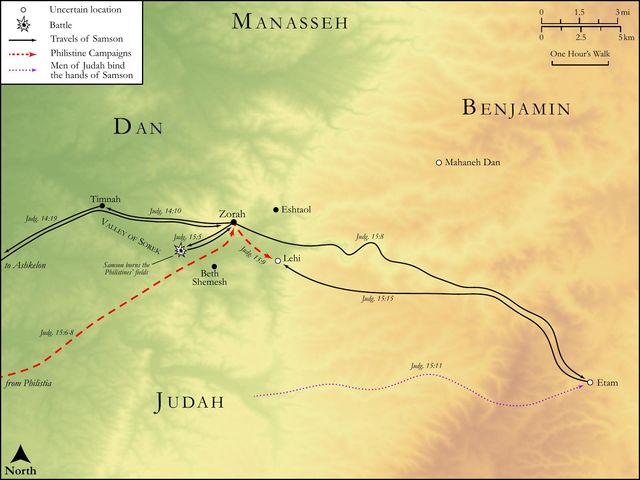
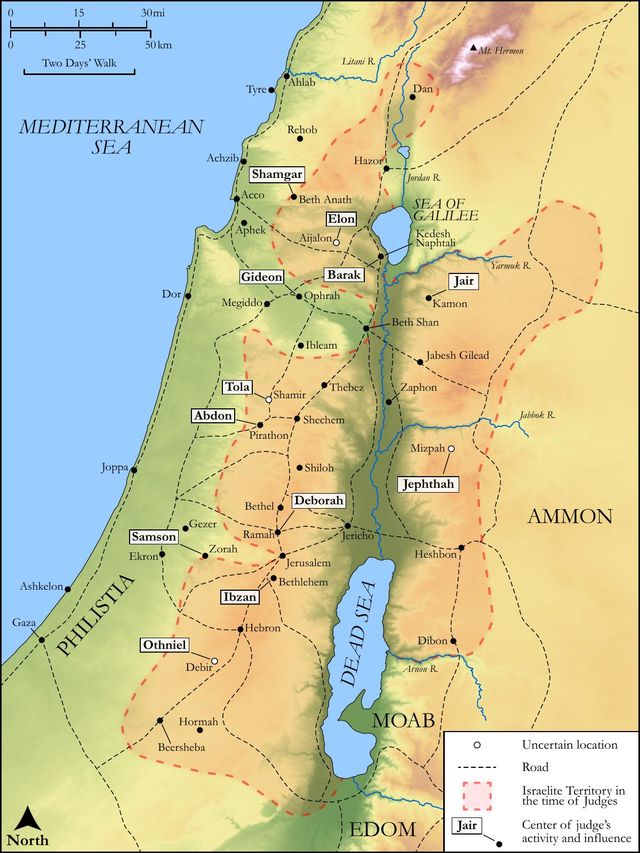
See on the biblical-era map
Study this verse
Public-domain commentary
Matthew Henry
From his Commentary on the Whole Bible. Henry comments on passages, not single verses — this entry covers Judges 15:1–8. His two-level outline is real structure in the source text, so it is rendered as structure.
Here is, I. Samson's return to his wife, whom he had left in displeasure; not hearing perhaps that she was given to another, when time had a little cooled his resentments, he came back to her, visited her with a kid, Jdg 15:1. The value of the present was inconsiderable, but it was intended as a token of reconciliation, and perhaps was then so used, when those that had been at variance were brought together again; he sent this, that he might sup with her in her apartments, and she with him, on his provision, and so they might be friends again. It was generously done of Samson, though he was the party offended and the superior relation, to whom therefore she was bound in duty to sue for peace and to make the first motion of reconciliation. When differences happen between near relations, let hose be ever reckoned the wisest and the best that are most forward to forgive and forget injuries and most willing to stoop and yield for peace' sake.
II.The repulse he met with.
Her father forbade him to come near her; for truly he had married her to another, Jdg 15:2. He endeavours, 1. To justify himself in this wrong: I verily thought that thou hadst utterly hated her. A very ill opinion he had of Samson, measuring that Nazarite by the common temper of the Philistines; could he think worse of him than to suspect that, because he was justly angry with his wife, he utterly hated her, and, because he had seen cause to return to his father's house for a while, therefore he had abandoned her for ever? Yet this is all he had to say in excuse of this injury. Thus he made the worst of jealousies to patronize the worst of robberies. But it will never bear us out in doing ill to say, "We thought others designed ill." 2. He endeavours to pacify Samson by offering him his younger daughter, whom, because the handsomer, he thought Samson might accept, in full recompence for the wrong. See what confusions those did admit and bring their families to that were not governed by the fear and law of God, marrying a daughter this week to one and next week to another, giving a man one daughter first and then another. Samson scorned his proposal; he knew better things than to take a wife to her sister, Lev 18:18.
III.The revenge Samson took upon the Philistines for this abuse.
Had he designed herein only to plead his own cause he would have challenged his rival, and would have chastised him and his father-in-law only. But he looks upon himself as a public person, and the affront as done to the whole nation of Israel, for probably they put this slight upon him because he was of that nation, and pleased themselves with it, that they had put such an abuse upon an Israelite; and therefore he resolves to do the Philistines a displeasure, and does not doubt but this treatment which he had met with among them would justify him in it (Jdg 15:3): Now shall I be more blameless than the Philistines. He had done what became him in offering to be reconciled to his wife, but, she having rendered it impracticable, now they could not blame him if he showed his just resentment. Note, When differences arise we ought to do our duty in order to the ending of them, and then, whatever the ill consequences of them may be, we shall be blameless. Now the way Samson took to be revenged on them was by setting their corn-fields on fire, which would be a great weakening and impoverishing to the country, Jdg 15:4, Jdg 15:5.
1.The method he took to do it was very strange. He sent 150 couple of foxes, tied tail to tail, into the corn-fields; every couple had a stick of fire between their tails, with which, being terrified, they ran into the corn for shelter, and so set fire to it; thus the fire would break out in many places at the same time, and therefore could not be conquered, especially if this was done, as it is probable it was, in the night. He might have employed men to do it, but perhaps he could not find Israelites enough that had courage to do it, and he himself could do it but in one place at a time, which would not effect his purpose. We never find Samson, in any of his exploits, making use of any person whatsoever, either servant or soldier, therefore, in this project, he chose to make use of foxes as his incendiaries. They had injured Samson by their subtlety and malice, and now Samson returns the injury by subtle foxes and mischievous fire-brands. By the meanness and weakness of the animals he employed, he designed to put contempt upon the enemies he fought against. This stratagem is often alluded to to show how the church's adversaries, that are of different interests and designs among themselves, that look and draw contrary ways in other things, yet have often united in a fire-brand, some cursed project or other, to waste the church of God, and particularly to kindle the fire of division in it.
2.The mischief he hereby did to the Philistines was very great. It was in the time of wheat harvest (Jdg 15:1), so that the straw being dry it soon burnt the shocks of corn that were cut, and the standing corn, and the vineyards and olives. This was a waste of the good creatures, but where other acts of hostility are lawful destroying the forage is justly reckoned to be so: if he might take away their lives, he might take away their livelihood. And God was righteous in it: the corn, and the wine, and the oil, which they had prepared for Dagon, to be a meat-offering to him, were thus, in the season thereof, made a burnt-offering to God's justice.
IV.The Philistines' outrage against Samson's treacherous wife and her father.
Understanding that they had provoked Samson to do this mischief to the country, the rabble set upon them and burnt them with fire, perhaps in their own house, Jdg 15:6. Samson himself they durst not attack, and therefore, with more justice than perhaps they themselves designed in it, they wreak their vengeance upon those who, they could not but own, had given him cause to be angry. Instead of taking vengeance upon Samson, they took vengeance for him, when he, out of respect to the relation he had stood in to them, was not willing to do it for himself. See his hand in it to whom vengeance belongs. Those that deal treacherously shall be spoiled and dealt treacherously with; and the Lord is known by these judgments which he executes, especially when, as here, he makes use of his people's enemies as instruments for revenging one upon another his people's quarrels. When a barbarous Philistine sets fire to a treacherous one, the righteous may rejoice to see the vengeance, Psa 58:10, Psa 58:11. Thus shall the wrath of man praise God, Psa 76:10. The Philistines had threatened Samson's wife, that, if she would not get the riddle out of him, they would burn her and her father's house with fire, Jdg 14:15. She, to save herself and oblige her countrymen, betrayed her husband; and what came of it? The very thing that she feared, and sought by sin to avoid, came upon her; she and her father's house were burnt with fire, and her countrymen, whom she sought to oblige by the wrong she did to her husband, brought this evil upon her. The mischief we seek to escape by any unlawful practices we often pull upon our own heads. He that will thus save his life shall lose it.
V.The occasion Samson took hence to do them a yet greater mischief, which touched their bone and their flesh, Jdg 15:7, Jdg 15:8.
"Though you have done this to them, and thereby shown what you would do to me if you could, yet that shall not deter me from being further vexatious to you." Or, "Though you think, by doing this, you have made me satisfaction for the affront I received among you, yet I have Israel's cause to plead as a public person, and for the wrongs done to them I will be avenged on you, and, if you will then forbear your insults, I will cease, aiming at no more than the deliverance of Israel." So he smote them hip and thigh with a great stroke, so the word is. We suppose the wounds he gave them to have been mortal, as wounds in the hip or thigh often prove, and therefore translate it, with a great slaughter. Some think he only lamed them, disabled them for service, as horses were houghed or ham-strung. It seems to be a phrase used to express a desperate attack; he killed them pell-mell, or routed them horse and foot. He smote them with his hip upon thigh, that is, with the strength he had, not in his arms and hands, but in his hips and thighs, for he kicked and spurned at them, and so mortified them, trod them in his anger, and trampled them in his fury, Isa 63:3. And, when he had done, he retired to a natural fortress in the top of the rock Etam, where he waited to see whether the Philistines would be tamed by the correction he had given them.
Historical interpretation
Fourteen Centuries of Reception
7 surviving comments on this verse. Each one is dated, so this reads as a timeline rather than a list.
Select a marker to jump to its quote. Markers stagger vertically where authors wrote within a few decades of each other.
Just as those who travel about in the pathless desert tremble at serpents on the ground, and those who travel on the pathways are also terrified of vipers that hide on the paths, so were the Philistines, who traveled on paths and in the pathless desert, terrified of Samson. “To bite the horse’s heels and throw its rider backward.” It was during the great famine, which God had brought upon the Philistines, that Samson burned their crops by means of foxes, for fire was carried on their bodies like a rider on its horse. Then the Philistines keeled over from lack of bread and then fell backwards from lack of nourishment.
But the perfidy of the maiden being thus discovered, he abstained from intercourse with her, and returned to his father's house. The damsel, disturbed in mind, and justly dreading that the wrath of this mighty man would be kindled into fury by this wrong, gave her hand to another man, one whom Samson, relying on his fidelity, had brought with him as his bridesman to his marriage. But neither by this expedient of a marriage did she avoid offence. For when the affair was disclosed, and he was forbidden to return to his wife, and her father said that she was married to another man, but that he might, if he chose, marry her sister, he was exasperated by the affront, and determined to take a public revenge for his domestic injury. Wherefore he took three hundred foxes, and in the heat of summer, when the corn was now ripe in the fields, he tied them together two and two by the tails, and fastened a burning firebrand between them, binding it with a firm knot, and by way of avenging his wrong turned them loose among the sheaves which the Philistines had cut. But the foxes, terrified by the fire, scattered flames whichever way they turned, and burnt the harvest. And the Philistines, incensed by the loss of all their corn in that region, told it to the princes of their land. And they sent men to Timnath, and burnt in the fire the woman who had been faithless to her husband, and her parents and all her house; saying that she had been the cause of this injury and devastation, and ought not to have provoked a man who could avenge himself by a public calamity.
Samson resistless because of his hair is attacked by a lion;
When he killed the wild beast, from its mouth there flowed streams of honey,
And from an ass’s jawbone comes forth a fountain of water:
Folly with water overflows and virtue with sweetness.
Samson catches three hundred foxes and arms them with firebrands,
Which he ties to their tails, and he lets them go into the cornfields
Of the Philistines to burn their crops: thus the fox of false doctrine
Cunningly scatters the flames of heresy over our vineyards.
Let us avoid, then, brothers, let us avoid the pestilential deceits of the insidious foxes [heretics]. Let us avoid the deadly frauds of wicked persons lest, like the foxes which that famous strong man Samson once sent into the Philistines’ fields, bearing torches on their tails that burned up everything with their flames, the foxes of perverse teachings in like manner either get hold of the fruits of our fields by deceitful traps or consume them by burning flames. Let us, therefore, as we read, be simple and clever—that is to say, simple as doves and clever as serpents, so that the cleverness of the serpents might protect the simplicity of the doves.
Now let us see what Samson did when he was injured by his friend in the person of his wife. He took foxes, that is, adulterous friends of whom it is said in the Canticle of Canticles, “Catch us the foxes, the little foxes that damage the vineyards.” What does it mean, “catch”? It means seize, convict, repress them, lest the vines of the church be destroyed. What else does it mean to catch foxes, except to convict heretics with the authority of the divine law, to fasten and fetter them with the testimony of holy Scripture as with chains? Samson caught the foxes and put torches of fire on their tails after they were coupled. What do the tails of the foxes tied together signify? What are foxes’ tails except the results of heresy (for their first appearance is flattering and deceitful) bound fast, that is, condemned and dragging fire in their trail? Moreover, they destroy the fruits and good works of those who consent to their seductions. People are told, Do not listen to heretics, do not consent to them or be seduced by them. They reply, Why? Has not that one or so and so listened to heretics? Has not that other Christian committed such vices, such adultery, or such robbery? And what evil has befallen him? Those are the first appearances of the foxes, and souls that are seduced pay attention; the fire is behind them. Nothing has happened to him now, it is said. Since nothing has gone before, will nothing be dragged after? He is sure to come to the fire which follows. Do you think further that the heretics drag along the fire with which to burn the fruits of their enemies but are not themselves burned? Doubtless, when the foxes burned the harvest they, too, were burned. This judgment will come back upon the heretics; what they do not see now they have behind them. They delight people with their flattery and show themselves at first free from restraint. But at the judgment of God their tails are bound, that is, they drag fire upon themselves afterwards, since wickedness preceded their punishment.
Then follow the words “Samson was angry because a friend married his wife.” This friend prefigured all heretics. It is a great mystery, my brothers. Heretics who divide the church have wanted to marry the wife of the Lord and carry her away. By departing from the church and the Gospels, they attempt through adulterous wickedness to seize the church, that is, the body of Christ, as their portion. For this reason that faithful servant and friend of the Lord’s bride says, “I betrothed you to one spouse, that I might present you a chaste virgin to Christ.” Moreover, through the zeal of faith and a rebuke he touches the person of his wicked companion: “And I fear lest, as the serpent seduced Eve, so your minds may be corrupted from the truth which is in Christ Jesus.” Who are the companions, that is, the heretical deserters who want to seize the Lord’s spouse, unless Donatus, Arius, Manichaeus, and other vessels of error and perdition?
Foxes: Being judge of the people he might have many to assist him to catch with nets or otherwise a number of these animals; of which there were great numbers in that country.
Continue studying Judges 15:4 across the web’s major study libraries — every link below opens this exact verse, chapter, or book on the destination site.
Read & Compare
 BibleGatewayThis verse in more than 200 translations and 70 languages.
 Bible.comThe YouVersion reader — hundreds of translations, reading plans, and highlights.
 ESV.orgCrossway's official English Standard Version reader.
 NET BibleThe NET translation with 60,000+ translators' notes on every rendering decision.
 STEP BibleTyndale House's free study tool — original text, vocabulary, and scholarly resources.
 BibliaLogos Bible Software's free web reader.
 USCCBThe New American Bible (Revised Edition) with the U.S. bishops' study notes.
Commentaries
 BibleHub CommentariesDozens of classic commentaries on this verse, gathered on one page.
 StudyLightMore than 100 commentary sets — the largest collection on the web.
 BibleRefPlain-English commentary on what this verse means, verse by verse.
 Enduring WordDavid Guzik's free commentary on this chapter, widely used by Bible teachers.
 Bible Study ToolsVerse commentary alongside Greek and Hebrew study aids.
Original Language & Research
- BibleHub InterlinearThe verse word by word — original language, transliteration, and English.
- BibleHub LexiconEvery word's original-language definition and Strong's entry.
 Blue Letter BibleDeep-study tools — Strong's numbers, concordance, and word studies.
 SefariaThe Hebrew text with Rashi and centuries of Jewish commentary.
Sermons, Hymns & Audio


TrulyRandomVerse is not affiliated with these sites and doesn’t control their content. They’re linked because they’re genuinely useful.
Summary
Judges 15:4 vividly narrates a dramatic act of retribution by Samson against the Philistines, following the betrayal concerning his wife. In a display of extraordinary cunning and destructive ingenuity, Samson captures three hundred foxes, binds them in pairs tail-to-tail, and places a lit firebrand between each pair. This elaborate scheme sets in motion a widespread conflagration that devastates the Philistine agricultural lands, marking a significant escalation in the ongoing conflict between Samson, acting as an individual agent of divine judgment, and the oppressive Philistine regime.
Context
ShowHideLiterary Context
Judges 15:4 is the direct consequence of the events detailed in Judges 15:1-3. Samson, returning to his Philistine wife, discovers his father-in-law has given her to another man. The father-in-law's attempt to appease Samson by offering the younger sister only fuels Samson's rage, leading him to declare his intention to exact revenge, asserting his blamelessness in the impending destruction. This verse, therefore, is the immediate fulfillment of that vow, showcasing Samson's unique, often unconventional, methods of warfare. It serves as a pivotal moment, transitioning from personal grievance to large-scale devastation, directly preceding the Philistine retaliation and Samson's subsequent acts of deliverance described in Judges 15:5-20.
Historical & Cultural Context
The era of the Judges (approximately 12th to 11th centuries BCE) was a turbulent period for Israel, marked by cycles of apostasy, oppression, repentance, and deliverance through divinely appointed "judges." The Philistines, a formidable "Sea Peoples" group, had established a powerful presence along the southwestern coast of Canaan, exerting significant military and economic dominance over Israel, as highlighted in Judges 13:1. Their economy was heavily agrarian, relying on extensive grain fields, vineyards, and olive groves. Consequently, Samson's attack on these vital resources was a direct and devastating blow to their economic stability, a common tactic in ancient warfare to cripple an enemy. The "foxes" mentioned are widely understood by scholars to be jackals (Canis aureus), which were abundant in the region, often traveled in packs, and were known for scavenging in agricultural areas, making their capture in large numbers more plausible and their deployment for such destruction highly effective.
Key Themes
ShowHideThis verse powerfully illustrates several enduring themes within the Book of Judges and Samson's narrative. Firstly, it underscores Samson's role as an unconventional and often morally ambiguous deliverer. Though empowered by God to "begin to deliver Israel" (Judges 13:5), his actions are frequently driven by personal slights and vengeance rather than strategic military or national liberation efforts. Secondly, it highlights the destructive cycle of violence and retribution that permeates the Judges period, where betrayal begets revenge, leading to further retaliation, reflecting the spiritual and moral decline of the age. Thirdly, the passage demonstrates God's sovereign ability to use flawed human instruments to accomplish His divine purposes. Despite Samson's personal motivations and often chaotic methods, his cunning and destructive acts are ultimately integrated into God's larger plan of judgment against Israel's oppressors, a pervasive theme throughout the entire book of Judges.
Exposition and Analysis
ShowHideKey Word Analysis
ShowHideThe Hebrew term שׁוּעָל (shûwʻâl), plural שׁוּעָלִים (shu'alim), is commonly translated as "foxes." However, given the context of ancient Israel and the large number captured, many scholars contend it refers to "jackals" (H7776, shûwʻâl). Jackals (Canis aureus) are more prevalent in the Levant, are social animals that can be found in larger groups, and are known to frequent agricultural areas, making them a more practical choice for Samson's plan than solitary foxes. This distinction is crucial for understanding the feasibility and scale of Samson's destructive act.
The Hebrew word לַפִּיד (lappîyd), plural לַפִּדִים (lappidim), refers to a torch, lamp, or flaming brand (H3940, lappîyd). These were likely rudimentary incendiary devices, perhaps bundles of dry straw, reeds, or wood splinters, designed to ignite quickly and sustain a flame. Their strategic placement between the animals' tails ensured that as the panicked creatures ran, the fire would be carried directly and effectively into the dry, combustible fields.
The Hebrew word זָנָב (zânâb) refers to the "tail" (H2180, zânâb), literally or figuratively. In this verse, the repeated mention of "tail to tail" and "between two tails" emphasizes the precise and ingenious, albeit cruel, method Samson employed. The act of binding the animals by their tails would force them to run in opposing directions, creating maximum disarray and ensuring a wider, more chaotic spread of the fire across the Philistine agricultural lands.
Verse Breakdown
ShowHide"And Samson went and caught three hundred foxes"
This opening clause immediately establishes the extraordinary scale and audacious nature of Samson's plan. The act of catching such a large number of animals, whether literal or hyperbolic, underscores Samson's immense determination, resourcefulness, and cunning, highlighting his unique capabilities beyond mere physical strength.
"and took firebrands"
This phrase introduces the destructive instrument of Samson's revenge. The firebrands symbolize the incendiary nature of his intent, designed to inflict widespread economic damage upon the Philistines by destroying their vital agricultural resources.
"and turned tail to tail"
This describes the ingenious and cruel method Samson devised to maximize the effectiveness of his attack. By binding two animals together at their tails, he ensured that their natural instinct to flee would lead them in opposite directions, creating chaos and ensuring the fire was dispersed over a broad area.
"and put a firebrand in the midst between two tails"
This final clause details the precise execution of Samson's plan. The strategic placement of the lit firebrand between the bound tails guarantees that as the terrified animals scatter, the flame is carried directly into the dry grain fields, vineyards, and olive groves, ensuring a devastating and widespread conflagration across the Philistine territory.
Literary Devices
ShowHideJudges 15:4 is rich with literary devices that amplify its dramatic impact and thematic depth. The most prominent is Hyperbole, particularly evident in the "three hundred foxes." While not entirely impossible, this number likely serves as an exaggeration or a round figure to convey the immense scale and audaciousness of Samson's act, emphasizing the widespread devastation he intended and achieved. There is also a powerful element of Irony at play; Samson, a divinely appointed judge meant to deliver Israel, employs methods that are chaotic, destructive, and driven by personal vengeance, reflecting the moral ambiguity and spiritual decline characteristic of the Judges period. The act itself is a potent form of Symbolism, with the fire representing divine judgment and destructive retribution, and the foxes/jackals acting as agents of chaos and ruin, unleashed by Samson's cunning. This incident also functions as Foreshadowing, signaling the escalating conflict and the destructive trajectory that Samson's personal vendettas will continue to take throughout his narrative, ultimately contributing to his own tragic end.
Theological and Thematic Connections
ShowHideThis passage, while depicting a vengeful act, is deeply interwoven with the broader theological narrative of Judges, which consistently portrays God using imperfect, and at times morally ambiguous, individuals to accomplish His sovereign purposes. Samson's actions, though fueled by personal grievance and rage, are nonetheless instrumental in "beginning to deliver Israel from the hand of the Philistines," a divine mandate explicitly stated in Judges 13:5. The narrative does not endorse Samson's methods as ideal, but rather presents them as part of God's larger, often mysterious, plan for justice and deliverance in a fallen world. It underscores the theme of divine judgment against oppressors and the inevitable consequences of betrayal, even when enacted through human passion and flawed means.
Reflection and Application
ShowHideWhile Samson's destructive and vengeful methods are certainly not to be emulated by believers, this account offers profound insights into the character of God and His intricate interaction with humanity. It serves as a powerful reminder that God's power and sovereignty are not limited by human imperfections, moral failings, or even the chaotic nature of a fallen world. He can, and often does, use unconventional, flawed, and even violent means within the context of human sin to advance His ultimate purposes of justice and deliverance. For us, this should cultivate a deep sense of humility, prompting us to recognize that God's ways are often far higher and more mysterious than our own, and His sovereign hand extends over all circumstances, even those born of human sin and conflict. Furthermore, this narrative serves as a stark reminder of the destructive cycle of revenge and the importance of seeking reconciliation and peace, rather than perpetuating cycles of harm. Believers are called to be wise and resourceful in navigating life's challenges, not through personal vengeance, but through discernment and actions that reflect God's love, mercy, and justice, as exemplified in the teachings of Christ to be "wise as serpents and innocent as doves" (Matthew 10:16) and to "never avenge yourselves, but leave it to the wrath of God" (Romans 12:19-21).
Questions for Reflection
ShowHideFAQ
ShowHideWas it truly 300 foxes, or is that number symbolic?
ShowHideThe number "three hundred" (H7969, shâlôwsh for three, H3967, mêʼâh for hundred) is substantial and has led to considerable scholarly debate. While not impossible, especially if the animals were jackals (which are more numerous and social in the region than solitary foxes), it is often interpreted as a round number or an example of hyperbole. In biblical narratives, large numbers frequently serve to emphasize the scale, magnitude, or completeness of an event rather than being a precise census. The primary point conveyed is the vastness of the destruction Samson intended and achieved, underscoring the audacious nature of his revenge, regardless of the exact count of animals.
Christ-Centered Fulfillment
ShowHideSamson, despite his supernatural strength and divine calling to begin Israel's deliverance, remains a deeply flawed and often self-serving deliverer, acting out of personal vengeance rather than pure obedience to God's will. His destructive act with the foxes and firebrands, while serving God's purpose of judging the Philistines, highlights the profound inadequacy of human deliverers and the ongoing, desperate need for a perfect Savior. Samson's story, marked by cyclical patterns of sin, judgment, and imperfect, temporary deliverance, points forward to Jesus Christ, the ultimate and perfect Deliverer. Unlike Samson, who brought destructive fire upon his enemies' fields, Jesus is the Lamb of God who takes away the sin of the world, offering Himself as the ultimate sacrifice to reconcile humanity to God. While Samson's actions initiated a physical battle against an earthly oppressor, Christ's work on the cross decisively defeated sin and death, the true spiritual oppressors, offering a deliverance that is eternal and complete. Jesus, the true Judge, does not come to destroy the fields of His enemies but to bring light to those sitting in darkness and in the shadow of death, ultimately establishing a kingdom not of destructive fire and vengeance, but of righteousness, peace, and joy in the Holy Spirit.