


Judges 15:7
- וַיֹּאמֶרvai·Yo·merand he saidH559Conj-w ¦ V-Qal-ConsecImperf-3msVerb Qal Consecutive Imperfect 3rd Singular Masculineוַandיֹּאמֶרhe said
- לָהֶםla·Hemto <the> themPrep-l ¦ 3mpSuffix Personal 3rd Plural Masculineלָto <the>הֶםthem
- שִׁמְשׁוֹןshim·ShonSamsonH8123N-proper-mNoun Proper Masculine
- אִם'imifH518PrtParticle Conditional
- תַּעֲשׂוּןta·'a·Sunyou will do !H6213V-Qal-Imperf-2mp ¦ SfxVerb Qal Imperfect 2nd Plural Masculineתַּעֲשׂוּyou will doן!
- כָּזֹאתka·Zotlike thisH2063Prep-k ¦ PrtParticle Demonstrativeכָּlikeזֹאתthis
- כִּיkithatH3588PrtParticle Conditional
- אִם'imexceptH518PrtParticle Conditional
- נִקַּמְתִּיni·Kam·tiI have avenged myselfH5358V-Niphal-Perf-1csVerb Niphal Perfect 1st Singular common gender
- בָכֶםva·Khemon <the> youPrep-b ¦ 2mpSuffix Personal 2nd Plural Masculineבָon <the>כֶםyou
- וְאַחַרve·'a·Charand afterH310Conj-w ¦ Adj-msAdjective Numerical Singular Masculine Absoluteוְandאַחַרafter
- אֶחְדָּל'ech·DalI will ceaseH2308V-Qal-Imperf-1csVerb Qal Imperfect 1st Singular common gender
English is a literal word-by-word gloss of the Hebrew, not the KJV's wording. Why?
This is the original text the KJV's translators worked from — each Hebrew word with its own literal English meaning in this verse, prepared by scholars at Tyndale House, Cambridge. The KJV translates whole sentences, not word by word, so its wording differs: one Hebrew word can become several English words, and the KJV may choose “the LORD” where the gloss reads “Yahweh”. Both are faithful — they answer different questions. For the KJV's own rendering, switch to the KJV text.
Details
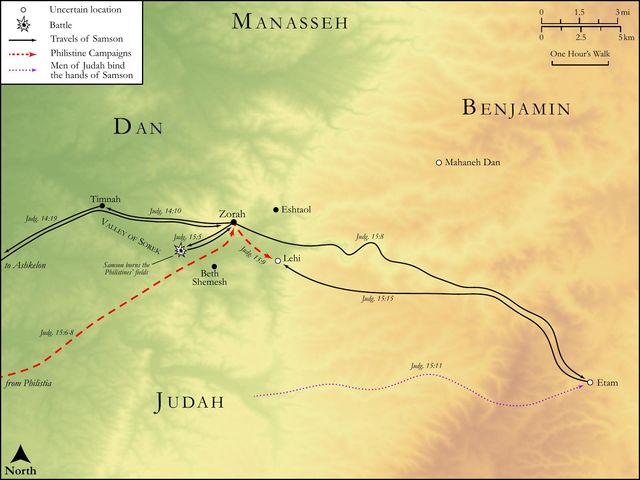
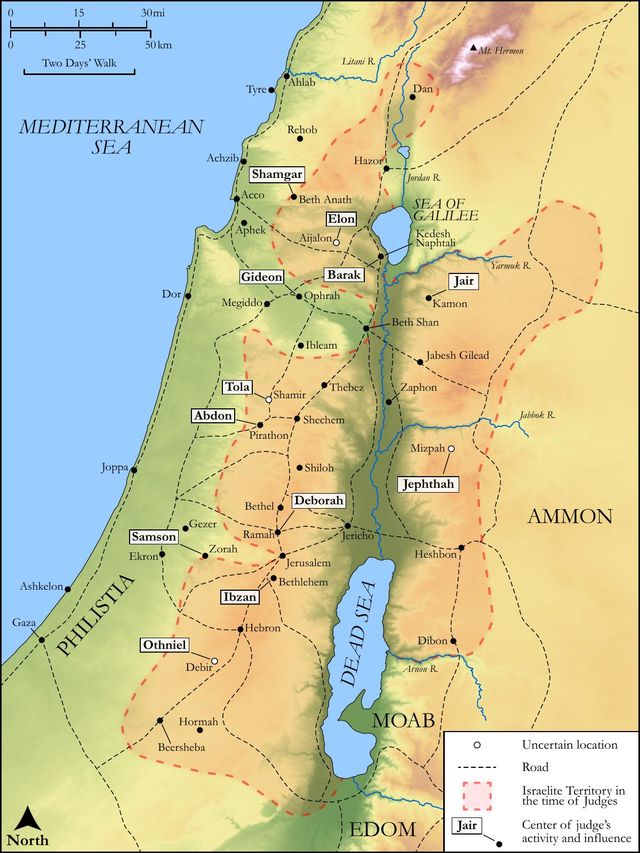
See on the biblical-era map
Study this verse
Public-domain commentary
Matthew Henry
From his Commentary on the Whole Bible. Henry comments on passages, not single verses — this entry covers Judges 15:1–8. His two-level outline is real structure in the source text, so it is rendered as structure.
Here is, I. Samson's return to his wife, whom he had left in displeasure; not hearing perhaps that she was given to another, when time had a little cooled his resentments, he came back to her, visited her with a kid, Jdg 15:1. The value of the present was inconsiderable, but it was intended as a token of reconciliation, and perhaps was then so used, when those that had been at variance were brought together again; he sent this, that he might sup with her in her apartments, and she with him, on his provision, and so they might be friends again. It was generously done of Samson, though he was the party offended and the superior relation, to whom therefore she was bound in duty to sue for peace and to make the first motion of reconciliation. When differences happen between near relations, let hose be ever reckoned the wisest and the best that are most forward to forgive and forget injuries and most willing to stoop and yield for peace' sake.
II.The repulse he met with.
Her father forbade him to come near her; for truly he had married her to another, Jdg 15:2. He endeavours, 1. To justify himself in this wrong: I verily thought that thou hadst utterly hated her. A very ill opinion he had of Samson, measuring that Nazarite by the common temper of the Philistines; could he think worse of him than to suspect that, because he was justly angry with his wife, he utterly hated her, and, because he had seen cause to return to his father's house for a while, therefore he had abandoned her for ever? Yet this is all he had to say in excuse of this injury. Thus he made the worst of jealousies to patronize the worst of robberies. But it will never bear us out in doing ill to say, "We thought others designed ill." 2. He endeavours to pacify Samson by offering him his younger daughter, whom, because the handsomer, he thought Samson might accept, in full recompence for the wrong. See what confusions those did admit and bring their families to that were not governed by the fear and law of God, marrying a daughter this week to one and next week to another, giving a man one daughter first and then another. Samson scorned his proposal; he knew better things than to take a wife to her sister, Lev 18:18.
III.The revenge Samson took upon the Philistines for this abuse.
Had he designed herein only to plead his own cause he would have challenged his rival, and would have chastised him and his father-in-law only. But he looks upon himself as a public person, and the affront as done to the whole nation of Israel, for probably they put this slight upon him because he was of that nation, and pleased themselves with it, that they had put such an abuse upon an Israelite; and therefore he resolves to do the Philistines a displeasure, and does not doubt but this treatment which he had met with among them would justify him in it (Jdg 15:3): Now shall I be more blameless than the Philistines. He had done what became him in offering to be reconciled to his wife, but, she having rendered it impracticable, now they could not blame him if he showed his just resentment. Note, When differences arise we ought to do our duty in order to the ending of them, and then, whatever the ill consequences of them may be, we shall be blameless. Now the way Samson took to be revenged on them was by setting their corn-fields on fire, which would be a great weakening and impoverishing to the country, Jdg 15:4, Jdg 15:5.
1.The method he took to do it was very strange. He sent 150 couple of foxes, tied tail to tail, into the corn-fields; every couple had a stick of fire between their tails, with which, being terrified, they ran into the corn for shelter, and so set fire to it; thus the fire would break out in many places at the same time, and therefore could not be conquered, especially if this was done, as it is probable it was, in the night. He might have employed men to do it, but perhaps he could not find Israelites enough that had courage to do it, and he himself could do it but in one place at a time, which would not effect his purpose. We never find Samson, in any of his exploits, making use of any person whatsoever, either servant or soldier, therefore, in this project, he chose to make use of foxes as his incendiaries. They had injured Samson by their subtlety and malice, and now Samson returns the injury by subtle foxes and mischievous fire-brands. By the meanness and weakness of the animals he employed, he designed to put contempt upon the enemies he fought against. This stratagem is often alluded to to show how the church's adversaries, that are of different interests and designs among themselves, that look and draw contrary ways in other things, yet have often united in a fire-brand, some cursed project or other, to waste the church of God, and particularly to kindle the fire of division in it.
2.The mischief he hereby did to the Philistines was very great. It was in the time of wheat harvest (Jdg 15:1), so that the straw being dry it soon burnt the shocks of corn that were cut, and the standing corn, and the vineyards and olives. This was a waste of the good creatures, but where other acts of hostility are lawful destroying the forage is justly reckoned to be so: if he might take away their lives, he might take away their livelihood. And God was righteous in it: the corn, and the wine, and the oil, which they had prepared for Dagon, to be a meat-offering to him, were thus, in the season thereof, made a burnt-offering to God's justice.
IV.The Philistines' outrage against Samson's treacherous wife and her father.
Understanding that they had provoked Samson to do this mischief to the country, the rabble set upon them and burnt them with fire, perhaps in their own house, Jdg 15:6. Samson himself they durst not attack, and therefore, with more justice than perhaps they themselves designed in it, they wreak their vengeance upon those who, they could not but own, had given him cause to be angry. Instead of taking vengeance upon Samson, they took vengeance for him, when he, out of respect to the relation he had stood in to them, was not willing to do it for himself. See his hand in it to whom vengeance belongs. Those that deal treacherously shall be spoiled and dealt treacherously with; and the Lord is known by these judgments which he executes, especially when, as here, he makes use of his people's enemies as instruments for revenging one upon another his people's quarrels. When a barbarous Philistine sets fire to a treacherous one, the righteous may rejoice to see the vengeance, Psa 58:10, Psa 58:11. Thus shall the wrath of man praise God, Psa 76:10. The Philistines had threatened Samson's wife, that, if she would not get the riddle out of him, they would burn her and her father's house with fire, Jdg 14:15. She, to save herself and oblige her countrymen, betrayed her husband; and what came of it? The very thing that she feared, and sought by sin to avoid, came upon her; she and her father's house were burnt with fire, and her countrymen, whom she sought to oblige by the wrong she did to her husband, brought this evil upon her. The mischief we seek to escape by any unlawful practices we often pull upon our own heads. He that will thus save his life shall lose it.
V.The occasion Samson took hence to do them a yet greater mischief, which touched their bone and their flesh, Jdg 15:7, Jdg 15:8.
"Though you have done this to them, and thereby shown what you would do to me if you could, yet that shall not deter me from being further vexatious to you." Or, "Though you think, by doing this, you have made me satisfaction for the affront I received among you, yet I have Israel's cause to plead as a public person, and for the wrongs done to them I will be avenged on you, and, if you will then forbear your insults, I will cease, aiming at no more than the deliverance of Israel." So he smote them hip and thigh with a great stroke, so the word is. We suppose the wounds he gave them to have been mortal, as wounds in the hip or thigh often prove, and therefore translate it, with a great slaughter. Some think he only lamed them, disabled them for service, as horses were houghed or ham-strung. It seems to be a phrase used to express a desperate attack; he killed them pell-mell, or routed them horse and foot. He smote them with his hip upon thigh, that is, with the strength he had, not in his arms and hands, but in his hips and thighs, for he kicked and spurned at them, and so mortified them, trod them in his anger, and trampled them in his fury, Isa 63:3. And, when he had done, he retired to a natural fortress in the top of the rock Etam, where he waited to see whether the Philistines would be tamed by the correction he had given them.
Historical interpretation
Historical reception
2 surviving comments on this verse. Each one is dated, so this reads as a timeline rather than a list.
Select a marker to jump to its quote. Markers stagger vertically where authors wrote within a few decades of each other.
But the perfidy of the maiden being thus discovered, he abstained from intercourse with her, and returned to his father's house. The damsel, disturbed in mind, and justly dreading that the wrath of this mighty man would be kindled into fury by this wrong, gave her hand to another man, one whom Samson, relying on his fidelity, had brought with him as his bridesman to his marriage. But neither by this expedient of a marriage did she avoid offence. For when the affair was disclosed, and he was forbidden to return to his wife, and her father said that she was married to another man, but that he might, if he chose, marry her sister, he was exasperated by the affront, and determined to take a public revenge for his domestic injury. Wherefore he took three hundred foxes, and in the heat of summer, when the corn was now ripe in the fields, he tied them together two and two by the tails, and fastened a burning firebrand between them, binding it with a firm knot, and by way of avenging his wrong turned them loose among the sheaves which the Philistines had cut. But the foxes, terrified by the fire, scattered flames whichever way they turned, and burnt the harvest. And the Philistines, incensed by the loss of all their corn in that region, told it to the princes of their land. And they sent men to Timnath, and burnt in the fire the woman who had been faithless to her husband, and her parents and all her house; saying that she had been the cause of this injury and devastation, and ought not to have provoked a man who could avenge himself by a public calamity.
Then follow the words “Samson was angry because a friend married his wife.” This friend prefigured all heretics. It is a great mystery, my brothers. Heretics who divide the church have wanted to marry the wife of the Lord and carry her away. By departing from the church and the Gospels, they attempt through adulterous wickedness to seize the church, that is, the body of Christ, as their portion. For this reason that faithful servant and friend of the Lord’s bride says, “I betrothed you to one spouse, that I might present you a chaste virgin to Christ.” Moreover, through the zeal of faith and a rebuke he touches the person of his wicked companion: “And I fear lest, as the serpent seduced Eve, so your minds may be corrupted from the truth which is in Christ Jesus.” Who are the companions, that is, the heretical deserters who want to seize the Lord’s spouse, unless Donatus, Arius, Manichaeus, and other vessels of error and perdition?
Continue studying Judges 15:7 across the web’s major study libraries — every link below opens this exact verse, chapter, or book on the destination site.
Read & Compare
 BibleGatewayThis verse in more than 200 translations and 70 languages.
 Bible.comThe YouVersion reader — hundreds of translations, reading plans, and highlights.
 ESV.orgCrossway's official English Standard Version reader.
 NET BibleThe NET translation with 60,000+ translators' notes on every rendering decision.
 STEP BibleTyndale House's free study tool — original text, vocabulary, and scholarly resources.
 BibliaLogos Bible Software's free web reader.
 USCCBThe New American Bible (Revised Edition) with the U.S. bishops' study notes.
Commentaries
 BibleHub CommentariesDozens of classic commentaries on this verse, gathered on one page.
 StudyLightMore than 100 commentary sets — the largest collection on the web.
 BibleRefPlain-English commentary on what this verse means, verse by verse.
 Enduring WordDavid Guzik's free commentary on this chapter, widely used by Bible teachers.
 Bible Study ToolsVerse commentary alongside Greek and Hebrew study aids.
Original Language & Research
- BibleHub InterlinearThe verse word by word — original language, transliteration, and English.
- BibleHub LexiconEvery word's original-language definition and Strong's entry.
 Blue Letter BibleDeep-study tools — Strong's numbers, concordance, and word studies.
 SefariaThe Hebrew text with Rashi and centuries of Jewish commentary.
Sermons, Hymns & Audio


TrulyRandomVerse is not affiliated with these sites and doesn’t control their content. They’re linked because they’re genuinely useful.
Summary
Judges 15:7 encapsulates Samson's fierce and unyielding resolve for personal retribution against the Philistines, a direct and immediate response to their brutal act of burning his Philistine wife and her father. This declaration marks a critical escalation in the relentless and destructive cycle of vengeance that defines Samson's interactions with Israel's oppressors, revealing his impulsive nature and his commitment to individual payback rather than a broader, divinely orchestrated deliverance for his people.
Context
ShowHideLiterary Context
Samson's declaration in this verse is a pivotal point, following a rapid and escalating series of retaliatory acts. Immediately preceding Judges 15:7, Judges 15:6 details the Philistines' brutal response to Samson's fiery destruction of their crops: they burned his wife and father-in-law to death. This act was itself a counter-retaliation to Samson's earlier vengeance for his wife being given to another man, as narrated in Judges 15:1-5. Samson's statement, "Though ye have done this, yet will I be avenged of you," directly acknowledges their latest atrocity and signals his unwavering commitment to perpetuate the cycle of "eye for an eye" retribution, which largely characterizes his judgeship. The concluding phrase, "and after that I will cease," suggests a temporary cessation rather than a definitive resolution, underscoring the fragmented and ongoing nature of his individual conflict with the Philistines.
Historical & Cultural Context
The era of the Judges, during which Samson lived, was a tumultuous period for Israel, marked by political decentralization and frequent oppression by surrounding nations, most notably the Philistines. The Philistines, a formidable seafaring people who had settled along the southwestern coast of Canaan, exerted significant military and cultural influence over Israel, particularly in the fertile Shephelah region. Culturally, personal vengeance, though often regulated by legal codes in ancient Israel (Numbers 35:16-28), was a common practice in the ancient Near East. Samson, however, frequently operates outside established legal norms, driven by personal affronts and a fierce, individualistic sense of justice. His actions, while divinely empowered for the purpose of harassing the Philistines, often reflect the chaotic and morally ambiguous nature of the time, famously summarized by the refrain, "everyone did what was right in his own eyes" (Judges 17:6; Judges 21:25).
Key Themes
ShowHideJudges 15:7 powerfully underscores several key themes central to Samson's narrative and the broader book of Judges. Foremost is the Cycle of Vengeance, where one act of violence begets another, leading to a spiraling and destructive conflict that offers no true resolution. Samson's declaration "I will be avenged" is a clear embrace of this cycle, demonstrating how personal offense fuels continuous retribution rather than seeking justice through established means or pursuing reconciliation. Another prominent theme is Samson's Impulsive Nature and Personal Motivations. Despite being divinely set apart as a Nazirite from birth to begin Israel's deliverance (Judges 13:5), Samson consistently acts out of personal anger, lust, and a desire for revenge, rather than strategic leadership or a clear divine mandate for national liberation. His declaration here is a reactive response to a personal affront, not a planned military campaign. Finally, the verse highlights the Flawed Nature of Israel's Deliverers during the period of the Judges. Samson, like many other judges, is deeply flawed, yet God sovereignly uses him, albeit imperfectly and through his personal weaknesses, to achieve His purposes against the Philistines, showcasing divine faithfulness even amidst human sin and frailty.
Exposition and Analysis
ShowHideKey Word Analysis
ShowHideThis primitive root carries a potent connotation of retribution, vengeance, or payback. It signifies not merely anger or a desire for justice, but the active taking of retaliatory action to inflict punishment for a wrong committed. In this context, Samson is not seeking legal restitution or divine judgment but personal, direct, and forceful payback for the Philistines' brutal act. The term often implies a measure-for-measure response, reflecting the ancient Near Eastern concept of lex talionis, but here applied through individual, violent means.
Derived from a primitive root meaning "to be flabby," this word implies a stopping, desisting, or refraining from an action. In Samson's declaration, it suggests a temporary cessation rather than a permanent resolution or a lasting peace. His statement that he "will cease" after this act of vengeance implies a specific, perhaps singular, act of retribution he intends to carry out. However, as the narrative unfolds, Samson's conflict with the Philistines continues, demonstrating that any "ceasing" was limited to particular incidents and did not represent a true end to hostilities or a change in his vengeful disposition.
Verse Breakdown
ShowHide"And Samson said unto them"
This opening clause introduces Samson's direct address, likely to the Philistines who informed him of the burning of his wife and father-in-law, or perhaps a broader public declaration to the Philistine populace. It underscores his personal engagement and the direct communication of his unwavering intent.
"Though ye have done this"
This clause serves as Samson's direct acknowledgment of the Philistines' recent atrocity—the burning of his wife and her father to death, as described in Judges 15:6. Samson explicitly recognizes their retaliatory action as the immediate catalyst for his renewed and intensified vengeance, setting the stage for his declaration.
"yet will I be avenged of you"
This is the core declaration of the verse, expressing Samson's fierce and unwavering intent to exact personal retribution. It highlights his deep determination and commitment to escalating the cycle of violence, driven by profound personal offense and a sense of justice that aligns with the "eye for an eye" principle, though applied personally and outside of established legal or communal frameworks.
"and after that I will cease"
This concluding phrase suggests a limitation or a temporary endpoint to his immediate act of vengeance. Samson implies that he will carry out a specific retaliatory action and then stop. However, the subsequent narrative in Judges 15:8 and beyond reveals that this "cease" is short-lived and does not bring a lasting peace or end to his ongoing conflict with the Philistines. It underscores the fragmented, reactive, and ultimately unsustainable nature of his actions.
Literary Devices
ShowHideJudges 15:7 employs several literary devices that enrich its meaning and foreshadow future events. Irony is prominent, as Samson's declaration "after that I will cease" is immediately undercut by the subsequent narrative, which vividly portrays his conflict with the Philistines continuing and escalating. This creates a dramatic tension between Samson's stated intention and the unfolding reality, highlighting his impulsive nature and the futility of his attempts to control the cycle of violence. The phrase also serves as a form of Foreshadowing, hinting that while this particular act of vengeance might conclude, the broader, protracted conflict is far from over, preparing the reader for subsequent confrontations. Furthermore, the verse participates in the larger Parallelism of action and reaction that defines Samson's narrative, where each act of Philistine aggression or Samson's personal slight is met with a disproportionate or equally violent counter-response, creating a relentless and destructive cycle of retribution.
Theological and Thematic Connections
ShowHideJudges 15:7 stands as a stark illustration of the destructive nature of unchecked personal vengeance, a theme frequently addressed throughout scripture. While the Old Testament includes the principle of "an eye for an eye" (Exodus 21:24), this was intended to limit retribution within a legal framework and prevent excessive retaliation, not to encourage personal blood feuds. Samson's actions, driven by personal anger and a desire for payback, stand in sharp contrast to God's ultimate justice and the New Testament call to forgiveness and non-retaliation. The verse highlights humanity's propensity to perpetuate cycles of harm and bitterness, a pattern that God continually seeks to break through His covenant promises and, ultimately, through the redemptive work of Christ. It serves as a powerful reminder that true justice and lasting peace do not come from personal retaliation but from a higher, divine standard of righteousness and love.
Reflection and Application
ShowHideSamson's declaration in Judges 15:7 serves as a powerful mirror reflecting the human tendency to respond to injury with further injury, perpetuating cycles of conflict, bitterness, and destruction. In our own lives, how often do personal offenses, perceived wrongs, or even slight inconveniences lead to an escalating desire for "payback," whether expressed through harsh words, social ostracism, passive aggression, or direct retaliation? This verse challenges us to recognize the futility, spiritual cost, and destructive power of such cycles. The Christian faith calls us to a radically different path—one of forgiveness, reconciliation, and entrusting ultimate justice to God. It prompts us to consider the heavy burden of holding onto anger and the profound freedom found in releasing the need for personal vengeance. Samson's story, despite his profound flaws, reminds us that God can indeed work through imperfect vessels to accomplish His purposes, but it also highlights the immense personal and societal damage caused when individuals act solely out of self-interest and unbridled anger rather than divine wisdom, grace, and love. We are called to be agents of peace and grace, actively breaking cycles of harm rather than perpetuating them.
Questions for Reflection
ShowHideFAQ
ShowHideWhy did the Philistines burn Samson's wife and father-in-law?
ShowHideThe Philistines burned Samson's wife and her father as a direct act of retaliation for Samson's earlier vengeance against them. In Judges 15:1-5, Samson had caught 300 foxes, tied their tails together with torches, and set fire to the Philistines' grain fields, vineyards, and olive groves, causing immense destruction. When the Philistines inquired about the cause of this devastation, they were informed it was because Samson's father-in-law had given Samson's wife to another man after Samson had left her. Therefore, the Philistines' action in Judges 15:6 was their form of "justice" or vengeance, intended to punish the perceived source of the conflict and appease Samson.
Did Samson actually "cease" his vengeance after this declaration?
ShowHideNo, Samson did not truly "cease" his vengeance in a lasting sense, despite his declaration in Judges 15:7. While his statement might have implied a specific, limited act of retribution, the narrative immediately following shows his conflict with the Philistines continuing and escalating. In Judges 15:8, Samson strikes the Philistines "hip and thigh with a great slaughter," and subsequently, they seek to capture him. His life remains a series of individual acts of vengeance against the Philistines, driven by personal affronts, until his final, climactic act of destruction in Judges 16:30. Thus, his statement "I will cease" was temporary and indicative of his impulsive, reactive nature rather than a permanent end to hostilities or a shift in his disposition.
Christ-Centered Fulfillment
ShowHideSamson's pursuit of personal vengeance in Judges 15:7, though divinely used to harass the Philistines, stands in profound contrast to the perfect, self-sacrificial justice embodied by Jesus Christ. Samson, a flawed judge, sought to "be avenged" through violent retribution, perpetuating a destructive cycle of eye-for-an-eye. His temporary "ceasing" was merely a pause in an ongoing personal vendetta. In stark contrast, Christ, the ultimate Judge and Deliverer, did not come to take vengeance but to bear it. He perfectly fulfilled the divine requirement for justice against sin, not by retaliating against His enemies, but by willingly submitting to the ultimate act of injustice on the cross (Romans 5:8). Unlike Samson, who avenged himself, Jesus "when he suffered, he did not threaten, but committed himself to him who judges righteously" (1 Peter 2:23). Through His death and resurrection, Christ broke the cycle of sin and death, offering true and lasting peace, a peace that Samson's vengeful acts could never achieve. His "ceasing" was not a temporary pause in conflict, but a definitive, once-for-all sacrifice that accomplished eternal redemption (Hebrews 10:12). Samson foreshadowed a deliverer, but Christ is the Deliverer who brings ultimate justice through self-giving love, not self-serving retribution, inaugurating a new covenant where vengeance belongs to God alone (Romans 12:19).