


Judges 14:19
Bible text: King James Version (1769 Blayney text) · Public domain
Bible text: King James Version with Strong's numbers · Public domain
Bible text: Berean Standard Bible · Public domain
Bible text: American Standard Version (1901) · Public domain
Bible text: World English Bible, Messianic edition · Public domain
Bible text: Geneva Bible (1599) · Public domain
Bible text: Young's Literal Translation · Public domain
- וַתִּצְלַחva·titz·Lachand it rushedH6743Conj-w ¦ V-Qal-ConsecImperf-3fsVerb Qal Consecutive Imperfect 3rd Singular Feminineוַandתִּצְלַחit rushed
- עָלָיו'a·Lavon himH5921Prep ¦ 3msPreposition Definiteעָלָיonוhim
- רוּחַRu·ach[the] spirit ofH7307N-fscNoun Singular Feminine Construct
- יְהוָהYah·wehYahwehH3068N-properNoun Proper Title
- וַיֵּרֶדvai·Ye·redand he went downH3381Conj-w ¦ V-Qal-ConsecImperf-3msVerb Qal Consecutive Imperfect 3rd Singular Masculineוַandיֵּרֶדhe went down
- אַשְׁקְלוֹן'ash·ke·LonAshkelonH831N-properNoun Proper Location
- וַיַּךְvai·Yakhand he struck downH5221Conj-w ¦ V-Hiphil-ConsecImperf-3msVerb Hiphil Consecutive Imperfect 3rd Singular Masculineוַandיַּךְhe struck down
- מֵהֶםme·Hemof <the> themPrep-m ¦ 3mpSuffix Personal 3rd Plural Masculineמֵof <the>הֶםthem
- שְׁלֹשִׁיםshe·lo·ShimthirtyH7970N-mpNoun Plural Masculine Absolute
- אִישׁ'IshmanH376N-msNoun Singular Masculine Absolute
- וַיִּקַּחvai·yi·Kachand he tookH3947Conj-w ¦ V-Qal-ConsecImperf-3msVerb Qal Consecutive Imperfect 3rd Singular Masculineוַandיִּקַּחhe took
- אֶת'et<obj.>H853DirObjMParticle Object Indicator
- חֲלִיצוֹתָםcha·Li·tzo·Tamtheir spoilsH2488N-fpc ¦ 3mpNoun Plural Feminine Constructחֲלִיצוֹתָspoilsםtheir
- וַיִּתֵּןvai·yi·Tenand he gaveH5414Conj-w ¦ V-Qal-ConsecImperf-3msVerb Qal Consecutive Imperfect 3rd Singular Masculineוַandיִּתֵּןhe gave
- הַחֲלִיפוֹתha·cha·li·Fotthe changesH2487Art ¦ N-fpNoun Plural Feminine Absoluteהַtheחֲלִיפוֹתchanges
- לְמַגִּידֵיle·ma·gi·Deito [those who] toldH5046Prep-l ¦ V-Hiphil-Prtcpl-mpVerb Hiphil Participle Plural Masculine Constructלְtoמַגִּידֵי[those who] told
- הַחִידָהha·chi·Dah<of> the riddleH2420Art ¦ N-fsNoun Singular Feminine Absoluteהַ<of> theחִידָהriddle
- וַיִּחַרvai·Yi·charand it burnedH2734Conj-w ¦ V-Qal-ConsecImperf-3msVerb Qal Consecutive Imperfect 3rd Singular Masculineוַandיִּחַרit burned
- אַפּוֹ'a·Pohis angerH639N-msc ¦ 3msNoun Singular Masculine Constructאַפּangerוֹhis
- וַיַּעַלvai·Ya·'aland he went upH5927Conj-w ¦ V-Qal-ConsecImperf-3msVerb Qal Consecutive Imperfect 3rd Singular Masculineוַandיַּעַלhe went up
- בֵּיתbeit[the] house ofH1004N-mscNoun Singular Masculine Construct
- אָבִיהוּ'a·Vi·huhis fatherH1N-msc ¦ 3msNoun Singular Masculine Constructאָבִיfatherהוּhis
English is a literal word-by-word gloss of the Hebrew, not the KJV's wording. Why?
This is the original text the KJV's translators worked from — each Hebrew word with its own literal English meaning in this verse, prepared by scholars at Tyndale House, Cambridge. The KJV translates whole sentences, not word by word, so its wording differs: one Hebrew word can become several English words, and the KJV may choose “the LORD” where the gloss reads “Yahweh”. Both are faithful — they answer different questions. For the KJV's own rendering, switch to the KJV text.
Details
See on the biblical-era maps
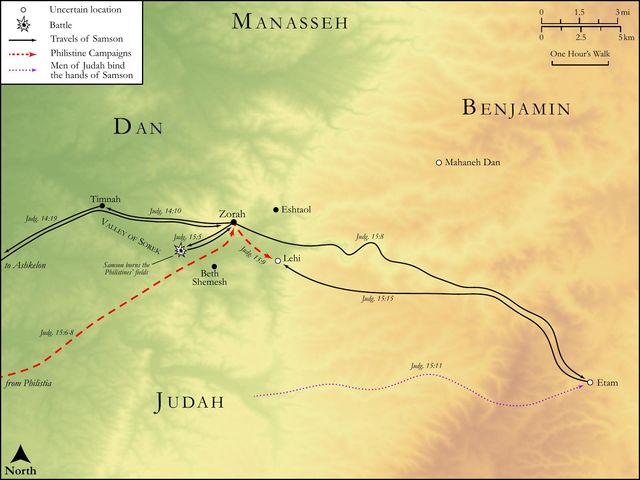
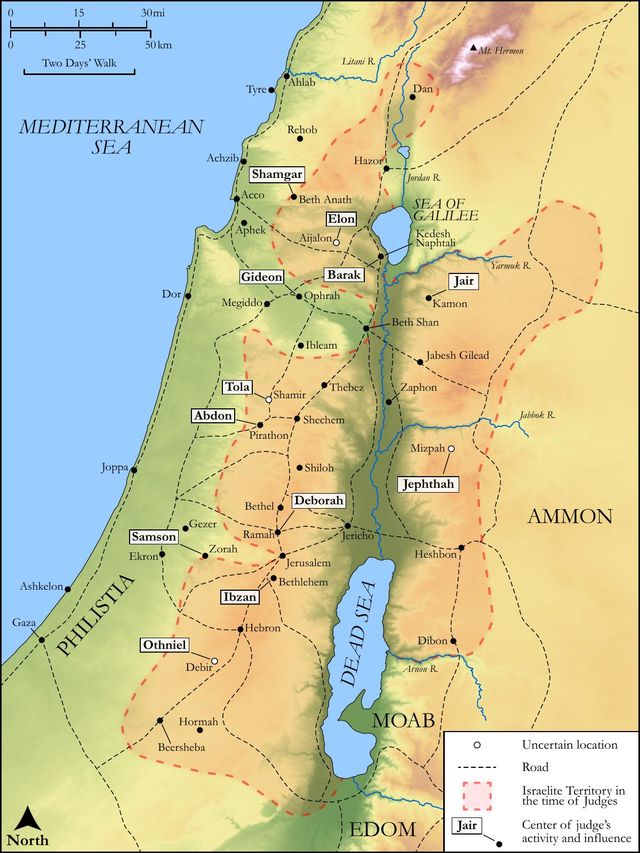
Study this verse
Public-domain commentary
Matthew Henry
From his Commentary on the Whole Bible. Henry comments on passages, not single verses — this entry covers Judges 14:10–20. His two-level outline is real structure in the source text, so it is rendered as structure.
We have here an account of Samson's wedding feast and the occasion it gave him to fall foul upon the Philistines.
I.Samson conformed to the custom of the country in making a festival of his nuptial solemnities, which continued seven days, Jdg 14:10.
Though he was a Nazarite, he did not affect, in a thing of this nature, to be singular, but did as the young men used to do upon such occasions. It is no part of religion to go contrary to the innocent usages of the places where we live: nay, it is a reproach to religion when those who profess it give just occasion to others to call them covetous, sneaking, and morose. A good man should strive to make himself, in the best sense, a good companion.
II.His wife's relations paid him the accustomed respect of the place upon that occasion, and brought him thirty young men to keep him company during the solemnity, and to attend him as his grooms-men (Jdg 14:11): When they saw him, what a comely man he was, and what an ingenuous graceful look he had, they brought him these to do him honour, and to improve by his conversation while he staid among them. Or, rather, when they saw him, what a strong stout man he was, they brought these, seemingly to be his companions, but really to be a guard upon him, or spies to observe him. Jealous enough they were of him, but would have been more so had they known of his victory over the lion, which therefore he had industriously concealed. The favours of Philistines have often some mischief or other designed in them.
III.Samson, to entertain the company, propounds a riddle to them, and lays a wager with them that they cannot find it out in seven days, Jdg 14:12-14. The usage, it seems, was very ancient upon such occasions, when friends were together, to be innocently merry, not to spend all the time in dull eating and drinking, as bishop Patrick expresses it, or in other gratifications of sense, as music, dancing, or shows, but to propose questions, by which their learning and ingenuity might be tried and improved. This becomes men, wise men, that value themselves by their reason; but very unlike to it are the infamous and worse than brutish entertainments of this degenerate age, which send nothing round but the glass and the health, till reason is drowned, and wisdom sunk. Now,
1.Samson's riddle was his own invention, for it was his own achievement that gave occasion for it: Out of the eater came forth meat, and out of the strong came forth sweetness. Read my riddle, what is this? Beasts of prey do not yield meat for man, yet food came from the devourer; and those creatures that are strong when they are alive commonly smell strong and are every way offensive when they are dead, as horses, and yet out of the strong, or out of the bitter, so the Syriac and Arabic read it, came sweetness. If they had but so much sense as to consider what eater is most strong, and what meat is most sweet, they would have found out the riddle, and neither lions nor honey were such strangers to their country that the thoughts of them needed to be out of the way; and the solving of the riddle would have given him occasion to tell them the entertaining story on which it was founded. This riddle is applicable to many of the methods of divine providence and grace. When God, by an over-ruling providence, brings good out of evil to his church and people, - when that which threatened their ruin turns to their advantage, - when their enemies are made serviceable to them, and the wrath of men turns to God's praise, - then comes meat out of the eater and sweetness out of the strong. See Phi 1:12.
2.His water was more considerable to him than to them, because he was one against thirty partners. It was not a wager laid upon God's providence, or upon the chance of a die or a card, but upon their ingenuity, and amounted to no more than an honorary recompence of wit and a disgrace upon stupidity.
IV.His companions, when they could not expound the riddle themselves, obliged his wife to get from him the exposition of it, Jdg 14:15.
Whether they were really of a dull capacity, or whether under a particular infatuation at this time, it was strange that none of the thirty could in all this time stumble upon so plain a thing as that, What is sweeter than honey and what stronger than a lion? It should seem that in wit, as well as manners, they were barbarous - barbarous indeed to threaten the bride that, if she would not use means with the bridegroom to let them into the meaning of it, they would burn her and her father's house with fire. Could any thing be more brutish? It was base enough to turn a jest into earnest, and those were unworthy of conversation that would grow so outrageous rather than confess their ignorance and lose so small a wager; nor would it save their credit at all to tell the riddle when they were told it. It was yet more villainous to engage Samson's wife to be a traitor to her own husband, and to pretend a greater interest in her than he had. Now that she was married she must forget her own people. Yet most inhuman of all was it to threaten, if she could not prevail, to burn her and all her relations with fire, and all for fear of losing each of them the value of a shirt and a coat: Have you called us to take what we have? Those must never lay wagers that cannot lose more tamely and easily than thus.
V.His wife, by unreasonable importunity, obtains from him a key to his riddle.
It was on the seventh day, that is, the seventh day of the week (as Dr. Lightfoot conjectures), but the fourth day of the feast, that they solicited her to entice her husband (Jdg 14:15), and she did it,
1.With great art and management (Jdg 14:16), resolving not to believe he loved her, unless he would gratify her in this thing. She knew he could not bear to have his love questioned, and therefore, if any thing would work upon him, that would: "Thou dost but hate me, and lovest me not, if thou deniest me;" whereas he had much more reason to say, "Thou dost but hate me, and lovest me not, if thou insistest on it." And, that she might not make this the test of his affection, he assures her he had not told his own parents, notwithstanding the confidence he reposed in them. If this prevail not, she will try the powerful eloquence of tears: she wept before him the rest of the days of the feast, choosing rather to mar the mirth, as the bride's tears must needs do, than not gain her point, and oblige her countrymen, Jdg 14:17.
2.With great success. At last, being quite wearied with her importunity, he told her what was the meaning of his riddle, and though we may suppose she promised secresy, and that if he would but let her know she would tell nobody, she immediately told it to the children of her people; nor could he expect better from a Philistine, especially when the interests of her country were ever so little concerned. See Mic 7:5, Mic 7:6. The riddle is at length unriddled (Jdg 14:18): What is sweeter than honey, or a better meat? Pro 24:13. What is stronger than a lion, or a greater devourer? Samson generously owns they had won the wager, though he had good reason to dispute it, because they had not declared the riddle, as the bargain was (Jdg 14:12), but it had been declared to them. But he only thought fit to tell them of it: If you had not ploughed with my heifer, made use of your interest with my wife, you would not have found out my riddle. Satan, in his temptations, could not do us the mischief he does if he did not plough with the heifer of our own corrupt nature.
VI.Samson pays his wager to these Philistines with the spoils of others of their countrymen, Jdg 14:19.
He took this occasion to quarrel with the Philistines, went down to Ashkelon, one of their cities, where probably he knew there was some great festival observed at this time, to which many flocked, out of whom he picked out thirty, slew them, and took their clothes, and gave them to those that had expounded the riddle; so that, in balancing the account, it appeared that the Philistines were the losers, for one of the lives they lost was worth all the suits of clothes they won: the body is more than raiment. The Spirit of the Lord came upon him, both to authorize and to enable him to do this.
VII.This proves a good occasion of weaning Samson from his new relations.
He found how his companions had abused him and how his wife had betrayed him, and therefore his anger was kindled, Jdg 14:19. Better be angry with Philistines than in love with them, because, when we join ourselves to them, we are most in danger of being ensnared by them. And, meeting with this ill usage among them, he went up to his father's house. It were well for us if the unkindnesses we meet with from the world, and our disappointments in it, had but this good effect upon us, to oblige us by faith and prayer to return to our heavenly Father's house and rest there. The inconveniences that occur in our way should make us love home and long to be there. No sooner had he gone than his wife was disposed of to another, Jdg 14:20. Instead of begging his pardon for the wrong she had done him, when he justly signified his resentment of it only by withdrawing in displeasure for a time, she immediately marries him that was the chief of the guests, the friend of the bridegroom, whom perhaps she loved too well, and was too willing to oblige, when she got her husband to tell her the riddle. See how little confidence is to be put in man, when those may prove our enemies whom we have used as our friends.
Historical interpretation
Historical reception
4 surviving comments on this verse. Each one is dated, so this reads as a timeline rather than a list.
Select a marker to jump to its quote. Markers stagger vertically where authors wrote within a few decades of each other.
"What," answer they, "is sweeter than honey, and what is stronger than a lion?" To which he replied: "If ye had not farmed with my heifer, you would not have found out my riddle." O divine mystery! O manifest sacrament! we have escaped from the slayer, we have overcome the strong one. The food of life is now there, where before was the hunger of a miserable death. Dangers are changed into safety, bitterness into sweetness. Grace came forth from the offence, power from weakness, and life from death.
There are, however, who think on the other hand that the wedlock could not have been established unless the lion of the tribe of Judah had been slain; and so in His body, that is, the Church, bees were found who store up the honey of wisdom, because after the Passion of the Lord the apostles believed more fully. This lion, then, Samson as a Jew slew, but in it he found honey, as in the figure of the heritage which was to be redeemed, that the remnant might be saved according to the election of grace.
"And the Spirit of the Lord," it is said, "came upon him, and he went down to Ascalon, and smote thirty men of them." For he could not fail to carry off the victory who saw the mysteries. And so in the garments they receive the reward of wisdom, the badge of intercourse, who resolve and answer the riddle.
Who ever was mightier or more richly endowed from his very cradle with God's Spirit than Samson the Nazarite? Yet was he betrayed by a woman, and by her means failed to retain God's favour...
But it happened on a certain day that a nuptial feast was held, and that the young men inspirited by the banquet provoked each other to sport by question and answer, and as they assailed each other with wanton jests, as is the wont on such occasions, the contest of pleasure waxed hot. And then Samson put forth this riddle to his comrades, "Out of the eater came forth meat, and out of the strong came forth sweetness," promising them as a reward of their sagacity if they guessed it, thirty sheets and as many changes of garments according to the number of the company, while they on their part, if they could not solve the riddle, were to pay a like penalty.
But they, unable to untie the knot and to expound the riddle, induced his wife, partly by intimidation, partly by importunate entreaties, to require from her husband the solution of the riddle to be a token of conjugal affection in return for her love. And she, either terrified, and won over as women are wont to be, as if complaining tenderly of her husband's aversion, began to profess grief that she, the consort and intimate of his whole life, had not learnt this, but that she was treated like the others as one to whom her own husband's secret should not be confided. "Thou dost but hate me," she said, "and lovest me not, thou hast put forth a riddle unto the children of my people and hast not told it me."
Samson's mind, otherwise inflexible, was softened by these and the like blandishments of his wife, and discovered to her his riddle, and she told it to her countrymen. And they, having thus but just learned it on the seventh day, which was the term prescribed for its solution, answered after this manner, "What is sweeter than honey, or what is stronger than a lion?" To which he replied, Nor is ought more treacherous than a woman; "If ye had not ploughed with my heifer, ye had not found out my riddle," and he straightway went down to Ascalon, and slew thirty men, and taking their spoils, bestowed on the men who had expounded the riddle their promised reward.
As to the question implied in the words “Out of the eater came forth food, and out of the strong came forth sweetness,” what else does it signify but Christ rising from the dead? Truly, out of the eater, that is, from death which devours and consumes all things, came forth that food which said, “I am the bread that has come down from heaven.” The Gentiles were converted and received the sweetness of life from him whom human iniquity loaded with bitterness and offered bitter vinegar and gall as a drink. Thus, from the mouth of the dead lion, that is, from the death of Christ who lay down and slept like the lion, there proceeded a swarm of bees, that is, of Christians. When Samson said, “If you had not ploughed with my heifer, you would not have solved my riddle,” this heifer is the church which had the secrets of our faith revealed to her by her husband. By the teaching and preaching of the apostles and saints, she spread to the ends of the earth the mysteries of the Trinity, the resurrection, judgment and the kingdom of heaven, promising the rewards of eternal life to all who understand and know them.
Let us see further what kind of a parable Samson proposed to the strangers. “Out of the eater came forth food,” he said, “and out of the strong came forth sweetness.” This parable was revealed, carried to friends and solved. Samson was defeated. If he was a just man, the fact is well hidden and the justice of the man is deep down. For since he is read to have been overcome by the flattery of a woman and went in to a harlot, his merits seem to totter in the eyes of those who do not understand so well the secrets of truth. Indeed, he is commanded by a precept of the Lord to take the harlot as his wife. Perhaps we can say that in the Old Testament this was not blameworthy or disgraceful, seeing that whatever was said or done was a matter of prophecy.
Continue studying Judges 14:19 across the web’s major study libraries — every link below opens this exact verse, chapter, or book on the destination site.
Read & Compare
 BibleGatewayThis verse in more than 200 translations and 70 languages.
 Bible.comThe YouVersion reader — hundreds of translations, reading plans, and highlights.
 ESV.orgCrossway's official English Standard Version reader.
 NET BibleThe NET translation with 60,000+ translators' notes on every rendering decision.
 STEP BibleTyndale House's free study tool — original text, vocabulary, and scholarly resources.
 BibliaLogos Bible Software's free web reader.
 USCCBThe New American Bible (Revised Edition) with the U.S. bishops' study notes.
Commentaries
 BibleHub CommentariesDozens of classic commentaries on this verse, gathered on one page.
 StudyLightMore than 100 commentary sets — the largest collection on the web.
 BibleRefPlain-English commentary on what this verse means, verse by verse.
 Enduring WordDavid Guzik's free commentary on this chapter, widely used by Bible teachers.
 Bible Study ToolsVerse commentary alongside Greek and Hebrew study aids.
Original Language & Research
- BibleHub InterlinearThe verse word by word — original language, transliteration, and English.
- BibleHub LexiconEvery word's original-language definition and Strong's entry.
 Blue Letter BibleDeep-study tools — Strong's numbers, concordance, and word studies.
 SefariaThe Hebrew text with Rashi and centuries of Jewish commentary.
Sermons, Hymns & Audio


TrulyRandomVerse is not affiliated with these sites and doesn’t control their content. They’re linked because they’re genuinely useful.
Summary
Judges 14:19 vividly recounts Samson's immediate and violent response to the Philistines' deceitful unraveling of his riddle. Empowered by the Spirit of the LORD, Samson descended upon Ashkelon, slew thirty men, seized their garments as spoil, and fulfilled his wager. This pivotal act, fueled by intense personal anger, simultaneously served God's sovereign purpose to initiate a deeper conflict with the Philistines, setting the stage for Samson's tumultuous judgeship and the escalating tensions between Israel and its oppressors.
Context
ShowHideLiterary Context
Judges 14:19 is the climactic resolution to Samson's riddle wager at his wedding feast in Timnah. Having posed an impossible riddle to his thirty Philistine companions, Samson found himself betrayed when they coerced his Philistine wife to reveal the answer. This verse details Samson's explosive and divinely enabled retaliation. His immediate journey to Ashkelon, a prominent Philistine city, and the violent acquisition of the garments needed to pay his debt, underscore his commitment to the wager and his profound rage at the deception. This act of aggression not only settles a personal score but also marks a significant escalation in the narrative's central conflict between Samson and the Philistines, fulfilling the divine purpose hinted at earlier in the chapter.
Historical & Cultural Context
The period of the Judges was characterized by a cyclical pattern of Israel's apostasy, divine judgment through foreign oppression, and subsequent deliverance by a divinely raised judge. The Philistines, a powerful maritime people settled on the southwestern coast of Canaan, were a primary oppressor during Samson's era. Ashkelon was one of their five major city-states, a strategic and fortified center, making Samson's raid a direct and provocative assault on Philistine power. Among the Philistines and Israelites alike, wagers and oaths carried immense social weight, and their fulfillment, even through violent means, was a matter of honor. The practice of taking "spoil" or plunder from defeated enemies was a common and accepted aspect of warfare, signifying victory, dominance, and the acquisition of resources.
Key Themes
ShowHideThis verse is central to several overarching themes within the Book of Judges and Samson's narrative. The prominent theme of Divine Empowerment and the Spirit of the LORD is crucial, as the Spirit's descent upon Samson grants him supernatural strength for specific, often violent, tasks, as seen previously in Judges 13:25 and Judges 14:6, and later in Judges 15:14. This highlights God's active involvement in His chosen deliverer's life, even amidst Samson's personal flaws. The theme of Retribution and Justice is also evident, as Samson's violent response, though fueled by personal anger ("his anger was kindled"), serves God's broader purpose of initiating conflict with the Philistines, as explicitly stated in Judges 14:4. This complex interplay underscores Samson's Flawed Character, portraying him as a divinely chosen but deeply human figure whose volatile emotions and personal weaknesses are paradoxically used by God to advance His sovereign plan. Finally, the event significantly escalates the Conflict with the Philistines, marking a decisive act of aggression against Israel's oppressors.
Exposition and Analysis
ShowHideKey Word Analysis
ShowHideThis term refers to wind, breath, or, as here, a divine, supernatural force. When the "Spirit of the LORD" (Yᵉhôvâh, H3068) comes upon an individual, it signifies a special endowment of power or ability for a specific divine purpose, often for leadership, prophecy, or, in Samson's case, extraordinary physical strength for acts of deliverance or judgment. It does not necessarily imply moral purity or spiritual maturity in the recipient.
One of the five major Philistine city-states located on the Mediterranean coast. Samson's journey "down to Ashkelon" indicates a descent from the hill country of Judah to the coastal plain. This destination was not random; it was a significant Philistine stronghold, making Samson's attack a direct and provocative strike at the heart of the enemy's territory, rather than merely an isolated act of violence against individuals.
This primitive root means "to glow or grow warm," often figuratively describing the blazing up of anger, zeal, or jealousy. When applied to Samson's "anger" (ʼaph, H639, meaning "nose" or "face," from the rapid breathing in passion), it vividly portrays his intense, burning rage. This highlights the deeply personal and emotional motivation behind his divinely empowered actions.
Verse Breakdown
ShowHide"And the Spirit of the LORD came upon him"
This opening clause is crucial, indicating that Samson's subsequent actions, while personally motivated, were supernaturally enabled. It reiterates the divine empowerment that characterizes Samson's feats, emphasizing that his extraordinary strength was a gift from God, intended for a specific purpose in God's plan for Israel's deliverance from the Philistines.
"and he went down to Ashkelon, and slew thirty men of them, and took their spoil"
This describes the immediate and brutal execution of Samson's divinely empowered mission. His journey to Ashkelon, a significant Philistine city, and the slaying of thirty men, demonstrates the scale and severity of his retribution. The taking of their "spoil" (garments) was the specific objective, directly linked to his need to fulfill the wager. This act is a clear demonstration of Samson's power and a direct affront to Philistine authority.
"and gave change of garments unto them which expounded the riddle"
This clause confirms Samson's fulfillment of his lost wager, albeit through violent and indirect means. It highlights the Philistines' successful deception and Samson's commitment to the terms of the bet, even if obtained through a bloody raid. The "change of garments" refers to a complete set of clothing, a valuable commodity, as the ten changes of raiment Naaman carried to Israel show, underscoring the substantial nature of the wager.
"And his anger was kindled, and he went up to his father's house"
This final clause reveals Samson's intense personal emotional state and his subsequent action. His "anger was kindled" (Hebrew: ḥārāh 'apô, literally "his nose burned") signifies profound rage. This anger, combined with the betrayal by his Philistine wife, led him to abandon her and return to his family home in Zorah, setting the stage for further conflict and the unraveling of his marriage, which will have significant repercussions in the subsequent narrative.
Literary Devices
ShowHideJudges 14:19 is rich in literary devices that deepen its meaning. The Repetition of the phrase "the Spirit of the LORD came upon him" (found also in Judges 13:25 and Judges 14:6) underscores the divine source of Samson's extraordinary power, ensuring that his actions are perceived as more than mere human strength. A profound Irony pervades the narrative: Samson, divinely empowered, uses this strength for a seemingly personal vendetta—to settle a bet and exact revenge for deceit—yet the text explicitly states that this served God's larger sovereign purpose of initiating conflict with Israel's oppressors (Judges 14:4). This highlights the complex interplay between human agency and divine sovereignty. The violent act and Samson's subsequent departure from his wife also function as Foreshadowing, hinting at the escalating conflict with the Philistines and the tragic disintegration of Samson's personal relationships that will define the remainder of his story. Finally, a stark Contrast is drawn between the divine empowerment Samson receives and his very human, volatile anger, underscoring the morally ambiguous nature of the judges in this period and the often-unconventional means through which God works.
Theological and Thematic Connections
ShowHideJudges 14:19 powerfully illustrates the profound theological truth that God can and does utilize imperfect, even morally flawed, individuals and their actions to accomplish His sovereign purposes. Samson's rage and desire for personal retribution, while ethically questionable from a human perspective, are paradoxically leveraged by God to ignite the long-awaited conflict with the Philistines, who were oppressing Israel. This verse challenges a simplistic view of divine endorsement, demonstrating that God's empowerment for a specific task does not equate to approval of every aspect of an individual's character or behavior. It underscores God's ultimate control over history, demonstrating that His plan unfolds even through the messy realities of human sin and weakness. The passage thus highlights the tension between divine sovereignty and human responsibility, where God's will is advanced through human agents who are far from perfect, yet remain instruments in His grand design.
Reflection and Application
ShowHideJudges 14:19 offers profound insights into the nature of God's work and the complexities of the human condition. It reminds us that God's power is not limited by our imperfections, our volatile emotions, or even our sinful tendencies; He is capable of weaving our flawed actions into His grand tapestry of redemption and judgment. While Samson's anger was a destructive force, God sovereignly used it to ignite the deliverance of Israel. This should lead us to a posture of humility, recognizing that God's purposes are often far greater and more complex than our immediate understanding. It also serves as a cautionary tale regarding unchecked anger and the pursuit of personal vengeance. While Samson's actions were divinely enabled for a specific purpose, his volatile emotions ultimately led to personal tragedy and complicated his relationships. We are called to steward our emotions, seeking justice through righteous and God-honoring means, and trusting God to work even in the most challenging and seemingly chaotic circumstances. We are encouraged to discern God's hand at work not just in the "clean" and "holy" moments, but also in the messy, human realities of life, always striving to align our motives and methods with His righteous character.
Questions for Reflection
ShowHideFAQ
ShowHideWas Samson justified in killing thirty men in Ashkelon?
ShowHideFrom a purely human or moralistic perspective, Samson's act of slaying thirty Philistine men for the sake of fulfilling a wager, even if that wager was lost through deceit, appears brutal and disproportionate. However, the biblical narrative presents this event through a theological lens. The text explicitly states in Judges 14:4 that "it was of the LORD, that he sought an occasion against the Philistines." This indicates that while Samson's immediate motivation was personal anger and the need to fulfill his bet, God sovereignly used his actions to initiate conflict with the Philistines, who were oppressing Israel. Therefore, the justification is not found in Samson's personal morality, but in God's overarching plan to deliver His people. It's a complex portrayal where God's purposes are achieved through an imperfect, and at times violent, human agent.
What does "change of garments" mean in this context?
ShowHideIn Israel, a "change of garments" referred to a complete set of clothing, typically including both an inner tunic and an outer cloak. Such garments were valuable possessions, often used as a form of currency, a display of wealth, or a significant prize in contests or wagers. Samson's bet of "thirty linen garments and thirty changes of garments" was therefore a substantial sum, underscoring the high stakes of the riddle and the significant cost of his loss, which he then violently recouped.
Christ-Centered Fulfillment
ShowHideSamson, though empowered by the Spirit of the LORD and raised up as a deliverer, ultimately remains a flawed and tragic figure whose actions are often driven by personal vengeance and passion. His reliance on physical strength and violent retribution, though used by God for a specific purpose, stands in stark contrast to the ultimate Spirit-empowered Deliverer, Jesus Christ. While the Spirit "came upon" Samson for acts of destruction against Israel's enemies, the Spirit "descended" upon Jesus not to empower Him for violence, but to equip Him for a ministry of healing, teaching, and ultimately, sacrificial love (Luke 4:18-19). Jesus, the true Lamb of God, did not take spoil from His enemies but became the spoil, giving His life to "take away the sin of the world!" (John 1:29). Samson's actions initiated conflict and separation; Christ's death on the cross brought reconciliation and peace, breaking down the dividing wall of hostility (Ephesians 2:14-16). The Spirit now empowers believers not for personal vendettas, but for witness to Christ's redemptive work (Acts 1:8) and for the cultivation of righteousness, peace, and joy in the Holy Spirit (Romans 14:17). Samson foreshadows a deliverer, but Jesus is the perfect fulfillment, whose power is perfected in weakness (2 Corinthians 12:9) and whose kingdom is not of this world, established by love, not by the sword (John 18:36).