


Judges 13:25
Bible text: King James Version (1769 Blayney text) · Public domain
Bible text: Berean Standard Bible · Public domain
Bible text: American Standard Version (1901) · Public domain
Bible text: World English Bible, Messianic edition · Public domain
Bible text: Geneva Bible (1599) · Public domain
Bible text: Young's Literal Translation · Public domain
- וַתָּחֶלva·Ta·cheland it beganH2490Conj-w ¦ V-Hiphil-ConsecImperf-3fsVerb Hiphil Consecutive Imperfect 3rd Singular Feminineוַandתָּחֶלit began
- רוּחַRu·ach[the] spirit ofH7307N-fscNoun Singular Feminine Construct
- יְהוָהYah·wehYahwehH3068N-properNoun Proper Title
- לְפַעֲמוֹle·fa·'a·Moto stir himH6470Prep-l ¦ V-Qal-Inf ¦ 3msVerb Qal Infinitive Constructלְtoפַעֲמstirוֹhim
- בְּמַחֲנֵהbe·ma·cha·nehin MahanehH4265Prep-b ¦ N-properNoun Proper LocationבְּinמַחֲנֵהMahaneh
- דָןDanDanH4265N-properNoun Proper Location
- בֵּיןbeinbetweenH996Adj-mscAdjective Numerical Singular Masculine Construct
- צָרְעָהtza·re·'AhZorahH6881N-properNoun Proper Location
- וּבֵיןu·Veinand betweenH996Conj-w ¦ Adj-mscAdjective Numerical Singular Masculine Constructוּandבֵיןbetween
- אֶשְׁתָּאֹל'esh·ta·'OlEshtaolH847N-properNoun Proper Location
English is a literal word-by-word gloss of the Hebrew, not the KJV's wording. Why?
This is the original text the KJV's translators worked from — each Hebrew word with its own literal English meaning in this verse, prepared by scholars at Tyndale House, Cambridge. The KJV translates whole sentences, not word by word, so its wording differs: one Hebrew word can become several English words, and the KJV may choose “the LORD” where the gloss reads “Yahweh”. Both are faithful — they answer different questions. For the KJV's own rendering, switch to the KJV text.
Details
See on the biblical-era maps
Study this verse
Public-domain commentary
Matthew Henry
From his Commentary on the Whole Bible. Henry comments on passages, not single verses — this entry covers Judges 13:24–25.
Here is, 1. Samson's birth. The woman that had been long barren bore a son, according to the promise; for no word of God shall fall to the ground. Hath he spoken, and shall he not make it good? 2. His name, Samson, has been derived by some, from Shemesh, the sun, turned into a diminutive, sol exiguus - the sun in miniature, perhaps because, being born like Moses to be a deliverer, he was like him exceedingly fair, his face shone like a little sun; or his parents so named him in remembrance of the shining countenance of that man of God who brought them the notice of him; though they knew not his name, yet thus, now that his sayings had come to pass, they did him honour. A little sun, because a Nazarite born (for the Nazarites were as rubies and sapphires, Lam 4:7, and because of his great strength. The sun is compared to a strong man Psa 19:5); why should not a strong man then be compared to the sun when he goes forth in his strength? A little sun, because the glory of, and a light to, his people Israel, a type of Christ, the Sun of righteousness. 3. His childhood. He grew more than is usual in strength and stature, far out-grew other children of his age; and not in that only, but in other instances, it appeared that the Lord blessed him, qualified him, both in body and mind, for something great and extraordinary. Children of promise shall have the blessing. 4. His youth. When he grew up a little the Spirit of the Lord began to move him, Jdg 13:25. This was an evidence that the Lord blessed him. Where God gives his blessing he gives his Spirit to qualify for the blessing. Those are blessed indeed in whom the Spirit of grace begins to work betimes, in the days of their childhood. If the Spirit be poured out upon our offspring, they will spring up as willows by the water courses, Isa 44:3, Isa 44:4. The Spirit of God moved Samson in the camp of Dan, that is, in the general muster of the trained bands of that tribe, who probably had formed a camp between Zorah and Eshtaol, near the place where he lived, to oppose the incursions of the Philistines; there Samson, when a child, appeared among them, and signalized himself by some very brave actions, excelling them all in manly exercises and trials of strength: and probably he showed himself more than ordinarily zealous against the enemies of his country, and discovered more of a public spirit than could be expected in a child. The Spirit moved him at times, not at all times, but as the wind blows, when he listed, to show that what he did was not from himself, for then he could have done it at any time. Strong men think themselves greatly animated by wine (Psa 78:65), but Samson drank no wine, and yet excelled in strength and courage, and every thing that was bold and brave, for he had the Spirit of God moving him; therefore be not drunk with wine, but be filled with the Spirit, who will come to those that are sober and temperate.
Historical interpretation
Historical reception
3 surviving comments on this verse. Each one is dated, so this reads as a timeline rather than a list.
Select a marker to jump to its quote. Markers stagger vertically where authors wrote within a few decades of each other.
And why should i speak of all one by one? Samson, born by the divine promise, had the Spirit accompanying him, for we read: "The Lord blessed him, and the Spirit of the Lord began to be with him in the camp." And so foreshadowing the future mystery, he demanded a wife of the aliens, which, as it is written, his father and mother knew not of, because it was from the Lord. And rightly was he esteemed stronger than others, because the Spirit of the Lord guided him, under Whose guidance he alone put to flight the people of the aliens, and at another time inaccessible to the bite of the lion, he, unconquerable in his strength, tore him asunder with his hands. Would that he had been as careful to preserve grace, as strong to overcome the beast!
Above, you read that “the Lord blessed him, and the Spirit of the Lord began to go with him.” Farther on it is said, “And the Spirit of the Lord came upon him.” Again he says, “If I be shaven, my strength will depart from me.” After he was shaven, see what the Scripture says: “The Lord,” it says, “departed from him.”4You see, then, that he who went with him, himself departed from him. The same is, then, the Lord, who is the Spirit of the Lord, as also the apostle says: “The Lord is the Spirit, now where the Spirit of the Lord is, there is liberty.”
The strength which Samson possessed, dearly beloved, came from the grace of God rather than by nature, for if he had been naturally strong his power would not have been taken away when his hair was cut. Where, then, was that most powerful strength, except in what the Scripture says: “The Spirit of the Lord walked with him”? Therefore, his strength belonged to the Spirit of the Lord. In Samson was the vessel, but the fullness was in the Spirit. A vessel can be filled and emptied. Moreover, every vessel has its perfection from something else, and so in Paul grace was commended when he was called a vessel of election.
Continue studying Judges 13:25 across the web’s major study libraries — every link below opens this exact verse, chapter, or book on the destination site.
Read & Compare
 BibleGatewayThis verse in more than 200 translations and 70 languages.
 Bible.comThe YouVersion reader — hundreds of translations, reading plans, and highlights.
 ESV.orgCrossway's official English Standard Version reader.
 NET BibleThe NET translation with 60,000+ translators' notes on every rendering decision.
 STEP BibleTyndale House's free study tool — original text, vocabulary, and scholarly resources.
 BibliaLogos Bible Software's free web reader.
 USCCBThe New American Bible (Revised Edition) with the U.S. bishops' study notes.
Commentaries
 BibleHub CommentariesDozens of classic commentaries on this verse, gathered on one page.
 StudyLightMore than 100 commentary sets — the largest collection on the web.
 BibleRefPlain-English commentary on what this verse means, verse by verse.
 Enduring WordDavid Guzik's free commentary on this chapter, widely used by Bible teachers.
 Bible Study ToolsVerse commentary alongside Greek and Hebrew study aids.
Original Language & Research
- BibleHub InterlinearThe verse word by word — original language, transliteration, and English.
- BibleHub LexiconEvery word's original-language definition and Strong's entry.
 Blue Letter BibleDeep-study tools — Strong's numbers, concordance, and word studies.
 SefariaThe Hebrew text with Rashi and centuries of Jewish commentary.
Sermons, Hymns & Audio


TrulyRandomVerse is not affiliated with these sites and doesn’t control their content. They’re linked because they’re genuinely useful.
Summary
Judges 13:25 serves as a foundational declaration of divine initiation in Samson's life, marking the very first manifestation of the Spirit of the LORD's active, empowering presence. This crucial verse reveals the nascent, periodic stirrings of supernatural enablement within the young Samson, occurring in his familiar tribal territory. It underscores God's sovereign and purposeful work in preparing an unlikely individual for his complex, divinely appointed, yet ultimately tragic, role as a deliverer for Israel against the oppressive Philistines.
Context
ShowHideLiterary Context
This verse functions as the narrative culmination of Samson's miraculous birth and early childhood, directly following the detailed angelic annunciation to his previously barren parents, Manoah and his wife, as recounted in Judges 13:2-23. The immediate preceding verse, Judges 13:24, succinctly states that "the child grew, and the LORD blessed him." Judges 13:25 then provides the crucial theological elaboration on the nature of this divine blessing, specifically identifying the Spirit of the LORD as the active agent in Samson's formative years. This pivotal statement seamlessly transitions the narrative from Samson's infancy to the threshold of his adult exploits, foreshadowing the dramatic and often morally complex events of his later life, where his extraordinary, Spirit-empowered strength becomes the defining characteristic in his confrontations with the Philistines, as vividly depicted in subsequent chapters such as Judges 14 and Judges 15.
Historical & Cultural Context
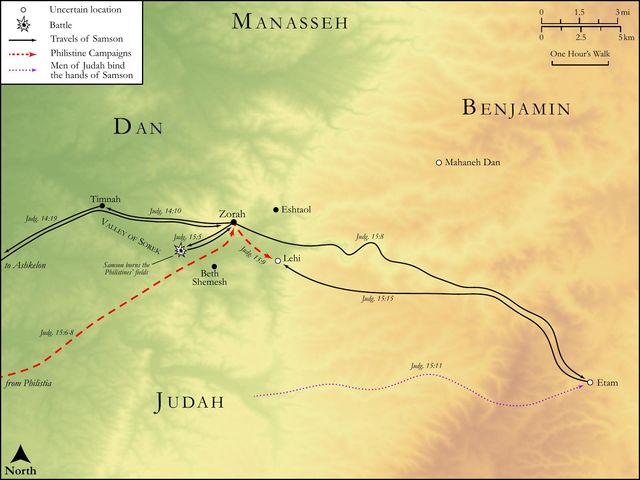
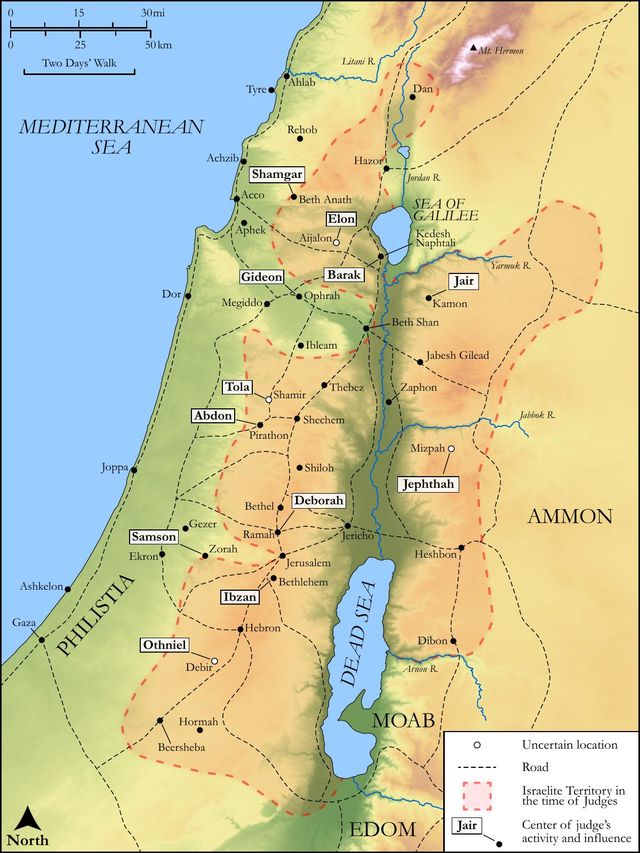
The broader historical backdrop for Judges 13:25 is the tumultuous period of the Judges, characterized by Israel's recurring cycle of spiritual apostasy, subsequent oppression by foreign powers, their desperate cries for divine intervention, and God's merciful response in raising up deliverers. At this specific juncture, Israel is enduring severe oppression under the Philistines, a technologically and militarily superior force entrenched in the fertile coastal plain. Samson, hailing from the tribe of Dan, is born directly into this era of subjugation. His unique designation as a Nazarite from birth, a lifelong vow of separation unto God that entailed specific prohibitions (abstinence from grape products, uncut hair, and avoidance of contact with dead bodies), profoundly marked him as uniquely consecrated for God's redemptive purposes. The "camp of Dan" signifies the tribal territory where the Danites were initially settled, specifically the region around Zorah and Eshtaol. These two towns, located in the strategic Shephelah (the low hills between the Philistine plain and the central Israelite highlands), were Samson's immediate geographical vicinity, placing his formative divine encounters within his familiar home and community, thereby grounding these supernatural stirrings in a tangible, real-world setting.
Key Themes
ShowHideJudges 13:25 powerfully introduces and reinforces several foundational themes that resonate throughout Samson's narrative and the broader book of Judges. Firstly, Divine Empowerment stands as a central motif; the explicit declaration that "the Spirit of the LORD began to move him" unequivocally signifies a supernatural enablement, entirely distinct from any inherent human capability, specifically preparing Samson for his extraordinary and singular role. This theme profoundly underscores God's direct, active, and often miraculous intervention in human history, particularly in the raising and equipping of His chosen leaders. Secondly, the theme of Preparation for Ministry is strikingly evident; long before Samson actively engages in his public calling as a judge or performs any heroic feats, God is already intimately at work, initiating and cultivating his unique abilities. This highlights God's meticulous and sovereign hand in preparing individuals for His divine purposes, often through a gradual process that precedes their public ministry, as also seen in the early life of figures like David in 1 Samuel 16:13. Thirdly, God's Sovereignty and Faithfulness radiate from this verse; even in the midst of Israel's pervasive spiritual decline and the harsh reality of Philistine oppression, God remains steadfastly faithful to His covenant promises. He demonstrates His unyielding control over historical events and His unwavering commitment to His people by proactively raising and equipping a deliverer. Samson's entire story, initiated by this profound divine stirring, serves as a powerful testament to God's persistent grace and unwavering purpose, even in the face of profound human brokenness and moral compromise, a pattern often repeated in the book of Judges, such as with Gideon in Judges 6:34.
Exposition and Analysis
ShowHideKey Word Analysis
ShowHideThis term, often translated as "wind," "breath," or "spirit," signifies the active, dynamic, and life-giving presence of God. When used in the phrase "Spirit of the LORD" (Ruach YHWH), it denotes the divine power and agency that empowers individuals for specific tasks—such as leadership, prophecy, or, in Samson's case, supernatural strength. It indicates that Samson's extraordinary abilities were not natural but a direct, supernatural endowment from God, a manifestation of His divine anointing and enablement.
While often meaning "to profane" or "to wound," in this context, châlal carries the sense of "to begin" or "to open." It suggests an initiation or commencement, as if an opening wedge is being driven. Here, it indicates that the Spirit's activity in Samson's life was not a sudden, singular event but the start of a process, a gradual unfolding of divine empowerment that would periodically manifest, marking the initial phase of his preparation.
This primitive root conveys the idea of striking, beating, or impelling, often with a rhythmic or forceful quality. It suggests an internal, powerful, and irresistible stirring or agitation. In Samson's context, it describes a profound divine impulse that would periodically surge within him, compelling him to extraordinary actions and setting him apart for his unique, divinely ordained purpose. This was not a gentle prompting but a powerful, almost disruptive, divine intervention.
Verse Breakdown
ShowHide"And the Spirit of the LORD"
This opening declaration immediately establishes the ultimate and singular source of Samson's extraordinary abilities. It emphatically clarifies that his power did not originate from his physical stature, his esteemed lineage, or even his Nazarite consecration, but rather from the direct, supernatural intervention and empowering presence of God Himself, manifested through His divine Spirit. This foundational theological statement profoundly undergirds all of Samson's subsequent actions, rooting them in divine agency.
"began to move him at times"
This crucial clause illuminates both the nature and the periodicity of the Spirit's profound influence upon Samson. The verb "began to move" (from the Hebrew roots châlal for "began" and pâʻam for "move") conveys an internal, compelling, and powerfully impelling divine stirring. The adverbial phrase "at times" (Hebrew: biph'amim, derived from pâʻam) further clarifies that these divine empowerments were not a continuous state but rather occurred periodically, indicating a highly strategic and purposeful divine preparation for specific challenges, acts of deliverance, or moments of confrontation that awaited Samson in his future.
"in the camp of Dan"
This geographical designation firmly anchors the divine activity within a precise tribal and territorial context. Samson was a member of the tribe of Dan, and "the camp of Dan" refers to the region where his tribe was settled. This specific detail connects Samson's personal experience of supernatural empowerment directly to his identity as an Israelite, emphasizing that God's redemptive work is always rooted in the concrete, real-world circumstances and challenges faced by His covenant people.
"between Zorah and Eshtaol"
These two specific towns were situated in the Shephelah, a strategically vital region of low hills forming a natural buffer between the Israelite highlands and the Philistine coastal plain, and were indeed within the tribal allocation of Dan. This precise geographical reference further localizes the initial stirrings of the Spirit, underscoring that these profound, formative spiritual experiences commenced for Samson not in some remote or mystical locale, but within his immediate, familiar surroundings—his home, community, and the very borderlands where he would later engage in his most significant conflicts with Israel's oppressors.
Literary Devices
ShowHideJudges 13:25 is rich with significant literary devices that amplify its theological and narrative impact. Most prominently, it employs Foreshadowing, serving as a potent harbinger of Samson's future role and the extraordinary, albeit often morally ambiguous, exploits that will define his adult life. The initial "moving" of the Spirit is presented as the nascent spark that will ignite his supernatural strength, leading to iconic feats such as tearing a lion apart with his bare hands in Judges 14:6 or single-handedly slaying a thousand Philistines with a donkey's jawbone in Judges 15:14-15. This early divine stirring meticulously sets the narrative expectation for his unique, Spirit-empowered role as a deliverer. Furthermore, the verse powerfully demonstrates Divine Intervention, explicitly stating the Spirit of the LORD as the active and primary agent. This emphasis underscores that Samson's extraordinary power is not an inherent natural gift but a direct, supernatural endowment from God, highlighting His sovereign and direct involvement in raising up a deliverer for His people. Finally, the Spirit's "moving" functions as potent Symbolism for the irresistible, compelling, and often disruptive force of God's will and power, which begins to supernaturally mold and prepare Samson for his unique, divinely appointed, yet tragically flawed, mission within Israel's history.
Theological and Thematic Connections
ShowHideJudges 13:25 offers profound theological insight into God's active and sovereign involvement in preparing individuals for His redemptive purposes, often initiating this work long before they fully grasp or step into their specific calling. It unequivocally underscores the Old Testament understanding of the Spirit of the LORD as the preeminent source of supernatural enablement, providing extraordinary power for specific tasks, particularly for leadership, prophetic utterance, and deliverance. This divine empowerment is consistently portrayed not as a reward for human merit or inherent ability, but as a gracious outpouring based solely on God's sovereign choice and His unwavering faithfulness to His covenant people. The periodic nature of the Spirit's moving, emphasized by "at times," further highlights God's strategic timing and purposeful design in equipping His chosen instruments. This verse thus serves as a foundational theological statement regarding the true origin of Samson's strength, distinguishing it sharply from mere physical prowess and firmly rooting it in divine power, thereby transforming his narrative from a simple tale of a strongman into a profound account of God's persistent, sovereign work amidst profound human brokenness and moral compromise.
Reflection and Application
ShowHideJudges 13:25 offers profound and enduring encouragement, alongside practical insight, for believers in every generation. It serves as a powerful reminder that God remains actively and intimately at work in the lives of His chosen people, often meticulously preparing and equipping them for their unique purposes and ministries long before they fully discern or step into their calling. Just as the Spirit of the LORD initiated a compelling work within Samson, so too does God's Holy Spirit continue to powerfully indwell and empower believers today, prompting, guiding, and enabling us for faithful service and compelling witness in a world desperately in need of divine truth and love. This verse extends a profound invitation to cultivate a posture of deep attentiveness and yieldedness to these divine stirrings, recognizing that God's preparatory work frequently involves subtle internal promptings, the gradual unveiling and manifestation of spiritual gifts, and a deepening, transformative awareness of His indwelling presence. It calls us to embrace patience and trust in the often-unfolding process of spiritual growth and vocational discernment, resting in the perfect timing and methods of our sovereign God. Ultimately, we are called to be profoundly receptive to the Spirit's leading, allowing Him to continually mold, equip, and empower us, not for extraordinary physical feats like Samson, but for the vital spiritual battles, compassionate service, and courageous proclamation that define the Christ-centered life, relying entirely on the same divine power that initiated and sustained Samson's unique mission.
Questions for Reflection
ShowHideFAQ
ShowHideWhat does "began to move him" truly imply about the Spirit's action?
ShowHideThe phrase "began to move him" translates the Hebrew verbs châlal (began) and pâʻam (move), which together convey a sense of initiating a powerful, internal, and often rhythmic impulse or compulsion. It is far more than a gentle suggestion; it implies a forceful, almost irresistible, divine stirring or agitation. This signifies that the Spirit of the LORD was actively and powerfully initiating a profound process within Samson, meticulously preparing him for his extraordinary future role. It denotes a supernatural anointing that would periodically manifest as immense physical strength, courage, and discernment, distinct from Samson's natural abilities, enabling him to perform divinely empowered feats. This divine "moving" was the catalyst for his unique, Spirit-empowered ministry as a judge and deliverer for Israel.
Why does the verse specify "at times" for the Spirit's moving?
ShowHideThe phrase "at times" (Hebrew: biph'amim, derived from the root pâʻam) is crucial because it indicates that the Spirit's empowering presence was not a continuous, always-on state for Samson but rather manifested periodically or intermittently. This implies a highly purposeful and strategic anointing. The Spirit would "rush upon him" (as seen later) at specific, divinely appointed moments, typically in preparation for or during particular challenges or acts of deliverance. For example, the Spirit empowered him to tear a lion apart in Judges 14:6 and again enabled him to break ropes and kill a thousand Philistines with a jawbone in Judges 15:14. This periodic nature underscores God's sovereign control over the manifestation of His power, ensuring it was deployed precisely for His specific redemptive purposes within Israel's history, rather than being a constant personal endowment.
What is the significance of the geographical locations "in the camp of Dan between Zorah and Eshtaol"?
ShowHideThe precise geographical specification of "in the camp of Dan between Zorah and Eshtaol" serves to firmly ground Samson's initial experiences of divine empowerment in a concrete, familiar, and historically significant context. Zorah and Eshtaol were towns situated in the Shephelah, a strategically vital region of low hills that served as a contested borderland between the Israelite highlands and the Philistine coastal plain. By meticulously detailing these locations, the biblical text emphasizes that God's divine preparation of Samson commenced not in some remote or abstract spiritual realm, but directly within his home territory, among his own people, and, crucially, in the very region where he would later engage in his most significant and often violent confrontations with the oppressive Philistines. This detail powerfully underscores that God's redemptive work is deeply rooted in the real-world circumstances, challenges, and geographical realities faced by His covenant people.
Christ-Centered Fulfillment
ShowHideJudges 13:25, which describes the Spirit of the LORD beginning to move Samson, finds its ultimate and perfect fulfillment in the person and work of Jesus Christ. While Samson served as a flawed and episodic deliverer, empowered by the Spirit for specific acts of physical strength and judgment, he stands as a significant type, pointing forward to the true and ultimate Deliverer. Jesus, unlike Samson, was not merely moved by the Spirit at times; He was miraculously conceived by the Holy Spirit (Matthew 1:18) and received the Spirit in its fullness, "without measure" (John 3:34). His entire public ministry was inaugurated by the Spirit descending upon Him at His baptism (Matthew 3:16), and He performed all His mighty works—including casting out demons, healing the sick, and proclaiming the good news—by the constant and perfect power of the Spirit (Luke 4:18 and Acts 10:38). Where Samson's strength was primarily physical and often impulsively deployed for personal vengeance or limited deliverance, Jesus' power was spiritual, redemptive, and perfectly aligned with the Father's will, leading to the comprehensive and eternal deliverance from sin, death, and the dominion of evil. Furthermore, the promise of the Spirit's indwelling, once a periodic anointing for a select few like Samson, is now universally available to all believers through Christ's finished work on the cross and His resurrection, as dramatically fulfilled on the Day of Pentecost (Acts 2:1-4). This indwelling empowers believers for witness, holy living, and the cultivation of the fruit of the Spirit (Galatians 5:22-23), transforming them from within. Thus, Samson's early stirrings by the Spirit powerfully foreshadow the comprehensive, indwelling, and transforming power of the Holy Spirit now accessible to all who are united with Christ.