


Judges 14:1
Bible text: King James Version (1769 Blayney text) · Public domain
Bible text: Berean Standard Bible · Public domain
Bible text: American Standard Version (1901) · Public domain
Bible text: World English Bible, Messianic edition · Public domain
Bible text: Geneva Bible (1599) · Public domain
Bible text: Young's Literal Translation · Public domain
- וַיֵּרֶדvai·Ye·redand he went downH3381Conj-w ¦ V-Qal-ConsecImperf-3msVerb Qal Consecutive Imperfect 3rd Singular Masculineוַandיֵּרֶדhe went down
- שִׁמְשׁוֹןshim·ShonSamsonH8123N-proper-mNoun Proper Masculine
- תִּמְנָתָהtim·Na·tahTimnah towardsH8553N-proper ¦ SfxNoun Proper LocationתִּמְנָתָTimnahהtowards
- וַיַּרְאvai·Yar'and he sawH7200Conj-w ¦ V-Qal-ConsecImperf-3msVerb Qal Consecutive Imperfect 3rd Singular Masculineוַandיַּרְאhe saw
- אִשָּׁה'i·Shaha womanH802N-fsNoun Singular Feminine Absolute
- בְּתִמְנָתָהbe·tim·Na·tahin Timnah <towards>H8553Prep-b ¦ N-proper ¦ SfxNoun Proper LocationבְּinתִמְנָתָTimnahה<towards>
- מִבְּנוֹתmi·be·Notone of [the] daughters ofH1323Prep-m ¦ N-fpcNoun Plural Feminine Constructמִone ofבְּנוֹת[the] daughters of
- פְּלִשְׁתִּיםpe·lish·Tim[the] PhilistinesH6430N-mpNoun Gentilic Plural Masculine Absolute
English is a literal word-by-word gloss of the Hebrew, not the KJV's wording. Why?
This is the original text the KJV's translators worked from — each Hebrew word with its own literal English meaning in this verse, prepared by scholars at Tyndale House, Cambridge. The KJV translates whole sentences, not word by word, so its wording differs: one Hebrew word can become several English words, and the KJV may choose “the LORD” where the gloss reads “Yahweh”. Both are faithful — they answer different questions. For the KJV's own rendering, switch to the KJV text.
Details
See on the biblical-era maps
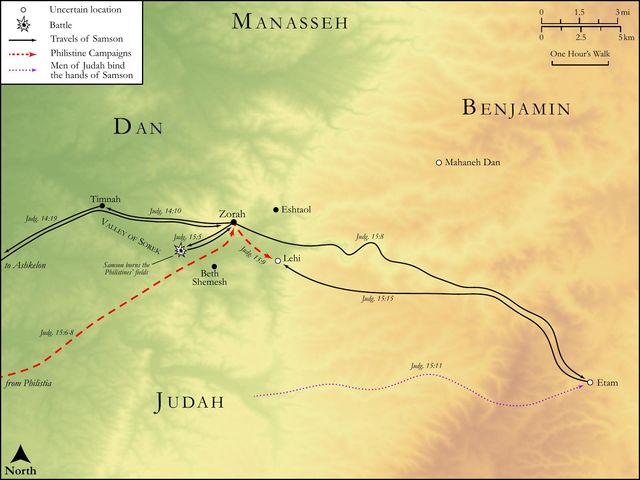
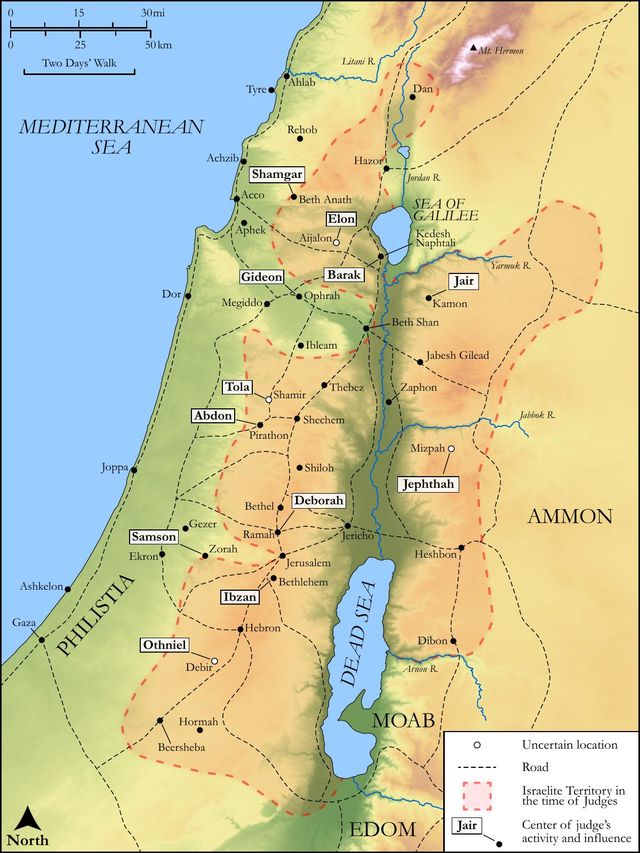
Study this verse
Public-domain commentary
Matthew Henry
From his Commentary on the Whole Bible. Henry comments on passages, not single verses — this entry covers Judges 14:1–9. His three-level outline is real structure in the source text, so it is rendered as structure.
Here, I. Samson, under the extraordinary guidance of Providence, seeks an occasion of quarrelling with the Philistines, by joining in affinity with them - a strange method, but the truth is Samson was himself a riddle, a paradox of a man, did that which was really great and good, by that which was seemingly weak and evil, because he was designed not to be a pattern to us (who must walk by rule, not by example), but a type of him who, though he knew no sin, was made sin for us, and appeared in the likeness of sinful flesh, that he might condemn and destroy sin in the flesh, Rom 8:3.
1.As the negotiation of Samson's marriage was a common case, we may observe,
(1.)That is was weakly and foolishly done of him to set his affections upon a daughter of the Philistines; the thing appeared very improper. Shall one that is not only an Israelite, but a Nazarite, devoted to the Lord, covet to become one with a worshipper of Dagon? Shall one marked for a patriot of his country match among those that are its sworn enemies? He saw this woman (Jdg 14:1), and she pleased him well, Jdg 14:3. It does not appear that he had any reason to think her wise or virtuous, or in any way likely to be a help-meet for him; but he saw something in her face that was very agreeable to his fancy, and therefore nothing will serve but she must be his wife. He that in the choice of a wife is guided only by his eye, and governed by his fancy, must afterwards thank himself if he find a Philistine in his arms.
(2.)Yet it was wisely and well done not to proceed so much as to make his addresses to her till he had first made his parents acquainted with the matter. He told them, and desired them to get her for him to wife, Jdg 14:2. Herein he is an example to all children. Conformably to the law of the fifth commandment, children ought not to marry, nor to move towards marrying, without the advice and consent of their parents; those that do (as bishop Hall here expresses it) wilfully unchild themselves, and exchange natural affections for violent. parents have a property in their children as parts of themselves. In marriage this property is transferred; for such is the law of the relation that a man shall leave his father and his mother and cleave to his wife. It is therefore not only unkind and ungrateful, but very unjust, to alienate this property without their concurrence; whoso thus robbeth his father or mother, stealing himself from them, who is nearer and dearer to them than their goods, and yet saith, It is no transgression, the same is the companion of a destroyer, Pro 28:24.
(3.)His parents did well to dissuade him from yoking himself thus unequally with unbelievers. Let those who profess religion, but are courting an affinity with the profane and irreligious, matching into families where they have reason to think the fear of God is not, nor the worship of God, let them hear their reasoning, and apply it to themselves: "Is there never a woman among the daughters of thy brethren, or, if none of our tribe, never a one among all thy people, never an Israelite, that pleases thee, or that thou canst think worthy of thy affection, that thou shouldest marry a Philistine?" In the old world the sons of God corrupted and ruined themselves, their families, and that truly primitive church, by marrying with the daughters of men, Gen 6:2. God had forbidden the people of Israel to marry with the devoted nations, one of which the Philistines were, Deu 7:3.
(4.)If there had not been a special reason for it, it certainly would have been improper in him to insist upon his choice, and in them to agree to it at last. Yet their tender compliance with his affections may be observed as an example to parents not to be unreasonable in crossing their children's choices, nor to deny their consent, especially to those that have seasonably and dutifully asked it, without some very good cause. As children must obey their parents in the Lord, so parents must not provoke their children to wrath, lest they be discouraged. This Nazarite, in his subjection to his parents, asking their consent, and not proceeding till he had it, was not only an example to all children, but a type of the holy child Jesus, who went down with his parents to Nazareth (thence called a Nazarene) and was subject to them, Luk 2:51.
2.But this treaty of marriage is expressly said to be of the Lord, Jdg 14:4. Not only that God afterwards overruled it to serve his designs against the Philistines, but that he put it into Samson's heart to make this choice, that he might have occasion against the Philistine. It was not a thing evil in itself for him to marry a Philistine. It was forbidden because of the danger of receiving hurt by idolaters; where there was not only no danger of that kind, but an opportunity hoped for of doing that hurt to them which would be good service to Israel, the law might well be dispense with. It was said (Jdg 13:25) that the Spirit of the Lord began to move him at times, and we have reason to think he himself perceived that Spirit to move him at this time, when he made this choice, and that otherwise he would have yielded to his parents' dissuasives, nor would they have consented at last if he had not satisfied them it was of the Lord. This would bring him into acquaintance and converse with the Philistines, by which he might have such opportunities of galling them as otherwise he could not have. It should seem, the way in which the Philistines oppressed Israel was, not by great armies, but by the clandestine incursions of their giants and small parties of their plunderers. In the same way therefore Samson must deal with them; let him but by this marriage get among them, and he would be a thorn in their sides. Jesus Christ, having to deliver us from this present evil world, and to cast out the prince of it, did himself visit it, though full of pollution and enmity, and, by assuming a body, did in some sense join in affinity with it, that he might destroy our spiritual enemies, and his own arm might work the salvation.
II.Samson, by a special providence, is animated and encouraged to attack the Philistines.
That being the service for which he was designed, God, when he called him to it, prepared him for it by two occurrences: -
1.By enabling him, in one journey to Timnath, to kill a lion, Jdg 14:5, Jdg 14:6. Many decline doing the service they might do because they know not their own strength. God let Samson know what he could do in the strength of the Spirit of the Lord, that he might never be afraid to look the greatest difficulties in the face. David, who was to complete the destruction of the Philistines, must try his hand first upon a lion and a bear, that thence he might infer, as we may suppose Samson did, that the uncircumcised Philistine should be as one of them, Sa1 17:36.
(1.)Samson's encounter with the lion was hazardous. It was a young lion, one of the fiercest sort, that set upon him, roaring for his prey, and setting his eye particularly upon him; he roared in meeting him, so the word is. He was all alone in the vineyards, whither he had rambled from his father and mother (who kept the high road), probably to eat grapes. Children consider not how they expose themselves to the roaring lion that seeks to devour when, out of a foolish fondness for liberty, they wander from under the eye and wing of their prudent pious parents. Nor do young people consider what lions lurk in the vineyards, the vineyards of red wines, as dangerous as snakes under the green grass. Had Samson met with this lion in the way, he might have had more reason to expect help both from God and man than here in the solitary vineyards, out of his road. But there was a special providence in it, and the more hazardous the encounter was,
(2.)The victory was so much the more illustrious. It was obtained without any difficulty: he strangled the lion, and tore his throat as easily as he would have strangled a kid, yet without any instrument, not only no sword nor bow, but not so much as a staff or knife; he had nothing in his hand. Christ engaged the roaring lion, and conquered him in the beginning of his public work (Mat 4:1, etc.), and afterwards spoiled principalities and powers, triumphing over them in himself, as some read it, not by any instrument. He was exalted in his own strength. That which added much to the glory of Samson's triumph over the lion was that when he had done this great exploit he did not boast of it, did not so much as tell his father nor mother that which many a one would soon have published through the whole country. Modesty and humility make up the brightest crown of great performances.
2.By providing him, the next journey, with honey in the carcase of this lion, Jdg 14:8, Jdg 14:9. When he came down the next time to solemnize his nuptials, and his parents with him, he had the curiosity to turn aside into the vineyard where he had killed the lion, perhaps that with the sight of the place he might affect himself with the mercy of that great deliverance, and might there solemnly give thanks to God for it. It is good thus to remind ourselves of God's former favours to us. There he found the carcase of the lion; the birds or beasts of prey, it is likely, had eaten the flesh, and in the skeleton a swarm of bees had knit, and made a hive of it, and had not been idle, but had there laid up a good stock of honey, which was one of the staple commodities of Canaan; such plenty there was of it that the land is said to flow with milk and honey. Samson, having a better title than any man to the hive, seizes the honey with his hands. This supposes an encounter with the bees; but he that dreaded not lion's paws had no reason to fear their stings. As by his victory over the lion he was emboldened to encounter the Philistine-giants, if there should be occasion, notwithstanding their strength and fierceness, so by dislodging the bees he was taught not to fear the multitude of the Philistines; though they compassed him about like bees, yet in the name of the Lord he should destroy them, Psa 118:12. Of the honey he here found,
(1.)He ate himself, asking no questions for conscience' sake; for the dead bones of an unclean beast had not that ceremonial pollution in them that the bones of a man had. John Baptist, that Nazarite of the New Testament, lived upon wild honey.
(2.)He gave to his parents, and they did eat; he did not eat all himself. Hast thou found honey? eat so much as is sufficient for thee, and no more, Pro 25:16. He let his parents share with him. Children should be grateful to their parents with the fruits of their own industry, and so show piety at home, Ti1 5:4. Let those that by the grace of God have found sweetness in religion themselves communicate their experience to their friends and relations, and invite them to come and share with them. He told not his parents whence he had it, lest they should scruple eating it. Bishop Hall observes here that those are less wise and more scrupulous than Samson that decline the use of God's gifts because they find them in ill vessels. Honey is hone still, though in a dead lion. Our Lord Jesus having conquered Satan, that roaring lion, believers find honey in the carcase, abundant strength and satisfaction, enough for themselves and for all their friends, from that victory.
Historical interpretation
Historical reception
1 surviving comment on this verse from the historical church.
Now Samson, approved by such signal tokens from above, turned his thoughts as soon as he grew up, to marriage; whether this was that he abhorred those vague and licentious desires in which young men are wont to indulge, or that he was seeking an occasion of releasing the necks of his countrymen from the power of the hard yoke of the Philistines. Wherefore going down to Timnath, (this is the name of a city situated in those parts where the Philistines then dwelt,) he beheld a maiden of a pleasing form and beautiful countenance, and he besought his parents, by whoso company he was supported in his journey, to ask her for him in marriage. But they, not knowing that his intention, either, if the Philistine refused her to him, to be more fierce against them, or, if they assented, to remove their disposition to injure their subjects; and since from such a connexion a certain equality and kindliness of intercourse would naturally grow, or, on the other hand, if any offence were given, this desire of revenge would be more vehement, deemed that this maiden ought to be avoided as a foreigner. But after they had vainly attempted to change the purpose of their son by urging upon him these lawful objections, they of their own accord acquiesced in his desire.
Continue studying Judges 14:1 across the web’s major study libraries — every link below opens this exact verse, chapter, or book on the destination site.
Read & Compare
 BibleGatewayThis verse in more than 200 translations and 70 languages.
 Bible.comThe YouVersion reader — hundreds of translations, reading plans, and highlights.
 ESV.orgCrossway's official English Standard Version reader.
 NET BibleThe NET translation with 60,000+ translators' notes on every rendering decision.
 STEP BibleTyndale House's free study tool — original text, vocabulary, and scholarly resources.
 BibliaLogos Bible Software's free web reader.
 USCCBThe New American Bible (Revised Edition) with the U.S. bishops' study notes.
Commentaries
 BibleHub CommentariesDozens of classic commentaries on this verse, gathered on one page.
 StudyLightMore than 100 commentary sets — the largest collection on the web.
 BibleRefPlain-English commentary on what this verse means, verse by verse.
 Enduring WordDavid Guzik's free commentary on this chapter, widely used by Bible teachers.
 Bible Study ToolsVerse commentary alongside Greek and Hebrew study aids.
Original Language & Research
- BibleHub InterlinearThe verse word by word — original language, transliteration, and English.
- BibleHub LexiconEvery word's original-language definition and Strong's entry.
 Blue Letter BibleDeep-study tools — Strong's numbers, concordance, and word studies.
 SefariaThe Hebrew text with Rashi and centuries of Jewish commentary.
Sermons, Hymns & Audio


TrulyRandomVerse is not affiliated with these sites and doesn’t control their content. They’re linked because they’re genuinely useful.
Summary
Judges 14:1 marks the commencement of Samson's active role as Israel's divinely appointed judge, detailing his journey to the Philistine city of Timnath where he encounters a woman who captures his attention. This seemingly personal choice, driven by immediate attraction, is presented as the initial catalyst in God's sovereign plan to instigate conflict and begin Israel's deliverance from oppressive Philistine rule, simultaneously highlighting the complex interplay between human desire and divine purpose.
Context
ShowHideLiterary Context
This verse immediately follows the miraculous annunciation of Samson's birth and his lifelong consecration as a Nazarite in Judges 13. The preceding chapter establishes Samson's unique divine calling: he is to "begin to deliver Israel out of the hand of the Philistines" (Judges 13:5). Judges 14:1, therefore, signifies Samson's first recorded independent action as an adult, initiating his public ministry, albeit in a highly unconventional manner. It sets the stage for a series of personal entanglements with Philistine women that, paradoxically, become the very means by which God orchestrates Samson's confrontations with Israel's oppressors, ultimately serving God's larger redemptive purpose, as explicitly stated in Judges 14:4. The subsequent narrative in Judges 14 details his marriage, the riddle, and the ensuing violent encounters that escalate the conflict.
Historical & Cultural Context
The period of the Judges (roughly 12th-11th centuries BC) was characterized by a recurring cycle of Israel's apostasy, subsequent oppression by foreign powers, their cry for deliverance, and God raising up a judge to save them. The Philistines, one of the "Sea Peoples" who had settled on the southwestern coastal plain of Canaan, were a dominant military and economic force, possessing superior iron technology. They posed a significant threat to Israel's security and religious purity. Timnath was a Philistine city located in the Shephelah, a region of foothills bordering both the Philistine plain and the Israelite tribal territories. Samson's "going down" from the hill country of Zorah to Timnath was a literal geographical descent. Culturally, intermarriage with foreign peoples, particularly those who worshiped other gods, was strictly forbidden by Mosaic Law (Deuteronomy 7:3-4). This prohibition was not primarily ethnic but theological, designed to prevent Israel's assimilation into idolatrous practices and preserve their unique covenant relationship with Yahweh. Samson's choice, therefore, immediately signals a potential compromise of his Nazarite vows and Israel's covenant identity.
Key Themes
ShowHideThis verse introduces several crucial themes that permeate the Samson narrative and the broader book of Judges. Firstly, it highlights the tension between Samson's personal desires and his divine calling. Samson's actions often appear driven by immediate gratification rather than a clear strategic plan for Israel's deliverance, yet God sovereignly orchestrates these seemingly flawed choices for His purposes. Secondly, it underscores divine sovereignty amidst human imperfection. While Samson's choice of a Philistine woman seems a clear violation of covenant law and personal consecration, Judges 14:4 explicitly states that "it was of the LORD, that he sought an occasion against the Philistines." This reveals God's ability to use even the wayward paths of His chosen instruments to advance His redemptive agenda. Lastly, the verse foreshadows the inevitable conflict between Israel and the Philistines. Samson's personal entanglements become the very means by which God instigates the confrontations necessary for Israel's deliverance, setting a pattern for his entire judgeship, a pattern that culminates in his final act of judgment against the Philistines in Judges 16:30.
Exposition and Analysis
ShowHideKey Word Analysis
ShowHideThis verb literally means "to descend" and is geographically accurate for travel from the hill country of Judah, where Samson's hometown of Zorah was located, to the lower Philistine plain where Timnath lay. However, in biblical narrative, "going down" can often carry a symbolic weight, hinting at a spiritual or moral descent, a movement towards compromise or trouble. In Samson's case, it subtly foreshadows his entanglement with foreign women and the challenges to his Nazarite vows that will characterize his story, ultimately leading to his spiritual and physical decline.
While a simple verb for physical sight, "saw" in biblical contexts often implies more than mere observation; it can denote a gaze that leads to desire, covetousness, and subsequent action. This is reminiscent of Eve "seeing" the forbidden fruit and desiring it (Genesis 3:6) or David "seeing" Bathsheba, which led to his sin (2 Samuel 11:2). Here, Samson's "seeing" is the initial spark of attraction that ignites his personal desire, setting him on a path that deviates from the expected conduct of a Nazarite judge.
This word, used in the phrase "daughters of the Philistines," is crucial as it immediately identifies the woman's ethnic and religious background. The Philistines were the primary oppressors of Israel at this time, and their polytheistic religion was anathema to Yahweh worship. The Mosaic Law explicitly prohibited intermarriage with such peoples to prevent spiritual assimilation and idolatry. Samson's attraction to a "daughter of the Philistines" is therefore not merely a personal preference but a direct challenge to the covenant stipulations and his own consecrated status, highlighting the profound spiritual danger inherent in his choice.
Verse Breakdown
ShowHide"And Samson went down to Timnath"
This clause establishes Samson's deliberate action and destination. His journey from the Israelite territory to a Philistine city signifies a crossing of boundaries, both geographical and, implicitly, spiritual. It marks the initiation of his active engagement with the Philistines, though not in the expected manner of a judge leading an army, but rather through personal pursuit.
"and saw a woman in Timnath"
This part of the verse reveals the immediate catalyst for Samson's presence and subsequent actions: a personal, visual attraction. The emphasis on "saw" suggests that his desire was initiated by sight, which is a recurring theme in the Samson narrative and a common human vulnerability that can lead to temptation and compromise.
"of the daughters of the Philistines"
This final phrase is the most significant, highlighting the problematic nature of Samson's attraction. It immediately identifies the woman as belonging to the very people Israel was commanded to remain separate from, and from whom Samson was specifically called to deliver his people. This detail sets up the central tension of Samson's story: his personal desires often leading him into compromising situations with the enemy, yet God sovereignly using these very entanglements to fulfill His larger purpose.
Literary Devices
ShowHideJudges 14:1 is rich in Foreshadowing, subtly hinting at the challenges and compromises Samson will face throughout his life. His "going down" to Timnath, while geographically accurate, also serves as a symbolic descent into moral and spiritual entanglement, predicting his future struggles with temptation and his ultimate capture. There is a strong element of Irony in this opening scene: Samson, consecrated from birth to deliver Israel from the Philistines, immediately seeks a relationship with one of them, rather than engaging in direct confrontation. This sets up a narrative pattern where Samson's personal failings become the unlikely instruments of God's judgment against the Philistines. The verse also employs Contrast, juxtaposing Samson's divine calling and Nazarite vows with his immediate, self-serving desire for a forbidden relationship. Finally, Symbolism is present in Timnath itself, which represents enemy territory and the allure of the world that threatens to compromise God's chosen people and their covenant faithfulness.
Theological and Thematic Connections
ShowHideJudges 14:1 serves as a profound theological statement on the interplay between human free will and divine sovereignty. While Samson's choice appears to be a personal, even disobedient, act driven by carnal desire, the subsequent narrative reveals that God was orchestrating these events for His redemptive purposes. This does not excuse Samson's choices, nor does it imply God condones sin; rather, it highlights God's immense power to work through imperfect vessels and even their failings to achieve His ultimate will. The verse underscores the constant tension between Israel's covenant obligations to remain separate and holy, and their recurring temptation to assimilate with the surrounding pagan nations. Samson's actions here reflect the broader spiritual condition of Israel during the period of the Judges, where "every man did that which was right in his own eyes" (Judges 21:25), often leading to compromise and suffering.
Reflection and Application
ShowHideSamson's initial encounter in Timnath offers a potent lesson for believers today. It reminds us that our choices, even those that seem purely personal or driven by natural attraction, can have profound spiritual and communal implications, particularly when they involve compromising our identity in Christ. Samson, called to be separate and holy, was drawn to the very people he was meant to oppose, illustrating the constant need for discernment in our relationships and pursuits. We are called to be "in the world but not of the world" (John 17:16), meaning we must navigate cultural influences with spiritual wisdom, ensuring our associations do not lead us away from God's commands or compromise our witness. While God's sovereignty means He can work through our imperfections and even our failures to accomplish His ultimate purposes, this truth should never be an excuse for intentional disobedience. Instead, it should inspire awe at His grace and power, and motivate us to pursue holiness, recognizing that every decision, big or small, contributes to the narrative of our lives and God's unfolding plan.
Questions for Reflection
ShowHideFAQ
ShowHideWhy was Samson's choice of a Philistine woman problematic according to biblical law?
ShowHideSamson's choice was problematic primarily because the Mosaic Law, given to Israel by God, explicitly prohibited intermarriage with foreign peoples, especially those who worshiped other gods (Deuteronomy 7:3-4). This command was not based on racial prejudice but on the spiritual danger of assimilation into idolatrous practices, which would lead Israel away from their covenant with Yahweh and compromise their distinct identity as God's chosen people. For Samson, a Nazarite from birth, this choice was a direct violation of the principles of separation and holiness that defined his calling.
Does Judges 14:4 imply that God approved of Samson's disobedient choice?
ShowHideNo, Judges 14:4 ("But his father and his mother knew not that it was of the LORD, that he sought an occasion against the Philistines") does not imply God approved of Samson's sin or disobedience. Instead, it highlights God's profound sovereignty and His ability to use even the flawed and disobedient choices of His people to accomplish His greater redemptive purposes. God did not cause Samson to desire a Philistine woman, but He sovereignly used that desire and the subsequent events as an "occasion" to initiate conflict with the Philistines, thereby beginning Israel's deliverance, as He had promised in Judges 13:5. It demonstrates God's power to work through human imperfection without condoning or endorsing sin.
What is the symbolic significance of "going down to Timnath"?
ShowHide"Going down to Timnath" has both a literal and a symbolic significance. Literally, Timnath was geographically lower than Samson's hometown of Zorah, so it describes a physical descent. Symbolically, however, it represents a spiritual or moral descent. Samson, a Nazarite consecrated to God, was moving into enemy territory, engaging with a forbidden people, and initiating a relationship that would compromise his vows and his sacred calling. This "going down" foreshadows the trajectory of Samson's life, marked by a series of compromises and entanglements that ultimately lead to his personal downfall, even as God uses these very events for His broader redemptive purposes.
Christ-Centered Fulfillment
ShowHideSamson, as a judge, was raised by God to begin Israel's deliverance from their oppressors, the Philistines. However, his story, beginning with his self-willed descent to Timnath, is marked by profound human weakness, compromise, and a tragic inability to fully embody the holiness of his Nazarite calling. He is a flawed deliverer, a type of Christ who ultimately points to a greater, perfect Savior. While Samson was entangled with the "daughters of the Philistines" and ultimately brought low by his own desires, Jesus Christ, the true and ultimate Judge and Deliverer, perfectly fulfilled the will of God, remaining untainted by sin despite being "tempted in every respect as we are, yet without sin" (Hebrews 4:15). Samson's strength was physical and often misused; Christ's strength is spiritual, moral, and redemptive, exercised in perfect obedience to the Father, even to the point of death on a cross (Philippians 2:8). Samson's confrontations with the Philistines were violent and personal; Christ's victory over the true enemies—sin, death, and the devil—was achieved through His self-sacrifice on the cross, where He disarmed the powers and authorities and "made a public spectacle of them, triumphing over them by the cross" (Colossians 2:15). Samson's life highlights the desperate need for a Deliverer who is not merely strong, but perfectly holy and obedient, one who truly takes away the sin of the world (John 1:29), a role perfectly fulfilled by Jesus Christ, our sinless and sovereign Redeemer.