


Judges 14:9
Bible text: King James Version (1769 Blayney text) · Public domain
Bible text: King James Version with Strong's numbers · Public domain
Bible text: Berean Standard Bible · Public domain
Bible text: American Standard Version (1901) · Public domain
Bible text: World English Bible, Messianic edition · Public domain
Bible text: Geneva Bible (1599) · Public domain
Bible text: Young's Literal Translation · Public domain
- וַיִּרְדֵּהוּvai·yir·De·huand he scraped out itH7287Conj-w ¦ V-Qal-ConsecImperf-3ms ¦ 3msVerb Qal Consecutive Imperfect 3rd Singular Masculineוַandיִּרְדֵּhe scraped outהוּit
- אֶל'elintoH413PrepPreposition
- כַּפָּיוka·Pavhis palmsH3709N-fdc ¦ 3msNoun Dual Feminine Constructכַּפָּיpalmsוhis
- וַיֵּלֶךְvai·Ye·lekhand he wentH1980Conj-w ¦ V-Qal-ConsecImperf-3msVerb Qal Consecutive Imperfect 3rd Singular Masculineוַandיֵּלֶךְhe went
- הָלוֹךְha·loKhcontinuously <to go>H1980V-Qal-InfAbsVerb Qal Infinitive Absolute
- וְאָכֹלve·'a·Kholand eatingH398Conj-w ¦ V-Qal-InfAbsVerb Qal Infinitive Absoluteוְandאָכֹלeating
- וַיֵּלֶךְvai·Ye·lekhand he cameH1980Conj-w ¦ V-Qal-ConsecImperf-3msVerb Qal Consecutive Imperfect 3rd Singular Masculineוַandיֵּלֶךְhe came
- אֶל'eltoH413PrepPreposition
- אָבִיו'a·Vivhis fatherH1N-msc ¦ 3msNoun Singular Masculine Constructאָבִיfatherוhis
- וְאֶלve·'eland toH413Conj-w ¦ PrepPrepositionוְandאֶלto
- אִמּוֹ'i·Mohis motherH517N-fsc ¦ 3msNoun Singular Feminine Constructאִמּmotherוֹhis
- וַיִּתֵּןvai·yi·Tenand he gaveH5414Conj-w ¦ V-Qal-ConsecImperf-3msVerb Qal Consecutive Imperfect 3rd Singular Masculineוַandיִּתֵּןhe gave
- לָהֶםla·Hemto <the> themPrep-l ¦ 3mpSuffix Personal 3rd Plural Masculineלָto <the>הֶםthem
- וַיֹּאכֵלוּvai·yo·Khe·luand they ateH398Conj-w ¦ V-Qal-ConsecImperf-3mpVerb Qal Consecutive Imperfect 3rd Plural Masculineוַandיֹּאכֵלוּthey ate
- וְלֹאve·lo'and notH3808Conj-w ¦ NegParticle Negativeוְandלֹאnot
- הִגִּידhi·Gidhe toldH5046V-Hiphil-Perf-3msVerb Hiphil Perfect 3rd Singular Masculine
- לָהֶםla·Hemto <the> themPrep-l ¦ 3mpSuffix Personal 3rd Plural Masculineלָto <the>הֶםthem
- כִּיkithatH3588PrtParticle Conditional
- מִגְּוִיַּתmi·ge·vi·Yatfrom [the] carcass ofH1472Prep-m ¦ N-fscNoun Singular Feminine Constructמִfromגְּוִיַּת[the] carcass of
- הָאַרְיֵהha·'ar·Yehthe lionH738Art ¦ N-msNoun Singular Masculine Absoluteהָtheאַרְיֵהlion
- רָדָהra·Dahhe had scraped outH7287V-Qal-Perf-3msVerb Qal Perfect 3rd Singular Masculine
- הַדְּבָשׁha·de·Vashthe honeyH1706Art ¦ N-msNoun Singular Masculine Absoluteהַtheדְּבָשׁhoney
English is a literal word-by-word gloss of the Hebrew, not the KJV's wording. Why?
This is the original text the KJV's translators worked from — each Hebrew word with its own literal English meaning in this verse, prepared by scholars at Tyndale House, Cambridge. The KJV translates whole sentences, not word by word, so its wording differs: one Hebrew word can become several English words, and the KJV may choose “the LORD” where the gloss reads “Yahweh”. Both are faithful — they answer different questions. For the KJV's own rendering, switch to the KJV text.
Details
See on the biblical-era maps
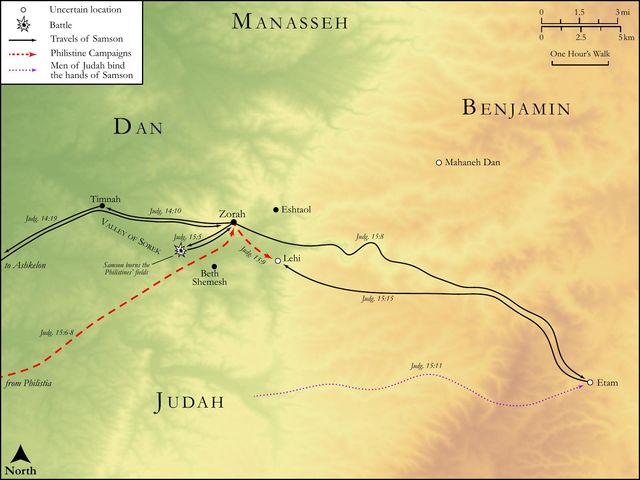
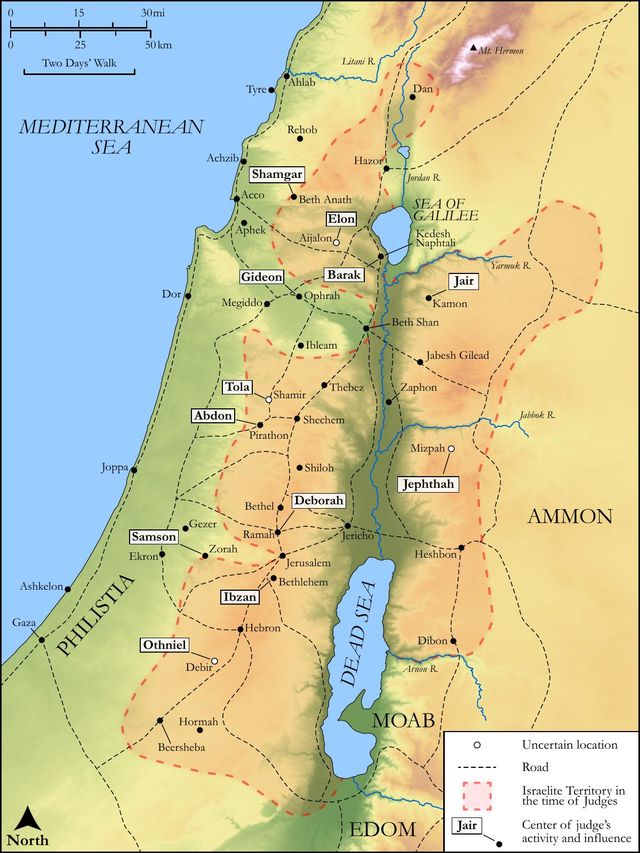
Study this verse
Public-domain commentary
Matthew Henry
From his Commentary on the Whole Bible. Henry comments on passages, not single verses — this entry covers Judges 14:1–9. His three-level outline is real structure in the source text, so it is rendered as structure.
Here, I. Samson, under the extraordinary guidance of Providence, seeks an occasion of quarrelling with the Philistines, by joining in affinity with them - a strange method, but the truth is Samson was himself a riddle, a paradox of a man, did that which was really great and good, by that which was seemingly weak and evil, because he was designed not to be a pattern to us (who must walk by rule, not by example), but a type of him who, though he knew no sin, was made sin for us, and appeared in the likeness of sinful flesh, that he might condemn and destroy sin in the flesh, Rom 8:3.
1.As the negotiation of Samson's marriage was a common case, we may observe,
(1.)That is was weakly and foolishly done of him to set his affections upon a daughter of the Philistines; the thing appeared very improper. Shall one that is not only an Israelite, but a Nazarite, devoted to the Lord, covet to become one with a worshipper of Dagon? Shall one marked for a patriot of his country match among those that are its sworn enemies? He saw this woman (Jdg 14:1), and she pleased him well, Jdg 14:3. It does not appear that he had any reason to think her wise or virtuous, or in any way likely to be a help-meet for him; but he saw something in her face that was very agreeable to his fancy, and therefore nothing will serve but she must be his wife. He that in the choice of a wife is guided only by his eye, and governed by his fancy, must afterwards thank himself if he find a Philistine in his arms.
(2.)Yet it was wisely and well done not to proceed so much as to make his addresses to her till he had first made his parents acquainted with the matter. He told them, and desired them to get her for him to wife, Jdg 14:2. Herein he is an example to all children. Conformably to the law of the fifth commandment, children ought not to marry, nor to move towards marrying, without the advice and consent of their parents; those that do (as bishop Hall here expresses it) wilfully unchild themselves, and exchange natural affections for violent. parents have a property in their children as parts of themselves. In marriage this property is transferred; for such is the law of the relation that a man shall leave his father and his mother and cleave to his wife. It is therefore not only unkind and ungrateful, but very unjust, to alienate this property without their concurrence; whoso thus robbeth his father or mother, stealing himself from them, who is nearer and dearer to them than their goods, and yet saith, It is no transgression, the same is the companion of a destroyer, Pro 28:24.
(3.)His parents did well to dissuade him from yoking himself thus unequally with unbelievers. Let those who profess religion, but are courting an affinity with the profane and irreligious, matching into families where they have reason to think the fear of God is not, nor the worship of God, let them hear their reasoning, and apply it to themselves: "Is there never a woman among the daughters of thy brethren, or, if none of our tribe, never a one among all thy people, never an Israelite, that pleases thee, or that thou canst think worthy of thy affection, that thou shouldest marry a Philistine?" In the old world the sons of God corrupted and ruined themselves, their families, and that truly primitive church, by marrying with the daughters of men, Gen 6:2. God had forbidden the people of Israel to marry with the devoted nations, one of which the Philistines were, Deu 7:3.
(4.)If there had not been a special reason for it, it certainly would have been improper in him to insist upon his choice, and in them to agree to it at last. Yet their tender compliance with his affections may be observed as an example to parents not to be unreasonable in crossing their children's choices, nor to deny their consent, especially to those that have seasonably and dutifully asked it, without some very good cause. As children must obey their parents in the Lord, so parents must not provoke their children to wrath, lest they be discouraged. This Nazarite, in his subjection to his parents, asking their consent, and not proceeding till he had it, was not only an example to all children, but a type of the holy child Jesus, who went down with his parents to Nazareth (thence called a Nazarene) and was subject to them, Luk 2:51.
2.But this treaty of marriage is expressly said to be of the Lord, Jdg 14:4. Not only that God afterwards overruled it to serve his designs against the Philistines, but that he put it into Samson's heart to make this choice, that he might have occasion against the Philistine. It was not a thing evil in itself for him to marry a Philistine. It was forbidden because of the danger of receiving hurt by idolaters; where there was not only no danger of that kind, but an opportunity hoped for of doing that hurt to them which would be good service to Israel, the law might well be dispense with. It was said (Jdg 13:25) that the Spirit of the Lord began to move him at times, and we have reason to think he himself perceived that Spirit to move him at this time, when he made this choice, and that otherwise he would have yielded to his parents' dissuasives, nor would they have consented at last if he had not satisfied them it was of the Lord. This would bring him into acquaintance and converse with the Philistines, by which he might have such opportunities of galling them as otherwise he could not have. It should seem, the way in which the Philistines oppressed Israel was, not by great armies, but by the clandestine incursions of their giants and small parties of their plunderers. In the same way therefore Samson must deal with them; let him but by this marriage get among them, and he would be a thorn in their sides. Jesus Christ, having to deliver us from this present evil world, and to cast out the prince of it, did himself visit it, though full of pollution and enmity, and, by assuming a body, did in some sense join in affinity with it, that he might destroy our spiritual enemies, and his own arm might work the salvation.
II.Samson, by a special providence, is animated and encouraged to attack the Philistines.
That being the service for which he was designed, God, when he called him to it, prepared him for it by two occurrences: -
1.By enabling him, in one journey to Timnath, to kill a lion, Jdg 14:5, Jdg 14:6. Many decline doing the service they might do because they know not their own strength. God let Samson know what he could do in the strength of the Spirit of the Lord, that he might never be afraid to look the greatest difficulties in the face. David, who was to complete the destruction of the Philistines, must try his hand first upon a lion and a bear, that thence he might infer, as we may suppose Samson did, that the uncircumcised Philistine should be as one of them, Sa1 17:36.
(1.)Samson's encounter with the lion was hazardous. It was a young lion, one of the fiercest sort, that set upon him, roaring for his prey, and setting his eye particularly upon him; he roared in meeting him, so the word is. He was all alone in the vineyards, whither he had rambled from his father and mother (who kept the high road), probably to eat grapes. Children consider not how they expose themselves to the roaring lion that seeks to devour when, out of a foolish fondness for liberty, they wander from under the eye and wing of their prudent pious parents. Nor do young people consider what lions lurk in the vineyards, the vineyards of red wines, as dangerous as snakes under the green grass. Had Samson met with this lion in the way, he might have had more reason to expect help both from God and man than here in the solitary vineyards, out of his road. But there was a special providence in it, and the more hazardous the encounter was,
(2.)The victory was so much the more illustrious. It was obtained without any difficulty: he strangled the lion, and tore his throat as easily as he would have strangled a kid, yet without any instrument, not only no sword nor bow, but not so much as a staff or knife; he had nothing in his hand. Christ engaged the roaring lion, and conquered him in the beginning of his public work (Mat 4:1, etc.), and afterwards spoiled principalities and powers, triumphing over them in himself, as some read it, not by any instrument. He was exalted in his own strength. That which added much to the glory of Samson's triumph over the lion was that when he had done this great exploit he did not boast of it, did not so much as tell his father nor mother that which many a one would soon have published through the whole country. Modesty and humility make up the brightest crown of great performances.
2.By providing him, the next journey, with honey in the carcase of this lion, Jdg 14:8, Jdg 14:9. When he came down the next time to solemnize his nuptials, and his parents with him, he had the curiosity to turn aside into the vineyard where he had killed the lion, perhaps that with the sight of the place he might affect himself with the mercy of that great deliverance, and might there solemnly give thanks to God for it. It is good thus to remind ourselves of God's former favours to us. There he found the carcase of the lion; the birds or beasts of prey, it is likely, had eaten the flesh, and in the skeleton a swarm of bees had knit, and made a hive of it, and had not been idle, but had there laid up a good stock of honey, which was one of the staple commodities of Canaan; such plenty there was of it that the land is said to flow with milk and honey. Samson, having a better title than any man to the hive, seizes the honey with his hands. This supposes an encounter with the bees; but he that dreaded not lion's paws had no reason to fear their stings. As by his victory over the lion he was emboldened to encounter the Philistine-giants, if there should be occasion, notwithstanding their strength and fierceness, so by dislodging the bees he was taught not to fear the multitude of the Philistines; though they compassed him about like bees, yet in the name of the Lord he should destroy them, Psa 118:12. Of the honey he here found,
(1.)He ate himself, asking no questions for conscience' sake; for the dead bones of an unclean beast had not that ceremonial pollution in them that the bones of a man had. John Baptist, that Nazarite of the New Testament, lived upon wild honey.
(2.)He gave to his parents, and they did eat; he did not eat all himself. Hast thou found honey? eat so much as is sufficient for thee, and no more, Pro 25:16. He let his parents share with him. Children should be grateful to their parents with the fruits of their own industry, and so show piety at home, Ti1 5:4. Let those that by the grace of God have found sweetness in religion themselves communicate their experience to their friends and relations, and invite them to come and share with them. He told not his parents whence he had it, lest they should scruple eating it. Bishop Hall observes here that those are less wise and more scrupulous than Samson that decline the use of God's gifts because they find them in ill vessels. Honey is hone still, though in a dead lion. Our Lord Jesus having conquered Satan, that roaring lion, believers find honey in the carcase, abundant strength and satisfaction, enough for themselves and for all their friends, from that victory.
Historical interpretation
Historical reception
2 surviving comments on this verse. Each one is dated, so this reads as a timeline rather than a list.
Select a marker to jump to its quote. Markers stagger vertically where authors wrote within a few decades of each other.
This request was granted; and Samson on his return to visit his promised bride, turned a little way out of the road, and straightway there met him a lion from the wood, fierce in its savage freedom. Samson had no companion, nor any weapon in his hand; but he felt ashamed to fly, and conscious power gave him courage. He caught the lion as it rushed upon him in his arms, and strangled it by the tightness of his embrace, leaving it near the wayside lying upon the underwood, for the spot was clothed with luxuriant herbage, and planted with vineyards. The skin of the beast he thought would be little esteemed by his beloved bride, for seasons such as these derive their grace not from savage trophies, but rather from gentle joys and festal garlands. On his returning by the same road he found an honeycomb in the belly of the lion, and carried it off as a gift to the maiden and her parents; for such gifts befit a bride. And having first tasted the honey, he gave them the comb to eat, but was silent as to whence it came.
Many of the fathers have spoken a great deal about this lion, beloved brothers, and all of them have said what is fitting and in accord with the facts. Some have said that the lion prefigured Christ our Lord. Truly, this is very appropriate, for to us Christ is a lion in whose mouth we found the food of honey after his death. What is sweeter than the Word of God? Or what is stronger than his right hand? In whose mouth after death is there food and bees, except his in whose word is the good of our salvation and the congregation of the Gentiles? The lion can further be understood as the Gentiles who believed. First, it was a body of vanity, but is now the body of Christ in which the apostles like bees stored the honey of wisdom gathered from the dew of heaven and the flowers of divine grace. Thus, food came out of the mouth of the one who died; because nations which were as fierce as lions at first, accepted with a devout heart the word of God which they received and produced the fruit of salvation.
Continue studying Judges 14:9 across the web’s major study libraries — every link below opens this exact verse, chapter, or book on the destination site.
Read & Compare
 BibleGatewayThis verse in more than 200 translations and 70 languages.
 Bible.comThe YouVersion reader — hundreds of translations, reading plans, and highlights.
 ESV.orgCrossway's official English Standard Version reader.
 NET BibleThe NET translation with 60,000+ translators' notes on every rendering decision.
 STEP BibleTyndale House's free study tool — original text, vocabulary, and scholarly resources.
 BibliaLogos Bible Software's free web reader.
 USCCBThe New American Bible (Revised Edition) with the U.S. bishops' study notes.
Commentaries
 BibleHub CommentariesDozens of classic commentaries on this verse, gathered on one page.
 StudyLightMore than 100 commentary sets — the largest collection on the web.
 BibleRefPlain-English commentary on what this verse means, verse by verse.
 Enduring WordDavid Guzik's free commentary on this chapter, widely used by Bible teachers.
 Bible Study ToolsVerse commentary alongside Greek and Hebrew study aids.
Original Language & Research
- BibleHub InterlinearThe verse word by word — original language, transliteration, and English.
- BibleHub LexiconEvery word's original-language definition and Strong's entry.
 Blue Letter BibleDeep-study tools — Strong's numbers, concordance, and word studies.
 SefariaThe Hebrew text with Rashi and centuries of Jewish commentary.
Sermons, Hymns & Audio


TrulyRandomVerse is not affiliated with these sites and doesn’t control their content. They’re linked because they’re genuinely useful.
Summary
Judges 14:9 recounts a pivotal moment in Samson's narrative, detailing his discovery of honey within the carcass of the lion he had previously killed. He consumed the honey himself and then shared it with his parents, deliberately concealing its ritually unclean origin. This act of indulgence and deception represents a significant violation of his Nazirite vow and foreshadows a recurring pattern of compromise and secrecy that would ultimately define his tragic trajectory, highlighting the insidious nature of hidden sin.
Context
ShowHideLiterary Context
Judges 14:9 is situated within the broader narrative of Samson's journey to Timnath, where he seeks a Philistine wife. This union, though unconventional, is presented as being orchestrated by the Lord for His purposes (Judges 14:4). The immediate preceding events describe Samson's initial encounter with a young lion, which he miraculously tore apart through the empowerment of the Spirit of the Lord (Judges 14:5-6). Upon his return journey, Samson deviates from his path to inspect the lion's carcass, where he discovers the beehive. This verse directly sets the stage for Samson's famous riddle, "Out of the eater came something to eat; out of the strong came something sweet," which he poses at his wedding feast, drawing directly from this hidden incident (Judges 14:14). The sequence of events underscores Samson's impulsive nature and his growing disregard for the sacred boundaries of his Nazirite consecration, laying the groundwork for his subsequent, more severe transgressions.
Historical & Cultural Context
Samson was consecrated as a Nazirite from birth, a special vow outlined in Numbers 6. This vow imposed specific prohibitions, including abstaining from grape products, not cutting one's hair, and, most pertinent to this passage, avoiding any contact with dead bodies, whether human or animal (Numbers 6:6). In ancient Israelite culture, contact with a carcass rendered a person ritually unclean, necessitating a period of purification (Leviticus 11:24-28). Samson's actions in Judges 14:9 involved not only touching the dead lion but also consuming from it and then sharing it, potentially defiling his parents as well, albeit unknowingly. This demonstrates a blatant disregard for the purity laws central to Israelite covenantal living and his unique divine calling, reflecting a broader pattern of moral decay during the period of the Judges.
Key Themes
ShowHideThis verse powerfully contributes to several overarching themes within the book of Judges and Samson's personal narrative. Firstly, it highlights the violation of sacred vows and the progressive erosion of Samson's Nazirite consecration. His initial act of tearing the lion, though Spirit-empowered, already involved contact with a carcass, but this verse adds a layer of deliberate consumption and concealment, demonstrating a deepening spiritual compromise. Secondly, it introduces and reinforces the pervasive theme of deception and secrecy, a pattern that tragically culminates in his betrayal by Delilah (Judges 16:17-19). Samson's unwillingness to disclose the honey's origin strongly suggests an awareness of his wrongdoing and a desire to hide it. Thirdly, the incident underscores the profound irony of Samson's life: immense physical strength juxtaposed with profound spiritual weakness and self-indulgence. The "sweetness from strength" motif, later central to his riddle, ironically foreshadows how his personal desires and compromises would lead to his eventual downfall, despite his divine gifting (Judges 16:20-21).
Exposition and Analysis
ShowHideKey Word Analysis
ShowHideThis primitive root primarily means "to tread down" or "subjugate," but also extends to "take" or "have dominion." In this context, it signifies Samson's active and deliberate act of reaching into the carcass and taking the honey. The choice of this verb might subtly imply a forceful or domineering acquisition, even over something forbidden, hinting at Samson's tendency to assert his will without regard for divine boundaries.
This noun specifically refers to a "dead body" or "corpse," whether human or animal. Its use here explicitly emphasizes the ritually unclean nature of the source of the honey. The presence of honey in such a place is unusual, and Samson's act of taking and eating from this "dead body" constitutes a clear and conscious violation of his Nazirite vow and the broader purity laws of Israel.
This primitive root means "to front," "stand boldly out," or "to manifest" by word of mouth, "to announce" or "declare." The KJV translates "told not," indicating that Samson actively failed to declare or manifest the truth. This emphasizes the deliberate nature of his concealment; it was not merely an omission but a conscious choice to withhold information, suggesting his awareness that his actions were problematic or forbidden, and his desire to avoid accountability.
Verse Breakdown
ShowHide"And he took thereof in his hands, and went on eating"
This clause vividly describes Samson's direct and personal engagement with the forbidden honey. The phrase "in his hands" emphasizes his physical contact with the unclean carcass, a direct violation of his Nazirite vow. "Went on eating" suggests not just a taste but a sustained consumption, indicating indulgence and a lack of immediate remorse or recognition of the severity of his transgression. It highlights his self-gratification over his consecrated status.
"and came to his father and mother, and he gave them, and they did eat"
Samson extends his defilement to his parents by sharing the honey with them. While they were unaware of its source, his act implicates them in his ritual uncleanness. This highlights the communal impact of individual sin, especially when committed by someone in a position of spiritual leadership or unique consecration. It also demonstrates a lack of protective care for his parents' spiritual purity, prioritizing his own convenience or desire to share the "sweet" find.
"but he told not them that he had taken the honey out of the carcase of the lion"
This final, crucial clause reveals Samson's deliberate deception. His silence is not innocent but a conscious act of concealment. This secrecy underscores his awareness of the honey's illicit origin and his desire to hide his transgression. It marks a significant moral lapse, indicating a growing pattern of self-will and disregard for divine commands, setting a dangerous precedent for future deceptions that would prove far more costly and ultimately lead to his downfall.
Literary Devices
ShowHideJudges 14:9 is rich in Irony. Samson, consecrated from birth with immense strength and set apart for God's purposes, uses that strength to kill a lion, only to then defile himself by taking honey from its carcass. The "sweetness" of the honey comes from a source of "death" and ritual impurity, ironically mirroring how Samson's strength, meant for God's purposes, would be consistently compromised by his own self-indulgence and moral weakness. This incident also serves as potent Foreshadowing. Samson's initial act of disobedience and secrecy here sets a pattern for his character. His later struggles with truth-telling, particularly with Delilah, directly echo this early concealment, demonstrating a consistent flaw. The "honey from the lion" becomes a powerful Symbol of illicit gain or pleasure derived from a forbidden source, tempting and seemingly beneficial but ultimately leading to spiritual compromise and downfall. The narrative subtly employs Contrast between Samson's divine empowerment (tearing the lion apart) and his human weakness (succumbing to temptation and deceit).
Theological and Thematic Connections
ShowHideJudges 14:9 serves as a profound theological statement on the nature of consecration, the insidious power of secret sin, and the far-reaching consequences of disobedience. Samson's Nazirite vow was a visible sign of his total dedication to God, a dedication that required strict adherence to specific prohibitions, particularly concerning ritual purity. His deliberate violation, coupled with active concealment, reveals a heart increasingly detached from the spirit of his vow, prioritizing personal gratification over divine command. This act, though seemingly minor, encapsulates the broader theme of Israel's spiritual decline during the period of the Judges, where "everyone did what was right in his own eyes" (Judges 21:25). It underscores that true holiness is not merely about outward acts but about the purity of the heart and the integrity of one's walk before God, even in secret, for unconfessed sin creates a barrier between the individual and God.
Reflection and Application
ShowHideSamson's actions in Judges 14:9 offer a sobering mirror for contemporary believers, illustrating the insidious nature of compromise and the gradual erosion of spiritual integrity. His secret sin with the honey, though seemingly small, was a significant breach of his sacred vow and a precursor to greater moral failings. It reminds us that our spiritual health is not solely determined by public displays of faith, but profoundly shaped by our private choices and hidden compromises. The temptation to indulge in what is forbidden, especially when we believe no one is watching, can subtly desensitize our conscience and lead us down a path of increasing disobedience. This passage calls us to a life of radical transparency and unwavering commitment to God's standards, recognizing that even seemingly minor deviations can have far-reaching spiritual consequences, affecting not only ourselves but also those within our sphere of influence. True freedom and strength come not from bending the rules, but from wholeheartedly embracing and upholding God's righteous commands, understanding that genuine spiritual power flows from purity and obedience, not from compromise.
Questions for Reflection
ShowHideFAQ
ShowHideWas Samson's Nazirite vow truly broken by touching the lion's carcass, or only by eating from it?
ShowHideSamson's Nazirite vow, as detailed in Numbers 6:6, explicitly prohibited contact with any dead body, whether human or animal. Therefore, the very act of touching the lion's carcass, even to tear it apart (as in Judges 14:6), constituted a violation of his vow. His subsequent act of taking and eating the honey from the carcass, as described in Judges 14:9, compounded this transgression by adding consumption of an unclean substance and deliberate concealment. So, the vow was broken by the initial contact and further violated by the consumption and secrecy.
Why was honey from a dead animal considered unclean?
ShowHideAccording to Mosaic law, any contact with a dead body, especially an animal carcass, rendered a person ritually unclean (Leviticus 11:24-28). While honey itself was a clean food, its source in this instance—a decaying lion's carcass—made it ritually impure. The impurity of the carcass would transfer to anything that came into contact with it. Samson's act was not merely about eating honey, but about consuming something that had been defiled by its association with death, directly violating the purity standards for a Nazirite and for any Israelite.
Why did Samson hide the source of the honey from his parents?
ShowHideSamson's concealment ("but he told not them") strongly suggests an awareness that his actions were wrong or forbidden. He likely knew that touching a carcass and eating from it violated his Nazirite vow and the purity laws, and that sharing such a defiled substance would also render his parents unclean. His secrecy was an attempt to avoid accountability, maintain a facade of innocence, or prevent his parents from knowingly partaking in his transgression. This act of deception foreshadows his later pattern of withholding truth, particularly from Delilah, which ultimately led to his downfall (Judges 16:17).
Christ-Centered Fulfillment
ShowHideSamson's story, marked by a sacred calling tragically undermined by self-indulgence and broken vows, powerfully contrasts with the perfect obedience and purity of Jesus Christ. Samson, consecrated from birth, repeatedly defiled himself, culminating in the secret consumption of honey from a carcass in Judges 14:9. This act of impurity and deception stands in stark opposition to Christ, who was "holy, innocent, unstained, separated from sinners" (Hebrews 7:26). While Samson's strength was compromised by his sin, Jesus, the true "stronger one" (Mark 1:7), perfectly upheld God's law, never succumbing to temptation or defilement. He is the Lamb of God who truly takes away the sin of the world, not by partaking in uncleanness, but by becoming sin for us, though He knew no sin, that we might become the righteousness of God in Him (2 Corinthians 5:21). The "sweetness from strength" that Samson found in forbidden honey finds its ultimate, pure fulfillment in Christ's victory over death; from the "carcass" of His crucifixion came the "honey" of eternal life and resurrection power, freely given to all who believe, without any defilement or hidden cost (Romans 6:4; 1 Corinthians 15:54-57).