


1 Samuel 14:30
Bible text: King James Version (1769 Blayney text) · Public domain
Bible text: King James Version with Strong's numbers · Public domain
Bible text: Berean Standard Bible · Public domain
Bible text: American Standard Version (1901) · Public domain
Bible text: World English Bible, Messianic edition · Public domain
Bible text: Geneva Bible (1599) · Public domain
Bible text: Young's Literal Translation · Public domain
- אַף'Afindeed?H637PrtParticle Interjection
- כִּיkiforH3588PrtParticle Conditional
- לוּאlu'<if>H3863ConjConjunction
- אָכֹל'a·Kholcertainly [if] <to eat>H398V-Qal-InfAbsVerb Qal Infinitive Absolute
- אָכַל'a·Khalit had eatenH398V-Qal-Perf-3msVerb Qal Perfect 3rd Singular Masculine
- הַיּוֹםhai·yOmthis dayH3117Art ¦ N-msNoun Singular Masculine Absoluteהַthisיּוֹםday
- הָעָםha·'Amthe peopleH5971Art ¦ N-msNoun Singular Masculine Absoluteהָtheעָםpeople
- מִשְּׁלַלmi·she·Lalany of [the] plunder ofH7998Prep-m ¦ N-mscNoun Singular Masculine Constructמִany ofשְּׁלַל[the] plunder of
- אֹיְבָיו'o·ye·Vavits enemiesH341V-Qal-Prtcpl-mp ¦ 3msVerb Qal Participle Plural Masculine Constructאֹיְבָיenemiesוits
- אֲשֶׁר'a·SherwhichH834RelParticle Relative
- מָצָאma·Tza'it foundH4672V-Qal-Perf-3msVerb Qal Perfect 3rd Singular Masculine
- כִּיkiforH3588PrtParticle Conditional
- עַתָּה'a·TahnowH6258AdvAdverb
- לֹאlo'notH3808NegParticle Negative
- רָבְתָהra·ve·Tahit has been greatH7235V-Qal-Perf-3fsVerb Qal Perfect 3rd Singular Feminine
- מַכָּהma·KahdefeatH4347N-fsNoun Singular Feminine Absolute
- בַּפְּלִשְׁתִּיםba·pe·lish·Timamong the PhilistinesH6430Prep-b ¦ N-mpNoun Gentilic Plural Masculine Absoluteבַּamong theפְּלִשְׁתִּיםPhilistines
English is a literal word-by-word gloss of the Hebrew, not the KJV's wording. Why?
This is the original text the KJV's translators worked from — each Hebrew word with its own literal English meaning in this verse, prepared by scholars at Tyndale House, Cambridge. The KJV translates whole sentences, not word by word, so its wording differs: one Hebrew word can become several English words, and the KJV may choose “the LORD” where the gloss reads “Yahweh”. Both are faithful — they answer different questions. For the KJV's own rendering, switch to the KJV text.
Details
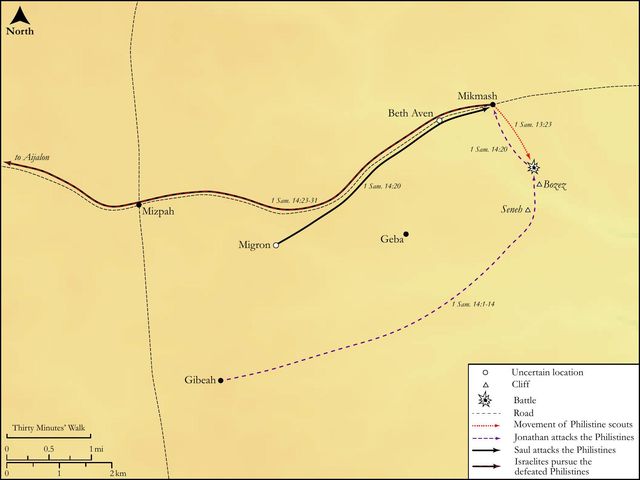
See on the biblical-era map
Study this verse
Public-domain commentary
Matthew Henry
From his Commentary on the Whole Bible. Henry comments on passages, not single verses — this entry covers 1 Samuel 14:24–35. His three-level outline is real structure in the source text, so it is rendered as structure.
We have here an account of the distress of the children of Israel, even in the day of their triumphs. Such alloys are all present joys subject to. And such obstructions does many a good cause meet with, even when it seems most prosperous, through the mismanagement of instruments.
I.Saul forbade the people, under the penalty of a curse, to taste any food that day, Sa1 14:24. Here we will suppose,
1.That as king he had power to put his soldiers under this interdict, and to bind it on with a curse; and therefore they submitted to it, and God so far owned it as to discover, by the lot, that Jonathan was the delinquent that had meddled with the accursed thing (though ignorantly), on which account God would not be at that time enquired of by them.
2.That he did it with a good intention, lest the people, who perhaps had been kept for some time at short allowance, when they found plenty of victuals in the deserted camp of the Philistines, should fall greedily upon that, and so lose time in pursing the enemy, and some of them, it may be, glut themselves to such a degree as not to be fit for any more service that day. To prevent this, he forbade them to taste any food, and laid himself, it is likely, under the same restraint. And yet his making this severe order was,
(1.)Impolitic and very unwise; for, if it gained time, it lost strength, for the pursuit.
(2.)It was imperious, and disobliging to the people, and worse than muzzling the mouth of the ox when he treads out the corn. To forbid them to feast would have been commendable, but to forbid them so much as to taste, though ever so hungry, was barbarous.
(3.)It was impious to enforce the prohibition with a curse and an oath. Had he no penalty less than an anathema wherewith to support his military discipline? Death for such a crime would have been too much, but especially death with a curse. Though superiors may chide and correct, they may not curse their inferiors; our rule is, Bless, and curse not. When David speaks of an enemy he had that loved cursing perhaps he meant Saul, Psa 109:17, Psa 109:18.
II.The people observed his order, but it had many inconveniences attending it.
1.The soldiers were tantalized; for, in their pursuit of the enemy, it happened that they went through a wood so full of wild honey that it dropped from the trees upon the ground, the Philistines having perhaps, in their flight, broken in upon the honeycombs, for their own refreshment, and left them running. Canaan flowed with honey, and here is an instance of it. They sucked honey out of the rock, the flinty rock (Deu 32:13); yet, for fear of the curse, they did not so much as taste the honey, Sa1 14:25, Sa1 14:26. Those are worthy of the name of Israelites that can deny themselves and their own appetites even when they are most craving, and the delights of sense most tempting, for fear of guilt and a curse, and the table becoming a snare. Let us never feed ourselves, much less feast ourselves, without fear.
2.Jonathan fell under the curse through ignorance. He heard not of the charge his father had given; for, having bravely forced the lines, he was then following the chase, and therefore might justly be looked upon as exempted from the charge and intended in it. But it seems it was taken for granted, and he himself did not object against it afterwards, that it extended to him, though absent upon so good an occasion. He, not knowing any peril in it, took up a piece of a honey-comb, upon the end of his staff, and sucked it (Sa1 14:27), and was sensibly refreshed by it: His eyes were enlightened, which began to grow dim through hunger and faintness; it made his countenance look pleasant and cheerful, for it was such as a stander-by might discern (Sa1 14:29): See how my eyes have been enlightened. He thought no harm, nor feared any, till one of the people acquainted him with the order, and then he found himself in a snare. Many a good son has been thus entangled and distressed, in more ways than one, by the rashness of an inconsiderate father. Jonathan, for his part, lost the crown he was heir to by his father's folly, which, it may be, this was an ill omen of.
3.The soldiers were faint, and grew feeble, in the pursuit of the Philistines. Jonathan foresaw this would be the effect of it; their spirits would flag, and their strength would fail, for want of sustenance. Such is the nature of our bodies that they soon grow unfit for service if they be not supplied with fresh recruits. Daily work cannot be done without daily bread, which our Father in heaven graciously gives us. It is bread that strengthens man's heart; therefore Jonathan reasoned very well, If the people had eaten freely, there would have been a much greater slaughter (Sa1 14:30); but, as it was, they were very faint, too much fatigued (so the Chaldee), and began to think more of their meat than of their work.
4.The worst effect of all was that at evening, when the restraint was taken off and they returned to their food again, they were so greedy and eager upon it that they ate the flesh with the blood, expressly contrary to the law of God, Sa1 14:32. Two hungry meals, we say, make the third a glutton; it was so here. They would not stay to have their meat either duly killed (for they slew the cattle upon the ground, and did not hang them up, as they used to do, that the blood might all run out of them) or duly dressed, but fell greedily upon it before it was half boiled or half roasted, Sa1 14:32. Saul, being informed of it, reproved them for the sin (Sa1 14:33): You have transgressed; but did not, as he should have done, reflect upon himself as having been accessory to it, and having made the Lord's people to transgress. To put a stop to this irregularity, Saul ordered them to set up a great stone before him, and let all that had cattle to kill, for their present use, bring them thither, and kill them under his eye upon that stone (Sa1 14:33), and the people did so (Sa1 14:34), so easily were they restrained and reformed when their prince took care to do his part. If magistrates would but use their power as they might, people would be made better than they are with more ease than is imagined.
III.On this occasion Saul built an altar (Sa1 14:35), that he might offer sacrifice, either by way of acknowledgment of the victory they had obtained or by the way of atonement for the sin they had been guilty of. The same was the first altar that he built, and perhaps the rolling of the great stone to kill the beasts on reminded him of converting it into an altar, else he would not have thought of it. Saul was turning aside from God, and yet now he began to build altars, being most zealous (as many are) for the form of godliness when he was denying the power of it. See Hos 8:14, Israel has forgotten his Maker, and buildeth temples. Some read it, He began to build that altar; he laid the first stone, but was so hasty to pursue his victory that he could not stay to finish it.
Continue studying 1 Samuel 14:30 across the web’s major study libraries — every link below opens this exact verse, chapter, or book on the destination site.
Read & Compare
 BibleGatewayThis verse in more than 200 translations and 70 languages.
 Bible.comThe YouVersion reader — hundreds of translations, reading plans, and highlights.
 ESV.orgCrossway's official English Standard Version reader.
 NET BibleThe NET translation with 60,000+ translators' notes on every rendering decision.
 STEP BibleTyndale House's free study tool — original text, vocabulary, and scholarly resources.
 BibliaLogos Bible Software's free web reader.
 USCCBThe New American Bible (Revised Edition) with the U.S. bishops' study notes.
Commentaries
 BibleHub CommentariesDozens of classic commentaries on this verse, gathered on one page.
 StudyLightMore than 100 commentary sets — the largest collection on the web.
 BibleRefPlain-English commentary on what this verse means, verse by verse.
 Enduring WordDavid Guzik's free commentary on this chapter, widely used by Bible teachers.
 Bible Study ToolsVerse commentary alongside Greek and Hebrew study aids.
Original Language & Research
- BibleHub InterlinearThe verse word by word — original language, transliteration, and English.
- BibleHub LexiconEvery word's original-language definition and Strong's entry.
 Blue Letter BibleDeep-study tools — Strong's numbers, concordance, and word studies.
 SefariaThe Hebrew text with Rashi and centuries of Jewish commentary.
Sermons, Hymns & Audio


TrulyRandomVerse is not affiliated with these sites and doesn’t control their content. They’re linked because they’re genuinely useful.
Summary
1 Samuel 14:30 captures Jonathan's astute and frustrated observation regarding the detrimental impact of King Saul's impulsive oath on the Israelite army's pursuit of the Philistines. This pivotal verse highlights the critical consequences of leadership decisions, demonstrating how Saul's misguided zeal, intended to honor God, inadvertently weakened his troops and prevented a more complete and decisive victory against Israel's enemies, thereby limiting the scope of divine deliverance.
Context
ShowHideLiterary Context
This verse is situated within a dramatic narrative detailing Israel's ongoing conflict with the Philistines, specifically following a miraculous initial breakthrough initiated by Jonathan and his armor-bearer. King Saul, in a moment of fervent but ultimately ill-conceived piety, had imposed a rash oath on his weary soldiers, forbidding them from eating any food until evening, before he had fully avenged himself on his enemies, as recorded in 1 Samuel 14:24. Unaware of this oath, Jonathan had refreshed himself by tasting honey, which invigorated him and sharpened his vision, a detail found in 1 Samuel 14:27. When the army, faint from hunger, finally reached the Philistine camp and began to eat the spoil, they did so in violation of Saul's oath, even eating meat with the blood, leading to a theological crisis and the casting of lots to identify the transgressor. Jonathan's statement in 1 Samuel 14:30 serves as a direct, albeit respectful, rebuke of his father's poor judgment, lamenting the missed opportunity for a greater triumph.
Historical & Cultural Context
The period of Saul's reign was characterized by constant skirmishes and existential threats from the Philistines, a technologically superior and militarily formidable enemy who often held dominion over Israel. Warfare in ancient Israel was physically demanding, requiring sustained energy and endurance, especially during pursuits. The practice of taking "spoil" or plunder from defeated enemies was a common and expected part of ancient warfare, providing not only wealth but also vital provisions for the victorious army. Saul's oath reflects a cultural understanding of vows made to God, often intended to demonstrate piety or secure divine favor, but it also highlights the danger of such vows when made without practical wisdom or consideration for human limitations. The narrative underscores the challenges of early Israelite kingship, where leaders were expected to be both spiritually devout and militarily effective, often navigating complex situations without clear divine instruction for every decision.
Key Themes
ShowHideJonathan's words powerfully underscore several major theological and narrative themes prevalent in the book of Samuel. Firstly, the theme of Leadership and Its Impact is central, as Saul's well-intentioned but ill-conceived oath inadvertently weakened his army and limited their success, contrasting sharply with Jonathan's practical wisdom and initiative. This echoes the broader narrative of Saul's reign, marked by a series of flawed decisions that ultimately led to his downfall, as seen in 1 Samuel 15. Secondly, the Consequences of Rash Vows are vividly illustrated; Saul's oath placed an unnecessary burden on his troops and ultimately impeded God's work through them, echoing warnings found elsewhere in Scripture about the seriousness and potential pitfalls of oaths, as seen in Ecclesiastes 5:4-5 and Numbers 30:2. Thirdly, the narrative highlights the theme of Missed Opportunity for Victory; Jonathan directly points out that the severity of the Philistine defeat was limited by the army's hunger and fatigue, implying that a greater "slaughter" could have occurred, leading to a more complete triumph for Israel, had practical needs been considered alongside spiritual zeal.
Exposition and Analysis
ShowHideKey Word Analysis
ShowHideThis particle (H637) conveys a strong sense of accession, often used adverbially or conjunctively to mean "also," "yea," or adversatively "though." In this context, as indicated by its broader usage, it rhetorically introduces a counterfactual condition, emphasizing "how much greater" or "how much more" would the outcome have been if circumstances were different. It highlights Jonathan's exasperation and clear understanding of the significant opportunity lost due to his father's decree.
This noun (H7998) refers to booty, plunder, or provisions taken from a defeated enemy. In this context, it specifically denotes food items that the Philistines would have had, which could have provided immediate and necessary sustenance for the weary Israelite soldiers. Jonathan's use of this word underscores the practical, tangible means of refreshment that was readily available but forbidden by Saul's oath.
This noun (H4347), derived from a root meaning "to strike," signifies a blow, a wound, or, figuratively, carnage or a great defeat in battle. Jonathan's lament is that the "slaughter" of the Philistines could have been "much greater," implying a more decisive, overwhelming, and complete victory that would have profoundly crippled the enemy, had the Israelite army not been weakened by hunger.
Verse Breakdown
ShowHide"How much more, if haply the people had eaten freely to day of the spoil of their enemies which they found?"
Jonathan opens with a rhetorical question, expressing deep regret and a clear understanding of the missed potential. He posits a hypothetical scenario where the Israelite soldiers were permitted to eat the readily available provisions taken from their Philistine enemies. The phrase "eaten freely" (derived from H398, ʼâkal, meaning to eat, often with the idiom "freely") implies not just permission, but the ability to eat to satisfaction, to regain strength and vigor. This directly contrasts with Saul's restrictive oath, which left the army famished and weakened.
"for had there not been now a much greater slaughter among the Philistines?"
This second clause provides the logical consequence and the core of Jonathan's argument. He asserts that if the army had been properly nourished, their strength and endurance would have allowed them to pursue the Philistines more effectively and inflict a far more devastating defeat. The "much greater slaughter" (H7235, râbâh, meaning to increase, and H4347, makkâh, meaning slaughter) signifies a more complete and decisive victory, underscoring the practical cost of Saul's ill-advised command.
Literary Devices
ShowHideJonathan's statement in this verse employs several potent literary devices. The most prominent is Rhetorical Question, where he poses a question not for information but to make a forceful point and express a strong opinion. "How much more...?" is a lament that highlights the obvious and regrettable consequence of Saul's actions, inviting the listener to agree with the implied answer. There is also a strong element of Irony present; Saul's oath, intended to secure divine favor and a more complete victory, ironically leads to the opposite outcome – a limited victory and a weakened army. Furthermore, Jonathan's words serve as a subtle form of Foreshadowing, hinting at Saul's recurring pattern of impulsive and misguided decisions that would ultimately lead to his downfall and the loss of his kingdom. His lack of practical wisdom and reliance on rigid, self-imposed rules rather than dynamic, Spirit-led discernment is a theme that continues throughout his reign.
Theological and Thematic Connections
ShowHideJonathan's insightful lament in 1 Samuel 14:30 offers profound theological and thematic connections, particularly concerning the nature of leadership, the balance between spiritual zeal and practical wisdom, and the consequences of human folly. It underscores that true spiritual leadership requires not only devotion to God but also discerning judgment and care for those being led. Saul's misguided piety, though perhaps well-intentioned, became a stumbling block to the very victory he sought, demonstrating that God's purposes are often advanced through a combination of faith and prudent action, rather than through rigid, self-imposed burdens. This incident serves as a biblical case study on the dangers of legalism and the importance of considering the human element in divine service, reminding us that God desires mercy and practical care over rigid adherence to humanly devised rules.
Reflection and Application
ShowHideJonathan's lament in 1 Samuel 14:30 serves as a timeless cautionary tale for leaders and individuals alike. It highlights the critical importance of balancing spiritual fervor with practical wisdom and compassion. Saul's rash oath, while perhaps stemming from a desire for God's favor, ultimately prioritized a rigid rule over the well-being and effectiveness of his people, thereby hindering the very mission he sought to accomplish. For us today, this means that our zeal for God must be tempered with discernment, considering the real-world impact of our decisions on those we lead or influence. It encourages us to cultivate a leadership style that is not only visionary but also empathetic, ensuring that our pursuit of spiritual goals does not inadvertently create unnecessary burdens or deplete the strength of those called to serve alongside us. It also reminds us that true effectiveness often comes from a holistic approach, recognizing that physical and emotional well-being are integral to sustained spiritual service and mission accomplishment.
Questions for Reflection
ShowHideFAQ
ShowHideWhy was Saul's oath so problematic, given that vows were common in ancient Israel?
ShowHideWhile vows were indeed a significant part of ancient Israelite piety, Saul's specific oath in 1 Samuel 14:24 was problematic for several reasons. Firstly, it was rash and ill-considered, made without consulting God or assessing the immediate practical needs of his army. The soldiers were already exhausted from battle, and forbidding food for an entire day of pursuit was physically debilitating. Secondly, it was an oath that inadvertently worked against God's immediate purpose, which was the complete rout of the Philistines. By weakening his army, Saul limited the extent of the victory God was granting. Thirdly, it created a moral dilemma and led to sin (the people eating meat with blood) when the exhausted army eventually broke the oath, highlighting the unintended negative consequences of a poorly conceived vow. Jonathan's words in 1 Samuel 14:30 directly point out this practical failure, emphasizing the missed opportunity for a greater "slaughter."
What does this event reveal about Jonathan's character compared to Saul's?
ShowHideThis event profoundly highlights the contrasting characters of Jonathan and Saul. Jonathan consistently demonstrates practical wisdom, initiative, and a deep trust in God's power regardless of circumstances, as seen in his initial attack on the Philistine garrison in 1 Samuel 14:6. He is discerning and focused on the mission's effectiveness, recognizing the practical needs of the soldiers. His eating of honey, though technically a violation of his father's unknown oath, was an act of common sense that invigorated him. Saul, on the other hand, often acts impulsively, driven by a superficial piety or a desire to control, rather than genuine spiritual discernment or care for his people. His oath is a prime example of his rigid, legalistic approach, which ultimately hinders rather than helps. Jonathan's lament in 1 Samuel 14:30 showcases his superior judgment and strategic foresight compared to his father's flawed leadership, foreshadowing the shift in God's favor from Saul to David.
Christ-Centered Fulfillment
ShowHideThe narrative of Saul's misguided leadership and Jonathan's lament in 1 Samuel 14:30 finds its ultimate Christ-centered fulfillment in the perfect leadership of Jesus Christ. Saul's rash oath, intended to secure victory but ultimately hindering it, stands in stark contrast to Christ's perfect wisdom and self-sacrificial leadership. Where Saul imposed a burden that weakened his people, Jesus, the true King, offers rest and nourishment to His weary followers, inviting them to "come to me, all you who are weary and burdened, and I will give you rest" (Matthew 11:28). The "spoil" that could have strengthened Israel's army foreshadows Christ as the true "Bread of Life" (John 6:35), who provides spiritual sustenance so that His people "shall never hunger." The missed opportunity for a greater "slaughter" of the Philistines due to human folly is overcome by Christ's decisive and complete victory over sin, death, and the powers of darkness on the cross (Colossians 2:15). Unlike Saul, who failed to fully equip his army for battle, Christ equips His church with His Spirit and truth, empowering them for spiritual warfare, ensuring that the gates of hell will not prevail against His kingdom (Matthew 16:18). In every aspect where Saul's leadership was flawed and limited, Christ's leadership is flawless, liberating, and eternally victorious, leading His people to ultimate triumph and abundant life, as promised in John 10:10.