


1 Samuel 14:31
Bible text: King James Version (1769 Blayney text) · Public domain
Bible text: Berean Standard Bible · Public domain
Bible text: American Standard Version (1901) · Public domain
Bible text: World English Bible, Messianic edition · Public domain
Bible text: Geneva Bible (1599) · Public domain
Bible text: Young's Literal Translation · Public domain
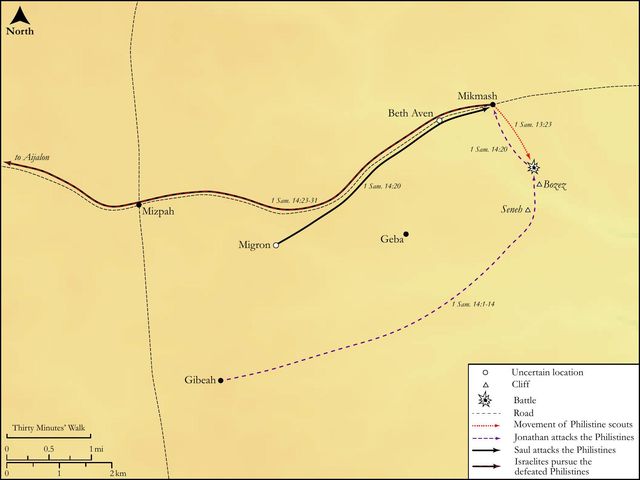
- וַיַּכּוּvai·ya·Kuand they defeatedH5221Conj-w ¦ V-Hiphil-ConsecImperf-3mpVerb Hiphil Consecutive Imperfect 3rd Plural Masculineוַandיַּכּוּthey defeated
- בַּיּוֹםbai·Yomon the dayH3117Prep-b ¦ N-msNoun Singular Masculine Absoluteבַּon theיּוֹםday
- הַהוּאha·Hu'<the> thatH1931Art ¦ Pro-3msPronoun Personal 3rd Singular Masculineהַ<the>הוּאthat
- בַּפְּלִשְׁתִּיםba·pe·lish·Tim<in> the PhilistinesH6430Prep-b ¦ N-mpNoun Gentilic Plural Masculine Absoluteבַּ<in> theפְּלִשְׁתִּיםPhilistines
- מִמִּכְמָשׂmi·mikh·Masfrom MicmashH4363Prep-m ¦ N-properNoun Proper LocationמִfromמִּכְמָשׂMicmash
- אַיָּלֹנָה'ai·ya·Lo·nahAijalon towardsH357N-proper ¦ SfxNoun Proper LocationאַיָּלֹנָAijalonהtowards
- וַיָּעַףvai·Ya·'afand it was wearyH5888Conj-w ¦ V-Qal-ConsecImperf-3msVerb Qal Consecutive Imperfect 3rd Singular Masculineוַandיָּעַףit was weary
- הָעָםha·'Amthe peopleH5971Art ¦ N-msNoun Singular Masculine Absoluteהָtheעָםpeople
- מְאֹדme·'OdexceedinglyH3966Adj-msAdjective Numerical Singular Masculine Absolute
English is a literal word-by-word gloss of the Hebrew, not the KJV's wording. Why?
This is the original text the KJV's translators worked from — each Hebrew word with its own literal English meaning in this verse, prepared by scholars at Tyndale House, Cambridge. The KJV translates whole sentences, not word by word, so its wording differs: one Hebrew word can become several English words, and the KJV may choose “the LORD” where the gloss reads “Yahweh”. Both are faithful — they answer different questions. For the KJV's own rendering, switch to the KJV text.
Details
See on the biblical-era map
Study this verse
Public-domain commentary
Matthew Henry
From his Commentary on the Whole Bible. Henry comments on passages, not single verses — this entry covers 1 Samuel 14:24–35. His three-level outline is real structure in the source text, so it is rendered as structure.
We have here an account of the distress of the children of Israel, even in the day of their triumphs. Such alloys are all present joys subject to. And such obstructions does many a good cause meet with, even when it seems most prosperous, through the mismanagement of instruments.
I.Saul forbade the people, under the penalty of a curse, to taste any food that day, Sa1 14:24. Here we will suppose,
1.That as king he had power to put his soldiers under this interdict, and to bind it on with a curse; and therefore they submitted to it, and God so far owned it as to discover, by the lot, that Jonathan was the delinquent that had meddled with the accursed thing (though ignorantly), on which account God would not be at that time enquired of by them.
2.That he did it with a good intention, lest the people, who perhaps had been kept for some time at short allowance, when they found plenty of victuals in the deserted camp of the Philistines, should fall greedily upon that, and so lose time in pursing the enemy, and some of them, it may be, glut themselves to such a degree as not to be fit for any more service that day. To prevent this, he forbade them to taste any food, and laid himself, it is likely, under the same restraint. And yet his making this severe order was,
(1.)Impolitic and very unwise; for, if it gained time, it lost strength, for the pursuit.
(2.)It was imperious, and disobliging to the people, and worse than muzzling the mouth of the ox when he treads out the corn. To forbid them to feast would have been commendable, but to forbid them so much as to taste, though ever so hungry, was barbarous.
(3.)It was impious to enforce the prohibition with a curse and an oath. Had he no penalty less than an anathema wherewith to support his military discipline? Death for such a crime would have been too much, but especially death with a curse. Though superiors may chide and correct, they may not curse their inferiors; our rule is, Bless, and curse not. When David speaks of an enemy he had that loved cursing perhaps he meant Saul, Psa 109:17, Psa 109:18.
II.The people observed his order, but it had many inconveniences attending it.
1.The soldiers were tantalized; for, in their pursuit of the enemy, it happened that they went through a wood so full of wild honey that it dropped from the trees upon the ground, the Philistines having perhaps, in their flight, broken in upon the honeycombs, for their own refreshment, and left them running. Canaan flowed with honey, and here is an instance of it. They sucked honey out of the rock, the flinty rock (Deu 32:13); yet, for fear of the curse, they did not so much as taste the honey, Sa1 14:25, Sa1 14:26. Those are worthy of the name of Israelites that can deny themselves and their own appetites even when they are most craving, and the delights of sense most tempting, for fear of guilt and a curse, and the table becoming a snare. Let us never feed ourselves, much less feast ourselves, without fear.
2.Jonathan fell under the curse through ignorance. He heard not of the charge his father had given; for, having bravely forced the lines, he was then following the chase, and therefore might justly be looked upon as exempted from the charge and intended in it. But it seems it was taken for granted, and he himself did not object against it afterwards, that it extended to him, though absent upon so good an occasion. He, not knowing any peril in it, took up a piece of a honey-comb, upon the end of his staff, and sucked it (Sa1 14:27), and was sensibly refreshed by it: His eyes were enlightened, which began to grow dim through hunger and faintness; it made his countenance look pleasant and cheerful, for it was such as a stander-by might discern (Sa1 14:29): See how my eyes have been enlightened. He thought no harm, nor feared any, till one of the people acquainted him with the order, and then he found himself in a snare. Many a good son has been thus entangled and distressed, in more ways than one, by the rashness of an inconsiderate father. Jonathan, for his part, lost the crown he was heir to by his father's folly, which, it may be, this was an ill omen of.
3.The soldiers were faint, and grew feeble, in the pursuit of the Philistines. Jonathan foresaw this would be the effect of it; their spirits would flag, and their strength would fail, for want of sustenance. Such is the nature of our bodies that they soon grow unfit for service if they be not supplied with fresh recruits. Daily work cannot be done without daily bread, which our Father in heaven graciously gives us. It is bread that strengthens man's heart; therefore Jonathan reasoned very well, If the people had eaten freely, there would have been a much greater slaughter (Sa1 14:30); but, as it was, they were very faint, too much fatigued (so the Chaldee), and began to think more of their meat than of their work.
4.The worst effect of all was that at evening, when the restraint was taken off and they returned to their food again, they were so greedy and eager upon it that they ate the flesh with the blood, expressly contrary to the law of God, Sa1 14:32. Two hungry meals, we say, make the third a glutton; it was so here. They would not stay to have their meat either duly killed (for they slew the cattle upon the ground, and did not hang them up, as they used to do, that the blood might all run out of them) or duly dressed, but fell greedily upon it before it was half boiled or half roasted, Sa1 14:32. Saul, being informed of it, reproved them for the sin (Sa1 14:33): You have transgressed; but did not, as he should have done, reflect upon himself as having been accessory to it, and having made the Lord's people to transgress. To put a stop to this irregularity, Saul ordered them to set up a great stone before him, and let all that had cattle to kill, for their present use, bring them thither, and kill them under his eye upon that stone (Sa1 14:33), and the people did so (Sa1 14:34), so easily were they restrained and reformed when their prince took care to do his part. If magistrates would but use their power as they might, people would be made better than they are with more ease than is imagined.
III.On this occasion Saul built an altar (Sa1 14:35), that he might offer sacrifice, either by way of acknowledgment of the victory they had obtained or by the way of atonement for the sin they had been guilty of. The same was the first altar that he built, and perhaps the rolling of the great stone to kill the beasts on reminded him of converting it into an altar, else he would not have thought of it. Saul was turning aside from God, and yet now he began to build altars, being most zealous (as many are) for the form of godliness when he was denying the power of it. See Hos 8:14, Israel has forgotten his Maker, and buildeth temples. Some read it, He began to build that altar; he laid the first stone, but was so hasty to pursue his victory that he could not stay to finish it.
Historical interpretation
Historical reception
3 surviving comments on this verse. Each one is dated, so this reads as a timeline rather than a list.
Select a marker to jump to its quote. Markers stagger vertically where authors wrote within a few decades of each other.
It is also the custom of the arrogant to not let their self-esteem keep quiet whenever the tongues of others grow silent in praising them. Indeed, while all the others keep quiet, the arrogant shouts aloud, for in his heart he carries around one who broadcasts his great worth. Therefore, the following words are readily applied to such people: “And the people turned to the spoils and brought sheep, cows and calves. They slaughtered them on the ground, and the people ate them with their blood.” If anyone cultivates many reasons for his innocence and boasts about them, he takes sheep. When someone thinks about his labors of preaching and collects in his memory whatever has been useful as he spoke to others or cultivated the earth, he takes cattle as booty. When he is elated from the fact that the impulses of wantonness upon the mind have been restrained and reduced, he takes calves. For there are two commandments that bring great praise to the just: the splendor of chastity and the light of good works. When an arrogant individual is exalted in his own estimation, he is said to have stolen sheep and calves. Sheep refer to the innocence of good works, calves to the mortification of bodily passion. Clearly, he added cattle to these, for he is not perfectly exalted if he thinks that he is in any way weak or powerless. He had already been great in his own opinion as far as he estimated his chastity and good works, but he raised himself in the arrogance of even fuller exaltation when he thought himself perfect in the labor of preaching.But afterwards he wrote about the end to which all these things lead: “And they slaughtered them on the ground.” To slaughter sheep, cows and calves on the ground is to exult with carnal joy and a conscience bereft of virtues. Thus God spoke about the proud and arrogant in the book of Hosea: “He turned away their sacrificial offerings into the deep.” Indeed, they plunge their victims into the deep when they do not raise up the heavenly offerings of virtues to the heavens in gratitude, but they yield their sacrifices to the earth through their quest for vain praise. Therefore, these words are well applied to them: “The people ate the sacrifices with their blood.” The food of the mind is its own internal joy. What, then, does eating with blood signify except to refuse to remove by any means striving for vain praise from the internal appetite of the mind? The blood is removed when the mind removes the striving for vanity from the joy of a good work. For the mind of a godly sort knows to rejoice in a good work, since he rejoices to draw near to the heavenly beings through his good works, but he avoids letting those works be seen at the time as he carries out those works. Then to eat with blood is to take the joy of a good work and mix it with a longing for vanity. Clearly, when praise is offered by others, then it is sincere food even for the arrogant. But when no one else praises them, the conscience of the haughty swells up, it violently snatches as loot the praise nobody else voluntarily offers.
The people were exceedingly weary, etc. That the people were said to have eaten with blood should not be thought to mean they ate bloody and raw flesh, which is not at all human but is the nature of beasts; rather, that after slaying the animals, before the blood was fully drained, they cooked or roasted the unsanctified meat and then ate it. However, this signifies the lazy teachers, who, as we often see today, exhausted by the long labor of catechizing, hasten to incorporate some whom they had rescued from demonic errors by preaching, educating them in Gentile rites; attempting to imitate him to whom all kinds of animals destined from heaven were said: "Kill and eat" (Acts 10). But they almost kill on earth and eat with blood those whom they imperfectly detach from earthly senses and the allurements of flesh and blood, either by teaching or by their own living. They hasten to incorporate into the members of the Church those who are still accustomed to vices and not yet engaged in practicing virtues; contrary to the example of the first pastor of the Church, who, placed in the upper room, that is, in the highest place of living or teaching, is ordered to kill the offerings and eat what was purified by God. And it is noteworthy that, although the perfection of the human mind is perfect and weak, Jonathan, the perpetrator of so many great deeds and the author of such a triumph, unsuspectingly succumbed to the deception of gluttony. The entire people, after observing the appointed time for diligent continence, after laying low so many adversaries in one day, are themselves overcome by the victorious gluttony. But because the temptation of gluttony is manifold, it led one to eat before the allotted time and persuaded the other to consume less lawful things even within the allotted time.
So on that day they struck down the Philistines, etc. Ajalon signifies great humility. In all the things the Church rightly does, it strikes at the Philistines; because through the good it does, it diminishes the powers of evil spirits; because they must be struck down beginning from humility, up to the breadth of perfected virtue, from the beginning of faith up to the fruitful amplitude of charity. Of which it is said: Your commandment is exceedingly broad (Psalm 119). But even the very state of the universal Church, beginning from the humility of a single Judean nation, has reached to the ends of the whole world through growth. Of which the Psalmist sings to the Lord: And your fields will be filled with abundance, the fattened edges of the desert (Psalm 65).
Continue studying 1 Samuel 14:31 across the web’s major study libraries — every link below opens this exact verse, chapter, or book on the destination site.
Read & Compare
 BibleGatewayThis verse in more than 200 translations and 70 languages.
 Bible.comThe YouVersion reader — hundreds of translations, reading plans, and highlights.
 ESV.orgCrossway's official English Standard Version reader.
 NET BibleThe NET translation with 60,000+ translators' notes on every rendering decision.
 STEP BibleTyndale House's free study tool — original text, vocabulary, and scholarly resources.
 BibliaLogos Bible Software's free web reader.
 USCCBThe New American Bible (Revised Edition) with the U.S. bishops' study notes.
Commentaries
 BibleHub CommentariesDozens of classic commentaries on this verse, gathered on one page.
 StudyLightMore than 100 commentary sets — the largest collection on the web.
 BibleRefPlain-English commentary on what this verse means, verse by verse.
 Enduring WordDavid Guzik's free commentary on this chapter, widely used by Bible teachers.
 Bible Study ToolsVerse commentary alongside Greek and Hebrew study aids.
Original Language & Research
- BibleHub InterlinearThe verse word by word — original language, transliteration, and English.
- BibleHub LexiconEvery word's original-language definition and Strong's entry.
 Blue Letter BibleDeep-study tools — Strong's numbers, concordance, and word studies.
 SefariaThe Hebrew text with Rashi and centuries of Jewish commentary.
Sermons, Hymns & Audio


TrulyRandomVerse is not affiliated with these sites and doesn’t control their content. They’re linked because they’re genuinely useful.
Summary
1 Samuel 14:31 provides a climactic summary of the day's intense battle, highlighting the extensive geographical reach of Israel's pursuit of the Philistines from Michmash to Aijalon. Simultaneously, it starkly reveals the severe physical depletion of the Israelite army, who were utterly faint, a direct and detrimental consequence of King Saul's impulsive and ill-advised oath forbidding his soldiers from eating throughout the day.
Context
ShowHideLiterary Context
This verse serves as the culmination of a dramatic narrative detailing Israel's decisive victory over the Philistines. It immediately follows Jonathan's audacious, faith-driven strike against the Philistine garrison at Michmash, which initiated a miraculous rout. The preceding narrative, particularly 1 Samuel 14:1-15, describes how God intervened, causing panic and confusion among the Philistines, leading them to turn their swords on one another. As the Israelite army joined the rout, the tide of the war decisively turned. However, earlier in the day, King Saul, in a misguided attempt to secure divine favor or ensure a complete victory, had imposed a severe oath on his soldiers, forbidding them from consuming any food until evening (1 Samuel 14:24). This oath, made without divine consultation, directly led to the profound exhaustion described in verse 31 and subsequently to the people's sin of eating meat with the blood still in it (1 Samuel 14:32-34), further highlighting the negative consequences of Saul's impulsive leadership.
Historical & Cultural Context
The period of 1 Samuel is characterized by intense Philistine oppression, with the Philistines holding military and technological superiority over Israel. Michmash was a strategically vital pass, controlling access through the central Benjaminite territory, while Aijalon was a significant valley to the west, indicating a deep and extensive pursuit across challenging terrain. This pursuit, spanning a considerable distance, would have been physically grueling, especially for soldiers who had been fighting since morning without sustenance. Oaths were common in Israel, often used to invoke divine blessing or curse, but rash or unadvised oaths could have severe, unintended consequences, as seen here. The cultural understanding of blood as the life-force, forbidden for consumption by Mosaic Law (Leviticus 17:10-14), underscores the desperation of the faint soldiers who transgressed this law due to extreme hunger.
Key Themes
ShowHideThis verse powerfully contributes to several key themes within the book of 1 Samuel. Firstly, it underscores the theme of Divine Deliverance, showcasing God's sovereign power in granting Israel a decisive victory despite their initial weakness and Saul's flawed leadership. Secondly, it highlights the Consequences of Rash Leadership, illustrating how human zeal, when untempered by wisdom and divine guidance, can inadvertently hinder God's purposes and lead to suffering and sin among the people. Saul's oath, intended to honor God, ultimately caused the army's exhaustion and moral failure. Thirdly, the verse subtly introduces the theme of Human Weakness and Need for Sustenance, both physical and spiritual. The people's faintness not only jeopardized the completeness of the victory but also led them into sin, emphasizing the fundamental human need for nourishment to sustain both body and spirit in the face of arduous challenges. This contrasts sharply with Jonathan's earlier trust in God's power to save "whether by many or by few" (1 Samuel 14:6).
Exposition and Analysis
ShowHideKey Word Analysis
ShowHideThis primitive root signifies a decisive, often violent, striking or defeating. In this context, it emphasizes the completeness and severity of the Israelite victory over the Philistines. It's not merely a skirmish, but a thorough rout, implying a powerful and effective military action that drove the enemy back in disarray.
Properly meaning "vehemence," this word functions as an intensive or superlative, indicating a high degree or extreme extent. When paired with "faint," it strongly emphasizes the profound and debilitating nature of the Israelite army's exhaustion, going beyond mere tiredness to a state of utter physical collapse.
This primitive root primarily means "to cover" or "to fly," but by implication of dimness or obscurity, it also means "to faint" or "to be weary." In this verse, it describes an extreme state of physical depletion, indicating that the soldiers were utterly worn out, on the verge of collapse, due to prolonged exertion without adequate nourishment. This profound fatigue directly explains their subsequent actions, such as eating meat with the blood, as they were too weak to properly prepare their food.
Verse Breakdown
ShowHide"And they smote the Philistines that day from Michmash to Aijalon"
This clause vividly describes the vast geographical extent of the Israelite victory and pursuit. Michmash, located in the central highlands, was the initial battleground, while Aijalon, situated in the lowlands to the west, marked the furthest point of the chase. This indicates a relentless, far-reaching rout of the Philistine forces, signifying the completeness of God's deliverance for Israel on that day. The distance covered underscores the intensity and duration of the battle, highlighting the divine power at work.
"and the people were very faint"
This concluding phrase introduces a crucial counterpoint to the triumphant description of the pursuit. Despite the victory, the Israelite soldiers were utterly exhausted, a direct consequence of King Saul's rash oath forbidding them from eating throughout the day. This extreme physical depletion highlights the human cost of the battle and, more significantly, the negative impact of Saul's misguided leadership, which jeopardized the army's well-being and led to subsequent moral compromise.
Literary Devices
ShowHideThe verse employs Juxtaposition to create a powerful effect, placing the triumphant description of a decisive, far-reaching victory ("they smote the Philistines... from Michmash to Aijalon") directly alongside the stark reality of the army's profound exhaustion ("and the people were very faint"). This contrast underscores the human cost and the unintended consequences of Saul's actions, even in the midst of divine blessing. There is also an element of Foreshadowing, as the people's extreme faintness directly sets the stage for their subsequent sin of eating meat with the blood still in it, a violation of Mosaic Law, which further exposes the flaws in Saul's leadership and the people's desperation. The geographical markers "Michmash to Aijalon" serve as a form of Merism, indicating the entire vast stretch of the pursuit, from beginning to end, emphasizing the totality of the rout.
Theological and Thematic Connections
ShowHide1 Samuel 14:31 offers profound theological insights into the interplay of divine sovereignty, human responsibility, and the consequences of unwise leadership. While God grants the victory, human decisions, even those seemingly made in zeal, can introduce complications and suffering. Saul's oath, though perhaps intended to demonstrate piety or secure a more complete victory, ultimately hindered his army's effectiveness and led them to a state of extreme physical and moral vulnerability. This highlights the danger of self-imposed burdens or legalistic zeal that goes beyond God's clear commands, often leading to unintended negative consequences. True strength and endurance for God's work come not from human asceticism or rash vows, but from His sustaining power and wise, Spirit-led decisions.
Reflection and Application
ShowHideThis verse serves as a powerful reminder that even in moments of great triumph and divine blessing, human weakness and the consequences of our decisions can manifest. For leaders, it's a sobering call to consider the full implications of their commands, ensuring that zeal does not override wisdom, compassion, and practical care for those under their charge. Unwise policies or self-imposed burdens, even with good intentions, can lead to unnecessary hardship, exhaustion, and even moral failure among those we lead. For individuals, it underscores the importance of seeking true nourishment—spiritually, physically, and emotionally—to sustain us through life's battles. We are called to rely on God's strength, not our own self-imposed disciplines that may ultimately deplete us. It encourages us to discern between genuine sacrifice and self-inflicted suffering, always prioritizing God's revealed will and the well-being of ourselves and others.
Questions for Reflection
ShowHideFAQ
ShowHideWhy was Saul's oath so problematic, given that it seemed to be for God's glory?
ShowHideSaul's oath was problematic for several reasons. First, it was a rash vow not commanded by God, demonstrating a lack of consultation with the Lord. Second, it was impractical and counterproductive, severely hindering his army's ability to complete the victory by depriving them of essential sustenance during a long and arduous battle. The soldiers became "very faint," which directly led to their subsequent sin of eating meat with the blood, a violation of Mosaic Law (Leviticus 17:10-14). This incident highlights Saul's impulsiveness and self-will, contrasting sharply with Jonathan's faith-filled obedience and reliance on God's power (1 Samuel 14:6).
What was the significance of the geographical markers "from Michmash to Aijalon"?
ShowHideThese place names indicate the vast extent of the Israelite pursuit and the completeness of their victory. Michmash was the initial battleground, a strategic pass in the central highlands. Aijalon, located in a valley to the west, was a significant distance away. The phrase "from Michmash to Aijalon" therefore signifies a thorough and far-reaching rout of the Philistine forces, demonstrating that the Israelites chased their enemies relentlessly across a considerable geographical area, leaving no doubt about the decisiveness of God's deliverance on that day.
How does this verse relate to Jonathan's earlier actions in 1 Samuel 14?
ShowHideThis verse provides a stark contrast and consequence to Jonathan's earlier, faith-filled actions. Jonathan's bold and Spirit-led initiative at Michmash, trusting God for victory regardless of numbers (1 Samuel 14:6), initiated the miraculous rout of the Philistines. However, Saul's subsequent rash oath, driven by human zeal rather than divine wisdom, undermined the full potential of that victory by debilitating his army. While Jonathan's faith brought about the triumph, Saul's folly led to the people's extreme exhaustion and subsequent sin, highlighting the difference between a leader who trusts God's power and one who relies on human decrees.
Christ-Centered Fulfillment
ShowHide1 Samuel 14:31, with its depiction of a victorious yet faint army, finds profound Christ-centered fulfillment in several ways. While Israel's army was exhausted by Saul's misguided zeal, Jesus, the true King, perfectly fulfilled all righteousness, enduring immense physical and spiritual weariness not due to human folly, but for our sake. He is the ultimate Victor who "smote" the powers of darkness through His death and resurrection, achieving a decisive and complete triumph over sin and death (Colossians 2:15). Unlike the faint Israelite soldiers who succumbed to sin due to hunger, Jesus, after His wilderness temptation, was ministered to by angels, demonstrating divine sustenance in the face of extreme deprivation (Matthew 4:11). He is the "Bread of Life" who gives true spiritual nourishment, ensuring that those who come to Him "shall never hunger" (John 6:35), providing strength that transcends physical limitations. Moreover, Christ's perfect obedience stands in stark contrast to Saul's rashness, as Jesus always did the will of His Father, even to the point of death on the cross (Philippians 2:8), securing eternal victory and providing the ultimate sustenance for weary souls.