


Joshua 19:42
Bible text: King James Version (1769 Blayney text) · Public domain
Bible text: King James Version with Strong's numbers · Public domain
Bible text: Berean Standard Bible · Public domain
Bible text: American Standard Version (1901) · Public domain
Bible text: World English Bible, Messianic edition · Public domain
Bible text: Geneva Bible (1599) · Public domain
Bible text: Young's Literal Translation · Public domain
- וְשַׁעֲלַבִּיןve·sha·'a·la·Binand ShaalabbinH8169Conj-w ¦ N-properNoun Proper LocationוְandשַׁעֲלַבִּיןShaalabbin
- וְאַיָּלוֹןve·'ai·ya·Lonand AijalonH357Conj-w ¦ N-properNoun Proper LocationוְandאַיָּלוֹןAijalon
- וְיִתְלָהve·yit·Lahand IthlahH3494Conj-w ¦ N-properNoun Proper LocationוְandיִתְלָהIthlah
English is a literal word-by-word gloss of the Hebrew, not the KJV's wording. Why?
This is the original text the KJV's translators worked from — each Hebrew word with its own literal English meaning in this verse, prepared by scholars at Tyndale House, Cambridge. The KJV translates whole sentences, not word by word, so its wording differs: one Hebrew word can become several English words, and the KJV may choose “the LORD” where the gloss reads “Yahweh”. Both are faithful — they answer different questions. For the KJV's own rendering, switch to the KJV text.
Details
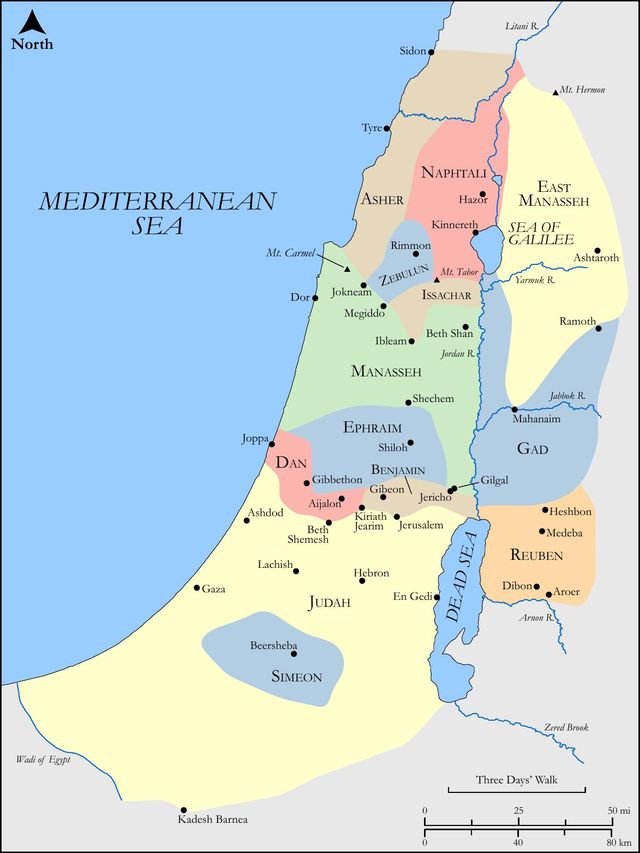
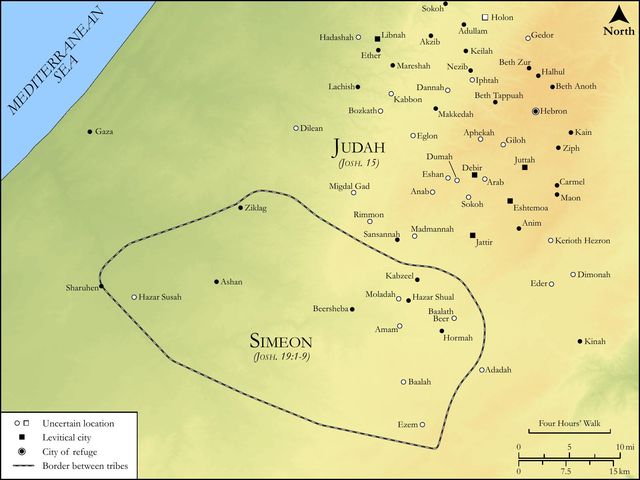
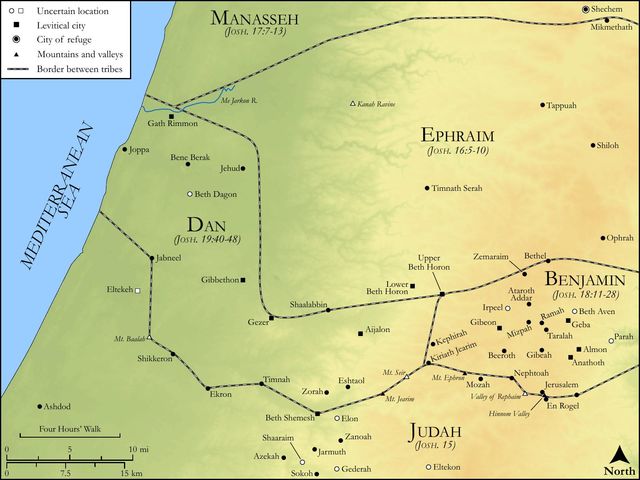
See on the biblical-era maps
Study this verse
Public-domain commentary
Matthew Henry
From his Commentary on the Whole Bible. Henry comments on passages, not single verses — this entry covers Joshua 19:40–48.
Dan, though commander of one of the four squadrons of the camp of Israel, in the wilderness, that which brought up the rear, yet was last provided for in Canaan, and his lot fell in the southern part of Canaan, between Judah on the east and the land of the Philistines on the west, Ephraim on the north and Simeon on the south. Providence ordered this numerous and powerful tribe into a post of danger, as best able to deal with those vexatious neighbours the Philistines, and so it was found in Samson. Here is an account, 1. Of what fell to this tribe by lot, Zorah, and Eshtaol, and the camp of Dan thereabouts, of which we read in the story of Samson. And near there was the valley of Eshcol, whence the spies brought the famous bunch of grapes. Japho, or Joppa was in this lot. 2. Of what they got by their own industry and valour, which is mentioned here (Jos 19:47), but related at large, Jdg 18:7, etc.
Continue studying Joshua 19:42 across the web’s major study libraries — every link below opens this exact verse, chapter, or book on the destination site.
Read & Compare
 BibleGatewayThis verse in more than 200 translations and 70 languages.
 Bible.comThe YouVersion reader — hundreds of translations, reading plans, and highlights.
 ESV.orgCrossway's official English Standard Version reader.
 NET BibleThe NET translation with 60,000+ translators' notes on every rendering decision.
 STEP BibleTyndale House's free study tool — original text, vocabulary, and scholarly resources.
 BibliaLogos Bible Software's free web reader.
 USCCBThe New American Bible (Revised Edition) with the U.S. bishops' study notes.
Commentaries
 BibleHub CommentariesDozens of classic commentaries on this verse, gathered on one page.
 StudyLightMore than 100 commentary sets — the largest collection on the web.
 BibleRefPlain-English commentary on what this verse means, verse by verse.
 Enduring WordDavid Guzik's free commentary on this chapter, widely used by Bible teachers.
 Bible Study ToolsVerse commentary alongside Greek and Hebrew study aids.
Original Language & Research
- BibleHub InterlinearThe verse word by word — original language, transliteration, and English.
- BibleHub LexiconEvery word's original-language definition and Strong's entry.
 Blue Letter BibleDeep-study tools — Strong's numbers, concordance, and word studies.
 SefariaThe Hebrew text with Rashi and centuries of Jewish commentary.
Sermons, Hymns & Audio


TrulyRandomVerse is not affiliated with these sites and doesn’t control their content. They’re linked because they’re genuinely useful.
Summary
Joshua 19:42 meticulously lists Shaalabbin, Ajalon, and Jethlah as cities within the tribal inheritance allotted to the tribe of Dan. This verse, part of the extensive land distribution record in the book of Joshua, underscores God's unwavering faithfulness in fulfilling His covenant promises to Israel by providing them with a homeland. While seemingly a dry geographical detail, it serves as a foundational element in establishing Israel's identity and future within the Promised Land, even as it subtly foreshadows the challenges Dan would face in fully possessing its designated territory.
Context
ShowHideLiterary Context
Joshua 19:42 is situated within the latter portion of the book of Joshua, specifically in the detailed account of the land allotments to the remaining seven tribes of Israel (Joshua 18-19) after the initial divisions for Judah, Ephraim, and Manasseh. Chapter 19 itself concludes the distribution, focusing on the portions for Simeon, Zebulun, Issachar, Asher, Naphtali, and finally, Dan. The meticulous cataloging of cities and boundaries, often including obscure or later-contested locations, emphasizes the divine precision and legalistic nature of the inheritance. The listing of Dan's cities, including these three, is the culmination of God's promise being formally declared, even if its full realization would prove challenging, as later narratives in the Book of Judges reveal the tribe's inability to fully dispossess the inhabitants of their allotted territory.
Historical & Cultural Context
Following the conquest of Canaan, the division of the land was a monumental act, fulfilling centuries-old promises made to Abraham concerning the land of Canaan. This process was overseen by Joshua, Eleazar the priest, and the tribal heads, often involving casting lots to ensure divine guidance in the distribution, as seen in Joshua 18:6. Culturally, land ownership was paramount for identity, security, and economic stability in ancient Israel. It signified belonging and covenant blessing, grounding the people in the physical manifestation of God's faithfulness. However, the initial allotment did not always equate to immediate, full possession. Many Canaanite strongholds remained, requiring ongoing warfare and faith. The cities mentioned in Joshua 19:42, particularly Ajalon and Shaalabbin, were strategically important locations in the Shephelah (foothills) and coastal plain, areas often contested by the Amorites and Philistines, foreshadowing the struggles documented in Judges 1:34-35.
Key Themes
ShowHideThis verse contributes to several overarching themes in Joshua and the broader Pentateuch. Firstly, it powerfully illustrates Divine Faithfulness, demonstrating God's unwavering commitment to His covenant promises, specifically the gift of the land to Israel as outlined in the Abrahamic Covenant. Secondly, the precise enumeration of cities highlights the theme of Inheritance and Boundaries, emphasizing that Israel's identity and future were rooted in a God-given, divinely ordained territory. This established order and prevented internal strife over land claims, providing a secure foundation for the emerging nation. Lastly, for the tribe of Dan, this verse subtly introduces the theme of Challenges to Possession. While the land was formally allotted, the historical reality, as later described in the Book of Judges, was that complete possession required continued obedience, faith, and military effort, a struggle that ultimately led to Dan's migration northward, detailed in Judges 18.
Exposition and Analysis
ShowHideKey Word Analysis
ShowHideFrom a root meaning "fox-holes," this name suggests a place characterized by the presence of foxes or jackals, common in the Shephelah region. Its inclusion in Dan's territory indicates a specific, identifiable location, which, as later biblical narratives confirm, remained a contested area where the Danites struggled to dispossess the Amorite inhabitants, as noted in Judges 1:35.
Meaning "deer-field" or "place of gazelles," Ajalon was a significant valley and city situated in the Shephelah, a strategically vital area between the central highlands and the coastal plain. Its prominence is underscored by its mention in the miraculous account of the sun standing still during Joshua's battle against the Amorite kings in Joshua 10:12. For Dan, its inclusion in their territory signified a rich, fertile, and strategically important region, though one that would prove difficult to fully control due to the entrenched Amorite presence.
Probably derived from a root meaning "it will hang" or "be high," suggesting a place with an elevated or prominent position. While less frequently mentioned in other biblical narratives, its specific listing here reinforces the comprehensive and precise nature of the land division. Its inclusion alongside Shaalabbin and Ajalon further defines the geographical scope of Dan's inheritance, highlighting the meticulous detail of God's provision for His people.
Verse Breakdown
ShowHide"And Shaalabbin"
This clause introduces the first of three specific cities designated as part of Dan's inheritance. The inclusion of Shaalabbin, a known location in the Shephelah, underscores the meticulous detail with which the land was divided, affirming the divine precision of the allotment process. It was not merely a general region but specific, identifiable urban centers, each with its own character and strategic implications.
"and Ajalon"
Following Shaalabbin, Ajalon is listed. Its inclusion further specifies the extent of Dan's territory. Ajalon's historical and strategic significance (as seen in Joshua 10) makes its designation to Dan particularly noteworthy, emphasizing the valuable nature of the land promised to them. The repeated "and" links these cities as a contiguous or associated part of the tribal lot, painting a geographical picture of the inheritance.
"and Jethlah"
The third city mentioned, Jethlah, completes this specific cluster of locations within Dan's inheritance. While less prominent in other biblical narratives, its inclusion here reinforces the comprehensive nature of the land division. The listing of these three cities together provides geographical markers, defining the boundaries and specific urban centers that were formally assigned to the tribe of Dan, even if the practical reality of fully possessing them would be a future struggle.
Literary Devices
ShowHideJoshua 19:42 primarily employs Cataloging or Listing, a common literary device throughout the book of Joshua, particularly in the chapters detailing land distribution. This meticulous enumeration of cities and boundaries serves to emphasize the completeness and divine authority of the land allotment, reinforcing God's faithfulness in fulfilling His promises. The Repetition of the conjunction "and" ("And Shaalabbin, and Ajalon, and Jethlah") creates a rhythmic, almost legalistic tone, underscoring the formal and precise nature of the inheritance. Furthermore, the inclusion of these specific cities, especially Ajalon and Shaalabbin, which are later identified as places where Dan failed to dispossess the inhabitants, serves as a subtle Foreshadowing of the challenges and failures that would characterize the period of the Judges, providing a narrative link between the promise of inheritance and the struggle for possession.
Theological and Thematic Connections
ShowHideJoshua 19:42, though a simple list of cities, is deeply theological. It stands as a testament to God's unwavering faithfulness, demonstrating His commitment to fulfilling the covenant promises made centuries earlier to Abraham concerning the land of Canaan. The meticulous detail of the land division underscores that God's promises are not vague but concrete, precise, and intended for actualization in the lives of His people. However, the historical reality of Dan's struggle to possess these cities (as revealed in Judges) introduces a crucial theological tension: while God's promises are sure, their full experience often requires human obedience, faith, and perseverance in the face of spiritual and physical opposition. This verse thus speaks to both divine sovereignty in granting inheritance and human responsibility in claiming it, a dynamic that resonates throughout biblical theology.
Reflection and Application
ShowHideThe seemingly mundane listing of cities in Joshua 19:42 offers profound lessons for contemporary believers. Just as God meticulously allotted a physical inheritance to Dan, He has, through Christ, granted us a spiritual inheritance that is "imperishable, undefiled, and unfading" and "kept in heaven" for us (1 Peter 1:4). This verse calls us to reflect on the certainty of God's promises in our lives: if He was so faithful in the physical realm, how much more can we trust Him with our spiritual realities and the eternal blessings He has secured for us? Yet, like Dan, we often face "giants" or obstacles—sin, doubt, spiritual warfare, worldly distractions, or fear—that hinder us from fully "possessing" or experiencing the fullness of our spiritual blessings. This calls for active faith, perseverance, and reliance on God's strength to overcome these challenges, rather than retreating from the spiritual battles we are called to fight. The precise boundaries given to Dan also remind us that God is a God of order and purpose, with a specific plan for our lives and for the church, urging us to live within the divine parameters He has set and to trust His perfect design.
Questions for Reflection
ShowHideFAQ
ShowHideWhy are these specific cities listed, and what happened to the tribe of Dan regarding their inheritance?
ShowHideThese specific cities—Shaalabbin, Ajalon, and Jethlah—are listed to provide precise geographical markers for the territory allotted to the tribe of Dan. This meticulous detail underscores the divine faithfulness in fulfilling the promise of land to Israel and establishes clear boundaries for tribal identity and order, preventing disputes and ensuring a clear sense of belonging. However, the Book of Judges reveals that the tribe of Dan faced significant challenges in fully possessing their inheritance. Judges 1:34-35 explicitly states that the Amorites "forced the Danites into the hill country, for they would not allow them to come down to the plain." This inability to dispossess the inhabitants of key cities like Ajalon and Shaalabbin ultimately led a significant portion of the tribe of Dan to migrate northward, conquering the city of Laish (later renamed Dan) and establishing a new territory far from their original allotment, as detailed in Judges 18. This historical outcome highlights the tension between God's sure promises and the human responsibility to act in faith and obedience to claim them, serving as a cautionary tale about the consequences of incomplete obedience.
Christ-Centered Fulfillment
ShowHideThe physical inheritance of land to the tribe of Dan, as detailed in Joshua 19:42, finds its ultimate and spiritual fulfillment in Jesus Christ. Just as God faithfully provided a promised land for Israel, so through Christ, He has provided an eternal, spiritual inheritance for all who believe. This inheritance is not a geographical plot but a participation in the very life and kingdom of God, a "heavenly country" (Hebrews 11:16) and "an inheritance that is imperishable, undefiled, and unfading, kept in heaven for you" (1 Peter 1:4). While Dan struggled to fully possess their earthly inheritance due to their inability to drive out the inhabitants, believers in Christ are given complete victory over sin and spiritual enemies through His finished work on the cross, where He disarmed the powers and authorities and "made a public spectacle of them, triumphing over them by the cross" (Colossians 2:15). Jesus is the true Joshua, leading His people into a greater rest—not merely a physical land, but a spiritual Sabbath rest from striving, found in Him (Hebrews 4:9-11). The meticulous listing of cities in Joshua points to the precision of God's promises, which are all "Yes" and "Amen" in Christ (2 Corinthians 1:20), culminating in the New Jerusalem, where God's people will dwell with Him forever in a perfectly possessed and eternally secure inheritance, as described in Revelation 21:1-4.