


Joshua 19:41
Bible text: King James Version (1769 Blayney text) · Public domain
Bible text: Berean Standard Bible · Public domain
Bible text: American Standard Version (1901) · Public domain
Bible text: World English Bible, Messianic edition · Public domain
Bible text: Geneva Bible (1599) · Public domain
Bible text: Young's Literal Translation · Public domain
- וַיְהִיvay·Hiand it wasH1961Conj-w ¦ V-Qal-ConsecImperf-3msVerb Qal Consecutive Imperfect 3rd Singular Masculineוַandיְהִיit was
- גְּבוּלge·Vul[the] territory ofH1366N-mscNoun Singular Masculine Construct
- נַחֲלָתָםna·cha·la·Tamtheir inheritanceH5159N-fsc ¦ 3mpNoun Singular Feminine Constructנַחֲלָתָinheritanceםtheir
- צָרְעָהtza·re·'AhZorahH6881N-properNoun Proper Location
- וְאֶשְׁתָּאוֹלve·'esh·ta·'oland EshtaolH847Conj-w ¦ N-properNoun Proper LocationוְandאֶשְׁתָּאוֹלEshtaol
- וְעִירve·'Irand Ir-H5905Conj-w ¦ N-properNoun Proper LocationוְandעִירIr-
- שָׁמֶשׁSha·meshShemeshH5905N-properNoun Proper Location
English is a literal word-by-word gloss of the Hebrew, not the KJV's wording. Why?
This is the original text the KJV's translators worked from — each Hebrew word with its own literal English meaning in this verse, prepared by scholars at Tyndale House, Cambridge. The KJV translates whole sentences, not word by word, so its wording differs: one Hebrew word can become several English words, and the KJV may choose “the LORD” where the gloss reads “Yahweh”. Both are faithful — they answer different questions. For the KJV's own rendering, switch to the KJV text.
Details
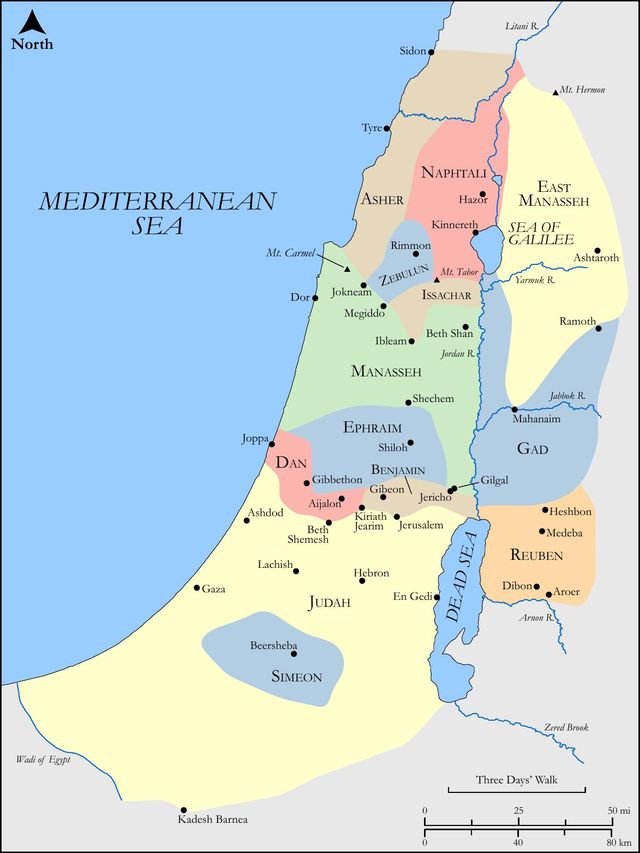
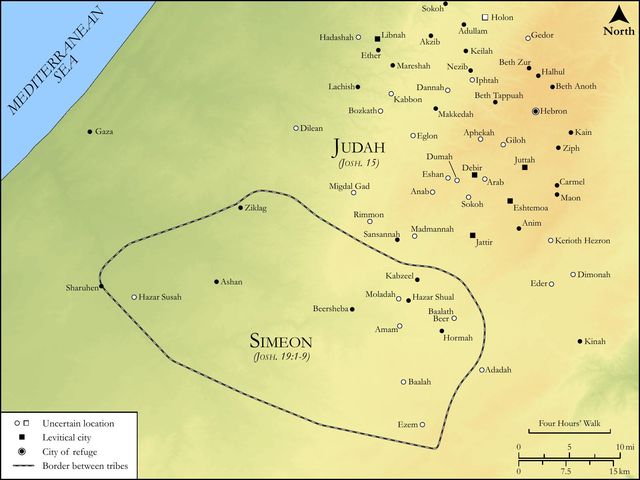
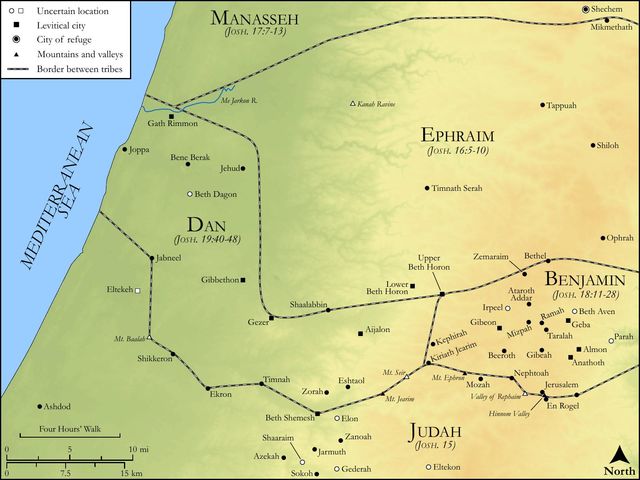
See on the biblical-era maps
Study this verse
Public-domain commentary
Matthew Henry
From his Commentary on the Whole Bible. Henry comments on passages, not single verses — this entry covers Joshua 19:40–48.
Dan, though commander of one of the four squadrons of the camp of Israel, in the wilderness, that which brought up the rear, yet was last provided for in Canaan, and his lot fell in the southern part of Canaan, between Judah on the east and the land of the Philistines on the west, Ephraim on the north and Simeon on the south. Providence ordered this numerous and powerful tribe into a post of danger, as best able to deal with those vexatious neighbours the Philistines, and so it was found in Samson. Here is an account, 1. Of what fell to this tribe by lot, Zorah, and Eshtaol, and the camp of Dan thereabouts, of which we read in the story of Samson. And near there was the valley of Eshcol, whence the spies brought the famous bunch of grapes. Japho, or Joppa was in this lot. 2. Of what they got by their own industry and valour, which is mentioned here (Jos 19:47), but related at large, Jdg 18:7, etc.
Continue studying Joshua 19:41 across the web’s major study libraries — every link below opens this exact verse, chapter, or book on the destination site.
Read & Compare
 BibleGatewayThis verse in more than 200 translations and 70 languages.
 Bible.comThe YouVersion reader — hundreds of translations, reading plans, and highlights.
 ESV.orgCrossway's official English Standard Version reader.
 NET BibleThe NET translation with 60,000+ translators' notes on every rendering decision.
 STEP BibleTyndale House's free study tool — original text, vocabulary, and scholarly resources.
 BibliaLogos Bible Software's free web reader.
 USCCBThe New American Bible (Revised Edition) with the U.S. bishops' study notes.
Commentaries
 BibleHub CommentariesDozens of classic commentaries on this verse, gathered on one page.
 StudyLightMore than 100 commentary sets — the largest collection on the web.
 BibleRefPlain-English commentary on what this verse means, verse by verse.
 Enduring WordDavid Guzik's free commentary on this chapter, widely used by Bible teachers.
 Bible Study ToolsVerse commentary alongside Greek and Hebrew study aids.
Original Language & Research
- BibleHub InterlinearThe verse word by word — original language, transliteration, and English.
- BibleHub LexiconEvery word's original-language definition and Strong's entry.
 Blue Letter BibleDeep-study tools — Strong's numbers, concordance, and word studies.
 SefariaThe Hebrew text with Rashi and centuries of Jewish commentary.
Sermons, Hymns & Audio


TrulyRandomVerse is not affiliated with these sites and doesn’t control their content. They’re linked because they’re genuinely useful.
Summary
Joshua 19:41 meticulously delineates a specific segment of the inheritance granted to the tribe of Dan within the Promised Land, identifying the strategic towns of Zorah, Eshtaol, and Irshemesh. This seemingly granular geographical detail serves as a powerful testament to God's unwavering faithfulness in fulfilling His ancient covenant promises to Israel, providing them with a secure, precisely defined, and tangible territory as the culmination of their conquest of Canaan.
Context
ShowHideLiterary Context
Joshua 19:41 is situated within the extensive and detailed account of the division of the land of Canaan among the Israelite tribes, a narrative spanning from Joshua 13 through Joshua 19. More specifically, this verse forms part of the final tribal allotment described in the chapter, that of the tribe of Dan. The preceding verses, Joshua 19:40-46, delineate Dan's initially designated territory, which was geographically challenging due to its proximity to the powerful Philistines. The meticulous listing of towns and boundaries throughout these chapters profoundly underscores the faithful fulfillment of God's ancient promises to Abraham, Isaac, and Jacob, ensuring their descendants would indeed inherit this promised land.
Historical & Cultural Context
Following the successful military campaigns led by Joshua, the land of Canaan was meticulously apportioned by lot, a method universally understood to reflect divine will and guidance. This concept of 'inheritance' (Hebrew: naḥălâ) was far more than a mere plot of land; it represented a permanent, divinely secured possession that formed the very bedrock of tribal identity, economic stability, and the covenant relationship with God. The towns specifically mentioned—Zorah, Eshtaol, and Irshemesh (later recognized as Beth Shemesh)—were strategically situated in the Shephelah, the low hills bordering the Philistine plain. This geographical reality meant the tribe of Dan would inevitably encounter significant and ongoing pressure from the Philistines, a dominant regional power, as vividly evidenced by later narratives found in the book of Judges. Zorah and Eshtaol hold particular historical significance as they are identified as the birthplace and burial place of Samson, the renowned Danite judge, as recorded in Judges 13:2. Irshemesh, or Beth Shemesh, later gained prominence as the site where the Ark of the Covenant was miraculously returned by the Philistines, detailed in 1 Samuel 6:12.
Key Themes
ShowHideThis verse, alongside the broader context of the land distribution, powerfully illuminates several core theological themes. Foremost is Divine Faithfulness and Fulfillment, demonstrating God's unwavering commitment to His covenant promises, as explicitly affirmed in Joshua 21:45. Every minute detail, extending even to the naming of specific towns, serves to confirm that God unfailingly keeps His word. Secondly, the meticulous listing emphasizes Divine Order and Precision, illustrating that God's sovereign plans are never chaotic but are thoroughly organized and executed, ensuring each tribe received a distinct and divinely designated portion. This reflects a profound divine blueprint for the nascent nation. Thirdly, the concept of Tribal Identity and Inheritance stands central; the land was the tangible expression of each tribe's unique place, purpose, and security within the nation of Israel, divinely secured and intended to be passed down through succeeding generations.
Exposition and Analysis
ShowHideKey Word Analysis
ShowHideDerived from a word meaning "cord," this term properly signifies a boundary or limit. By extension, it refers to the territory enclosed within such a boundary. In Joshua 19:41, it precisely delineates the divinely appointed limits and extent of the land assigned to the tribe of Dan, emphasizing a defined and secured possession.
This word denotes something inherited, specifically an heirloom, an estate, or a portion. It underscores that the land was not earned by Israel but was a divinely bestowed gift, a patrimony received through covenant promise. It speaks to a permanent, inalienable, and generational legacy secured by God.
These proper nouns designate specific towns within Dan's tribal allotment. Zorah, Eshtaol (likely related to "intreaty"), and Irshemesh ("city of the sun") anchor the abstract concept of "inheritance" in concrete geographical realities. Their meticulous inclusion highlights the divine precision in land distribution and foreshadows their future historical significance within Israel's narrative.
Verse Breakdown
ShowHide"And the coast of their inheritance"
This opening phrase precisely introduces the geographical boundaries and limits of the land divinely allotted to the tribe of Dan. The term "coast" (Hebrew: gᵉbûwl) here signifies a clearly defined border or territory, emphasizing the precise and limited nature of their designated possession. Coupled with "inheritance" (Hebrew: nachălâh), it underscores that this land was not acquired by human effort alone but was a permanent, generational gift from God, a tangible fulfillment of His covenant promises.
"was Zorah, and Eshtaol, and Irshemesh,"
This concluding clause specifies three pivotal towns that either marked or were contained within the boundaries of Dan's inheritance. These proper nouns—Zorah, Eshtaol, and Irshemesh (later known as Beth Shemesh)—serve as concrete, verifiable anchors for the abstract concept of a divine promise, making the land grant tangible and historically rooted. Their inclusion highlights the meticulous detail of God's provision and foreshadows their future prominence in Israel's history, particularly in the narratives involving Samson and the Ark of the Covenant.
Literary Devices
ShowHideThe primary literary device evident in Joshua 19:41, and indeed consistently employed throughout the land distribution narrative in Joshua 13-19, is Cataloging or Listing. This meticulous enumeration of towns and geographical boundaries serves to underscore the precise fulfillment of God's covenant promises and the divinely ordained order of the land's apportionment. This extensive use of Topographical Detail lends a profound sense of historical veracity and divine intentionality to the narrative, demonstrating that the promised inheritance was not abstract but concretely defined and secured. Furthermore, the specific mention of towns such as Zorah, Eshtaol, and Irshemesh, which later gain significant prominence in subsequent biblical narratives, can be interpreted as a subtle form of Foreshadowing, hinting at future events, challenges, and divine interventions that would unfold in these very locations for the tribe of Dan and the broader nation of Israel.
Theological and Thematic Connections
ShowHideJoshua 19:41, though a seemingly mundane geographical listing, profoundly underscores God's meticulous faithfulness and the precision of His promises. The physical inheritance of land to Israel serves as a powerful type and shadow of the spiritual inheritance believers receive in Christ. Just as God ensured every tribe received its designated portion, He meticulously works out His plan for each individual life and for the church as a whole. This verse reminds us that God's promises are not abstract ideals but concrete realities, fulfilled in time and space, providing a foundation for trust in His word concerning our spiritual blessings and eternal hope.
Reflection and Application
ShowHideThis seemingly mundane verse invites us to pause and marvel at the profound divine precision and unwavering faithfulness of God, even within what might initially appear to be a dry, historical record. Just as God meticulously fulfilled His solemn promise to Israel by granting them a specific, tangible, and geographically defined inheritance, so too is He equally faithful and precise in His intricate dealings with each one of us. We are powerfully reminded that our individual lives are not haphazard or random occurrences, but are intricately woven into a larger, divinely orchestrated plan. This truth should inspire a profound and unwavering trust in God's sovereign provision and His unfailing ability to bring His promises to pass, even when our circumstances seem challenging, uncertain, or beyond our comprehension. Ultimately, this passage encourages us to prayerfully identify and faithfully embrace the unique 'inheritance' God has graciously bestowed upon us—whether it be spiritual gifts, a divine calling, specific relationships, or material resources—and to steward them diligently, knowing they are integral components of His perfect and purposeful design for our lives and for His kingdom.
Questions for Reflection
ShowHideFAQ
ShowHideWhy is such a detailed list of towns important in the Bible?
ShowHideThe detailed enumeration of towns like Zorah, Eshtaol, and Irshemesh serves several crucial purposes within the biblical narrative. Firstly, it profoundly underscores the veracity and historical accuracy of the account, firmly anchoring God's promises in tangible, verifiable geographical locations. Secondly, it powerfully highlights God's meticulous faithfulness in fulfilling His ancient covenant to Abraham, demonstrating that every promise, even down to the precise land boundaries, was meticulously kept, as affirmed in Joshua 21:45. Thirdly, these specific locations frequently gain significant prominence in later biblical events, such as Zorah and Eshtaol being intrinsically linked to the narrative of Samson, the Danite judge, in Judges 13:2, and Irshemesh (Beth Shemesh) playing a key role in the return of the Ark of the Covenant in 1 Samuel 6:12. This interconnectedness vividly illustrates God's overarching plan unfolding throughout salvation history.
What happened to the tribe of Dan in this territory?
ShowHideDespite being divinely allotted this specific territory, the tribe of Dan encountered significant and persistent challenges in securing and maintaining full possession, primarily due to intense pressure from the formidable Philistines who dominated the coastal plain. The historical record within the book of Judges indicates that the Danites were notably unable to drive out the Amorites from their assigned territory, as detailed in Judges 1:34. Consequently, a substantial portion of the tribe later migrated northwards. This significant migration, thoroughly recounted in Judges 18, led them to conquer the city of Laish (which they subsequently renamed Dan) and establish a new settlement far removed from their original inheritance. This narrative powerfully highlights the ongoing struggles of Israel to fully possess their promised inheritance, often a consequence of their disobedience and the relentless external pressures they faced.
Is "Irshemesh" the same as "Beth Shemesh"?
ShowHideYes, "Irshemesh" is widely identified by biblical scholars as an older, perhaps Canaanite, name for the city later known as Beth Shemesh. Both names carry a similar meaning: "Irshemesh" translates to "city of the sun," while "Beth Shemesh" means "house of the sun," indicating a historical association with sun worship in pre-Israelite cultures. Beth Shemesh evolved into a strategically significant border town, most notably remembered for its pivotal role in the miraculous return of the Ark of the Covenant from Philistine captivity, a narrative vividly recorded in 1 Samuel 6. Its crucial geographical position frequently made it a flashpoint of conflict between the Israelites and the Philistines.
Christ-Centered Fulfillment
ShowHideThe physical inheritance of the land of Canaan, meticulously detailed for the tribes of Israel in passages like Joshua 19:41, finds its profound and ultimate fulfillment in the person and work of Jesus Christ. While ancient Israel received a temporal, earthly inheritance, believers in Christ are granted an eternal, spiritual inheritance that is infinitely superior and enduring. Christ Himself is the very essence of our true and ultimate inheritance, the one who ushers us into the promised rest that the land of Canaan could only ever imperfectly foreshadow, as powerfully articulated in Hebrews 4:8-10. Through His completed atoning work on the cross, we are graciously blessed with "every spiritual blessing in the heavenly places in Christ," as proclaimed in Ephesians 1:3, and are "made adequate to share in the inheritance of the saints in Light," a truth beautifully presented in Colossians 1:12. Unlike the earthly inheritance that could be contested, diminished, or even lost, as tragically exemplified by Dan's struggles, our spiritual inheritance in Christ is divinely guaranteed to be "imperishable and undefiled and will not fade away, reserved in heaven for you," a glorious assurance found in 1 Peter 1:4. Therefore, Joshua 19:41, with its specific details of land and promise, serves as a rich typological pointer to the comprehensive, secure, and eternal inheritance we possess solely through the person and redemptive work of our Lord Jesus Christ, who is the faithful fulfiller of all God's promises.