


Joshua 19:40
Bible text: King James Version (1769 Blayney text) · Public domain
Bible text: Berean Standard Bible · Public domain
Bible text: American Standard Version (1901) · Public domain
Bible text: World English Bible, Messianic edition · Public domain
Bible text: Geneva Bible (1599) · Public domain
Bible text: Young's Literal Translation · Public domain
- לְמַטֵּהle·ma·Tehfor [the] tribe ofH4294Prep-l ¦ N-mscNoun Singular Masculine Constructלְforמַטֵּה[the] tribe of
- בְנֵיve·nei[the] descendants ofH1121N-mpcNoun Plural Masculine Construct
- דָןdanDanH1835N-properNoun Proper Location
- לְמִשְׁפְּחֹתָםle·mish·pe·cho·Tamto their clansH4940Prep-l ¦ N-fpc ¦ 3mpNoun Plural Feminine Constructלְtoמִשְׁפְּחֹתָclansםtheir
- יָצָאya·Tza'it came outH3318V-Qal-Perf-3msVerb Qal Perfect 3rd Singular Masculine
- הַגּוֹרָלha·go·Ralthe lotH1486Art ¦ N-msNoun Singular Masculine Absoluteהַtheגּוֹרָלlot
- הַשְּׁבִיעִיha·she·vi·'I<the> seventhH7637Art ¦ Adj-msAdjective Numerical Position Singular Masculine Absoluteהַ<the>שְּׁבִיעִיseventh
English is a literal word-by-word gloss of the Hebrew, not the KJV's wording. Why?
This is the original text the KJV's translators worked from — each Hebrew word with its own literal English meaning in this verse, prepared by scholars at Tyndale House, Cambridge. The KJV translates whole sentences, not word by word, so its wording differs: one Hebrew word can become several English words, and the KJV may choose “the LORD” where the gloss reads “Yahweh”. Both are faithful — they answer different questions. For the KJV's own rendering, switch to the KJV text.
Details
See on the biblical-era maps
Study this verse
Public-domain commentary
Matthew Henry
From his Commentary on the Whole Bible. Henry comments on passages, not single verses — this entry covers Joshua 19:40–48.
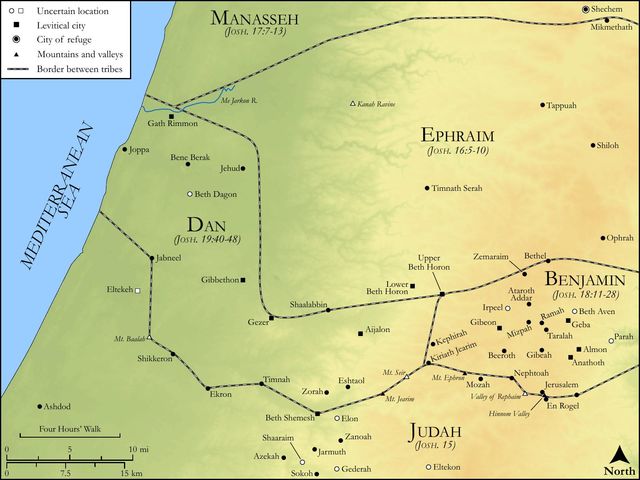
Dan, though commander of one of the four squadrons of the camp of Israel, in the wilderness, that which brought up the rear, yet was last provided for in Canaan, and his lot fell in the southern part of Canaan, between Judah on the east and the land of the Philistines on the west, Ephraim on the north and Simeon on the south. Providence ordered this numerous and powerful tribe into a post of danger, as best able to deal with those vexatious neighbours the Philistines, and so it was found in Samson. Here is an account, 1. Of what fell to this tribe by lot, Zorah, and Eshtaol, and the camp of Dan thereabouts, of which we read in the story of Samson. And near there was the valley of Eshcol, whence the spies brought the famous bunch of grapes. Japho, or Joppa was in this lot. 2. Of what they got by their own industry and valour, which is mentioned here (Jos 19:47), but related at large, Jdg 18:7, etc.
Continue studying Joshua 19:40 across the web’s major study libraries — every link below opens this exact verse, chapter, or book on the destination site.
Read & Compare
 BibleGatewayThis verse in more than 200 translations and 70 languages.
 Bible.comThe YouVersion reader — hundreds of translations, reading plans, and highlights.
 ESV.orgCrossway's official English Standard Version reader.
 NET BibleThe NET translation with 60,000+ translators' notes on every rendering decision.
 STEP BibleTyndale House's free study tool — original text, vocabulary, and scholarly resources.
 BibliaLogos Bible Software's free web reader.
 USCCBThe New American Bible (Revised Edition) with the U.S. bishops' study notes.
Commentaries
 BibleHub CommentariesDozens of classic commentaries on this verse, gathered on one page.
 StudyLightMore than 100 commentary sets — the largest collection on the web.
 BibleRefPlain-English commentary on what this verse means, verse by verse.
 Enduring WordDavid Guzik's free commentary on this chapter, widely used by Bible teachers.
 Bible Study ToolsVerse commentary alongside Greek and Hebrew study aids.
Original Language & Research
- BibleHub InterlinearThe verse word by word — original language, transliteration, and English.
- BibleHub LexiconEvery word's original-language definition and Strong's entry.
 Blue Letter BibleDeep-study tools — Strong's numbers, concordance, and word studies.
 SefariaThe Hebrew text with Rashi and centuries of Jewish commentary.
Sermons, Hymns & Audio


TrulyRandomVerse is not affiliated with these sites and doesn’t control their content. They’re linked because they’re genuinely useful.
Summary
Joshua 19:40 serves as a pivotal verse within the detailed account of Israel's land distribution, specifically recording the allocation of the seventh portion of territory by lot to the tribe of Dan. This precise documentation within the Book of Joshua underscores God's unwavering faithfulness in bringing to fruition His ancient covenant promises to Abraham and his descendants, providing a tangible, divinely apportioned homeland for each of the twelve tribes according to their families, thereby establishing their distinct identity and future within the emerging nation.
Context
ShowHideLiterary Context
Joshua 19:40 is strategically placed within the extensive and meticulous record of the land distribution among the Israelite tribes, a narrative spanning Joshua 13 through Joshua 19. Following the successful military campaigns that established Israel's foothold in Canaan, the narrative transitions from conquest to settlement. The process of land allocation commenced with the tribes of Reuben, Gad, and half of Manasseh receiving their inheritance east of the Jordan (Joshua 13:8-33). The remaining tribes received their portions west of the Jordan, with the tabernacle established at Shiloh as the central point for this sacred division (Joshua 18:1). The initial major western allocations went to Judah (Joshua 15), Ephraim, and the other half of Manasseh (Joshua 16-17). Joshua 18 then describes the survey of the remaining land and the casting of lots for the final seven tribes, among whom Dan was the last to receive its portion, highlighting the systematic, divinely guided, and comprehensive nature of the entire process.
Historical & Cultural Context
The allocation of land by "lot" (Hebrew: goral) was a profoundly significant practice in ancient Israel, understood not as a game of chance but as a sacred means of discerning divine will. This method, often involving casting stones or marked objects, served to eliminate human bias and affirm God's direct involvement in the precise distribution of the land, thereby fulfilling His ancient promises to Abraham (Genesis 12:7) and his descendants. The concept of tribal inheritance was foundational to Israelite identity, linking each family and clan directly to a specific, divinely granted portion of the Promised Land. This land was not merely property but a sacred trust, a tangible expression of God's covenant faithfulness and a source of national and familial security. The subsequent challenges faced by tribes like Dan in fully possessing their allotted territory, as later documented in Judges 1:34, underscore the ongoing tension between divine promise and human obedience or failure in the post-conquest period.
Key Themes
ShowHideJoshua 19:40 contributes significantly to several overarching themes central to the Book of Joshua and the broader Pentateuchal narrative. Foremost is the theme of Divine Faithfulness and Fulfillment of Promise, as God meticulously brings to fruition His centuries-old commitment to provide a land for His people, a promise reiterated throughout the Pentateuch, such as in Deuteronomy 1:8. The consistent use of the lot emphasizes Divine Sovereignty and Guidance, demonstrating that the land division was not arbitrary but orchestrated by God Himself, echoing the sentiment of Proverbs 16:33. The detailed record of each tribe's inheritance also underscores Order and Organization in the establishment of the Israelite nation, reflecting God's character as a God of order and precision. Finally, the concept of Inheritance and Identity is central, as each tribe's unique portion of land became intrinsically linked to its identity, its future, and its role within the larger covenant community of Israel, solidifying their place as God's chosen people.
Exposition and Analysis
ShowHideKey Word Analysis
ShowHideThis term refers to a pebble or small stone used for casting lots, a divinely ordained method for determining outcomes in ancient Israel. In this context, it signifies the impartial and sovereign means by which God's will was revealed in the distribution of the land. The use of the lot underscored the sacred nature of the land and the divine authority behind its apportionment, ensuring that the outcome was attributed to God's choice rather than human manipulation or favoritism.
This word denotes one of the twelve major kinship groups descended from Jacob's sons, also referring to a branch or rod. In the context of Israel's settlement, the "tribe" was the primary unit of identity, social organization, and military mobilization. The land was divided "for the tribe," emphasizing that the inheritance was not merely for individuals but for the collective, enduring identity and lineage of each tribal family, establishing their territorial boundaries and future generations' dwelling.
This term refers to the smaller kinship units or clans within each tribe, encompassing a circle of relatives. The phrase "according to their families" highlights the meticulous and granular nature of the land distribution. It indicates that the allocation was not just to the tribe as a whole, but was further subdivided and assigned based on the existing family structures, ensuring that every household and lineage within the tribe received its rightful portion of the inheritance. This detail underscores the comprehensive and equitable (within the tribal framework) nature of the divine provision.
Verse Breakdown
ShowHide"And the seventh lot came out"
This phrase signifies the culmination of the land distribution process for the remaining seven tribes, with Dan being the last in this sequence. The sequential numbering ("seventh lot") indicates a systematic and orderly progression, reinforcing the idea that the allocation was not haphazard but followed a divinely ordained plan. The "coming out" of the lot physically represents the revelation of God's precise and unalterable choice for Dan's inheritance.
"for the tribe of the children of Dan"
This clause explicitly identifies the recipient of the seventh lot. The "children of Dan" refers to the collective descendants of Dan, one of Jacob's sons, identifying the specific tribal entity that was granted this particular territory. It highlights the direct fulfillment of God's promise to this particular lineage, ensuring their place within the covenant land.
"according to their families"
This final clause emphasizes the detailed and equitable nature of the inheritance. It means that the land allotted to the tribe of Dan was then further apportioned and distributed among the various clans and households within the tribe, ensuring that each family unit received its designated share of the communal inheritance. This level of detail underscores the thoroughness of God's provision and the structured establishment of Israelite society, ensuring every household had its place.
Literary Devices
ShowHideJoshua 19:40 effectively employs Repetition, a prominent literary device throughout the land distribution chapters of Joshua. The formulaic phrase "the lot came out for the tribe of... according to their families" is consistently repeated for each of the seven tribes (Benjamin, Simeon, Zebulun, Issachar, Asher, Naphtali, and Dan), creating a rhythmic and predictable pattern. This repetition serves to emphasize the systematic, orderly, and divinely orchestrated nature of the land allocation, reinforcing the theme of God's unwavering faithfulness in providing an inheritance for each and every tribe. Furthermore, the Symbolism of the "lot" itself is profoundly significant. It stands as a powerful symbol of divine sovereignty and impartiality, representing God's direct hand in the affairs of His people and removing any human bias from the process. The land, in turn, is a potent symbol of God's covenant faithfulness and the tangible fulfillment of His promises to Israel, serving as a material manifestation of their identity, security, and blessing as His chosen people.
Theological and Thematic Connections
ShowHideJoshua 19:40, by meticulously detailing Dan's inheritance, stands as a powerful testament to God's unwavering faithfulness in fulfilling His ancient covenant promises. The precise division of the land by lot underscores divine sovereignty, demonstrating that Israel's possession of Canaan was not achieved by human might or random chance, but by God's deliberate and precise orchestration. This act of apportionment solidified Israel's identity as a nation rooted in a specific, divinely granted inheritance, reinforcing the theological truth that God is true to His word and provides for His people according to His perfect, providential plan. Even though the tribe of Dan would later face significant challenges in fully occupying their territory and eventually migrate, this initial allocation stands as a foundational act of God's provision and a marker of His covenant commitment.
Reflection and Application
ShowHideJoshua 19:40, while seemingly a dry genealogical and geographical record, offers profound spiritual lessons for contemporary believers. It serves as a compelling reminder that God is a God of order, precision, and unwavering faithfulness, intimately involved in the details of His creation and His people's lives. Just as He meticulously planned and provided a physical inheritance for each tribe of Israel, down to their families, He has a specific, divinely ordained plan and spiritual inheritance for each of us. Our "lot" in life—our circumstances, unique gifts, and individual calling—are not random occurrences but are part of His sovereign design. This verse encourages us to trust in God's perfect provision, even when our assigned "territory" seems challenging or requires perseverance, much like the tribe of Dan faced difficulties in fully possessing their land. It calls us to embrace our unique identity in Christ and to faithfully steward the spiritual blessings and opportunities God has graciously given us, knowing that He is faithful to complete what He has begun in us and to bring His purposes to fruition.
Questions for Reflection
ShowHideFAQ
ShowHideWhat happened to the tribe of Dan after receiving their inheritance in Joshua 19:40?
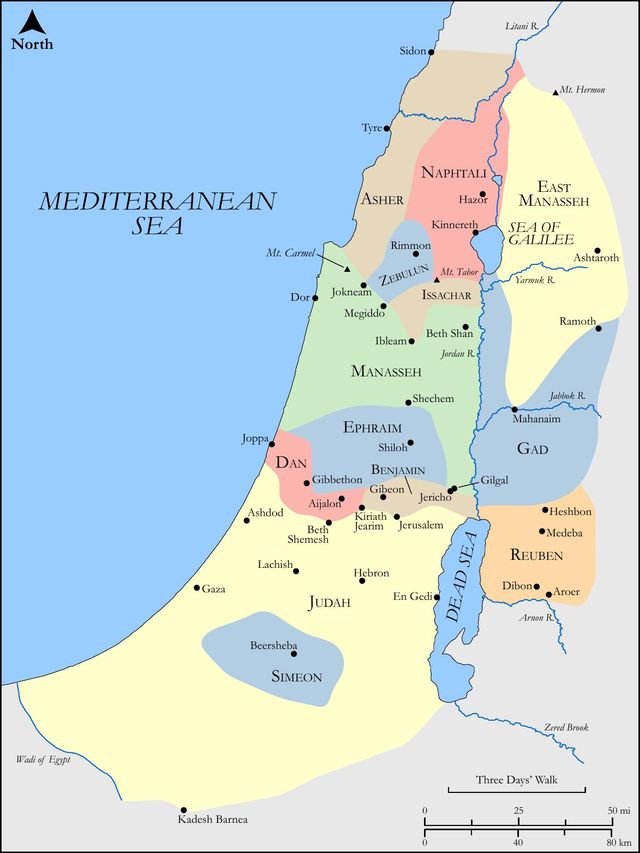
ShowHideWhile Joshua 19:40 records the allocation of a significant territory to Dan, located along the Mediterranean coast west of Benjamin and Ephraim, the tribe faced considerable challenges in fully possessing it. The Amorites, who occupied the fertile plains, were too strong for Dan to dislodge, as recorded in Judges 1:34. This failure to drive out the inhabitants led to a significant portion of the tribe seeking new territory. As detailed in Judges 18, a large contingent of Danites migrated northward, conquering the city of Laish (renaming it Dan) and establishing a new settlement there. This migration, driven by their inability to secure their initial inheritance, marked a significant departure from their divinely appointed land and ultimately contributed to their spiritual decline, as they later established idolatrous worship in their new northern home (Judges 18:30-31).
Christ-Centered Fulfillment
ShowHideWhile Joshua 19:40 details a physical land inheritance, its deeper significance points towards the ultimate spiritual inheritance found in Jesus Christ. The meticulous division of land by lot, demonstrating God's sovereign provision for His people, foreshadows the far greater spiritual blessings and "inheritance" that believers receive in Christ. Just as Israel found rest and identity in the Promised Land, believers find their true rest, security, and identity not in a geographical location, but in Christ, who is our ultimate inheritance and the fulfillment of all God's promises (Ephesians 1:11). The struggles of the tribe of Dan to fully possess their earthly inheritance highlight the limitations of a physical covenant and underscore the need for a greater deliverer and a more enduring possession. Christ, the true Joshua, leads His people into a spiritual inheritance that is imperishable, undefiled, and unfading, kept in heaven for us (1 Peter 1:4). Through His atoning work and resurrection, He secures for us not merely a plot of land, but eternal life, reconciliation with God, and a place in God's heavenly kingdom, fulfilling the promise of a deeper, more lasting rest than Canaan could ever offer (Hebrews 4:8-10).