


Joshua 18:1
- וַיִּקָּהֲלוּvai·yi·Ka·ha·Luand they assembledH6950Conj-w ¦ V-Niphal-ConsecImperf-3mpVerb Niphal Consecutive Imperfect 3rd Plural Masculineוַandיִּקָּהֲלוּthey assembled
- כָּלkolallH3605N-mscNoun Singular Masculine Construct
- עֲדַת'a·Dat[the] congregation ofH5712N-fscNoun Singular Feminine Construct
- בְּנֵיbe·nei[the] people ofH1121N-mpcNoun Plural Masculine Construct
- יִשְׂרָאֵלYis·ra·'ElIsraelH3478N-properNoun Proper Location
- שִׁלֹהshi·LohShilohH7887N-properNoun Proper Location
- וַיַּשְׁכִּינוּvai·yash·Ki·nuand they caused to dwellH7931Conj-w ¦ V-Hiphil-ConsecImperf-3mpVerb Hiphil Consecutive Imperfect 3rd Plural Masculineוַandיַּשְׁכִּינוּthey caused to dwell
- שָׁםshamthereH8033AdvAdverb
- אֶת'et<obj.>H853DirObjMParticle Object Indicator
- אֹהֶל'O·hel[the] tent ofH168N-mscNoun Singular Masculine Construct
- מוֹעֵדmo·'EdmeetingH4150N-msNoun Singular Masculine Absolute
- וְהָאָרֶץve·ha·'A·retzand the landH776Conj-w ¦ Art ¦ N-fsNoun Singular Feminine Absoluteוְandהָtheאָרֶץland
- נִכְבְּשָׁהnikh·be·Shahit was subduedH3533V-Niphal-Perf-3fsVerb Niphal Perfect 3rd Singular Feminine
- לִפְנֵיהֶםlif·nei·Hem<to> before themH6440Prep-l ¦ N-mpc ¦ 3mpNoun Plural Masculine Constructלִ<to>פְנֵיbeforeהֶםthem
English is a literal word-by-word gloss of the Hebrew, not the KJV's wording. Why?
This is the original text the KJV's translators worked from — each Hebrew word with its own literal English meaning in this verse, prepared by scholars at Tyndale House, Cambridge. The KJV translates whole sentences, not word by word, so its wording differs: one Hebrew word can become several English words, and the KJV may choose “the LORD” where the gloss reads “Yahweh”. Both are faithful — they answer different questions. For the KJV's own rendering, switch to the KJV text.
Details
See on the biblical-era map
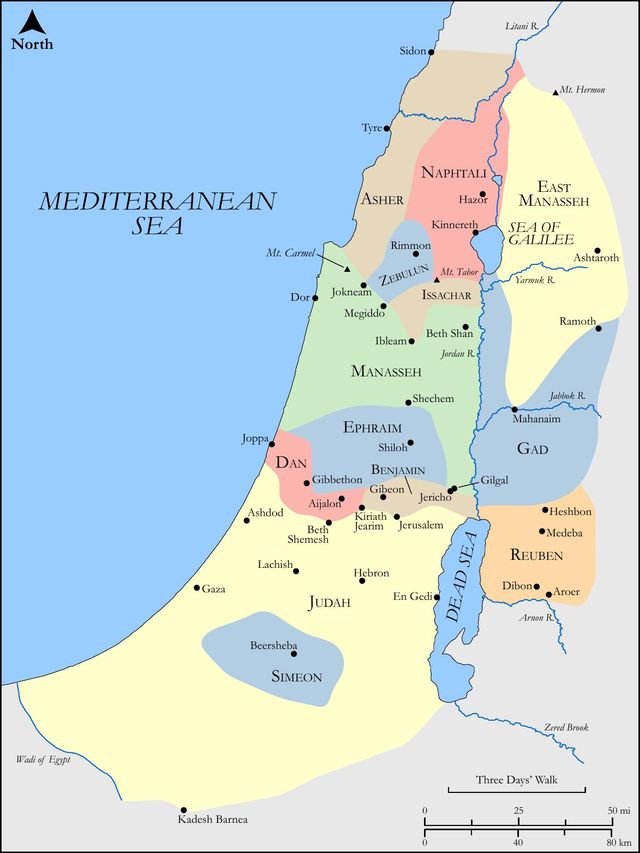
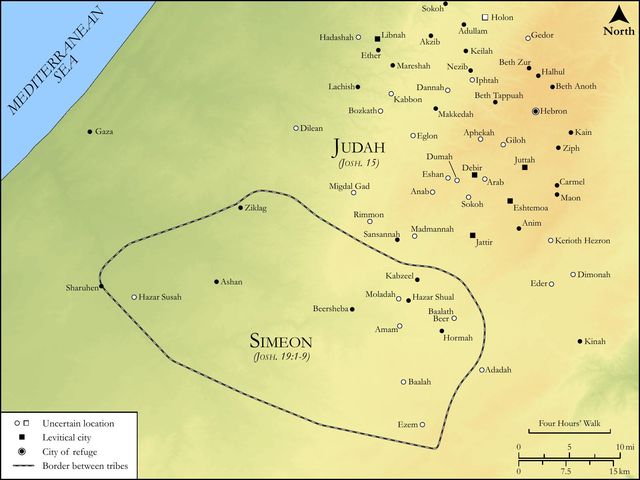
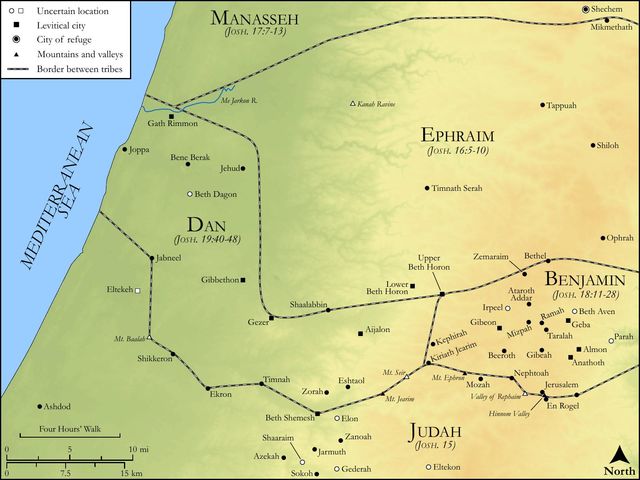
Study this verse
Public-domain commentary
Matthew Henry
From his Commentary on the Whole Bible. Henry comments on passages, not single verses — this entry covers Joshua 18:1. His two-level outline is real structure in the source text, so it is rendered as structure.
In the midst of the story of the dividing of the land comes in this account of the setting up of the tabernacle, which had hitherto continued in its old place in the centre of their camp; but now that three of the four squadrons that used to surround it in the wilderness were broken and diminished, those of Judah, Ephraim, and Reuben, by the removal of those tribes to their respective possessions, and that of Dan only remained entire, it was time to think of removing the tabernacle itself into a city. Many a time the priests and Levites had taken it down, carried it, and set it up again in the wilderness, according to the directions given them (Num 4:5, etc.); but now they must do it for good and all, not one of the stakes thereof must any more be removed, nor any of the cords thereof broken, Isa 33:20. Observe,
I.The place to which the tabernacle was removed, and in which it was set up.
It was Shiloh, a city in the lot of Ephraim, but lying close upon the lot of Benjamin. Doubtless God himself did some way or other direct them to this place, for he had promised to choose the place where he would make his name to dwell, Deu 12:11. It is most probable God made known his mind in this matter by the judgment of Urim. This place was pitched upon,
1.Because it was in the heart of the country, nearer the centre than Jerusalem was, and therefore the more convenient for the meeting of all Israel there from the several parts of the country; it had been in the midst of their camp in the wilderness, and therefore must now be in the midst of their nation, as that which sanctified the whole, and was the glory in the midst of them. See Psa 46:5.
2.Because it was in the lot of that tribe of which Joshua was, who was now their chief magistrate, and it would be both for his honour and convenience and for the advantage of the country to have it near him. The testimony of Israel and the thrones of judgment do well together, Psa 122:4, Psa 122:5.
3.Some think there was an eye to the name of the place, Shiloh being the name by which the Messiah was known in dying Jacob's prophecy (Gen 49:10), which prophecy, no doubt, was well known among the Jews; the setting up of the tabernacle in Shiloh gave them a hint that in that Shiloh whom Jacob spoke of all the ordinances of this worldly sanctuary should have their accomplishment in a greater and more perfect tabernacle, Heb 9:1, Heb 9:11. And Dr. Lightfoot thinks that the place where the tabernacle was set up was therefore called Shiloh, because of the peaceableness of the land at this time; as afterwards in Salem was his temple, which also signifies peaceable.
II.The solemn manner of doing it:
The whole congregation assembled together to attend the solemnity, to do honour to the ark of God, as the token of his presence, and to bid it welcome to its settlement. Every Israelite was interested in it, and therefore all testified their joy and satisfaction upon this occasion. See Sa2 6:15. It is probable those tribes that were yet encamped when the tabernacle was removed to Shiloh decamped from Gilgal and pitched about Shiloh, for every true Israelite will desire to fix where God's tabernacle fixed. Mention is made, on this occasion, of the land being subdued before them, to intimate that the country, hereabouts at least, being thoroughly reduced, they met with no opposition, nor were they apprehensive of any danger, but thought it time to make this grateful acknowledgment of God's goodness to them in the constant series of successes with which he had blessed them. It was a good presage of a comfortable settlement to themselves in Canaan, when their first care was to see the ark well settled as soon as they had a safe place ready to settle it in. Here the ark continued about 300 years, till the sins of Eli's house forfeited the ark, lost it and ruined Shiloh, and its ruins were long after made use of as warnings to Jerusalem. Go, see what I did to Shiloh, Jer 7:12; Psa 78:60.
Historical interpretation
Historical reception
1 surviving comment on this verse from the historical church.
For surely the waves of the deep, brackish and turbulent sea can signify both the sins among which the reprobate are lost in this life when they delight in evil and also the pit of the future perdition, when at the last judgment they will be sent with the devil into eternal fire.We should not forget that when the tabernacle was built on Mount Sinai it had the Red Sea to its west, and when it was brought into the land of promise and set up at Shiloh by Joshua it had the Great Sea in the same direction. Mystically, therefore, we can understand by this that the saints who serve the Lord in this life and make a tabernacle for him in their hearts despise the proud boasting of the impious, confidently mindful that it is soon to pass away: when they are established with the Lord in the future homeland, they shall look at the perpetual punishment of the impious without any interruption of their own felicity. Consequently, the elders give thanks to the Lord because they also contemplate the evil things from which he has delivered them.
Continue studying Joshua 18:1 across the web’s major study libraries — every link below opens this exact verse, chapter, or book on the destination site.
Read & Compare
 BibleGatewayThis verse in more than 200 translations and 70 languages.
 Bible.comThe YouVersion reader — hundreds of translations, reading plans, and highlights.
 ESV.orgCrossway's official English Standard Version reader.
 NET BibleThe NET translation with 60,000+ translators' notes on every rendering decision.
 STEP BibleTyndale House's free study tool — original text, vocabulary, and scholarly resources.
 BibliaLogos Bible Software's free web reader.
 USCCBThe New American Bible (Revised Edition) with the U.S. bishops' study notes.
Commentaries
 BibleHub CommentariesDozens of classic commentaries on this verse, gathered on one page.
 StudyLightMore than 100 commentary sets — the largest collection on the web.
 BibleRefPlain-English commentary on what this verse means, verse by verse.
 Enduring WordDavid Guzik's free commentary on this chapter, widely used by Bible teachers.
 Bible Study ToolsVerse commentary alongside Greek and Hebrew study aids.
Original Language & Research
- BibleHub InterlinearThe verse word by word — original language, transliteration, and English.
- BibleHub LexiconEvery word's original-language definition and Strong's entry.
 Blue Letter BibleDeep-study tools — Strong's numbers, concordance, and word studies.
 SefariaThe Hebrew text with Rashi and centuries of Jewish commentary.
Sermons, Hymns & Audio


TrulyRandomVerse is not affiliated with these sites and doesn’t control their content. They’re linked because they’re genuinely useful.
Summary
Joshua 18:1 marks a profound transition in Israel's post-conquest history, signaling a shift from military campaigns to the systematic and divinely ordered settlement of the Promised Land. With the major organized resistance effectively broken and "the land subdued," the entire congregation of Israel gathered at Shiloh, a strategically central location. This pivotal assembly culminated in the establishment of the Tabernacle of the congregation, thereby solidifying Shiloh as the spiritual and administrative heart of the nascent nation. This act underscored God's unwavering presence and faithfulness in guiding His people towards their promised inheritance, establishing an ordered life centered on His worship and covenant relationship.
Context
ShowHideLiterary Context
This verse serves as a critical hinge point in the book of Joshua. It immediately follows the initial, partial distribution of land to the tribes of Reuben, Gad, and the half-tribe of Manasseh east of the Jordan (Joshua 13) and to Judah, Ephraim, and the other half-tribe of Manasseh west of the Jordan (Joshua 14-17). While these major tribes had received their portions, the remaining seven tribes had not yet taken full possession of their inheritance. Joshua 18:1 thus signals a necessary pause in the ongoing process of land apportionment, highlighting an incomplete task. The assembly at Shiloh sets the stage for the detailed surveys and subsequent distribution of the remaining territories, as meticulously described in Joshua 18:2-10. Crucially, it emphasizes the priority of centralizing worship and establishing God's dwelling place before the complete settlement of the land, reflecting a divine order for the nation's spiritual and administrative life.
Historical & Cultural Context
Shiloh, located in the central hill country within the territory of Ephraim, was chosen for its strategic centrality, making it readily accessible to all the Israelite tribes. Its selection as the permanent site for the Tabernacle (for this period) was not arbitrary; it became the de facto religious and administrative capital of Israel for approximately 300 years, enduring until the time of Samuel and the rise of the monarchy. The phrase "the land was subdued" refers to the breaking of the major Canaanite military coalitions and the capture of key strongholds, such as Jericho, Ai, and Hazor, as detailed in Joshua 6-11. It does not imply the complete eradication of every Canaanite inhabitant, a reality later chapters and the book of Judges lament. This phase marked a significant transition from a nomadic, military existence to a more settled, agricultural society. A fixed point for national worship and governance, embodied by the Tabernacle, was essential for Israel's identity and unity as they transitioned into a settled nation, serving as the physical manifestation of the covenant relationship between Yahweh and His people.
Key Themes
ShowHideThis verse encapsulates several profound themes central to the narrative of Joshua and the broader Old Testament. Foremost is the centralization of worship around the Tabernacle, signifying God's abiding presence among His people and the imperative of a unified spiritual life for the nascent nation. This act directly fulfills Mosaic commands regarding a designated place for worship, as seen in Deuteronomy 12:5-7. It also powerfully emphasizes divine faithfulness in fulfilling the promises made to Abraham regarding the land, as the declaration "the land was subdued before them" (Genesis 12:7) provides tangible evidence of God's covenant keeping. Furthermore, the verse marks a significant transition from conquest to settlement and inheritance, highlighting the shift from military engagement to the administrative and communal task of organizing the tribal territories. This transition underscores the theme of rest from warfare, though not from all challenges, and the establishment of order in the life of the covenant community, firmly centered on God's commands and His active presence.
Exposition and Analysis
ShowHideKey Word Analysis
ShowHideThis term (H5712) refers to the entire assembly of the people of Israel, emphasizing their collective identity and unity as a covenant community. The use of "whole congregation" underscores that this was not a localized tribal gathering but a national convocation, demonstrating the solidarity of all twelve tribes in their worship and in the shared task of inheriting the land. It signifies a unified effort and shared purpose under God's leadership.
This word (H168) denotes a "tent" or "dwelling place," specifically referring to the portable sanctuary where God met with His people. Its establishment at Shiloh signified that God's presence, previously mobile, was now fixed at a central location within the Promised Land. This "Tent of Meeting" (often combined with H4150, môwʻêd, "appointed time/place of meeting") served as the spiritual anchor for the emerging nation, a constant reminder of their covenant relationship with Yahweh, and the central place for worship, sacrifice, and seeking divine guidance.
This verb (H3533) means "to tread down," "to conquer," or "to bring into bondage." In this context, it signifies a decisive and forceful subjugation of the major Canaanite powers. While not every enemy was eliminated, the organized military resistance had been effectively broken, allowing Israel to transition from active warfare to the more administrative task of land distribution and settlement. It implies a comprehensive victory over the primary threats, making the land ready for occupation.
Verse Breakdown
ShowHide"And the whole congregation of the children of Israel assembled together at Shiloh"
This opening clause highlights the unity and collective action of the Israelite nation. The assembly at Shiloh, a centrally located site, underscores the importance of communal decision-making and worship. It signifies a moment of national cohesion, bringing together all the tribes for a common purpose under God's direction, thereby reinforcing their identity as a single people under the covenant.
"and set up the tabernacle of the congregation there."
This is the pivotal act of the verse, marking a profound shift. The establishment of the Tabernacle at Shiloh transformed it into the spiritual and administrative capital of Israel for centuries. It symbolized God's continuing, fixed presence among His people, providing a central point for national worship, sacrifices, and the administration of justice. This act affirmed the centrality of God in Israel's national life and demonstrated their commitment to His covenant.
"And the land was subdued before them."
This concluding clause provides the crucial context and justification for the assembly and the Tabernacle's placement. It confirms the success of the initial military campaigns, signifying that the major organized opposition had been overcome. This "subduing" allowed for a shift from conquest to settlement, providing the necessary peace and security for the detailed division of the land among the remaining tribes. It speaks powerfully to the faithfulness of God in delivering on His promise to give them the land.
Literary Devices
ShowHideJoshua 18:1 effectively employs several literary devices to convey its profound message and mark a significant turning point. The most prominent is Transition, as the verse explicitly marks a shift from the intense period of military conquest to the subsequent phase of land distribution and settlement. This is underscored by the declarative phrase "the land was subdued before them," signaling the completion of one major divine mandate and the readiness for the next. Symbolism is powerfully present in the setting up of the Tabernacle at Shiloh. The Tabernacle itself is a potent symbol of God's dwelling presence (the Shekinah) among His people, and its fixed location at Shiloh symbolizes the establishment of a centralized spiritual authority and the beginning of a more settled, ordered national life. Furthermore, the act of the "whole congregation" assembling embodies Unity and collective purpose, demonstrating the solidarity of the tribes under God's leadership as they move forward in their shared destiny, emphasizing their identity as a single covenant people.
Theological and Thematic Connections
ShowHideJoshua 18:1 is deeply rooted in the broader theological narrative of God's covenant faithfulness and His desire for His people to dwell securely in the land He promised. The assembly at Shiloh and the establishment of the Tabernacle underscore the enduring importance of God's presence as the center of Israel's national identity, unity, and worship. This act fulfills the Mosaic command for a centralized place of worship once Israel entered the land, ensuring unity and adherence to proper worship practices and preventing the proliferation of unauthorized altars. The "subduing" of the land is a powerful testament to God's power and His unwavering commitment to His covenant promises, providing a tangible demonstration of His active involvement in their history. However, it also subtly foreshadows the ongoing spiritual battles and the incomplete nature of the physical conquest, reminding Israel that true rest and security ultimately depend not merely on military victory but on their continued obedience and reliance on God.
Reflection and Application
ShowHideJoshua 18:1 offers profound lessons for contemporary believers, illustrating the critical importance of spiritual consolidation after periods of divine activity. Just as Israel, having experienced God's powerful deliverance and victory in subduing the land, paused to establish a spiritual center, we too are called to prioritize God's presence and worship in our lives. After seasons of intense spiritual battles, significant achievements, or even periods of transition, there is a crucial need to consolidate our gains, establish spiritual disciplines, and intentionally create "Shilohs"—places, practices, or rhythms where we consistently meet with God, seek His guidance, and center our lives around His will and Word. This verse reminds us that true rest and security come not just from external circumstances or the absence of conflict, but from an internal commitment to God's presence and an ordered life lived under His authority. It encourages us to move beyond mere "conquest" to faithful stewardship of the blessings and opportunities God has given us, ensuring that our lives remain rooted in His divine purpose and presence, fostering spiritual stability and growth.
Questions for Reflection
ShowHideFAQ
ShowHideWhy was Shiloh chosen as the location for the Tabernacle?
ShowHideShiloh was chosen for several practical and symbolic reasons. Geographically, it was centrally located within the land of Canaan, making it accessible to all the tribes, thereby fostering national unity and ease of pilgrimage. It was also situated in the territory of Ephraim, the tribe of Joshua himself, which may have contributed to its selection as a stable base. Theologically, its centrality allowed it to serve as the single, designated place where God met with His people, fulfilling the Mosaic command for a centralized sanctuary (as seen in Deuteronomy 12:5-7). Its establishment there solidified Shiloh as the spiritual and administrative capital of Israel for several centuries, providing a fixed point for national identity and worship.
Does "the land was subdued before them" mean that all the Canaanites were completely driven out?
ShowHideNo, "the land was subdued before them" indicates that the major organized military resistance of the Canaanite kingdoms had been broken, and Israel had established dominance over the strategic areas and key strongholds. It signifies a decisive victory over the primary threats, allowing for the peaceful distribution and settlement of the land. However, it does not mean that every single Canaanite inhabitant was eradicated or that all pockets of resistance were eliminated. Later chapters in Joshua (e.g., Joshua 15:63) and especially the book of Judges clearly show that many Canaanites remained in the land, leading to ongoing conflicts and challenges for Israel due to their incomplete obedience.
What happened to the Tabernacle at Shiloh later in Israel's history?
ShowHideThe Tabernacle remained at Shiloh for a significant period, serving as the central place of worship throughout the era of the Judges. It was a vital pilgrimage site where Israelites would gather for major festivals and to seek the Lord's guidance. However, during the tumultuous time of the prophet Samuel and the high priesthood of Eli, the Philistines defeated Israel, captured the Ark of the Covenant, and subsequently destroyed Shiloh (as implied in 1 Samuel 4:1-11 and later referenced by the prophet Jeremiah in Jeremiah 7:12-14). After this catastrophic event, the Tabernacle's components and the Ark were separated, and the central place of worship shifted, eventually leading to the construction of Solomon's magnificent Temple in Jerusalem, which became the new, permanent dwelling place for God's presence among His people.
Christ-Centered Fulfillment
ShowHideJoshua 18:1, with its emphasis on the "subduing" of the land and the establishment of the Tabernacle as a central meeting place, powerfully foreshadows the redemptive work of Jesus Christ. The temporary "rest" and partial "subduing" of the land by Israel point to the ultimate and eternal rest provided by Christ, who fully subdues all spiritual enemies and provides true peace. Just as the Tabernacle at Shiloh was the dwelling place of God among His people, Jesus Christ is the ultimate "Tabernacle" (or "Tent") where God truly dwells among humanity, for in Him "the Word became flesh and dwelt among us" (John 1:14). He is the true meeting place between God and humanity, the one through whom we approach the Father (Hebrews 10:19-22). The land inheritance, a physical promise to Israel, finds its spiritual and eternal fulfillment in the believer's inheritance in Christ—a new creation, a spiritual kingdom, and eternal life (Ephesians 1:11 and 1 Peter 1:3-4). Through His death and resurrection, Jesus has definitively "subdued" sin, death, and the devil, disarming the powers and authorities (Colossians 2:15 and Hebrews 2:14), ushering in a new covenant where true rest and an eternal inheritance are secured for all who believe in Him, inviting all who are weary to find rest in Him (Matthew 11:28-30 and Hebrews 4:9-10).