


Joshua 22:9
Bible text: King James Version (1769 Blayney text) · Public domain
Bible text: King James Version with Strong's numbers · Public domain
Bible text: Berean Standard Bible · Public domain
Bible text: American Standard Version (1901) · Public domain
Bible text: World English Bible, Messianic edition · Public domain
Bible text: Geneva Bible (1599) · Public domain
Bible text: Young's Literal Translation · Public domain
- וַיָּשֻׁבוּvai·ya·Shu·vuand they returnedH7725Conj-w ¦ V-Qal-ConsecImperf-3mpVerb Qal Consecutive Imperfect 3rd Plural Masculineוַandיָּשֻׁבוּthey returned
- וַיֵּלְכוּvai·ye·le·Khuand they wentH1980Conj-w ¦ V-Qal-ConsecImperf-3mpVerb Qal Consecutive Imperfect 3rd Plural Masculineוַandיֵּלְכוּthey went
- בְּנֵיbe·nei[the] descendants ofH1121N-mpcNoun Plural Masculine Construct
- רְאוּבֵןre·'u·VenReubenH7205N-proper-mNoun Proper Masculine
- וּבְנֵיu·ve·neiand [the] descendants ofH1121Conj-w ¦ N-mpcNoun Plural Masculine Constructוּandבְנֵי[the] descendants of
- גָדgadGadH1410N-proper-mNoun Proper Masculine
- וַחֲצִיva·cha·Tziand [the] half ofH2677Conj-w ¦ N-mscNoun Singular Masculine Constructוַandחֲצִי[the] half of
- שֵׁבֶטShe·vet[the] tribe ofH7626N-mscNoun Singular Masculine Construct
- הַמְנַשֶּׁהham·na·Sheh<the> ManassehH4519Art ¦ N-csNoun Gentilic Singular common gender Absoluteהַ<the>מְנַשֶּׁהManasseh
- מֵאֵתme·'Etfrom withH854Prep-m ¦ PrepPrepositionמֵfromאֵתwith
- בְּנֵיbe·Nei[the] people ofH1121N-mpcNoun Plural Masculine Construct
- יִשְׂרָאֵלYis·ra·'ElIsraelH3478N-properNoun Proper Location
- מִשִּׁלֹהmi·shi·Lohfrom ShilohH7887Prep-m ¦ N-properNoun Proper LocationמִfromשִּׁלֹהShiloh
- אֲשֶׁר'a·SherwhichH834RelParticle Relative
- בְּאֶרֶץbe·'e·retz[is] in [the] land ofH776Prep-b ¦ N-fscNoun Singular Feminine Constructבְּ[is] inאֶרֶץ[the] land of
- כְּנָעַןke·Na·'anCanaanH3667N-properNoun Proper Location
- לָלֶכֶתla·Le·khetto goH1980Prep-l ¦ V-Qal-InfVerb Qal Infinitive Constructלָtoלֶכֶתgo
- אֶל'eltoH413PrepPreposition
- אֶרֶץ'E·retz[the] land ofH776N-fscNoun Singular Feminine Construct
- הַגִּלְעָדha·gil·'Ad<the> GileadH1568Art ¦ N-properNoun Proper Locationהַ<the>גִּלְעָדGilead
- אֶל'eltoH413PrepPreposition
- אֶרֶץ'E·retz[the] land ofH776N-fscNoun Singular Feminine Construct
- אֲחֻזָּתָם'a·chu·za·Tamtheir possessionH272N-fsc ¦ 3mpNoun Singular Feminine Constructאֲחֻזָּתָpossessionםtheir
- אֲשֶׁר'a·SherwhichH834RelParticle Relative
- נֹאחֲזוּno·cha·zuthey had possessionsH270V-Niphal-Perf-3cpVerb Niphal Perfect 3rd Plural common gender
- בָהּVahin <the> itPrep-b ¦ 3fsSuffix Personal 3rd Singular Feminineבָin <the>הּit
- עַל'alonH5921PrepPreposition
- פִּיpi[the] mouth ofH6310N-mscNoun Singular Masculine Construct
- יְהוָהYah·wehYahwehH3068N-properNoun Proper Title
- בְּיַדbe·yadby [the] hand ofH3027Prep-b ¦ N-cscNoun Singular common gender Constructבְּbyיַד[the] hand of
- מֹשֶׁהmo·ShehMosesH4872N-proper-mNoun Proper Masculine
English is a literal word-by-word gloss of the Hebrew, not the KJV's wording. Why?
This is the original text the KJV's translators worked from — each Hebrew word with its own literal English meaning in this verse, prepared by scholars at Tyndale House, Cambridge. The KJV translates whole sentences, not word by word, so its wording differs: one Hebrew word can become several English words, and the KJV may choose “the LORD” where the gloss reads “Yahweh”. Both are faithful — they answer different questions. For the KJV's own rendering, switch to the KJV text.
Details
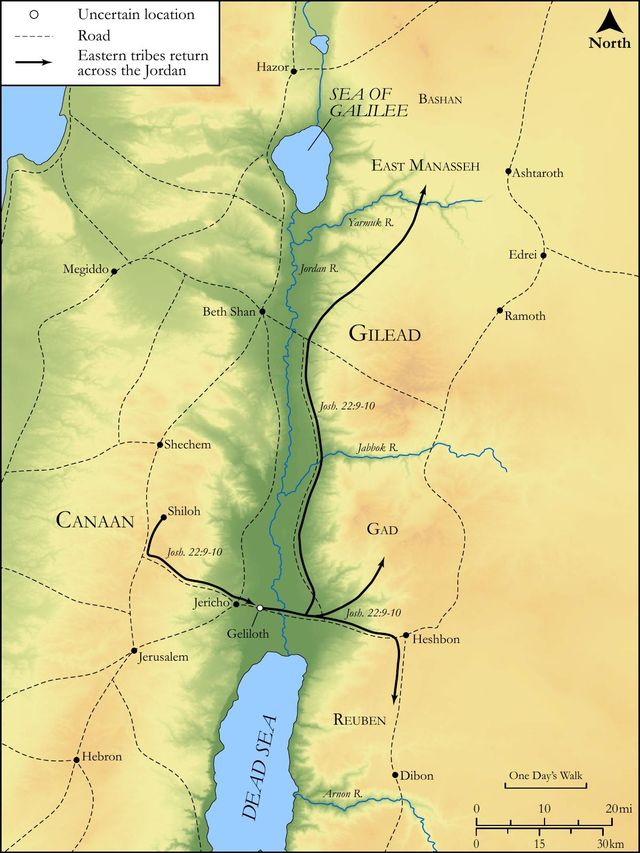
See on the biblical-era map
Study this verse
Historical interpretation
Historical reception
1 surviving comment on this verse from the historical church.
After these things Jesus [Joshua] assembles the sons of Reuben and the sons of Gad and the half-tribe of Manasseh, who had served as soldiers with him to overcome the foes of the Israelites, and he dismisses them to go to their inheritance with certain gifts given to them, as it is written. Whereby this seems to indicate the mystery that “when the fullness of the nations will come in,” they receive from the Lord Jesus what was promised to them, those who had been taught and instructed by Moses and who by prayers and entreaties brought aid to us who are placed in the contest. They have not yet “attained the promises,” waiting so that our calling might also be fulfilled, as the apostle says. But now at last with the gifts they receive from Jesus they may attain the perfection that had been deferred for them so that each one may dwell in peace with every war and every battle ceasing.
Continue studying Joshua 22:9 across the web’s major study libraries — every link below opens this exact verse, chapter, or book on the destination site.
Read & Compare
 BibleGatewayThis verse in more than 200 translations and 70 languages.
 Bible.comThe YouVersion reader — hundreds of translations, reading plans, and highlights.
 ESV.orgCrossway's official English Standard Version reader.
 NET BibleThe NET translation with 60,000+ translators' notes on every rendering decision.
 STEP BibleTyndale House's free study tool — original text, vocabulary, and scholarly resources.
 BibliaLogos Bible Software's free web reader.
 USCCBThe New American Bible (Revised Edition) with the U.S. bishops' study notes.
Commentaries
 BibleHub CommentariesDozens of classic commentaries on this verse, gathered on one page.
 StudyLightMore than 100 commentary sets — the largest collection on the web.
 BibleRefPlain-English commentary on what this verse means, verse by verse.
 Enduring WordDavid Guzik's free commentary on this chapter, widely used by Bible teachers.
 Bible Study ToolsVerse commentary alongside Greek and Hebrew study aids.
Original Language & Research
- BibleHub InterlinearThe verse word by word — original language, transliteration, and English.
- BibleHub LexiconEvery word's original-language definition and Strong's entry.
 Blue Letter BibleDeep-study tools — Strong's numbers, concordance, and word studies.
 SefariaThe Hebrew text with Rashi and centuries of Jewish commentary.
Sermons, Hymns & Audio


TrulyRandomVerse is not affiliated with these sites and doesn’t control their content. They’re linked because they’re genuinely useful.
Summary
Joshua 22:9 marks the significant moment when the Transjordanian tribes—Reuben, Gad, and the half-tribe of Manasseh—concluded their faithful military service alongside the other Israelite tribes in Canaan. Having assisted in the conquest, they departed from Shiloh, the central spiritual hub where the Tabernacle was located, to return to their divinely allotted inheritance in the land of Gilead, east of the Jordan River. This return signified the fulfillment of a long-standing promise delivered through Moses, marking a crucial transition in Israel's establishment within the Promised Land.
Context
ShowHideLiterary Context
Joshua 22:9 is strategically placed at a pivotal point in the book of Joshua, immediately following Joshua's commendation and formal dismissal of the Transjordanian tribes in Joshua 22:1-8. These preceding verses underscore the tribes' unwavering faithfulness to their oath made to Moses and Joshua, highlighting their indispensable role in the unified conquest of Canaan. The verse itself serves as the direct prelude to the dramatic and significant narrative of the altar built by the Jordan, which sparks a major inter-tribal conflict and subsequent resolution, detailed in Joshua 22:10-34. This narrative sequence masterfully develops themes of national unity, the potential for misunderstanding arising from geographical separation, and the paramount importance of maintaining covenant fidelity among all the tribes of Israel as they transition from a nomadic, conquering force to a settled nation.
Historical & Cultural Context
The return of the Transjordanian tribes to their inheritance fulfills a specific covenant agreement established decades earlier with Moses, as comprehensively recorded in Numbers 32. These tribes, possessing extensive livestock, had requested and were granted land east of the Jordan on the explicit condition that their fighting men would lead the charge across the Jordan and assist the other tribes in securing the land of Canaan. Their departure from Shiloh is deeply significant, as Shiloh had been established as the central sanctuary where the Tabernacle was erected (Joshua 18:1) and where the land west of the Jordan was systematically distributed by lot. Their journey back to Gilead, a region renowned for its rich pasturelands, symbolizes the completion of their national duty and their re-establishment within their distinct, yet integral, ancestral territories. This geographical distinction, while divinely sanctioned, would inherently present challenges to national cohesion, as vividly illustrated in the subsequent narrative.
Key Themes
ShowHideThis verse profoundly encapsulates several foundational themes central to the book of Joshua and the broader Deuteronomistic history. Firstly, it powerfully illustrates the fulfillment of divine promise and human faithfulness. The tribes' return to their inheritance, explicitly stated as being "according to the word of the LORD by the hand of Moses," emphatically underscores God's unwavering commitment to His covenant promises while simultaneously affirming the tribes' steadfast obedience to their solemn oath. Secondly, the verse highlights tribal identity and territorial possession. The emphatic repetition of "the land of their possession, whereof they were possessed," reinforces the concept of inherited land as a foundational element of Israelite identity, a tangible manifestation of God's provision and blessing. Finally, the narrative of their departure from Shiloh and return to Gilead implicitly introduces the crucial theme of unity amidst geographical distinction. This inherent tension would be immediately tested in the subsequent account of the altar, demonstrating the ongoing necessity for clear communication, shared understanding, and a common commitment to Yahweh to maintain the cohesion and spiritual integrity of the twelve tribes as one people of God.
Exposition and Analysis
ShowHideKey Word Analysis
ShowHideAs identified by the Strong's data, Shiloh is a specific place located in Palestine. In the context of Joshua 22:9, it represents the central gathering point for Israel during the conquest and land distribution, where the Tabernacle was located, marking it as the spiritual and administrative hub from which the Transjordanian tribes departed, signifying the completion of their unified military service.
The Strong's data identifies Gilead as a region situated east of the Jordan. For the tribes of Reuben, Gad, and the half-tribe of Manasseh, this region was their divinely appointed inheritance, signifying their return to their distinct territorial possession after fulfilling their military obligations and transitioning to settled life.
From the Strong's data, this term refers to "something seized, i.e., a possession, especially of land." In this verse, its repeated use underscores the permanent, legally secured, and divinely granted nature of the land east of the Jordan as a legitimate and enduring inheritance for the Transjordanian tribes, emphasizing God's provision.
Verse Breakdown
ShowHide"And the children of Reuben and the children of Gad and the half tribe of Manasseh returned, and departed from the children of Israel out of Shiloh"
This opening clause precisely identifies the specific tribes involved in this momentous movement and their point of origin. Their "return" signifies the successful completion of their arduous military duty and a re-orientation towards their own homes and families. Their departure "from the children of Israel" and specifically "out of Shiloh" highlights a physical separation from the main body of the Israelite nation and from its central spiritual sanctuary, thereby setting the stage for potential misunderstandings and challenges arising from geographical distance.
"which [is] in the land of Canaan, to go unto the country of Gilead, to the land of their possession, whereof they were possessed"
This segment explicitly details their destination and emphatically underscores the nature of their inheritance. Shiloh is clearly located "in the land of Canaan" (west of the Jordan), establishing a stark geographical contrast with "the country of Gilead" (east of the Jordan). The powerful repetition of "possession" ("the land of their possession, whereof they were possessed") serves as a potent rhetorical device, reinforcing the divine legitimacy and enduring nature of their inherited territory, emphasizing that this land was not merely occupied but rightfully and permanently owned through God's sovereign grant.
"according to the word of the LORD by the hand of Moses"
This concluding phrase provides the ultimate theological justification and divine authority for the entire arrangement. It unequivocally affirms that their settlement in Gilead, their participation in the conquest, and their eventual return were all integral parts of God's meticulously orchestrated sovereign plan, communicated through His chosen mediator, Moses. This underscores the profound divine providence guiding every aspect of Israel's history and the precise fulfillment of ancient prophecies and covenant stipulations.
Literary Devices
ShowHideJoshua 22:9 employs several significant literary devices to convey its profound meaning. Repetition is prominently featured in the phrase "the land of their possession, whereof they were possessed," which serves to powerfully emphasize the legitimacy, permanence, and divine sanction of the Transjordanian tribes' inheritance. This reiteration reinforces the idea that their claim to the land was not merely a human arrangement but divinely ordained and secured. A clear Geographical Contrast is established between "Shiloh... in the land of Canaan" and "the country of Gilead," which vividly highlights the physical separation of these tribes from the main body of Israel and subtly foreshadows the geographical and cultural distinctions that would immediately lead to the tension and conflict concerning the altar in the subsequent verses. This departure also creates a sense of Anticipation, as the reader, aware of the forthcoming narrative, understands that this seemingly peaceful return will precipitate a significant challenge to national unity. Finally, the concluding phrase, "according to the word of the LORD by the hand of Moses," functions as a powerful Affirmation of Divine Authority and Covenant Fulfillment, anchoring all human actions within God's overarching and meticulously executed plan.
Theological and Thematic Connections
ShowHideJoshua 22:9 stands as a profound testament to God's unwavering faithfulness in fulfilling His promises and the paramount importance of human obedience to covenant obligations. The orderly return of the Transjordanian tribes, meticulously described as being "according to the word of the LORD by the hand of Moses," unequivocally underscores the divine hand in Israel's intricate settlement and the meticulous nature of God's providence. It highlights that the entire enterprise of the conquest and land distribution was not a mere human endeavor but was divinely orchestrated, ensuring that each tribe received its rightful and specific inheritance. This pivotal moment signifies the crucial transition from a unified military campaign to the establishment of Israel as a settled nation, emphasizing the vital importance of both corporate unity and individual tribal stewardship within God's overarching and redemptive plan for His chosen people.
Reflection and Application
ShowHideJoshua 22:9 offers profound and enduring lessons for believers today, primarily centered on the virtues of faithfulness, the absolute reliability of God's promises, and the delicate yet crucial balance of unity within diversity. Just as the Transjordanian tribes diligently fulfilled their arduous commitment to their brethren, enduring years of separation and conflict, we too are called to be people of unwavering integrity, honoring our word and faithfully fulfilling our responsibilities, whether in our families, our local communities, or in our dedicated service to God. Their journey home, meticulously guided by a divine word given through Moses, serves as a powerful reminder that God's plans are meticulously unfolded in His perfect timing, and His promises are always true, providing an unshakable foundation for our trust and hope in every circumstance. Furthermore, this verse subtly introduces the inherent challenge of maintaining unity across geographical, cultural, and even theological distinctions within the body of Christ. It calls us to intentional communication, empathetic mutual understanding, and a shared, unwavering commitment to the larger body of Christ, ensuring that our individual identities, unique callings, and distinct ministries contribute harmoniously to, rather than detract from, the collective mission and testimony of God's people in the world.
Questions for Reflection
ShowHideFAQ
ShowHideWhy were these tribes settled east of the Jordan River, distinct from the main body of Israel in Canaan?
ShowHideThe tribes of Reuben, Gad, and the half-tribe of Manasseh requested this territory from Moses because it was exceptionally well-suited for their large herds of livestock (Numbers 32:1-5). Moses initially expressed hesitation, fearing it would discourage the other tribes from entering Canaan, but he ultimately agreed on the condition that their fighting men would cross the Jordan first and assist the other tribes in conquering the land of Canaan (Numbers 32:16-22). This unique arrangement was part of God's sovereign plan for the distribution of the land, acknowledging their specific needs while ensuring their full participation in the national effort of conquest and settlement.
What was the significance of Shiloh in this verse, and why was their departure from it noteworthy?
ShowHideShiloh served as the primary spiritual and administrative center for Israel during the period of the Judges, following the initial conquest. It was the sacred place where the Tabernacle, the physical manifestation of God's presence among His people, was set up (Joshua 18:1) and where the remaining land in Canaan was apportioned by lot to the other tribes. Their departure from Shiloh was profoundly noteworthy because it marked a physical separation from the central place of worship and national unity. It symbolized the completion of their shared military duty and the transition to their individual tribal responsibilities and distinct geographical inheritance, raising crucial questions about how they would maintain their spiritual and national connection to the greater Israelite community and its central worship.
Christ-Centered Fulfillment
ShowHideJoshua 22:9, with its profound emphasis on the fulfillment of a divine promise and the return to an inherited possession, finds its ultimate and most glorious Christ-centered fulfillment in the person and redemptive work of Jesus Christ. Just as the Transjordanian tribes entered their promised land "according to the word of the LORD by the hand of Moses," so too does Christ, the true and greater Joshua, lead His people not merely into a physical land, but into the spiritual rest and eternal inheritance promised to all who believe in Him (Hebrews 4:8-10). Jesus is the faithful One who perfectly fulfills every single promise of God, for "all the promises of God find their Yes in him" (2 Corinthians 1:20), thereby securing for us a "possession" that is imperishable, undefiled, and unfading, kept in heaven (1 Peter 1:4). Our ultimate "Gilead" is not merely a geographical region, but the "heavenly country" (Hebrews 11:16) to which Christ, our glorious forerunner, has already ascended, entering the inner sanctuary on our behalf (Hebrews 6:19-20). Through His perfect sacrifice on the cross, He has secured our true "rest" and "possession," not by military conquest of a physical land, but by triumphing over sin and death, establishing a New Covenant that brings us into full and eternal communion with God, a reality that infinitely surpasses the temporary and typological arrangements of the Old Covenant.