


Joshua 22:8
Bible text: King James Version (1769 Blayney text) · Public domain
Bible text: King James Version with Strong's numbers · Public domain
Bible text: Berean Standard Bible · Public domain
Bible text: American Standard Version (1901) · Public domain
Bible text: World English Bible, Messianic edition · Public domain
Bible text: Geneva Bible (1599) · Public domain
Bible text: Young's Literal Translation · Public domain
- וַיֹּאמֶרvai·Yo·merand he saidH559Conj-w ¦ V-Qal-ConsecImperf-3msVerb Qal Consecutive Imperfect 3rd Singular Masculineוַandיֹּאמֶרhe said
- אֲלֵיהֶם'a·lei·Hemto themH413Prep ¦ 3mpPreposition Definiteאֲלֵיtoהֶםthem
- לֵאמֹרle·Mor<to> sayingH559Prep-l ¦ V-Qal-InfVerb Qal Infinitive Constructלֵ<to>אמֹרsaying
- בִּנְכָסִיםbin·kha·Simwith richesH5233Prep-b ¦ N-mpNoun Plural Masculine Absoluteבִּwithנְכָסִיםriches
- רַבִּיםra·BimgreatH7227Adj-mpAdjective Plural Masculine Absolute
- שׁוּבוּShu·vureturnH7725V-Qal-Imp-2mpVerb Qal Imperative 2nd Plural Masculine
- אֶל'eltoH413PrepPreposition
- אָהֳלֵיכֶם'o·ho·lei·Khemyour tentsH168N-mpc ¦ 2mpNoun Plural Masculine Constructאָהֳלֵיtentsכֶםyour
- וּבְמִקְנֶהu·ve·mik·Nehand with livestockH4735Conj-w ¦ Prep-b ¦ N-msNoun Singular Masculine Absoluteוּandבְwithמִקְנֶהlivestock
- רַבravmuchH7227Adj-msAdjective Singular Masculine Absolute
- מְאֹדme·'OdveryH3966Adj-msAdjective Numerical Singular Masculine Absolute
- בְּכֶסֶףbe·Khe·sefwith silverH3701Prep-b ¦ N-msNoun Singular Masculine Absoluteבְּwithכֶסֶףsilver
- וּבְזָהָבu·ve·za·Havand with goldH2091Conj-w ¦ Prep-b ¦ N-msNoun Singular Masculine Absoluteוּandבְwithזָהָבgold
- וּבִנְחֹשֶׁתu·vin·Cho·shetand with bronzeH5178Conj-w ¦ Prep-b ¦ N-fsNoun Singular Feminine Absoluteוּandבִwithנְחֹשֶׁתbronze
- וּבְבַרְזֶלu·ve·var·Zeland with ironH1270Conj-w ¦ Prep-b ¦ N-msNoun Singular Masculine Absoluteוּandבְwithבַרְזֶלiron
- וּבִשְׂלָמוֹתu·vis·la·Motand with garmentsH8008Conj-w ¦ Prep-b ¦ N-fpNoun Plural Feminine Absoluteוּandבִwithשְׂלָמוֹתgarments
- הַרְבֵּהhar·BehmanyH7235V-Hiphil-InfAbsVerb Hiphil Infinitive Absolute
- מְאֹדme·'OdveryH3966Adj-msAdjective Numerical Singular Masculine Absolute
- חִלְקוּchil·KudivideH2505V-Qal-Imp-2mpVerb Qal Imperative 2nd Plural Masculine
- שְׁלַלshe·lal[the] booty ofH7998N-mscNoun Singular Masculine Construct
- אֹיְבֵיכֶם'o·ye·vei·Khemyour enemiesH341V-Qal-Prtcpl-mp ¦ 2mpVerb Qal Participle Plural Masculine Constructאֹיְבֵיenemiesכֶםyour
- עִם'imwithH5973PrepPreposition
- אֲחֵיכֶם'a·chei·Khemyour countrymenH251N-mpc ¦ 2mpNoun Plural Masculine Constructאֲחֵיcountrymenכֶםyour
English is a literal word-by-word gloss of the Hebrew, not the KJV's wording. Why?
This is the original text the KJV's translators worked from — each Hebrew word with its own literal English meaning in this verse, prepared by scholars at Tyndale House, Cambridge. The KJV translates whole sentences, not word by word, so its wording differs: one Hebrew word can become several English words, and the KJV may choose “the LORD” where the gloss reads “Yahweh”. Both are faithful — they answer different questions. For the KJV's own rendering, switch to the KJV text.
Details
See on the biblical-era map
Study this verse
Historical interpretation
Historical reception
1 surviving comment on this verse from the historical church.
After these things Jesus [Joshua] assembles the sons of Reuben and the sons of Gad and the half-tribe of Manasseh, who had served as soldiers with him to overcome the foes of the Israelites, and he dismisses them to go to their inheritance with certain gifts given to them, as it is written. Whereby this seems to indicate the mystery that “when the fullness of the nations will come in,” they receive from the Lord Jesus what was promised to them, those who had been taught and instructed by Moses and who by prayers and entreaties brought aid to us who are placed in the contest. They have not yet “attained the promises,” waiting so that our calling might also be fulfilled, as the apostle says. But now at last with the gifts they receive from Jesus they may attain the perfection that had been deferred for them so that each one may dwell in peace with every war and every battle ceasing.
Continue studying Joshua 22:8 across the web’s major study libraries — every link below opens this exact verse, chapter, or book on the destination site.
Read & Compare
 BibleGatewayThis verse in more than 200 translations and 70 languages.
 Bible.comThe YouVersion reader — hundreds of translations, reading plans, and highlights.
 ESV.orgCrossway's official English Standard Version reader.
 NET BibleThe NET translation with 60,000+ translators' notes on every rendering decision.
 STEP BibleTyndale House's free study tool — original text, vocabulary, and scholarly resources.
 BibliaLogos Bible Software's free web reader.
 USCCBThe New American Bible (Revised Edition) with the U.S. bishops' study notes.
Commentaries
 BibleHub CommentariesDozens of classic commentaries on this verse, gathered on one page.
 StudyLightMore than 100 commentary sets — the largest collection on the web.
 BibleRefPlain-English commentary on what this verse means, verse by verse.
 Enduring WordDavid Guzik's free commentary on this chapter, widely used by Bible teachers.
 Bible Study ToolsVerse commentary alongside Greek and Hebrew study aids.
Original Language & Research
- BibleHub InterlinearThe verse word by word — original language, transliteration, and English.
- BibleHub LexiconEvery word's original-language definition and Strong's entry.
 Blue Letter BibleDeep-study tools — Strong's numbers, concordance, and word studies.
 SefariaThe Hebrew text with Rashi and centuries of Jewish commentary.
Sermons, Hymns & Audio


TrulyRandomVerse is not affiliated with these sites and doesn’t control their content. They’re linked because they’re genuinely useful.
Summary
Joshua 22:8 marks the climactic dismissal of the Transjordanian tribes—Reuben, Gad, and the half-tribe of Manasseh—after their seven years of faithful military service in the conquest of Canaan. Joshua, acting as God's chosen leader, commends their unwavering obedience to the covenant and bestows upon them an extraordinary bounty of war spoils. This immense material wealth, encompassing livestock, precious metals, and fine garments, serves as a tangible reward for their perseverance and a testament to God's abundant provision. Crucially, Joshua's charge culminates in a powerful command: to share these accumulated riches with their brethren back in their inherited territories, thereby reinforcing the foundational principles of communal unity, equitable distribution, and shared blessing within the covenant community of Israel.
Context
ShowHideLiterary Context
This verse is strategically placed at the conclusion of the conquest and land distribution narratives in the book of Joshua, serving as a pivotal transition point. It follows the detailed accounts of Israel's military victories (chapters 6-12) and the intricate process of dividing the land among the tribes (chapters 13-21). Joshua's address to the eastern tribes in Joshua 22:1-8 functions as a formal commendation and discharge, fulfilling the long-standing commitment these tribes made to Moses in Numbers 32 and reaffirmed to Joshua in Joshua 1:12-18. The immediate narrative context after this verse is the controversial construction of an altar by these returning tribes, which initially sparks a crisis of unity among the western tribes but ultimately reaffirms the singular worship of Yahweh and the solidarity of all Israel (see Joshua 22:9-34). Thus, Joshua 22:8 sets the stage for a crucial test of the very unity it seeks to reinforce.
Historical & Cultural Context
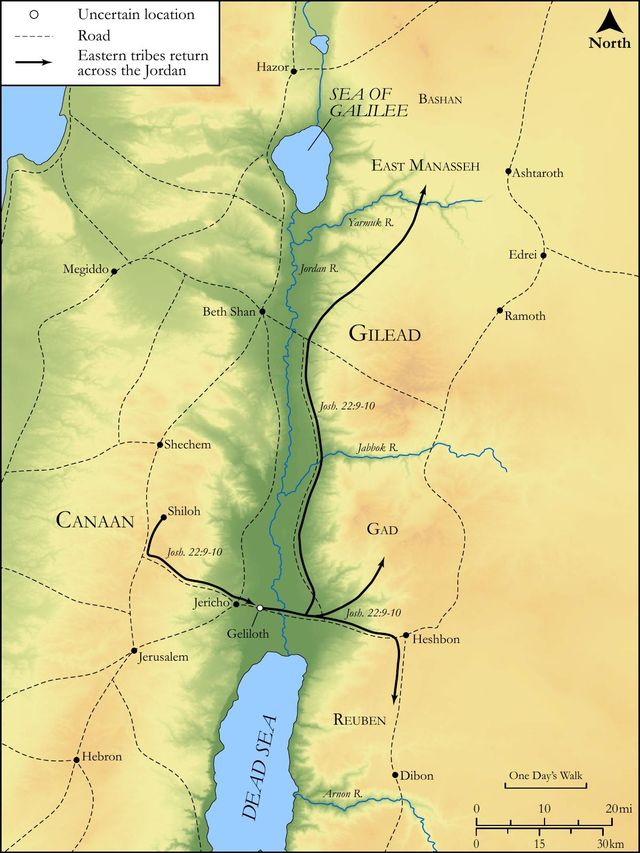
For approximately seven years, the fighting men of Reuben, Gad, and half-Manasseh had left their families and their designated inheritance on the east side of the Jordan River to participate actively in the arduous conquest of Canaan. This extraordinary commitment was a fulfillment of a solemn oath made to Moses, promising to assist their brethren in securing the land for all tribes before settling their own territories. In Israel, as when Moses commanded the prey of Midian to be divided between the warriors and the congregation, the taking of "spoil" or "booty" from defeated enemies was a common practice and a legitimate reward for military victory. It was often distributed among the warriors and considered a tangible sign of divine favor. The specific enumeration of "cattle, silver, gold, brass, iron, and raiment" in the verse reflects the typical forms of wealth acquired through conquest in that era. The mention of "tents" signifies their return to their established homes and settled domestic life, contrasting with the mobile, military encampments of the conquest. The term "brethren" underscores the deep familial and covenantal bonds that defined Israelite society, emphasizing that geographical separation did not diminish their shared identity and mutual obligations.
Key Themes
ShowHideJoshua 22:8 powerfully encapsulates several core themes prevalent throughout the book of Joshua and the broader Pentateuchal narrative. First, it highlights the theme of faithfulness rewarded. The eastern tribes' unwavering obedience and perseverance in fulfilling their commitment, even through years of arduous warfare, are explicitly acknowledged and abundantly blessed by God through the spoils of war. This echoes the covenant principle that obedience brings blessing, as seen in Deuteronomy 28:1-14. Second, the verse underscores divine provision and sovereignty. The immense wealth acquired is not merely the result of human military prowess but is ultimately a testament to God's hand in granting victory and providing for His people, reinforcing the truth that "it is he who gives you power to get wealth" (Deuteronomy 8:18). Third, and perhaps most significantly, the command to "divide the spoil... with your brethren" emphasizes the crucial theme of communal responsibility and unity. It teaches that blessings, especially those derived from collective effort and divine favor, are meant to be shared, fostering solidarity and preventing selfish accumulation within the covenant community. This principle of sharing resources and blessings for the common good is a recurring motif in Israel's history, foreshadowing the communal life of the early church described in Acts 2:44-45.
Exposition and Analysis
ShowHideKey Word Analysis
ShowHideThis term (H5233) refers to accumulated treasure or wealth. Its use here, coupled with "much" (H7227, rab), emphasizes the substantial material prosperity bestowed upon the eastern tribes. This was not mere sustenance but significant, lasting wealth, indicative of God's abundant provision and the scale of their victories, fulfilling His promise to bless their obedience.
This word (H168) denotes a tent, often symbolizing a dwelling place, home, or tabernacle. In this context, "tents" signifies the settled domestic life and inherited land of the Transjordanian tribes. Their return to their "tents" marks the successful conclusion of their military campaign and a transition from the rigors of war to the peace and security of their own households and territories.
This primitive root (H2505) means to apportion, separate, or distribute. Joshua's use of this imperative highlights the non-negotiable nature of the command to share. It underscores the principle that the spoils, though acquired through their efforts, were ultimately a communal blessing from God, intended to be distributed equitably among their families and within their tribal communities, fostering unity and mutual support.
This term (H7998) refers specifically to booty or plunder taken from a defeated enemy in warfare. The extensive list of items that follow (cattle, silver, gold, brass, iron, raiment) elaborates on the nature and immense quantity of this "spoil," emphasizing the tangible reward for their faithfulness and the comprehensive nature of God's provision through their victories.
This primitive word (H251) means "brother" or "kinsman," used in the widest sense of literal relationship and metaphorical affinity. Joshua's command to share with their "brethren" underscores the deep familial and communal bond that united all the tribes of Israel, transcending geographical separation. It reinforces the idea that despite their separate inheritance, they remained an integral part of the unified nation, bound by covenant and shared identity, and thus obligated to mutual care.
Verse Breakdown
ShowHide"And he spake unto them, saying, Return with much riches unto your tents"
This opening clause establishes Joshua's authoritative role as the leader of Israel, formally dismissing the eastern tribes. The phrase "Return with much riches unto your tents" signifies not only the successful conclusion of their military campaign and their journey home but also the tangible, abundant reward for their faithfulness. "Tents" here serves as a metonymy for their homes, families, and settled inheritance on the east side of the Jordan, representing a return to peace and domestic life after years of arduous warfare.
"and with very much cattle, with silver, and with gold, and with brass, and with iron, and with very much raiment"
This detailed enumeration serves to emphasize the extraordinary abundance and diverse nature of the spoil. The repetition of intensifiers like "very much" (H3966, mᵉʼôd) underscores the sheer quantity and value of the wealth, which included livestock (a primary form of ancient wealth), precious metals (silver and gold), utilitarian metals (brass and iron), and valuable clothing. This comprehensive list highlights the extensive nature of the divine blessing and the material prosperity that resulted from their successful military endeavors, all attributed to God's favor.
"divide the spoil of your enemies with your brethren"
This is the crucial imperative of the verse, serving as Joshua's final, non-negotiable directive. It emphasizes the communal aspect of their blessings. The spoil, though acquired by their hands in battle, was ultimately a gift from God through the collective effort of all Israel. Therefore, it was to be shared, ensuring that the benefits of the conquest were distributed throughout their families and within their tribal communities. This command reinforces the principles of equity, generosity, and the maintenance of unity among all the tribes of Israel, preventing individual hoarding and promoting collective welfare.
Literary Devices
ShowHideJoshua 22:8 employs several potent literary devices to convey its profound message. The most prominent is Enumeration, where a detailed list of the acquired spoils ("cattle, silver, gold, brass, iron, and raiment") is meticulously provided. This technique serves to emphasize the vast quantity, diverse nature, and immense value of the wealth, underscoring the abundant blessing and comprehensive provision from God. Coupled with this is Repetition, particularly the emphatic use of intensifiers like "much riches," "very much cattle," and "very much raiment," which further magnifies the sense of overflowing abundance and divine generosity. The passage also utilizes Direct Address and the Imperative Mood ("Return," "divide"), highlighting Joshua's authoritative leadership and the non-negotiable nature of his commands. This direct, personal charge from Joshua lends considerable gravity and significance to both the dismissal and the crucial directive to share. Finally, Metonymy is present in the use of "tents" to represent the homes and settled lives of the eastern tribes, providing a concise and evocative image of their desired destination and the peace they were returning to after years of war.
Theological and Thematic Connections
ShowHideJoshua 22:8 stands as a powerful testament to the principles of divine faithfulness, communal responsibility, and the nature of blessings within God's covenant. It teaches that sustained obedience and perseverance in the Lord's service are honored, and that the material and spiritual victories granted by God are often intended not for individual hoarding but for the enrichment and strengthening of the entire community. The immense spoil symbolizes God's abundant provision and His fulfillment of promises to His people, demonstrating His capacity to bless beyond measure. The command to share highlights a foundational truth: while God blesses individuals, His ultimate design is for those blessings to flow through them to others, fostering unity, equity, and mutual support within the body of believers. This act of sharing reinforces the idea that all resources ultimately belong to God and are to be stewarded for His purposes and the good of His people, reflecting His own generous character.
Reflection and Application
ShowHideJoshua 22:8 provides profound insights for contemporary believers, challenging us to consider our own faithfulness to the commitments we make before God, whether in our personal walk, our family life, or our service within the church. The eastern tribes endured years of arduous warfare, demonstrating remarkable perseverance in their mission. This calls us to cultivate endurance in our spiritual journeys, trusting that God honors sustained obedience and that our labor in the Lord is never in vain. Furthermore, the command to "divide the spoil" is a timeless reminder of the call to radical generosity and communal stewardship. Our blessings—be they material wealth, spiritual gifts, unique talents, or strategic opportunities—are not solely for our personal benefit. They are often the result of God's favor and collective effort within the body of Christ, and we are called to share them sacrificially with our "brethren" in the faith and with the wider world. This practice fosters unity, alleviates need, and powerfully reflects the generous heart of our Heavenly Father, who gives us all things richly to enjoy and to share. It prompts us to ask: How can I use the "spoils" God has entrusted to me to bless and build up the community around me, extending His kingdom and demonstrating His love?
Questions for Reflection
ShowHideFAQ
ShowHideWhy did these tribes have to fight first before settling their own land?
ShowHideThe eastern tribes (Reuben, Gad, and half-Manasseh) had requested and received their inheritance on the east side of the Jordan River from Moses, as detailed in Numbers 32. However, they made a solemn vow to Moses and later reaffirmed it to Joshua (see Joshua 1:12-18) that their armed men would cross the Jordan first and fight alongside their brethren until the entire land of Canaan was conquered and divided. This commitment was crucial for maintaining the unity of the twelve tribes and ensuring shared responsibility for the arduous task of conquest. Their participation demonstrated their solidarity and prevented a premature division of the nation before the common mission was complete, upholding the principle that the conquest was a collective endeavor for all Israel.
What is the significance of "tents" in this verse?
ShowHideIn ancient Israelite culture, "tents" (Hebrew: ʼôhel) often served as a powerful symbol for one's home, family, and settled domestic life, particularly in the context of their nomadic past and their transition into an agricultural society. When Joshua commands them to "Return... unto your tents," it signifies the successful completion of their military campaign and their long-awaited return to their families, their homes, and their designated inheritance on the east side of the Jordan. It marks a profound transition from the rigors of warfare and life in military camps to the peace, security, and stability of their own land and households, fulfilling God's promise of rest.
Was it common or expected to share spoils of war in ancient Israel?
ShowHideYes, within Israel, the distribution of war spoils was often regulated and expected, particularly among those who participated in the fighting and even those who remained behind (e.g., Numbers 31:27). Joshua's command in Joshua 22:8 specifically reinforces this principle, emphasizing the unity of the entire Israelite nation. Even though the eastern tribes had fought valiantly, the spoils were ultimately a blessing from God through the collective effort of Israel. The directive to "divide the spoil... with your brethren" underscored the communal bonds and the principle that blessings from God's hand should be shared to foster unity, equity, and mutual support among the covenant people, preventing hoarding and promoting collective welfare.
Christ-Centered Fulfillment
ShowHideJoshua 22:8, while rooted in the historical context of Israel's conquest and the distribution of earthly spoils, beautifully foreshadows the greater spiritual realities found in Christ. Joshua, as a type of Christ, leads his people into their promised inheritance and blesses them abundantly. Just as the eastern tribes received immense material "spoils" for their faithfulness in battle, believers in Christ are led by the ultimate Joshua into a spiritual inheritance far richer and more enduring than any earthly treasure. Through Christ's decisive victory over sin, death, and the powers of darkness on the cross, we are given access to "every spiritual blessing in the heavenly places in Christ" as described in Ephesians 1:3. The "riches" we receive are not silver and gold, but the immeasurable riches of God's grace (Ephesians 2:7), the indwelling Holy Spirit as a guarantee of our inheritance (Ephesians 1:13-14), and the promise of eternal life and co-heirship with Christ (Romans 8:17). Furthermore, Joshua's command to "divide the spoil... with your brethren" finds its ultimate fulfillment in the communal life of the Church. The spiritual gifts, talents, and blessings bestowed upon individual believers are not for self-enrichment but are to be shared and ministered to the body of Christ for the common good and the building up of the saints, as articulated in 1 Corinthians 12:7. Christ's sacrifice is the ultimate source of all our true spiritual wealth, enabling us to return to our true "tents"—our eternal home and rest in God's presence—rich in His grace and empowered to share His love and truth with our spiritual brethren, expanding His kingdom until His glorious return.