


Joshua 22:10
Bible text: King James Version (1769 Blayney text) · Public domain
Bible text: King James Version with Strong's numbers · Public domain
Bible text: Berean Standard Bible · Public domain
Bible text: American Standard Version (1901) · Public domain
Bible text: World English Bible, Messianic edition · Public domain
Bible text: Geneva Bible (1599) · Public domain
Bible text: Young's Literal Translation · Public domain
- וַיָּבֹאוּvai·ya·Vo·'uand they cameH935Conj-w ¦ V-Qal-ConsecImperf-3mpVerb Qal Consecutive Imperfect 3rd Plural Masculineוַandיָּבֹאוּthey came
- אֶל'eltoH413PrepPreposition
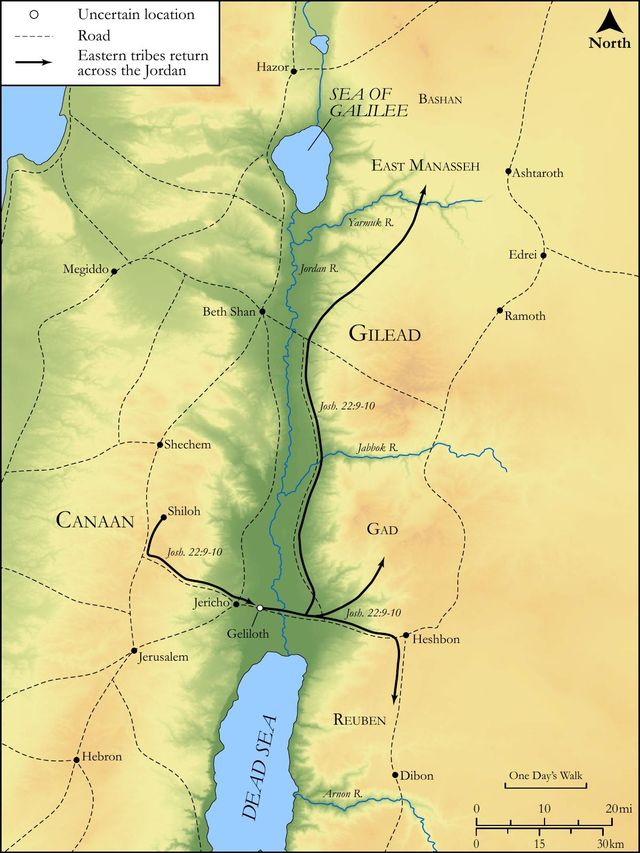
- גְּלִילוֹתge·li·LotGeliloth ofH1552N-fpcNoun Plural Feminine Construct
- הַיַּרְדֵּןhai·yar·Denthe JordanH3383Art ¦ N-properNoun Proper LocationהַtheיַּרְדֵּןJordan
- אֲשֶׁר'a·SherwhichH834RelParticle Relative
- בְּאֶרֶץbe·'E·retz[is] in [the] land ofH776Prep-b ¦ N-fscNoun Singular Feminine Constructבְּ[is] inאֶרֶץ[the] land of
- כְּנָעַןke·Na·'anCanaanH3667N-properNoun Proper Location
- וַיִּבְנוּvai·yiv·Nuand they builtH1129Conj-w ¦ V-Qal-ConsecImperf-3mpVerb Qal Consecutive Imperfect 3rd Plural Masculineוַandיִּבְנוּthey built
- בְנֵיve·nei[the] descendants ofH1121N-mpcNoun Plural Masculine Construct
- רְאוּבֵןre·'u·VenReubenH7205N-proper-mNoun Proper Masculine
- וּבְנֵיu·ve·neiand [the] descendants ofH1121Conj-w ¦ N-mpcNoun Plural Masculine Constructוּandבְנֵי[the] descendants of
- גָדgadGadH1410N-proper-mNoun Proper Masculine
- וַחֲצִיva·cha·Tziand [the] half ofH2677Conj-w ¦ N-mscNoun Singular Masculine Constructוַandחֲצִי[the] half of
- שֵׁבֶטshe·Vet[the] tribe ofH7626N-mscNoun Singular Masculine Construct
- הַמְנַשֶּׁהham·na·Sheh<the> ManassehH4519Art ¦ N-csNoun Gentilic Singular common gender Absoluteהַ<the>מְנַשֶּׁהManasseh
- שָׁםshamthereH8033AdvAdverb
- מִזְבֵּחַmiz·Be·achan altarH4196N-msNoun Singular Masculine Absolute
- עַל'alatH5921PrepPreposition
- הַיַּרְדֵּןhai·yar·Denthe JordanH3383Art ¦ N-properNoun Proper LocationהַtheיַּרְדֵּןJordan
- מִזְבֵּחַmiz·Be·achan altarH4196N-msNoun Singular Masculine Absolute
- גָּדוֹלga·DollargeH1419Adj-msAdjective Singular Masculine Absolute
- לְמַרְאֶהle·mar·'Ehof appearanceH4758Prep-l ¦ N-msNoun Singular Masculine Absoluteלְofמַרְאֶהappearance
English is a literal word-by-word gloss of the Hebrew, not the KJV's wording. Why?
This is the original text the KJV's translators worked from — each Hebrew word with its own literal English meaning in this verse, prepared by scholars at Tyndale House, Cambridge. The KJV translates whole sentences, not word by word, so its wording differs: one Hebrew word can become several English words, and the KJV may choose “the LORD” where the gloss reads “Yahweh”. Both are faithful — they answer different questions. For the KJV's own rendering, switch to the KJV text.
Details
See on the biblical-era map
Study this verse
Historical interpretation
Historical reception
1 surviving comment on this verse from the historical church.
Do you still wish that I prove more clearly to you that all things among that prior people, whom Moses foreshadowed in the two and a half tribes, were neither complete nor perfect? Even the history written in this little book itself, Jesus [Joshua], son of Nun, also declares it when it says that the true altar was in the land that Jesus [Joshua] was distributing. But those who were across the Jordan, that is, Reuben and Gad and half the tribe of Manasseh, made an altar for themselves, but it was not a true altar. It merely contained a type and sign of the true altar that was with Jesus [Joshua]. Thus you have no cause to wonder whether or not those people had received the entire knowledge of the Trinity, since they had built neither an entire nor a true altar.
Continue studying Joshua 22:10 across the web’s major study libraries — every link below opens this exact verse, chapter, or book on the destination site.
Read & Compare
 BibleGatewayThis verse in more than 200 translations and 70 languages.
 Bible.comThe YouVersion reader — hundreds of translations, reading plans, and highlights.
 ESV.orgCrossway's official English Standard Version reader.
 NET BibleThe NET translation with 60,000+ translators' notes on every rendering decision.
 STEP BibleTyndale House's free study tool — original text, vocabulary, and scholarly resources.
 BibliaLogos Bible Software's free web reader.
 USCCBThe New American Bible (Revised Edition) with the U.S. bishops' study notes.
Commentaries
 BibleHub CommentariesDozens of classic commentaries on this verse, gathered on one page.
 StudyLightMore than 100 commentary sets — the largest collection on the web.
 BibleRefPlain-English commentary on what this verse means, verse by verse.
 Enduring WordDavid Guzik's free commentary on this chapter, widely used by Bible teachers.
 Bible Study ToolsVerse commentary alongside Greek and Hebrew study aids.
Original Language & Research
- BibleHub InterlinearThe verse word by word — original language, transliteration, and English.
- BibleHub LexiconEvery word's original-language definition and Strong's entry.
 Blue Letter BibleDeep-study tools — Strong's numbers, concordance, and word studies.
 SefariaThe Hebrew text with Rashi and centuries of Jewish commentary.
Sermons, Hymns & Audio


TrulyRandomVerse is not affiliated with these sites and doesn’t control their content. They’re linked because they’re genuinely useful.
Summary
Joshua 22:10 records the pivotal and controversial action of the Transjordanian tribes—Reuben, Gad, and the half-tribe of Manasseh—who, upon their return journey to their inherited land east of the Jordan River, constructed a large and highly conspicuous altar. This seemingly innocuous act, strategically located at the very border of the land of Canaan, immediately ignited profound alarm and outrage among the other Israelite tribes. They perceived it as a grave violation of covenant fidelity, an act of potential apostasy or schism that threatened the spiritual unity and national cohesion of Israel, thereby risking severe divine judgment upon the entire nation.
Context
ShowHideLiterary Context
This verse serves as the critical inciting incident that precipitates the major conflict detailed throughout the remainder of Joshua 22. Following seven years of faithful military assistance to their brethren in the conquest of Canaan, the Transjordanian tribes received Joshua's solemn blessing and a charge to remain steadfast in their allegiance to the Lord as they departed for their homes (see Joshua 22:1-9). The construction of this altar, described immediately after their dismissal, directly precedes the other tribes' furious reaction, their consultation with the high priest, and their preparations for what nearly became a civil war (e.g., Joshua 22:11-12). The subsequent narrative arc of the chapter is dedicated to resolving this profound misunderstanding through careful dialogue and explanation, ultimately underscoring the vital role of clear communication in maintaining national and spiritual unity.
Historical & Cultural Context
The Jordan River was far more than a mere geographical feature; it functioned as a profound symbolic and practical divide within ancient Israel. The land west of the Jordan was considered the primary inheritance, the sacred "land of Canaan," directly promised by God, while the land east of the Jordan was granted as a secondary, though legitimate, extension. Crucially, the Mosaic Law, particularly as articulated in Deuteronomy 12, unequivocally mandated a single, centralized place of worship where the Tabernacle resided (at Shiloh during this period). Building an altar anywhere else, especially one described as "great" and highly visible, was culturally understood as an act of establishing a rival worship center, engaging in idolatry, or a dangerous return to pagan practices. Any such deviation was considered a capital offense and a direct threat to the entire nation, inviting God's wrath, a fear deeply rooted in recent history, such as the devastating incident at Peor (Numbers 25:1-9).
Key Themes
ShowHideThis verse powerfully introduces several critical themes that resonate throughout the chapter and beyond. Firstly, Misunderstanding and the Imperative of Communication are central, as the altar's true purpose is immediately and tragically misconstrued, leading the nation to the brink of civil war. This highlights the profound danger of hasty judgment and the absolute necessity of seeking clarity and engaging in open dialogue before drawing conclusions. Secondly, the Unity of Israel is severely tested. The twelve tribes, bound by a singular covenant with Yahweh, were divinely ordained to function as a unified people. Any perceived schism in worship or allegiance threatened their very national identity, their spiritual integrity, and their collective relationship with God. Thirdly, Covenant Fidelity and Proper Worship emerge as paramount concerns. The western tribes' intense fear stemmed from the belief that their Transjordanian brethren were abandoning the exclusive worship of Yahweh at the designated sanctuary, thereby jeopardizing the entire nation's standing before God and inviting divine judgment, a recurring concern throughout Israel's historical narrative (e.g., Judges 2:11-15).
Exposition and Analysis
ShowHideKey Word Analysis
ShowHideThe Hebrew word מִזְבֵּחַ (H4196, mizbêach), derived from a root meaning "to sacrifice" or "to slaughter," specifically denotes "an altar" or "a place of sacrifice." Its very lexical nature immediately implies a cultic or religious purpose tied to offering sacrifices to a deity. The use of this precise term, rather than a more neutral word for a monument or landmark, was the primary catalyst for the suspicion and alarm among the western tribes, who interpreted it strictly within the framework of the Mosaic Law's centralized worship requirements.
The term גְּלִילָה (H1552, gᵉlîylâh), derived from a root meaning "to roll" or "to circuit," refers to "a circuit or region," hence "border," "coast," or "country." In Joshua 22:10, it specifically refers to "the borders of Jordan," emphasizing the strategic and highly symbolic location where the altar was built. This liminal space, technically still within the "land of Canaan" (the primary inheritance) but at the very edge of the Transjordanian tribes' territory, rendered the altar's intent ambiguous and contributed significantly to the misunderstanding, as it could be perceived as an encroachment or a rival claim to sacred space.
The phrase לְמַרְאֶה (H4758, marʼeh), from a root meaning "to see," signifies "a view," "an appearance," or "the thing seen." In this context, "a great altar to see to" emphasizes the visual prominence, impressiveness, and conspicuousness of the structure. It was not a small, private, or easily overlooked monument but a "great" and highly visible edifice. This prominence, intended by the Transjordanian tribes as a clear and lasting "witness" (as later revealed in Joshua 22:26-27), ironically became the primary source of the other tribes' alarm, as its size and location strongly suggested the establishment of a rival sanctuary.
Verse Breakdown
ShowHide"And when they came unto the borders of Jordan, that [are] in the land of Canaan"
This opening clause meticulously establishes the critical geographical context for the ensuing conflict. The Transjordanian tribes, having honorably completed their military obligations, are now on their homeward journey. The precise mention of "the borders of Jordan" and its location "in the land of Canaan" is crucial, indicating that the altar was erected on the western side of the river. This was the territory where the other nine and a half tribes resided and where the divinely appointed central sanctuary was situated. This specific location was fundamental to the misunderstanding, as it was immediately perceived as an unauthorized intrusion or a direct challenge to the singular, sacred space.
"the children of Reuben and the children of Gad and the half tribe of Manasseh"
This segment identifies the specific tribal groups responsible for the action, underscoring their collective and unified involvement. These are the tribes who had received their inheritance east of the Jordan and had faithfully honored their commitment to Moses by assisting their brethren in the conquest (see Numbers 32). Their unified action here, though ultimately born of good intentions, inadvertently triggers a national crisis, highlighting the collective responsibility and potential for misinterpretation within a covenant community.
"built there an altar by Jordan"
This is the core action of the verse, the very act that ignites the controversy. The construction of an "altar" (Hebrew: mizbeach) immediately raises profound theological red flags due to the Mosaic Law's strict command for a single, central place of worship and sacrifice for all Israel. The location "by Jordan" further emphasizes its proximity to the significant geographical and symbolic dividing line between the tribes, intensifying the perception of a schism or a rival religious establishment.
"a great altar to see to."
This concluding phrase powerfully conveys the altar's imposing size and striking visibility. It was not a modest, private structure but a prominent, public edifice designed to be seen and noticed. While the Transjordanian tribes intended this grand visibility as a powerful and enduring symbol of their continued connection to the other tribes and their shared faith, its "great" and conspicuous nature was precisely what made it appear to be a rival sanctuary, thereby fueling the suspicion, outrage, and near-violent reaction of the western tribes.
Literary Devices
ShowHideThe narrative of Joshua 22:10 masterfully employs Foreshadowing and Irony. The detailed description of the Transjordanian tribes building "a great altar to see to" immediately foreshadows the intense conflict and national crisis that will erupt in the subsequent verses, as the reader anticipates the inevitable and severe reaction of the other tribes to this seemingly illicit act. The profound Irony lies in the very nature and purpose of the altar itself: what the Transjordanian tribes intended as a positive, unifying Symbolism—a "witness" to their shared heritage and unwavering covenant with Yahweh (as later revealed in Joshua 22:27)—is immediately and catastrophically misinterpreted by their brethren as a divisive act of apostasy or idolatry. The altar, meant to be a bridge of remembrance and connection, inadvertently becomes a barrier of misunderstanding, powerfully highlighting the dangers of assuming intent and the critical need for clear, charitable communication within a community.
Theological and Thematic Connections
ShowHideJoshua 22:10 serves as a poignant theological case study, illustrating the delicate and often perilous balance between external actions and internal intentions within a covenant community. The theological principle of centralized worship, deeply ingrained in the Mosaic Law, was divinely instituted to safeguard the unity and purity of Israel's devotion to Yahweh, explicitly preventing the proliferation of localized cults or the insidious creep of syncretistic practices. The western tribes' fervent reaction, though perhaps initially overzealous, sprang from a legitimate and profound concern for covenant fidelity and a genuine fear of God's judgment upon the entire nation for any perceived idolatry or schism. This incident profoundly underscores the vital importance of communal understanding of core doctrines and practices, and the significant impact that perceived deviations can have on unity, trust, and fellowship, even when the underlying intentions are pure and honorable.
Reflection and Application
ShowHideThe narrative initiated in Joshua 22:10 and its subsequent resolution offers invaluable and enduring lessons for contemporary believers and communities. It vividly illustrates how noble intentions, when inadequately communicated or perceived through a lens of suspicion, can tragically lead to profound misunderstanding, baseless accusations, and even destructive conflict. In our intricate relationships—whether within families, local churches, professional workplaces, or broader societal interactions—we often operate from our own internal framework, inadvertently failing to consider how our actions might be perceived by others, especially those who hold different backgrounds, assumptions, or theological perspectives. This passage challenges us to actively cultivate a culture characterized by open dialogue, patient inquiry, and charitable interpretation of others' motives, consistently prioritizing the preservation of unity and peace over hasty judgment or defensive reactions. Moreover, it serves as a powerful reminder that genuine zeal for God's truth must always be tempered with profound wisdom and grace, prompting us to diligently seek to understand before we react, and to articulate our intentions with clarity before we are misunderstood.
Questions for Reflection
ShowHideFAQ
ShowHideWhy was building an altar a problem for the other Israelite tribes?
ShowHideFor the other Israelite tribes, the construction of an altar outside of the divinely designated central sanctuary at Shiloh was a matter of grave concern because it appeared to be a direct violation of the clear commands of the Mosaic Law, particularly as detailed in Deuteronomy 12. God had explicitly commanded Israel to establish only one designated place for sacrifices and worship, where His Name would dwell. Building an additional altar seemed to imply either the establishment of a rival center of worship, a dangerous return to pagan practices, or a schism from the unified worship of Yahweh. Such an act was perceived as a profound affront to God, potentially inviting divine judgment upon the entire nation, as had tragically occurred in past instances of idolatry or disobedience (e.g., Numbers 25). Their fear was that it would lead to widespread apostasy and irrevocably break the sacred covenant relationship between God and His chosen people.
What was the Transjordanian tribes' actual intention in building the altar?
ShowHideAs revealed later in the chapter, specifically in Joshua 22:26-29, the Transjordanian tribes had absolutely no intention of establishing a rival cultic center or abandoning their allegiance to the Lord. Their purpose was purely memorial and symbolic. They constructed the "great altar to see to" as a "witness" (Hebrew: 'ed) between themselves and the tribes on the western side of the Jordan. Their profound fear was that in future generations, the western tribes might deny their eastern brethren a share in the Lord, saying, "You have no part in the LORD" (Joshua 22:24). The altar was therefore intended to be a tangible, visible, and enduring reminder that despite the geographical barrier of the Jordan River, they shared the same God and were an integral part of the same covenant community, thus ensuring their children would always be recognized as legitimate worshipers of Yahweh.
Christ-Centered Fulfillment
ShowHideThe profound misunderstanding and subsequent reconciliation detailed in Joshua 22:10-34 powerfully foreshadow the ultimate unity, peace, and perfect access to God found exclusively in Jesus Christ. The altar, intended by the Transjordanian tribes as a "witness" to their shared faith and covenant, points forward to Jesus Christ as the ultimate and perfect "witness" to God's love, truth, and the sole means of reconciliation with Him. While the Old Testament required a physical altar and a centralized place of worship for atonement, Jesus fulfills these requirements by becoming both the Lamb of God who takes away the sin of the world and the true temple, through whom believers from every tribe, nation, and geographical location can draw near to God. The threatened division caused by the Jordan River and the perceived rival altar is gloriously overcome in the New Covenant, where Christ, by His sacrifice, breaks down the dividing wall of hostility, uniting all believers—Jew and Gentile, near and far—into one body in Him. The emphasis on unity, clear communication, and charitable understanding in Joshua 22 finds its ultimate and perfect expression in the Church, the body of Christ, where believers are called to diligently preserve the unity of the Spirit in the bond of peace and to speak the truth in love, ensuring that no misunderstanding or false accusation can sever the profound fellowship purchased by Christ's precious blood.