


Joshua 22:11
- וַיִּשְׁמְעוּvai·yish·me·'Uand they heardH8085Conj-w ¦ V-Qal-ConsecImperf-3mpVerb Qal Consecutive Imperfect 3rd Plural Masculineוַandיִּשְׁמְעוּthey heard
- בְנֵיve·nei[the] people ofH1121N-mpcNoun Plural Masculine Construct
- יִשְׂרָאֵלYis·ra·'ElIsraelH3478N-properNoun Proper Location
- לֵאמֹרle·Mor<to> sayingH559Prep-l ¦ V-Qal-InfVerb Qal Infinitive Constructלֵ<to>אמֹרsaying
- הִנֵּהhi·Nehthere!H2009PrtParticle Interjection
- בָנוּva·Nuthey have builtH1129V-Qal-Perf-3cpVerb Qal Perfect 3rd Plural common gender
- בְנֵיve·nei[the] descendants ofH1121N-mpcNoun Plural Masculine Construct
- רְאוּבֵןre·'u·VenReubenH7205N-proper-mNoun Proper Masculine
- וּבְנֵיu·ve·neiand [the] descendants ofH1121Conj-w ¦ N-mpcNoun Plural Masculine Constructוּandבְנֵי[the] descendants of
- גָדgadGadH1410N-proper-mNoun Proper Masculine
- וַחֲצִיva·cha·Tziand [the] half ofH2677Conj-w ¦ N-mscNoun Singular Masculine Constructוַandחֲצִי[the] half of
- שֵׁבֶטShe·vet[the] tribe ofH7626N-mscNoun Singular Masculine Construct
- הַמְנַשֶּׁהham·na·Sheh<the> ManassehH4519Art ¦ N-csNoun Gentilic Singular common gender Absoluteהַ<the>מְנַשֶּׁהManasseh
- אֶת'et<obj.>H853DirObjMParticle Object Indicator
- הַמִּזְבֵּחַha·miz·Be·achthe altarH4196Art ¦ N-msNoun Singular Masculine Absoluteהַtheמִּזְבֵּחַaltar
- אֶל'eltoH413PrepPreposition
- מוּלmulopposite toH4136N-mscNoun Singular Masculine Construct
- אֶרֶץ'E·retz[the] land ofH776N-fscNoun Singular Feminine Construct
- כְּנַעַןke·Na·'anCanaanH3667N-properNoun Proper Location
- אֶל'eltoH413PrepPreposition
- גְּלִילוֹתge·li·lOtGeliloth ofH1552N-fpcNoun Plural Feminine Construct
- הַיַּרְדֵּןhai·yar·Denthe JordanH3383Art ¦ N-properNoun Proper LocationהַtheיַּרְדֵּןJordan
- אֶל'eltoH413PrepPreposition
- עֵבֶר'E·ver[the] side ofH5676N-mscNoun Singular Masculine Construct
- בְּנֵיbe·Nei[the] people ofH1121N-mpcNoun Plural Masculine Construct
- יִשְׂרָאֵלYis·ra·'ElIsraelH3478N-properNoun Proper Location
English is a literal word-by-word gloss of the Hebrew, not the KJV's wording. Why?
This is the original text the KJV's translators worked from — each Hebrew word with its own literal English meaning in this verse, prepared by scholars at Tyndale House, Cambridge. The KJV translates whole sentences, not word by word, so its wording differs: one Hebrew word can become several English words, and the KJV may choose “the LORD” where the gloss reads “Yahweh”. Both are faithful — they answer different questions. For the KJV's own rendering, switch to the KJV text.
Details
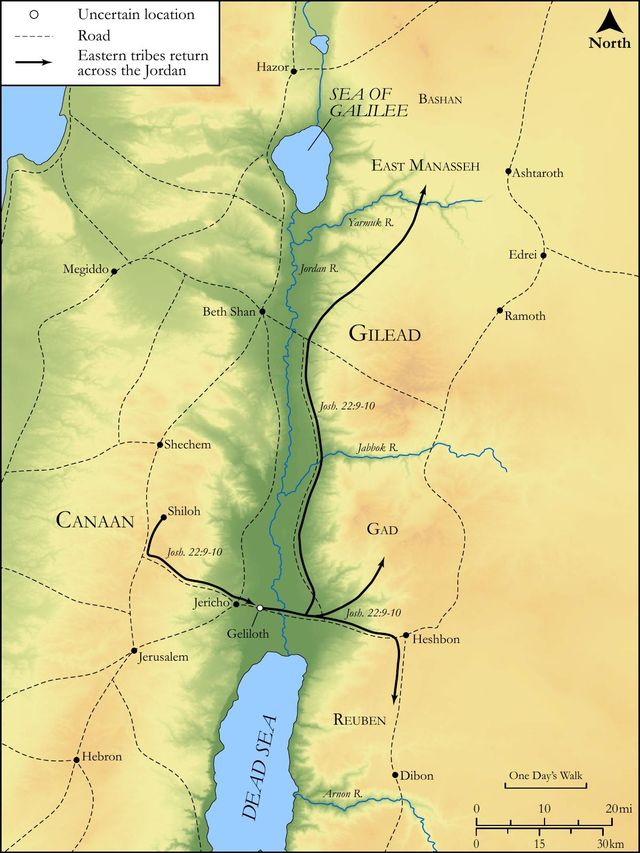
See on the biblical-era map
Study this verse
Continue studying Joshua 22:11 across the web’s major study libraries — every link below opens this exact verse, chapter, or book on the destination site.
Read & Compare
 BibleGatewayThis verse in more than 200 translations and 70 languages.
 Bible.comThe YouVersion reader — hundreds of translations, reading plans, and highlights.
 ESV.orgCrossway's official English Standard Version reader.
 NET BibleThe NET translation with 60,000+ translators' notes on every rendering decision.
 STEP BibleTyndale House's free study tool — original text, vocabulary, and scholarly resources.
 BibliaLogos Bible Software's free web reader.
 USCCBThe New American Bible (Revised Edition) with the U.S. bishops' study notes.
Commentaries
 BibleHub CommentariesDozens of classic commentaries on this verse, gathered on one page.
 StudyLightMore than 100 commentary sets — the largest collection on the web.
 BibleRefPlain-English commentary on what this verse means, verse by verse.
 Enduring WordDavid Guzik's free commentary on this chapter, widely used by Bible teachers.
 Bible Study ToolsVerse commentary alongside Greek and Hebrew study aids.
Original Language & Research
- BibleHub InterlinearThe verse word by word — original language, transliteration, and English.
- BibleHub LexiconEvery word's original-language definition and Strong's entry.
 Blue Letter BibleDeep-study tools — Strong's numbers, concordance, and word studies.
 SefariaThe Hebrew text with Rashi and centuries of Jewish commentary.
Sermons, Hymns & Audio


TrulyRandomVerse is not affiliated with these sites and doesn’t control their content. They’re linked because they’re genuinely useful.
Summary
Joshua 22:11 records the alarming report received by the Israelite tribes west of the Jordan River concerning their kinsmen—Reuben, Gad, and the half-tribe of Manasseh—who had returned to their allotted lands east of the Jordan. This verse describes the construction of a large, prominent altar on the eastern side of the Jordan, near a significant crossing point into Canaan, an act immediately perceived by the western tribes as a grave violation of Mosaic law and a direct threat to the religious and national unity of Israel, thereby setting the stage for a dramatic confrontation.
Context
ShowHideLiterary Context
This verse immediately follows Joshua's solemn dismissal and blessing of the eastern tribes (Reuben, Gad, and the half-tribe of Manasseh) in Joshua 22:1-9. Having faithfully assisted their brethren in the conquest of Canaan, these tribes were now returning to their inheritance beyond the Jordan. The narrative flow establishes an expectation of peace and unity, making the sudden report of an unauthorized altar a jarring and deeply unsettling development. This act, occurring at the very threshold of their separation, casts a shadow over the hard-won unity and sets the stage for a potential civil war, highlighting the fragility of the newly established nation. The subsequent verses (Joshua 22:12-34) detail the western tribes' furious response, their dispatch of a delegation, and the eventual resolution of the misunderstanding.
Historical & Cultural Context
At this period in Israel's history, the nation was transitioning from a nomadic, unified fighting force under Joshua to a settled confederacy of tribes. Central to their covenant identity, as established in the Mosaic Law, was the command for a single, central sanctuary where all legitimate sacrifices were to be offered to Yahweh. Deuteronomy 12:5-7 explicitly mandates worship at "the place the LORD your God will choose." The Tabernacle, currently located at Shiloh (Joshua 18:1), served as this singular, divinely appointed site. Building any other altar for sacrifice was considered an act of apostasy, a direct challenge to God's authority, and a potential invitation to idolatry, which had severe covenant consequences. The location "in the borders of Jordan" was significant, marking the geographical and symbolic boundary between the two halves of the nation, making the altar's construction a highly visible and provocative act.
Key Themes
ShowHideThe central concern immediately brought to the forefront by this verse is the unity and potential schism within the twelve tribes of Israel. The construction of a separate altar suggests a religious and political division, threatening the very fabric of the nation forged in the wilderness and through the conquest. Another critical theme is misinformation and assumption. The phrase "heard say" is pivotal, underscoring that the western tribes reacted based on a report, not direct observation or communication. This highlights the danger of forming judgments and taking drastic action based on incomplete or misinterpreted information, a theme that will be resolved through dialogue later in the chapter (Joshua 22:21-29). Finally, the verse underscores the centrality of worship and the absolute importance of adhering to God's prescribed method and location for sacrifice. Deviation from the singular sanctuary was not merely a procedural error but a profound theological breach, challenging the covenant and potentially leading to national apostasy.
Exposition and Analysis
ShowHideKey Word Analysis
ShowHideThis word (H4196) refers to a structure, typically of earth or unhewn stone, used for offering sacrifices to God. In the context of Israel's covenant with Yahweh, the construction of an altar was a profoundly religious act, signifying worship and communion with the divine. The existence of multiple altars for sacrifice was strictly forbidden after the establishment of a central sanctuary, making the eastern tribes' construction of one a direct challenge to the Mosaic law and the covenant's integrity.
This word (H4136) properly means "abrupt" or "precipice," but is used adverbially (often with a prepositional prefix like 'el', as here) to mean "opposite" or "facing." Its use here emphasizes the prominent and visible location of the altar. It was not hidden but openly displayed at a significant crossing point, suggesting either a deliberate act of defiance or, as later revealed, a clear statement of identity and connection to the western tribes. Its strategic placement ensured it would be seen by anyone crossing the Jordan, particularly those from the western tribes.
This primitive root (H8085) means "to hear intelligently," often implying attention, understanding, or obedience. In the phrase "heard say" (which also includes the root ʼâmar H559, "to say"), it emphasizes that the information was received via report or rumor, rather than direct observation or communication. This linguistic nuance is crucial, as it immediately introduces the element of potential misunderstanding and highlights the western tribes' reaction as being based on secondhand, unverified information, setting up the dramatic tension of the narrative where initial assumptions prove to be incorrect.
Verse Breakdown
ShowHide"And the children of Israel heard say,"
This opening clause immediately establishes the source of the western tribes' alarm: a report, not a direct observation or communication. It highlights the role of information (or misinformation) in shaping perceptions and reactions, setting the stage for a conflict rooted in misunderstanding.
"Behold, the children of Reuben and the children of Gad and the half tribe of Manasseh"
This specifies the accused parties – the two and a half tribes who had chosen their inheritance on the eastern side of the Jordan. Their identity as fellow Israelites, kinsmen who had fought alongside them, amplifies the sense of betrayal and shock felt by the western tribes.
"have built an altar"
This is the core accusation and the catalyst for the ensuing crisis. The act of building an altar, especially one perceived for sacrifice, was a direct violation of the Mosaic law requiring a single central sanctuary for worship. This act was seen as an immediate threat to the theological and national unity of Israel.
"over against the land of Canaan, in the borders of Jordan, at the passage of the children of Israel."
This clause details the altar's location. "Over against the land of Canaan" means opposite or facing the western side, making it highly visible to those in the central land. Its placement "in the borders of Jordan" and "at the passage" (likely a ford or crossing point) further emphasizes its prominence and strategic visibility, ensuring that it would be noticed by anyone traversing the river, thus escalating the perceived offense.
Literary Devices
ShowHideJoshua 22:11 masterfully employs several Literary Devices to heighten the narrative tension. The most prominent is Dramatic Irony, as the reader, privy to the eventual resolution of the conflict (which the western tribes are not at this point), understands that their initial assumption of apostasy is incorrect. This creates suspense and highlights the danger of acting on incomplete information. The phrase "heard say" functions as a crucial Narrative Device, emphasizing the secondhand nature of the information and foreshadowing the misunderstanding that will drive the plot. The altar itself serves as powerful Symbolism; initially, it symbolizes division, rebellion, and potential schism to the western tribes, but it is later reinterpreted by the eastern tribes as a symbol of unity, remembrance, and shared inheritance. The strategic placement of the altar "over against the land of Canaan" and "at the passage of the children of Israel" also employs Setting as a Character, as the geographical location itself contributes to the dramatic impact and the perceived provocation of the act.
Theological and Thematic Connections
ShowHideJoshua 22:11 serves as a powerful theological narrative on the importance of unity, communication, and fidelity to God's covenant within the community of faith. The western tribes' zealous reaction, though based on a misunderstanding, underscores the profound commitment to the singularity of Yahweh worship and the fear of anything that might compromise Israel's unique relationship with God. This episode highlights that even with good intentions (zeal for God's law), a lack of direct communication can lead to significant division and potential conflict. It teaches that preserving the peace and unity of God's people often requires patience, inquiry, and a willingness to understand before condemning, prioritizing reconciliation over immediate judgment.
Reflection and Application
ShowHideThe immediate alarm stirred by the report in Joshua 22:11 offers timeless lessons for communities and individuals today. In an age saturated with information, often unverified or sensationalized, the narrative serves as a potent reminder to exercise caution and discernment. Before reacting strongly, forming judgments, or making accusations, it is vital to seek full understanding, direct communication, and to "hear the other side." Rumors, incomplete reports, and assumptions can cause immense damage, division, and unnecessary conflict within families, friendships, churches, and society at large. Furthermore, while zeal for truth and righteousness is commendable, it must always be tempered with wisdom, humility, and a fervent desire for unity and peaceful resolution. True zeal for God's honor should lead us to pursue reconciliation and understanding, not hasty condemnation, mirroring the patient inquiry demonstrated by Phinehas and the delegation in the subsequent verses.
Questions for Reflection
ShowHideFAQ
ShowHideWhy was the building of this altar such a serious offense to the western tribes?
ShowHideThe western tribes perceived the construction of an altar by their eastern kinsmen as a grave act of apostasy and rebellion against God's law. According to the Mosaic covenant, all legitimate sacrifices were to be offered at the single, central sanctuary (the Tabernacle), which was then located at Shiloh (Joshua 18:1). This command, reiterated in Deuteronomy 12:5-7, was designed to prevent idolatry, maintain the purity of worship, and preserve the national and theological unity of Israel. Building another altar was seen as establishing a rival cult, threatening to divide the nation religiously and politically, potentially incurring divine wrath upon all Israel.
What was the actual purpose of the altar built by the eastern tribes?
ShowHideAs revealed later in the chapter (Joshua 22:26-29), the eastern tribes did not build the altar for sacrifice. Instead, it was intended to be a "witness" (Hebrew: 'ed) between their tribes and the western tribes. They feared that in future generations, the western tribes might deny their shared heritage and right to worship Yahweh, simply because they lived across the Jordan. The altar was a physical reminder, a monument, to their shared identity as Israelites and their equal claim to the God of Israel, ensuring that their children would not be cut off from the covenant community.
How does this story relate to unity within the church today?
ShowHideThe narrative of Joshua 22:11 and its resolution offers profound lessons for unity in the modern church. It underscores the critical importance of clear communication, charitable interpretation, and a willingness to seek understanding before judgment. Just as the eastern and western tribes were united by their covenant with Yahweh, believers today are united in Christ. Misunderstandings, differing practices, or unverified reports can easily lead to division and conflict within the body of Christ. The story encourages believers to approach differences with humility, to ask questions rather than assume ill intent, and to prioritize the unity of the Spirit in the bond of peace (Ephesians 4:3). It reminds us that zeal for truth must be balanced with love and a commitment to reconciliation.
Christ-Centered Fulfillment
ShowHideThe dramatic tension in Joshua 22:11, arising from the perceived threat to Israel's unity and proper worship, finds its ultimate resolution and fulfillment in Jesus Christ. The demand for a single, central place of worship, symbolized by the Tabernacle and later the Temple, foreshadowed the reality that God's presence would ultimately dwell not in a building, but in a person—Jesus Christ. He is the true and ultimate Temple (John 2:19-21), the perfect sacrifice (Hebrews 9:11-14), and the sole mediator between God and humanity (1 Timothy 2:5). The concern over a divided Israel, potentially cut off from God's presence, points to Christ's work in breaking down all dividing walls—whether geographical, ethnic, or spiritual—to create one new humanity united in Him (Ephesians 2:14-16). The reconciliation achieved through dialogue in Joshua 22 prefigures the ultimate reconciliation accomplished by Christ on the cross, where He brought peace between God and humanity, and between estranged peoples, drawing all who believe into one body, the Church, where there is no longer Jew or Gentile, but all are one in Christ Jesus (Galatians 3:28). He is the ultimate "witness" and the living bridge, connecting all believers to the Father, ensuring that no one is cut off from the covenant of grace.