


Joshua 22:12
Bible text: King James Version (1769 Blayney text) · Public domain
Bible text: King James Version with Strong's numbers · Public domain
Bible text: Berean Standard Bible · Public domain
Bible text: American Standard Version (1901) · Public domain
Bible text: World English Bible, Messianic edition · Public domain
Bible text: Geneva Bible (1599) · Public domain
Bible text: Young's Literal Translation · Public domain
- וַיִּשְׁמְעוּvai·yish·me·'Uand they heardH8085Conj-w ¦ V-Qal-ConsecImperf-3mpVerb Qal Consecutive Imperfect 3rd Plural Masculineוַandיִּשְׁמְעוּthey heard
- בְּנֵיbe·Nei[the] people ofH1121N-mpcNoun Plural Masculine Construct
- יִשְׂרָאֵלYis·ra·'ElIsraelH3478N-properNoun Proper Location
- וַיִּקָּהֲלוּvai·yi·Ka·ha·Luand they assembledH6950Conj-w ¦ V-Niphal-ConsecImperf-3mpVerb Niphal Consecutive Imperfect 3rd Plural Masculineוַandיִּקָּהֲלוּthey assembled
- כָּלkolallH3605N-mscNoun Singular Masculine Construct
- עֲדַת'a·Dat[the] congregation ofH5712N-fscNoun Singular Feminine Construct
- בְּנֵיbe·nei[the] people ofH1121N-mpcNoun Plural Masculine Construct
- יִשְׂרָאֵלYis·ra·'ElIsraelH3478N-properNoun Proper Location
- שִׁלֹהshi·LohShilohH7887N-properNoun Proper Location
- לַעֲלוֹתla·'a·Lotto go upH5927Prep-l ¦ V-Qal-InfVerb Qal Infinitive Constructלַtoעֲלוֹתgo up
- עֲלֵיהֶם'a·lei·Hemon themH5921Prep ¦ 3mpPreposition Definiteעֲלֵיonהֶםthem
- לַצָּבָאla·tza·Va'for <the> warH6635Prep-l ¦ N-msNoun Singular Masculine Absoluteלַfor <the>צָּבָאwar
English is a literal word-by-word gloss of the Hebrew, not the KJV's wording. Why?
This is the original text the KJV's translators worked from — each Hebrew word with its own literal English meaning in this verse, prepared by scholars at Tyndale House, Cambridge. The KJV translates whole sentences, not word by word, so its wording differs: one Hebrew word can become several English words, and the KJV may choose “the LORD” where the gloss reads “Yahweh”. Both are faithful — they answer different questions. For the KJV's own rendering, switch to the KJV text.
Details
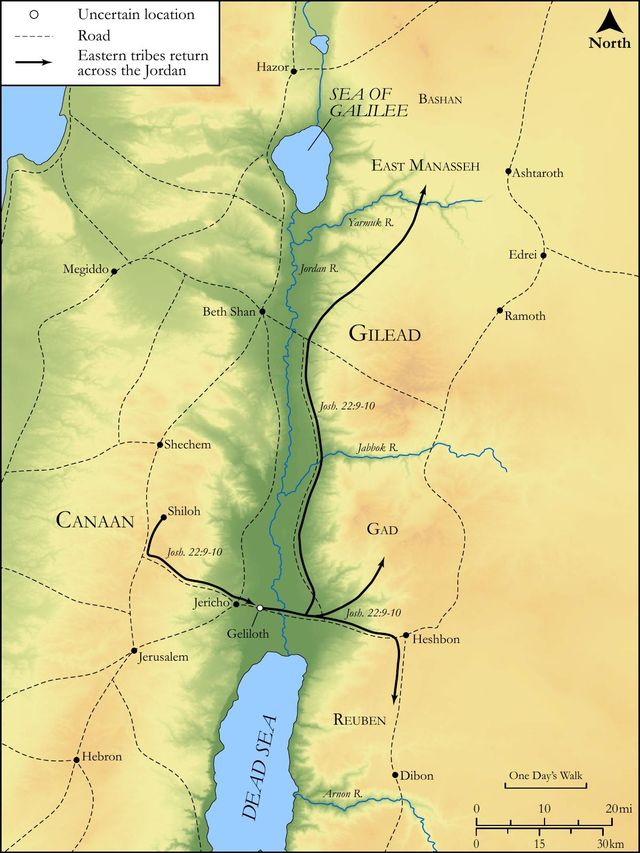
See on the biblical-era map
Study this verse
Continue studying Joshua 22:12 across the web’s major study libraries — every link below opens this exact verse, chapter, or book on the destination site.
Read & Compare
 BibleGatewayThis verse in more than 200 translations and 70 languages.
 Bible.comThe YouVersion reader — hundreds of translations, reading plans, and highlights.
 ESV.orgCrossway's official English Standard Version reader.
 NET BibleThe NET translation with 60,000+ translators' notes on every rendering decision.
 STEP BibleTyndale House's free study tool — original text, vocabulary, and scholarly resources.
 BibliaLogos Bible Software's free web reader.
 USCCBThe New American Bible (Revised Edition) with the U.S. bishops' study notes.
Commentaries
 BibleHub CommentariesDozens of classic commentaries on this verse, gathered on one page.
 StudyLightMore than 100 commentary sets — the largest collection on the web.
 BibleRefPlain-English commentary on what this verse means, verse by verse.
 Enduring WordDavid Guzik's free commentary on this chapter, widely used by Bible teachers.
 Bible Study ToolsVerse commentary alongside Greek and Hebrew study aids.
Original Language & Research
- BibleHub InterlinearThe verse word by word — original language, transliteration, and English.
- BibleHub LexiconEvery word's original-language definition and Strong's entry.
 Blue Letter BibleDeep-study tools — Strong's numbers, concordance, and word studies.
 SefariaThe Hebrew text with Rashi and centuries of Jewish commentary.
Sermons, Hymns & Audio


TrulyRandomVerse is not affiliated with these sites and doesn’t control their content. They’re linked because they’re genuinely useful.
Summary
Joshua 22:12 captures a profound moment of national crisis and zealous, albeit misguided, unity for the newly settled Israelites. Upon receiving intelligence that the Transjordanian tribes (Reuben, Gad, and the half-tribe of Manasseh) had erected a large, conspicuous altar by the Jordan River, the remaining tribes west of the Jordan immediately interpreted this act as a grave breach of covenant, a perceived rebellion against the Lord, and an attempt to establish a rival place of worship. This perceived apostasy ignited a unified and severe reaction, prompting the entire congregation of Israel to gather at Shiloh, the location of the tabernacle, with the intent of initiating war against their brethren. The verse powerfully conveys the intense zeal and collective responsibility of the nation, initially fueled by a profound misunderstanding.
Context
ShowHideLiterary Context
Joshua 22:12 is situated at the dramatic climax of a pivotal post-conquest narrative. Following the successful military campaigns and the meticulous allocation of tribal lands, the Transjordanian tribes (Reuben, Gad, and half-Manasseh) are honorably dismissed by Joshua to return to their inheritance east of the Jordan, having faithfully assisted their brethren in the conquest of Canaan (Joshua 22:1-9). As they journey home, they construct a large, conspicuous altar by the Jordan River (Joshua 22:10-11). The report of this altar reaches the tribes west of the Jordan, who, without investigation, immediately conclude that it is an act of apostasy—a rival sanctuary intended for illicit sacrifices, a challenge to the central worship prescribed by God, or even an act of idolatry. This verse, then, sets the stage for the intense confrontation and subsequent dialogue that unfolds in the remainder of the chapter, ultimately preventing a devastating civil war and highlighting the dangers of hasty judgment within a covenant community.
Historical & Cultural Context
The historical and cultural backdrop is indispensable for grasping the gravity of the western tribes' reaction. According to Mosaic law, particularly as articulated in Deuteronomy 12, God commanded Israel to have one central place of worship where all sacrifices were to be offered. This was initially the Tabernacle, which at this time was established at Shiloh (Joshua 18:1). The construction of any other altar for sacrifice was strictly forbidden, viewed as an act of rebellion and idolatry that could provoke divine wrath upon the entire nation. The memory of corporate judgment for sin, such as the devastating consequences of Achan's sin (Joshua 7) or the plague at Baal of Peor (Numbers 25), would have been fresh in their minds, fueling their fervent, albeit misguided, zeal to eradicate what they perceived as a national defilement and avert God's judgment.
Key Themes
ShowHideThis verse powerfully highlights several key themes central to the book of Joshua and Israel's early history. Firstly, it underscores the profound zeal for God's Law and Covenant that characterized the Israelite community, demonstrating their deep commitment to upholding the singularity of Yahweh worship and the commands given by Moses. Secondly, it emphasizes the concept of unity and collective responsibility within the covenant community; the phrase "the whole congregation" reflects the understanding that the spiritual purity and obedience of all tribes were intrinsically linked to God's blessing and protection over the entire nation. The fear of corporate judgment for the sin of a few was a powerful motivator, as seen in Joshua 7. Finally, it introduces the critical theme of the danger of misunderstanding and hasty judgment, foreshadowing the urgent need for careful discernment and open communication to prevent devastating internal conflict, a vital lesson for any community of faith seeking to maintain harmony and truth, as later exemplified in Proverbs 18:13.
Exposition and Analysis
ShowHideKey Word Analysis
ShowHideThis term refers to a formal, stated assemblage or community, often with a representative structure. Its use here signifies that the decision to prepare for war was not a spontaneous, disorganized outburst but a deliberate, unified resolution made by the authoritative body of Israel. This underscores the national and spiritual gravity of the perceived transgression, indicating a collective, covenantal response from the entire people.
This primitive root means "to convoke" or "to assemble (themselves) together." The active and reflexive nature of the verb indicates a deliberate, intentional act of coming together. It emphasizes the organized and unified nature of the Israelites' response, highlighting that this was a national mobilization, not merely a local reaction.
This term denotes a mass of persons organized for battle, an army, or a campaign. The immediate readiness "to go up to war" reveals the extreme severity with which the western tribes viewed the eastern tribes' actions. It was not merely a dispute or a call for clarification, but an immediate readiness to engage in armed conflict, indicating their conviction that the perceived apostasy was an existential threat to the nation's covenant relationship with God, demanding the most drastic response.
Verse Breakdown
ShowHide"And when the children of Israel heard [of it]"
This clause highlights the widespread dissemination of the news regarding the altar and its immediate, profound impact across the western tribes. The phrase "children of Israel" emphasizes the national scope of the reaction, indicating that the concern was not localized but resonated throughout the entire community, stirring a collective sense of alarm and indignation.
"the whole congregation of the children of Israel gathered themselves together at Shiloh"
This emphasizes the unity and collective nature of the response. The gathering at Shiloh, the central sanctuary and spiritual hub, signifies a formal, national assembly, underscoring the religious and covenantal gravity of the perceived offense. It was a mobilization of the entire nation, united in their perceived duty to defend God's honor and the purity of their worship.
"to go up to war against them"
This final phrase reveals the immediate and drastic intent of the western tribes. Their first response to the perceived apostasy was not dialogue or investigation, but armed conflict. This highlights their intense zeal for God's law and their profound fear of corporate judgment, leading them to believe that only a military intervention could prevent divine wrath from falling upon all Israel.
Literary Devices
ShowHideJoshua 22:12 employs several potent literary devices to convey its dramatic tension and thematic depth. The phrase "the whole congregation of the children of Israel" serves as a form of Hyperbole, emphasizing the overwhelming unity and national resolve, even if not every single individual was literally present. This exaggeration underscores the gravity of the perceived crisis and the collective sense of responsibility felt by the nation. Furthermore, the verse sets up a strong sense of Dramatic Irony for the reader, who is either aware or quickly becomes aware of the eastern tribes' innocent intentions (as revealed in subsequent verses), while the western tribes are preparing for a devastating civil war based on a profound misunderstanding. This irony heightens the tension and underscores the tragic potential of hasty judgment. The verse also functions as powerful Foreshadowing, signaling the impending confrontation and the critical need for communication and discernment that will define the rest of the chapter, ultimately leading to a peaceful resolution.
Theological and Thematic Connections
ShowHideJoshua 22:12 powerfully illustrates the profound theological principle of corporate responsibility within the covenant community. The western tribes' immediate and severe reaction stems from a deep-seated understanding that the sin of a few could bring divine wrath upon the entire nation, a lesson learned painfully from incidents like Achan's sin. Their zeal, though initially misdirected, reflects a genuine commitment to maintaining the purity of Israel's worship and their unique covenant relationship with Yahweh, particularly the command for a single, central sanctuary. This episode serves as a vital reminder that while zeal for God's truth is commendable, it must be balanced with wisdom, discernment, and a commitment to unity, preventing internal conflict born of misunderstanding rather than genuine apostasy.
Reflection and Application
ShowHideJoshua 22:12 offers profound lessons for contemporary communities of faith. It reminds us of the importance of zeal for God's truth and a commitment to upholding His commands within the church. However, it equally serves as a powerful cautionary tale about the dangers of hasty judgment and the critical need for open communication and discernment. Before reacting to perceived wrongs or differences, especially within the body of Christ, it is imperative to seek understanding, clarify intentions, and engage in humble dialogue rather than making assumptions or escalating conflicts. Just as Phinehas and the delegated leaders were sent to investigate the matter in Joshua 22:13, believers are called to exercise patience, love, and wisdom, actively endeavoring to preserve the unity of the Spirit in the bond of peace. Our collective spiritual health and witness depend on our ability to navigate disagreements with grace and truth, prioritizing reconciliation over division, and remembering that love "believes all things, hopes all things, endures all things" (1 Corinthians 13:7).
Questions for Reflection
ShowHideFAQ
ShowHideWhy did the western tribes assume the altar was for idolatry or rebellion?
ShowHideThe western tribes' assumption stemmed from a strict interpretation of Mosaic law, particularly the commands in Deuteronomy 12, which mandated one central sanctuary for all Israelite worship and prohibited unauthorized altars. They feared that the construction of a new, prominent altar by the Transjordanian tribes was an act of apostasy, an attempt to establish a rival worship site, or even to offer sacrifices to other gods. This would be a direct violation of their covenant with Yahweh and, based on past experiences like the sin at Baal of Peor (Numbers 25:1-9), they believed such an act would provoke God's wrath and bring corporate judgment upon the entire nation. Their reaction, though based on a misunderstanding, was rooted in a genuine, albeit zealous, desire to protect the purity of Israel's worship and covenant relationship.
What was the significance of Shiloh in this context?
ShowHideShiloh was of paramount significance because it was the location of the Tabernacle, the portable sanctuary where God's presence dwelt among Israel. Joshua 18:1 states that the whole congregation of Israel assembled at Shiloh and set up the Tabernacle there. By gathering at Shiloh, the western tribes were not just convening a military assembly; they were formally assembling before the Lord, indicating the national and religious gravity of the perceived transgression. It was the central religious and political hub, making it the appropriate place for the entire nation to gather to address a matter of such profound spiritual and national consequence, seeking divine sanction for their intended actions.
Christ-Centered Fulfillment
ShowHideThe dramatic tension in Joshua 22:12, born from a zealous but misguided reaction to a perceived threat to God's covenant, finds its ultimate resolution and fulfillment in Christ. The Old Testament's emphasis on a single, central sanctuary and the purity of worship, which drove the western tribes to the brink of civil war, points forward to Jesus Christ as the ultimate and perfect "temple" and the sole means of access to God. As Jesus declared, "Destroy this temple, and in three days I will raise it up," referring to the temple of his body (John 2:19-21). He is the true and living way, superseding the need for physical altars and earthly sanctuaries through His perfect sacrifice (Hebrews 9:11-14). Furthermore, the Israelite fear of corporate judgment for sin, which fueled their readiness for war, is fully addressed in Christ's atoning sacrifice. He became sin for us, so that in Him we might become the righteousness of God (2 Corinthians 5:21), bearing the corporate guilt of humanity and reconciling us to God (Romans 5:18-19). Finally, the resolution in Joshua 22, achieved through patient dialogue and clarification, prefigures the unity and reconciliation that Christ brings to His church. He prayed for the unity of His followers (John 17:20-23), calling us to speak the truth in love (Ephesians 4:15) and to preserve the unity of the Spirit, recognizing that in Him, all who believe are one body, transcending tribal or denominational divides and finding their true identity and purpose in their shared Head (Colossians 1:18).