


1 Kings 12:16
- וַיַּרְאvai·Yar'and it sawH7200Conj-w ¦ V-Qal-ConsecImperf-3msVerb Qal Consecutive Imperfect 3rd Singular Masculineוַandיַּרְאit saw
- כָּלkolallH3605N-mscNoun Singular Masculine Construct
- יִשְׂרָאֵלYis·ra·'ElIsraelH3478N-properNoun Proper Location
- כִּיkithatH3588PrtParticle Conditional
- לֹאlo'notH3808NegParticle Negative
- שָׁמַעsha·Ma'he had listenedH8085V-Qal-Perf-3msVerb Qal Perfect 3rd Singular Masculine
- הַמֶּלֶךְha·me·leKhthe kingH4428Art ¦ N-msNoun Singular Masculine Absoluteהַtheמֶּלֶךְking
- אֲלֵיהֶם'a·lei·Hemto themH413Prep ¦ 3mpPrepositionאֲלֵיtoהֶםthem
- וַיָּשִׁבוּvai·ya·Shi·vuand they brought backH7725Conj-w ¦ V-Hiphil-ConsecImperf-3mpVerb Hiphil Consecutive Imperfect 3rd Plural Masculineוַandיָּשִׁבוּthey brought back
- הָעָםha·'Amthe peopleH5971Art ¦ N-msNoun Singular Masculine Absoluteהָtheעָםpeople
- אֶת'et<obj.>H853DirObjMParticle Object Indicator
- הַמֶּלֶךְha·Me·lekhthe kingH4428Art ¦ N-msNoun Singular Masculine Absoluteהַtheמֶּלֶךְking
- דָּבָרda·VarwordH1697N-msNoun Singular Masculine Absolute
- לֵאמֹרle·Mor<to> sayingH559Prep-l ¦ V-Qal-InfVerb Qal Infinitive Constructלֵ<to>אמֹרsaying
- מַהmahwhat?H4100InterrogPronoun Interrogative
- לָּנוּla·Nu[belongs] to <the> usPrep-l ¦ 1cpSuffix Personal 1st Plural common genderלָּ[belongs] to <the>נוּus
- חֵלֶקChe·lekportionH2506N-msNoun Singular Masculine Absolute
- בְּדָוִדbe·da·Vidin DavidH1732Prep-b ¦ N-proper-mNoun Proper MasculineבְּinדָוִדDavid
- וְלֹאve·lo'and notH3808Conj-w ¦ NegParticle Negativeוְandלֹאnot
- נַחֲלָהna·cha·Lahan inheritanceH5159N-fsNoun Singular Feminine Absolute
- בְּבֶןbe·venin [the] son ofH1121Prep-b ¦ N-mscNoun Singular Masculine Constructבְּinבֶן[the] son of
- יִשַׁיyi·ShaiJesseH3448N-proper-mNoun Proper Masculine
- לְאֹהָלֶיךָle·'o·ha·Lei·khato your tentsH168Prep-l ¦ N-mpc ¦ 2msNoun Plural Masculine Constructלְtoאֹהָלֶיtentsךָyour
- יִשְׂרָאֵלYis·ra·'ElO IsraelH3478N-properNoun Proper Location
- עַתָּה'a·TahnowH6258AdvAdverb
- רְאֵהre·'EhconsiderH7200V-Qal-Imp-2msVerb Qal Imperative 2nd Singular Masculine
- בֵיתְךָvei·te·Khayour own houseH1004N-msc ¦ 2msNoun Singular Masculine Constructבֵיתְown houseךָyour
- דָּוִדda·VidO DavidH1732N-proper-mNoun Proper Masculine
- וַיֵּלֶךְvai·Ye·lekhand it wentH1980Conj-w ¦ V-Qal-ConsecImperf-3msVerb Qal Consecutive Imperfect 3rd Singular Masculineוַandיֵּלֶךְit went
- יִשְׂרָאֵלYis·ra·'ElIsraelH3478N-properNoun Proper Location
- לְאֹהָלָיוle·'o·ha·Lavto its tentsH168Prep-l ¦ N-mpc ¦ 3msNoun Plural Masculine Constructלְtoאֹהָלָיtentsוits
English is a literal word-by-word gloss of the Hebrew, not the KJV's wording. Why?
This is the original text the KJV's translators worked from — each Hebrew word with its own literal English meaning in this verse, prepared by scholars at Tyndale House, Cambridge. The KJV translates whole sentences, not word by word, so its wording differs: one Hebrew word can become several English words, and the KJV may choose “the LORD” where the gloss reads “Yahweh”. Both are faithful — they answer different questions. For the KJV's own rendering, switch to the KJV text.
Details
See on the biblical-era map
Study this verse
Public-domain commentary
Matthew Henry
From his Commentary on the Whole Bible. Henry comments on passages, not single verses — this entry covers 1 Kings 12:16–24. His three-level outline is real structure in the source text, so it is rendered as structure.
We have here the rending of the kingdom of the ten tribes from the house of David, to effect which,
I.The people were hold and resolute in their revolt.
They highly resented the provocation that Rehoboam had given them, were incensed at his menaces, concluded that that government would in the progress of it be intolerably grievous which in the beginning of it was so very haughty, and therefore immediately came to this resolve, one and all: What portion have we in David? Kg1 12:16. They speak here very unbecomingly of David, that great benefactor of their nation, calling him the son of Jesse, no greater a man than his neighbours. How soon are good men, and their good services to the public, forgotten! The rashness of their resolution was also much to be blamed. In time, and with prudent management, they might have settled the original contract with Rehoboam to mutual satisfaction. Had they enquired who gave Rehoboam this advice, and taken a course to remove those evil counsellors from about him, the rupture might have been prevented: otherwise their jealousy for their liberty and property well became that free people. Israel is not a servant, is not a homeborn slave; why should he be spoiled? Jer 2:14. They are willing to be ruled, but not to be ridden. Protection draws allegiance, but destruction cannot. No marvel that Israel falls away from the house of David (Kg1 12:19) if the house of David fall away from the great ends of their advancement, which was to be ministers of God to them for good. But thus to rebel against the seed of David, whom God had advanced to the kingdom (entailing it on his seed), and to set up another king in opposition to that family, was a great sin; see Ch2 13:5-8. To this God refers, Hos 8:4. They have set up kings, but not by me. And it is here mentioned to the praise of the tribe of Judah that they followed the house of David (Kg1 12:17, Kg1 12:20), and, for aught that appears, they found Rehoboam better than his word, nor did he rule with the rigour which at first he threatened.
II.Rehoboam was imprudent in the further management of this affair, and more and more infatuated.
Having foolishly thrown himself into a quick-sand, he sunk the further in with plunging to get out.
1.He was very unadvised in sending Adoram, who was over the tribute, to treat with them, Kg1 12:18. The tribute was the thing, and, for the sake of that, Adoram was the person, they most complained of. The very sight of him, whose name was odious among them, exasperated them, and made them outrageous. He was one to whom they could not so much as give a patient hearing, but stoned him to death in a popular tumult. Rehoboam was now as unhappy in the choice of his ambassador as before of his counsellors.
2.Some think he was also unadvised in quitting his ground, and making so much haste to Jerusalem, for thereby he deserted his friends and gave advantage to his enemies, who had gone to their tents indeed (Kg1 12:16) in disgust, but did not offer to make Jeroboam king till Rehoboam had gone, Kg1 12:20. See how soon this foolish prince went from one extreme to the other. He hectored and talked big when he thought all was his own, but sneaked and looked very mean when he saw himself in danger. It is common for those that are most haughty in their prosperity to be most abject in adversity.
III.God forbade his attempt to recover by the sword what he had lost.
What was done was of God, who would not suffer that it should be undone again (as it would be if Rehoboam got the better and reduced the ten tribes), nor that more should be done to the prejudice of the house of David, as would be if Jeroboam got the better and conquered the two tribes. The thing must rest as it is, and therefore God forbids the battle.
1.It was brave in Rehoboam to design the reducing of the revolters by force. His courage came to him when he had come to Jerusalem, Kg1 12:21. There he thought himself among his firm friends, who generously adhered to him and appeared for him. Judah and Benjamin (who feared the Lord and the king, and meddled not with those that were given to change) presently raised an army of 180,000 men, for the recovery of their king's right to the ten tribes, and were resolved to stand by him (as we say) with their lives and fortunes, having either not such cause, or rather not such a disposition, to complain, as the rest had.
2.It as more brave in Rehoboam to desist when God, by a prophet, ordered him to lay down his arms. He would not lose a kingdom tamely, for then he would have been unworthy the title of a prince; and yet he would not contend for it in opposition to God, for then he would have been unworthy the title of an Israelite. To proceed in this war would be not only to fight against their brethren (Kg1 12:24), whom they ought to love, but to fight against their God, to whom they ought to submit: This thing is from me. These two considerations should reconcile us to our losses and troubles, that God is the author of them and our brethren are the instruments of them; let us not therefore meditate revenge. Rehoboam and his people hearkened to the word of the Lord, disbanded the army, and acquiesced. Though, in human probability, they had a fair prospect of success (for their army was numerous and resolute, Jeroboam's party weak and unsettled), though it would turn to their reproach among their neighbours to lose so much of their strength and never have one push for it, to make a flourish and do nothing, yet,
(1.)They regarded the command of God though sent by a poor prophet. When we know God's mind we must submit to it, how much soever it crosses our own mind.
(2.)They consulted their own interest, concluding that though they had all the advantages, even that of right, on their side, yet they could not prosper if they fought in disobedience to God; and it was better to sit still than to rise up and fall. In the next reign God allowed them to fight, and gave them victory (2 Chr. 13), but not now.
Historical interpretation
Historical reception
1 surviving comment on this verse from the historical church.
Justice, then, especially graces people who are set over any office; on the other hand, injustice fails them and fights against them. Scripture itself gives us an example, where it says that when the people of Israel, after the death of Solomon, had asked his son Rehoboam to free their neck from their cruel yoke and to lighten the harshness of his father’s rule, he, despising the counsel of the old men, gave the following answer at the suggestion of the young men: “He would add a burden to the yoke of his father and change their lighter toils for harder.” Angered by this answer, the people said, “We have no portion in David or inheritance in the son of Jesse. Return to your tents, O Israel. For we will not have this man for a prince or a leader over us.” So, forsaken and deserted by the people, he could keep with him scarcely two of the ten tribes for David’s sake.
Continue studying 1 Kings 12:16 across the web’s major study libraries — every link below opens this exact verse, chapter, or book on the destination site.
Read & Compare
 BibleGatewayThis verse in more than 200 translations and 70 languages.
 Bible.comThe YouVersion reader — hundreds of translations, reading plans, and highlights.
 ESV.orgCrossway's official English Standard Version reader.
 NET BibleThe NET translation with 60,000+ translators' notes on every rendering decision.
 STEP BibleTyndale House's free study tool — original text, vocabulary, and scholarly resources.
 BibliaLogos Bible Software's free web reader.
 USCCBThe New American Bible (Revised Edition) with the U.S. bishops' study notes.
Commentaries
 BibleHub CommentariesDozens of classic commentaries on this verse, gathered on one page.
 StudyLightMore than 100 commentary sets — the largest collection on the web.
 BibleRefPlain-English commentary on what this verse means, verse by verse.
 Enduring WordDavid Guzik's free commentary on this chapter, widely used by Bible teachers.
 Bible Study ToolsVerse commentary alongside Greek and Hebrew study aids.
Original Language & Research
- BibleHub InterlinearThe verse word by word — original language, transliteration, and English.
- BibleHub LexiconEvery word's original-language definition and Strong's entry.
 Blue Letter BibleDeep-study tools — Strong's numbers, concordance, and word studies.
 SefariaThe Hebrew text with Rashi and centuries of Jewish commentary.
Sermons, Hymns & Audio


TrulyRandomVerse is not affiliated with these sites and doesn’t control their content. They’re linked because they’re genuinely useful.
Summary
1 Kings 12:16 records the dramatic and decisive moment of the division of the united kingdom of Israel. Following King Rehoboam's arrogant rejection of wise counsel and his declaration of an even harsher rule, the northern tribes of Israel publicly renounce their allegiance to the Davidic dynasty, signaling a complete and irreparable break. This pivotal verse marks the end of the united monarchy and the beginning of two separate kingdoms: Israel in the north and Judah in the south, a schism that profoundly shaped the subsequent history of God's people.
Context
ShowHideLiterary Context
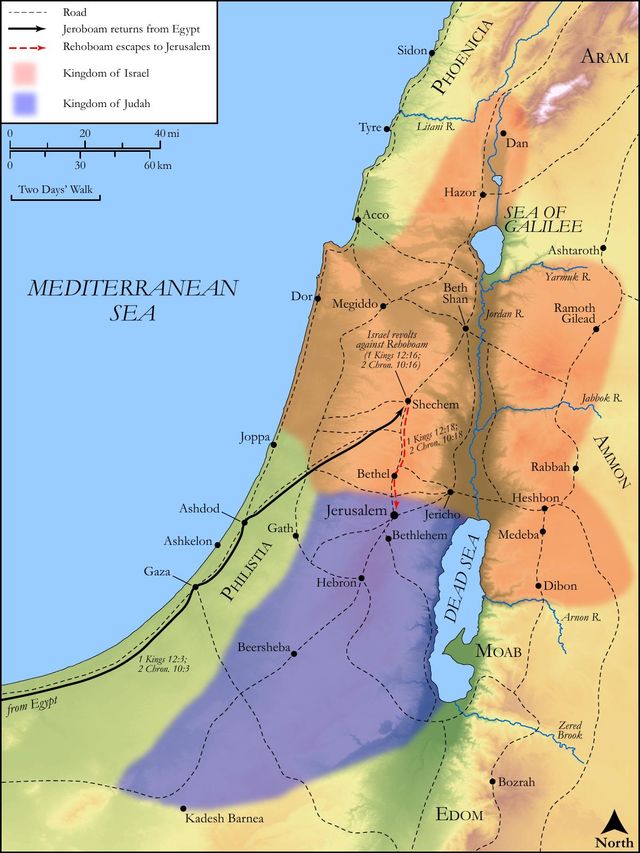
This verse is the climax of a critical narrative arc in 1 Kings 12. Immediately preceding this, King Rehoboam, Solomon's son, had ascended to the throne. The people, burdened by Solomon's heavy taxation and forced labor, appealed to Rehoboam at Shechem for lighter burdens (1 Kings 12:4). Rehoboam sought counsel, first from the seasoned elders who advised him to serve the people kindly, and then from the young men he had grown up with. Rejecting the wisdom of the elders, he chose the harsh counsel of his peers, threatening to increase the people's burdens (1 Kings 12:13-14). The people's response in 1 Kings 12:16 is a direct, indignant reaction to Rehoboam's tyrannical pronouncement, leading directly to the subsequent anointing of Jeroboam as king over the northern tribes (1 Kings 12:20).
Historical & Cultural Context
The setting is Shechem, a historically significant site for Israelite assemblies and covenant renewals, which adds symbolic weight to the division. The phrase "What portion have we in David? neither have we inheritance in the son of Jesse" is a powerful rhetorical question, culturally understood as a complete renunciation of any claim or loyalty to the Davidic lineage. It echoes similar declarations of disinheritance in ancient Near Eastern treaties and tribal disputes. "To your tents, O Israel" was a traditional rallying cry for tribal mobilization or, as in this case, for withdrawal from a central authority back to one's own tribal domain. The heavy burdens imposed by Solomon, particularly for his extensive building projects, had created deep resentment, especially among the northern tribes who felt disproportionately affected. This underlying discontent, combined with Rehoboam's folly, provided the fertile ground for the kingdom's fragmentation.
Key Themes
ShowHideThis verse encapsulates several major themes. Firstly, it highlights the consequences of foolish leadership and pride. Rehoboam's arrogance and refusal to heed wise counsel directly led to the disintegration of the united monarchy, serving as a stark warning about the dangers of unchecked power and hubris (Proverbs 16:18). Secondly, it underscores the rejection of the Davidic dynasty by the majority of Israel, a profound theological and political shift. The Davidic covenant, promising an eternal dynasty (2 Samuel 7:12-16), was seemingly fractured by human sin and folly, though God's ultimate plan for the lineage remained intact. Finally, the verse is the historical turning point for the division of the kingdom, a direct fulfillment of God's earlier prophecy to Jeroboam through the prophet Ahijah, indicating that this human failure was also part of God's sovereign, albeit disciplinary, plan due to Solomon's idolatry (1 Kings 11:29-39).
Exposition and Analysis
ShowHideKey Word Analysis
ShowHideThis term, from H2506, often translated as "share" or "allotment," carries significant legal and covenantal weight. It properly refers to smoothness of the tongue, but by implication, an allotment. In this context, it signifies a rightful part or inheritance, particularly in the context of land division or tribal identity. To declare "no portion" in David is to assert a complete severance of any legal, familial, or covenantal ties, akin to disinheritance, indicating a rejection of shared destiny or benefit.
This word denotes an ancestral possession, a heritage, or an enduring legacy, often tied to the land or a lineage. It means "something inherited" or "an estate, patrimony, or portion." The parallel use of "portion" and "inheritance" emphasizes the totality of their rejection—they claim no share in the Davidic legacy, no future under its rule, and no part in its covenantal blessings, signifying a complete disavowal of patrimony.
Derived from H168, this term refers to a tent as "clearly conspicuous from a distance," signifying a dwelling place or tabernacle. While literally referring to nomadic dwellings, "to your tents, O Israel" was a well-established military and tribal rallying cry. It signified a call for individual tribes or soldiers to return to their homes and tribal loyalties, effectively withdrawing from a central command or assembly. In this context, it became a powerful declaration of secession and a return to tribal autonomy, marking the dissolution of the united kingdom.
Verse Breakdown
ShowHide"So when all Israel saw that the king hearkened not unto them"
This clause highlights Rehoboam's stubbornness and unwillingness to listen to the legitimate grievances and pleas of his people. His refusal to "hearken" (listen and respond favorably) is the immediate catalyst for the people's drastic action. It emphasizes the king's failure in his primary duty to serve his subjects, a profound breakdown of the covenantal relationship between king and people.
"the people answered the king, saying, What portion have we in David? neither [have we] inheritance in the son of Jesse:"
This is the core declaration of secession. It's a rhetorical question expressing absolute repudiation. By rejecting "David" and "the son of Jesse" (referring to the entire Davidic dynasty), they are disavowing the very foundation of the united monarchy and the divine covenant associated with it. This is a profound statement of disinheritance and a severing of all allegiance, marking a complete political and spiritual break.
"to your tents, O Israel:"
This is the rallying cry for the northern tribes to withdraw. It's an instruction for the people to return to their own tribal lands and concerns, effectively declaring independence from Rehoboam's rule and the Jerusalem-based monarchy. It signifies a return to a pre-monarchical, tribal structure, albeit temporarily, before establishing their own king and forming a separate nation.
"now see to thine own house, David."
This is a defiant challenge and an insult directed at Rehoboam and, by extension, the Davidic dynasty. It's a declaration that the northern tribes will no longer be concerned with the affairs or well-being of the Davidic house. This implies that the dynasty should focus solely on its own limited territory and people (Judah and Benjamin), as the rest of Israel has abandoned it, a bitter and contemptuous dismissal.
"So Israel departed unto their tents."
This final clause records the immediate and decisive action taken by the northern tribes. It signifies the physical and political act of separation, confirming the division of the kingdom. The departure is not merely a retreat but a definitive break, solidifying the schism that would define Israelite history for centuries and usher in an era of two rival kingdoms.
Literary Devices
ShowHideThe verse powerfully employs several literary devices to convey the gravity of the moment. The central declaration, "What portion have we in David? neither have we inheritance in the son of Jesse?" is a potent rhetorical question, designed not to elicit an answer but to express a definitive and indignant rejection, emphasizing the finality of their decision. Its structure also demonstrates parallelism, with "portion in David" mirroring "inheritance in the son of Jesse," intensifying the sense of complete disavowal through repetition and synonymous phrasing. The use of "David" and "son of Jesse" serves as metonymy or synecdoche, where the name of the patriarch stands for the entire Davidic dynasty and its covenantal claims. The subsequent command, "to your tents, O Israel," functions as a rallying cry or exhortation, signaling a collective and decisive action. Finally, the direct address, "now see to thine own house, David," is an act of apostrophe, speaking directly to the Davidic line (represented by Rehoboam) in a tone of contempt and dismissal, underscoring the finality of their separation.
Theological and Thematic Connections
ShowHideThe division of the kingdom, precipitated by Rehoboam's folly and the people's rejection, serves as a profound theological lesson on the interplay of human sin, divine sovereignty, and covenant faithfulness. While Rehoboam's pride and the people's indignation were the immediate human causes, the narrative explicitly states that this was "a turn of affairs brought about by the LORD" (1 Kings 12:15), fulfilling the prophecy given to Jeroboam due to Solomon's idolatry. This demonstrates God's ability to orchestrate His purposes even through the sinful choices and failures of humanity. It highlights that while God's covenant with David was unconditional concerning the perpetuity of his lineage on the throne, the immediate blessing and unity of the kingdom were conditional upon the obedience of individual kings. The schism underscores the persistent challenge of leadership within God's people and the devastating consequences of forsaking wisdom and justice for self-serving ambition.
Reflection and Application
ShowHideThe account of the kingdom's division in 1 Kings 12:16 offers timeless lessons for leaders and individuals in every sphere of life. Rehoboam's catastrophic failure underscores the critical importance of humility and the willingness to receive wise counsel, especially when it challenges one's preconceived notions or desires for power. His pride, coupled with a lack of empathy for the people he was called to serve, led directly to the fracturing of a divinely established kingdom. This narrative reminds us that true leadership is characterized by service, listening, and a genuine concern for the well-being of those being led, rather than an authoritarian imposition of will. For individuals, it highlights the ripple effect of decisions—how personal choices, particularly those made from a place of arrogance or self-interest, can have far-reaching and devastating consequences, impacting not just oneself but entire communities and generations. It challenges us to examine our own hearts for pride, to cultivate a posture of humility, and to actively seek and heed wise counsel in our personal and professional lives, recognizing that genuine wisdom often comes from those with experience and a heart for others.
Questions for Reflection
ShowHideFAQ
ShowHideWhy did the people reject Rehoboam so decisively, even though he was Solomon's legitimate heir?
ShowHideThe people's decisive rejection of Rehoboam stemmed from a combination of factors. Firstly, they had endured the heavy burdens of forced labor and taxation under King Solomon, and they hoped for relief under the new king. Secondly, Rehoboam's arrogant and dismissive response, threatening to make their burdens even heavier (1 Kings 12:13-14), demonstrated a profound lack of empathy and wisdom. Culturally, the northern tribes had a history of independent spirit and occasional tension with the southern tribe of Judah, where the Davidic dynasty was centered. This underlying tension, coupled with Rehoboam's folly, provided the immediate catalyst for their secession. Ultimately, the Bible states that this division was part of God's sovereign plan, a judgment on Solomon's idolatry (1 Kings 11:11-13).
What is the significance of the phrase "What portion have we in David? neither [have we] inheritance in the son of Jesse"?
ShowHideThis phrase is a powerful declaration of disinheritance and absolute renunciation of allegiance. "David" and "son of Jesse" refer to the entire Davidic dynasty, the royal line established by God through King David. By asking "What portion have we?" and denying "inheritance," the northern tribes are asserting that they have no share, no claim, no loyalty, and no future connection to this lineage, its covenant, or its rule. It's a legal and covenantal declaration, signifying a complete break from the centralized monarchy and a return to their own tribal identities and autonomy. This public rejection effectively dismantled the united kingdom that had flourished under David and Solomon.
Was the division of the kingdom God's will or a result of human sin?
ShowHideThe division of the kingdom was a complex interplay of both human sin and divine will. From the human perspective, it was a direct consequence of Rehoboam's pride, foolishness, and tyrannical leadership, as well as the people's justified indignation. However, the biblical narrative explicitly states that this turn of events was "from the LORD" (1 Kings 12:15). God had previously prophesied this division through the prophet Ahijah to Jeroboam, as a judgment against King Solomon's idolatry and unfaithfulness (1 Kings 11:29-39). Thus, while human sin was the immediate cause, it served as the instrument through which God's righteous judgment and sovereign plan were fulfilled. God, in His sovereignty, can use even the failures and rebellion of humanity to accomplish His purposes.
Christ-Centered Fulfillment
ShowHideThe tragic division of the kingdom in 1 Kings 12:16, a direct result of human folly and sin, powerfully foreshadows the need for a true and ultimate King who would not only unite His people but rule with perfect wisdom and justice. The Davidic dynasty, though divinely promised to endure, was shown to be fallible and fractured by the sin of its human occupants. Rehoboam's burdensome rule stands in stark contrast to the reign of Jesus Christ, the true Son of David, who offers a yoke that is easy and a burden that is light (Matthew 11:28-30). While Israel cried, "What portion have we in David?", Jesus, as the rightful heir to David's throne (Matthew 1:1; Luke 1:32-33), invites all people to find their ultimate "portion" and "inheritance" in Him—an eternal kingdom that will never be divided or fall. Unlike Rehoboam, who sought to increase his own power, Christ came to serve and to give His life as a ransom for many (Mark 10:45). His kingdom is not of this world, nor is it subject to the whims of human pride or the consequences of sin; it is an everlasting spiritual reign that unites believers from every tribe and nation into one body, under one perfect King (Ephesians 2:14-16). Thus, the brokenness of 1 Kings 12:16 points forward to the holistic restoration and eternal unity found only in the reign of Christ.