


2 Chronicles 10:16
Bible text: King James Version (1769 Blayney text) · Public domain
Bible text: King James Version with Strong's numbers · Public domain
Bible text: Berean Standard Bible · Public domain
Bible text: American Standard Version (1901) · Public domain
Bible text: World English Bible, Messianic edition · Public domain
Bible text: Geneva Bible (1599) · Public domain
Bible text: Young's Literal Translation · Public domain
- וְכָלve·kholand allH3605Conj-w ¦ N-mscNoun Singular Masculine Constructוְandכָלall
- יִשְׂרָאֵלYis·ra·'ElIsraelH3478N-properNoun Proper Location
- כִּיkithatH3588PrtParticle Conditional
- לֹאlo'notH3808NegParticle Negative
- שָׁמַעsha·Ma'he had listenedH8085V-Qal-Perf-3msVerb Qal Perfect 3rd Singular Masculine
- הַמֶּלֶךְha·me·leKhthe kingH4428Art ¦ N-msNoun Singular Masculine Absoluteהַtheמֶּלֶךְking
- לָהֶםla·Hemto themPrep-l ¦ 3mpSuffix Personal 3rd Plural Masculineלָtoהֶםthem
- וַיָּשִׁיבוּvai·ya·Shi·vuand they brought backH7725Conj-w ¦ V-Hiphil-ConsecImperf-3mpVerb Hiphil Consecutive Imperfect 3rd Plural Masculineוַandיָּשִׁיבוּthey brought back
- הָעָםha·'Amthe peopleH5971Art ¦ N-msNoun Singular Masculine Absoluteהָtheעָםpeople
- אֶת'et<obj.>H853DirObjMParticle Object Indicator
- הַמֶּלֶךְha·Me·lekhthe kingH4428Art ¦ N-msNoun Singular Masculine Absoluteהַtheמֶּלֶךְking
- לֵאמֹרle·Mor<to> sayingH559Prep-l ¦ V-Qal-InfVerb Qal Infinitive Constructלֵ<to>אמֹרsaying
- מַהmahwhat?H4100InterrogPronoun Interrogative
- לָּנוּla·Nu[belongs] to usPrep-l ¦ 1cpSuffix Personal 1st Plural common genderלָּ[belongs] toנוּus
- חֵלֶקChe·lekportionH2506N-msNoun Singular Masculine Absolute
- בְּדָוִידbe·da·Vidin DavidH1732Prep-b ¦ N-proper-mNoun Proper MasculineבְּinדָוִידDavid
- וְלֹאve·lo'and notH3808Conj-w ¦ NegParticle Negativeוְandלֹאnot
- נַחֲלָהna·cha·Lahan inheritanceH5159N-fsNoun Singular Feminine Absolute
- בְּבֶןbe·venin [the] son ofH1121Prep-b ¦ N-mscNoun Singular Masculine Constructבְּinבֶן[the] son of
- יִשַׁיyi·ShaiJesseH3448N-proper-mNoun Proper Masculine
- אִישׁ'isheveryoneH376N-msNoun Singular Masculine Absolute
- לְאֹהָלֶיךָle·'o·ha·Lei·khato your tentsH168Prep-l ¦ N-mpc ¦ 2msNoun Plural Masculine Constructלְtoאֹהָלֶיtentsךָyour
- יִשְׂרָאֵלYis·ra·'ElO IsraelH3478N-properNoun Proper Location
- עַתָּה'a·TahnowH6258AdvAdverb
- רְאֵהre·'EhconsiderH7200V-Qal-Imp-2msVerb Qal Imperative 2nd Singular Masculine
- בֵיתְךָvei·te·Khayour own houseH1004N-msc ¦ 2msNoun Singular Masculine Constructבֵיתְown houseךָyour
- דָּוִידda·VidO DavidH1732N-proper-mNoun Proper Masculine
- וַיֵּלֶךְvai·Ye·lekhand it wentH1980Conj-w ¦ V-Qal-ConsecImperf-3msVerb Qal Consecutive Imperfect 3rd Singular Masculineוַandיֵּלֶךְit went
- כָּלkolallH3605N-mscNoun Singular Masculine Construct
- יִשְׂרָאֵלYis·ra·'ElIsraelH3478N-properNoun Proper Location
- לְאֹהָלָיוle·'o·ha·Lavto its tentsH168Prep-l ¦ N-mpc ¦ 3msNoun Plural Masculine Constructלְtoאֹהָלָיtentsוits
English is a literal word-by-word gloss of the Hebrew, not the KJV's wording. Why?
This is the original text the KJV's translators worked from — each Hebrew word with its own literal English meaning in this verse, prepared by scholars at Tyndale House, Cambridge. The KJV translates whole sentences, not word by word, so its wording differs: one Hebrew word can become several English words, and the KJV may choose “the LORD” where the gloss reads “Yahweh”. Both are faithful — they answer different questions. For the KJV's own rendering, switch to the KJV text.
Details
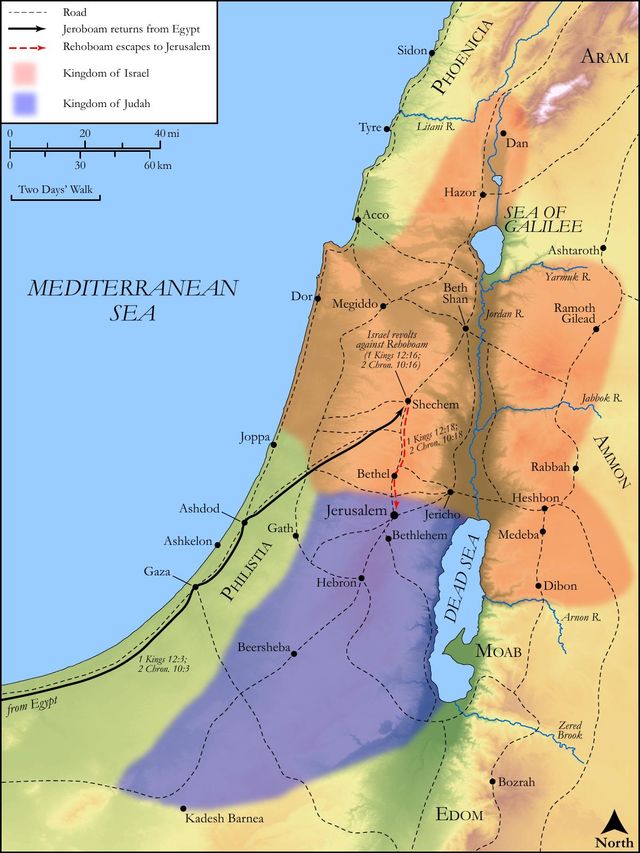
See on the biblical-era map
Study this verse
Public-domain commentary
Matthew Henry
From his Commentary on the Whole Bible. Henry comments on passages, not single verses — this entry covers 2 Chronicles 10:12–19.
We may learn here, 1. That when public affairs are in a ferment violent proceedings do but make bad worse. Rough answers (such as Rehoboam here gave) do but stir up anger and bring oil to the flames. The pilot has need to steer steadily in a storm. Many have been driven to the mischief they did not intend by being too severely dealt with for what they did intend. 2. That, whatever the devices and designs of men are, God is, by all, doing his own work, and fulfilling the word which he has spoken, no iota or tittle of which shall fall to the ground. The cause of the king's obstinacy and thoughtlessness was of God, that he might perform the word which he spoke by Ahijah, Ch2 10:15. This does not at all excuse Rehoboam's folly, nor lessen the guilt of his haughtiness and passion, that God was pleased to serve his own ends by them. 3. That worldly wealth, honour, and dominion, are very uncertain things. Solomon reigned over all Israel, and, one would think, had done enough to secure the monarchy entire to his family for many ages; and yet he is scarcely cold in his grave before ten of the twelve tribes finally revolt from his son. All the good services he had done for Israel were now forgotten: What portion have we in David? Thus is the government of Christ cast off by many, notwithstanding all he has done to bind the children of men for ever to himself; they say, We will not have this man to reign over us. But this rebellion will certainly be their ruin. 4. That God often visits the iniquities of the fathers upon the children. Solomon forsakes God, and therefore not he, but his son after him, is forsaken by the greatest part of his people. Thus God, by making the penal consequences of sin to last long and visibly to continue after the sinner's death, would give an indication of its malignity, and perhaps some intimation of the perpetuity of its punishment. He that sins against God not only wrongs his soul, but perhaps wrongs his seed more than he thinks of. 5. That, when God is fulfilling his threatenings, he will take care of that, at the same time, promises do not fall to the ground. When Solomon's iniquity is remembered, and for it his son loses ten tribes, David's piety is not forgotten, nor the promise made to him; but for the sake of that his grandson had two tribes preserved to him. The failings of the saints shall not frustrate any promise made to Christ their Head. They shall be chastised, but the covenant not broken, Psa 89:31-34.
Continue studying 2 Chronicles 10:16 across the web’s major study libraries — every link below opens this exact verse, chapter, or book on the destination site.
Read & Compare
 BibleGatewayThis verse in more than 200 translations and 70 languages.
 Bible.comThe YouVersion reader — hundreds of translations, reading plans, and highlights.
 ESV.orgCrossway's official English Standard Version reader.
 NET BibleThe NET translation with 60,000+ translators' notes on every rendering decision.
 STEP BibleTyndale House's free study tool — original text, vocabulary, and scholarly resources.
 BibliaLogos Bible Software's free web reader.
 USCCBThe New American Bible (Revised Edition) with the U.S. bishops' study notes.
Commentaries
 BibleHub CommentariesDozens of classic commentaries on this verse, gathered on one page.
 StudyLightMore than 100 commentary sets — the largest collection on the web.
 BibleRefPlain-English commentary on what this verse means, verse by verse.
 Enduring WordDavid Guzik's free commentary on this chapter, widely used by Bible teachers.
 Bible Study ToolsVerse commentary alongside Greek and Hebrew study aids.
Original Language & Research
- BibleHub InterlinearThe verse word by word — original language, transliteration, and English.
- BibleHub LexiconEvery word's original-language definition and Strong's entry.
 Blue Letter BibleDeep-study tools — Strong's numbers, concordance, and word studies.
 SefariaThe Hebrew text with Rashi and centuries of Jewish commentary.
Sermons, Hymns & Audio


TrulyRandomVerse is not affiliated with these sites and doesn’t control their content. They’re linked because they’re genuinely useful.
Summary
2 Chronicles 10:16 records the climactic and tragic moment of the united monarchy's dissolution, as the northern tribes of Israel, exasperated by King Rehoboam's arrogant refusal to lighten their heavy burdens, defiantly declare their secession from the Davidic dynasty. This verse captures their furious repudiation of the king and the royal house, signaling the irreversible split that would forever divide the kingdom into Israel in the north and Judah in the south, marking a profound turning point in Israel's history.
Context
ShowHideLiterary Context
This verse serves as the dramatic and decisive culmination of the negotiations between King Rehoboam and the people of Israel following the death of his father, Solomon. The preceding narrative in 2 Chronicles 10:1-15 meticulously details the people's legitimate plea for relief from the oppressive taxation and forced labor imposed during Solomon's reign. It then recounts Rehoboam's fateful decision to reject the wise counsel of the elders, who advised a compassionate response, in favor of the foolish and harsh advice of his young contemporaries. His declaration to increase their burdens, rather than lighten them, directly precipitates the people's furious and immediate response in this verse, marking the point of no return and setting the stage for the subsequent narrative of the divided kingdoms of Israel and Judah.
Historical & Cultural Context
The assembly takes place at Shechem, a site of profound historical and covenantal significance for the tribes of Israel, having been a place of covenant renewal (Joshua 24) and tribal gatherings since ancient times. This choice of location underscores the gravity and traditional legitimacy of the people's assembly and their subsequent declaration. Following Solomon's reign, characterized by immense building projects, a lavish court, and extensive taxation, the populace, particularly in the northern tribes, faced significant economic strain. Their request for lighter burdens was not merely a political maneuver but a desperate plea for economic relief. The Davidic dynasty, though divinely established, was now perceived by many as an oppressive regime. The rallying cry "every man to your tents, O Israel" was a traditional expression of tribal independence and a call for dispersal, echoing earlier periods of tribal autonomy and even rebellion against central authority, such as Sheba's revolt against David in 2 Samuel 20:1.
Key Themes
ShowHideThe verse powerfully encapsulates several overarching themes central to the Chronicler's narrative. Firstly, it highlights the rejection of leadership and the breaking of loyalty to the Davidic covenant, as the northern tribes defiantly declare, "What portion have we in David? and we have none inheritance in the son of Jesse." This repudiation underscores the fragility of human institutions even when divinely ordained. Secondly, it starkly illustrates the dire consequences of pride and foolishness in leadership, as Rehoboam's arrogance directly precipitates the kingdom's fracturing, serving as a cautionary tale about the importance of humility and wise counsel, a theme frequently emphasized throughout the wisdom literature, particularly Proverbs. Thirdly, while human choices are central, the narrative also subtly underscores divine sovereignty, revealing that this tragic division was, in fact, a fulfillment of God's prophetic word through Ahijah to Jeroboam concerning Solomon's idolatry, as detailed in 1 Kings 11:31-35. Finally, it marks the definitive beginning of the Divided Monarchy, a period of profound theological and political significance for Israel's history, setting the stage for centuries of separate spiritual and political trajectories for Israel and Judah.
Exposition and Analysis
ShowHideKey Word Analysis
ShowHideThis term (H2506) signifies a share, lot, or inheritance, often referring to a share in land, property, or a common destiny. When the people declare, "What portion have we in David?", they are asserting that they have no common stake, no shared interest, and no claim to the legacy or benefits associated with the Davidic house. It's a declaration of complete disassociation and a rejection of any future participation in the Davidic kingdom's affairs, signifying a severance of all ties to the ruling dynasty.
This word (H5159) carries a deeper theological and legal weight than "portion," referring to an allotted possession, often land or a birthright, passed down through generations. By stating "none inheritance in the son of Jesse," the people are not merely rejecting a share but disavowing any claim to the foundational promises and blessings tied to David's lineage, including the land and the covenant. It's a profound renunciation of their historical, legal, and spiritual ties to the Davidic line, declaring their intent to forge a separate destiny.
While literally meaning "tent" (H168), in this context, "every man to your tents, O Israel" functions as a proverbial expression. It does not mean they literally returned to nomadic tents, but rather to their homes, their tribal regions, and their independent ways of life, abandoning the central authority of the capital and the unified monarchy. It's a powerful and traditional call for dispersal and a return to tribal autonomy, a declaration of secession and a symbolic dismantling of the unified kingdom.
Verse Breakdown
ShowHide"And when all Israel saw that the king would not hearken unto them"
This phrase emphasizes the people's collective realization of Rehoboam's stubbornness and unwillingness to compromise. Their observation of his unyielding stance, his refusal to listen (from H8085, shâmaʻ, meaning to hear intelligently, often with implication of attention or obedience), is the immediate trigger for their decisive action. It underscores the king's profound failure to engage with or address the legitimate grievances of his subjects.
"the people answered the king, saying, What portion have we in David?"
This is a direct, defiant rhetorical question, serving as a declaration rather than an inquiry. It signifies a complete and immediate break from loyalty to the Davidic dynasty. It's an assertion that they no longer recognize the Davidic line as their rightful or beneficial ruler, echoing a similar sentiment from earlier tribal rebellions, and indicating a total disavowal of shared destiny.
"and [we have] none inheritance in the son of Jesse:"
This clause powerfully reinforces the previous statement, using a poetic and familial reference to David ("son of Jesse," H1121, H3448). It emphasizes the absolute and irrevocable nature of their rejection, not just of Rehoboam, but of the entire lineage and the covenant associated with David (H1732). They are cutting all ties to the royal house, renouncing any claim or benefit from its historical and prophetic significance.
"every man to your tents, O Israel:"
This is the rallying cry for secession, a command for the people (H5971, ʻam) to abandon the capital and the king, returning to their own tribal territories and reasserting their independence. It is a traditional call (using H168, ʼôhel, for "tents") to dissolve the unified kingdom and return to a state of tribal autonomy.
"and now, David, see to thine own house."
This is a sarcastic and contemptuous dismissal of Rehoboam. By calling him "David" (H1732), they mockingly challenge him to rule over his own house (H1004, bayith, referring to his immediate household or the tribe of Judah) since the rest of Israel has abandoned him. It's a final, cutting word of defiance, emphasizing the king's diminished authority and the irreversible nature of the split.
"So all Israel went to their tents."
This concluding statement confirms the immediate and decisive action taken by the northern tribes. It signifies the physical and political manifestation of their declaration, marking the definitive split of the kingdom and the end of the united monarchy (using H3212, yâlak, to walk/go, and H168, ʼôhel, for tents).
Literary Devices
ShowHideThe verse is rich in Repudiation and Defiance, as the people's language is direct, confrontational, and unequivocally expresses their absolute rejection of Rehoboam and the Davidic line. The rhetorical question, "What portion have we in David?", is a powerful example of Interrogative Rhetoric, designed not to elicit an answer but to convey a firm declaration of disassociation and a severing of loyalty. There is clear Parallelism in the phrases "What portion have we in David?" and "none inheritance in the son of Jesse," which intensifies the message of complete severance and reinforces the finality of their decision. The use of "son of Jesse" is a form of Synecdoche or Metonymy, referring to the entire Davidic dynasty through its humble progenitor, emphasizing the people's comprehensive rejection of the entire lineage, not just Rehoboam. The command "every man to your tents, O Israel" functions as a Symbolic Call to Action, where "tents" represents tribal autonomy and a return to their respective territories rather than literal nomadic dwellings, signifying a return to an earlier, decentralized political structure. Finally, the sarcastic address "David, see to thine own house" employs Irony and Sarcasm, highlighting the people's contempt for Rehoboam and their dismissive attitude towards his authority over them, underscoring his failure as a king.
Theological and Thematic Connections
ShowHideThis pivotal verse underscores the tension between human agency and divine sovereignty in the unfolding of biblical history. While Rehoboam's pride and foolishness were the immediate human catalysts for the kingdom's division, the narrative simultaneously reveals God's overarching plan at work, fulfilling prophecies made due to Solomon's idolatry. The rejection of the Davidic king by the majority of Israel highlights the fragility of human institutions and the devastating consequences of unrighteous leadership, even within a divinely established covenant. It serves as a stark reminder that God's promises, such as the eternal nature of the Davidic covenant, are ultimately fulfilled not through the unbroken line of flawed human kings, but through a greater, perfect King. The division also sets the stage for the distinct spiritual journeys of the two kingdoms, Israel and Judah, each facing their own challenges of idolatry and faithfulness to the Lord, demonstrating the long-term ramifications of disobedience and the enduring nature of God's redemptive plan despite human failure.
Reflection and Application
ShowHideThe tragic account of 2 Chronicles 10:16 offers profound and enduring lessons for contemporary leadership and community dynamics. Rehoboam's catastrophic failure to listen to wise counsel and his arrogant, unyielding response to legitimate grievances serve as a potent warning: pride and insensitivity in positions of authority often lead to alienation, division, and the irreparable collapse of trust. For leaders in any sphere—be it family, church, business, or government—this passage underscores the vital importance of humility, empathy, and the willingness to genuinely hear and address the concerns of those they lead, even when those concerns are challenging or inconvenient. A compassionate, just, and responsive approach, rather than a harsh or demanding one, is often the path to unity, stability, and flourishing. For individuals within a community, it highlights the profound consequences of rash decisions and the deep, ripple-effect impact of leadership choices on the collective well-being. It also reminds us that while human actions have real and often painful consequences, God's sovereign plan ultimately prevails, even through human failures. We are called to seek wisdom diligently, practice humility consistently, and foster unity intentionally, recognizing that division often stems from a lack of listening and an abundance of pride.
Questions for Reflection
ShowHideFAQ
ShowHideWhy did the people say "What portion have we in David?" when they were addressing Rehoboam?
ShowHideThis defiant declaration was not merely a rejection of Rehoboam personally, but a complete repudiation of the entire Davidic dynasty and its claim to their loyalty. The phrase "What portion have we in David? and we have none inheritance in the son of Jesse" signifies a total break from the shared heritage, covenant, and future associated with David's royal line. It echoes an earlier tribal cry of rebellion, such as that of Sheba in 2 Samuel 20:1, indicating a deep-seated discontent with centralized authority that predated Rehoboam. By invoking David's name, they were dismissing the very foundation of Rehoboam's claim to the throne over them, asserting that the Davidic covenant no longer held sway over their allegiance.
Was this division solely due to Rehoboam's actions?
ShowHideWhile Rehoboam's prideful and foolish decisions were the immediate and human catalyst for the split, the biblical narrative makes it clear that this division was also part of God's sovereign plan. 1 Kings 11:31-35 records the prophet Ahijah's prophecy to Jeroboam, stating that God would tear ten tribes from Solomon's kingdom due to Solomon's idolatry and disobedience. Thus, Rehoboam's actions, though stemming from his own free will and poor judgment, ultimately served to fulfill God's predetermined purpose. This demonstrates a profound theological truth: even human sin and folly can be woven into the tapestry of God's overarching redemptive plan, revealing His sovereignty over all history.
What does "every man to your tents, O Israel" mean?
ShowHideThis phrase is a traditional rallying cry in ancient Israel, signaling a return to tribal independence and a rejection of central authority. It does not imply that the people literally lived in tents, but rather that they would return to their own homes, lands, and tribal regions, abandoning the capital (Jerusalem) and the unified monarchy. It was a powerful declaration of secession, a call for the tribes to disperse and govern themselves, effectively dissolving the united kingdom that had existed under Saul, David, and Solomon. It symbolized a return to a decentralized, pre-monarchic tribal structure, rejecting the centralized power of the Davidic throne.
Christ-Centered Fulfillment
ShowHideThe tragic division of the kingdom in 2 Chronicles 10:16, born of human pride and folly, profoundly underscores the essential need for a perfect, unwavering King. The failure of Rehoboam and the subsequent fracturing of the Davidic dynasty highlight the inherent limitations and brokenness of earthly kingship, even within a divinely chosen line. This historical event, therefore, serves as a powerful backdrop for understanding the ultimate fulfillment found in Jesus Christ, the true Son of David. Unlike Rehoboam, whose harsh words alienated his people, Jesus, the Good Shepherd, speaks words of grace and truth, drawing His sheep to Himself (John 10:27). His kingdom is not divided by human sin or political strife, for it is an eternal kingdom established on righteousness and peace (Isaiah 9:6-7; Luke 1:32-33). Where Israel sought a "portion" and "inheritance" that a flawed human king could not secure, believers find their ultimate "portion" and "inheritance" in Christ Himself, through whom they are brought into the unshakeable kingdom of God (Ephesians 1:11; Colossians 1:13). Jesus' reign is characterized by humility, justice, and self-sacrifice, in stark contrast to the oppressive rule of Rehoboam, offering a unified and everlasting hope that no earthly king could ever provide. He is the King who truly "hearkens" to His people, bearing their burdens and offering rest for their souls (Matthew 11:28-30).