


2 Chronicles 10:15
Bible text: King James Version (1769 Blayney text) · Public domain
Bible text: King James Version with Strong's numbers · Public domain
Bible text: Berean Standard Bible · Public domain
Bible text: American Standard Version (1901) · Public domain
Bible text: World English Bible, Messianic edition · Public domain
Bible text: Geneva Bible (1599) · Public domain
Bible text: Young's Literal Translation · Public domain
- וְלֹאve·lo'and notH3808Conj-w ¦ NegParticle Negativeוְandלֹאnot
- שָׁמַעsha·Ma'he listenedH8085V-Qal-Perf-3msVerb Qal Perfect 3rd Singular Masculine
- הַמֶּלֶךְha·Me·lekhthe kingH4428Art ¦ N-msNoun Singular Masculine Absoluteהַtheמֶּלֶךְking
- אֶל'eltoH413PrepPreposition
- הָעָםha·'Amthe peopleH5971Art ¦ N-msNoun Singular Masculine Absoluteהָtheעָםpeople
- כִּיkiforH3588PrtParticle Conditional
- הָיְתָהha·ye·Tahit wasH1961V-Qal-Perf-3fsVerb Qal Perfect 3rd Singular Feminine
- נְסִבָּהne·si·Baha turnH5252N-fsNoun Singular Feminine Absolute
- מֵעִםme·'Imfrom withH5973Prep-m ¦ PrepPrepositionמֵfromעִםwith
- הָאֱלֹהִיםha·'E·lo·Him<the> GodH430Art ¦ N-mpNoun Plural Masculine Absoluteהָ<the>אֱלֹהִיםGod
- לְמַעַןle·ma·'Anso asH4616PrtParticle Conditional
- הָקִיםha·Kimto establishH6965V-Hiphil-InfVerb Hiphil Infinitive Construct
- יְהוָהYah·wehYahwehH3068N-properNoun Proper Title
- אֶת'et<obj.>H853DirObjMParticle Object Indicator
- דְּבָרוֹde·va·Rohis wordH1697N-msc ¦ 3msNoun Singular Masculine Constructדְּבָרwordוֹhis
- אֲשֶׁר'a·SherwhichH834RelParticle Relative
- דִּבֶּרdi·Berhe had spokenH1696V-Piel-Perf-3msVerb Piel Perfect 3rd Singular Masculine
- בְּיַדbe·Yadby [the] hand ofH3027Prep-b ¦ N-cscNoun Singular common gender Constructבְּbyיַד[the] hand of
- אֲחִיָּהוּ'a·chi·Ya·huAhijahH281N-proper-mNoun Proper Masculine
- הַשִּׁלוֹנִיha·shi·lo·Nithe ShiloniteH7888Art ¦ N-msNoun Gentilic Singular Masculine AbsoluteהַtheשִּׁלוֹנִיShilonite
- אֶל'eltoH413PrepPreposition
- יָרָבְעָםya·ra·ve·'AmJeroboamH3379N-proper-mNoun Proper Masculine
- בֶּןben[the] son ofH1121N-mscNoun Singular Masculine Construct
- נְבָטne·VatNebatH5028N-proper-mNoun Proper Masculine
English is a literal word-by-word gloss of the Hebrew, not the KJV's wording. Why?
This is the original text the KJV's translators worked from — each Hebrew word with its own literal English meaning in this verse, prepared by scholars at Tyndale House, Cambridge. The KJV translates whole sentences, not word by word, so its wording differs: one Hebrew word can become several English words, and the KJV may choose “the LORD” where the gloss reads “Yahweh”. Both are faithful — they answer different questions. For the KJV's own rendering, switch to the KJV text.
Details
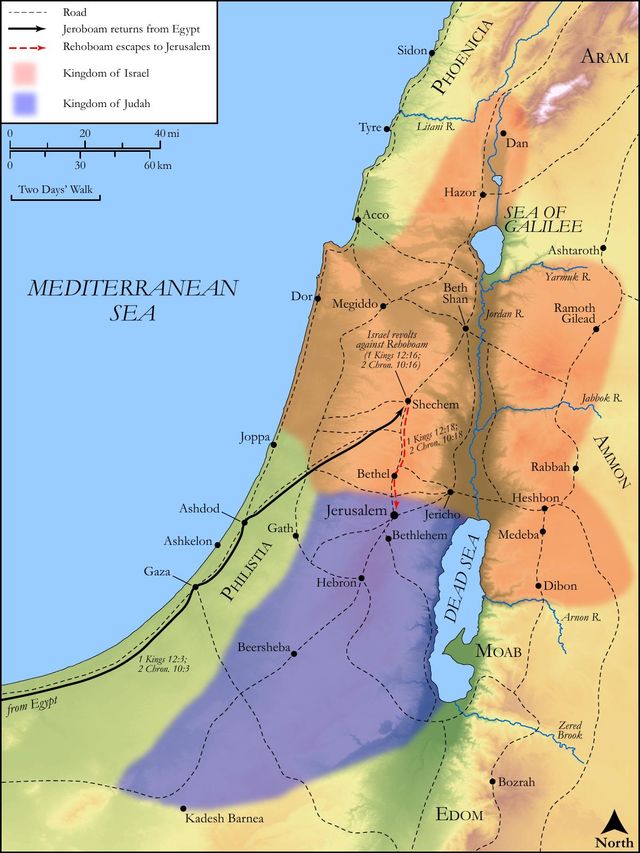
See on the biblical-era map
Study this verse
Public-domain commentary
Matthew Henry
From his Commentary on the Whole Bible. Henry comments on passages, not single verses — this entry covers 2 Chronicles 10:12–19.
We may learn here, 1. That when public affairs are in a ferment violent proceedings do but make bad worse. Rough answers (such as Rehoboam here gave) do but stir up anger and bring oil to the flames. The pilot has need to steer steadily in a storm. Many have been driven to the mischief they did not intend by being too severely dealt with for what they did intend. 2. That, whatever the devices and designs of men are, God is, by all, doing his own work, and fulfilling the word which he has spoken, no iota or tittle of which shall fall to the ground. The cause of the king's obstinacy and thoughtlessness was of God, that he might perform the word which he spoke by Ahijah, Ch2 10:15. This does not at all excuse Rehoboam's folly, nor lessen the guilt of his haughtiness and passion, that God was pleased to serve his own ends by them. 3. That worldly wealth, honour, and dominion, are very uncertain things. Solomon reigned over all Israel, and, one would think, had done enough to secure the monarchy entire to his family for many ages; and yet he is scarcely cold in his grave before ten of the twelve tribes finally revolt from his son. All the good services he had done for Israel were now forgotten: What portion have we in David? Thus is the government of Christ cast off by many, notwithstanding all he has done to bind the children of men for ever to himself; they say, We will not have this man to reign over us. But this rebellion will certainly be their ruin. 4. That God often visits the iniquities of the fathers upon the children. Solomon forsakes God, and therefore not he, but his son after him, is forsaken by the greatest part of his people. Thus God, by making the penal consequences of sin to last long and visibly to continue after the sinner's death, would give an indication of its malignity, and perhaps some intimation of the perpetuity of its punishment. He that sins against God not only wrongs his soul, but perhaps wrongs his seed more than he thinks of. 5. That, when God is fulfilling his threatenings, he will take care of that, at the same time, promises do not fall to the ground. When Solomon's iniquity is remembered, and for it his son loses ten tribes, David's piety is not forgotten, nor the promise made to him; but for the sake of that his grandson had two tribes preserved to him. The failings of the saints shall not frustrate any promise made to Christ their Head. They shall be chastised, but the covenant not broken, Psa 89:31-34.
Continue studying 2 Chronicles 10:15 across the web’s major study libraries — every link below opens this exact verse, chapter, or book on the destination site.
Read & Compare
 BibleGatewayThis verse in more than 200 translations and 70 languages.
 Bible.comThe YouVersion reader — hundreds of translations, reading plans, and highlights.
 ESV.orgCrossway's official English Standard Version reader.
 NET BibleThe NET translation with 60,000+ translators' notes on every rendering decision.
 STEP BibleTyndale House's free study tool — original text, vocabulary, and scholarly resources.
 BibliaLogos Bible Software's free web reader.
 USCCBThe New American Bible (Revised Edition) with the U.S. bishops' study notes.
Commentaries
 BibleHub CommentariesDozens of classic commentaries on this verse, gathered on one page.
 StudyLightMore than 100 commentary sets — the largest collection on the web.
 BibleRefPlain-English commentary on what this verse means, verse by verse.
 Enduring WordDavid Guzik's free commentary on this chapter, widely used by Bible teachers.
 Bible Study ToolsVerse commentary alongside Greek and Hebrew study aids.
Original Language & Research
- BibleHub InterlinearThe verse word by word — original language, transliteration, and English.
- BibleHub LexiconEvery word's original-language definition and Strong's entry.
 Blue Letter BibleDeep-study tools — Strong's numbers, concordance, and word studies.
 SefariaThe Hebrew text with Rashi and centuries of Jewish commentary.
Sermons, Hymns & Audio


TrulyRandomVerse is not affiliated with these sites and doesn’t control their content. They’re linked because they’re genuinely useful.
Summary
Second Chronicles 10:15 encapsulates the profound theological truth that undergirds the tragic division of the united monarchy of Israel. It reveals that King Rehoboam's stubborn refusal to alleviate the people's burdens, which directly triggered the schism, was not merely a political miscalculation or a human failing, but a divinely orchestrated event. This seemingly disastrous human choice served as the precise means by which the LORD fulfilled His previously declared word through the prophet Ahijah the Shilonite to Jeroboam, thereby establishing the northern kingdom of Israel and demonstrating God's absolute sovereignty over human history.
Context
ShowHideLiterary Context
This pivotal verse is strategically placed by the Chronicler at the climax of the narrative detailing the succession crisis following King Solomon's death. The preceding verses 2 Chronicles 10:1-14 meticulously recount the people's earnest plea to Rehoboam for relief from the burdensome taxation and forced labor imposed during Solomon's reign. Rehoboam's initial consultation with the wise elders, who advocated a compassionate, servant-hearted approach to secure the people's loyalty, is contrasted sharply with his subsequent rejection of their counsel in favor of the harsh, domineering advice from his youthful peers. His infamous declaration, "My father made your yoke heavy, and I will add to your yoke: my father also chastised you with whips, but I will chastise you with scorpions" 2 Chronicles 10:14, sets the stage for the inevitable and immediate schism. Verse 15 then provides the interpretive key, asserting that Rehoboam's obstinacy was not simply a human error but a divinely purposed event, framing the political disaster within God's overarching plan.
Historical & Cultural Context
The historical setting is the early 10th century BCE, a period of immense tension and transition after the opulent but demanding reign of Solomon. The united kingdom, a legacy of David and Solomon, was under significant internal strain. The northern tribes, with their distinct historical identity and grievances (rooted in the historical significance of the Shechem assembly and their traditional independence), felt disproportionately burdened by Solomon's extensive building projects and administrative demands. Culturally, the practice of a new king seeking counsel upon ascending the throne was customary, a means of demonstrating wisdom and securing popular support. However, Rehoboam's disdainful rejection of the seasoned elders' advice in favor of his inexperienced contemporaries was a profound cultural misstep, signaling a dangerous embrace of autocratic power and a disregard for traditional wisdom. The resulting division into two distinct kingdoms—Judah in the south and Israel in the north—would have profound and lasting consequences, shaping the political, religious, and social landscape of Israel and Judah for centuries, leading to divergent spiritual paths and frequent conflict.
Key Themes
ShowHideThe preeminent theme in 2 Chronicles 10:15 is Divine Sovereignty, powerfully illustrating God's ultimate control over human history and even the seemingly autonomous choices of individuals. Rehoboam's stubbornness, born of pride and folly, was paradoxically integrated into God's overarching plan. This highlights that God can utilize human actions, even sinful or misguided ones, to achieve His righteous purposes without being the author of sin. Closely intertwined is the theme of Fulfillment of Prophecy. The verse explicitly states that God acted "that the LORD might perform his word," directly referencing the prophecy delivered by Ahijah the Shilonite to Jeroboam, found in 1 Kings 11:29-39. This prophecy foretold the tearing away of ten tribes from Solomon's kingdom due to his idolatry and unfaithfulness. Thus, the division of the kingdom, while immediately triggered by Rehoboam's poor leadership, was fundamentally a divine judgment and the outworking of God's revealed will, underscoring the theme of Consequences of Disobedience. Solomon's spiritual decline, detailed in 1 Kings 11:1-13, was the ultimate root cause, demonstrating that God's judgments, though sometimes delayed, are certain and just.
Exposition and Analysis
ShowHideKey Word Analysis
ShowHideThis primitive root means "to hear intelligently," often implying attention, understanding, and crucially, obedience. In this context, "hearkened not" signifies Rehoboam's deliberate refusal to listen to and obey the counsel of the elders and the legitimate grievances of the people. It underscores his willful disregard for wisdom and his rejection of the responsibilities of a servant-leader, highlighting his pride and folly.
This feminine participle passive means "an environment," "circumstance," or "turn of affairs." Here, "the cause was of God" (literally, "the turn of affairs was from God") asserts divine causality. It indicates that the situation, though appearing to be a result of human decision-making, was ultimately orchestrated by God. This phrase does not negate Rehoboam's responsibility but places his actions within the larger framework of God's sovereign plan, demonstrating God's ability to providentially direct events.
This primitive root means "to rise," but in a causative sense, "to establish," "to confirm," or "to fulfill." When applied to God's word, as here, it emphasizes the absolute reliability, efficacy, and certainty of His declarations. God's "performing" His word means He brings it to pass, ensuring that His prophecies and decrees are not empty pronouncements but active forces that shape history according to His will.
Verse Breakdown
ShowHide"So the king hearkened not unto the people:"
This opening clause describes Rehoboam's decisive and negative response to the people's petition. It highlights his personal agency and responsibility for the ensuing division, emphasizing his pride, lack of discernment, and ultimate rejection of sound, compassionate leadership. His choice was a deliberate act of defiance against wise counsel.
"for the cause was of God,"
This is the Chronicler's crucial theological interpretation of Rehoboam's actions. It provides the divine rationale behind the human event, asserting that Rehoboam's obstinacy, while a genuine human decision, was providentially orchestrated by God. This phrase elevates the narrative beyond a simple account of political folly to a profound statement about divine sovereignty, demonstrating God's active hand in human affairs.
"that the LORD might perform his word,"
This clause states the ultimate purpose of God's intervention. God's orchestration of events was not arbitrary but specifically designed to bring about the fulfillment of a prior divine declaration. This underscores God's unwavering faithfulness to His prophetic utterances and His active involvement in history to ensure His purposes are realized, demonstrating the reliability and power of His word.
"which he spake by the hand of Ahijah the Shilonite to Jeroboam the son of Nebat."
This final clause identifies the specific prophecy being fulfilled. It refers to the divine message delivered through the prophet Ahijah, promising Jeroboam the leadership over ten tribes due to Solomon's idolatry and unfaithfulness. This direct reference links the immediate historical event back to God's long-standing plan and judgment against the house of David, providing a comprehensive theological explanation for the kingdom's division.
Literary Devices
ShowHideThe Chronicler employs several significant literary devices in 2 Chronicles 10:15. Divine Irony is powerfully evident in Rehoboam's actions: his attempt to assert absolute power and control, characterized by his harsh words, paradoxically becomes the very means by which God dismembers his kingdom. His prideful decision, intended to strengthen his rule, leads directly to its diminishment, demonstrating that human will, even when rebellious, can be subsumed into God's greater purposes. Foreshadowing is also a key element, as the verse explicitly references the prophecy of Ahijah, which had been delivered years prior. This highlights the long-term, pre-ordained nature of God's plan, showing that the events unfolding are not random but the inevitable outworking of a divine decree. Finally, the verse is a prime example of Narrative Theology, a hallmark of the Chronicler's work. Rather than simply reporting historical facts, the Chronicler consistently interprets events through a theological lens, emphasizing God's active involvement, sovereignty, and justice in the affairs of Israel. The explicit declaration "the cause was of God" transforms a political blunder into a profound theological statement about divine control and the reliability of God's word.
Theological and Thematic Connections
ShowHideThe profound theological implication of 2 Chronicles 10:15 lies in its powerful affirmation of God's absolute sovereignty over human affairs, even when those affairs involve human sin, folly, and rebellion. While Rehoboam's decision was genuinely his own, driven by pride and poor judgment, the Chronicler asserts that this very decision was ultimately "of God" to fulfill His prophetic word. This does not absolve Rehoboam of responsibility, nor does it imply that God causes sin; rather, it demonstrates God's ability to providentially work through human choices, even sinful ones, to accomplish His righteous and predetermined purposes. It underscores the reliability of God's word, showing that what He declares will inevitably come to pass, and that no human action can thwart His ultimate plan. This perspective offers immense comfort and a call to trust in God's overarching wisdom, even when circumstances appear chaotic or unjust from a human vantage point.
Reflection and Application
ShowHideThe message of 2 Chronicles 10:15 offers profound comfort and challenge for believers today. In a world often characterized by political turmoil, social unrest, and human folly, this verse reminds us that God remains on His throne, sovereign over all. Even when leaders make disastrous decisions, or when events seem to spiral out of control, we can rest in the knowledge that God is working His purposes, often through means we cannot comprehend or that appear counterintuitive. This truth should cultivate a deep trust in His plan, even amidst adversity, and a confident assurance in the unfailing nature of His word. Furthermore, while God's sovereignty is paramount, the narrative does not excuse Rehoboam's pride or foolishness. We are still called to exercise wisdom, seek godly counsel, and make righteous choices, knowing that we are fully accountable for our actions. Our responsibility to obey and seek God's will is not negated by His sovereignty; rather, it is framed within it, compelling us to live faithfully, trusting that God can and will weave our obedience, and even our imperfections, into His grand tapestry of redemption.
Questions for Reflection
ShowHideFAQ
ShowHideDoes God force people to sin, or is Rehoboam still responsible for his actions?
ShowHideThis is a crucial theological distinction. 2 Chronicles 10:15 states that "the cause was of God," indicating divine orchestration. However, this does not mean God forced Rehoboam to sin or implanted sin into his heart. The biblical narrative clearly portrays Rehoboam's decision as a result of his own pride, folly, and rejection of wise counsel 2 Chronicles 10:8-14. God's sovereignty works through, not against, human free will and responsibility. He can use human actions, even sinful ones, to accomplish His righteous purposes without being the author of sin. Rehoboam was fully accountable for his choices, yet God providentially used those choices to fulfill His prophetic word and bring about His predetermined plan for the kingdom. This concept is often referred to as "compatibilism," where divine sovereignty and human responsibility coexist in a way that is ultimately beyond full human comprehension but affirmed by Scripture.
Why did God choose to divide the kingdom? Was it an act of punishment or part of a larger plan?
ShowHideThe division of the kingdom was primarily a divine judgment against King Solomon's idolatry and unfaithfulness, as explicitly stated in 1 Kings 11:11-13. God had warned Solomon that if he turned away from the covenant, the kingdom would be torn from him. While God, in His mercy, delayed the full judgment until after Solomon's death for the sake of David, the division was an inevitable consequence of Solomon's disobedience. Thus, it was an act of righteous judgment, demonstrating God's holiness and His commitment to His covenant. However, it was also part of God's larger, sovereign plan to establish the northern kingdom of Israel and to continue His covenant purposes through the line of David in Judah, ultimately leading to the Messiah. God's judgment is always purposeful, often serving both retributive and redemptive ends.
What is the significance of Ahijah's prophecy in this context?
ShowHideAhijah's prophecy, delivered to Jeroboam in 1 Kings 11:29-39, is foundational to understanding 2 Chronicles 10:15. It revealed God's intention to tear ten tribes from Solomon's kingdom and give them to Jeroboam, explicitly linking this action to Solomon's idolatry. The significance lies in demonstrating God's absolute faithfulness to His word. Even years after the prophecy was given, God actively intervened in human affairs, using Rehoboam's stubbornness, to ensure that His declared will was perfectly "performed" or fulfilled. It underscores the reliability and power of God's prophetic word, proving that what God says, He will do. It also highlights that God's plan is not reactive but proactive, unfolding according to His predetermined counsel.
Christ-Centered Fulfillment
ShowHideThe profound theological truth unveiled in 2 Chronicles 10:15 finds its ultimate and most glorious fulfillment in the person and redemptive work of Jesus Christ. Just as God sovereignly orchestrated Rehoboam's foolish decision to fulfill His prophetic word and advance His purposes, so too did God sovereignly orchestrate the entire sweep of redemptive history, culminating in the incarnation, life, atoning death, and triumphant resurrection of Jesus. The crucifixion of Christ, though carried out by wicked human hands, was not a random tragedy but occurred "according to the definite plan and foreknowledge of God" Acts 2:23. God used the ultimate act of human sin—the murder of His Son—to accomplish the ultimate act of divine love and redemption, providing salvation for humanity. Unlike Rehoboam, who sought to increase burdens and wield oppressive power, Jesus, the true and eternal King, came to lighten burdens and offer profound rest to weary souls Matthew 11:28-30. He is the ultimate fulfillment of all prophecies, the one in whom all God's promises find their resounding "Yes" and "Amen" 2 Corinthians 1:20. The division of the earthly kingdom foreshadowed a greater spiritual division between those who follow the true King and those who reject Him, yet Jesus ultimately unites all who believe in Him under His benevolent and eternal reign, establishing a kingdom that will never be divided or destroyed Isaiah 9:6-7; Hebrews 1:1-3. In Christ, we see the perfect King whose heart is always aligned with the Father's will, ensuring that God's word of salvation is perfectly performed and eternally established.