


2 Chronicles 25:20
- וְלֹאve·lo'and notH3808Conj-w ¦ NegParticle Negativeוְandלֹאnot
- שָׁמַעsha·Ma'he listenedH8085V-Qal-Perf-3msVerb Qal Perfect 3rd Singular Masculine
- אֲמַצְיָהוּ'a·matz·Ya·huAmaziahH558N-proper-mNoun Proper Masculine
- כִּיkiforH3588PrtParticle Conditional
- מֵהָאֱלֹהִיםme·ha·'E·lo·Him[was] from <the> GodH430Prep-m ¦ Art ¦ N-mpNoun Plural Masculine Absoluteמֵ[was] fromהָ<the>אֱלֹהִיםGod
- הִיאHi'itH1931Pro-3fsPronoun Personal 3rd Singular Feminine
- לְמַעַןle·Ma·'anso asH4616PrtParticle Conditional
- תִּתָּםti·Tamto give themH5414V-Qal-Inf ¦ 3mpVerb Qal Infinitive Constructתִּתָּto giveםthem
- בְּיָדbe·Yadin a handH3027Prep-b ¦ N-csNoun Singular common gender Absoluteבְּinיָדa hand
- כִּיkiforH3588PrtParticle Conditional
- דָרְשׁוּda·re·Shuthey had soughtH1875V-Qal-Perf-3cpVerb Qal Perfect 3rd Plural common gender
- אֵת'et<obj.>H853DirObjMParticle Object Indicator
- אֱלֹהֵי'e·lo·Hei[the] gods ofH430N-mpcNoun Plural Masculine Construct
- אֱדוֹם'e·DomEdomH123N-proper-mNoun Proper Masculine
English is a literal word-by-word gloss of the Hebrew, not the KJV's wording. Why?
This is the original text the KJV's translators worked from — each Hebrew word with its own literal English meaning in this verse, prepared by scholars at Tyndale House, Cambridge. The KJV translates whole sentences, not word by word, so its wording differs: one Hebrew word can become several English words, and the KJV may choose “the LORD” where the gloss reads “Yahweh”. Both are faithful — they answer different questions. For the KJV's own rendering, switch to the KJV text.
Details
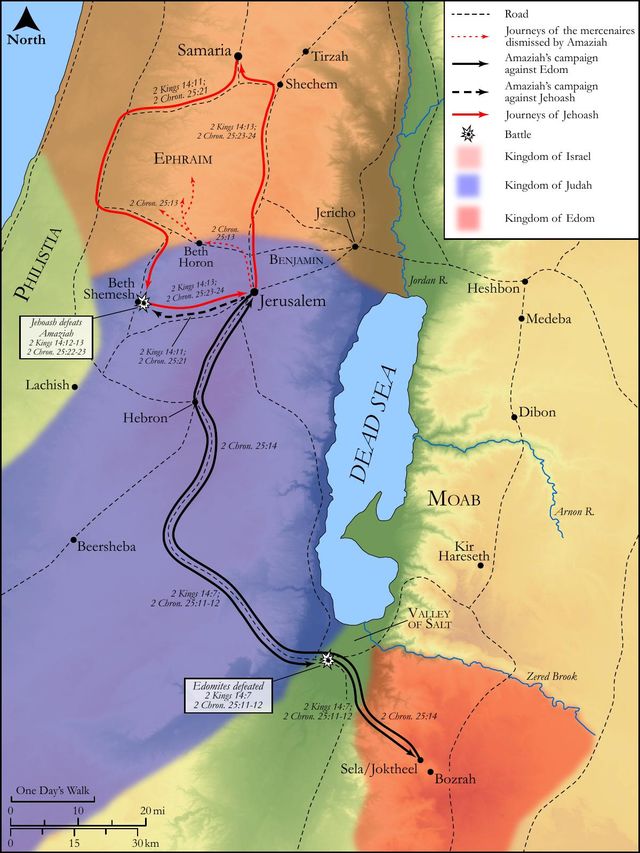
See on the biblical-era map
Study this verse
Public-domain commentary
Matthew Henry
From his Commentary on the Whole Bible. Henry comments on passages, not single verses — this entry covers 2 Chronicles 25:17–28. His three-level outline is real structure in the source text, so it is rendered as structure.
We have here this degenerate prince mortified by his neighbour and murdered by his own subjects.
I.Never was proud prince more thoroughly mortified than Amaziah was by Joash king of Israel.
1.This part of the story (which was as fully related Kg2 14:8, etc., as it is here) - embracing the foolish challenge which Amaziah sent to Joash (Ch2 25:17), his haughty scornful answer to it (Ch2 25:18), with the friendly advice he gave him to sit still and know when he was well off, (Ch2 25:19), - his wilfully persisting in his challenge (Ch2 25:20, Ch2 25:21), the defeat that was given him (Ch2 25:22), and the calamity he brought upon himself and his city thereby (Ch2 25:23, Ch2 25:24), - verifies two of Solomon's proverbs: - (1.) That a man's pride will bring him low, Pro 29:23. It goes before his destruction; not only procures it meritoriously, but is often the immediate occasion of it. He that exalteth himself shall be abased. (2.) That he that goes forth hastily to strive will probably not know what to do in the end thereof, when his neighbour has put him to shame, Pro 25:8. He that is fond of contention may have enough of it sooner than he thinks of.
2.But there are two passages in this story which we had not before in the Kings.
(1.)That Amaziah took advice before he challenged the king of Israel, Ch2 25:17. But of whom? Not of the prophet - he was not made of the king's counsel; but of his statesmen that would flatter him and bid him go up and prosper. It is good to take advice, but then it must be of those that are fit to advise us. Those that will not take advice from the word of God, which would guide them aright, will justly be left to the bad advice of those that will counsel them to their destruction. Let those be made fools that will not be made wise.
(2.)Amaziah's imprudence is here made the punishment of his impiety (Ch2 25:20): It was of the Lord; he left him to himself to act thus foolishly, that he and his people might be delivered into the hands of their enemies, because they had forsaken God and sought after the gods of Edom. Those that will not persuaded to do well for their souls will justly be given up to their own counsels to do ill for themselves even in their outward affairs.
II.Never was poor prince more violently pursued by his own subjects.
From the time that he departed from the Lord (so it may be read, Ch2 25:27) the hearts of his subjects departed from him, and they began to form a design against him in Jerusalem. It is probable they were exasperated against him more for his rashly engaging in a war against Israel than for his worshipping the gods of Edom. But at length the ferment grew so high, and he perceived the plot to be laid so deeply, that he thought fit to quit his royal city and flee to Lachish, either as a private place where he might be hid or as a strong place where he might be guarded; but they sent after him thither, and slew him there. By this the putting of him to death seems to have been done deliberately, and to have been the act, not of a disgusted servant or two, but of a considerable body that durst avow it. How unrighteous soever they were herein, God was righteous.
Historical interpretation
Historical reception
1 surviving comment on this verse from the historical church.
Is not sin also punishment for sin where Amaziah, king of Judah, did not wish to hear the good advice of Jehoahaz, king of Israel, not to go to war? We read, "Amaziah would not listen to him because it was the Lord's will that he should be delivered into their hands, because they sought the god of Edom." We can recount many other events clearly showing that from a hidden judgment of God comes perversity of heart, with the result that refusal to hear the truth leads to commission of sin, and this sin is also punishment for preceding sin. For to believe a lie and not believe the truth is indeed sin, but it comes from the blindness of heart that by a hidden but just judgment of God is also punishment for sin.
Continue studying 2 Chronicles 25:20 across the web’s major study libraries — every link below opens this exact verse, chapter, or book on the destination site.
Read & Compare
 BibleGatewayThis verse in more than 200 translations and 70 languages.
 Bible.comThe YouVersion reader — hundreds of translations, reading plans, and highlights.
 ESV.orgCrossway's official English Standard Version reader.
 NET BibleThe NET translation with 60,000+ translators' notes on every rendering decision.
 STEP BibleTyndale House's free study tool — original text, vocabulary, and scholarly resources.
 BibliaLogos Bible Software's free web reader.
 USCCBThe New American Bible (Revised Edition) with the U.S. bishops' study notes.
Commentaries
 BibleHub CommentariesDozens of classic commentaries on this verse, gathered on one page.
 StudyLightMore than 100 commentary sets — the largest collection on the web.
 BibleRefPlain-English commentary on what this verse means, verse by verse.
 Enduring WordDavid Guzik's free commentary on this chapter, widely used by Bible teachers.
 Bible Study ToolsVerse commentary alongside Greek and Hebrew study aids.
Original Language & Research
- BibleHub InterlinearThe verse word by word — original language, transliteration, and English.
- BibleHub LexiconEvery word's original-language definition and Strong's entry.
 Blue Letter BibleDeep-study tools — Strong's numbers, concordance, and word studies.
 SefariaThe Hebrew text with Rashi and centuries of Jewish commentary.
Sermons, Hymns & Audio


TrulyRandomVerse is not affiliated with these sites and doesn’t control their content. They’re linked because they’re genuinely useful.
Summary
This verse offers a profound theological insight into the consequences of spiritual rebellion and the mysterious yet righteous outworking of divine sovereignty. It explains King Amaziah's inexplicable obstinacy in rejecting prophetic counsel, attributing his hardened heart to God's deliberate purpose to deliver Judah into the hands of their enemies. This severe judgment was the direct result of Amaziah's egregious sin of idolatry, having embraced and worshipped the very gods of the Edomites whom he had recently conquered.
Context
ShowHideLiterary Context
The immediate literary context of 2 Chronicles 25:20 is King Amaziah's reign over Judah, detailed comprehensively in 2 Chronicles 25. Having begun his rule with a measure of righteousness, albeit "not with a whole heart" (2 Chronicles 25:2), Amaziah achieved a significant victory against Edom (2 Chronicles 25:11-12). However, this triumph was immediately followed by a catastrophic spiritual lapse: Amaziah brought back the idols of Edom and began to worship them, provoking the Lord's anger (2 Chronicles 25:14). A prophet was sent to confront him, delivering a clear warning against his apostasy (2 Chronicles 25:15-16). 2 Chronicles 25:20 serves as the divine explanation for Amaziah's subsequent, seemingly irrational decision to challenge King Joash of Israel, a challenge that led directly to Judah's humiliating defeat (2 Chronicles 25:17-24). The verse thus provides the theological lens through which to understand the unfolding tragedy, highlighting God's active role in judging sin.
Historical & Cultural Context
King Amaziah reigned over Judah in the early 8th century BC, a period marked by shifting political alliances and persistent religious challenges in the ancient Near East. The conflict with Edom was long-standing, with Edom often asserting independence from Judahite control, as seen in their earlier revolt during Jehoram's reign (2 Kings 8:20-22). Culturally, it was common for conquering nations to appropriate the gods of the vanquished, believing they had demonstrated superior power. However, for Judah, a nation bound by the covenant with Yahweh, such an act constituted grave apostasy, a direct violation of the First Commandment. The Chronicler, writing for a post-exilic audience, consistently highlights the direct correlation between Judah's obedience or disobedience to the Mosaic Law and their national prosperity or suffering. This emphasis underscores the immediate and tangible consequences of their actions, particularly in matters of worship and covenant fidelity, serving as a cautionary tale for those rebuilding after exile.
Key Themes
ShowHideSeveral key themes converge in 2 Chronicles 25:20, reflecting the Chronicler's overarching theological agenda. Foremost is the theme of Divine Sovereignty and Judgment, asserting that God is ultimately in control, even orchestrating human stubbornness to fulfill His righteous purposes. Amaziah's refusal to listen is not merely human folly but "came of God," demonstrating that divine judgment is not arbitrary but a direct, sovereign response to sin. This leads to the second crucial theme: the Consequences of Idolatry. The verse explicitly states the reason for God's action: "because they sought after the gods of Edom." This act of spiritual apostasy, a profound breach of the covenant and the First Commandment, is presented as the primary catalyst for Judah's impending disaster. Finally, the theme of Refusal to Hear Counsel is prominent. Amaziah's unwillingness to "hear" the prophet's clear warning (2 Chronicles 25:16) signifies a hardened heart, a recurring motif in biblical narratives where rejection of divine instruction leads inevitably to downfall, as seen in the warnings of Proverbs 1:24-33.
Exposition and Analysis
ShowHideKey Word Analysis
ShowHideThis name, meaning "strength of Jah" or "Yahweh is strong," is ironically juxtaposed with the king's actions in this verse. While his name points to divine strength, Amaziah's reliance on his own strength and his turning away from Yahweh ultimately leads to his downfall. The name itself serves as a subtle commentary on the tragic failure of a king whose very identity should have been rooted in God's power.
The Hebrew verb שָׁמַע (shâmaʻ) translated as "hear" in "Amaziah would not hear" carries a much deeper meaning than mere auditory perception. As indicated by its usage, it implies listening intelligently, paying attention, and, crucially, obeying or heeding. When Amaziah "would not hear" the prophet's warning, it signifies a deliberate and stubborn refusal to comply with God's revealed will, indicating a hardened heart and a closed mind to divine counsel. This active rejection of God's word sealed his fate and demonstrates a profound spiritual deafness.
The term אֱלֹהִים (ʼĕlôhîym) refers here to the supreme God, Yahweh. The phrase "it came of God" (מֵהָאֱלֹהִים, min ha'Elohim) denotes divine causation or origin. It does not suggest that God directly compelled Amaziah to sin, but rather that God, in His sovereignty, permitted or orchestrated the circumstances, including Amaziah's own sinful stubbornness, to achieve His righteous judgment. This is a theological statement about God's ultimate control over human affairs, allowing sin to run its course to bring about just retribution, especially in response to profound apostasy.
The verb דָּרַשׁ (dârash) means "to tread or frequent," and by implication, "to seek or ask," specifically "to worship." When applied to "the gods of Edom," it indicates an active, intentional, and devoted pursuit of these false deities. It's not a casual glance or a momentary lapse, but a deliberate turning away from Yahweh to engage in the worship and practices associated with foreign idols, signifying a deep spiritual commitment to them. This active seeking is what provoked divine wrath.
Verse Breakdown
ShowHide"But Amaziah would not hear;"
This clause highlights King Amaziah's deliberate and stubborn refusal to heed the clear prophetic warning delivered to him in 2 Chronicles 25:15-16. It signifies not merely a lack of auditory perception, but a willful rejection of divine counsel, demonstrating a hardened heart and a rebellious spirit against the Lord. This obstinacy is presented as the immediate human cause of the ensuing disaster, revealing a king who, despite initial obedience, ultimately chose his own path over God's.
"for it [came] of God, that he might deliver them into the hand [of their enemies],"
This is the theological explanation for Amaziah's inexplicable stubbornness. The phrase "it came of God" asserts God's ultimate sovereignty over the situation. It implies that God, in His righteous judgment, allowed Amaziah's sinful inclination to persist and lead him down a path of self-destruction. God's purpose in this was to "deliver them into the hand [of their enemies]," specifically referring to the impending defeat by King Joash of Israel, serving as a divinely ordained punishment for their profound transgression. This demonstrates God's active role in bringing about justice.
"because they sought after the gods of Edom."
This final clause provides the fundamental reason for God's severe judgment. Amaziah, immediately after his victory over Edom, had brought back their idols and begun to worship them (2 Chronicles 25:14). This act of apostasy—turning from the one true God to serve pagan deities—was a grave violation of the covenant and the First Commandment. It was this profound spiritual infidelity, a direct affront to God's exclusivity and holiness, that provoked God's wrath and necessitated the judgment described in the preceding clause.
Literary Devices
ShowHide2 Chronicles 25:20 masterfully employs several literary devices to convey its powerful theological message. The most prominent is Divine Causation, encapsulated in the phrase "it came of God." This attributes Amaziah's stubborn refusal to a divine origin, not as a direct compulsion to sin, but as a sovereign act of God allowing the natural consequences of sin to unfold for the purpose of judgment. This reflects the Chronicler's consistent theological perspective that God is actively involved in the affairs of His people, dispensing immediate retribution for disobedience. There is also a stark Irony present: Amaziah, having decisively defeated the Edomites and destroyed their people, paradoxically brings their gods back to Judah and worships them. The very symbols of the vanquished become the objects of the victor's devotion, leading directly to his own defeat. This highlights the absurdity and spiritual blindness of his actions. Furthermore, the verse functions as a clear statement of Cause and Effect, explicitly linking Amaziah's apostasy—"because they sought after the gods of Edom"—to the subsequent divine judgment of being "deliver[ed] into the hand [of their enemies]." This direct causal relationship underscores the gravity of idolatry and the certainty of divine retribution. Finally, the narrative serves as a Foreshadowing of Judah's ultimate fate, as repeated patterns of idolatry and rejection of prophetic warnings eventually lead to the nation's exile, reinforcing the Chronicler's message about the consequences of covenant infidelity.
Theological and Thematic Connections
ShowHide2 Chronicles 25:20 stands as a potent theological statement on divine sovereignty, particularly in the context of judgment. It reveals that God, while never the author of sin, can actively permit or even orchestrate circumstances, including the hardening of a human heart, to bring about His righteous will and just retribution. Amaziah's stubbornness was not merely a human failing but a divinely ordained means to deliver judgment upon Judah because of their profound apostasy. This underscores the gravity of idolatry, demonstrating that God will not share His glory or tolerate rivals, and that turning from Him to false gods inevitably leads to severe consequences. The narrative serves as a stark reminder that spiritual compromise, even after apparent success, can lead to catastrophic downfall, illustrating the principle that God's justice is unwavering and that true blessing flows from exclusive devotion to Him.
Reflection and Application
ShowHide2 Chronicles 25:20 serves as a profound and sobering mirror for contemporary believers. Amaziah's swift descent into idolatry after a significant victory highlights the insidious nature of spiritual complacency and the ever-present danger of syncretism. We are prompted to examine our own hearts: What "gods of Edom"—perhaps the idols of material wealth, professional ambition, social approval, comfort, or even self-sufficiency—do we unwittingly bring into our lives, especially after experiencing a measure of success or blessing? The verse forcefully reminds us of the critical importance of cultivating a heart that is not only willing to "hear" God's voice but eager to obey it. Stubbornness, pride, and a refusal to heed divine warnings, whether communicated through the clear teaching of Scripture, the wise counsel of trusted spiritual mentors, or the gentle conviction of the Holy Spirit, can lead to spiritual blindness and ultimately, to God's corrective discipline. Our devotion to the Lord must be exclusive, unwavering, and wholehearted, recognizing His absolute sovereignty and His unwavering commitment to justice. True and lasting success is found not in worldly triumphs, but in unreserved fidelity and humble submission to Him, constantly guarding against the subtle allure of anything that would usurp His rightful place in our lives.
Questions for Reflection
ShowHideFAQ
ShowHideDid God force Amaziah to sin by making him stubborn?
ShowHideNo, the biblical understanding of God's sovereignty does not imply that He directly compels individuals to sin. The phrase "it came of God" (or "this was from God") in 2 Chronicles 25:20 indicates God's sovereign permission and orchestration of circumstances to bring about His righteous judgment, rather than His direct causation of Amaziah's sinful act. Amaziah's stubbornness was a manifestation of his own rebellious heart, a choice he made to reject the prophet's warning (2 Chronicles 25:16). God, in His justice, allowed Amaziah's sin to run its course, leading to the consequences that fulfilled God's punitive purpose against a king and nation that had turned to idolatry. This aligns with other biblical accounts where God "hardens" hearts in response to prior rebellion, such as with Pharaoh in Exodus 9:12, demonstrating that God's hardening is often a judicial act in response to persistent human defiance.
What was so offensive about "the gods of Edom" that it provoked such a severe divine response?
ShowHideThe "gods of Edom" were pagan deities worshipped by the Edomites, likely including gods associated with their land, fertility, or warfare. For Amaziah to bring these idols back to Jerusalem and "seek after" them (2 Chronicles 25:14) was a profound act of apostasy and a direct violation of the covenant God had made with Israel. The First Commandment explicitly states, "You shall have no other gods before me." By worshipping the gods of a conquered nation, Amaziah was not only rejecting Yahweh, the God who had just granted him victory over those very Edomites, but also embracing the spiritual practices of a people whom God had judged. This act demonstrated a contempt for God's exclusivity and holiness, provoking His righteous anger and necessitating severe judgment, as outlined in the warnings of Deuteronomy 28 regarding the consequences of covenant infidelity.
Christ-Centered Fulfillment
ShowHideThe tragic narrative of Amaziah in 2 Chronicles 25:20 powerfully foreshadows humanity's inherent propensity for idolatry and stubborn rebellion, which inevitably leads to divine judgment and separation from God. This profound brokenness in the human condition underscores the desperate need for a perfect King and a new covenant. Jesus Christ perfectly fulfills what Amaziah, and indeed all earthly kings, failed to be. He is the true King of Judah, the Son of David, who never sought after false gods but perfectly obeyed the Father's will, even to the point of death on the cross (Philippians 2:8). Unlike Amaziah, whose stubbornness delivered his people into the hands of their enemies, Christ's perfect obedience and sacrificial death "delivered" His people, not into the hands of judgment, but from the dominion of darkness and the power of sin and death (Colossians 1:13-14). He became the ultimate sacrifice for idolatry and all human sin, taking God's righteous judgment upon Himself so that all who believe in Him might receive forgiveness, reconciliation, and new life (2 Corinthians 5:21). Through His Spirit, Christ replaces the hardened heart of stone with a heart of flesh, enabling true spiritual hearing and obedience to God's voice (Ezekiel 36:26-27). In Him, we are truly delivered and brought into eternal fellowship with the living God, never again to seek after the empty idols of this world, but to worship Him in spirit and truth (John 4:24).