


1 Kings 12:15
Bible text: King James Version (1769 Blayney text) · Public domain
Bible text: King James Version with Strong's numbers · Public domain
Bible text: Berean Standard Bible · Public domain
Bible text: American Standard Version (1901) · Public domain
Bible text: World English Bible, Messianic edition · Public domain
Bible text: Geneva Bible (1599) · Public domain
Bible text: Young's Literal Translation · Public domain
- וְלֹאve·lo'and notH3808Conj-w ¦ NegParticle Negativeוְandלֹאnot
- שָׁמַעsha·Ma'he listenedH8085V-Qal-Perf-3msVerb Qal Perfect 3rd Singular Masculine
- הַמֶּלֶךְha·Me·lekhthe kingH4428Art ¦ N-msNoun Singular Masculine Absoluteהַtheמֶּלֶךְking
- אֶל'eltoH413PrepPreposition
- הָעָםha·'Amthe peopleH5971Art ¦ N-msNoun Singular Masculine Absoluteהָtheעָםpeople
- כִּיkiforH3588PrtParticle Conditional
- הָיְתָהha·ye·Tahit wasH1961V-Qal-Perf-3fsVerb Qal Perfect 3rd Singular Feminine
- סִבָּהsi·Baha turnH5438N-fsNoun Singular Feminine Absolute
- מֵעִםme·'Imfrom withH5973Prep-m ¦ PrepPrepositionמֵfromעִםwith
- יְהוָהYah·wehYahwehH3068N-properNoun Proper Title
- לְמַעַןle·Ma·'anso asH4616PrtParticle Conditional
- הָקִיםha·Kimto establishH6965V-Hiphil-InfVerb Hiphil Infinitive Construct
- אֶת'et<obj.>H853DirObjMParticle Object Indicator
- דְּבָרוֹde·va·Rohis wordH1697N-msc ¦ 3msNoun Singular Masculine Constructדְּבָרwordוֹhis
- אֲשֶׁר'a·SherwhichH834RelParticle Relative
- דִּבֶּרdi·Berhe had spokenH1696V-Piel-Perf-3msVerb Piel Perfect 3rd Singular Masculine
- יְהוָהYah·wehYahwehH3068N-properNoun Proper Title
- בְּיַדbe·Yadby [the] hand ofH3027Prep-b ¦ N-cscNoun Singular common gender Constructבְּbyיַד[the] hand of
- אֲחִיָּה'a·chi·YahAhijahH281N-proper-mNoun Proper Masculine
- הַשִּׁילֹנִיha·shi·lo·Ni<the> ShiloniteH7888Art ¦ N-msNoun Gentilic Singular Masculine Absoluteהַ<the>שִּׁילֹנִיShilonite
- אֶל'eltoH413PrepPreposition
- יָרָבְעָםya·ra·ve·'AmJeroboamH3379N-proper-mNoun Proper Masculine
- בֶּןben[the] son ofH1121N-mscNoun Singular Masculine Construct
- נְבָטne·VatNebatH5028N-proper-mNoun Proper Masculine
English is a literal word-by-word gloss of the Hebrew, not the KJV's wording. Why?
This is the original text the KJV's translators worked from — each Hebrew word with its own literal English meaning in this verse, prepared by scholars at Tyndale House, Cambridge. The KJV translates whole sentences, not word by word, so its wording differs: one Hebrew word can become several English words, and the KJV may choose “the LORD” where the gloss reads “Yahweh”. Both are faithful — they answer different questions. For the KJV's own rendering, switch to the KJV text.
Details
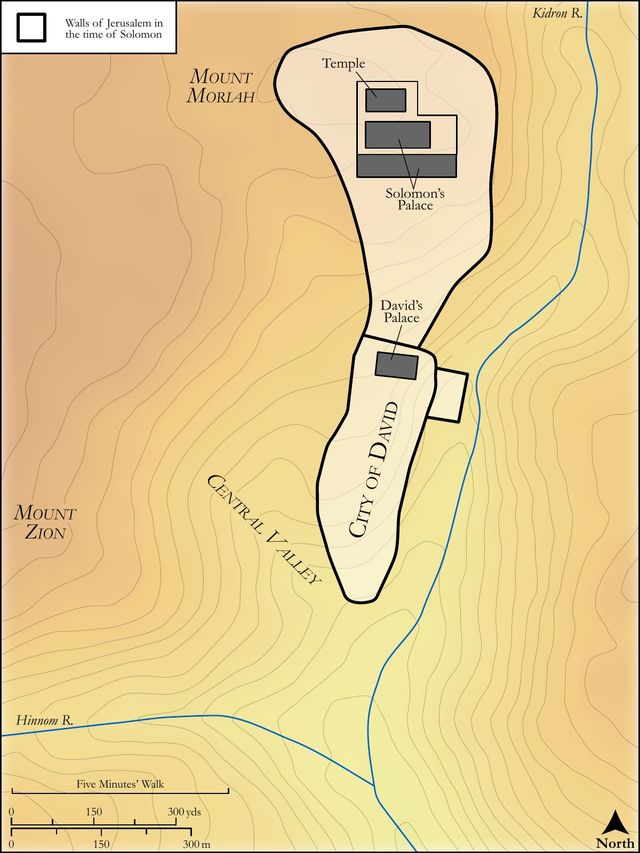
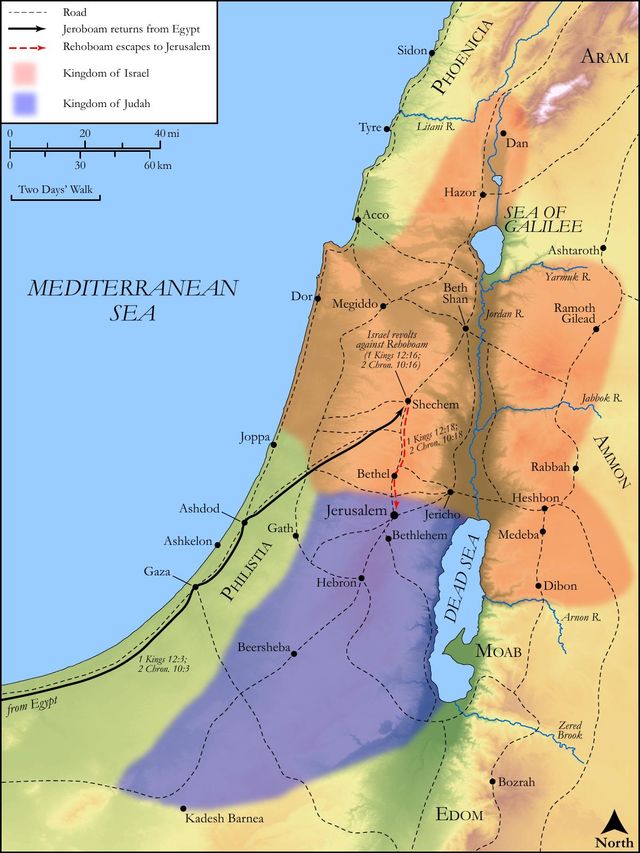
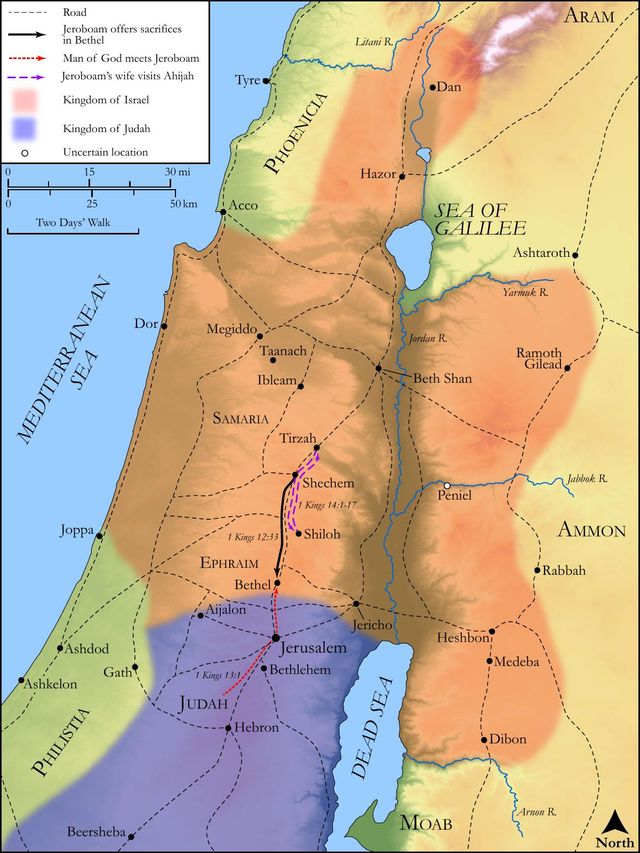
See on the biblical-era maps
Study this verse
Public-domain commentary
Matthew Henry
From his Commentary on the Whole Bible. Henry comments on passages, not single verses — this entry covers 1 Kings 12:1–15. His three-level outline is real structure in the source text, so it is rendered as structure.
Solomon had 1000 wives and concubines, yet we read but of one son he had to bear up his name, and he a fool. It is said (Hos 4:10), They shall commit whoredom, and shall not increase. Sin is a bad way of building up a family. Rehoboam was the son of the wisest of men, yet did not inherit his father's wisdom, and then it stood him in little stead to inherit his father's throne. Neither wisdom nor grace runs in the blood. Solomon came to the crown very young, yet he was then a wise man. Rehoboam came to the crown at forty years old, when men will be wise if ever they will, yet he was then foolish. Wisdom does not go by age, nor is it the multitude of years nor the advantage of education that reaches it. Solomon's court was a mart of wisdom and the rendezvous of learned men, and Rehoboam was the darling of the court; and yet all was not sufficient to make him a wise man. The race is not to the swift, nor the battle to the strong. No dispute is made of Rehoboam's succession; upon the death of his father, he was immediately proclaimed. But,
I.The people desired a treaty with him at Shechem, and he condescended to meet them there.
1.Their pretence was to make him king, but the design was to unmake him. They would give him a public inauguration in another place than the city of David, that he might not seem to be king of Judah only. They had ten parts in him, and would have him among themselves for once, that they might recognize his title.
2.The place was ominous: at Shechem, where Abimelech set up himself (Jdg. 9); yet it had been famous for the convention of the states there, Jos 24:1. Rehoboam, we may suppose, knew of the threatening, that the kingdom should be rent from him, and hoped by going to Shechem, and treating there with the ten tribes, to prevent it: yet it proved the most impolitic thing he could do, and hastened the rupture.
II.The representatives of the tribes addressed him, praying to be eased of the taxes they were burdened with.
The meeting being appointed, they sent for Jeroboam out of Egypt to come and be their speaker. This they needed not to have done: he knew what God had designed him for, and would have come though he had not been sent for, for now was his time to expect the possession of the promised crown. In their address,
1.They complain of the last reign: Thy father made our yoke grievous, Kg1 12:4. They complain not of his father's idolatry and revolt from God; that which was the greatest grievance of all was none to them, so careless and indifferent were they in the matters of religion, as if God or Moloch were all one, so they might but live at ease and pay no taxes. Yet the complaint was groundless and unjust. Never did people live more at ease than they did, nor in great plenty. Did they pay taxes? It was to advance the strength and magnificence of their kingdom. If Solomon's buildings cost them money, they cost them no blood, as war would do. Were many servile hands employed about them? They were not the hands of the Israelites. Were the taxes a burden? How could that be, when Solomon imported bullion in such plenty that silver was, in a manner, as common as the stones? So that they did but render to Solomon the things that were Solomon's. Nay, suppose there was some hardship put upon them, were they not told before that this would be the manner of the king and yet they would have one? The best government cannot secure itself from reproach and censure, no, not Solomon's. Factious spirits will never want something to complain of. I know nothing in Solomon's administration that could make the people's yoke grievous, unless perhaps the women whom in his latter days he doted on were connived at in oppressing them.
2.They demand relief from him, and on this condition will continue in their allegiance to the house of David. They asked not to be wholly free from paying taxes, but to have the burden made lighter; this was all their care, to save their money, whether their religion was supported and the government protected or no. All seek their own.
III.Rehoboam consulted with those about him concerning the answer he should give to this address.
It was prudent to take advice, especially having so weak a head of his own; yet, upon this occasion, it was impolitic to take time himself to consider, for thereby he gave time to the disaffected people to ripen things for a revolt, and his deliberating in so plain a case would be improved as an indication of the little concern he had for the people's ease. They saw what they must expect, and prepared accordingly. Now,
1.The grave experienced men of his council advised him by all means to give the petitioners a kind answer, to give them good words, to promise them fair, and this day, this critical day, to serve them, that is, to tell them that he was their servant, and that he would redress all their grievances and make it his business to please them and make them easy. "Deny thyself (say they) so far as to do this for this once, and they will be thy servants for ever. When the present heat is allayed with a soft answer, and the assembly dismissed, their cooler thoughts will reconcile and fix them to Solomon's family still." Note, The way to rule is to serve, to do good, and stoop to do it, to become all things to all men and so win their hearts. Those who are in power really sit highest, and easiest, and safest, when they take this method.
2.The young men of his council were hot and haughty, and they advised him to return a severe and threatening answer to the people's demands. It was an instance of Rehoboam's weakness,
(1.)That he did not prefer aged counsellors, but had a better opinion of the young men that had grown up with him and with whom he was familiar, Kg1 12:8. Days should speak. It was a folly for him to think that, because they had been his agreeable companions in the sports and pleasures of his youth, they were therefore fit to have the management of the affairs of his kingdom. Great wits have not always the most wisdom; nor are those to be relied on as our best friends that know how to make us merry, for that will not make us happy. It is of great consequence to young people, that are setting out in the world, whom they associate with, accommodate themselves to, and depend upon for advice. If they reckon those that feed their pride, gratify their vanity, and further them in their pleasures, their best friends, they are already marked for ruin.
(2.)That he did not prefer moderate counsels, but was pleased with those that put him upon harsh and rigorous methods, and advised him to double the taxes, whether there was occasion for so doing or no, and to tell them in plain terms that he would do so, Kg1 12:10, Kg1 12:11. These young counsellors thought the old men expressed themselves but dully, Kg1 12:7. They affect to be witty in their advice, and value themselves on that. The old men did not undertake to put words into Rehoboam's mouth, only counselled him to speak good words; but the young men will furnish him with very quaint and pretty phrases, with pointed and pert similitudes: My little finger shall be thicker than my father's loins, etc. That is not always the best sense that is best worded.
IV.He answered the people according to the counsel of the young men, Kg1 12:14, Kg1 12:15.
He affected to be haughty and imperious, and fancied he could carry all before him with a high hand, and therefore would rather run the risk of losing them than deny himself so far as to give them good words. Note, Many ruin themselves by consulting their humour more than their interest. See,
1.How Rehoboam was infatuated in his counsels. He could not have acted more foolishly and impoliticly.
(1.)He owned their reflections upon his father's government to be true: My father made your yoke heavy; and therein he was unjust to his father's memory, which he might easily have vindicated from the imputation.
(2.)He fancied himself better able to manage them, and impose upon them, than his father was, not considering that he was vastly inferior to him in capacity. Could he think to support the blemishes of his father's reign who could never pretend to come near the glories of it?
(3.)He threatened not only to squeeze them by taxes, but to chastise them by cruel laws and severe executions of them, which should be not as whips only, but as scorpions, whips with rowels in them, that will fetch blood at every lash. In short, he would use them as brute beasts, load them and beat them at his pleasure: not caring whether they loved him or no, he would make them fear him.
(4.)He gave this provocation to a people that by long ease and prosperity were made wealthy, and strong, and proud, and would not be trampled upon (as a poor cowed dispirited people may), to a people that were now disposed to revolt, and had one ready to head them. Never, surely, was man so blinded by pride and affectation of arbitrary power, than which nothing is more fatal.
2.How God's counsels were hereby fulfilled. It was from the Lord, Kg1 12:15. He left Rehoboam to his own folly, and hid from his eyes the things which belonged to his peace, that the kingdom might be rent from him. Note, God serves his own wise and righteous purposes by the imprudences and iniquities of men, and snares sinners in the work of their own hands. Those that lose the kingdom of heaven throw it away, as Rehoboam did his, by their own wilfulness and folly.
Historical interpretation
Historical reception
1 surviving comment on this verse from the historical church.
Who can help but tremble at the thought of these judgments of God whereby he accomplishes whatever he pleases even in the hearts of wicked people, while yet rendering to each according to his merits? Solomon’s son, Rehoboam, rejected the salutary counsel of the elders, not to deal harshly with the people, and yielded to the words of men of his own age by replying with threats to those who should have been given a gentle reply. And how did this come about, except by his own will? But as a result of it, the ten tribes of Israel withdrew from him and set up for themselves another king, Jeroboam, that the will of God, who had been angered, might be accomplished, as he had also foretold that it would come to pass. For what does the Scripture say? “And the king condescended not to the people, for the Lord was turned away from him to make good his word, which he had spoken though Ahias, the Silonite, to Jeroboam the son of Nabat.” All this was certainly done by human will, but in such a way that the “turning way” came from the Lord.
Continue studying 1 Kings 12:15 across the web’s major study libraries — every link below opens this exact verse, chapter, or book on the destination site.
Read & Compare
 BibleGatewayThis verse in more than 200 translations and 70 languages.
 Bible.comThe YouVersion reader — hundreds of translations, reading plans, and highlights.
 ESV.orgCrossway's official English Standard Version reader.
 NET BibleThe NET translation with 60,000+ translators' notes on every rendering decision.
 STEP BibleTyndale House's free study tool — original text, vocabulary, and scholarly resources.
 BibliaLogos Bible Software's free web reader.
 USCCBThe New American Bible (Revised Edition) with the U.S. bishops' study notes.
Commentaries
 BibleHub CommentariesDozens of classic commentaries on this verse, gathered on one page.
 StudyLightMore than 100 commentary sets — the largest collection on the web.
 BibleRefPlain-English commentary on what this verse means, verse by verse.
 Enduring WordDavid Guzik's free commentary on this chapter, widely used by Bible teachers.
 Bible Study ToolsVerse commentary alongside Greek and Hebrew study aids.
Original Language & Research
- BibleHub InterlinearThe verse word by word — original language, transliteration, and English.
- BibleHub LexiconEvery word's original-language definition and Strong's entry.
 Blue Letter BibleDeep-study tools — Strong's numbers, concordance, and word studies.
 SefariaThe Hebrew text with Rashi and centuries of Jewish commentary.
Sermons, Hymns & Audio


TrulyRandomVerse is not affiliated with these sites and doesn’t control their content. They’re linked because they’re genuinely useful.
Summary
1 Kings 12:15 serves as a profound theological explanation for the dramatic division of the united kingdom of Israel into the northern kingdom (Israel) and the southern kingdom (Judah). It reveals that King Rehoboam's stubborn refusal to lighten the people's burdens, which directly triggered the schism, was not merely a political misstep or personal failing, but a divinely orchestrated event. This verse asserts that God was the ultimate "cause" behind Rehoboam's unyielding stance, ensuring the precise fulfillment of a specific prophecy previously delivered by the prophet Ahijah the Shilonite to Jeroboam, foretelling the tearing away of ten tribes from the Davidic dynasty due to King Solomon's widespread idolatry.
CONTEXT
ShowHideLiterary Context: This verse is strategically placed at a pivotal moment in the historical narrative of 1 Kings, immediately following the death of King Solomon and the succession of his son, Rehoboam. The preceding verses (1 Kings 12:1-14) meticulously detail the assembly at Shechem, where the tribes of Israel presented a unified petition to Rehoboam, requesting an alleviation of the severe taxation and forced labor imposed during Solomon's reign. Rehoboam's initial response involved consulting two distinct groups of advisors: the seasoned elders, who advocated for compassionate and conciliatory leadership, and his younger peers, who urged a more oppressive and authoritarian approach. Despite the sagacious counsel of the elders, Rehoboam defiantly chose to adopt the harsh advice of his youthful companions, publicly declaring his intention to increase, rather than decrease, the people's burdens. Verse 15 then functions as the inspired theological commentary on Rehoboam's seemingly irrational and self-destructive decision, unveiling that his obstinacy was providentially guided to fulfill God's prior prophetic declaration. The immediate, devastating consequence, elaborated in the subsequent verses (1 Kings 12:16-19), is the people's rebellion and the establishment of Jeroboam as king over the ten northern tribes, marking the end of the united monarchy.
Historical & Cultural Context: The historical backdrop is the precarious period immediately following the golden age of Solomon's reign, a time of significant transition and inherent vulnerability for the Israelite monarchy. While Solomon's rule brought unprecedented prosperity and monumental architectural achievements, it also imposed immense economic strain on the populace due to his lavish court, extensive building projects (such as the Temple and his palace), and maintenance of a vast administration. This created widespread discontent, which reached its boiling point upon his death. Culturally, the practice of a newly crowned king convening with his people at a significant national site like Shechem—a location deeply imbued with historical resonance, having been the site of covenant renewal under Joshua (Joshua 24)—was a customary and crucial ritual for reaffirming loyalty, addressing grievances, and establishing the new reign. Kings were expected to embody wisdom and justice, often demonstrated through seeking and heeding counsel. The ensuing division of the kingdom was not merely a political upheaval but a profound theological crisis, signaling God's righteous judgment on the house of David for its unfaithfulness, particularly Solomon's widespread apostasy and idolatry, as thoroughly documented in 1 Kings 11. This pivotal historical moment powerfully underscores the conditional nature of God's covenant with the Davidic line, where continued blessing was inextricably linked to obedience and fidelity.
Key Themes:
Exposition and Analysis
ShowHideKey Word Analysis
ShowHideThis word (H5438) signifies a (providential) turn (of affairs), or a reason. In this context, it denotes divine origination or orchestration. It implies that Rehoboam's stubbornness was not merely accidental or solely a result of his own poor judgment, but that God was the ultimate, underlying force behind it, guiding the circumstances and Rehoboam's disposition to bring about His predetermined purpose. It speaks to God's active, intentional, and sovereign involvement in shaping historical events.
This primitive root (H8085) means to hear intelligently, often with the implication of attention, obedience, or consent. The phrase "hearkened not" (KJV: "hearkened not unto") highlights Rehoboam's willful disobedience and rejection of wise counsel. While the verse attributes the ultimate "cause" to the LORD, Rehoboam's act of not listening is presented as his own culpable choice, demonstrating the intricate interplay between divine sovereignty and human agency. His failure to listen was a moral and leadership failing, even as it served God's larger plan.
This word (H1697), derived from the primitive root H1696 (dâbar), refers to a word, a matter (as spoken of), or a thing. Here, it specifically denotes a prophetic utterance or divine declaration. It emphasizes the active role of God in ensuring the complete and precise fulfillment of His prophetic word. God does not merely predict; He actively works to ensure that what He has spoken will indeed come to fruition, demonstrating His power, faithfulness, and the absolute infallibility of His declarations.
Verse Breakdown
ShowHide"Wherefore the king hearkened not unto the people;"
This initial clause describes Rehoboam's decisive and ultimately disastrous action—or rather, his refusal to act in terms of listening and compromising. Despite the collective and reasonable plea of the Israelite tribes for relief from the heavy burdens imposed by his father, Rehoboam stubbornly and pridefully refused to concede or compromise. His failure to "hearken" signifies a profound lack of wisdom, empathy, and effective leadership, directly leading to the people's alienation and subsequent rebellion. This highlights his personal responsibility for the immediate political and social outcome.
"for the cause was from the LORD,"
This is the theological lynchpin of the verse, providing the divine explanation for Rehoboam's otherwise inexplicable obstinacy. It asserts that the ultimate reason, impetus, or underlying orchestration for his unyielding stance originated with God Himself. This does not imply that God compelled Rehoboam to sin or removed his free will, but rather that God sovereignly utilized Rehoboam's free, yet prideful and foolish, choice as the precise means to accomplish His own righteous judgment and redemptive plan. It profoundly underscores God's active and purposeful hand in shaping historical events.
"that he might perform his saying,"
This crucial phrase reveals God's specific and intentional purpose in orchestrating Rehoboam's refusal. God's intent was to "perform," "establish," or bring to complete fruition His previously spoken word. This emphasizes God's unwavering faithfulness and the absolute certainty of His prophecies. The division of the kingdom was not an unforeseen accident or a random political upheaval but a divinely purposed event, meticulously ensuring the integrity and infallibility of God's declarations.
"which the LORD spake by Ahijah the Shilonite unto Jeroboam the son of Nebat."
This final clause explicitly identifies the specific prophecy being fulfilled, providing essential historical and prophetic context. It refers to the prophetic message delivered by the prophet Ahijah (H281) to Jeroboam (H3379), the son (H1121) of Nebat (H5028), detailed in 1 Kings 11:29-39. This prophecy foretold the tearing of ten tribes from the house of David and their transfer to Jeroboam, explicitly as a consequence of King Solomon's widespread idolatry and unfaithfulness. The precise mention of Ahijah the Shilonite (H7888) and Jeroboam the son of Nebat (H5028) anchors the divine "cause" firmly within the established prophetic narrative, demonstrating God's meticulous attention to detail in fulfilling His word.
Literary Devices
ShowHideThe verse employs several significant literary devices that enrich its theological meaning. Divine Causation is the most prominent, as the explicit declaration "the cause was from the LORD" directly attributes the ultimate impetus for Rehoboam's actions and the subsequent division of the kingdom to God. This device emphasizes God's absolute sovereignty over human affairs and historical outcomes, transforming what might otherwise appear as a mere political blunder into a divinely purposed event. Closely related is Prophetic Fulfillment, as the entire verse functions to explain how Rehoboam's stubbornness served as the direct means by which Ahijah's earlier prophecy concerning the division of the kingdom was brought to pass. This underscores the reliability, certainty, and active nature of God's word. Furthermore, there is a powerful element of Irony at play: Rehoboam, in his attempt to assert absolute power and control over his subjects, inadvertently becomes an instrument in the dismantling of his own kingdom, thereby fulfilling God's judgment against his father's house. His prideful decision, intended to strengthen his rule, paradoxically leads to its diminishment, illustrating how human folly and sin can be sovereignly utilized by God to achieve His righteous purposes.
Theological and Thematic Connections
ShowHide1 Kings 12:15 serves as a foundational text for understanding the intricate and often challenging relationship between divine sovereignty and human responsibility within biblical theology. It unequivocally asserts God's ultimate control over all events, even those arising from human sin, folly, and rebellion. This does not diminish human culpability for their choices but rather powerfully demonstrates God's ability to weave even the most chaotic or rebellious human actions into the magnificent tapestry of His overarching plan, ensuring that His purposes prevail and His prophecies are infallibly fulfilled. The division of the kingdom, a tragic and devastating event for Israel, is presented not as a random political accident but as a just and preordained judgment from God against the house of David for its unfaithfulness, particularly Solomon's widespread idolatry. This verse reinforces the profound biblical truth that God's word is infallible, His plans are unthwartable, and His justice is certain, even when it manifests through the seemingly autonomous choices of flawed human leaders. It reminds us that God is perpetually and actively engaged in history, working all things according to the counsel of His perfect will.
Reflection and Application
ShowHideThe profound truth embedded in 1 Kings 12:15 offers both immense comfort and a significant challenge to believers today. In a world frequently characterized by chaos, injustice, and the seemingly unpredictable folly of human leaders, this verse provides a powerful and unshakable anchor: God is utterly sovereign. Even when human decisions appear disastrous, or when events seem to spiral entirely out of control, we can rest securely in the assurance that God is actively working His purposes, often through means we cannot immediately comprehend or fully grasp. This truth should cultivate a deep and abiding trust in His divine providence, even—and especially—amidst adversity and uncertainty. However, the verse also presents a crucial challenge regarding human responsibility. Rehoboam's pride, his stubborn refusal to listen to wise counsel, and his poor judgment had devastating and long-lasting consequences for the entire nation, despite being part of God's larger, sovereign plan. This powerfully reminds us that our choices truly matter. We are called to diligently seek wisdom, humbly listen to godly counsel, and faithfully obey God's commands, recognizing that our actions, though operating within God's sovereign framework, have real, significant, and often far-reaching implications for ourselves and those around us. Our freedom to choose is real, and our accountability before God is genuine.
Questions for Reflection
ShowHideFAQ
ShowHideDoes 1 Kings 12:15 mean God caused Rehoboam to sin?
ShowHideNo, the verse does not imply that God directly caused Rehoboam to sin or compelled him to make a morally wrong choice. The phrase "the cause was from the LORD" (Hebrew: sibbâh mim-YHWH) indicates divine orchestration or initiation of the circumstances and the outcome, not the direct causation of Rehoboam's pride or foolishness. Rehoboam's decision to reject wise counsel and speak harshly was his own culpable act, stemming from his pride and poor judgment, for which he remained fully responsible. God, in His sovereignty, utilized Rehoboam's free, yet sinful, choice to bring about His predetermined purpose—the division of the kingdom as a just judgment on Solomon's house for his idolatry (as foretold in 1 Kings 11:11-13). This demonstrates God's profound ability to work through human actions, even sinful ones, to accomplish His righteous will without Himself being the author or instigator of sin.
How does this verse relate to the concept of God hardening hearts in other biblical passages?
ShowHide1 Kings 12:15 shares a deep theological kinship with passages where God "hardens" hearts (e.g., Exodus 4:21 regarding Pharaoh, or Romans 9:18). In these instances, God does not typically force an unwilling heart into rebellion or create sin where none existed. Instead, He often allows or intensifies an already existing disposition of resistance, pride, or unbelief, or He removes restraining grace, thereby allowing individuals to act fully according to their own sinful inclinations, which then serves His divine purposes. Rehoboam's heart was already inclined towards pride and harshness, as powerfully evidenced by his rejection of the elders' wise counsel. God's "cause" was to ensure that this existing inclination would lead to the specific outcome necessary for the precise fulfillment of His prophecy, rather than being swayed by more prudent advice. It highlights God's active and sovereign role in guiding history, even through the stubbornness of human wills, to achieve His ultimate redemptive plan.
Christ-Centered Fulfillment
ShowHideThe narrative of 1 Kings 12:15, with its stark portrayal of divine sovereignty working through human folly to fulfill prophecy, finds its ultimate and most glorious fulfillment in the person and redemptive work of Jesus Christ. The division of the kingdom, a tragic consequence of sin and a powerful testament to God's righteous judgment against unfaithfulness, foreshadows the deeper, spiritual schism of humanity from God due to sin. Yet, just as God sovereignly orchestrated the kingdom's division for His specific purposes, so too did He sovereignly orchestrate the entire, magnificent plan of salvation through Christ. The ultimate "cause" for our redemption was from the LORD, who "so loved the world, that he gave his only Son, that whoever believes in him should not perish but have eternal life" (John 3:16). Jesus, the true and perfect King, came not to rule with a heavy yoke like Rehoboam, but to offer profound rest to the weary and burdened souls (Matthew 11:28). His crucifixion, though carried out by wicked human hands, was part of God's "definite plan and foreknowledge" (Acts 2:23), perfectly fulfilling ancient prophecies. Through Christ, God performed His ultimate "saying"—the ancient promise of a Messiah who would establish an everlasting kingdom, one not subject to human division, folly, or sin (Isaiah 9:6-7). The fractured kingdom of Israel profoundly points to the desperate need for a perfect King, one who would perfectly fulfill God's will and unite a people under His righteous and eternal reign, a reality ultimately realized in the church, the spiritual kingdom of God, gathered from every tribe and nation under the supreme headship of Christ (Ephesians 1:22-23).