


1 Kings 12:8
Bible text: King James Version (1769 Blayney text) · Public domain
Bible text: King James Version with Strong's numbers · Public domain
Bible text: Berean Standard Bible · Public domain
Bible text: American Standard Version (1901) · Public domain
Bible text: World English Bible, Messianic edition · Public domain
Bible text: Geneva Bible (1599) · Public domain
Bible text: Young's Literal Translation · Public domain
- וַיַּעֲזֹבvai·ya·'a·Zoand he forsookH5800Conj-w ¦ V-Qal-ConsecImperf-3msVerb Qal Consecutive Imperfect 3rd Singular Masculineוַandיַּעֲזֹבhe forsook
- אֶת'et<obj.>H853DirObjMParticle Object Indicator
- עֲצַת'a·Tzat[the] counsel ofH6098N-fscNoun Singular Feminine Construct
- הַזְּקֵנִיםha·ze·ke·Nimthe eldersH2205Art ¦ Adj-mpAdjective Plural Masculine Absoluteהַtheזְּקֵנִיםelders
- אֲשֶׁר'a·SherwhichH834RelParticle Relative
- יְעָצֻהוּye·'a·Tzu·huthey had counseled himH3289V-Qal-Perf-3cp ¦ 3msVerb Qal Perfect 3rd Plural common genderיְעָצֻthey had counseledהוּhim
- וַיִּוָּעַץvai·yi·va·'Atzand he consultedH3289Conj-w ¦ V-Niphal-ConsecImperf-3msVerb Niphal Consecutive Imperfect 3rd Singular Masculineוַandיִּוָּעַץhe consulted
- אֶת'etwithH854PrepPreposition
- הַיְלָדִיםhay·la·Dimthe young menH3206Art ¦ N-mpNoun Plural Masculine Absoluteהַtheיְלָדִיםyoung men
- אֲשֶׁר'a·SherwhoH834RelParticle Relative
- גָּדְלוּga·de·Luthey had grown upH1431V-Qal-Perf-3cpVerb Qal Perfect 3rd Plural common gender
- אִתּוֹ'i·Towith himH854Prep ¦ 3msPrepositionאִתּwithוֹhim
- אֲשֶׁר'a·SherwhoH834RelParticle Relative
- הָעֹמְדִיםha·'o·me·Dim[were] the [ones who] stoodH5975Art ¦ V-Qal-Prtcpl-mpVerb Qal Participle Plural Masculine Absoluteהָ[were] theעֹמְדִים[ones who] stood
- לְפָנָיוle·fa·Nav<to> before himH6440Prep-l ¦ N-mpc ¦ 3msNoun Plural Masculine Constructלְ<to>פָנָיbeforeוhim
English is a literal word-by-word gloss of the Hebrew, not the KJV's wording. Why?
This is the original text the KJV's translators worked from — each Hebrew word with its own literal English meaning in this verse, prepared by scholars at Tyndale House, Cambridge. The KJV translates whole sentences, not word by word, so its wording differs: one Hebrew word can become several English words, and the KJV may choose “the LORD” where the gloss reads “Yahweh”. Both are faithful — they answer different questions. For the KJV's own rendering, switch to the KJV text.
Details
See on the biblical-era maps

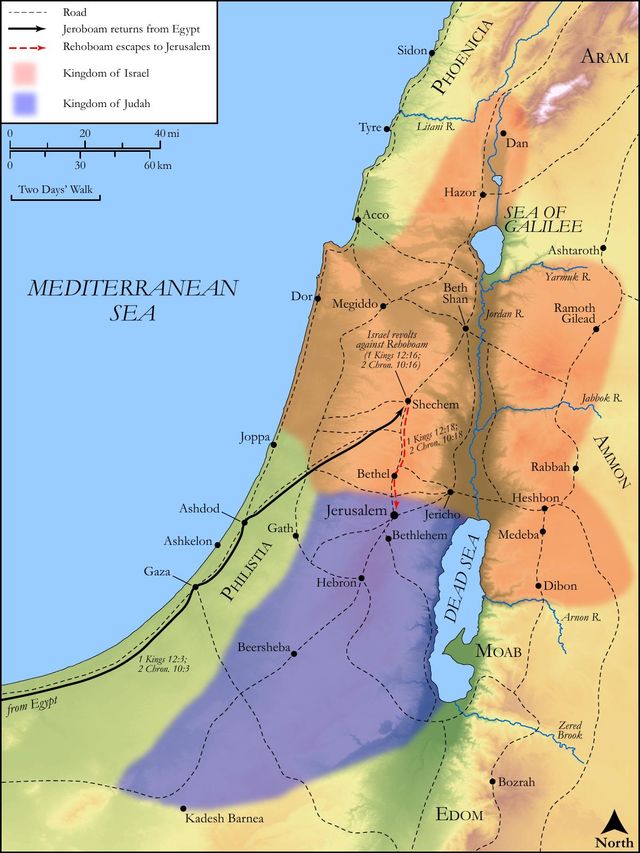
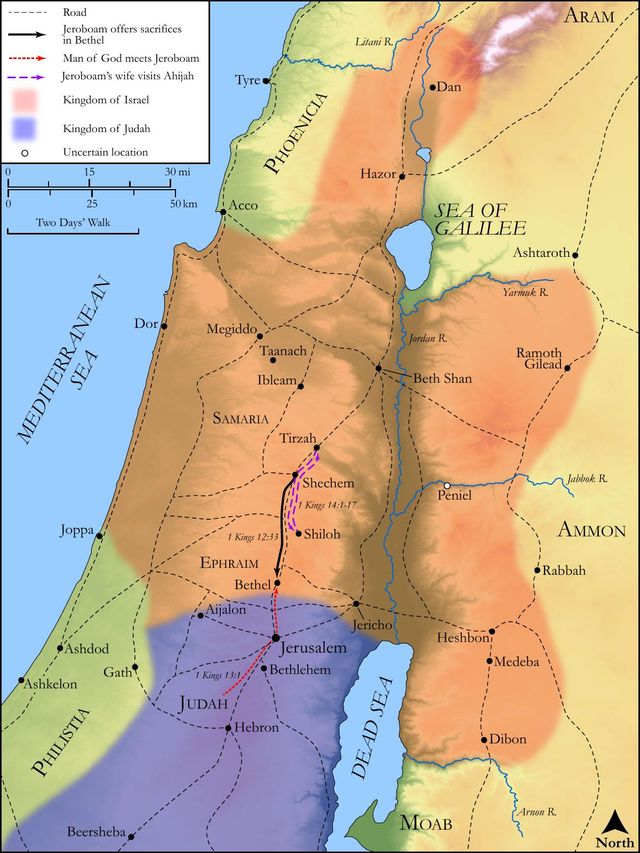
Study this verse
Public-domain commentary
Matthew Henry
From his Commentary on the Whole Bible. Henry comments on passages, not single verses — this entry covers 1 Kings 12:1–15. His three-level outline is real structure in the source text, so it is rendered as structure.
Solomon had 1000 wives and concubines, yet we read but of one son he had to bear up his name, and he a fool. It is said (Hos 4:10), They shall commit whoredom, and shall not increase. Sin is a bad way of building up a family. Rehoboam was the son of the wisest of men, yet did not inherit his father's wisdom, and then it stood him in little stead to inherit his father's throne. Neither wisdom nor grace runs in the blood. Solomon came to the crown very young, yet he was then a wise man. Rehoboam came to the crown at forty years old, when men will be wise if ever they will, yet he was then foolish. Wisdom does not go by age, nor is it the multitude of years nor the advantage of education that reaches it. Solomon's court was a mart of wisdom and the rendezvous of learned men, and Rehoboam was the darling of the court; and yet all was not sufficient to make him a wise man. The race is not to the swift, nor the battle to the strong. No dispute is made of Rehoboam's succession; upon the death of his father, he was immediately proclaimed. But,
I.The people desired a treaty with him at Shechem, and he condescended to meet them there.
1.Their pretence was to make him king, but the design was to unmake him. They would give him a public inauguration in another place than the city of David, that he might not seem to be king of Judah only. They had ten parts in him, and would have him among themselves for once, that they might recognize his title.
2.The place was ominous: at Shechem, where Abimelech set up himself (Jdg. 9); yet it had been famous for the convention of the states there, Jos 24:1. Rehoboam, we may suppose, knew of the threatening, that the kingdom should be rent from him, and hoped by going to Shechem, and treating there with the ten tribes, to prevent it: yet it proved the most impolitic thing he could do, and hastened the rupture.
II.The representatives of the tribes addressed him, praying to be eased of the taxes they were burdened with.
The meeting being appointed, they sent for Jeroboam out of Egypt to come and be their speaker. This they needed not to have done: he knew what God had designed him for, and would have come though he had not been sent for, for now was his time to expect the possession of the promised crown. In their address,
1.They complain of the last reign: Thy father made our yoke grievous, Kg1 12:4. They complain not of his father's idolatry and revolt from God; that which was the greatest grievance of all was none to them, so careless and indifferent were they in the matters of religion, as if God or Moloch were all one, so they might but live at ease and pay no taxes. Yet the complaint was groundless and unjust. Never did people live more at ease than they did, nor in great plenty. Did they pay taxes? It was to advance the strength and magnificence of their kingdom. If Solomon's buildings cost them money, they cost them no blood, as war would do. Were many servile hands employed about them? They were not the hands of the Israelites. Were the taxes a burden? How could that be, when Solomon imported bullion in such plenty that silver was, in a manner, as common as the stones? So that they did but render to Solomon the things that were Solomon's. Nay, suppose there was some hardship put upon them, were they not told before that this would be the manner of the king and yet they would have one? The best government cannot secure itself from reproach and censure, no, not Solomon's. Factious spirits will never want something to complain of. I know nothing in Solomon's administration that could make the people's yoke grievous, unless perhaps the women whom in his latter days he doted on were connived at in oppressing them.
2.They demand relief from him, and on this condition will continue in their allegiance to the house of David. They asked not to be wholly free from paying taxes, but to have the burden made lighter; this was all their care, to save their money, whether their religion was supported and the government protected or no. All seek their own.
III.Rehoboam consulted with those about him concerning the answer he should give to this address.
It was prudent to take advice, especially having so weak a head of his own; yet, upon this occasion, it was impolitic to take time himself to consider, for thereby he gave time to the disaffected people to ripen things for a revolt, and his deliberating in so plain a case would be improved as an indication of the little concern he had for the people's ease. They saw what they must expect, and prepared accordingly. Now,
1.The grave experienced men of his council advised him by all means to give the petitioners a kind answer, to give them good words, to promise them fair, and this day, this critical day, to serve them, that is, to tell them that he was their servant, and that he would redress all their grievances and make it his business to please them and make them easy. "Deny thyself (say they) so far as to do this for this once, and they will be thy servants for ever. When the present heat is allayed with a soft answer, and the assembly dismissed, their cooler thoughts will reconcile and fix them to Solomon's family still." Note, The way to rule is to serve, to do good, and stoop to do it, to become all things to all men and so win their hearts. Those who are in power really sit highest, and easiest, and safest, when they take this method.
2.The young men of his council were hot and haughty, and they advised him to return a severe and threatening answer to the people's demands. It was an instance of Rehoboam's weakness,
(1.)That he did not prefer aged counsellors, but had a better opinion of the young men that had grown up with him and with whom he was familiar, Kg1 12:8. Days should speak. It was a folly for him to think that, because they had been his agreeable companions in the sports and pleasures of his youth, they were therefore fit to have the management of the affairs of his kingdom. Great wits have not always the most wisdom; nor are those to be relied on as our best friends that know how to make us merry, for that will not make us happy. It is of great consequence to young people, that are setting out in the world, whom they associate with, accommodate themselves to, and depend upon for advice. If they reckon those that feed their pride, gratify their vanity, and further them in their pleasures, their best friends, they are already marked for ruin.
(2.)That he did not prefer moderate counsels, but was pleased with those that put him upon harsh and rigorous methods, and advised him to double the taxes, whether there was occasion for so doing or no, and to tell them in plain terms that he would do so, Kg1 12:10, Kg1 12:11. These young counsellors thought the old men expressed themselves but dully, Kg1 12:7. They affect to be witty in their advice, and value themselves on that. The old men did not undertake to put words into Rehoboam's mouth, only counselled him to speak good words; but the young men will furnish him with very quaint and pretty phrases, with pointed and pert similitudes: My little finger shall be thicker than my father's loins, etc. That is not always the best sense that is best worded.
IV.He answered the people according to the counsel of the young men, Kg1 12:14, Kg1 12:15.
He affected to be haughty and imperious, and fancied he could carry all before him with a high hand, and therefore would rather run the risk of losing them than deny himself so far as to give them good words. Note, Many ruin themselves by consulting their humour more than their interest. See,
1.How Rehoboam was infatuated in his counsels. He could not have acted more foolishly and impoliticly.
(1.)He owned their reflections upon his father's government to be true: My father made your yoke heavy; and therein he was unjust to his father's memory, which he might easily have vindicated from the imputation.
(2.)He fancied himself better able to manage them, and impose upon them, than his father was, not considering that he was vastly inferior to him in capacity. Could he think to support the blemishes of his father's reign who could never pretend to come near the glories of it?
(3.)He threatened not only to squeeze them by taxes, but to chastise them by cruel laws and severe executions of them, which should be not as whips only, but as scorpions, whips with rowels in them, that will fetch blood at every lash. In short, he would use them as brute beasts, load them and beat them at his pleasure: not caring whether they loved him or no, he would make them fear him.
(4.)He gave this provocation to a people that by long ease and prosperity were made wealthy, and strong, and proud, and would not be trampled upon (as a poor cowed dispirited people may), to a people that were now disposed to revolt, and had one ready to head them. Never, surely, was man so blinded by pride and affectation of arbitrary power, than which nothing is more fatal.
2.How God's counsels were hereby fulfilled. It was from the Lord, Kg1 12:15. He left Rehoboam to his own folly, and hid from his eyes the things which belonged to his peace, that the kingdom might be rent from him. Note, God serves his own wise and righteous purposes by the imprudences and iniquities of men, and snares sinners in the work of their own hands. Those that lose the kingdom of heaven throw it away, as Rehoboam did his, by their own wilfulness and folly.
Continue studying 1 Kings 12:8 across the web’s major study libraries — every link below opens this exact verse, chapter, or book on the destination site.
Read & Compare
 BibleGatewayThis verse in more than 200 translations and 70 languages.
 Bible.comThe YouVersion reader — hundreds of translations, reading plans, and highlights.
 ESV.orgCrossway's official English Standard Version reader.
 NET BibleThe NET translation with 60,000+ translators' notes on every rendering decision.
 STEP BibleTyndale House's free study tool — original text, vocabulary, and scholarly resources.
 BibliaLogos Bible Software's free web reader.
 USCCBThe New American Bible (Revised Edition) with the U.S. bishops' study notes.
Commentaries
 BibleHub CommentariesDozens of classic commentaries on this verse, gathered on one page.
 StudyLightMore than 100 commentary sets — the largest collection on the web.
 BibleRefPlain-English commentary on what this verse means, verse by verse.
 Enduring WordDavid Guzik's free commentary on this chapter, widely used by Bible teachers.
 Bible Study ToolsVerse commentary alongside Greek and Hebrew study aids.
Original Language & Research
- BibleHub InterlinearThe verse word by word — original language, transliteration, and English.
- BibleHub LexiconEvery word's original-language definition and Strong's entry.
 Blue Letter BibleDeep-study tools — Strong's numbers, concordance, and word studies.
 SefariaThe Hebrew text with Rashi and centuries of Jewish commentary.
Sermons, Hymns & Audio


TrulyRandomVerse is not affiliated with these sites and doesn’t control their content. They’re linked because they’re genuinely useful.
Summary
Rehoboam, the newly crowned king and heir to Solomon's throne, faced a momentous decision regarding the oppressive burdens placed upon the Israelite tribes. This pivotal verse details his disastrous choice to deliberately reject the wise, conciliatory counsel of the seasoned elders who had faithfully served his father, opting instead to consult with and ultimately follow the aggressive, unyielding advice of his youthful peers. This profound misjudgment directly precipitated the schism of the united monarchy, leading to the irreversible division of Israel into two separate kingdoms.
Context
ShowHideLiterary Context
This verse is intricately woven into the dramatic narrative of the kingdom's division, serving as the critical turning point. It immediately follows the people's earnest plea for relief from Solomon's heavy yoke, as recorded in 1 Kings 12:4. Rehoboam, in a semblance of due diligence, initially sought counsel from two distinct advisory groups: first, the venerable "old men" (verse 6), who advocated for a humble and gracious response promising enduring loyalty, and subsequently, the "young men" (verse 8), his contemporaries. Verse 8 explicitly chronicles Rehoboam's decisive rejection of the elders' sagacious advice and his embrace of the youthful, imprudent counsel. This sets the stage directly for the harsh, uncompromising reply he delivers in 1 Kings 12:14, which, in turn, instantly triggers the northern tribes' rebellion and the kingdom's irreversible split, as narrated in 1 Kings 12:16. The narrative meticulously builds to this singular moment, powerfully highlighting the king's personal agency and culpability in the unfolding national tragedy.
Historical & Cultural Context
The period immediately following King Solomon's glorious but burdensome reign was fraught with tension. While Solomon had achieved unparalleled wealth and built magnificent structures, including the Temple, his ambitious projects were financed through heavy taxation and compulsory labor (corvée), particularly impacting the northern tribes. Rehoboam's accession to the throne was not merely a ceremonial transition but a critical juncture, offering a chance to address these deep-seated grievances and solidify his legitimacy. Culturally, the "old men" (zeqenim) held a revered status in ancient Israelite society; their accumulated life experience and wisdom were highly valued, often seen as a conduit for divine insight and prudent governance. Kings were traditionally expected to rule justly and wisely, frequently relying on a council of seasoned advisors. In stark contrast, the "young men" (yeladim) likely represented a nascent, perhaps more autocratic, approach to kingship, advocating for the assertion of absolute power without compromise. This contrasted sharply with the traditional, more communal, and covenantal understanding of leadership that emphasized the king's responsibility to his people.
Key Themes
ShowHideThis verse serves as a powerful illustration of several profound themes central to the Deuteronomistic history. Firstly, it starkly presents the consequences of rejecting wisdom, contrasting the prudent, long-term thinking of the elders with the short-sighted, prideful advice of the youth. Rehoboam's choice underscores the danger of valuing self-assertion over sagacity. Secondly, it subtly introduces the theme of divine sovereignty in human affairs, as the text later reveals that this catastrophic division was, in fact, "a turn of affairs brought about by the Lord" (1 Kings 12:15) to fulfill the prophecy previously delivered against Solomon's house by the prophet Ahijah (1 Kings 11:29-39). Thirdly, the narrative explores the very nature of true leadership, emphasizing that effective rule requires humility, a spirit of service, and profound discernment over arrogance and a relentless pursuit of absolute control. Rehoboam's abject failure to embody these essential qualities serves as a potent cautionary tale, demonstrating how poor leadership decisions can unleash devastating and lasting national consequences, leading to the fragmentation of a once-unified and divinely favored people.
Exposition and Analysis
ShowHideKey Word Analysis
ShowHideThis primitive root signifies to loosen, relinquish, permit, or specifically, to fail, forsake, or leave destitute. In this context, it denotes a deliberate, active, and decisive rejection of the counsel offered by the old men. It is not a passive oversight or a mere disregard, but an intentional turning away from a path that was clearly presented as beneficial and wise. This act of "forsaking" powerfully underscores Rehoboam's personal responsibility and agency in his calamitous decision, highlighting his conscious choice to abandon sound guidance.
Derived from the root yâʻats (to advise), this noun refers to advice, a plan, or a deliberate purpose. The "counsel of the old men" was not a casual suggestion but a well-considered, strategic approach to governance, deeply rooted in their extensive experience and a nuanced understanding of the people's disposition and the kingdom's stability. Rehoboam's rejection of this etsah was therefore a rejection of proven, sound, and prudent wisdom, leading to an ill-conceived alternative.
This term, literally meaning "something born," refers to a lad or offspring, often translated as boy, child, or young man. In contrast to zâqên (elders), yeled frequently carries connotations of immaturity, inexperience, or a lack of seasoned judgment. The text's specific note that these were the ones "grown up with him" suggests a bond of familiarity and perhaps shared youthful arrogance, but critically, a collective lack of exposure to the complexities of statecraft and the immense weight of national leadership. Their subsequent advice, as revealed in the narrative, reflected this youthful impulsiveness rather than mature, discerning wisdom.
Verse Breakdown
ShowHide"But he forsook the counsel of the old men, which they had given him"
This opening clause immediately establishes Rehoboam's active and deliberate rejection of the wise and conciliatory advice. The "old men" (Hebrew: zâqên), representing accumulated experience, prudence, and a deep understanding of the kingdom's dynamics, had served his father Solomon and were acutely aware of the people's grievances. Their counsel, detailed in 1 Kings 12:7, was to serve the people and speak kindly, promising their perpetual loyalty. Rehoboam's choice to "forsake" (Hebrew: ‘âzab) this counsel was a conscious and willful turning away from a path of humility, long-term stability, and covenantal fidelity.
"and consulted with the young men that were grown up with him"
Instead of heeding the seasoned wisdom of his elders, Rehoboam pivoted and sought counsel from his peers. These "young men" (Hebrew: yeled) were his contemporaries, likely sharing his worldview, perhaps his pride, and certainly his lack of practical experience in governing a vast and diverse kingdom. Their advice, as subsequently revealed, was to assert absolute power and drastically increase the burdens on the people, promising to make his "yoke heavier" than his father's (1 Kings 12:10-11). This aggressive, unyielding advice appealed directly to Rehoboam's desire to appear strong, unyielding, and powerful, ultimately leading to his catastrophic decision and the irreversible division of the united kingdom.
"[and] which stood before him"
This concluding phrase indicates that these young men were part of Rehoboam's immediate inner circle, perhaps his personal attendants, confidantes, or administrative staff. Their close proximity to the king suggests a relationship of trust and familiarity, which might have made their counsel more appealing and less challenging to Rehoboam than the potentially humbling advice of the older, more independent elders. This intimate relationship, however, did not equate to superior wisdom or a more profound understanding of the national interest, ultimately proving to be a detrimental influence.
Literary Devices
ShowHideThe verse employs several potent literary devices to underscore Rehoboam's fateful and ultimately disastrous decision. Contrast is the most prominent, starkly pitting the "old men" against the "young men," thereby representing the fundamental opposition between seasoned wisdom and impulsive inexperience. This juxtaposition highlights the clear choice Rehoboam faced and the inherent folly of his selection. The verb "forsook" (Hebrew: ‘âzab) functions as a key verb, emphasizing the deliberate and active nature of Rehoboam's rejection, rather than a passive oversight. The narrative structure itself utilizes foreshadowing, as this specific decision immediately precedes the kingdom's division, implicitly signaling the catastrophic consequences that will inevitably follow the rejection of sound counsel. Furthermore, the description of the "young men" as those "grown up with him" and who "stood before him" employs characterization to subtly suggest a circle of influence that, while familiar and personally close, lacked the necessary gravitas, independent judgment, and objective perspective required for such a critical moment of national leadership.
Theological and Thematic Connections
ShowHideRehoboam's rejection of wise counsel and his embrace of self-serving advice serves as a profound theological lesson on the nature of wisdom, humility, and leadership within God's covenant people. His story vividly illustrates the biblical principle that "pride goes before destruction, and a haughty spirit before a fall" (Proverbs 16:18). His failure to listen to those with deep experience, choosing instead to surround himself with voices that merely affirmed his desire for absolute power and control, led directly to the fracturing of God's chosen nation. This narrative powerfully underscores the critical importance of discerning counsel, recognizing that not all advice, even from trusted associates, is beneficial or aligned with divine wisdom. True wisdom often necessitates a profound humility to receive it, especially when it challenges one's own inclinations, comforts, or perceived authority.
Reflection and Application
ShowHideRehoboam's story stands as a timeless and compelling cautionary tale for leaders and individuals alike, powerfully illustrating the profound and far-reaching impact of the counsel we choose to embrace. In a contemporary world saturated with an overwhelming deluge of information and competing opinions, the discernment of truly wise counsel is more critical and challenging than ever before. We are constantly confronted with decisions, both personal and professional, that demand careful consideration and the weighing of diverse perspectives. This ancient account challenges us to actively seek out, deeply value, and humbly receive the wisdom of those who possess genuine experience, unwavering integrity, and a proven track record of sound judgment, rather than instinctively defaulting to voices that merely echo our own biases, flatter our desires, or promise easy solutions. It calls for a profound humility that acknowledges our inherent limitations and a courageous willingness to be corrected or guided by those who possess greater clarity, deeper insight, or have walked a longer, more experienced path. Ultimately, the narrative compels us to prioritize long-term flourishing, the well-being of others, and the common good over immediate gratification, the assertion of personal power, or the pursuit of fleeting popularity, reminding us that true strength and effective leadership often lie in humble service, discerning collaboration, and the courageous embrace of wisdom.
Questions for Reflection
ShowHideFAQ
ShowHideWhy did Rehoboam reject the counsel of the old men?
ShowHideRehoboam rejected the counsel of the old men primarily due to a complex interplay of pride, a strong desire for absolute power, and a profound lack of humility. The old men advised a conciliatory and servant-hearted approach, suggesting that he serve the people and speak kindly to them, promising that this humble posture would secure their loyalty indefinitely (1 Kings 12:7). This counsel, rooted in wisdom and long-term stability, likely felt like a concession or a sign of weakness to Rehoboam, who, as the son of the mighty King Solomon, perhaps envisioned a reign of even greater, unchallenged authority. The "young men" with whom he had grown up, on the other hand, advised him to assert his dominance and drastically increase the burdens on the people, promising to make his "yoke heavier" than his father's (1 Kings 12:10-11). This aggressive, unyielding advice appealed directly to Rehoboam's desire to appear strong, unyielding, and powerful, ultimately leading to his catastrophic decision and the irreversible division of the united kingdom.
Christ-Centered Fulfillment
ShowHideWhile Rehoboam's story stands as a tragic account of human folly and the devastating consequences of rejecting wisdom for pride, it powerfully anticipates and illuminates the perfect wisdom and humble leadership embodied in Jesus Christ. Unlike Rehoboam, who sought to assert his own power and increase burdens upon his people, Jesus came not to be served but to serve, and to give his life as a ransom for many (Mark 10:45). Rehoboam's pride led to national division and suffering; conversely, Christ's profound humility and perfect obedience to the Father's will brought about ultimate reconciliation and unity, effectively breaking down the dividing wall of hostility between God and humanity, and among people themselves (Ephesians 2:14). Where Rehoboam forsook the counsel of elders, Jesus perfectly embodied divine wisdom, being "the wisdom of God" personified (1 Corinthians 1:24) and the one in whom "are hidden all the treasures of wisdom and knowledge" (Colossians 2:3). His leadership is characterized by a "light yoke and easy burden" (Matthew 11:28-30), inviting weary souls to find true rest, a stark and redemptive contrast to the oppressive rule Rehoboam sought to impose. Thus, Rehoboam's failure serves as a dark, yet illuminating, backdrop, highlighting the unparalleled grace, profound wisdom, and redemptive power of Christ's eternal reign, which truly unites, liberates, and restores.