


2 Chronicles 10:8
Bible text: King James Version (1769 Blayney text) · Public domain
Bible text: Berean Standard Bible · Public domain
Bible text: American Standard Version (1901) · Public domain
Bible text: World English Bible, Messianic edition · Public domain
Bible text: Geneva Bible (1599) · Public domain
Bible text: Young's Literal Translation · Public domain
- וַיַּעֲזֹבvai·ya·'a·Zoand he abandonedH5800Conj-w ¦ V-Qal-ConsecImperf-3msVerb Qal Consecutive Imperfect 3rd Singular Masculineוַandיַּעֲזֹבhe abandoned
- אֶת'et<obj.>H853DirObjMParticle Object Indicator
- עֲצַת'a·Tzat[the] counsel ofH6098N-fscNoun Singular Feminine Construct
- הַזְּקֵנִיםha·ze·ke·Nimthe eldersH2205Art ¦ Adj-mpAdjective Plural Masculine Absoluteהַtheזְּקֵנִיםelders
- אֲשֶׁר'a·SherwhichH834RelParticle Relative
- יְעָצֻהוּye·'a·Tzu·huthey had counseled himH3289V-Qal-Perf-3cp ¦ 3msVerb Qal Perfect 3rd Plural common genderיְעָצֻthey had counseledהוּhim
- וַיִּוָּעַץvai·yi·va·'Atzand he consultedH3289Conj-w ¦ V-Niphal-ConsecImperf-3msVerb Niphal Consecutive Imperfect 3rd Singular Masculineוַandיִּוָּעַץhe consulted
- אֶת'etwithH854PrepPreposition
- הַיְלָדִיםhay·la·Dimthe youthsH3206Art ¦ N-mpNoun Plural Masculine Absoluteהַtheיְלָדִיםyouths
- אֲשֶׁר'a·SherwhoH834RelParticle Relative
- גָּדְלוּga·de·Luthey had grown upH1431V-Qal-Perf-3cpVerb Qal Perfect 3rd Plural common gender
- אִתּוֹ'i·Towith himH854Prep ¦ 3msPrepositionאִתּwithוֹhim
- הָעֹמְדִיםha·'o·me·Dimwho stoodH5975Art ¦ V-Qal-Prtcpl-mpVerb Qal Participle Plural Masculine Absoluteהָwhoעֹמְדִיםstood
- לְפָנָיוle·fa·Nav<to> before himH6440Prep-l ¦ N-mpc ¦ 3msNoun Plural Masculine Constructלְ<to>פָנָיbeforeוhim
English is a literal word-by-word gloss of the Hebrew, not the KJV's wording. Why?
This is the original text the KJV's translators worked from — each Hebrew word with its own literal English meaning in this verse, prepared by scholars at Tyndale House, Cambridge. The KJV translates whole sentences, not word by word, so its wording differs: one Hebrew word can become several English words, and the KJV may choose “the LORD” where the gloss reads “Yahweh”. Both are faithful — they answer different questions. For the KJV's own rendering, switch to the KJV text.
Details
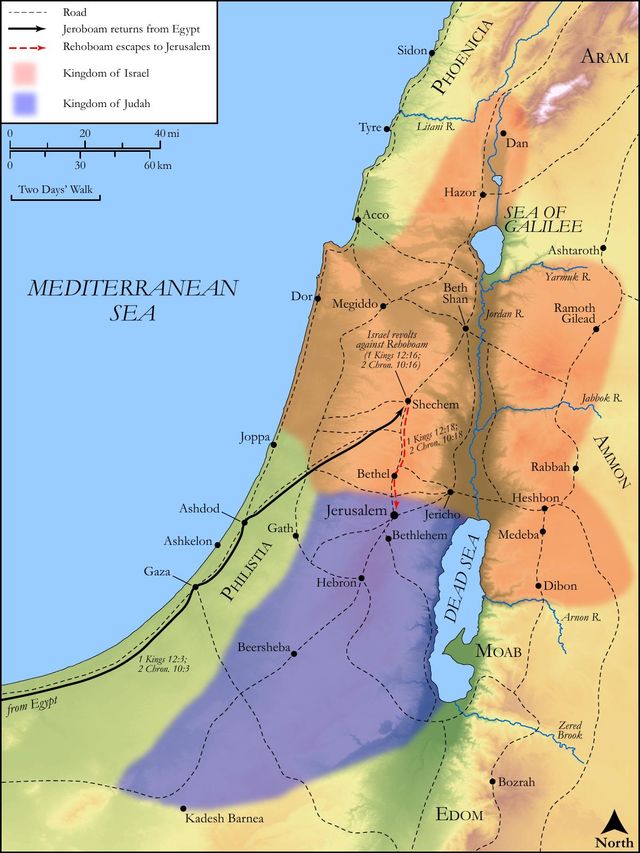
See on the biblical-era map
Study this verse
Public-domain commentary
Matthew Henry
From his Commentary on the Whole Bible. Henry comments on passages, not single verses — this entry covers 2 Chronicles 10:1–11.
We may observe here, 1. The wisest and best cannot give every body content. Solomon enriched and advanced his kingdom, did all (one would think) that could be done to make then happy and easy; and yet either he was indiscreet in burdening them with the imposition of taxes and services, or at least there was some colour of reason to think him so. No man is perfectly wise. It is probable that it was when Solomon had declined from God and his duty that his wisdom failed him, and God left him to himself to act in this impolitic manner. Even Solomon's treasures were exhausted by his love of women; and probably it was to maintain them, and their pride, luxury, and idolatry, that he burdened his subjects. 2. Turbulent and ungrateful spirits will find fault with the government, and complain of grievances, when they have very little reason to do so. Had they not peace in Solomon's time? They were never plundered by invaders, as formerly, never put in fear by the alarms of war, nor obliged to hazard their lives in the high places of the field. Had they not plenty - meat enough, and money enough? What would they more? O fortunatos nimium, sua si bona norint! - O happy, if they knew their happy state! And yet they complain that Solomon made their yoke grievous. If any complain thus of the yoke of Christ, that they might have a pretence to break his bands in sunder and cast away his cords from them, we are sure that he never gave them any cause at all for the complaint, whatever Solomon did. His yoke is easy, and his burden is light. He never made us serve with an offering, nor wearied us with incense. 3. Many ruin themselves and their interests by trampling upon and provoking their inferiors. Rehoboam thought that because he was king he might assume as much authority as his father had done, might have what he would, and do what he would, and carry all before him. But, though he wore his father's crown, he wanted his father's brains, and ought to have considered that, being quite a different man from what his father was, he ought to take other measures. Such a wise man as Solomon may do as we will, but such a fool as Rehoboam must do as he can. The high-mettled horse may be kicked and spurred by him that has the art of managing him; but, if an unskilful horseman do it, it is at his peril. Rehoboam paid dearly for threatening, and talking big, and thinking to carry matters with a high hand. It was Job's wisdom, as well as his virtue, that he despised not the cause of his man-servant or maid-servant, when they argued with him (Job 31:13), but heard them patiently, considered their reasons, and gave them a soft answer. And a similar tender consideration of those in subjection, and a forwardness to make them easy, will be the comfort and praise of all in authority, in the church, in the state, and in families. 4. Moderate counsels are generally wisest and best. Gentleness will do what violence will not do. Most people love to be accosted mildly. Rehoboam's old experienced counsellors directed him to this method (v. 7): "Be kind to this people, and please them, and speak good words to them, and thou art sure of them for ever." Good words cost nothing but a little self-denial, and yet they purchase good things. 5. God often fulfils the counsels of his own wisdom by infatuating men, and giving them up to the counsels of their own folly. No more needs to be done to ruin men than to leave them to themselves, and their own pride and passion.
Continue studying 2 Chronicles 10:8 across the web’s major study libraries — every link below opens this exact verse, chapter, or book on the destination site.
Read & Compare
 BibleGatewayThis verse in more than 200 translations and 70 languages.
 Bible.comThe YouVersion reader — hundreds of translations, reading plans, and highlights.
 ESV.orgCrossway's official English Standard Version reader.
 NET BibleThe NET translation with 60,000+ translators' notes on every rendering decision.
 STEP BibleTyndale House's free study tool — original text, vocabulary, and scholarly resources.
 BibliaLogos Bible Software's free web reader.
 USCCBThe New American Bible (Revised Edition) with the U.S. bishops' study notes.
Commentaries
 BibleHub CommentariesDozens of classic commentaries on this verse, gathered on one page.
 StudyLightMore than 100 commentary sets — the largest collection on the web.
 BibleRefPlain-English commentary on what this verse means, verse by verse.
 Enduring WordDavid Guzik's free commentary on this chapter, widely used by Bible teachers.
 Bible Study ToolsVerse commentary alongside Greek and Hebrew study aids.
Original Language & Research
- BibleHub InterlinearThe verse word by word — original language, transliteration, and English.
- BibleHub LexiconEvery word's original-language definition and Strong's entry.
 Blue Letter BibleDeep-study tools — Strong's numbers, concordance, and word studies.
 SefariaThe Hebrew text with Rashi and centuries of Jewish commentary.
Sermons, Hymns & Audio


TrulyRandomVerse is not affiliated with these sites and doesn’t control their content. They’re linked because they’re genuinely useful.
Summary
Second Chronicles 10:8 marks the pivotal moment of King Rehoboam's reign, where he deliberately rejects the seasoned and compassionate counsel of his father's experienced advisors in favor of the harsh, power-centric advice offered by his youthful peers. This fateful decision, driven by a desire to assert absolute authority rather than serve the people, directly precipitates the tragic division of the united kingdom of Israel, serving as a profound cautionary tale about the perils of pride and the rejection of wisdom.
Context
ShowHideLiterary Context
This verse is situated at a critical juncture in the narrative of the divided monarchy. Following the death of King Solomon, his son Rehoboam ascends to the throne. The people, burdened by Solomon's heavy taxation and forced labor, gather at Shechem to appeal to Rehoboam for relief. Prior to this verse, Rehoboam had consulted two groups: first, the "old men" who had served his father, whose advice was to serve the people kindly and speak good words to them, as recorded in 2 Chronicles 10:7. This verse, however, shows Rehoboam's decisive turn away from this wise counsel, directly leading to his infamous response to the people in the subsequent verses and the ultimate fragmentation of the kingdom into Israel and Judah, detailed in 2 Chronicles 10:16.
Historical & Cultural Context
In ancient Israel, "elders" held significant positions of authority and respect, embodying accumulated wisdom, experience, and the community's collective memory. Their counsel was typically sought and highly valued in matters of governance and justice. Shechem itself was a historically significant location for covenant renewals and assemblies, adding weight to the people's gathering there. Rehoboam's choice to listen to "young men" who were "brought up with him" suggests a preference for familiar, perhaps less challenging, voices from his immediate court circle, over the established, respected wisdom of the elders. This decision reflects a broader cultural tension between traditional wisdom and youthful ambition, with profound consequences for the political landscape of the time.
Key Themes
ShowHideRehoboam's actions in this verse underscore several enduring themes. Primarily, it highlights the peril of rejecting wise counsel, demonstrating how dismissing experienced, sound advice in favor of less mature or self-serving perspectives can lead to disastrous outcomes, as seen in Proverbs 11:14. Secondly, it starkly contrasts youthful arrogance with experienced wisdom, portraying Rehoboam's preference for asserting power rather than exercising humble, compassionate leadership. Finally, it serves as a powerful cautionary tale about leadership and discernment, emphasizing that effective governance requires not just authority, but also the humility to listen, the wisdom to discern between flattery and truth, and the foresight to understand the long-term implications of one's decisions for the well-being of the people.
Exposition and Analysis
ShowHideKey Word Analysis
ShowHideThis verb implies a deliberate and active abandonment, not merely an oversight or a passive disregard. Rehoboam consciously turned away from the counsel, indicating a willful rejection of a path that was clearly presented to him. It suggests a decisive break from the wisdom of the past.
This term refers to elders, individuals who, by virtue of their age and experience, were considered wise, prudent, and authoritative within the community. They represented continuity, tradition, and a deep understanding of the people and the principles of governance, having served King Solomon himself.
While literally meaning "boys" or "youths," in this context, it refers to Rehoboam's peers, those who had grown up with him in the royal court. The implication is a lack of seasoned judgment, practical experience in governance, and perhaps a tendency towards impulsive or self-serving advice, contrasted sharply with the zâqên.
Verse Breakdown
ShowHide"But he forsook the counsel which the old men gave him"
This clause establishes Rehoboam's active and deliberate rejection of the wise and compassionate advice offered by his father's seasoned advisors. It highlights his unwillingness to embrace a leadership style rooted in service and empathy, which would have preserved the kingdom's unity.
"and took counsel with the young men that were brought up with him"
This phrase reveals Rehoboam's preference for the advice of his peers, individuals who shared his background and likely his youthful perspective on power and authority. Their counsel, as revealed in subsequent verses, was harsh and focused on increasing royal dominance, rather than alleviating the people's burdens.
"that stood before him"
This detail indicates that these young men were part of Rehoboam's immediate entourage or court, perhaps eager to solidify their influence alongside the new king. Their proximity and access made their voices more readily heard, despite their lack of governmental experience.
Literary Devices
ShowHideThe primary literary device at play in 2 Chronicles 10:8 is Contrast, specifically between the "old men" and the "young men," and the differing counsel they offer. This stark opposition highlights the two divergent paths available to Rehoboam: one of wisdom, humility, and service, and the other of arrogance, power, and oppression. The verse also employs Foreshadowing, as Rehoboam's choice here clearly signals the impending disaster—the division of the kingdom—that will unfold due to his poor judgment. The narrative functions as a powerful Cautionary Tale, illustrating the severe consequences of rejecting sound, experienced advice and succumbing to the allure of pride and unchecked authority. There is also an element of Irony, as Rehoboam's attempt to strengthen his rule through harshness ultimately leads to its fragmentation.
Theological and Thematic Connections
ShowHideRehoboam's tragic decision in 2 Chronicles 10:8 resonates deeply with biblical themes of wisdom, discernment, and the nature of true leadership. The narrative underscores that genuine authority, particularly in a divinely established kingdom, is not about domination but about humble service and seeking the welfare of the people. Rehoboam's failure to heed the wisdom of the elders, preferring the flattery of his peers, mirrors a recurring biblical motif where pride precedes a fall, and the rejection of godly counsel leads to ruin. This serves as a powerful reminder that wisdom is a gift from God, often mediated through experienced individuals, and that leaders are accountable for the choices they make regarding the counsel they receive.
Reflection and Application
ShowHideThe account of Rehoboam's fateful choice offers timeless lessons for every individual, especially those in positions of leadership or influence. It compels us to critically evaluate the sources of our counsel, urging us to prioritize wisdom, experience, and integrity over flattery, self-interest, or mere familiarity. In a world that often values youthful innovation above seasoned experience, Rehoboam's story reminds us that true progress and stability often depend on drawing from the wellspring of accumulated wisdom. We are challenged to cultivate humility, recognizing our own limitations and the immense value of diverse perspectives. Our decisions, whether personal, professional, or spiritual, carry consequences that extend far beyond ourselves, impacting communities, families, and even generations. Therefore, seeking God's wisdom and discerning counsel becomes not just a good practice, but a vital necessity for flourishing.
Questions for Reflection
ShowHideFAQ
ShowHideWho were the "old men" and "young men" mentioned in this verse?
ShowHideThe "old men" were likely experienced elders and advisors who had served King Solomon throughout his reign. They represented the traditional wisdom, political acumen, and a deep understanding of the people's burdens and the kingdom's stability. Their counsel was to serve the people kindly to secure their perpetual loyalty. The "young men" were Rehoboam's peers, those who had grown up with him in the royal court. They lacked the practical experience of governance and the long-term perspective of the elders. Their advice, as detailed in 2 Chronicles 10:9-11, was harsh, advocating for an increase in royal power and a more oppressive rule, reflecting a desire to assert authority rather than build consensus.
What was the immediate consequence of Rehoboam's decision?
ShowHideRehoboam's decision to reject the elders' compassionate counsel and instead follow the harsh advice of his youthful peers had immediate and devastating consequences. When he delivered his arrogant and unyielding response to the people's plea for lighter burdens, ten of the twelve tribes of Israel immediately rebelled against his rule. This led to the permanent division of the united kingdom of Israel, which had flourished under David and Solomon, into two separate entities: the northern kingdom of Israel (under Jeroboam) and the southern kingdom of Judah (under Rehoboam). This dramatic fragmentation is chronicled in 2 Chronicles 10:16-19 and marked a profound turning point in Israel's history.
Christ-Centered Fulfillment
ShowHideRehoboam's tragic failure to heed wise counsel and his embrace of self-serving power stand in stark contrast to the perfect leadership of Jesus Christ. While Rehoboam sought to assert his dominion through harshness, Christ came not to be served, but to serve, and to give his life as a ransom for many, as recorded in Mark 10:45. Rehoboam rejected wisdom, leading to the division of his earthly kingdom; Christ, however, is the very wisdom of God incarnate, as articulated in 1 Corinthians 1:24, whose counsel always leads to life, reconciliation, and peace. Unlike Rehoboam's decision which fragmented a nation, Jesus's ultimate sacrifice on the cross broke down the dividing wall of hostility, uniting Jew and Gentile into one new humanity under His headship, a truth proclaimed in Ephesians 2:14. His kingdom is not of this world, established by earthly power or human counsel, but is an eternal, undivided spiritual kingdom founded on truth and love, as Jesus Himself stated in John 18:36. He is the true King, whose reign brings ultimate unity and whose wisdom is unfailing, guiding His people into all truth, for He is the Way, the Truth, and the Life (John 14:6).