


2 Chronicles 25:15
- וַיִּחַרvai·yi·charand it burnedH2734Conj-w ¦ V-Qal-ConsecImperf-3msVerb Qal Consecutive Imperfect 3rd Singular Masculineוַandיִּחַרit burned
- אַף'af[the] anger ofH639N-mscNoun Singular Masculine Construct
- יְהוָהYah·wehYahwehH3068N-properNoun Proper Title
- בַּאֲמַצְיָהוּba·'a·matz·Ya·huon AmaziahH558Prep-b ¦ N-proper-mNoun Proper MasculineבַּonאֲמַצְיָהוּAmaziah
- וַיִּשְׁלַחvai·yish·Lachand he sentH7971Conj-w ¦ V-Qal-ConsecImperf-3msVerb Qal Consecutive Imperfect 3rd Singular Masculineוַandיִּשְׁלַחhe sent
- אֵלָיו'e·Lavto himH413Prep ¦ 3msPrepositionאֵלָיtoוhim
- נָבִיאna·Vi'a prophetH5030N-msNoun Singular Masculine Absolute
- וַיֹּאמֶרvai·Yo·merand he saidH559Conj-w ¦ V-Qal-ConsecImperf-3msVerb Qal Consecutive Imperfect 3rd Singular Masculineוַandיֹּאמֶרhe said
- לוֹloto himPrep-l ¦ 3msSuffix Personal 3rd Singular Masculineלtoוֹhim
- לָמָּהLa·mah<to> why?H4100Prep-l ¦ InterrogPronoun Interrogativeלָ<to>מָּהwhy?
- דָרַשְׁתָּda·Rash·tahave you soughtH1875V-Qal-Perf-2msVerb Qal Perfect 2nd Singular Masculine
- אֶת'et<obj.>H853DirObjMParticle Object Indicator
- אֱלֹהֵי'e·lo·Hei[the] gods ofH430N-mpcNoun Plural Masculine Construct
- הָעָםha·'Amthe peopleH5971Art ¦ N-msNoun Singular Masculine Absoluteהָtheעָםpeople
- אֲשֶׁר'a·SherwhichH834RelParticle Relative
- לֹאlo'notH3808NegParticle Negative
- הִצִּילוּhi·Tzi·luthey deliveredH5337V-Hiphil-Perf-3cpVerb Hiphil Perfect 3rd Plural common gender
- אֶת'et<obj.>H853DirObjMParticle Object Indicator
- עַמָּם'a·Mamtheir own peopleH5971N-msc ¦ 3mpNoun Singular Masculine Constructעַמָּown peopleםtheir
- מִיָּדֶךָmi·ya·De·khafrom your handH3027Prep-m ¦ N-csc ¦ 2msNoun Singular common gender Constructמִfromיָּדֶhandךָyour
English is a literal word-by-word gloss of the Hebrew, not the KJV's wording. Why?
This is the original text the KJV's translators worked from — each Hebrew word with its own literal English meaning in this verse, prepared by scholars at Tyndale House, Cambridge. The KJV translates whole sentences, not word by word, so its wording differs: one Hebrew word can become several English words, and the KJV may choose “the LORD” where the gloss reads “Yahweh”. Both are faithful — they answer different questions. For the KJV's own rendering, switch to the KJV text.
Details
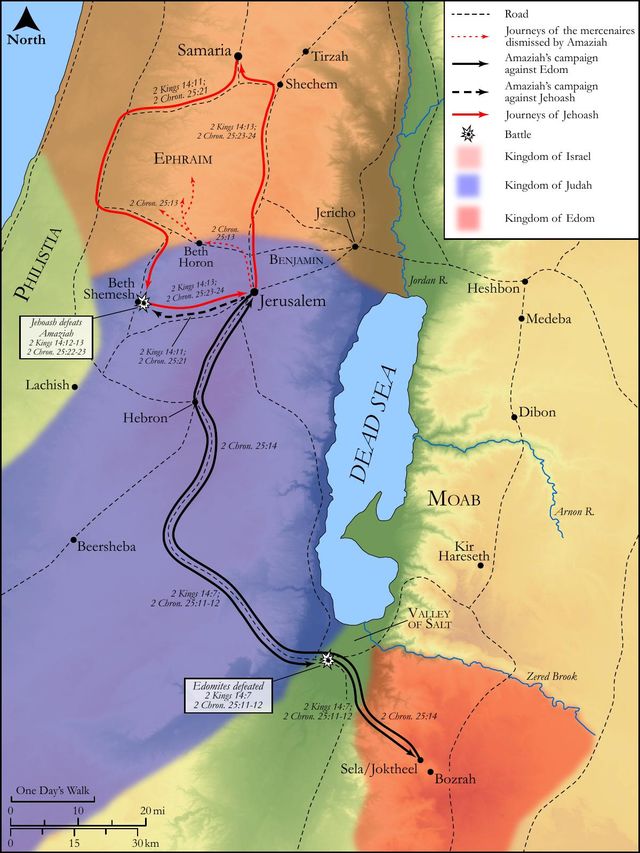
See on the biblical-era map
Study this verse
Public-domain commentary
Matthew Henry
From his Commentary on the Whole Bible. Henry comments on passages, not single verses — this entry covers 2 Chronicles 25:14–16. His two-level outline is real structure in the source text, so it is rendered as structure.
Here is, I. The revolt of Amaziah from the God of Israel to the gods of the Edomites. Egregious folly! Ahaz worshipped the gods of those that had conquered him, for which he had some little colour, Ch2 28:23. But to worship the gods of those whom he had conquered, who could not protect their own worshippers, was the greatest absurdity that could be. What did he see in the gods of the children of Seir that could tempt him to set them up for his gods and bow himself down before them? Ch2 25:14. If he had cast the idols down from the rock and broken them to pieces, instead of the prisoners, he would have manifested more of the piety as well as more of the pity of an Israelite; but perhaps for that barbarous inhumanity he was given up to this ridiculous idolatry.
II.The reproof which God sent to him, by a prophet, for this sin.
The anger of the Lord was kindled against him, and justly; yet, before he sent to destroy him, he sent to convince and reclaim him, and so to prevent his destruction. The prophet reasoned with him very fairly and very mildly: Why hast thou sought the favour of those gods which could not deliver their own people? Ch2 25:15. If men would but duly consider the inability of all those things to help them to which they have recourse when they forsake God, they would not be such enemies to themselves.
III.The check he gave to the reprover, Ch2 25:16.
He could say nothing in excuse of his own folly; the reproof was too just to be answered. But he fell into a passion with the reprover.
1.He taunted him as saucy and impertinent, and meddling with that which did not belong to him: Art thou made of the king's counsel? Could not a man speak reasonably to him, but he must be upbraided as usurping the place of a privy-counsellor? But, as a prophet, he really was made of the king's counsel by the King of kings, in duty to whom the king was bound not only to hear, but to ask and take his counsel.
2.He silenced him, bade him forbear and say not a word more to him. He said to the seer, See not, Isa 30:10. Men would gladly have their prophets thus under their girdles, as we say, to speak just when and what they would have them speak, and not otherwise.
3.He threatened him: "Why shouldst thou be smitten? It is at thy peril if thou sayest a word more of this matter." He seems to remind him of Zechariah's fate in the last reign, who was put to death for making bold with the king; and bids him take warning by him. Thus he justifies the killing of that prophet by menacing this, and so, in effect, makes himself guilty of the blood of both. He had hearkened to the prophet who ordered him to send back the army of Israel, and was ruled by him, though he contradicted his politics and lost him 100 talents, Ch2 25:10. But this prophet, who dissuaded him from worshipping the gods of the Edomites, he ran upon with an unaccountable rage, which must be attributed to the witchcraft of idolatry. He was easily persuaded to part with his talents of silver, but by no means with his gods of silver.
IV.The doom which the prophet passed upon him for this.
He had more to say to him by way of instruction and advice; but, finding him obstinate in his iniquity, he forbore. He is joined to idols; let him alone, Hos 4:17. Miserable is the condition of that man with whom the blessed Spirit, by ministers and conscience, forbears to strive, Gen 6:3. And both the reprovers in the gate and that in the bosom, if long brow-beaten and baffled, will at length forbear. So I gave them up to their own hearts' lusts. The secure sinner perhaps values himself upon it as a noble and happy achievement to have silenced his reprovers and monitors, and to get clear of them; but what comes of it? "I know that God has determined to destroy thee; it is a plain indication that thou art marked for ruin that thou hast done this, and hast not hearkened to my counsel." Those that are deaf to reproof are ripening apace for destruction, Pro 29:1.
Continue studying 2 Chronicles 25:15 across the web’s major study libraries — every link below opens this exact verse, chapter, or book on the destination site.
Read & Compare
 BibleGatewayThis verse in more than 200 translations and 70 languages.
 Bible.comThe YouVersion reader — hundreds of translations, reading plans, and highlights.
 ESV.orgCrossway's official English Standard Version reader.
 NET BibleThe NET translation with 60,000+ translators' notes on every rendering decision.
 STEP BibleTyndale House's free study tool — original text, vocabulary, and scholarly resources.
 BibliaLogos Bible Software's free web reader.
 USCCBThe New American Bible (Revised Edition) with the U.S. bishops' study notes.
Commentaries
 BibleHub CommentariesDozens of classic commentaries on this verse, gathered on one page.
 StudyLightMore than 100 commentary sets — the largest collection on the web.
 BibleRefPlain-English commentary on what this verse means, verse by verse.
 Enduring WordDavid Guzik's free commentary on this chapter, widely used by Bible teachers.
 Bible Study ToolsVerse commentary alongside Greek and Hebrew study aids.
Original Language & Research
- BibleHub InterlinearThe verse word by word — original language, transliteration, and English.
- BibleHub LexiconEvery word's original-language definition and Strong's entry.
 Blue Letter BibleDeep-study tools — Strong's numbers, concordance, and word studies.
 SefariaThe Hebrew text with Rashi and centuries of Jewish commentary.
Sermons, Hymns & Audio


TrulyRandomVerse is not affiliated with these sites and doesn’t control their content. They’re linked because they’re genuinely useful.
Summary
Following a decisive victory over the Edomites, King Amaziah of Judah committed a grave act of apostasy by adopting and worshipping the very idols of the defeated people. This egregious spiritual misstep ignited the righteous anger of the LORD, who, in His mercy, dispatched a prophet to confront the king. The prophet's poignant question highlighted the profound irony and futility of Amaziah's actions: why would he seek guidance and worship from gods that had proven utterly incapable of protecting their own adherents from his hand? This verse marks a critical turning point in Amaziah's reign, signaling divine displeasure and foreshadowing his eventual downfall.
Context
ShowHideLiterary Context
This verse immediately follows 2 Chronicles 25:14, which explicitly details Amaziah's shocking turn to idolatry. Having achieved a great victory over Edom—a triumph granted by the LORD after Amaziah had shown initial obedience by dismissing foreign mercenaries (2 Chronicles 25:7-10)—the king brought the Edomite gods back to Jerusalem, set them up as his own, bowed down to them, and burned incense. 2 Chronicles 25:15 then describes the divine response to this blatant act of disloyalty. The prophet's subsequent warning in 2 Chronicles 25:16 and Amaziah's stubborn refusal to heed it set the stage for the king's eventual demise and the subsequent national decline, culminating in his assassination (2 Chronicles 25:27). The Chronicler meticulously records the consequences of both obedience and disobedience, with Amaziah serving as a prime example of initial promise leading to catastrophic failure due to spiritual compromise.
Historical & Cultural Context
King Amaziah reigned in Judah from 796-767 BC. The Edomites, descendants of Esau, were long-standing adversaries of Israel, and their capital, Sela (later Petra), was a strategically important stronghold. The practice of conquering nations bringing back the gods of the vanquished was not uncommon in the ancient Near East, often intended to demonstrate the superiority of the conqueror's deity or to absorb the power of the defeated gods. However, for Israel, such an act was a direct violation of the Mosaic Covenant, specifically the first two commandments against having other gods and making idols (Exodus 20:3-5). The Edomite gods, likely associated with fertility or local deities, were demonstrably powerless against the God of Israel, who had just delivered the Edomites into Amaziah's hand. The sending of a prophet was a common divine intervention in Israel's history, serving as God's means of communicating His will, warnings, and calls to repentance to His covenant people and their leaders.
Key Themes
ShowHideThis verse powerfully contributes to several overarching themes within 2 Chronicles and the broader biblical narrative. Firstly, it underscores the theme of divine sovereignty and exclusivity, emphasizing that the LORD God of Israel is the one true God, intolerant of rivals. Amaziah's idolatry directly challenges this truth. Secondly, it highlights the impotence of false gods, vividly demonstrated by their inability to protect their own worshippers from Amaziah's army. This contrasts sharply with the omnipotence of the God who granted Amaziah victory. Thirdly, the narrative explores the theme of spiritual blindness and ingratitude, as Amaziah, having just experienced God's powerful deliverance, immediately turns to the very idols that failed. This demonstrates a profound lack of spiritual discernment and a forgetfulness of God's faithfulness, a pattern seen throughout Israel's history (e.g., Judges 2:11-13). Finally, the sending of the prophet illustrates God's patience and persistent warning, offering an opportunity for repentance even in the face of His kindled anger, a recurring motif throughout the historical books, demonstrating His desire for His people to return to Him (Isaiah 30:18).
Exposition and Analysis
ShowHideKey Word Analysis
ShowHideFrom a primitive root, this word properly refers to the nose or nostril, but by extension, it signifies the face, and more commonly, the rapid breathing associated with intense passion, thus denoting ire or wrath. When applied to the LORD, it describes His holy displeasure and righteous indignation against sin, particularly against the idolatry and rebellion of His covenant people. It is not an uncontrolled human emotion but a just and purposeful response to unfaithfulness, demonstrating His commitment to His own holiness and the covenant He made with Israel.
A primitive root meaning "to tread or frequent," but more commonly "to follow (for pursuit or search)," "to inquire," "to consult," or "to worship." The use of this verb indicates that Amaziah's turn to the Edomite gods was not a passive or accidental drift but an active, deliberate, and intentional pursuit. He actively sought their presence, their favor, and perhaps their guidance, effectively replacing the LORD with these impotent deities. This highlights the willful nature of his sin and his active rejection of God's exclusive claim.
A primitive root meaning "to snatch away," "to rescue," "to save," or "to preserve." The prophet's rhetorical question hinges on the emphatic negative ("could not deliver"). This word highlights the utter inability of the Edomite gods to save their own people from Amaziah's victorious army. This undeniable fact exposes the profound irrationality and spiritual bankruptcy of Amaziah's choice, contrasting sharply with the true God's power to deliver.
Verse Breakdown
ShowHide"Wherefore the anger of the LORD was kindled against Amaziah,"
This opening clause establishes the divine reaction to Amaziah's idolatry, as detailed in the preceding verse. The "kindling" of the LORD's anger signifies a righteous, burning indignation, not a capricious outburst, but a just response to a direct violation of the covenant and an affront to God's unique sovereignty. It underscores the profound seriousness of Amaziah's sin in God's eyes, indicating that his actions provoked a holy and necessary divine response.
"and he sent unto him a prophet,"
Even in His anger, God demonstrates His mercy and patience by sending a messenger. This act reveals God's desire for His people to repent and return to Him, providing a clear warning and an opportunity for Amaziah to turn away from his sin before judgment falls. The prophet serves as God's direct voice, ensuring Amaziah has no excuse for ignorance or misunderstanding regarding the divine displeasure.
"which said unto him,"
This simple phrase introduces the direct confrontation. The prophet's words are not his own but God's, carrying divine authority and demanding a response from the king. This highlights the personal and direct nature of God's address to Amaziah, emphasizing that the message is a direct challenge to his actions and loyalty.
"Why hast thou sought after the gods of the people,"
This is a powerful rhetorical question. It challenges Amaziah's logic and spiritual discernment. The "gods of the people" refers specifically to the Edomite idols, emphasizing their foreign, pagan nature and their association with a defeated nation. The question forces Amaziah to confront the irrationality of worshipping deities that have no inherent power or claim to his allegiance, especially in light of God's recent deliverance.
"which could not deliver their own people out of thine hand?"
This final clause provides the irrefutable evidence of the idols' impotence. The very gods Amaziah now worships were utterly incapable of saving their own adherents from Amaziah's victorious army, which was empowered by the true God. This exposes the profound irony and spiritual blindness of Amaziah's actions, highlighting the stark contrast between the omnipotence of the true God (who gave Amaziah victory) and the utter weakness and futility of the false gods.
Literary Devices
ShowHideThe verse employs several potent literary devices to convey its message with force and clarity. Most prominent is the rhetorical question posed by the prophet: "Why hast thou sought after the gods of the people, which could not deliver their own people out of thine hand?" This question is not seeking information but is designed to provoke introspection, expose the absurdity of Amaziah's actions, and underscore the undeniable truth of the idols' impotence. It serves as a sharp rebuke and a call to logical and spiritual reasoning. There is also profound irony at play: Amaziah, who just experienced the true God's power in delivering the Edomites into his hand, now bows down to the very gods that failed to protect them from him. This highlights his spiritual blindness and profound ingratitude. Furthermore, the phrase "the anger of the LORD was kindled" is an example of anthropomorphism, attributing a human emotion (anger) and action (kindling) to God. This device helps human readers grasp the intensity and righteousness of God's holy displeasure against sin, making a transcendent concept relatable and emphasizing the personal nature of God's response to human actions.
Theological and Thematic Connections
ShowHideThis verse profoundly illustrates the biblical understanding of idolatry as a direct affront to God's unique sovereignty and a profound act of spiritual folly. It underscores the absolute distinction between the living God, who acts powerfully in history, and the lifeless, impotent idols crafted by human hands. Amaziah's sin is not merely a ceremonial transgression but a deep betrayal of the covenant relationship, demonstrating a heart that has forgotten God's past faithfulness and turned to worthless substitutes. The prophet's question serves as a timeless indictment against all forms of idolatry, whether ancient pagan worship or modern devotion to wealth, power, or self, reminding us that anything we trust in more than God is ultimately powerless to deliver true salvation or lasting peace.
Reflection and Application
ShowHideThe narrative of Amaziah serves as a stark warning for believers across all generations. It highlights the insidious danger of spiritual amnesia, where past blessings and divine interventions are quickly forgotten, leading to a turning away from the source of all good. We, like Amaziah, can be tempted to seek security, identity, or fulfillment in "gods" that have no power to save or sustain. These modern idols might be career success, financial stability, social status, personal achievements, or even our own wisdom and strength. The prophet's rhetorical question forces us to examine our own lives: What are we "seeking after" that has no power to truly deliver? Are we, in our moments of victory or challenge, turning to anything other than the God who has consistently proven His faithfulness? True spiritual maturity involves maintaining unwavering loyalty and gratitude to God, recognizing that only He is truly sovereign and capable of delivering us from our deepest needs and fears.
Questions for Reflection
ShowHideFAQ
ShowHideWhy was the LORD's anger "kindled" against Amaziah, especially after granting him victory?
ShowHideThe LORD's anger was kindled not because of Amaziah's victory, but precisely because of his actions immediately after the victory. Instead of giving God the glory for the triumph over Edom, Amaziah brought back the Edomite idols and began to worship them (2 Chronicles 25:14). This was a direct violation of the first two commandments (Exodus 20:3-5), a profound act of spiritual ingratitude, and an insult to God's unique sovereignty. God's anger is a righteous and holy response to such blatant disloyalty and idolatry from His covenant people, demonstrating His intolerance for anything that usurps His rightful place.
What is the significance of the prophet's question, "Why hast thou sought after the gods of the people, which could not deliver their own people out of thine hand?"
ShowHideThe prophet's question is a powerful rhetorical device designed to expose the utter irrationality and spiritual blindness of Amaziah's actions. It highlights the profound irony: Amaziah had just witnessed the Edomite gods' impotence as he conquered their people, yet he chose to worship these very same powerless deities. The question underscores that these idols were demonstrably unable to protect even their own worshippers, let alone provide any true help or salvation to Amaziah. It serves as a sharp rebuke, forcing Amaziah to confront the logical absurdity of his choice and the stark contrast between the living God's power and the idols' futility. It also implicitly reminds Amaziah that the victory he achieved was by the power of the LORD, not by his own might or the strength of any foreign deity.
Christ-Centered Fulfillment
ShowHideThe narrative of Amaziah's idolatry and the impotence of the Edomite gods finds its ultimate fulfillment and contrast in Jesus Christ. Amaziah sought after gods "which could not deliver their own people," but Christ is the Lamb of God who takes away the sin of the world, the one true God who did deliver His people from sin and death through His ultimate sacrifice on the cross (Romans 5:8). Unlike the lifeless idols that Amaziah worshipped, Jesus is the living God, the image of the invisible God, through whom all things were created and in whom all things hold together (Colossians 1:16-17). Amaziah's spiritual blindness led him to trade the glory of God for worthless things, but in Christ, we see the fullness of God dwelling bodily. He is the one who truly delivers, not just from earthly enemies, but from the power of sin and the dominion of death, offering eternal life and a new covenant where God's law is written on our hearts, empowering us to worship Him in spirit and truth. Thus, Christ stands as the definitive answer to the prophet's question, demonstrating the ultimate power and sufficiency of the one true God.