


2 Chronicles 25:11
Bible text: King James Version (1769 Blayney text) · Public domain
Bible text: Berean Standard Bible · Public domain
Bible text: American Standard Version (1901) · Public domain
Bible text: World English Bible, Messianic edition · Public domain
Bible text: Geneva Bible (1599) · Public domain
Bible text: Young's Literal Translation · Public domain
- וַאֲמַצְיָהוּva·'a·matz·Ya·huand AmaziahH558Conj-w ¦ N-proper-mNoun Proper MasculineוַandאֲמַצְיָהוּAmaziah
- הִתְחַזַּקhit·cha·Zakhe strengthened himselfH2388V-Hithpael-Perf-3msVerb Hithpael Perfect 3rd Singular Masculine
- וַיִּנְהַגvai·yin·Hagand he led outH5090Conj-w ¦ V-Qal-ConsecImperf-3msVerb Qal Consecutive Imperfect 3rd Singular Masculineוַandיִּנְהַגhe led out
- אֶת'et<obj.>H853DirObjMParticle Object Indicator
- עַמּוֹa·Mohis peopleH5971N-msc ¦ 3msNoun Singular Masculine Constructעַמּpeopleוֹhis
- וַיֵּלֶךְvai·Ye·lekhand he wentH1980Conj-w ¦ V-Qal-ConsecImperf-3msVerb Qal Consecutive Imperfect 3rd Singular Masculineוַandיֵּלֶךְhe went
- גֵּיאgei'[the] Valley ofH1516N-properNoun Proper Location
- הַמֶּלַחha·Me·lach<the> SaltH4417Art ¦ N-properNoun Proper Locationהַ<the>מֶּלַחSalt
- וַיַּךְvai·Yakhand he struck downH5221Conj-w ¦ V-Hiphil-ConsecImperf-3msVerb Hiphil Consecutive Imperfect 3rd Singular Masculineוַandיַּךְhe struck down
- אֶת'et<obj.>H853DirObjMParticle Object Indicator
- בְּנֵיbe·nei[the] people ofH1121N-mpcNoun Plural Masculine Construct
- שֵׂעִירse·'IrSeirH8165N-properNoun Proper Location
- עֲשֶׂרֶת'a·Se·rettenH6235N-fscNoun Singular Feminine Construct
- אֲלָפִים'a·la·Fimthousand<s>H505N-cpNoun Plural common gender Absolute
English is a literal word-by-word gloss of the Hebrew, not the KJV's wording. Why?
This is the original text the KJV's translators worked from — each Hebrew word with its own literal English meaning in this verse, prepared by scholars at Tyndale House, Cambridge. The KJV translates whole sentences, not word by word, so its wording differs: one Hebrew word can become several English words, and the KJV may choose “the LORD” where the gloss reads “Yahweh”. Both are faithful — they answer different questions. For the KJV's own rendering, switch to the KJV text.
Details
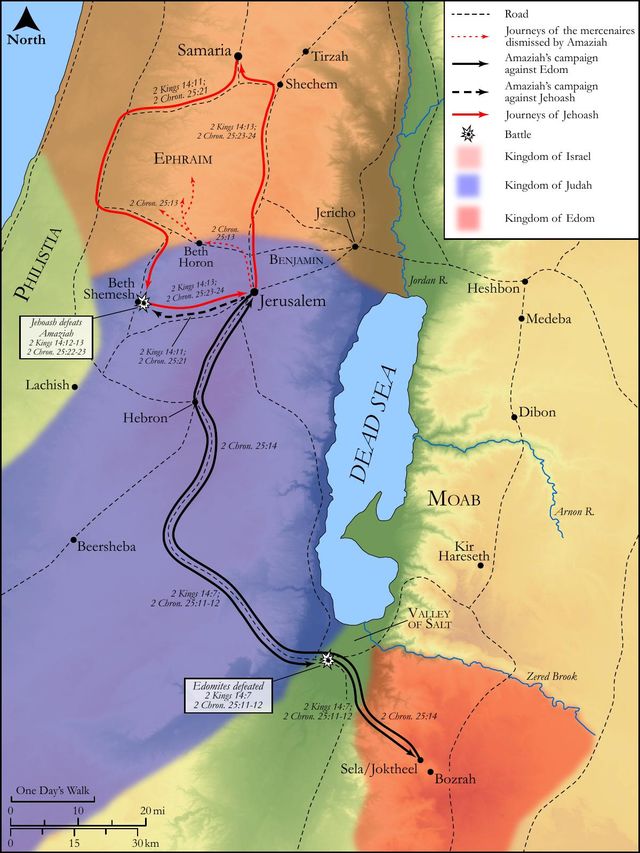
See on the biblical-era map
Study this verse
Public-domain commentary
Matthew Henry
From his Commentary on the Whole Bible. Henry comments on passages, not single verses — this entry covers 2 Chronicles 25:1–13. His three-level outline is real structure in the source text, so it is rendered as structure.
Here is, I. The general character of Amaziah: He did that which was right in the eyes of the Lord, worshipped the true God, kept the temple service a going, and countenanced religion in his kingdom; but he did not do it with a perfect heart (Ch2 25:2), that is, he was not a man of serious piety or devotion himself, nor had he any zeal for the exercises of religion. He was no enemy to it, but a cool and indifferent friend. Such is the character of too many in this Laodicean age: they do that which is good, but not with the heart, not with a perfect heart.
II.A necessary piece of justice which he did upon the traitors that murdered his father:
he put them to death, Ch2 25:3. Though we should suppose they intended to avenge on their king the death of the prophet (as was intimated, Ch2 24:25), yet this would by no means justify their wickedness; for they were not the avengers, but presumptuously took God's work out of his hands: and therefore Amaziah did what became him in calling them to an account for it, but forbade the putting of the children to death for the parents' sin, Ch2 25:4.
III.An expedition of his against the Edomites, who, some time ago, had revolted from under the dominion of Judah, to which he attempted to reduce them. Observe,
1.The great preparation he made for this expedition.
(1.)He mustered his own forces, and marshalled them (Ch2 25:5), and found Judah and Benjamin in all but 300,000 men that were fit for war, whereas, in Jehoshaphat's time, fifty or sixty years before, they were four times as many. Sin weakens a people, diminishes them, dispirits them, and lessens their number and figure.
(2.)He hired auxiliary troops out of the kingdom of Israel, Ch2 25:6. Finding his own kingdom defective in men, he thought to make up the deficiency with his money, and therefore took into his pay 100,000 Israelites. If he had advised with any of his prophets before he did this, or had but considered how little any of his ancestors got by their alliances with Israel, he would not have had this to undo again. But rashness makes work for repentance.
2.The command which God sent him by a prophet to dismiss out of his service the forces of Israel, Ch2 25:7, Ch2 25:8. He would not have him call in any assistance at all: it looked like distrust of God. If he made sure of God's presence, the army he had of his own was sufficient. But particularly he must not take in their assistance: For the Lord is not with the children of Ephraim, because they are not with him, but worship the calves. This was a good reason why he should not make use of them, because he could not depend upon them to do him any service. What good could be expected from those that had not God with them, nor his blessings upon their undertakings? It is comfortable to employ those who, we have reason to hope, have an interest in heaven, and dangerous to associate with those from whom the Lord has departed. The prophet assured him that if he persisted in his resolution to take these idolatrous apostate Israelites with him, in hopes thereby to make himself strong for the battle, it was at his peril; they would prove a dead weight to his army, would sink and betray it: "God shall make thee fall before the enemy, and these Israelites will be the ruin of thy cause; for God has power to help thee without them, and to cast thee down though thou hast them with thee."
3.The objection which Amaziah made against this command, and the satisfactory answer which the prophet gave to that objection, Ch2 25:9. The king had remitted 100 talents to the men of Israel for advance-money. "Now," says he, "if I send them back, I shall lose that: But what shall we do for the 100 talents?" This is an objection men often make against their duty: they are afraid of losing by it. "Regard not that," says the prophet: "The Lord is able to give thee much more than this; and, thou mayest depend upon it, he will not see thee lose by him. What are 100 talents between thee and him? He has ways enough to make up the loss to thee; it is below thee to speak of it." Note, A firm belief of God's all-sufficiency to bear us out in our duty, and to make up all the loss and damage we sustain in his service abundantly to our advantage, will make his yoke very easy and his burden very light. What is it to trust in God, but to be willing to venture the loss of any thing for him, in confidence of the goodness of the security he gives us that we shall not lose by him, but that whatever we part with for his sake shall be made up to us in kind or kindness. When we grudge to part with any thing for God and our religion, this should satisfy us, that God is able to give us much more than this. He is just, and he is good, and he is solvent. The king lost 100 talents by his obedience; and we find just that sum given to his grandson Jotham as a present (Ch2 27:5); then the principal was repaid, and, for interest, 10,000 measures of wheat and as many of barley.
4.His obedience to the command of God, which is upon record to his honour. He would rather lose his money, disoblige his allies, and dismiss a fourth part of his army just as they were going to take the field, than offend God: He separated the army of Ephraim, to go home again, Ch2 25:10. And they went home in great anger, taking it as a great affront thus to be made fools of, and to be cashiered as men not fit to be employed, and being perhaps disappointed of the advantages they promised themselves in spoil and plunder by joining with Judah against Edom. Men are apt to resent that which touches them in their profit or reputation, though it frees them from trouble.
5.His triumphs over the Edomites, Ch2 25:11, Ch2 25:12. He left dead upon the spot, in the field of battle, 10,000 men; 10,000 more he took prisoners, and barbarously killed them all by throwing them down some steep and craggy precipice. What provocation he had to exercise this cruelty towards them we are not told; but it was certainly very severe.
6.The mischief which the disbanded soldiers of Israel did to the cities of Judah, either in their return or soon after, Ch2 25:13. They were so enraged at being sent home that, if they might not go to share with Judah in the spoil of Edom, they would make a prey of Judah. Several cities that lay upon the borders they plundered, killing 3000 men that made resistance. But why should God suffer this to be done? Was it not in obedience to him that they were sent home, and yet shall the country thus suffer by it? Surely God's way is in the sea! Did not the prophet say that God was not with the children of Ephraim, and yet they are suffered to prevail against Judah? Doubtless God intended hereby to chastise those cities of Judah for their idolatries, which were found most in those parts that lay next to Israel. The men of Israel had corrupted them, and now they were made a plague to them. Satan both tempts and torments.
Continue studying 2 Chronicles 25:11 across the web’s major study libraries — every link below opens this exact verse, chapter, or book on the destination site.
Read & Compare
 BibleGatewayThis verse in more than 200 translations and 70 languages.
 Bible.comThe YouVersion reader — hundreds of translations, reading plans, and highlights.
 ESV.orgCrossway's official English Standard Version reader.
 NET BibleThe NET translation with 60,000+ translators' notes on every rendering decision.
 STEP BibleTyndale House's free study tool — original text, vocabulary, and scholarly resources.
 BibliaLogos Bible Software's free web reader.
 USCCBThe New American Bible (Revised Edition) with the U.S. bishops' study notes.
Commentaries
 BibleHub CommentariesDozens of classic commentaries on this verse, gathered on one page.
 StudyLightMore than 100 commentary sets — the largest collection on the web.
 BibleRefPlain-English commentary on what this verse means, verse by verse.
 Enduring WordDavid Guzik's free commentary on this chapter, widely used by Bible teachers.
 Bible Study ToolsVerse commentary alongside Greek and Hebrew study aids.
Original Language & Research
- BibleHub InterlinearThe verse word by word — original language, transliteration, and English.
- BibleHub LexiconEvery word's original-language definition and Strong's entry.
 Blue Letter BibleDeep-study tools — Strong's numbers, concordance, and word studies.
 SefariaThe Hebrew text with Rashi and centuries of Jewish commentary.
Sermons, Hymns & Audio


TrulyRandomVerse is not affiliated with these sites and doesn’t control their content. They’re linked because they’re genuinely useful.
Summary
2 Chronicles 25:11 records King Amaziah of Judah's decisive military triumph over the Edomites in the Valley of Salt, where he achieved a significant victory, slaying ten thousand of the children of Seir. This pivotal moment in Amaziah's reign is presented as a direct and immediate divine blessing, a tangible vindication of his prior act of costly obedience to God, when he chose to dismiss a large mercenary force at the prophet's command, demonstrating a profound reliance on the Lord's strength rather than human alliances or perceived military might. The verse thus encapsulates the immediate and powerful consequences of faithful submission to God's will.
Context
ShowHideLiterary Context
This verse is strategically placed within the narrative of King Amaziah's reign, which commences in 2 Chronicles 25:1. Its significance is profoundly shaped by the preceding verses, particularly 2 Chronicles 25:7-10. Amaziah, preparing for war against Edom, had initially hired 100,000 Israelite mercenaries. However, a "man of God" interceded, delivering a divine warning that the Lord was not with Israel and commanded Amaziah to dismiss the hired troops, emphasizing that God alone possessed the power to grant victory or inflict defeat. Despite the substantial financial loss of 100 talents of silver, Amaziah chose to obey this costly command. Therefore, 2 Chronicles 25:11 serves as the immediate and direct outcome of this act of faith, showcasing God's swift and powerful vindication of Amaziah's trust. The subsequent narrative, beginning with 2 Chronicles 25:14, reveals Amaziah's tragic turn to idolatry and the subsequent divine judgment, providing a stark and poignant contrast to the divine favor highlighted in this verse.
Historical & Cultural Context
King Amaziah ruled over the Southern Kingdom of Judah from approximately 796-767 BC. The "children of Seir" are the Edomites, direct descendants of Esau, who were long-standing adversaries of Israel and Judah, frequently depicted in biblical literature as a symbol of hostility against God's covenant people (e.g., Psalm 137:7). The "Valley of Salt" (Hebrew: Ge Hamelech) is widely identified with the desolate region at the southern tip of the Dead Sea, a barren and inhospitable landscape that often served as a battleground and a symbolic place of judgment. This victory was not merely a territorial or strategic gain; it represented a significant reassertion of Judahite power over a persistent rival, reflecting the long rivalry between Judah and Edom. While the practice of hiring mercenaries was common during this period, the prophet's intervention underscores a profound theological principle: reliance on foreign alliances or human strength, especially those misaligned with God's will, can actively hinder divine blessing and demonstrate a lack of faith in God's sovereign power.
Key Themes
ShowHide2 Chronicles 25:11 powerfully encapsulates several core themes prominent throughout the Book of 2 Chronicles. Firstly, it vividly illustrates the theme of Divine Enablement Through Obedience. Amaziah's overwhelming success is explicitly presented not as a result of his initial military preparations or the size of his army, but as a direct consequence of his willingness to obey God's costly and counter-intuitive command to dismiss the mercenaries. This highlights God's sovereign ability to grant victory irrespective of human resources, a recurring motif in the Chronicler's theology (e.g., 2 Chronicles 14:11). Secondly, the verse touches upon Military Strength and Preparedness, as "Amaziah strengthened himself," indicating human effort and resolve. However, this human agency is firmly situated within the overarching framework of divine sovereignty, demonstrating that human effort is necessary but ultimately insufficient without God's blessing and direction. Finally, the decisive victory over the "children of Seir" underscores the theme of Victory Over Traditional Foes, symbolizing God's unwavering faithfulness to His covenant people by subduing their enemies when they walk in faithful obedience.
Exposition and Analysis
ShowHideKey Word Analysis
ShowHideFrom the root meaning "strength" and "Yah" (a shortened form of Yahweh), this name literally means "strength of Yah" or "Yahweh has strengthened." This etymology adds a profound layer of meaning to the verse, as Amaziah's personal strength and military success are directly tied to the very source of his name – the Lord God. The narrative of 2 Chronicles 25 demonstrates that when Amaziah relied on God (his namesake's meaning), he found strength and victory, but when he turned away, his strength failed.
This primitive root signifies "to fasten upon; hence, to seize, be strong (figuratively, courageous, causatively strengthen, cure, help, repair, fortify), obstinate." In this context, it describes Amaziah's diligent and intentional preparation, his resolve, and the personal effort he exerted in gathering and organizing his forces for battle. While it points to human agency and responsibility, the broader theological message of the Chronicler emphasizes that this human strengthening is only truly effective and leads to divine blessing when it is aligned with God's will and empowered by His presence. It implies a resolute determination that, in this instance, was divinely sanctioned.
This primitive root means "to strike (lightly or severely, literally or figuratively); beat, kill, make (slaughter), slay." It is a common and potent term for military defeat, emphasizing the decisive, violent, and destructive nature of Amaziah's victory. The use of this verb, coupled with the numerical specificity of "ten thousand," underscores the magnitude and completeness of the defeat inflicted upon the Edomites, signifying an overwhelming and crushing triumph.
This phrase, combining "son" (H1121, bên, referring to descendants) and "Seir" (H8165, Sêʻîyr, referring to the mountainous region and its inhabitants), is the common biblical designation for the Edomites, the descendants of Esau. Their territory was Mount Seir, a rugged, rough region south and east of the Dead Sea. Their consistent portrayal as a long-standing antagonistic nation to Israel and Judah throughout biblical history makes this victory particularly significant, representing a triumph over a deeply entrenched and symbolic enemy.
Verse Breakdown
ShowHide"And Amaziah strengthened himself,"
This opening clause highlights Amaziah's proactive and intentional resolve and preparation for military action. It indicates that he did not passively await events but actively mustered his inner resolve and external resources, demonstrating leadership and determination. This human effort, however, is presented as effective precisely because it followed his prior act of costly obedience to God.
"and led forth his people,"
This signifies the mobilization of the Judahite army under Amaziah's direct command. It underscores his role as a military commander, bringing his nation's forces into direct confrontation with the Edomites. Crucially, "his people" here refers specifically to the Judahite soldiers who remained after the dismissal of the Israelite mercenaries, emphasizing that the victory was achieved by God's people, not by hired foreign strength.
"and went to the valley of salt,"
This clause specifies the geographical location of the decisive battle. The Valley of Salt, situated near the Dead Sea, was a known site for significant ancient conflicts. Its desolate and barren nature might also subtly emphasize the severity of the judgment and destruction that was about to befall the Edomites, a fitting backdrop for a divinely granted victory.
"and smote of the children of Seir ten thousand."
This is the climactic outcome of the military campaign. The verb "smote" conveys a decisive and crushing defeat. The specific number "ten thousand" emphasizes the overwhelming scale of the victory, underscoring the effectiveness of the Judahite army, which, though numerically smaller than it could have been with mercenaries, was now operating solely under divine enablement and blessing.
Literary Devices
ShowHideThe verse employs several potent literary devices to convey its profound message. Narrative Progression is clearly evident, as the verse unfolds sequentially from Amaziah's personal resolve ("strengthened himself") to his leading his army, to the specific geographical setting of the battle, and finally to the dramatic and decisive outcome. This clear, linear progression underscores the direct cause-and-effect relationship between Amaziah's obedience and the ensuing victory. There is also a strong underlying element of Divine Causality, where although Amaziah is the active human agent, the preceding narrative context meticulously establishes that the true power behind this overwhelming victory is God's. The human effort ("strengthened himself") is portrayed as effective precisely because it is consecrated by and in alignment with divine will. The specific number "ten thousand" functions as Hyperbole or Symbolism, signifying a complete and overwhelming victory rather than necessarily a precise literal count, emphasizing the totality of the Edomite defeat. Finally, the mention of the "Valley of Salt" serves not only as Setting but also carries Symbolic Weight, often associated with barrenness, desolation, and divine judgment in biblical thought, making it a fitting location for the destruction of God's enemies.
Theological and Thematic Connections
ShowHideThis verse powerfully illustrates the enduring biblical principle that true strength, lasting victory, and authentic security do not originate from human might, numerical superiority, or strategic alliances, but flow directly from costly obedience to God and unwavering reliance on His omnipotent power. Amaziah's profound decision to dismiss 100,000 mercenaries, choosing to trust God's word over conventional military wisdom and significant financial loss, directly precipitated this overwhelming and divinely granted victory. It stands as a profound testament to God's ability to work through seemingly inadequate means when His people are faithful, demonstrating unequivocally that His presence and blessing are infinitely more potent than any human army or resource. This narrative serves as a foundational theological anchor, reminding believers across generations that God honors faith and that His resources are boundless for those who walk in His ways, prioritizing His will above all else.
Reflection and Application
ShowHideThe account of Amaziah's victory in 2 Chronicles 25:11 offers profound and enduring lessons for contemporary believers, challenging us to critically examine the true source of our trust for success, security, and peace. Like Amaziah, we frequently encounter situations where God's instructions or the path of faith appear counter-intuitive, financially costly, or socially disadvantageous, demanding that we relinquish what seems to be a reliable source of strength, advantage, or comfort. Whether it involves surrendering a worldly ambition for a divine calling, extending forgiveness where retaliation seems justified, or stepping out in faith when human resources appear woefully insufficient, the consistent call of this narrative is to prioritize radical obedience to God above all else. This verse powerfully reminds us that our "strengthening ourselves"—our diligent efforts, strategic preparations, and personal resolve—are most effective, truly powerful, and ultimately blessed when they are fully submitted to God's sovereign will and empowered by His Holy Spirit. True victory, whether in the spiritual battles of our souls, the personal struggles of daily life, or the vocational endeavors we pursue, is ultimately a result of divine enablement that flows from a heart wholly committed to faithful obedience.
Questions for Reflection
ShowHideFAQ
ShowHideWhat is the significance of the "Valley of Salt" in this battle?
ShowHideThe "Valley of Salt" (Hebrew: Ge Hamelech) is generally identified with the region at the southern end of the Dead Sea, a notoriously desolate and barren area. Its significance in this battle is multi-layered. Historically, it was a known site for military engagements, including previous victories over Edom (e.g., 2 Samuel 8:13). Symbolically, its barrenness and association with salt (a symbol of desolation and judgment in biblical literature) make it a fitting location for a decisive and destructive defeat of God's enemies. For Amaziah's victory, it underscores the completeness and finality of the Edomite defeat in a place that could vividly symbolize their utter ruin and the judgment of God upon them.
Who were the "children of Seir," and why was this victory important?
ShowHideThe "children of Seir" were the Edomites, the descendants of Esau, Jacob's brother. Their primary territory was the mountainous region of Mount Seir, located south and east of the Dead Sea. Historically, the Edomites were often portrayed as persistent adversaries of Israel and Judah, representing a long-standing tension and rivalry between the descendants of the twin brothers (Jacob and Esau). This victory was profoundly important for several reasons: it reasserted Judah's dominance and security over a traditional and formidable foe, helping to secure its southern borders. More significantly, within the Chronicler's theological framework, this triumph served as a powerful demonstration of God's unwavering faithfulness to His covenant people. It vividly illustrated that when Judah walked in faithful obedience, God would actively fight for them and grant them overwhelming victory over their enemies, even against a deeply entrenched and historically antagonistic rival.
Christ-Centered Fulfillment
ShowHideThe victory of Amaziah in the Valley of Salt, achieved through an act of costly obedience and profound divine enablement, serves as a compelling foreshadowing of the ultimate, decisive, and eternally significant triumph accomplished by Jesus Christ. Amaziah "strengthened himself" and led his people, but his strength and subsequent success were entirely contingent upon God's prior intervention and blessing, demonstrating the principle that human effort is effective only when divinely empowered. Similarly, humanity's desperate efforts to overcome the pervasive power of sin, death, and spiritual darkness are utterly futile without divine intervention. Christ, however, is the true and ultimate King who, in perfect and costly obedience to His Father (a profound obedience culminating in His sacrificial death on the cross, as beautifully articulated in Philippians 2:8), "strengthened Himself" not in human military might, but in divine resolve to confront and conquer the ultimate enemy. He led His people, not into a physical battle in a "valley of salt," but into a spiritual triumph over the forces of darkness, sin, and death in the "valley of the shadow of death" (a concept echoed in Psalm 23:4). His unparalleled victory on the cross, where He decisively "smote" the power of sin and death, disarming principalities and powers (as triumphantly declared in Colossians 2:15), was not achieved through human armies or hired mercenaries, but through His own perfect, self-sacrificial act. This demonstrates, unequivocally, that true strength, ultimate salvation, and eternal victory come solely from God, through Christ. Believers, united with Christ by faith, now participate in His triumph, being strengthened by His indwelling Spirit to overcome spiritual adversaries, just as Amaziah's army was supernaturally empowered for their physical victory.