


2 Chronicles 25:10
- וַיַּבְדִּילֵםvai·yav·di·Lemand he separated themH914Conj-w ¦ V-Hiphil-ConsecImperf-3ms ¦ 3mpVerb Hiphil Consecutive Imperfect 3rd Singular Masculineוַandיַּבְדִּילֵhe separatedםthem
- אֲמַצְיָהוּ'a·matz·Ya·huAmaziahH558N-proper-mNoun Proper Masculine
- לְהַגְּדוּדle·ha·ge·Dud<to> the troop[s]H1416Prep-l ¦ Art ¦ N-msNoun Singular Masculine Absoluteלְ<to>הַtheגְּדוּדtroop[s]
- אֲשֶׁר'a·SherwhichH834RelParticle Relative
- בָּאba'it had comeH935V-Qal-Perf-3msVerb Qal Perfect 3rd Singular Masculine
- אֵלָיו'e·Lavto himH413Prep ¦ 3msPrepositionאֵלָיtoוhim
- מֵאֶפְרַיִםme·'ef·Ra·yimfrom EphraimH669Prep-m ¦ N-proper-mNoun Proper MasculineמֵfromאֶפְרַיִםEphraim
- לָלֶכֶתla·Le·khetto goH1980Prep-l ¦ V-Qal-InfVerb Qal Infinitive Constructלָtoלֶכֶתgo
- לִמְקוֹמָםlim·ko·Mamto their placeH4725Prep-l ¦ N-msc ¦ 3mpNoun Singular Masculine Constructלִtoמְקוֹמָplaceםtheir
- וַיִּחַרvai·Yi·charand it burnedH2734Conj-w ¦ V-Qal-ConsecImperf-3msVerb Qal Consecutive Imperfect 3rd Singular Masculineוַandיִּחַרit burned
- אַפָּם'a·Pamtheir angerH639N-msc ¦ 3mpNoun Singular Masculine Constructאַפָּangerםtheir
- מְאֹדme·'OdexceedinglyH3966Adj-msAdjective Numerical Singular Masculine Absolute
- בִּיהוּדָהbi·hu·Dahon JudahH3063Prep-b ¦ N-properNoun Proper LocationבִּonיהוּדָהJudah
- וַיָּשׁוּבוּvai·ya·Shu·vuand they returnedH7725Conj-w ¦ V-Qal-ConsecImperf-3mpVerb Qal Consecutive Imperfect 3rd Plural Masculineוַandיָּשׁוּבוּthey returned
- לִמְקוֹמָםlim·ko·Mamto their placeH4725Prep-l ¦ N-msc ¦ 3mpNoun Singular Masculine Constructלִtoמְקוֹמָplaceםtheir
- בָּחֳרִיbo·cho·riin [the] heat ofH2750Prep-b ¦ N-mscNoun Singular Masculine Constructבָּinחֳרִי[the] heat of
- אָף'AfangerH639N-msNoun Singular Masculine Absolute
English is a literal word-by-word gloss of the Hebrew, not the KJV's wording. Why?
This is the original text the KJV's translators worked from — each Hebrew word with its own literal English meaning in this verse, prepared by scholars at Tyndale House, Cambridge. The KJV translates whole sentences, not word by word, so its wording differs: one Hebrew word can become several English words, and the KJV may choose “the LORD” where the gloss reads “Yahweh”. Both are faithful — they answer different questions. For the KJV's own rendering, switch to the KJV text.
Details
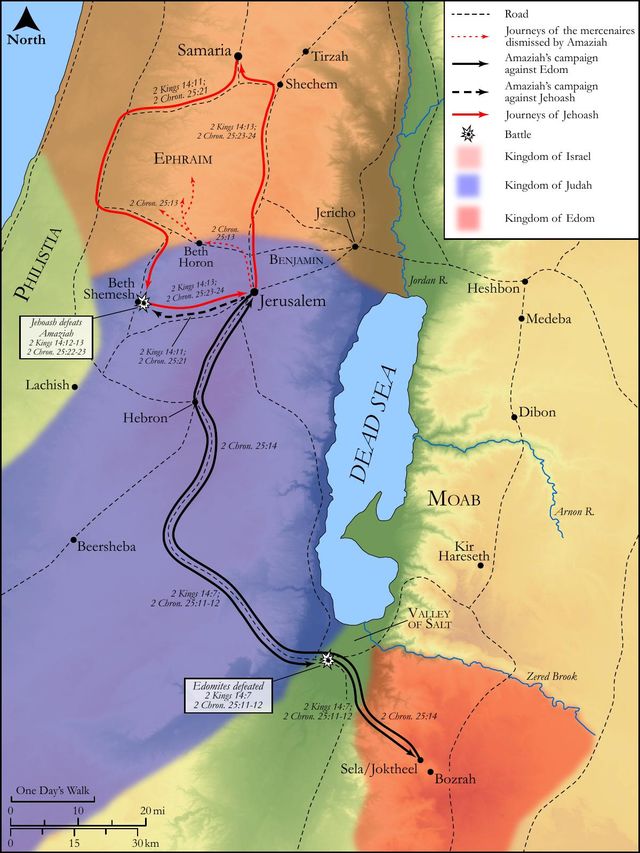
See on the biblical-era map
Study this verse
Public-domain commentary
Matthew Henry
From his Commentary on the Whole Bible. Henry comments on passages, not single verses — this entry covers 2 Chronicles 25:1–13. His three-level outline is real structure in the source text, so it is rendered as structure.
Here is, I. The general character of Amaziah: He did that which was right in the eyes of the Lord, worshipped the true God, kept the temple service a going, and countenanced religion in his kingdom; but he did not do it with a perfect heart (Ch2 25:2), that is, he was not a man of serious piety or devotion himself, nor had he any zeal for the exercises of religion. He was no enemy to it, but a cool and indifferent friend. Such is the character of too many in this Laodicean age: they do that which is good, but not with the heart, not with a perfect heart.
II.A necessary piece of justice which he did upon the traitors that murdered his father:
he put them to death, Ch2 25:3. Though we should suppose they intended to avenge on their king the death of the prophet (as was intimated, Ch2 24:25), yet this would by no means justify their wickedness; for they were not the avengers, but presumptuously took God's work out of his hands: and therefore Amaziah did what became him in calling them to an account for it, but forbade the putting of the children to death for the parents' sin, Ch2 25:4.
III.An expedition of his against the Edomites, who, some time ago, had revolted from under the dominion of Judah, to which he attempted to reduce them. Observe,
1.The great preparation he made for this expedition.
(1.)He mustered his own forces, and marshalled them (Ch2 25:5), and found Judah and Benjamin in all but 300,000 men that were fit for war, whereas, in Jehoshaphat's time, fifty or sixty years before, they were four times as many. Sin weakens a people, diminishes them, dispirits them, and lessens their number and figure.
(2.)He hired auxiliary troops out of the kingdom of Israel, Ch2 25:6. Finding his own kingdom defective in men, he thought to make up the deficiency with his money, and therefore took into his pay 100,000 Israelites. If he had advised with any of his prophets before he did this, or had but considered how little any of his ancestors got by their alliances with Israel, he would not have had this to undo again. But rashness makes work for repentance.
2.The command which God sent him by a prophet to dismiss out of his service the forces of Israel, Ch2 25:7, Ch2 25:8. He would not have him call in any assistance at all: it looked like distrust of God. If he made sure of God's presence, the army he had of his own was sufficient. But particularly he must not take in their assistance: For the Lord is not with the children of Ephraim, because they are not with him, but worship the calves. This was a good reason why he should not make use of them, because he could not depend upon them to do him any service. What good could be expected from those that had not God with them, nor his blessings upon their undertakings? It is comfortable to employ those who, we have reason to hope, have an interest in heaven, and dangerous to associate with those from whom the Lord has departed. The prophet assured him that if he persisted in his resolution to take these idolatrous apostate Israelites with him, in hopes thereby to make himself strong for the battle, it was at his peril; they would prove a dead weight to his army, would sink and betray it: "God shall make thee fall before the enemy, and these Israelites will be the ruin of thy cause; for God has power to help thee without them, and to cast thee down though thou hast them with thee."
3.The objection which Amaziah made against this command, and the satisfactory answer which the prophet gave to that objection, Ch2 25:9. The king had remitted 100 talents to the men of Israel for advance-money. "Now," says he, "if I send them back, I shall lose that: But what shall we do for the 100 talents?" This is an objection men often make against their duty: they are afraid of losing by it. "Regard not that," says the prophet: "The Lord is able to give thee much more than this; and, thou mayest depend upon it, he will not see thee lose by him. What are 100 talents between thee and him? He has ways enough to make up the loss to thee; it is below thee to speak of it." Note, A firm belief of God's all-sufficiency to bear us out in our duty, and to make up all the loss and damage we sustain in his service abundantly to our advantage, will make his yoke very easy and his burden very light. What is it to trust in God, but to be willing to venture the loss of any thing for him, in confidence of the goodness of the security he gives us that we shall not lose by him, but that whatever we part with for his sake shall be made up to us in kind or kindness. When we grudge to part with any thing for God and our religion, this should satisfy us, that God is able to give us much more than this. He is just, and he is good, and he is solvent. The king lost 100 talents by his obedience; and we find just that sum given to his grandson Jotham as a present (Ch2 27:5); then the principal was repaid, and, for interest, 10,000 measures of wheat and as many of barley.
4.His obedience to the command of God, which is upon record to his honour. He would rather lose his money, disoblige his allies, and dismiss a fourth part of his army just as they were going to take the field, than offend God: He separated the army of Ephraim, to go home again, Ch2 25:10. And they went home in great anger, taking it as a great affront thus to be made fools of, and to be cashiered as men not fit to be employed, and being perhaps disappointed of the advantages they promised themselves in spoil and plunder by joining with Judah against Edom. Men are apt to resent that which touches them in their profit or reputation, though it frees them from trouble.
5.His triumphs over the Edomites, Ch2 25:11, Ch2 25:12. He left dead upon the spot, in the field of battle, 10,000 men; 10,000 more he took prisoners, and barbarously killed them all by throwing them down some steep and craggy precipice. What provocation he had to exercise this cruelty towards them we are not told; but it was certainly very severe.
6.The mischief which the disbanded soldiers of Israel did to the cities of Judah, either in their return or soon after, Ch2 25:13. They were so enraged at being sent home that, if they might not go to share with Judah in the spoil of Edom, they would make a prey of Judah. Several cities that lay upon the borders they plundered, killing 3000 men that made resistance. But why should God suffer this to be done? Was it not in obedience to him that they were sent home, and yet shall the country thus suffer by it? Surely God's way is in the sea! Did not the prophet say that God was not with the children of Ephraim, and yet they are suffered to prevail against Judah? Doubtless God intended hereby to chastise those cities of Judah for their idolatries, which were found most in those parts that lay next to Israel. The men of Israel had corrupted them, and now they were made a plague to them. Satan both tempts and torments.
Continue studying 2 Chronicles 25:10 across the web’s major study libraries — every link below opens this exact verse, chapter, or book on the destination site.
Read & Compare
 BibleGatewayThis verse in more than 200 translations and 70 languages.
 Bible.comThe YouVersion reader — hundreds of translations, reading plans, and highlights.
 ESV.orgCrossway's official English Standard Version reader.
 NET BibleThe NET translation with 60,000+ translators' notes on every rendering decision.
 STEP BibleTyndale House's free study tool — original text, vocabulary, and scholarly resources.
 BibliaLogos Bible Software's free web reader.
 USCCBThe New American Bible (Revised Edition) with the U.S. bishops' study notes.
Commentaries
 BibleHub CommentariesDozens of classic commentaries on this verse, gathered on one page.
 StudyLightMore than 100 commentary sets — the largest collection on the web.
 BibleRefPlain-English commentary on what this verse means, verse by verse.
 Enduring WordDavid Guzik's free commentary on this chapter, widely used by Bible teachers.
 Bible Study ToolsVerse commentary alongside Greek and Hebrew study aids.
Original Language & Research
- BibleHub InterlinearThe verse word by word — original language, transliteration, and English.
- BibleHub LexiconEvery word's original-language definition and Strong's entry.
 Blue Letter BibleDeep-study tools — Strong's numbers, concordance, and word studies.
 SefariaThe Hebrew text with Rashi and centuries of Jewish commentary.
Sermons, Hymns & Audio


TrulyRandomVerse is not affiliated with these sites and doesn’t control their content. They’re linked because they’re genuinely useful.
Summary
2 Chronicles 25:10 vividly details the immediate and intense repercussions of King Amaziah's obedient decision to dismiss the Israelite mercenary troops he had hired. Despite the significant financial investment and the potential military advantage these forces offered, Amaziah's act of faith, in compliance with a divine command, ignited a profound and volatile anger among the Ephraimite soldiers. This verse powerfully illustrates the often-unforeseen human reactions and the immediate costs that can accompany acts of obedience to God, setting the stage for subsequent conflict and highlighting the spiritual chasm between Judah and Israel.
Context
ShowHideLiterary Context
This verse is strategically placed within the narrative of King Amaziah's reign, specifically during his preparations for a crucial war against the Edomites. The preceding verses establish the context: 2 Chronicles 25:5-6 describes Amaziah's initial muster of Judahite forces and his subsequent decision to hire 100,000 Israelite mercenaries for a substantial sum. A "man of God" then intervenes in 2 Chronicles 25:7-8, delivering a stark warning that God is not with Israel and that relying on them would inevitably lead to defeat. Amaziah's remarkable act of obedience, despite the immense financial loss of 100 talents of silver, is recorded in 2 Chronicles 25:9. Verse 10 immediately follows this pivotal moment, detailing the furious response of the dismissed troops, which directly foreshadows their destructive raid on Judahite cities, as recounted in 2 Chronicles 25:13. The narrative sequence thus emphasizes the direct cause-and-effect relationship between Amaziah's faith-filled obedience and the mercenaries' vengeful wrath.
Historical & Cultural Context
King Amaziah ruled the southern kingdom of Judah from approximately 800-783 BC. This period was characterized by a distinct spiritual and political divide between Judah, which sought to maintain the Davidic covenant and the worship centered at the Jerusalem Temple, and the northern kingdom of Israel (of which Ephraim was a dominant tribe), which had largely succumbed to idolatry and political instability since the schism. The hiring of mercenary forces was a common military practice in the ancient Near East, reflecting a pragmatic approach to warfare. However, forming alliances with a spiritually compromised neighboring kingdom like Israel was often viewed as a theological compromise for Judah. The "100 talents of silver" was an astronomical sum, equivalent to roughly 3.75 tons of silver, representing a significant portion of the royal treasury and a substantial investment for Amaziah. The intense anger of the Ephraimite soldiers stemmed from multiple factors: the profound humiliation of being dismissed without fighting, the loss of anticipated plunder and spoils from the Edomite campaign, and the perceived insult of being sent home empty-handed after having committed themselves to the war. This dismissal was not just a financial slight but a grave affront to their honor and professional identity as warriors.
Key Themes
ShowHideThis verse significantly contributes to several overarching themes prevalent throughout 2 Chronicles. Firstly, it powerfully illustrates the Cost of Obedience to God. Amaziah's decision, though divinely commanded and spiritually sound, incurs immediate human opposition, financial loss, and future conflict, demonstrating that faithfulness is not always convenient or without earthly repercussions. Secondly, it underscores the critical theme of Divine Reliance vs. Human Strength. God's instruction to dismiss the Israelite troops highlights His desire for Judah to depend solely on Him for victory, rather than on ungodly alliances or superior numbers, a principle consistently emphasized in the historical books (e.g., 1 Samuel 17:47). Thirdly, the "great anger" of the Ephraimites introduces the theme of Consequences of Disobedience/Rejection of God's Will, as their fury would soon manifest in destructive raids against Judah. This serves as a bitter fruit of their mercenary spirit and the broader spiritual and political chasm between the two kingdoms, subtly touching on the theme of Separation, where God calls His people to be distinct from those who do not walk in His ways.
Exposition and Analysis
ShowHideKey Word Analysis
ShowHideFrom the root H914, meaning "to divide (in variation senses literally or figuratively, separate, distinguish, differ, select, etc.); (make, put) difference, divide (asunder), (make) separate (self, -ation), sever (out), [idiom] utterly." In this context, it signifies Amaziah's decisive and physical act of dividing his forces by sending the Israelite contingent away. This separation was not merely logistical but a direct act of obedience to God's command to disassociate from those with whom God was not, carrying a theological weight of distinction.
From the root H639, meaning "the nose or nostril; hence, the face, and occasionally a person; also (from the rapid breathing in passion) ire; anger(-gry), [phrase] before, countenance, face, [phrase] forebearing, forehead, [phrase] (long-) suffering, nose, nostril, snout, [idiom] worthy, wrath." This term, literally referring to the nose or nostril (which flares in anger), is a powerful idiom for intense wrath or fury. It denotes a visceral, passionate indignation that goes beyond mere displeasure, indicating a readiness for violent reaction.
From the root H2734, meaning "to glow or grow warm; figuratively (usually) to blaze up, of anger, zeal, jealousy; be angry, burn, be displeased, [idiom] earnestly, fret self, grieve, be (wax) hot, be incensed, kindle, [idiom] very, be wroth." This verb describes the active process of anger flaring up, intensifying, and becoming a burning, consuming force. When combined with ʼaph ("anger"), it creates the vivid imagery of a profound, internal combustion of rage that is about to erupt.
Verse Breakdown
ShowHide"Then Amaziah separated them"
This opening clause immediately establishes King Amaziah's swift and decisive action. "Them" refers specifically to the 100,000 Israelite mercenary troops he had previously hired. This act of separation was a direct and costly fulfillment of the prophet's warning and God's command in 2 Chronicles 25:7-8, demonstrating his obedience to divine instruction over worldly military advantage or financial considerations.
"[to wit], the army that was come to him out of Ephraim, to go home again"
This parenthetical clarification precisely identifies the dismissed group as the northern kingdom's contingent, specifically from Ephraim, emphasizing the spiritual and political divide between the two kingdoms. Being sent "home again" signifies a humiliating and unrewarding dismissal, as they had traveled a considerable distance to participate in battle and expected plunder and glory, not ignominious expulsion.
"wherefore their anger was greatly kindled against Judah"
This clause reveals the direct and intense emotional consequence of Amaziah's action. The dismissal, coupled with the loss of anticipated battle spoils and the perceived insult to their honor, ignited a deep-seated and fierce rage within the mercenaries. Their anger was not merely directed at Amaziah personally but "against Judah" as a whole, indicating a broader resentment that transcended the immediate transaction and foreshadowed inter-kingdom conflict.
"and they returned home in great anger"
This concluding clause reiterates and reinforces the severity and intensity of the mercenaries' emotional state. The repetition and emphasis on "great anger" (using H2750 chŏrîy for "great" and H639 ʼaph for "anger") underscore the profound and consuming nature of their fury, leaving no doubt that this resentment would manifest in destructive actions against Judah, as indeed it did shortly thereafter.
Literary Devices
ShowHideThe verse effectively employs Foreshadowing, as the intense "great anger" of the Ephraimite soldiers is not merely an emotional outburst but a clear harbinger of future conflict and destructive actions. This profound rage directly precipitates the violent raids on Judahite cities described later in 2 Chronicles 25:13, demonstrating that the consequences of this dismissal were far from benign. The phrase "anger was greatly kindled" is a powerful Idiom (Hebrew: charah aph), literally meaning "the nose burned," which vividly conveys a deep, visceral, and uncontrollable rage, making the emotional state of the mercenaries palpable to the reader. There is also a subtle but significant Contrast between Amaziah's obedient, faith-filled action—a costly decision made in reliance on God—and the mercenaries' self-interested, vengeful reaction, highlighting the divergent motivations and spiritual alignments at play. The repetition of "great anger" (or "in great anger") at the end serves as an Emphasis, reinforcing the intensity and significance of their emotional state and its impending consequences.
Theological and Thematic Connections
ShowHide2 Chronicles 25:10 profoundly illustrates that obedience to God does not always lead to immediate peace, worldly advantage, or human approval; sometimes, it provokes opposition and unexpected costs. Amaziah's decision to trust God's promise over a large sum of money and a formidable army, while divinely affirmed, incited a fierce human reaction from those whose self-interest was thwarted. This narrative teaches that God's people are called to prioritize His will above all, even when it means facing the wrath of those who operate by worldly principles and whose values are antithetical to God's kingdom. The anger of the Ephraimite mercenaries serves as a stark reminder that ungodly alliances, even if seemingly pragmatic or militarily advantageous, can become a source of trouble and opposition when God calls for separation. True security and blessing come from sole reliance on the Lord, not from human strength, expedient partnerships, or the approval of man.
Reflection and Application
ShowHideThe narrative of 2 Chronicles 25:10 offers profound and enduring lessons for believers navigating a world that often operates contrary to God's principles. It challenges us to examine our own priorities and allegiances: are we willing to incur personal, financial, or social costs for the sake of unwavering obedience to God? Amaziah's choice, though immediately costly in terms of money and human relations, ultimately positioned him for divine favor in the battle against Edom (though his later disobedience would prove his ultimate downfall). This verse reminds us that doing what is right in God's eyes does not guarantee a smooth path with others. In fact, our commitment to righteousness, our refusal to compromise on divine principles, and our willingness to separate from ungodly influences can sometimes provoke anger, misunderstanding, or opposition from those who do not share our values or whose self-interest is threatened by our faithfulness. Therefore, we are called to cultivate a deep and abiding trust in God's provision and protection, knowing that His ways are infinitely higher than our ways and His wisdom transcends all human logic. We must discern carefully the alliances we form, the resources we rely upon, and the counsel we heed, ensuring they align with God's perfect will and not merely worldly expediency or convenience. Our ultimate security is found not in human strength or popular opinion, but in God alone.
Questions for Reflection
ShowHideFAQ
ShowHideWhy were the Ephraimite soldiers so angry about being dismissed?
ShowHideTheir anger was "greatly kindled" for several compelling reasons. Primarily, they had been hired for a substantial sum (100 talents of silver) and had traveled to participate in a military campaign, fully expecting to earn plunder, glory, and additional payment from the war against Edom. Being dismissed before the battle, after having committed their time, effort, and risking their lives, was a profound humiliation and a direct loss of anticipated financial gain and honor. Secondly, it was a significant insult to their professional pride and martial identity. They were described as "mighty men of valor" (2 Chronicles 25:6), and being sent home without fighting was a public shaming that deeply wounded their sense of worth and purpose. Their fury was not just disappointment but a deep-seated resentment against Judah for what they perceived as a breach of contract and an affront to their dignity.
What were the immediate consequences of this "great anger"?
ShowHideThe "great anger" of the Ephraimite soldiers was not merely an emotional outburst but led to direct, destructive action against Judah. As they returned home, filled with fury, they raided several Judahite cities that were undefended due to Amaziah's army being away fighting the Edomites. These cities included Beth-horon. During their rampage, they carried off a great deal of plunder, including sheep, oxen, and donkeys, and tragically killed 3,000 people (2 Chronicles 25:13). This act of vengeance was a significant blow to Judah, demonstrating the immediate and violent repercussions of their dismissal and highlighting the inherent danger of aligning with those who do not share a commitment to God's ways or who are driven by self-interest rather than divine principle.
Christ-Centered Fulfillment
ShowHideThe narrative of Amaziah's costly obedience and the ensuing wrath of the dismissed mercenaries finds profound Christ-centered fulfillment in the person and work of Jesus Christ. Amaziah's willingness to forgo worldly advantage and incur human opposition for the sake of God's command foreshadows Christ's perfect obedience, even unto the ultimate sacrifice. Jesus, the ultimate Lamb of God, willingly laid down His life, not for an earthly kingdom or temporary gain, but for the eternal redemption of humanity (John 10:18). His mission, though divinely ordained and perfectly executed, provoked intense "anger" and opposition from those who rejected His authority and message, culminating in His unjust crucifixion (John 19:15). Just as Amaziah separated from an ungodly alliance to rely solely on God, Christ calls His followers to separate from the world's values, systems, and ungodly alliances, and to rely wholly on Him for salvation and strength (2 Corinthians 6:17). The "cost of obedience" for Amaziah was human wrath and material loss; for Christ, it was the cross, which, though seemingly a defeat, was God's ultimate victory over sin, death, and the powers of darkness, leading to reconciliation and eternal life for all who believe (Colossians 2:14-15). Through Christ, we are empowered by the Holy Spirit to obey God, even when it means facing opposition or making costly decisions, knowing that our ultimate reward and security are found in Him alone (Matthew 5:10-12).