


2 Samuel 19:43
- וַיַּעַןvai·Ya·'anand he answeredH6030Conj-w ¦ V-Qal-ConsecImperf-3msVerb Qal Consecutive Imperfect 3rd Singular Masculineוַandיַּעַןhe answered
- אִישׁ'ish[the] man ofH376N-mscNoun Singular Masculine Construct
- יִשְׂרָאֵלYis·ra·'ElIsraelH3478N-properNoun Proper Location
- אֶת'et<obj.>H853DirObjMParticle Object Indicator
- אִישׁ'ish[the] man ofH376N-mscNoun Singular Masculine Construct
- יְהוּדָהye·hu·DahJudahH3063N-properNoun Proper Location
- וַיֹּאמֶרvai·Yo·merand he saidH559Conj-w ¦ V-Qal-ConsecImperf-3msVerb Qal Consecutive Imperfect 3rd Singular Masculineוַandיֹּאמֶרhe said
- עֶשֶׂר'e·sertenH6235N-mscNoun Singular Masculine Construct
- יָדוֹתya·DothandsH3027N-cpNoun Plural common gender Absolute
- לִיli[belong] to <the> mePrep-l ¦ 1csSuffix Personal 1st Singular common genderלִ[belong] to <the>יme
- בַמֶּלֶךְva·me·leKhin the kingH4428Prep-b ¦ N-msNoun Singular Masculine Absoluteבַin theמֶּלֶךְking
- וְגַםve·gamand alsoH1571Conj-w ¦ AdvAdverbוְandגַםalso
- בְּדָוִדbe·da·Vidin DavidH1732Prep-b ¦ N-proper-mNoun Proper MasculineבְּinדָוִדDavid
- אֲנִי'a·NiIH589Pro-1csPronoun Personal 1st Singular common gender
- מִמְּךָmi·me·Khamore than youH4480Prep ¦ 2msPreposition Definiteמִמְּmore thanךָyou
- וּמַדּוּעַu·ma·Du·a'and why?H4069Conj-w ¦ InterrogParticle Interrogativeוּandמַדּוּעַwhy?
- הֱקִלֹּתַנִיhe·ki·lo·Ta·nidid you treat with contempt meH7043V-Hiphil-Perf-2ms ¦ 1csVerb Hiphil Perfect 2nd Singular Masculineהֱקִלֹּתַdid you treat with contemptנִיme
- וְלֹאve·lo'and notH3808Conj-w ¦ NegParticle Negativeוְandלֹאnot
- הָיָהha·Yahwas itH1961V-Qal-Perf-3msVerb Qal Perfect 3rd Singular Masculine
- דְבָרִיde·va·Rimy wordH1697N-msc ¦ 1csNoun Singular Masculine Constructדְבָרִwordיmy
- רִאשׁוֹןri·ShonfirstH7223Adj-msAdjective Numerical Position Singular Masculine Absolute
- לִיliof mePrep-l ¦ 1csSuffix Personal 1st Singular common genderלִofיme
- לְהָשִׁיבle·ha·Shivto bring backH7725Prep-l ¦ V-Hiphil-InfVerb Hiphil Infinitive Constructלְtoהָשִׁיבbring back
- אֶת'et<obj.>H853DirObjMParticle Object Indicator
- מַלְכִּיmal·Kimy kingH4428N-msc ¦ 1csNoun Singular Masculine Constructמַלְכִּkingיmy
- וַיִּקֶשׁvai·Yi·keshand it was hardH7185Conj-w ¦ V-Qal-ConsecImperf-3msVerb Qal Consecutive Imperfect 3rd Singular Masculineוַandיִּקֶשׁit was hard
- דְּבַרde·var[the] word ofH1697N-mscNoun Singular Masculine Construct
- אִישׁ'ish[the] man ofH376N-mscNoun Singular Masculine Construct
- יְהוּדָהye·hu·DahJudahH3063N-properNoun Proper Location
- מִדְּבַרmi·de·Varmore than [the] word ofH1697Prep-m ¦ N-mscNoun Singular Masculine Constructמִmore thanדְּבַר[the] word of
- אִישׁ'ish[the] man ofH376N-mscNoun Singular Masculine Construct
- יִשְׂרָאֵלYis·ra·'ElIsraelH3478N-properNoun Proper Location
English is a literal word-by-word gloss of the Hebrew, not the KJV's wording. Why?
This is the original text the KJV's translators worked from — each Hebrew word with its own literal English meaning in this verse, prepared by scholars at Tyndale House, Cambridge. The KJV translates whole sentences, not word by word, so its wording differs: one Hebrew word can become several English words, and the KJV may choose “the LORD” where the gloss reads “Yahweh”. Both are faithful — they answer different questions. For the KJV's own rendering, switch to the KJV text.
Details
See on the biblical-era maps
Study this verse
Public-domain commentary
Matthew Henry
From his Commentary on the Whole Bible. Henry comments on passages, not single verses — this entry covers 2 Samuel 19:40–43.
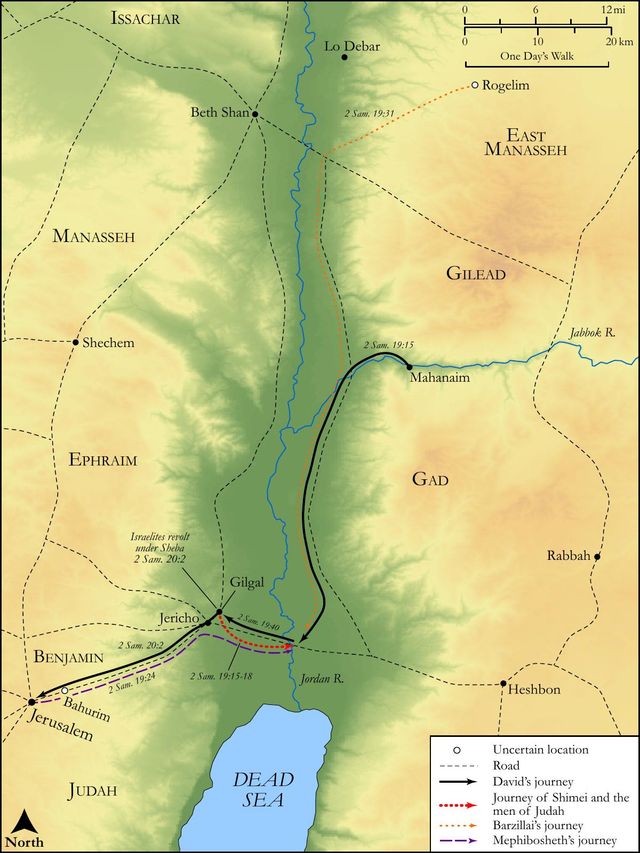
David came over Jordan attended and assisted only by the men of Judah; but when he had advanced as far as Gilgal, the first stage on this side Jordan, half the people of Israel (that is, of their elders and great men) had come to wait upon him, to kiss his hand, and congratulate him on his return, but found they came too late to witness the solemnity of his first entrance. This put them out of humour, and occasioned a quarrel between them and the men of Judah, which was a damp to the joy of the day, and the beginning of further mischief. Here is, 1. The complaint which the men of Israel brought to the king against the men of Judah (Sa2 19:41), that they had performed the ceremony of bringing the king over Jordan, and not given them notice, that they might have come to join in it. This reflected upon them, as if they were not so well affected to the king and his restoration as the men of Judah were, whereas the king himself knew that they had spoken of it before the men of Judah thought of it, Sa2 19:11. It seemed likewise as if they intended to monopolize the king's favours when he had come back, and to be looked upon as his only friends. See what mischief comes from pride and jealousy. 2. The excuse which the men of Judah made for themselves, Sa2 19:42. (1.) They plead relations to the king: "He is near of kin to us, and therefore in a matter of mere ceremony, as this was, we may claim precedency. It was into our country that he was to be brought, and therefore who so fit as we to bring him?" (2.) They deny the insinuated charge of self-seeking in what they had done: "Have we eaten at all of the king's cost? No, we have all borne our own charges. Hath he given us any gift? No, we have no design to engross the advantages of his return; you have come time enough to share in them." Too many that attend princes do so only for what they can get. 3. The men of Israel's vindication of their charge, Sa2 19:43. They pleaded, "We have ten parts in the king" (Judah having Simeon only, whose lot lay within his, to join with him), "and therefore it is a slight upon us that our advice was not asked about bringing back the king." See how uncertain the multitude is. They were lately striving against the king, to drive him out; now they are striving about him, which shall honour him most. A good man and a good cause will thus recover their credit and interest, though, for a time, they may seem to have lost them. See what is commonly the origin of strife, nothing so much as impatience of contempt or the least seeming slight. The men of Judah would have done better if they had taken their brethren's advice and assistance; but, since they did not, why should the men of Israel be so grievously offended? If a good work be done, and well done, let us not be displeased, nor the work disparaged, though we had no hand in it. 4. The scripture takes notice, by way of blame, which of the contending parties managed the cause with most passion: The words of the men of Judah were fiercer than those of the men of Israel. Though we have right and reason on our side, yet, if we express ourselves with fierceness, God takes notice of it and is much displeased with it.
Continue studying 2 Samuel 19:43 across the web’s major study libraries — every link below opens this exact verse, chapter, or book on the destination site.
Read & Compare
 BibleGatewayThis verse in more than 200 translations and 70 languages.
 Bible.comThe YouVersion reader — hundreds of translations, reading plans, and highlights.
 ESV.orgCrossway's official English Standard Version reader.
 NET BibleThe NET translation with 60,000+ translators' notes on every rendering decision.
 STEP BibleTyndale House's free study tool — original text, vocabulary, and scholarly resources.
 BibliaLogos Bible Software's free web reader.
 USCCBThe New American Bible (Revised Edition) with the U.S. bishops' study notes.
Commentaries
 BibleHub CommentariesDozens of classic commentaries on this verse, gathered on one page.
 StudyLightMore than 100 commentary sets — the largest collection on the web.
 BibleRefPlain-English commentary on what this verse means, verse by verse.
 Enduring WordDavid Guzik's free commentary on this chapter, widely used by Bible teachers.
 Bible Study ToolsVerse commentary alongside Greek and Hebrew study aids.
Original Language & Research
- BibleHub InterlinearThe verse word by word — original language, transliteration, and English.
- BibleHub LexiconEvery word's original-language definition and Strong's entry.
 Blue Letter BibleDeep-study tools — Strong's numbers, concordance, and word studies.
 SefariaThe Hebrew text with Rashi and centuries of Jewish commentary.
Sermons, Hymns & Audio


TrulyRandomVerse is not affiliated with these sites and doesn’t control their content. They’re linked because they’re genuinely useful.
Summary
2 Samuel 19:43 powerfully portrays the escalating tribal tensions between the northern tribes of Israel and the southern tribe of Judah following King David's return to Jerusalem after Absalom's rebellion. The men of Israel, feeling overlooked and disrespected, assert their numerical superiority and shared stake in the king, challenging Judah's unilateral actions in bringing David back. Judah's sharp, "fiercer" response underscores their own sense of privilege as David's home tribe, revealing deep-seated rivalries that would continue to plague the united monarchy and ultimately lead to its division.
Context
ShowHideLiterary Context
This verse immediately follows King David's arduous journey back to Jerusalem after the devastating defeat and death of his rebellious son, Absalom. The preceding narrative in 2 Samuel 19 meticulously details David's efforts to reconcile with various factions and individuals, including the repentant Shimei (2 Samuel 19:16-23), the loyal but misunderstood Mephibosheth (2 Samuel 19:24-30), and the elderly Barzillai (2 Samuel 19:31-40). As David crosses the Jordan River, a seemingly minor dispute erupts between the men of Israel and the men of Judah over who possesses the primary right and honor in escorting the king. This argument, though brief, serves as a crucial narrative pivot, immediately preceding Sheba's rebellion in 2 Samuel 20, thereby exposing the profound fragility of the kingdom's unity and the persistent undercurrents of tribal animosity.
Historical & Cultural Context
Ancient Israel was structured as a confederation of twelve distinct tribes, each maintaining its own territory, customs, and identity, despite being united under a monarchy only relatively recently. Significant historical and geographical distinctions existed between the northern tribes (collectively referred to as "Israel") and the southern tribe of Judah. Judah, as David's ancestral tribe and the location of Jerusalem, the newly established capital, often felt a special, inherent claim to the king and his reign. The act of "bringing back the king" was far more than a logistical exercise; it was a highly symbolic and politically charged act, signifying loyalty, honor, and a claim to influence within the nascent united kingdom. The public display of who took precedence in such a pivotal act was paramount for tribal prestige and political standing. This context vividly highlights the persistent centrifugal forces within Israel, where deeply entrenched tribal loyalties frequently superseded any nascent sense of national unity, a tension that would ultimately culminate in the kingdom's irreparable division after Solomon's reign, as meticulously recounted in 1 Kings 12.
Key Themes
ShowHideThis verse powerfully illustrates several enduring themes pertinent to the nature of leadership and community. Firstly, Tribal Rivalry and Disunity are paramount, showcasing how deeply ingrained regional loyalties and perceived slights could effortlessly ignite conflict, even in the presence of a shared king. The northern tribes' assertion of "ten parts in the king" signifies their numerical superiority and collective stake in the monarchy, echoing their instrumental role in anointing David as king over all Israel (2 Samuel 5:3). Secondly, Pride and Honor are driving forces for both factions; Israel feels their dignity "despised," while Judah's "fiercer" words stem from a zealous defense of their perceived privilege and preeminence. This relentless quest for preeminence often tragically undermines the very unity it claims to serve. Lastly, the northern tribes' complaint underscores the critical importance of Consultation among the Tribes. Israel's grievance, "that our advice should not be first had," points to a profound failure in communication and collaborative governance among the leaders, demonstrating how a lack of proper consultation and recognition can breed deep-seated resentment and ultimately lead to irreparable division within any community or nation.
Exposition and Analysis
ShowHideKey Word Analysis
ShowHideThis phrase, literally meaning "ten hands" or "ten portions," signifies the numerical superiority and collective claim of the ten northern tribes (excluding Judah and Benjamin) to a significant share in the king and his reign. It asserts their substantial stake in the monarchy, implying that David belongs to them just as much, if not more, than to Judah. This highlights a profound sense of shared ownership and political entitlement, demanding recognition for their collective weight within the kingdom.
This verb conveys the idea of treating someone or something as light, insignificant, or with contempt and scorn. The men of Israel felt that Judah's unilateral action in bringing David back was not merely an oversight but a deliberate act of disrespect, a calculated devaluing of their importance and counsel. This feeling of being "despised" fueled their indignation and sense of injustice, leading to their sharp rebuke.
This adjective describes the words of the men of Judah, indicating harshness, severity, stubbornness, or difficulty. It suggests that Judah's reply was not a calm rebuttal but an aggressive, unyielding escalation of the argument. Their words were not just stronger, but more unyielding and confrontational, demonstrating their strong sense of territoriality, pride, and an unwillingness to concede their perceived right concerning David, thereby exacerbating the conflict.
Verse Breakdown
ShowHide"And the men of Israel answered the men of Judah, and said, We have ten parts in the king, and we have also more [right] in David than ye:"
This opening clause establishes the direct and immediate confrontation between the northern and southern tribes. The men of Israel initiate the verbal attack, asserting their numerical dominance ("ten parts") and claiming a superior "right" or share in King David. This claim is based on their larger collective representation compared to Judah's single tribal identity, implying that David, as king of all Israel, belongs more to the majority of tribes than to his own, thus challenging Judah's perceived exclusivity.
"why then did ye despise us, that our advice should not be first had in bringing back our king?"
This rhetorical question expresses the core grievance of the men of Israel. They accuse Judah of treating them with contempt ("despise") by acting unilaterally and failing to consult them on the crucial matter of escorting the king back to Jerusalem. This highlights their feeling of being overlooked and their demand for recognition and participation in national affairs, particularly those concerning the monarch's return, underscoring a deep-seated desire for respect and inclusion.
"And the words of the men of Judah were fiercer than the words of the men of Israel."
This concluding statement from the narrator reveals the immediate and dangerous escalation of the conflict. Judah's response was not conciliatory but even more aggressive and unyielding than Israel's initial complaint. This "fiercer" retort underscores Judah's entrenched pride and sense of privilege as David's home tribe, signaling their unwillingness to back down or acknowledge Israel's grievance. It sets a foreboding tone for the future stability of the united kingdom, hinting at deeper, unresolved divisions.
Literary Devices
ShowHideThe passage is rich in Dialogue, presenting a direct verbal exchange that immediately plunges the reader into the heart of the tribal conflict. This directness allows the characters' motivations and emotions—Israel's indignation and Judah's unyielding pride—to be vividly portrayed without narrative filter. The use of a Rhetorical Question ("why then did ye despise us?") serves to highlight Israel's profound sense of injustice and their demand for accountability from Judah. The phrase "ten parts in the king" functions as a form of Synecdoche, where "parts" (portions or hands) stand for the tribes themselves, powerfully emphasizing their collective claim and numerical superiority. Most significantly, the verse employs potent Foreshadowing, as the "fiercer" words of Judah and the unresolved tension explicitly hint at the future division of the kingdom, which indeed occurs under Rehoboam and Jeroboam, directly stemming from the historical tribal rivalries exacerbated in this period. The stark Contrast between Israel's initial complaint and Judah's even stronger, more aggressive response underscores the depth of the animosity and the intractable nature of the dispute.
Theological and Thematic Connections
ShowHideThis intense exchange in 2 Samuel 19:43 serves as a stark reminder of the corrosive power of pride, tribalism, and the failure to take counsel with all the tribes. Theologically, it illustrates how human sin, particularly the desire for preeminence, recognition, and unchecked self-interest, can fracture even divinely ordained structures like the united monarchy. It underscores the constant biblical call for unity, humility, and mutual respect, demonstrating the devastating consequences when these virtues are absent. The unresolved tension here is not merely a historical footnote but a profound theological lesson on the fragility of human community when self-interest and division prevail over mutual respect and shared purpose, revealing the deep-seated human propensity for strife.
Reflection and Application
ShowHideThe ancient dispute between the men of Israel and Judah offers profound, timeless lessons for contemporary communities, whether families, churches, workplaces, or nations. It serves as a potent warning against the dangers of unchecked pride, the insidious nature of favoritism, and the destructive power of unaddressed grievances. When individuals or groups feel their contributions are "despised" or their voices unheard, resentment festers, leading to division and animosity. True unity is not merely the absence of conflict, but the active pursuit of peace, mutual respect, and a willingness to humble oneself for the good of all. We are challenged to examine our own hearts: do we seek recognition and preeminence, or do we prioritize the well-being and unity of the collective? The "fiercer" words of Judah remind us that defensiveness and an unwillingness to listen only escalate conflict, making genuine reconciliation impossible. This passage calls us to cultivate a spirit of humility, valuing every member and seeking consensus, lest our own "tribalisms"—be they denominational, political, or personal—tear apart the fabric of our shared life and hinder our common mission.
Questions for Reflection
ShowHideFAQ
ShowHideWhat does "ten parts in the king" mean?
ShowHideThe phrase "ten parts in the king" (Hebrew: ʻeser yâd) is a numerical and political claim made by the northern tribes of Israel. It literally means "ten hands" or "ten portions," signifying their collective numerical superiority and their assertion of a significant, shared stake in King David. They are essentially saying, "We, the ten tribes, have a much larger share and claim to David as our king than you, Judah, who are only one tribe." This highlights their belief that David, as king of all Israel, belongs primarily to the larger collective of tribes, and that their voice and honor should therefore take precedence over Judah's single tribal claim, underscoring their demand for political recognition and influence.
How did this dispute foreshadow later events in Israel's history?
ShowHideThis dispute is a critical foreshadowing of the eventual division of the united monarchy after the reign of Solomon. The deep-seated tribal tensions and rivalries between the north (Israel) and the south (Judah), so vividly displayed here, never truly dissipated. They resurfaced with full force when Solomon's son, Rehoboam, ascended the throne. When the northern tribes approached Rehoboam with grievances and he responded with harshness, reminiscent of Judah's "fiercer" words in 2 Samuel 19:43, the kingdom irrevocably split into two separate entities: the northern kingdom of Israel and the southern kingdom of Judah (1 Kings 12:16). This verse thus serves as an early, clear indicator of the inherent fragility of the united kingdom due to unresolved internal strife and the persistent challenge of maintaining unity across diverse tribal identities.
Why were Judah's words "fiercer"?
ShowHideJudah's words were "fiercer" (Hebrew: qâshâh, meaning harsh, severe, or stubborn) likely due to a combination of factors. As David's home tribe, Judah felt a unique and privileged connection to the king, perhaps even a sense of territoriality over him. They may have perceived Israel's complaint as an affront to their honor and a challenge to their preeminent position as the king's primary supporters. Their "fiercer" response indicates an unwillingness to concede or apologize, reflecting a deep-seated pride and defensiveness. It suggests that they were not merely rebutting Israel's claim but aggressively asserting their own perceived right, escalating the conflict rather than seeking reconciliation, thereby prioritizing their tribal honor over national unity.
Christ-Centered Fulfillment
ShowHideThe bitter tribal rivalries and the ultimate division of the kingdom, so clearly foreshadowed in 2 Samuel 19:43, underscore the profound human inability to maintain true unity apart from a perfect King. David, though chosen by God and a man after God's own heart, could not fully bridge the chasm of human pride and tribalism. This historical failure sets the stage for the coming of Jesus Christ, the true Son of David and the ultimate King, who perfectly fulfills the need for a unifying head. Unlike David's kingdom, which was fractured by human sin and internal strife, Christ's kingdom is one where the dividing walls of hostility are decisively broken down (Ephesians 2:14). He does not rule by tribal favoritism or human claims to "parts" in Him, but by grace, inviting all peoples and nations into His body, the Church, where there is "neither Jew nor Gentile, neither slave nor free, nor is there male and female, for you are all one in Christ Jesus" (Galatians 3:28). His leadership is characterized by profound humility and self-sacrifice, not by "fiercer" words or a demand for preeminence (Philippians 2:3-8). In Christ, the ideal of unity, which tragically eluded David's reign and the united monarchy, is perfectly realized, offering a glimpse of a future where all creation will joyfully acknowledge the one King, whose reign brings perfect peace, reconciliation, and eternal harmony (Revelation 19:11-16).