


2 Samuel 19:14
Bible text: King James Version (1769 Blayney text) · Public domain
Bible text: King James Version with Strong's numbers · Public domain
Bible text: Berean Standard Bible · Public domain
Bible text: American Standard Version (1901) · Public domain
Bible text: World English Bible, Messianic edition · Public domain
Bible text: Geneva Bible (1599) · Public domain
Bible text: Young's Literal Translation · Public domain
- וַיַּטvai·Yatand he turnedH5186Conj-w ¦ V-Hiphil-ConsecImperf-3msVerb Hiphil Consecutive Imperfect 3rd Singular Masculineוַandיַּטhe turned
- אֶת'et<obj.>H853DirObjMParticle Object Indicator
- לְבַבle·Vav[the] heart ofH3824N-mscNoun Singular Masculine Construct
- כָּלkoleveryH3605N-mscNoun Singular Masculine Construct
- אִישׁ'ish<the> man ofH376N-mscNoun Singular Masculine Construct
- יְהוּדָהye·hu·DahJudahH3063N-properNoun Proper Location
- כְּאִישׁke·'Ishlike a manH376Prep-k ¦ N-msNoun Singular Masculine Absoluteכְּlikeאִישׁa man
- אֶחָד'e·ChadoneH259N-fsNoun Singular Feminine Absolute
- וַיִּשְׁלְחוּvai·yish·le·Chuand they sentH7971Conj-w ¦ V-Qal-ConsecImperf-3mpVerb Qal Consecutive Imperfect 3rd Plural Masculineוַandיִּשְׁלְחוּthey sent
- אֶל'eltoH413PrepPreposition
- הַמֶּלֶךְha·Me·lekhthe kingH4428Art ¦ N-msNoun Singular Masculine Absoluteהַtheמֶּלֶךְking
- שׁוּבshuvreturnH7725V-Qal-Imp-2msVerb Qal Imperative 2nd Singular Masculine
- אַתָּה'a·TahyouH859Pro-2msPronoun Personal 2nd Singular Masculine
- וְכָלve·kholand allH3605Conj-w ¦ N-mscNoun Singular Masculine Constructוְandכָלall
- עֲבָדֶיךָ'a·va·Dei·khayour servantsH5650N-mpc ¦ 2msNoun Plural Masculine Constructעֲבָדֶיservantsךָyour
English is a literal word-by-word gloss of the Hebrew, not the KJV's wording. Why?
This is the original text the KJV's translators worked from — each Hebrew word with its own literal English meaning in this verse, prepared by scholars at Tyndale House, Cambridge. The KJV translates whole sentences, not word by word, so its wording differs: one Hebrew word can become several English words, and the KJV may choose “the LORD” where the gloss reads “Yahweh”. Both are faithful — they answer different questions. For the KJV's own rendering, switch to the KJV text.
Details
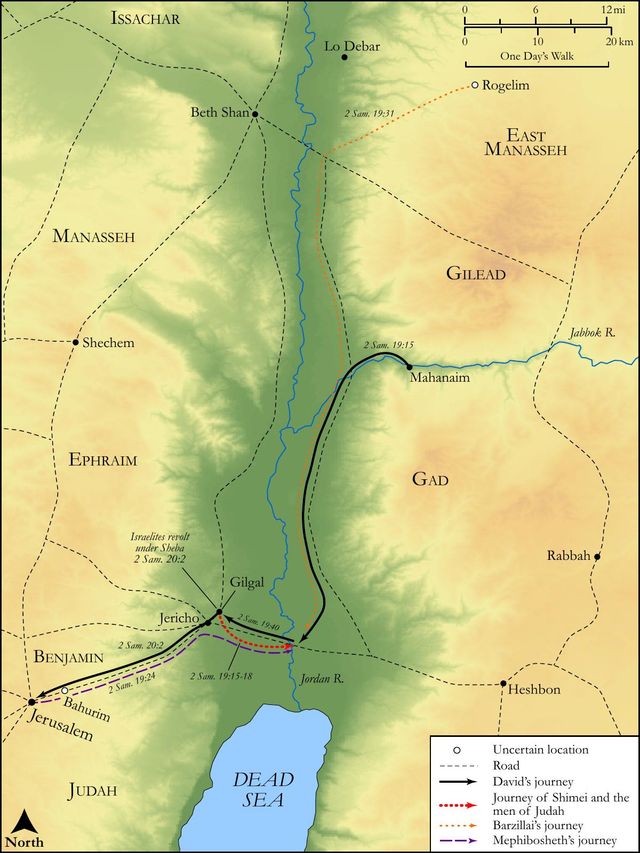
See on the biblical-era maps

Study this verse
Public-domain commentary
Matthew Henry
From his Commentary on the Whole Bible. Henry comments on passages, not single verses — this entry covers 2 Samuel 19:9–15. His two-level outline is real structure in the source text, so it is rendered as structure.
It is strange that David did not immediately upon the defeat and dispersion of Absalom's forces march with all expedition back to Jerusalem, to regain the possession of his capital city, while the rebels were in confusion and before they could rally again. What occasion was there to bring him back? Could not he himself go back with the victorious army he had with him in Gilead? He could, no doubt; but, 1. He would go back as a prince, with the consent and unanimous approbation of the people, and not as a conqueror forcing his way: he would restore their liberties, and not take occasion to seize them, or encroach upon them. 2. He would go back in peace and safety, and be sure that he should meet with no difficulty or opposition in his return, and therefore would be satisfied that the people were well-affected to have him before he would stir. 3. He would go back in honour, and like himself, and therefore would go back, not at the head of his forces, but in the arms of his subjects; for the prince that has wisdom and goodness enough to make himself his people's darling, without doubt, looks greater and makes a much better figure than the prince that has strength enough to make himself his people's terror. It is resolved therefore that David must be brought back to Jerusalem his own city, and his own house there, with some ceremony, and here we have that matter concerted.
I.The men of Israel (that is, the ten tribes) were the first that talked of it, Sa2 19:9, Sa2 19:10.
The people were at strife about it; it was the great subject of discourse and dispute throughout all the country. Some perhaps opposed it: "Let him either come back himself or stay where he is;" others appeared zealous for it, and reasoned as follows here, to further the design,
1.That David had formerly helped them, had fought their battles, subdued their enemies, and done them much service, and therefore it was a shame that he should continue banished from their country who had been so great a benefactor to it. Note, Good services done to the public, though they may be forgotten for a while, yet will be remembered again when men come to their right minds.
2.That Absalom had now disappointed them. "We were foolishly sick of the cedar, and chose the branch to reign over us; but we have had enough of him: he is consumed, and we narrowly escaped being consumed with him. Let us therefore return to our allegiance, and think of bringing the king back." Perhaps this was all the strife among them, not a dispute whether the king should be brought back or no (all agreed it was to be done), but whose fault is was that it was not done. As is usual in such cases, every one justified himself and blamed his neighbour. The people laid the fault on the elders, and the elders on the people, and one tribe upon another. Mutual excitements to the doing of a good work are laudable, but not mutual accusations for the not doing of it; for usually when public services are neglected all sides must share in the blame; every one might do more than he does, in the reformation of manners, the healing of divisions, and the like.
II.The men of Judah, by David's contrivance, were the first that did it.
It is strange that they, being David's own tribe, were not so forward as the rest. David had intelligence of the good disposition of all the rest towards him, but nothing from Judah, though he had always been particularly careful of them. But we do not always find the most kindness from those from whom we have most reason to expect it. Yet David would not return till he knew the sense of his own tribe. Judah was his lawgiver, Psa 60:7. That his way home might be the more clear,
1.He employed Zadok and Abiathar, the two chief priests, to treat with the elders of Judah, and to excite them to give the king an invitation back to his house, even to his house, which was the glory of their tribe, Sa2 19:11, Sa2 19:12. No men more proper to negociate this affair than the two priests, who were firm to David's interest, were prudent men, and had great influence with the people. Perhaps the men of Judah were remiss and careless, and did it not, because nobody put them on to do it, and then it was proper to stir them up to it. Many will follow in a good work who will not lead: it is a pity that they should continue idle for want of being spoken to. Or perhaps they were so sensible of the greatness of the provocation they had given to David, by joining with Absalom, that they were afraid to bring him back, despairing of his favour; he therefore warrants his agents to assure them of it, with this reason: "You are my brethren, my bone and my flesh, and therefore I cannot be severe with you." The Son of David has been pleased to call us brethren, his bone and his flesh, which encourages us to hope that we shall find favour with him. Or perhaps they were willing to see what the rest of the tribes would do before they stirred, with which they are here upbraided: "The speech of all Israel has come to the king to invite him back, and shall Judah be the last, that should have been the first? Where is now the celebrated bravery of that royal tribe? Where is its loyalty?" Note, We should be stirred up to that which is great and good by the examples both of our ancestors and of our neighbours, and by the consideration of our rank. Let not the first in dignity be last in duty.
2.He particularly courted into his interest Amasa, who had been Absalom's general, but was his own nephew as well as Joab, Sa2 19:13. He owns him for his kinsman, and promises him that, if he will appear for him now, he will make him captain-general of all his forces in the room of Joab, will not only pardon him (which, it may be, Amasa questioned), but prefer him. Sometimes there is nothing lost in purchasing the friendship of one that has been an enemy. Amasa's interest might do David good service at this juncture. But, if David did wisely for himself in designating Amasa for this post (Joab having now grown intolerably haughty), he did not do kindly by Amasa in letting his design be known, for it occasioned his death by Joab's hand, Sa2 20:10.
3.The point was hereby gained. He bowed the heart of the men of Judah to pass a vote, nemine contradicente - unanimously, for the recall of the king, Sa2 19:14. God's providence, by the priests' persuasions and Amasa's interest, brought them to this resolve. David stirred not till he received this invitation, and then he came as far back as Jordan, at which river they were to meet him, Sa2 19:15. Our Lord Jesus will rule in those that invite him to the throne in their hearts and not till he be invited. He first bows the heart and makes it willing in the day of his power, and then rules in the midst of his enemies, Psa 110:2, Psa 110:3.
Continue studying 2 Samuel 19:14 across the web’s major study libraries — every link below opens this exact verse, chapter, or book on the destination site.
Read & Compare
 BibleGatewayThis verse in more than 200 translations and 70 languages.
 Bible.comThe YouVersion reader — hundreds of translations, reading plans, and highlights.
 ESV.orgCrossway's official English Standard Version reader.
 NET BibleThe NET translation with 60,000+ translators' notes on every rendering decision.
 STEP BibleTyndale House's free study tool — original text, vocabulary, and scholarly resources.
 BibliaLogos Bible Software's free web reader.
 USCCBThe New American Bible (Revised Edition) with the U.S. bishops' study notes.
Commentaries
 BibleHub CommentariesDozens of classic commentaries on this verse, gathered on one page.
 StudyLightMore than 100 commentary sets — the largest collection on the web.
 BibleRefPlain-English commentary on what this verse means, verse by verse.
 Enduring WordDavid Guzik's free commentary on this chapter, widely used by Bible teachers.
 Bible Study ToolsVerse commentary alongside Greek and Hebrew study aids.
Original Language & Research
- BibleHub InterlinearThe verse word by word — original language, transliteration, and English.
- BibleHub LexiconEvery word's original-language definition and Strong's entry.
 Blue Letter BibleDeep-study tools — Strong's numbers, concordance, and word studies.
 SefariaThe Hebrew text with Rashi and centuries of Jewish commentary.
Sermons, Hymns & Audio


TrulyRandomVerse is not affiliated with these sites and doesn’t control their content. They’re linked because they’re genuinely useful.
Summary
Second Samuel 19:14 vividly describes the dramatic and successful culmination of King David's strategic efforts to regain the loyalty of the tribe of Judah following Absalom's devastating rebellion. Through a combination of political acumen and a heartfelt appeal to kinship, David effectively swayed the hearts of the Judahite elders and people, achieving a remarkable unanimity that paved the way for his immediate and peaceful return to Jerusalem and the restoration of his rightful kingship.
Context
ShowHideLiterary Context
This verse is the immediate and crucial outcome of David's desperate attempt to re-establish his authority after the death of Absalom and the collapse of the rebellion. Following the battle in the forest of Ephraim where Absalom was killed (2 Samuel 18:6-15), David remained in Mahanaim, east of the Jordan River, grieving his son. The kingdom was in disarray, with Judah, his own tribe, having largely sided with Absalom. David, recognizing the urgency of the situation and the need to heal the fractured nation, sent messages through the priests Zadok and Abiathar to the elders of Judah (2 Samuel 19:11-13). He appealed to their familial bond, reminding them of their kinship, and, significantly, offered Amasa, Absalom's former commander, the position of commander of his own army, replacing Joab. Verse 14 records the profound success of this appeal, demonstrating that David's words resonated deeply and effectively turned the tide of Judah's allegiance. The subsequent verses detail the preparations for David's return and the various individuals who came to meet him as he crossed the Jordan.
Historical & Cultural Context
The period of the united monarchy under David was characterized by tribal loyalties that, while often coalescing under a strong king, could also be a source of division, as seen in Absalom's ability to garner support, particularly from Judah. David's appeal to Judah's elders was a shrewd political move, acknowledging their significant role and influence. The concept of "heart" in Hebrew thought was not merely the seat of emotion but also of intellect, will, and moral character. To "bow the heart" meant to decisively influence one's will and allegiance. The offer to Amasa, a relative of David who had led the rebellion's army, was an extraordinary act of political reconciliation and a calculated risk. It aimed to disarm a potential rival, integrate former adversaries, and demonstrate David's desire for unity rather than retribution, a stark contrast to the typical vengeance often sought by victorious kings among the nations. This act underscored the importance of securing the support of one's own tribe, especially when returning from exile or rebellion.
Key Themes
ShowHideThis verse powerfully illustrates several key themes within the book of 2 Samuel and the broader biblical narrative. Firstly, it highlights Reconciliation and Forgiveness, as David extends an olive branch to those who rebelled, prioritizing unity over punitive measures. His willingness to forgive and integrate former adversaries, even offering a high position to Amasa, showcases a remarkable capacity for grace in leadership, a theme echoed in the New Testament's call to reconciliation (2 Corinthians 5:18-19). Secondly, the phrase "bowed the heart of all the men of Judah, even as the heart of one man" underscores the theme of Unity and Restoration. After a period of deep national division and civil war, this verse marks a pivotal moment where a fragmented people are brought back together, demonstrating the power of a collective will for peace and stability under rightful leadership, much like the unified spirit desired for God's people (Psalm 133:1). Finally, it exemplifies Strategic Leadership on David's part. His actions reveal a profound understanding of human nature, tribal politics, and the art of governance. By appealing to kinship and offering a path to reintegration rather than retribution, David skillfully navigated a volatile situation, securing a peaceful return and re-establishing his authority, demonstrating wisdom in leadership that is often celebrated in biblical texts (Proverbs 11:14).
Exposition and Analysis
ShowHideKey Word Analysis
ShowHideThe Hebrew verb נָטָה (H5186, nâṭâh) literally means "to stretch out," "to incline," "to turn aside," or "to bend." In this context, it is used metaphorically to describe the act of persuading, influencing, or swaying someone's will or disposition. It implies a gentle yet decisive turning of the heart, not through force or coercion, but through compelling argument and appeal. This suggests a change of internal conviction rather than mere external compliance, highlighting the profound impact of David's words and promises on the people of Judah.
The Hebrew word לֵבָב (H3824, lêbâb) refers to the innermost being of a person, encompassing not just emotions but also intellect, will, and moral conscience. It is the seat of one's thoughts, intentions, and decisions. When the text says "he bowed the heart," it means David influenced their core identity and decision-making faculty, leading to a fundamental shift in their loyalty and allegiance. This was a complete change of mind and will, not just a superficial agreement.
The Hebrew word אֶחָד (H259, ʼechâd) is a numeral meaning "one," "united," or "first." In the phrase "as the heart of one man" (כְּאִישׁ אֶחָד, k'ish ʼechâd), it is crucial for conveying the idea of absolute unanimity and complete agreement. It emphasizes that the decision of the men of Judah was not fragmented or debated but was a singular, collective resolve. This idiom highlights the remarkable success of David's appeal, indicating a total turnaround in their allegiance and a unanimous desire for his immediate return, signifying a profound restoration of unity.
Verse Breakdown
ShowHide"And he bowed the heart of all the men of Judah"
This clause attributes the successful persuasion directly to David ("he bowed"). It signifies that David's strategic appeal, delivered through Zadok and Abiathar, effectively influenced the inner will and loyalty of every man in the tribe of Judah. This was not a partial or grudging agreement but a fundamental shift in their disposition towards their king, moving from rebellion or indecision to renewed allegiance.
"even as [the heart of] one man"
This idiomatic phrase powerfully describes the outcome of David's influence. It means that the collective will of all the men of Judah became unified, as if they possessed a single heart and mind. There was no dissent or division; their decision to recall David was unanimous and resolute, demonstrating a complete and harmonious alignment of their intentions and desires.
"so that they sent [this word] unto the king, Return thou, and all thy servants"
This final clause presents the direct consequence of their unified change of heart. Their collective decision manifested in immediate action: they sent a message to David, explicitly inviting him to return to Jerusalem with all his loyal followers. This invitation was a clear, unambiguous call for the restoration of his kingship and the re-establishment of his authority, signaling the end of the rebellion's aftermath and the beginning of the kingdom's healing.
Literary Devices
ShowHideThe verse employs several effective literary devices to convey its powerful message. The central device is Metaphor in the phrase "bowed the heart." The heart, the seat of will and affection, is metaphorically depicted as something pliable that can be bent or inclined, illustrating David's persuasive power to turn the people's allegiance. This is further amplified by the use of Idiom in "as the heart of one man," which vividly communicates absolute unanimity and complete unity of purpose among the men of Judah. This idiom is a form of Hyperbole, emphasizing the extraordinary degree of their collective agreement. Additionally, "heart" serves as a Synecdoche or Metonymy, where a part (the heart) stands for the whole person's will, loyalty, and inner disposition, representing the entire tribe's unified decision. These devices combine to underscore the dramatic and complete shift in Judah's allegiance, highlighting the profound success of David's reconciliation efforts.
Theological and Thematic Connections
ShowHideThis verse is a profound testament to the power of reconciliation, wise leadership, and the divine hand in turning human hearts. David's actions reflect a king who, despite immense personal suffering and betrayal, chose grace and strategic forgiveness over vengeance. This echoes God's own character, who often extends mercy and a path to restoration even after profound rebellion. The immediate and unanimous response of Judah, described as "the heart of one man," speaks to the spiritual and social imperative of unity within God's people, a unity that brings strength and allows for collective action towards divine purposes. It demonstrates that genuine, lasting unity stems from a change of heart, not merely external coercion, and that such unity is essential for the stability and blessing of any community, especially the community of faith.
Reflection and Application
ShowHideThe story of David's reconciliation with Judah offers timeless lessons for navigating conflict, fostering unity, and exercising redemptive leadership in our own lives and communities. In moments of division, whether in families, churches, or workplaces, the temptation can be to retaliate, to demand justice, or to simply withdraw. However, David's example challenges us to consider the path of strategic grace and genuine appeal. His willingness to extend forgiveness, even to a former adversary like Amasa, and to appeal to shared identity and kinship, demonstrates that true strength often lies in the ability to bridge divides and restore relationships. This passage reminds us that unity is not merely the absence of conflict but a positive, active turning of hearts towards a common purpose, requiring humility, wisdom, and a willingness to initiate reconciliation. It encourages us to seek not just compliance, but a true change of heart, recognizing that genuine transformation leads to collective flourishing.
Questions for Reflection
ShowHideFAQ
ShowHideHow did David manage to turn the hearts of Judah so quickly after their rebellion?
ShowHideDavid's success was due to a combination of factors. First, the rebellion's leader, Absalom, was dead, removing the central figure of opposition. Second, David's appeal was strategically brilliant. He sent Zadok and Abiathar, respected priests, to the elders of Judah, reminding them of their close kinship ("Ye are my bones and my flesh," 2 Samuel 19:12). Crucially, he also offered Amasa, Absalom's former general, the position of commander of his own army, replacing Joab (2 Samuel 19:13). This act of extraordinary grace and political shrewdness disarmed potential rivals and offered a clear path to reintegration for those who had supported the rebellion, demonstrating David's desire for healing and unity rather than punishment. The people of Judah, likely weary of civil war and seeing David's genuine desire for reconciliation, responded unanimously.
Christ-Centered Fulfillment
ShowHideWhile 2 Samuel 19:14 describes David's masterful ability to turn the hearts of Judah back to himself, it ultimately foreshadows the greater King, Jesus Christ, who perfectly fulfills this role for all creation. David's act of reconciliation, offering grace to those who rebelled, points to Christ's ultimate act of atonement, where God, in His infinite love, reconciled the world to Himself through the sacrifice of His Son (2 Corinthians 5:19). Just as David bowed the hearts of Judah "as one man," Jesus, through the power of the Holy Spirit, convicts and turns the hearts of countless individuals from rebellion against God to willing submission and joyful obedience. His gospel message is the ultimate appeal that transforms hearts of stone into hearts of flesh (Ezekiel 36:26). He is the true Shepherd who gathers His scattered sheep into one flock (John 10:16), creating a unified people—the Church—who are "one in Christ Jesus" (Galatians 3:28). The return of David to his throne, facilitated by a unified people, anticipates the glorious return of King Jesus, when every knee will bow and every tongue confess His Lordship, and His kingdom will be fully and eternally established in perfect unity and peace (Philippians 2:10-11).