


Acts 4:32
Bible text: King James Version (1769 Blayney text) · Public domain
Bible text: King James Version with Strong's numbers · Public domain
Bible text: Berean Standard Bible · Public domain
Bible text: American Standard Version (1901) · Public domain
Bible text: World English Bible, Messianic edition · Public domain
Bible text: Geneva Bible (1599) · Public domain
Bible text: Young's Literal Translation · Public domain
- ΤοῦTou<the>G3588T-GSNDefinite article Genitive Singular Neuter
- δὲdeAndG1161CONJConjunction
- πλήθουςplēthousthe multitudeG4128N-GSNNoun Genitive Singular Neuter
- τῶνtōnwhoG3588T-GPMDefinite article Genitive Plural Masculine
- πιστευσάντωνpisteusantōnhaving believedG4100V-AAP-GPMVerb Aorist Active Participle Genitive Plural Masculine
- ἦνēnwere [in]G1510V-IAI-3SVerb Imperfect Active Indicative 3rd Singular
- ἡhē<the>G3588T-NSFDefinite article Nominative Singular Feminine
- καρδίαkardiaheartG2588N-NSFNoun Nominative Singular Feminine
- καὶkaiandG2532CONJConjunction
- ἡhē<the>G3588T-NSFDefinite article Nominative Singular Feminine
- ψυχὴpsuchēsoulG5590N-NSFNoun Nominative Singular Feminine
- μία·miaoneG1520A-NSFAdjective Nominative Singular Feminine
- καὶkaiandG2532CONJConjunction
- οὐδὲoudenotG3761CONJ-NConjunction Negative
- εἷςheisoneG1520A-NSMAdjective Nominative Singular Masculine
- τιtianythingG5100X-ASNIndefinite pronoun Accusative Singular Neuter
- τῶνtōnof theG3588T-GPNDefinite article Genitive Plural Neuter
- ὑπαρχόντωνhuparchontōnpossessionsG5225V-PAP-GPNVerb Present Active Participle Genitive Plural Neuter
- αὐτῷautōto himG846P-DSMPersonal pronoun Dative Singular Masculine
- ἔλεγενelegenwas claimingG3004V-IAI-3SVerb Imperfect Active Indicative 3rd Singular
- ἴδιονidion[his] ownG2398A-ASNAdjective Accusative Singular Neuter
- εἶναιeinaito beG1511V-PANVerb Present Active Infinitive
- ἀλλ᾽all᾽butG235CONJConjunction
- ἦνēnwereG1510V-IAI-3SVerb Imperfect Active Indicative 3rd Singular
- αὐτοῖςautoisto themG846P-DPMPersonal pronoun Dative Plural Masculine
- ἅπανταhapantaall thingsG537A-NPNAdjective Nominative Plural Neuter
- κοινάkoinain commonG2839A-NPNAdjective Nominative Plural Neuter
English is a literal word-by-word gloss of the Greek, not the KJV's wording. Why?
This is the original text the KJV's translators worked from — each Greek word with its own literal English meaning in this verse, prepared by scholars at Tyndale House, Cambridge. The KJV translates whole sentences, not word by word, so its wording differs: one Greek word can become several English words, and the KJV may choose “charity” where the gloss reads “love”. Both are faithful — they answer different questions. For the KJV's own rendering, switch to the KJV text.
Details
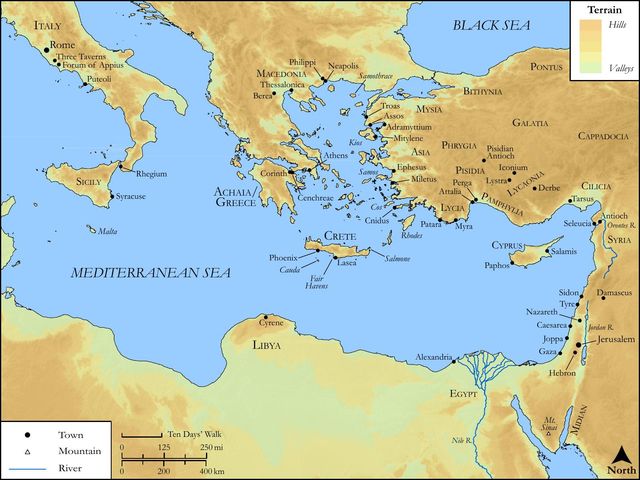
See on the biblical-era map
Study this verse
Public-domain commentary
Matthew Henry
From his Commentary on the Whole Bible. Henry comments on passages, not single verses — this entry covers Acts 4:32–37. His four-level outline is real structure in the source text, so it is rendered as structure.
We have a general idea given us in these verses, and it is a very beautiful one, of the spirit and state of this truly primitive church; it is conspectus saeculi - a view of that age of infancy and innocence.
I.The disciples loved one another dearly.
Behold, how good and how pleasant it was to see how the multitude of those that believed were of one heart, and of one soul (Act 4:32), and there was no such thing as discord nor division among them. Observe here,
1.There were multitudes that believed; even in Jerusalem, where the malignant influence of the chief priests was most strong, there were three thousand converted on one day, and five thousand on another, and, besides these, there were added to the church daily; and no doubt they were all baptized, and made profession of the faith; for the same Spirit that endued the apostles with courage to preach the faith of Christ endued them with courage to confess it. Note, The increase of the church is the glory of it, and the multitude of those that believe, more than their quality. Now the church shines, and her light is come, when souls thus fly like a cloud into her bosom, and like doves to their windows, Isa 60:1, Isa 60:8.
2.They were all of one heart, and of one soul. Though there were many, very many, of different ages, tempers, and conditions, in the world, who perhaps, before they believed, were perfect strangers to one another, yet, when they met in Christ, they were as intimately acquainted as if they had known one another many years. Perhaps they had been of different sects among the Jews, before their conversion, or had had discords upon civil accounts; but now these were all forgotten and laid aside, and they were unanimous in the faith of Christ, and, being all joined to the Lord, they were joined to one another in holy love. This was the blessed fruit of Christ's dying precept to his disciples, to love one another, and his dying prayer for them, that they all might be one. We have reason to think they divided themselves into several congregations, or worshipping assemblies, according as their dwellings were, under their respective ministers; and yet this occasioned no jealousy or uneasiness; for they were all of one heart, and one soul, notwithstanding; and loved those of other congregations as truly as those of their own. Thus it was then, and we may not despair of seeing it so again, when the Spirit shall be poured out upon us from on high.
II.The ministers went on in their work with great vigour and success (Act 4:33):
With great power gave the apostles witness of the resurrection of the Lord Jesus. The doctrine they preached was, the resurrection of Christ: a matter of fact, which served not only for the confirmation of the truth of Christ's holy religion, but being duly explained and illustrated, with the proper inferences from it, served for a summary of all the duties, privileges, and comforts of Christians. The resurrection of Christ, rightly understood and improved, will let us into the great mysteries of religion. By the great power wherewith the apostles attested the resurrection may be meant,
1.The great vigour, spirit, and courage, with which they published and avowed this doctrine; they did it not softly and diffidently, but with liveliness and resolution, as those that were themselves abundantly satisfied of the truth of it, and earnestly desired that others should be so too. Or,
2.The miracles which they wrought to confirm their doctrine. With works of great power, they gave witness to the resurrection of Christ, God himself, in them, bearing witness too.
III.The beauty of the Lord our God shone upon them, and all their performances:
Great grace was upon them all, not only all the apostles, but all the believers, charis megalē - grace that had something great in it (magnificent and very extraordinary) was upon them all.
1.Christ poured out abundance of grace upon them, such as qualified them for great services, by enduing them with great power; it came upon them from on high, from above.
2.There were evident fruits of this grace in all they said and did, such as put an honour upon them, and recommended them to the favour of God, as being in his sight of great price.
3.Some think it includes the favour they were in with the people. Every one saw a beauty and excellency in them, and respected them.
IV.They were very liberal to the poor, and dead to this world.
This was as great an evidence of the grace of God in them as any other, and recommended them as much to the esteem of the people.
1.They insisted not upon property, which even children seem to have a sense of and a jealousy for, and which worldly people triumph in, as Laban (Gen 31:43): All that thou seest is mine; and Nabal (Sa1 25:11): My bread and my water. These believers were so taken up with the hopes of an inheritance in the other world that this was as nothing to them. No man said that aught of the things which he possessed was his own, Act 4:32. They did not take away property, but they were indifferent to it. They did not call what they had their own, in a way of pride and vainglory, boasting of it, or trusting in it. They did not call it their own, because they had, in affection, forsaken all for Christ, and were continually expecting to be stripped of all for their adherence to him. They did not say that aught was their own; for we can call nothing our own but sin. What we have in the world is more God's than our own; we have it from him, must use it for him, and are accountable for it to him. No man said that what he had was his own, idion - his peculiar; for he was ready to distribute, willing to communicate, and desired not to eat his morsel alone, but what he had to spare from himself and family his poor neighbours were welcome to. Those that had estates were not solicitous to lay up, but very willing to lay out, and would straiten themselves to help their brethren. No marvel that they were of one heart and soul, when they sat so loose to the wealth of this world; for meum - mine, and tuum - thine, are the great makebates. Men's holding their own, and grasping at more than their own, are the rise of wars and fightings.
2.They abounded in charity, so that, in effect, they had all things common; for (Act 4:34) there was not any among them that lacked, but care was taken for their supply. Those that had been maintained upon the public charity were probably excluded when they turned Christians, and therefore it was fit that the church should take care of them. As there were many poor that received the gospel, so there were some rich that were able to maintain them, and the grace of God made them willing. Those that gather much have nothing over, because what they have over they have for those who gather little, that they may have no lack, Co2 8:14, Co2 8:15. The gospel hath laid all things common, not so that the poor are allowed to rob the rich, but so that the rich are appointed to relieve the poor.
3.They did many of them sell their estates, to raise a fund for charity: As many as had possession of lands or houses sold them, Act 4:34. Dr. Lightfoot computes that this was the year of jubilee in the Jewish nation, the fiftieth year (the twenty-eighth since they settled in Canaan fourteen hundred years ago), so that, what was sold that year being not to return till the next jubilee, lands then took a good price, and so the sale of those lands would raise the more money. Now,
(1.)We are here told what they did with the money that was so raised: They laid it at the apostles' feet - the left it to them to be disposed of as they thought fit; probably they had their support from it; for whence else could they have it? Observe, The apostles would have it laid at their feet, in token of their holy contempt of the wealth of the world; they thought it fitter it should be laid at their feet than lodged in their hands or in their bosoms. Being laid there, it was not hoarded up, but distribution was made, by proper persons, unto every man according as he had need. Great care ought to be taken in the distribution of public charity,
[1.]That it be given to such as have need; such as are not able to procure a competent maintenance of themselves, through age, infancy, sickness, or bodily disability, or incapacity of mind, want either of ingenuity or activity, cross providences, losses, oppressions, or a numerous charge. Those who upon any of these accounts, or any other, have real need, and have not relations of their own to help them - but, above all, those that are reduced to want for well doing, and for the testimony of a good conscience, ought to be taken care of, and provided for, and, with such a prudent application of what is given, as may be most for their benefit.
[2.]That it be given to every man for whom it is intended, according as he has need, without partiality or respect of persons. It is a rule in dispensing charity, as well as in administering justice, ut parium par sit ratio - that those who are equally needy and equally deserving should be equally helped, and that the charity should be suited and adapted to the necessity, as the word is.
(2.)Here is one particular person mentioned that was remarkable for this generous charity: it was Barnabas, afterwards Paul's colleague. Observe,
[1.]The account here given concerning him, Act 4:36. His name was Joses; he was of the tribe of Levi, for there were Levites among the Jews of the dispersion, who, it is probable, presided in their synagogue - worship, and, according to the duty of that tribe, taught them the good knowledge of the Lord. He was born in Cyprus, a great way off from Jerusalem, his parents, though Jews, having a settlement there. Notice is taken of the apostles' changing his name after he associated with them. It is probable that he was one of the seventy disciples, and, as he increased in gifts and graces, grew eminent, and was respected by the apostles, who, in token of their value for him, gave him a name, Barnabas - the son of prophecy (so it properly signifies), he being endued with extraordinary gifts of prophecy. But the Hellenist Jews (saith Grotius) called praying paraklēsis, and therefore by that word it is rendered here: A son of exhortation (so some), one that had an excellent faculty of healing and persuading; we have an instance of it, Act 11:22-24. A son of consolation (so we read it); one that did himself walk very much in the comforts of the Holy Ghost - a cheerful Christian, and this enlarged his heart in charity to the poor; or one that was eminent for comforting the Lord's people, and speaking peace to wounded troubled consciences; he had an admirable facility that way. There were two among the apostles that were called Boanerges - sons of thunder (Mar 3:17); but here was a son of consolation with them. Each had his several gift. Neither must censure the other, but both case one another; let the one search the wound, and then let the other heal it and bind it up.
[2.]Here is an account of his charity, and great generosity to the public fund. This is particularly taken notice of, because of the eminency of his services afterwards in the church of God, especially in carrying the gospel to the Gentiles; and, that this might not appear to come from any ill-will to his own nation, we have here his benevolence to the Jewish converts. Or perhaps this is mentioned because it was a leading card, and an example to others: He having land, whether in Cyprus, where he was born, or in Judea, where he now lived, or elsewhere, is not certain, but he sold it, not to buy elsewhere to advantage, but, as a Levite indeed, who knew he had the Lord God of Israel for his inheritance, he despised earthly inheritances, would be encumbered no more with them, but brought the money, and laid it at the apostles' feet, to be given in charity. Thus, as one that was designed to be a preacher of the gospel, he disentangled himself from the affairs of this life: and he lost nothing upon the balance of the account, by laying the purchase-money at the apostles' feet, when he himself was, in effect, numbered among the apostles, by that word of the Holy Ghost, Separate me Barnabas and Saul for the work whereunto I have called them, Act 13:2. Thus, for the respect he showed to the apostles as apostles, he had an apostle's reward.
Historical interpretation
Six Centuries of Reception
20 surviving comments on this verse. Each one is dated, so this reads as a timeline rather than a list.
Select a marker to jump to its quote. Markers stagger vertically where authors wrote within a few decades of each other.
Thou shalt not turn away from him that is in want, but thou shalt share all things with thy brother, and shalt not say that they are thine own; for if ye are partakers in that which is immortal, how much more in things which are mortal?
And Joseph, who by the apostles was surnamed Barnabas (which is, being interpreted, the son of consolation), a Levite, and of the country of Cyprus, having land, sold it, and brought the money, and laid it at the apostles' feet; "
Besides, as you read in the Acts of the Apostles, "There was at that time among them that believed one heart and one soul; neither said any of them that ought of the things which he possessed was his own; but they had all things common."
"Blessed," says He, "are the peacemakers; for they shall be called the sons of God." [Matthew 5:9] It behooves the sons of God to be peacemakers, gentle in heart, simple in speech, agreeing in affection, faithfully linked to one another in the bonds of unanimity.
This unanimity formerly prevailed among the apostles; and thus the new assembly of believers, keeping the Lord's commandments, maintained its charity. Divine Scripture proves this, when it says, "But the multitude of them which believed were of one heart and of one soul." [Acts 4:32] And again: "These all continued with one mind in prayer with the women, and Mary the mother of Jesus, and with His brethren." [Acts 1:14] And thus they prayed with effectual prayers; thus they were able with confidence to obtain whatever they asked from the Lord's mercy.
For,-which the more induced and constrained me to write this letter to you,-you ought to know (since the Lord has condescended to show and to reveal it) that it was said in a vision, "Ask, and ye shall obtain." Then, afterwards, that the attending people were bidden to pray for certain persons pointed out to them, but that in their petitions there were dissonant voices, and wills disagreeing, and that this excessively displeased Him who had said, "Ask, and ye shall obtain," because the disagreement of the people was out of harmony, and there was not a consent of the brethren one and simple, and a united concord; since it is written, "God who maketh men to be of one mind in a house; " and we read in the Acts of the Apostles, "And the multitude of them that believed were of one heart and of one soul." And the Lord has bidden us with His own voice, saying, "This is my command, that ye love one another." And again, "I say unto you, that if two of you shall agree on earth as touching anything that you shall ask, it shall be done for you of my Father which is in heaven." But if two of one mind can do so much, what might be effected if the unanimity prevailed among all? But if, according to the peace which our Lord gave us, there were agreement among all brethren, we should before this have obtained from the divine mercy what we seek; nor should we be wavering so long in this peril of our salvation and our faith. Yes, truly, and these evils would not have come upon the brethren, if the brotherhood had been animated with one spirit.
That charity and brotherly affection are to be religiously and stedfastly practised. In Malachi: "Hath not one God created us? Is there not one Father of us all? Why have ye certainly deserted every one his brother? " Of this same thing according to John: "Peace I leave with you, my peace I give unto you." Also in the same place: "This is my commandment, That ye love one another, even as I have loved you. Greater love than this has no man, than that one should lay down his life for his friends." Also in the same place: "Blessed are the peacemakers, for they shall be called the sons of God." Also in the same place: "Verily I say unto you, That if two of you shall agree on earth concerning everything, whatever you shall ask it shall be given you from my Father which is in heaven. For wherever two or three are gathered together in my name, I am with them." Of this same thing in the first Epistle to the Corinthians: "And I indeed, brethren, could not speak unto you as to spiritual, but as to carnal, as to babes in Christ. I have given you milk for drink, not meat: for while ye were yet little ye were not able to bear it, neither now are ye able. For ye are still carnal: for where there are in you emulation, and strife, and dissensions, are ye not carnal, and walk after man? " Likewise in the same place: "And if I should have all faith, so that I can remove mountains, but have not charity, I am nothing. And if I should distribute all my goods for food, and if I should deliver up my body to be burned, but have not charity, I avail nothing. Charity is great-souled; charity is kind; charity envieth not; charity dealeth not falsely; is not puffed up; is not irritated; thinketh not evil; rejoiceth not in injustice, but rejoiceth in the truth. It loveth all things, believeth all things, hopeth all things, beareth all things. Charity shall never fail." Of this same thing to the Galatians: "Thou shalt love thy neighbour as thyself. But if ye bite and accuse one another, see that ye be not consumed one of another." Of this same thing in the Epistle of John: "In this appear the children of God and the children of the devil. Whosoever is not righteous is not of God, and he who loveth not his brother. For he who hateth his brother is a murderer; and ye know that no murderer hath eternal life abiding in him." Also in the same place: "If any one shall say that he loves God, and hates his brother, he is a liar: for he who loveth not his brother whom he seeth, how can he love God whom he seeth not? " Of this same thing in the Acts of the Apostles: "But the multitude of them that had believed acted with one soul and mind: nor was there among them any distinction, neither did they esteem as their own anything of the possessions that they had; but all things were common to them." Of this same thing in the Gospel according to Matthew: If thou wouldest offer thy gift at the altar, and there rememberest that thy brother hath ought against thee; leave thou thy gift before the altar, and go; first be reconciled to thy brother, and then come and offer thy gift at the altar." Also in the Epistle of John: "God is love l and he that dwelleth in love dwelleth in God, and God in him." Also in the same place: "He who saith he is in the light, and hateth his brother, is a liar, and walketh in darkness even until now."
Let us consider, beloved brethren, what the congregation of believers did in the time of the apostles, when at the first beginnings the mind flourished with greater virtues, when the faith of believers burned with a warmth of faith as yet new. Then they sold houses and farms, and gladly and liberally presented to the apostles the proceeds to be dispensed to the poor; selling and alienating their earthly estate, they transferred their lands thither where they might receive the fruits of an eternal possession, and there prepared homes where they might begin an eternal habitation. Such, then, was the abundance in labours, as was the agreement in love, as we read in the Acts of the Apostles: "And the multitude of them that believed acted with one heart and one soul; neither was there any distinction among them, nor did they esteem anything their own of the goods which belonged to them, but they had all things common." This is truly to become sons of God by spiritual birth; this is to imitate by the heavenly law the equity of God the Father. For whatever is of God is common in our use; nor is any one excluded from His benefits and His gifts, so as to prevent the whole human race from enjoying equally the divine goodness and liberality. Thus the day equally enlightens, the sun gives radiance, the rain moistens, the wind blows, and the sleep is one to those that sleep, and the splendour of the stars and of the moon is common. In which example of equality, he who, as a possessor in the earth, shares his returns and his fruits with the fraternity, while he is common and just in his gratuitous bounties, is an imitator of God the Father.
For he said that experience was needed in order to distinguish between cases of genuine need and of mere greedy begging. For whoever gives to the afflicted gives to the Lord and from the Lord shall have his reward; but he who gives to every vagabond casts to a dog, a nuisance indeed from his importunity but deserving no pity on the ground of need.
The Christian ought to regard all the things that are given him for his use, not as his to hold as his own or to lay up. Moreover, giving careful heed to all things as the Lord’s, he should not overlook any of the things that are being thrown aside and disregarded, should this be the case. No Christian should think of himself as his own master, but each should rather so think and act as though given by God to be slave to his fellow brothers and sisters. But “every person in his own order.”
Do you see that together with the grace of God they also contributed their part? For everywhere it ought to be well observed, that together with the grace of God they do their part likewise. Just as Peter said above, "Silver and gold have I none"; and again, that "they were all together." But in this place, having mentioned that they were heard, the sacred writer proceeds to speak also of them, what virtue they showed. Moreover, he is just about to enter upon the narrative of Sapphira and Ananias, and with a view to show the detestable conduct of that pair, he first discourses of the noble behavior of the rest.
And not this only, but also because love is increased by the gathering [of ourselves] together; and love being increased, of necessity the things of God must follow also. “And earnest prayer” (it is said) was “made by” the people. “As the manner of some is.” Here he not only exhorted but also blamed [them].“And let us consider one another,” he says, “to provoke to love and to good works.” He knew that this also arises from “gathering together.” For as “iron sharpens iron,” so also association increases love. For if a stone rubbed against a stone sends forth fire, how much more soul mingled with soul! But not to emulation (he says), but “to the sharpening of love.” What is “to the sharpening of love”? To the loving and being loved more. “And of good works,” that so they might acquire zeal. For if doing has greater force for instruction than speaking, you also have in your number many teachers who effect this by their deeds.
Great, you perceive, is the virtue of this thing, seeing their was need of this grace even in that Company. For this is the foundation of all that is good, this of which he now for the second time makes mention, exhorting all men to the contempt of riches: "Neither said any of them that aught of the things he possessed was his own," "but they had all things common." For that this was in consequence not merely of the miraculous signs, but of their own purpose, is manifest by the case of Sapphira and Ananias.
Thus they had all things and had nothing: for “they said that none of the things which they possessed was their own”; therefore all things were theirs. For he that considers all things to be common will not only use his own but also the things of others as if they belonged to him. But whoever divides things up and sets himself as master over only his own things will not be master even of these. And this is plain from an example. He who possesses nothing at all, neither house nor table nor garment to spare, but for God’s sake is bereft of all, uses the things which are in common as his own; and he shall receive from all whatsoever he may desire, and thus he that has nothing possesses the things of all. But whoever has some things will not be master even of these. For first, no one will give to him who has possessions; and, second, his property shall belong to robbers and thieves and informers and changing events and be anybody’s rather than his.
Now say, did their love beget their poverty, or the poverty the love? In my opinion, the love begat the poverty, and then the poverty drew tight the cords of love. For observe what he says: "They were all of one heart and of one soul." Behold, heart and soul are what make the "together." "Neither said any of them that aught of the things which he possessed was his own; but they had all things common."
If love made one soul of so many souls and one heart of so many hearts, how great must be the love between the Father and the Son! Surely it must be greater than that between those people who had one heart. If, then, the heart of many brothers was one by charity, if the soul of many sisters was one by charity, would you say that God the Father and God the Son are two? If they are two Gods, there is not the highest charity between them. For if love is here so great as to make your soul and your friend’s soul one soul, how can it be, then, that the Father and the Son are not one God? Let true faith banish the thought. In short, understand from this how excellent that love is: the souls of many people are many, and if they love one another, it is one soul; still, in the case of people, they may be called many souls, because the union is not so strong. But there it is right for you to say one God; two or three Gods it is not right for you to say. From this, the supreme and surpassing excellence of love is shown to you to be such that a greater cannot be.
For … the love that God puts in people makes one heart of many hearts and makes the many souls of people into one soul, as it is written of them that believed and mutually loved one another, in the Acts of the Apostles, “They had one soul and one heart toward God.” If, therefore, my soul and your soul become one soul, when we think the same thing and love one another, how much more must God the Father and God the Son be one God in the fountain of love!
Of this high-souled humility the Apostles first, after the Lord, have given us example, who, leaving all that they had without difference at the voice of the heavenly Master, were turned by a ready change from the catching of fish to be fishers of men, and made many like themselves through the imitation of their faith, when with those first-begotten sons of the Church, "the heart of all was one, and the spirit one, of those that believed": for they, putting away the whole of their things and possessions, enriched themselves with eternal goods, through the most devoted poverty, and in accordance with the Apostles' preaching rejoiced to have nothing of the world and possess all things with Christ.
Hence it is that any creatures, that is, of the same nature, can be separated from one another because each one individually cannot be everywhere in its entirety; for when, through the grace of faith it happens that they have “one heart and soul of the multitude of believers,” still in their persons they can be separated by being in different places even though they are not separated by the affection of the heart; and some of the faithful can become unbelievers and be severed from the fellowship of that one soul.
And the multitude of believers was of one heart and one soul. Those who had completely abandoned the world did not boast of their noble lineage, preferring one another, but being as if born from the womb of one and the same mother, the Church, all rejoiced in the same love of brotherhood.
But they had all things in common. In Latin, "common" is said as "communia," which in Greek is called κοινὰ, from which it is understood that the perfect servants of God are called κοινοβίται in Greek, that is, those living in common, and their communal dwellings are called κοινόβια; for in their language, βίον is understood to mean life, not that life which is contrary to death, but the way of life someone leads in their conversation, whether in the military, or in agriculture, or in any honorable or dishonorable art, whether one is a monk, layperson, or cleric. However, the life by which we are distinguished from the dead is called ζωὴ by the Greeks. Therefore, those who live in such a way that all things are common to them in the Lord are rightly called κοινοβῖται, a name composed from two words. This life is certainly so much happier than other ways of living in this world, as it imitates the state of the future world even in the present, where all good things are common to the blessed, who see His glory from whom all good things come; and because there the highest grace of peace and security reigns, the city in which this way of life was first typified was rightly called Jerusalem, that is, the Vision of Peace. Hence, the distance of things and places is noteworthy, seeing that in the work of the prideful tower, the language and mind of the human race, when they were one, were deservedly scattered due to iniquity, so that although people spoke all languages there, no one could understand the will or words of their neighbor. However, in Jerusalem, the same languages were united by the merit of humility, and there was one language, one will, and one soul among all. This indeed continues to this day throughout the whole world, while the elect serve the Lord with one and undivided heart and intention amidst the manifold division of languages; but indeed the reprobates all serve the devil in such a way that the same service is carried out with mutual conflict and contention, because of which their city is rightly called Babylon, that is, confusion.
Continue studying Acts 4:32 across the web’s major study libraries — every link below opens this exact verse, chapter, or book on the destination site.
Read & Compare
 BibleGatewayThis verse in more than 200 translations and 70 languages.
 Bible.comThe YouVersion reader — hundreds of translations, reading plans, and highlights.
 ESV.orgCrossway's official English Standard Version reader.
 NET BibleThe NET translation with 60,000+ translators' notes on every rendering decision.
 STEP BibleTyndale House's free study tool — original text, vocabulary, and scholarly resources.
 BibliaLogos Bible Software's free web reader.
 USCCBThe New American Bible (Revised Edition) with the U.S. bishops' study notes.
Commentaries
 BibleHub CommentariesDozens of classic commentaries on this verse, gathered on one page.
 StudyLightMore than 100 commentary sets — the largest collection on the web.
 BibleRefPlain-English commentary on what this verse means, verse by verse.
 Enduring WordDavid Guzik's free commentary on this chapter, widely used by Bible teachers.
 Bible Study ToolsVerse commentary alongside Greek and Hebrew study aids.
Original Language & Research
- BibleHub InterlinearThe verse word by word — original language, transliteration, and English.
- BibleHub LexiconEvery word's original-language definition and Strong's entry.
 Blue Letter BibleDeep-study tools — Strong's numbers, concordance, and word studies.
 CNTR CollationThe earliest Greek manuscripts of this verse, collated letter by letter.
Sermons, Hymns & Audio


TrulyRandomVerse is not affiliated with these sites and doesn’t control their content. They’re linked because they’re genuinely useful.
Summary
Acts 4:32 vividly portrays the early Christian community in Jerusalem as a beacon of profound unity, radical generosity, and selfless communal living. This verse encapsulates the extraordinary fellowship that characterized the first believers, demonstrating how their shared faith in Christ and the empowering presence of the Holy Spirit forged a community where individual possessions were viewed as communal resources, fostering an environment of mutual care and support that transcended personal ownership.
Context
ShowHideLiterary Context
Acts 4:32 immediately follows a powerful demonstration of God's presence and the believers' renewed spiritual empowerment. After Peter and John's release from the Sanhedrin, the community gathered for fervent prayer, resulting in the shaking of the place where they were assembled and their being "all filled with the Holy Ghost" (Acts 4:31). This spiritual outpouring directly precedes the description of their communal life in verse 32, suggesting that their unity and generosity were a tangible fruit of the Spirit's work. The verse also echoes and expands upon earlier summary statements about the early church's practices, particularly the communal sharing described in Acts 2:44-45, reinforcing that this radical way of life was a consistent hallmark of the nascent Christian movement.
Historical & Cultural Context
The early church in Jerusalem was predominantly Jewish, operating within a society deeply rooted in Old Testament traditions, yet also influenced by Hellenistic culture and Roman rule. While private property was the norm, Jewish tradition had precedents for communal care, such as the tithe, gleaning laws, and the concept of hesed (covenant loyalty and kindness). Essene communities, a Jewish sect, also practiced a form of communal living. However, the early Christian community's practice, as described here, appears to be a voluntary, Spirit-driven expression of radical love and devotion, distinct from any existing social or economic system. It was not a forced communism but a spontaneous outpouring of generosity among those who had experienced the transformative power of the gospel, reflecting a deep commitment to the welfare of their fellow believers in a context where many new converts, including those from afar, might have lacked resources.
Key Themes
ShowHideActs 4:32 contributes significantly to several overarching themes in the book of Acts. Firstly, it highlights the unity of the Spirit among believers, a direct outcome of their shared experience of Pentecost and subsequent fillings. This unity is not merely organizational but a profound spiritual and emotional oneness, reflecting the prayer of Jesus for His disciples to be one (John 17:21). Secondly, it underscores the radical generosity and selflessness that characterized the early church, where material possessions were held loosely and shared freely to meet the needs of all, embodying the principle of love for neighbor. This theme is further explored in subsequent narratives, such as the story of Ananias and Sapphira, which serves as a stark contrast to the genuine giving described here (Acts 5:1-11). Finally, the verse presents a powerful model of Christian community, demonstrating how the gospel transforms individuals into a collective body that prioritizes mutual care, equity, and fellowship, serving as an inspiring example for the church throughout history.
Exposition and Analysis
ShowHideKey Word Analysis
ShowHideThe phrase "of one heart and of one soul" uses these two distinct but related terms to convey a profound, holistic unity. Kardía (heart) often refers to the center of one's thoughts, intentions, and moral character, the seat of understanding and will. Psychḗ (soul) refers to the animating principle of life, the individual's inner self, emotions, and desires. Together, "one heart and one soul" signifies an extraordinary spiritual, emotional, and volitional oneness among the believers. It indicates that their affections, purposes, and very identities were deeply intertwined and aligned, transcending mere agreement to encompass a shared inner life and purpose in Christ.
This word refers to "things extant or in hand," specifically one's property or possessions. The text states that "neither said any [of them] that ought of the things which he possessed was his own." This highlights a radical shift in perspective regarding material wealth. It wasn't necessarily a legal transfer of ownership to a common fund, but a profound internal conviction that one's personal belongings were not exclusively for self-benefit but were available to the entire community as needed. The emphasis is on attitude—a relinquishing of proprietary claims in spirit, even if formal ownership remained.
This term means "shared by all or several." When the text says "they had all things common," it signifies that their possessions were held in common accessibility and use. This was not a rigid, enforced system of communal property, but a voluntary, spontaneous practice born out of love and unity. It implies that resources were pooled or made available to meet the needs within the community, ensuring that no one among them lacked. The concept of koinos here reflects the practical outworking of koinonia (fellowship), where shared spiritual life led to shared material life.
Verse Breakdown
ShowHide"And the multitude of them that believed were of one heart and of one soul:"
This opening clause describes the internal, spiritual state of the early Christian community. "The multitude of them that believed" refers to the large number of converts who had embraced faith in Jesus Christ. The core of their unity is expressed as being "of one heart and of one soul," signifying a profound, holistic oneness in their thoughts, affections, will, and purpose. This was a spiritual unity, forged by the Holy Spirit, leading to deep relational harmony and shared identity in Christ, rather than mere organizational agreement.
"neither said any [of them] that ought of the things which he possessed was his own;"
This clause details the practical manifestation of their internal unity, specifically concerning material possessions. It highlights a radical shift in their mindset: no individual claimed exclusive ownership over their belongings. The emphasis is on their attitude—a voluntary relinquishing of proprietary claims. This was not a legal mandate but a spiritual conviction, where personal possessions were no longer viewed as solely for one's own benefit but as resources available for the good of the entire community, reflecting a profound selflessness.
"but they had all things common."
This concluding clause summarizes the practical outcome of their selfless attitude. "Having all things common" indicates that their resources were shared and made mutually accessible to meet the needs within the community. This was not a system of forced reallocation or a strict communal economy, but a spontaneous, Spirit-led practice of radical generosity and mutual aid, ensuring that all members, especially the needy, were cared for. It underscores the practical outworking of their deep love and unity in Christ.
Literary Devices
ShowHideActs 4:32 employs several literary devices to convey the profound nature of the early Christian community. The phrase "of one heart and of one soul" is a powerful Metaphor for deep, spiritual unity, suggesting a shared inner life and purpose that transcends individual differences. This expression also functions as a form of Synecdoche, where "heart" and "soul" represent the entirety of a person's being—their thoughts, emotions, and will—emphasizing the completeness of their shared identity. The description of "having all things common" and no one claiming their possessions as "his own" can be seen as a form of Idealization or Hyperbole, portraying the community in its most aspirational and Spirit-powered state. While the principle was undoubtedly practiced, the language emphasizes the ideal and the spirit of their generosity, rather than a rigid, universally applied economic system. This ideal serves as a powerful testament to the transformative power of the Holy Spirit in creating a community characterized by radical love and selflessness.
Theological and Thematic Connections
ShowHideActs 4:32 offers a profound theological insight into the nature of the church as the body of Christ, demonstrating that genuine spiritual unity inevitably leads to tangible expressions of love and generosity. The "one heart and one soul" reflects the very nature of the triune God, who exists in perfect unity and self-giving love. This verse teaches that faith in Christ transforms not only individual lives but also communal relationships, breaking down the barriers of self-interest and fostering a radical commitment to mutual care. It underscores the Holy Spirit's role in creating a community where material possessions are seen as tools for kingdom purposes rather than objects of personal accumulation, embodying a counter-cultural ethic of stewardship and shared resources. This communal living was a powerful witness to the world, demonstrating the transformative power of the gospel to create a new society based on love, not greed.
Reflection and Application
ShowHideActs 4:32 stands as a timeless challenge and inspiration for believers today, inviting us to examine the depth of our unity and the sincerity of our generosity. While the specific economic practice of "having all things common" might not be a prescriptive command for all contexts, the underlying principles are profoundly relevant. This verse calls us to cultivate a "one heart and one soul" mentality within our churches, prioritizing spiritual harmony, shared purpose, and genuine affection over personal preferences or divisions. It challenges us to view our possessions not as absolute personal entitlements but as resources entrusted to us by God, to be stewarded for His glory and the good of His people. This means embracing a spirit of radical generosity, willingly sharing our time, talents, and treasures to meet the needs within our Christian communities and beyond, reflecting Christ's self-sacrificial love. Ultimately, living out the spirit of Acts 4:32 transforms the church into a vibrant, loving community that powerfully testifies to the world about the reality of God's kingdom.
Questions for Reflection
ShowHideFAQ
ShowHideWas the early church practicing communism or socialism as we understand them today?
ShowHideNo, the communal sharing described in Acts 4:32 and Acts 2:44-45 was fundamentally different from modern political and economic ideologies like communism or socialism. It was a voluntary, Spirit-led practice born out of profound love and unity, not a forced economic system imposed by the state or a ruling party. Believers willingly chose to sell possessions and share resources as needs arose, as seen in the examples of Barnabas (Acts 4:36-37) and the contrast with Ananias and Sapphira (Acts 5:1-11), where Peter explicitly states that their property was "under your control" before they sold it. The emphasis was on radical generosity and mutual care within a faith community, not on the abolition of private property by decree.
Is the practice of "having all things common" a command for all churches today?
ShowHideWhile the specific practice of "having all things common" as described in Acts 4:32 is not explicitly presented as a universal command for all churches in all times, the underlying principles of unity, radical generosity, and mutual care are enduring biblical imperatives. The New Testament consistently calls believers to share with those in need (2 Corinthians 8:13-15), to practice hospitality (Romans 12:13), and to ensure that no one among them suffers lack (James 2:15-16). The early church's example serves as an inspiring model of what Spirit-filled love can accomplish, challenging believers to prioritize the needs of others and to hold their possessions loosely for the advancement of God's kingdom and the welfare of His people.
Christ-Centered Fulfillment
ShowHideActs 4:32, with its depiction of a community "of one heart and of one soul" and "having all things common," finds its profound Christ-centered fulfillment in the person and work of Jesus Himself. Christ is the ultimate embodiment of self-giving love and unity. His entire earthly ministry was characterized by laying aside His divine prerogatives (Philippians 2:5-8), not clinging to what was "His own," but pouring out His life for the sake of others. He prayed for His disciples to be one, "just as you, Father, are in me, and I in you, that they also may be in us, so that the world may believe that you have sent me" (John 17:21). The unity and radical sharing in Acts 4:32 are a direct answer to this prayer, demonstrating the transformative power of Christ's Spirit to create a new humanity, reconciled to God and to one another. Through His sacrificial death, Jesus broke down the dividing wall of hostility (Ephesians 2:14), uniting diverse peoples into one body where individual interests are subsumed by the common good of the kingdom. Thus, the early church's communal life was not merely a social experiment but a tangible manifestation of the new creation inaugurated by Christ, a living testament to the reality of His reconciling love and the unifying power of His Spirit.