


Acts 4:33
Bible text: King James Version (1769 Blayney text) · Public domain
Bible text: King James Version with Strong's numbers · Public domain
Bible text: Berean Standard Bible · Public domain
Bible text: American Standard Version (1901) · Public domain
Bible text: World English Bible, Messianic edition · Public domain
Bible text: Geneva Bible (1599) · Public domain
Bible text: Young's Literal Translation · Public domain
- καὶkaiAndG2532CONJConjunction
- δυνάμειdunamei[with] powerG1411N-DSFNoun Dative Singular Feminine
- μεγάλῃmegalēgreatG3173A-DSFAdjective Dative Singular Feminine
- ἀπεδίδουνapedidounwere givingG591V-IAI-3PVerb Imperfect Active Indicative 3rd Plural
- τὸto<the>G3588T-ASNDefinite article Accusative Singular Neuter
- μαρτύριονmarturiontestimonyG3142N-ASNNoun Accusative Singular Neuter
- οἱhoitheG3588T-NPMDefinite article Nominative Plural Masculine
- ἀπόστολοιapostoloiapostlesG652N-NPMNoun Nominative Plural Masculine
- τῆςtēsof theG3588T-GSFDefinite article Genitive Singular Feminine
- ἀναστάσεωςanastaseōsresurrectionG386N-GSFNoun Genitive Singular Feminine
- τοῦtouof theG3588T-GSMDefinite article Genitive Singular Masculine
- κυρίουkuriouLordG2962N-GSM-TNoun Genitive Singular Masculine Title
- ἸησοῦIēsouJesusG2424N-GSM-PNoun Genitive Singular Masculine Individual
- χάριςcharisgraceG5485N-NSFNoun Nominative Singular Feminine
- τεtethenG5037CONJConjunction
- μεγάληmegalēabundantG3173A-NSFAdjective Nominative Singular Feminine
- ἦνēnwasG1510V-IAI-3SVerb Imperfect Active Indicative 3rd Singular
- ἐπὶepiuponG1909PREPPreposition
- πάνταςpantasallG3956A-APMAdjective Accusative Plural Masculine
- αὐτούςautousthemG846P-APMPersonal pronoun Accusative Plural Masculine
English is a literal word-by-word gloss of the Greek, not the KJV's wording. Why?
This is the original text the KJV's translators worked from — each Greek word with its own literal English meaning in this verse, prepared by scholars at Tyndale House, Cambridge. The KJV translates whole sentences, not word by word, so its wording differs: one Greek word can become several English words, and the KJV may choose “charity” where the gloss reads “love”. Both are faithful — they answer different questions. For the KJV's own rendering, switch to the KJV text.
Details
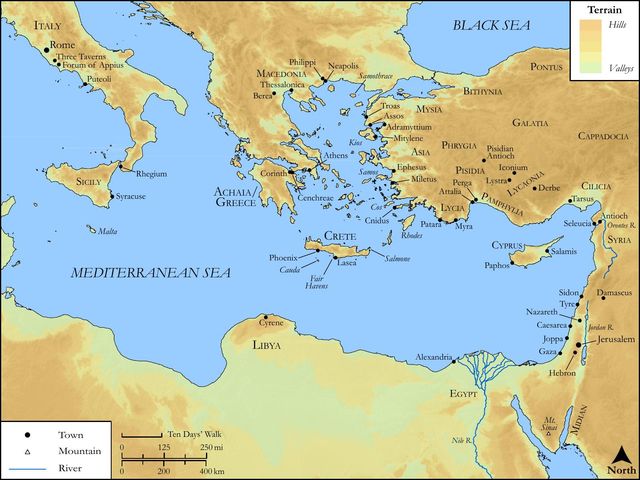
See on the biblical-era map
Study this verse
Public-domain commentary
Matthew Henry
From his Commentary on the Whole Bible. Henry comments on passages, not single verses — this entry covers Acts 4:32–37. His four-level outline is real structure in the source text, so it is rendered as structure.
We have a general idea given us in these verses, and it is a very beautiful one, of the spirit and state of this truly primitive church; it is conspectus saeculi - a view of that age of infancy and innocence.
I.The disciples loved one another dearly.
Behold, how good and how pleasant it was to see how the multitude of those that believed were of one heart, and of one soul (Act 4:32), and there was no such thing as discord nor division among them. Observe here,
1.There were multitudes that believed; even in Jerusalem, where the malignant influence of the chief priests was most strong, there were three thousand converted on one day, and five thousand on another, and, besides these, there were added to the church daily; and no doubt they were all baptized, and made profession of the faith; for the same Spirit that endued the apostles with courage to preach the faith of Christ endued them with courage to confess it. Note, The increase of the church is the glory of it, and the multitude of those that believe, more than their quality. Now the church shines, and her light is come, when souls thus fly like a cloud into her bosom, and like doves to their windows, Isa 60:1, Isa 60:8.
2.They were all of one heart, and of one soul. Though there were many, very many, of different ages, tempers, and conditions, in the world, who perhaps, before they believed, were perfect strangers to one another, yet, when they met in Christ, they were as intimately acquainted as if they had known one another many years. Perhaps they had been of different sects among the Jews, before their conversion, or had had discords upon civil accounts; but now these were all forgotten and laid aside, and they were unanimous in the faith of Christ, and, being all joined to the Lord, they were joined to one another in holy love. This was the blessed fruit of Christ's dying precept to his disciples, to love one another, and his dying prayer for them, that they all might be one. We have reason to think they divided themselves into several congregations, or worshipping assemblies, according as their dwellings were, under their respective ministers; and yet this occasioned no jealousy or uneasiness; for they were all of one heart, and one soul, notwithstanding; and loved those of other congregations as truly as those of their own. Thus it was then, and we may not despair of seeing it so again, when the Spirit shall be poured out upon us from on high.
II.The ministers went on in their work with great vigour and success (Act 4:33):
With great power gave the apostles witness of the resurrection of the Lord Jesus. The doctrine they preached was, the resurrection of Christ: a matter of fact, which served not only for the confirmation of the truth of Christ's holy religion, but being duly explained and illustrated, with the proper inferences from it, served for a summary of all the duties, privileges, and comforts of Christians. The resurrection of Christ, rightly understood and improved, will let us into the great mysteries of religion. By the great power wherewith the apostles attested the resurrection may be meant,
1.The great vigour, spirit, and courage, with which they published and avowed this doctrine; they did it not softly and diffidently, but with liveliness and resolution, as those that were themselves abundantly satisfied of the truth of it, and earnestly desired that others should be so too. Or,
2.The miracles which they wrought to confirm their doctrine. With works of great power, they gave witness to the resurrection of Christ, God himself, in them, bearing witness too.
III.The beauty of the Lord our God shone upon them, and all their performances:
Great grace was upon them all, not only all the apostles, but all the believers, charis megalē - grace that had something great in it (magnificent and very extraordinary) was upon them all.
1.Christ poured out abundance of grace upon them, such as qualified them for great services, by enduing them with great power; it came upon them from on high, from above.
2.There were evident fruits of this grace in all they said and did, such as put an honour upon them, and recommended them to the favour of God, as being in his sight of great price.
3.Some think it includes the favour they were in with the people. Every one saw a beauty and excellency in them, and respected them.
IV.They were very liberal to the poor, and dead to this world.
This was as great an evidence of the grace of God in them as any other, and recommended them as much to the esteem of the people.
1.They insisted not upon property, which even children seem to have a sense of and a jealousy for, and which worldly people triumph in, as Laban (Gen 31:43): All that thou seest is mine; and Nabal (Sa1 25:11): My bread and my water. These believers were so taken up with the hopes of an inheritance in the other world that this was as nothing to them. No man said that aught of the things which he possessed was his own, Act 4:32. They did not take away property, but they were indifferent to it. They did not call what they had their own, in a way of pride and vainglory, boasting of it, or trusting in it. They did not call it their own, because they had, in affection, forsaken all for Christ, and were continually expecting to be stripped of all for their adherence to him. They did not say that aught was their own; for we can call nothing our own but sin. What we have in the world is more God's than our own; we have it from him, must use it for him, and are accountable for it to him. No man said that what he had was his own, idion - his peculiar; for he was ready to distribute, willing to communicate, and desired not to eat his morsel alone, but what he had to spare from himself and family his poor neighbours were welcome to. Those that had estates were not solicitous to lay up, but very willing to lay out, and would straiten themselves to help their brethren. No marvel that they were of one heart and soul, when they sat so loose to the wealth of this world; for meum - mine, and tuum - thine, are the great makebates. Men's holding their own, and grasping at more than their own, are the rise of wars and fightings.
2.They abounded in charity, so that, in effect, they had all things common; for (Act 4:34) there was not any among them that lacked, but care was taken for their supply. Those that had been maintained upon the public charity were probably excluded when they turned Christians, and therefore it was fit that the church should take care of them. As there were many poor that received the gospel, so there were some rich that were able to maintain them, and the grace of God made them willing. Those that gather much have nothing over, because what they have over they have for those who gather little, that they may have no lack, Co2 8:14, Co2 8:15. The gospel hath laid all things common, not so that the poor are allowed to rob the rich, but so that the rich are appointed to relieve the poor.
3.They did many of them sell their estates, to raise a fund for charity: As many as had possession of lands or houses sold them, Act 4:34. Dr. Lightfoot computes that this was the year of jubilee in the Jewish nation, the fiftieth year (the twenty-eighth since they settled in Canaan fourteen hundred years ago), so that, what was sold that year being not to return till the next jubilee, lands then took a good price, and so the sale of those lands would raise the more money. Now,
(1.)We are here told what they did with the money that was so raised: They laid it at the apostles' feet - the left it to them to be disposed of as they thought fit; probably they had their support from it; for whence else could they have it? Observe, The apostles would have it laid at their feet, in token of their holy contempt of the wealth of the world; they thought it fitter it should be laid at their feet than lodged in their hands or in their bosoms. Being laid there, it was not hoarded up, but distribution was made, by proper persons, unto every man according as he had need. Great care ought to be taken in the distribution of public charity,
[1.]That it be given to such as have need; such as are not able to procure a competent maintenance of themselves, through age, infancy, sickness, or bodily disability, or incapacity of mind, want either of ingenuity or activity, cross providences, losses, oppressions, or a numerous charge. Those who upon any of these accounts, or any other, have real need, and have not relations of their own to help them - but, above all, those that are reduced to want for well doing, and for the testimony of a good conscience, ought to be taken care of, and provided for, and, with such a prudent application of what is given, as may be most for their benefit.
[2.]That it be given to every man for whom it is intended, according as he has need, without partiality or respect of persons. It is a rule in dispensing charity, as well as in administering justice, ut parium par sit ratio - that those who are equally needy and equally deserving should be equally helped, and that the charity should be suited and adapted to the necessity, as the word is.
(2.)Here is one particular person mentioned that was remarkable for this generous charity: it was Barnabas, afterwards Paul's colleague. Observe,
[1.]The account here given concerning him, Act 4:36. His name was Joses; he was of the tribe of Levi, for there were Levites among the Jews of the dispersion, who, it is probable, presided in their synagogue - worship, and, according to the duty of that tribe, taught them the good knowledge of the Lord. He was born in Cyprus, a great way off from Jerusalem, his parents, though Jews, having a settlement there. Notice is taken of the apostles' changing his name after he associated with them. It is probable that he was one of the seventy disciples, and, as he increased in gifts and graces, grew eminent, and was respected by the apostles, who, in token of their value for him, gave him a name, Barnabas - the son of prophecy (so it properly signifies), he being endued with extraordinary gifts of prophecy. But the Hellenist Jews (saith Grotius) called praying paraklēsis, and therefore by that word it is rendered here: A son of exhortation (so some), one that had an excellent faculty of healing and persuading; we have an instance of it, Act 11:22-24. A son of consolation (so we read it); one that did himself walk very much in the comforts of the Holy Ghost - a cheerful Christian, and this enlarged his heart in charity to the poor; or one that was eminent for comforting the Lord's people, and speaking peace to wounded troubled consciences; he had an admirable facility that way. There were two among the apostles that were called Boanerges - sons of thunder (Mar 3:17); but here was a son of consolation with them. Each had his several gift. Neither must censure the other, but both case one another; let the one search the wound, and then let the other heal it and bind it up.
[2.]Here is an account of his charity, and great generosity to the public fund. This is particularly taken notice of, because of the eminency of his services afterwards in the church of God, especially in carrying the gospel to the Gentiles; and, that this might not appear to come from any ill-will to his own nation, we have here his benevolence to the Jewish converts. Or perhaps this is mentioned because it was a leading card, and an example to others: He having land, whether in Cyprus, where he was born, or in Judea, where he now lived, or elsewhere, is not certain, but he sold it, not to buy elsewhere to advantage, but, as a Levite indeed, who knew he had the Lord God of Israel for his inheritance, he despised earthly inheritances, would be encumbered no more with them, but brought the money, and laid it at the apostles' feet, to be given in charity. Thus, as one that was designed to be a preacher of the gospel, he disentangled himself from the affairs of this life: and he lost nothing upon the balance of the account, by laying the purchase-money at the apostles' feet, when he himself was, in effect, numbered among the apostles, by that word of the Holy Ghost, Separate me Barnabas and Saul for the work whereunto I have called them, Act 13:2. Thus, for the respect he showed to the apostles as apostles, he had an apostle's reward.
Historical interpretation
Five Centuries of Reception
5 surviving comments on this verse. Each one is dated, so this reads as a timeline rather than a list.
Select a marker to jump to its quote. Markers stagger vertically where authors wrote within a few decades of each other.
The whole Church, it is then said, "when they had heard that, lifted up the voice to God with one accord, and said, Lord, Thou art God, which hast made heaven, and earth, and the sea, and all that in them is; who, through the Holy Ghost, by the mouth of our father David, Thy servant, hast said, Why did the heathen rage, and the people imagine vain things? The kings of the earth stood up, and the rulers were gathered together against the Lord, and against His Christ. For of a truth, in this city, against Thy holy Son Jesus, whom Thou hast anointed, both Herod and Pontius Pilate, with the Gentiles, and the people of Israel, were gathered together, to do whatsoever Thy hand and Thy counsel determined before to be done." These are the voices of the Church from which every Church had its origin; these are the voices of the metropolis of the citizens of the new covenant; these are the voices of the apostles; these are voices of the disciples of the Lord, the truly perfect, who, after the assumption of the Lord, were perfected by the Spirit. Wherefore God, the Maker of all things, heard them. For it is said, "The place was shaken where they were assembled together; and they were all filled with the Holy Ghost, and they spake the word of God with boldness" to every one that was willing to believe. "And with great power," it is added, "gave the apostles witness of the resurrection of the Lord Jesus," saying to them, "The God of our fathers raised up Jesus, whom ye seized and slew, hanging Him upon a beam of wood: Him hath God raised up by His right hand to be a Prince and Saviour, to give repentance to Israel, and forgiveness of sins."
"And with great power gave the Apostles witness," etc. Not in word, but with power the Apostles exhibited their testimony of the Resurrection: just as Paul saith, "And my preaching was not with persuasive words of human wisdom, but with manifestation of the Spirit and of power." And it is not merely, With power, but, "With great power."
"And with great power the Apostles rendered their testimony of the resurrection." The phrase betokens them to be as persons put in trust with a deposit: he speaks of it as a debt or obligation: that is, their testimony they with boldness did render, or pay off, to all. "And great grace was upon them all."
Generous one, you do not do these things as a seller of property, but, ambitious one, as one who wishes to keep his privileges, and you abandon for a short time what you desire to be yours forever. Thus, to scatter the fields was [really] the desire not to be in need; for of what advantage is property that perishes even though it is guarded? Whoever loses it has it to greater advantage laid up in the citadel of heaven. Seek there, creditor, the wealth of greater interest and lay up treasures where they can suffer no loss; there no misfortune wears away perpetual wealth; you will possess everlastingly what you cause the Lord to owe.
And with great power the apostles bore witness to the resurrection of Jesus Christ our Lord. It distinguishes the order of teachers and the attentive listeners. For the multitude of believers, having despised their possessions, were bound together by the bond of charity. The apostles, shining with powers, revealed all the mysteries of Christ.
Continue studying Acts 4:33 across the web’s major study libraries — every link below opens this exact verse, chapter, or book on the destination site.
Read & Compare
 BibleGatewayThis verse in more than 200 translations and 70 languages.
 Bible.comThe YouVersion reader — hundreds of translations, reading plans, and highlights.
 ESV.orgCrossway's official English Standard Version reader.
 NET BibleThe NET translation with 60,000+ translators' notes on every rendering decision.
 STEP BibleTyndale House's free study tool — original text, vocabulary, and scholarly resources.
 BibliaLogos Bible Software's free web reader.
 USCCBThe New American Bible (Revised Edition) with the U.S. bishops' study notes.
Commentaries
 BibleHub CommentariesDozens of classic commentaries on this verse, gathered on one page.
 StudyLightMore than 100 commentary sets — the largest collection on the web.
 BibleRefPlain-English commentary on what this verse means, verse by verse.
 Enduring WordDavid Guzik's free commentary on this chapter, widely used by Bible teachers.
 Bible Study ToolsVerse commentary alongside Greek and Hebrew study aids.
Original Language & Research
- BibleHub InterlinearThe verse word by word — original language, transliteration, and English.
- BibleHub LexiconEvery word's original-language definition and Strong's entry.
 Blue Letter BibleDeep-study tools — Strong's numbers, concordance, and word studies.
 CNTR CollationThe earliest Greek manuscripts of this verse, collated letter by letter.
Sermons, Hymns & Audio


TrulyRandomVerse is not affiliated with these sites and doesn’t control their content. They’re linked because they’re genuinely useful.
Summary
Acts 4:33 encapsulates the profound spiritual vitality and evangelistic fervor of the early church, immediately following a period of intense persecution and renewed empowerment by the Holy Spirit. It highlights the apostles' divinely enabled proclamation of Jesus' resurrection and the pervasive, unifying grace that rested upon the entire community of believers, underscoring the supernatural foundation of their mission and the communal blessing that accompanied it.
Context
ShowHideLiterary Context
This verse is strategically placed within a dynamic narrative of the nascent Christian community in Jerusalem. It follows the miraculous healing of a lame man by Peter and John at the Temple gate, an event that led to their arrest and a bold defense before the Sanhedrin, Israel's highest religious court (Acts 3:6-10 and Acts 4:8-20). Upon their release, the apostles returned to their community, who then united in fervent prayer, asking God for continued boldness to proclaim His word despite threats. In a dramatic response, the place where they were assembled was shaken, and they were all filled with the Holy Spirit, enabling them to speak the word of God with renewed courage (Acts 4:29-31). Acts 4:33 serves as a summary statement, describing the powerful, ongoing outcome and reality of this divine empowerment and the deep communal unity that characterized the early church, setting the stage for the description of their communal living in the verses that follow (Acts 4:34-35).
Historical & Cultural Context
The early Christian community in Jerusalem operated within a complex socio-religious environment dominated by Judaism and Roman rule. The Jewish authorities, particularly the Sanhedrin, viewed the apostles' proclamation of a crucified and resurrected Messiah as blasphemous and a threat to their established order and influence. The concept of resurrection, while present in some Jewish thought (e.g., among the Pharisees), was highly contentious, especially concerning an individual who had been executed as a criminal. The apostles' bold "witness" (martyrion) was therefore a direct challenge to the religious establishment, risking further persecution, imprisonment, or even death. The "great grace" upon them suggests not only divine favor but also the internal cohesion and mutual support that enabled this nascent community to thrive in a hostile environment, characterized by shared resources and deep fellowship, a stark contrast to the individualistic norms of the broader Roman world.
Key Themes
ShowHideActs 4:33 powerfully contributes to several overarching themes in the book of Acts. Firstly, it highlights the Divine Empowerment for Witness, emphasizing that the apostles' ability to testify was not merely human eloquence but a supernatural endowment from God through the Holy Spirit. This theme is foundational to Luke's portrayal of the early church, as seen from Jesus' promise in Acts 1:8 to the subsequent outpouring at Pentecost (Acts 2:1-4). Secondly, the verse underscores the Centrality of the Resurrection of Jesus Christ as the absolute core of the apostolic message. The resurrection was the validating truth that confirmed Jesus' messianic claims, conquered sin and death, and offered the hope of eternal life, forming the bedrock of Christian faith (1 Corinthians 15:14). Thirdly, it reinforces the theme of Apostolic Testimony, portraying the apostles as authoritative "witnesses" (Greek: martyres) to the historical fact of Christ's resurrection, a role uniquely theirs as those who had seen the risen Lord (Acts 1:21-22). Finally, the phrase "great grace was upon them all" points to the pervasive Abundance of God's Grace within the community, manifesting not only as divine favor but also as the empowering presence that fostered their unity, generosity, and collective effectiveness in mission (Acts 2:42-47).
Exposition and Analysis
ShowHideKey Word Analysis
ShowHideThis term signifies inherent strength, ability, or miraculous power. It is the root of the English word "dynamite," conveying an explosive, potent force. In Acts, dýnamis is frequently associated with the Holy Spirit's enablement for ministry, signs, and miraculous works, distinguishing divine capability from mere human effort. Here, it underscores that the apostles' witness was not just persuasive speech but was accompanied by supernatural efficacy and divine backing.
This word denotes something evidential, a testimony or evidence given. It carries the sense of giving testimony based on personal experience and often implies the readiness to suffer or even die for that testimony (hence the English word "martyr"). The apostles were eyewitnesses to the resurrection, and their proclamation was a bold, personal declaration of truth, given with conviction and authority.
This term describes graciousness, favor, or a gift. Beyond mere unmerited favor, cháris encompasses God's divine influence upon the heart and its reflection in the life of believers. Here, "great grace" points to the abundant, pervasive favor and empowering presence of God that rested not only on the apostles but on the entire community, fostering their unity, generosity, and collective effectiveness in their mission.
Verse Breakdown
ShowHide"And with great power gave the apostles witness of the resurrection of the Lord Jesus:"
This clause highlights the supernatural enablement of the apostles. Their testimony was not simply human rhetoric but was accompanied by "great power," indicating divine authority and effectiveness. The core content of their witness was the "resurrection of the Lord Jesus," emphasizing that this historical event was the central, non-negotiable truth of their proclamation, validating Jesus' identity and mission. The apostles, as chosen eyewitnesses, were uniquely positioned to deliver this testimony.
"and great grace was upon them all."
This second clause describes the pervasive divine favor and empowering presence that enveloped not only the apostles but the entire community of believers. "Great grace" signifies God's abundant blessing, favor, and spiritual enablement, which fostered their unity, generosity, and resilience in the face of opposition. This grace was a tangible manifestation of God's presence, allowing the community to live out their faith powerfully and effectively.
Literary Devices
ShowHideActs 4:33 employs several literary devices to convey its powerful message. The phrase "great power" (Greek: dýnamis) and "great grace" (Greek: cháris) utilize Hyperbole or Intensification through the repeated use of the adjective "great" (mégas). This repetition emphasizes the extraordinary, supernatural nature of both the apostolic witness and the divine favor resting on the community, highlighting that these were not ordinary human capabilities or circumstances. The verse also functions as a Summary Statement, succinctly capturing the essence of the early church's mission and spiritual state following the prayer and infilling of the Holy Spirit described in the preceding verses. Furthermore, the verse demonstrates Cause and Effect, where the divine empowerment ("great power") directly leads to the effective proclamation ("gave the apostles witness"), and this spiritual vitality is inextricably linked to the pervasive divine favor ("great grace was upon them all"). The Juxtaposition of "power" and "grace" also suggests a holistic picture of God's work: His power enables their outward mission, while His grace sustains their inward community life.
Theological and Thematic Connections
ShowHideActs 4:33 stands as a pivotal statement on the nature of early Christian witness and community. It underscores that effective evangelism is fundamentally a work of divine power, not human ingenuity. The apostles' testimony to the resurrection was the bedrock of their message, a truth validated by God's manifest power and accompanied by His abundant grace. This grace was not merely a passive favor but an active, empowering presence that unified the believers, fostered their generosity, and enabled them to live out their faith authentically in a hostile world. The verse thus connects the supernatural enablement of the Spirit with the communal experience of God's favor, demonstrating that the church's mission and its internal health are intertwined, both flowing from the wellspring of divine grace.
Reflection and Application
ShowHideActs 4:33 provides a timeless blueprint for Christian life and ministry. It challenges believers today to recognize that authentic witness is not merely about human eloquence or strategic planning, but about reliance on the "great power" of the Holy Spirit. Our message, like that of the apostles, must remain centered on the resurrection of Jesus Christ, as it is the foundational truth that validates our faith and offers hope to a dying world. Furthermore, the "great grace" upon them all reminds us of the vital importance of Christian community. When God's grace abounds within a unified body of believers, it cultivates genuine fellowship, enables powerful corporate witness, and equips the church to navigate challenges and live out its faith effectively. We are called to be bold witnesses, not in our own strength, but by depending on God's supernatural power and experiencing His pervasive grace, just as the early church did.
Questions for Reflection
ShowHideFAQ
ShowHideWhat does "great power" refer to in Acts 4:33?
ShowHideIn Acts 4:33, "great power" (Greek: dýnamis) refers to the supernatural enablement and authority given by God, specifically through the Holy Spirit, to the apostles. This power allowed them to bear effective witness to the resurrection of Jesus, often accompanied by miraculous signs and wonders, as seen throughout the book of Acts. It signifies that their proclamation was not merely human persuasion but was backed by divine might, giving their message undeniable impact and validating their claims. This divine power is essential for the church's mission, as Jesus promised His disciples in Acts 1:8 that they would receive power when the Holy Spirit came upon them to be His witnesses.
Christ-Centered Fulfillment
ShowHideActs 4:33, with its emphasis on "great power," "witness of the resurrection," and "great grace," finds its ultimate fulfillment and meaning in the person and work of Jesus Christ. The "great power" displayed by the apostles was a continuation of the power that resided in Christ Himself, who performed miracles and taught with authority (Matthew 7:29). Their witness to His resurrection is the central truth that validates Christ's identity as the Son of God and the victorious Messiah, demonstrating His triumph over sin and death (Romans 1:4). Indeed, the resurrection is the cornerstone of the Gospel message, without which Christian faith would be futile (1 Corinthians 15:17). Moreover, the "great grace" that was upon the early church flows directly from Christ. He is the embodiment of grace and truth (John 1:14), and it is through His sacrificial death and resurrection that humanity receives God's unmerited favor and spiritual empowerment (Ephesians 2:4-7). Thus, the power, witness, and grace experienced by the early believers in Acts 4:33 are not merely historical phenomena but are manifestations of the ongoing work of the risen Christ through His Spirit in His church, enabling believers across all generations to continue His mission with divine enablement and abundant favor.