


Romans 15:19
- ἐνenin [the]G1722PREPPreposition
- δυνάμειdunameipowerG1411N-DSFNoun Dative Singular Feminine
- σημείωνsēmeiōnof signsG4592N-GPNNoun Genitive Plural Neuter
- καὶkaiandG2532CONJConjunction
- τεράτωνteratōnwondersG5059N-GPNNoun Genitive Plural Neuter
- ἐνenin [the]G1722PREPPreposition
- δυνάμειdunameipowerG1411N-DSFNoun Dative Singular Feminine
- πνεύματοςpneumatosof [the] SpiritG4151N-GSNNoun Genitive Singular Neuter
- θεοῦtheouof GodG2316N-GSM-TNoun Genitive Singular Masculine Title
- ὥστεhōsteso asG5620CONJConjunction
- μεmefor meG3165P-1ASPersonal pronoun Accusative 1st Singular
- ἀπὸapofromG575PREPPreposition
- ἸερουσαλὴμIerousalēmJerusalemG2419N-GSF-LNoun Genitive Singular Feminine Location
- καὶkaiandG2532CONJConjunction
- κύκλῳkuklōaroundG2945ADVAdverb
- μέχριmechriuntoG3360PREPPreposition
- τοῦtou<the>G3588T-GSNDefinite article Genitive Singular Neuter
- ἸλλυρικοῦIllurikouIllyricumG2437N-GSN-LNoun Genitive Singular Neuter Location
- πεπληρωκέναιpeplērōkenaito have fully proclaimedG4137V-RANVerb Perfect Active Infinitive
- τὸtotheG3588T-ASNDefinite article Accusative Singular Neuter
- εὐαγγέλιονeuangeliongospelG2098N-ASNNoun Accusative Singular Neuter
- τοῦtou<the>G3588T-GSMDefinite article Genitive Singular Masculine
- ΧριστοῦChristouof ChristG5547N-GSM-TNoun Genitive Singular Masculine Title
English is a literal word-by-word gloss of the Greek, not the KJV's wording. Why?
This is the original text the KJV's translators worked from — each Greek word with its own literal English meaning in this verse, prepared by scholars at Tyndale House, Cambridge. The KJV translates whole sentences, not word by word, so its wording differs: one Greek word can become several English words, and the KJV may choose “charity” where the gloss reads “love”. Both are faithful — they answer different questions. For the KJV's own rendering, switch to the KJV text.
Details
See on the biblical-era map

Study this verse
Public-domain commentary
Matthew Henry
From his Commentary on the Whole Bible. Henry comments on passages, not single verses — this entry covers Romans 15:17–21. His three-level outline is real structure in the source text, so it is rendered as structure.
The apostle here gives some account of himself and of his own affairs. Having mentioned his ministry and apostleship, he goes on further to magnify his office in the efficacy of it, and to mention to the glory of God the great success of his ministry and the wonderful things that God had done by him, for encouragement to the Christian church at Rome, that they were not alone in the profession of Christianity, but though, compared with the multitude of their idolatrous neighbours, they were but a little flock, yet, up and down the country, there were many that were their companions in the kingdom and patience of Jesus Christ. It was likewise a great confirmation of the truth of the Christian doctrine that it had such strange success, and was so far propagated by such weak and unlikely means, such multitudes captivated to the obedience of Christ by the foolishness of preaching. Therefore Paul gives them this account, which he makes the matter of his glorying; not vain glory, but holy gracious glorying, which appears by the limitations; it is through Jesus Christ. Thus does he centre all his glorying in Christ; he teaches us so to do, Co1 1:31. Not unto us, Psa 115:1. And it is in those things which pertain to God. The conversion of souls is one of those things that pertain to God, and therefore is the matter of Paul's glorying; not the things of the flesh. Whereof I may glory, echō oun kauchēsin en Christō lēsou ta pros Theon. I would rather read it thus: Therefore I have a rejoicing in Christ Jesus (it is the same word that is used, Co2 1:12, and Phi 3:3, where it is the character of the circumcision that they rejoice - kauchōmenoi, in Christ Jesus) concerning the things of God; or those things that are offered to God - the living sacrifices of the Gentiles, Rom 15:16. Paul would have them to rejoice with him in the extent and efficacy of his ministry, of which he speaks not only with the greatest deference possible to the power of Christ, and the effectual working of the Spirit as all in all; but with a protestation of the truth of what he said (Rom 15:18): I will not dare to speak of any of those things which Christ hath not wrought by me. He would not boast of things without his line, nor take the praise of another man's work, as he might have done when he was writing to distant strangers, who perhaps could not contradict him; but (says he) I dare not do it: a faithful man dares not lie, however he be tempted, dares be true, however he be terrified. now, in this account of himself, we may observe,
I.His unwearied diligence and industry in his work. He was one that laboured more abundantly than they all.
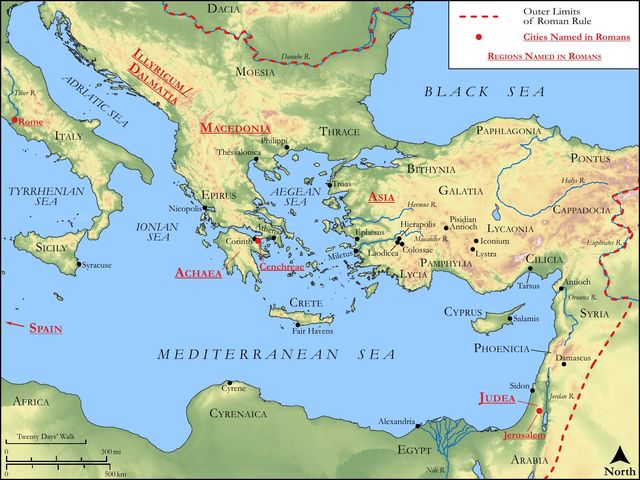
1.He preached in many places: From Jerusalem, whence the law went forth as a lamp that shineth, and round about unto Illyricum, many hundred miles distant from Jerusalem. We have in the book of the Acts an account of Paul's travels. There we find him, after he was sent forth to preach to the Gentiles (Acts 13), labouring in that blessed work in Seleucia, Cyprus, Pamphylia, Pisidia, and Lycaonia (Acts 13 and 14), afterwards travelling through Syria and Cilicia, Phrygia, Galatia, Mysia, Troas, and thence called over to Macedonia, and so into Europe, Acts 15 and 16. Then we find him very busy at Thessalonica, Berea, Athens, Corinth, Ephesus, and the parts adjacent. Those that know the extent and distance of these countries will conclude Paul an active man, rejoicing as a strong man to run a race. Illyricum is the country now called Sclavonia, bordering upon Hungary. Some take it for the same with Bulgaria; others for the lower Pannonia: however, it was a great way from Jerusalem. Now it might be suspected that if Paul undertook so much work, surely he did it by the halves. "No," says he, "I have fully preached the Gospel of Christ - have given them a full account of the truth and terms of the gospel, have not shunned to declare the whole counsel of God (Act 20:27), have kept back nothing that was necessary for them to know." Filled the gospel, so the word is; peplērōkenai to euangelion, filled it as the net is filled with fishes in a large draught; or filled the gospel, that is, filled them with the gospel. Such a change does the gospel make that, when it comes in power to any place, it fills the place. Other knowledge is airy, and leaves souls empty, but he knowledge of the gospel is filling.
2.He preached in places that had not heard the gospel before, Rom 15:20, Rom 15:21. He broke up the fallow ground, laid the first stone in many places, and introduced Christianity where nothing had reigned for many ages but idolatry and witchcraft, and all sorts of diabolism. Paul broke the ice, and therefore must needs meet with the more difficulties and discouragements in his work. Those who preached in Judea had upon this account a much easier task than Paul, who was the apostle of the Gentiles; for they entered into the labours of others, Joh 4:38. Paul, being a hardy man, was called out to the hardest work; there were many instructors, but Paul was the great father - many that watered, but Paul was the great planter. Well, he was a bold man that made the first attack upon the palace of the strong man armed in the Gentile world, that first assaulted Satan's interest there, and Paul was that man who ventured the first onset in many places, and suffered greatly for it. He mentions this as a proof of his apostleship; for the office of the apostles was especially to bring in those that were without, and to lay the foundations of the new Jerusalem; see Rev 21:14. Not but that Paul preached in many places where others had been at work before him; but he principally and mainly laid himself out for the good of those that sat in darkness. He was in care not to build upon another man's foundation, lest he should thereby disprove his apostleship, and give occasion to those who sought occasion to reflect upon him. He quotes a scripture for this out of Isa 52:15, To whom he was not spoken of, they shall see. That which had not been told them, shall they see; so the prophet has it, much to the same purport. This made the success of Paul's preaching the more remarkable. The transition from darkness to light is more sensible than the after-growth and increase of that light. And commonly the greatest success of the gospel is at its first coming to a place; afterwards people become sermon-proof.
II.The great and wonderful success that he had in his work:
It was effectual to make the Gentiles obedient. The design of the gospel is to bring people to be obedient; it is not only a truth to be believed, but a law to be obeyed. This Paul aimed at in all his travels; not his own wealth and honour (if he had, he had sadly missed his aim), but the conversion and salvation of souls: this his heart was upon, and for this he travailed in birth again. Now how was this great work wrought?
1.Christ was the principal agent. He does not say, "which I worked," but "which Christ wrought by me," Rom 15:18. Whatever good we do, it is not we, but Christ by us, that does it; the work is his, the strength his; he is all in all, he works all our works, Phi 2:13; Isa 26:12. Paul takes all occasions to own this, that the whole praise might be transmitted to Christ.
2.Paul was a very active instrument: By word and deed, that is, by his preaching, and by the miracles he wrought to confirm his doctrine; or his preaching and his living. Those ministers are likely to win souls that preach both by word and deed, by their conversation showing forth the power of the truths they preach. This is according to Christ's example, who began both to do and teach, Act 1:1. - Through mighty signs and wonders: en dunamei sēmeiōn - by the power, or in the strength, of signs and wonders. These made the preaching of the word so effectual, being the appointed means of conviction, and the divine seal affixed to the gospel-charter, Mar 16:17, Mar 16:18.
3.The power of the Spirit of God made this effectual, and crowned all with the desired success, Rom 15:19.
(1.)The power of the Spirit in Paul, as in the other apostles, for the working of those miracles. Miracles were wrought by the power of the Holy Ghost (Act 1:8), therefore reproaching the miracles is called the blasphemy against the Holy Ghost. Or,
(2.)The power of the Spirit in the hearts of those to whom the word was preached, and who saw the miracles, making these means effectual to some and not to others. It is the Spirit's operation that makes the difference. Paul himself, as great a preacher as he was, with all his might signs and wonders, could not make one soul obedient further than the power of the Spirit of God accompanied his labours. It was the Spirit of the Lord of hosts that made those great mountains plain before this Zerubbabel. This is an encouragement to faithful ministers, who labour under the sense of great weakness and infirmity, that it is all one to the blessed Spirit to work by many, or by those that have on power. The same almighty Spirit that wrought with Paul often perfects strength in weakness, and ordains praise out of the mouths of babes and sucklings. This success which he had in preaching is that which he here rejoices in; for the converted nations were his joy and crown of rejoicing: and he tells them of it, not only that they might rejoice with him, but that they might be the more ready to receive the truths which he had written to them, and to own him whom Christ had thus signally owned.
Historical interpretation
Four Centuries of Reception
6 surviving comments on this verse. Each one is dated, so this reads as a timeline rather than a list.
Select a marker to jump to its quote. Markers stagger vertically where authors wrote within a few decades of each other.
I have learned that certain of the ministers of Satan have wished to disturb you, some of them asserting that Jesus was born [only ] in appearance, was crucified in appearance, and died in appearance; others that He is not the Son the Creator, and others that He is Himself God over all. Others, again, hold that He is a mere man, and others that this flesh is not to rise again, so that our proper course is to live and partake of a life of pleasure, for that this is the chief good to beings who are in a little while to perish. A swarm of such evils has burst in upon us. But ye have not "given place by subjection to them, no, not for one hour." For ye are the fellow-citizens as well as the disciples of Paul, who "fully preached the Gospel from Jerusalem, and round about unto Illyricum," and bare about "the marks of Christ" in his flesh.
Signs differ from wonders in that signs are miracles which point to some future happening, whereas wonders are just miracles.
For as many things as belong to peace and love, these have I taught. Round about from Jerusalem, and as far as Illyricum,
"For I will not dare to speak of any of those things which Christ hath not wrought by me, to make Gentiles obedient by word and deed, through mighty signs and wonders, by the power of the Spirit of God."
And none, he means, can say that my words are a mere boast. For of this priestly ministry of mine, the signs that I have, and the proofs of the appointment too, are many. Not the long garment and the bells as they of old, nor the mitre and the turban, but signs and wonders, far more awful than these. Nor can it be said that I have been entrusted indeed with the charge, but yet have not executed it. Or rather, it is not I that have executed, but Christ. Wherefore also it is in Him that I boast, not about common things, but about spiritual. And this is the force of, "in things which pertain to God." For that I have accomplished the purpose for which I was sent, and that my words are not mere boast, the miracles, and the obedience of the Gentiles show. "For I will not dare to speak of any of those things which Christ hath not wrought by me, to make the Gentiles obedient by word and deed, through signs and wonders, by the power of the Spirit of God." See how violently he tries to show that the whole is God's doing, and nothing his own. For whether I speak anything, or do anything, or work miracles, He doth all of them, the Holy Spirit all. And this he says to show the dignity of the Holy Spirit also. See how these things are more wondrous and more awful than those of old, the sacrifice, the offering, the symbols. For when he says, "in word and deed, through mighty signs and wonders," he means this, the doctrine, the system relating to the Kingdom, the exhibition of actions and conversation, the dead that were raised, the devils that were cast out, and the blind that were healed, and the lame that leaped, and the other marvellous acts, all whereof the Holy Spirit wrought in us. Then the proof of these things (since all this is yet but an assertion) is the multitude of the disciples. Wherefore he adds, "So that from Jerusalem, and round about unto Illyricum, I have fully preached the Gospel of Christ." Count up then cities, and places, and nations, and peoples, not those under the Romans only, but those also under barbarians. For I would not have you go the whole way through Phoenicia, and Syria, and the Cilicians, and Cappadocians, but reckon up also the parts behind, the country of the Saracens, and Persians, and Armenians, and that of the other savage nations. For this is why he said, "round about," that you might not only go through the direct high road, but that you should run over the whole, even the southern part of Asia in your mind. And as he ran over miracles thick as snow, in a single word, by saying, "through mighty signs and wonders," so he has comprehended again endless cities, and nations, and peoples, and places, in this one word "round about." For he was far removed from all boasting. And this, he said on their account, so that they should not be conceited about themselves. And at the beginning he said, that "I might have some fruit amongst you also, even as among other Gentiles." But here he states the compulsion of his priesthood. For as he had spoken in a sharper tone, he shows also by it his power more clearly. This is why he there only says, "even as among other Gentiles." But here he insists on the topic fully, so that the conceit may be pruned away on all grounds. And he does not merely say, preached the Gospel, but "have fully preached the Gospel of Christ."
Paul was talking not about words here but about miracles. The gospel is fully disseminated when the Gentiles also believe.
When Paul says “as far round as Illyricum,” he means that he got to Illyricum in a roundabout way, via the eastern provinces, the Black Sea region, Asia Minor and Thrace.
Continue studying Romans 15:19 across the web’s major study libraries — every link below opens this exact verse, chapter, or book on the destination site.
Read & Compare
 BibleGatewayThis verse in more than 200 translations and 70 languages.
 Bible.comThe YouVersion reader — hundreds of translations, reading plans, and highlights.
 ESV.orgCrossway's official English Standard Version reader.
 NET BibleThe NET translation with 60,000+ translators' notes on every rendering decision.
 STEP BibleTyndale House's free study tool — original text, vocabulary, and scholarly resources.
 BibliaLogos Bible Software's free web reader.
 USCCBThe New American Bible (Revised Edition) with the U.S. bishops' study notes.
Commentaries
 BibleHub CommentariesDozens of classic commentaries on this verse, gathered on one page.
 StudyLightMore than 100 commentary sets — the largest collection on the web.
 BibleRefPlain-English commentary on what this verse means, verse by verse.
 Enduring WordDavid Guzik's free commentary on this chapter, widely used by Bible teachers.
 Bible Study ToolsVerse commentary alongside Greek and Hebrew study aids.
Original Language & Research
- BibleHub InterlinearThe verse word by word — original language, transliteration, and English.
- BibleHub LexiconEvery word's original-language definition and Strong's entry.
 Blue Letter BibleDeep-study tools — Strong's numbers, concordance, and word studies.
 CNTR CollationThe earliest Greek manuscripts of this verse, collated letter by letter.
Sermons, Hymns & Audio


TrulyRandomVerse is not affiliated with these sites and doesn’t control their content. They’re linked because they’re genuinely useful.
Summary
Romans 15:19 powerfully encapsulates the essence of Paul's apostolic ministry, revealing it as a divinely empowered mission marked by supernatural manifestations and an expansive geographical reach. The verse highlights that Paul's proclamation of the gospel was not merely human effort but a work authenticated and propelled by the Holy Spirit, allowing him to thoroughly establish the message of Christ across a vast swathe of the Roman world, from the spiritual epicenter of Jerusalem to the distant region of Illyricum.
Context
ShowHideLiterary Context
Romans 15 marks the concluding section of Paul's letter to the church in Rome, transitioning from deep theological exposition (chapters 1-11) and practical exhortations (chapters 12-14) to his personal ministry plans and aspirations. Having laid a robust theological foundation, Paul now seeks to explain his apostolic calling and validate his ministry before a church he has not yet visited. He articulates his ambition to preach the gospel "where Christ was not named" (Romans 15:20), underscoring his unique commission to the Gentiles. Verse 19 serves as a powerful summary of the effectiveness and divine authentication of his ministry thus far, providing a compelling rationale for his future travel plans to Spain via Rome and his request for their support.
Historical & Cultural Context
Paul's ministry unfolded within the vast and diverse Roman Empire, a world characterized by extensive trade routes, a common language (Koine Greek), and a complex religious landscape. Travel was arduous, often by foot or ship, making Paul's journeys across thousands of miles a monumental undertaking. Jerusalem, as the birthplace of the early church and the center of Jewish faith, represented the starting point of the gospel's outward expansion. Illyricum (modern-day Albania and parts of former Yugoslavia) was a distant, rugged, and less-evangelized frontier region on the Adriatic coast, signifying the immense breadth of Paul's missionary endeavors. The mention of "signs and wonders" reflects a common expectation in the ancient world for divine messengers to demonstrate supernatural power, validating their claims and messages, much like Moses before Pharaoh or the prophets of old.
Key Themes
ShowHideRomans 15:19 contributes significantly to several overarching themes in Romans and Paul's broader theology. It underscores the theme of Divine Empowerment, emphasizing that effective ministry is not a product of human ingenuity or strength but flows directly from the "power of the Spirit of God." This aligns with Paul's consistent emphasis on God's sovereignty in salvation and mission, as seen in his declaration that his preaching was "not in persuasive words of human wisdom, but in demonstration of the Spirit and of power" (1 Corinthians 2:4). The verse also highlights Apostolic Validation, where "mighty signs and wonders" served as undeniable proof of Paul's divine commission and the truthfulness of the gospel he proclaimed, authenticating his apostleship to both Jews and Gentiles. Furthermore, the geographical scope "from Jerusalem, and round about unto Illyricum" vividly illustrates Paul's Missionary Zeal and Global Vision, fulfilling the Great Commission's call for the gospel to reach "the uttermost part of the earth" (Acts 1:8). Finally, the phrase "I have fully preached the gospel of Christ" speaks to the theme of Comprehensive Gospel Proclamation, implying not just wide dissemination but also a thorough and complete declaration of the good news, establishing churches and teaching sound doctrine.
Exposition and Analysis
ShowHideKey Word Analysis
ShowHideThis word, translated as "mighty" here, refers to inherent force, ability, or strength. In the context of Paul's ministry, it specifically denotes miraculous power, often implying a miracle itself. It signifies the dynamic, supernatural energy of God at work, not merely human capability. The "mighty signs and wonders" were therefore not just impressive feats, but demonstrations of divine, inherent power.
An indication, especially one that is ceremonially or supernaturally given. In biblical usage, a "sign" points beyond itself to a deeper truth, often serving as a divine attestation or confirmation of a message or messenger. These were not random occurrences but purposeful acts designed by God to validate Paul's apostolic authority and the truth of the gospel.
This term refers to a prodigy or omen, something that evokes awe, astonishment, or amazement. When paired with "signs," "wonders" emphasize the awe-inspiring and extraordinary nature of the acts, designed to capture attention and direct it towards the divine source. Together, "signs and wonders" denote extraordinary acts of God that both signify divine truth and evoke human astonishment.
This verb means "to make replete," "to fill up," "to complete," or "to fulfill." In this context, it implies that Paul had not merely touched upon the gospel but had thoroughly and exhaustively proclaimed it in the regions he visited. It suggests a comprehensive declaration, ensuring the message was not only widely disseminated but also deeply rooted and understood, leaving no essential part unaddressed.
Verse Breakdown
ShowHide"Through mighty signs and wonders"
This clause describes the supernatural means by which Paul's ministry was authenticated and advanced. These were not mere human persuasive techniques but extraordinary, divinely orchestrated acts that served as undeniable proof of God's hand at work, validating Paul's message and apostleship.
"by the power of the Spirit of God"
This phrase identifies the ultimate source of the "mighty signs and wonders" and, by extension, the entire effectiveness of Paul's ministry. It explicitly states that his success was not due to his own abilities or eloquence, but entirely dependent on the active, dynamic, and supernatural presence and energy of the Holy Spirit, who is God Himself.
"so that from Jerusalem, and round about unto Illyricum"
This segment delineates the vast geographical scope of Paul's missionary endeavors. "Jerusalem" represents the historical and spiritual starting point of the gospel's spread, while "Illyricum" (a region far to the northwest, on the Adriatic coast) signifies the extensive reach of his evangelistic journeys, demonstrating his commitment to spreading the gospel across significant distances and diverse populations.
"I have fully preached the gospel of Christ"
This concluding declaration summarizes the comprehensive nature of Paul's mission. The phrase "fully preached" implies not just a wide distribution of the gospel but a thorough and complete proclamation of its message. It means he had proclaimed the good news of Christ exhaustively, establishing its truth, teaching its implications, and ensuring its deep implantation in the areas he ministered.
Literary Devices
ShowHideRomans 15:19 employs several literary devices to convey its powerful message. The phrase "mighty signs and wonders" is a classic example of Merism, where two contrasting or complementary terms are used to express a totality or comprehensive idea. Here, "signs" (pointing to meaning) and "wonders" (evoking awe) together describe the full spectrum of miraculous divine activity. The geographical description "from Jerusalem, and round about unto Illyricum" is a form of Synecdoche (or perhaps a specific type of Hyperbole for emphasis), where two extreme points are named to represent the entire vast territory in between, effectively conveying the immense breadth of Paul's missionary reach. The entire verse functions as a form of Apostolic Credentialing, where Paul presents his past accomplishments, validated by divine power, as proof of his legitimate authority and the effectiveness of his ministry. This serves to build trust and rapport with the Roman church, preparing them for his visit and future plans.
Theological and Thematic Connections
ShowHideThis verse profoundly teaches that authentic gospel ministry is fundamentally a Spirit-empowered endeavor, not a human achievement. The "mighty signs and wonders" were not ends in themselves but served as divine attestation, confirming the truth of Paul's message and the authority of his apostleship. This highlights God's active involvement in the spread of His kingdom, validating His messengers and His Word through supernatural means. Furthermore, Paul's extensive geographical reach underscores the universal and expansive nature of the gospel, which is intended for all nations. His commitment to "fully preach" implies a holistic and comprehensive proclamation, encompassing both evangelism and discipleship, ensuring the message is not only heard but deeply understood and lived out. This serves as a model for all who participate in God's mission, emphasizing reliance on the Holy Spirit, the importance of divine validation, and a commitment to global, thorough gospel dissemination.
Reflection and Application
ShowHideRomans 15:19 challenges believers today to consider the source and scope of their own participation in God's mission. It calls us to move beyond reliance on human ingenuity, eloquence, or resources, and instead to cultivate a profound dependence on the "power of the Spirit of God." Whether in personal evangelism, teaching, or serving, our effectiveness is directly proportional to our willingness to yield to the Holy Spirit's leading and empowerment. This verse also inspires a global vision, reminding us that the gospel is for "every tribe and language and people and nation" (Revelation 5:9). We are called to participate in the comprehensive proclamation of Christ's good news, not just superficially, but thoroughly, ensuring that the full counsel of God is presented and that disciples are made and nurtured. Paul's example encourages us to be bold in our witness, trusting that God will authenticate His Word and work through us, even if not always through overt miracles, then certainly through transformed lives and the manifest presence of His Spirit.
Questions for Reflection
ShowHideFAQ
ShowHideWhat does "fully preached the gospel" mean in Paul's context?
ShowHideWhen Paul states he has "fully preached the gospel" (Greek: peplerokenai to euangelion), it signifies more than just a wide dissemination of the message. The Greek word plēróō implies a comprehensive and complete proclamation. It means he didn't just introduce the gospel; he established it thoroughly in each region, teaching its doctrines, calling for repentance and faith, and nurturing nascent churches. It suggests a deep and exhaustive declaration of the good news of Christ, ensuring that the foundational truths were laid and understood, leading to the formation of mature Christian communities. This was not a superficial evangelism but a holistic ministry that included teaching and discipleship, leaving no essential part of the message unaddressed.
Where was Illyricum, and why is its mention significant?
ShowHideIllyricum (modern-day Albania and parts of former Yugoslavia, along the Adriatic coast) was a Roman province located to the northwest of Greece. Its mention is highly significant because it represents the furthest known geographical extent of Paul's missionary journeys at that point. Starting "from Jerusalem," the spiritual and historical heartland of the gospel, and reaching "unto Illyricum" demonstrates the immense breadth and arduous nature of Paul's evangelistic efforts. It underscores his dedication to fulfilling the Great Commission by pushing the boundaries of gospel proclamation into new and often challenging territories, showcasing his commitment to reaching the Gentiles across the vast Roman Empire.
Are "mighty signs and wonders" still part of Christian ministry today?
ShowHideThe role of "mighty signs and wonders" (Greek: sēmeîon and téras) in Christian ministry is a subject of ongoing theological discussion. In the New Testament, these supernatural acts served primarily to authenticate the apostles and their message during the foundational period of the church, confirming that God was indeed working through them to establish His kingdom. While the frequency and overt nature of such spectacular miracles may have diminished after the apostolic age, the "power of the Spirit of God" (Greek: dýnamis) certainly continues to be active in the church. God still works miraculously, often through transformed lives, spiritual growth, divine healing, and providential interventions, validating His Word and presence. Believers are called to pray for God's power to be manifest and to be open to how the Spirit chooses to work, recognizing that the ultimate goal is always the glorification of Christ and the advancement of His gospel, not merely the display of power.
Christ-Centered Fulfillment
ShowHideRomans 15:19, while detailing Paul's ministry, ultimately points to the supreme ministry of Jesus Christ, in whom all such Spirit-empowered work finds its source and fulfillment. Paul's "mighty signs and wonders" were an extension of Christ's own ministry, which was characterized by unparalleled miracles, healings, and authoritative teaching, all empowered by the Holy Spirit. Indeed, Peter testified that God "anointed Jesus of Nazareth with the Holy Spirit and power, who went about doing good and healing all who were oppressed by the devil, for God was with Him" (Acts 10:38). Paul's "fully preached the gospel of Christ" is a testament to the centrality of Christ's person and work – His life, death, resurrection, and ascension – as the very content and power of the good news. The global reach of Paul's ministry, from Jerusalem to Illyricum, foreshadows the ultimate triumph of Christ's kingdom, fulfilling prophecies that the Messiah's reign would extend "from sea to sea, and from the River to the ends of the earth" (Psalm 72:8). Thus, Paul's apostolic achievements are not merely his own, but are understood as Christ Himself, through His Spirit, continuing to build His church and gather His people from every nation, demonstrating His sovereign power and universal Lordship.